



Abstract
Even though quality management initiatives are crucial for enhancing the performance of Higher Education Institutions (HEIs), there is a lack of research on how the academic accreditation process influences it. This study aims to assess the impact of quality management initiatives on HEI performance, in addition to exploring the mediating role of academic accreditation. Using a quantitative research approach, from January 15, 2023, to May 15, 2023, we collected data from 370 participants employed in 76 HEIs located in the United Arab Emirates (UAE). The data collection employed a snowball sampling technique, utilizing survey questionnaires, and the analysis was performed using SmartPLS 4 software. The results show that quality management initiatives are pivotal in improving HEIs’ performance. In addition, academic accreditation, as an intermediary, amplifies the relationship between these initiatives and institutional performance. The findings imply that HEIs need to focus on quality management initiatives particularly leadership commitment, effective communication, and professional development to achieve academic accreditation as well as to enhance overall institutional performance.
Plain Language Summary
This research looks into how quality management initiatives affect the performance of Higher Education Institutions (HEIs) and how the academic accreditation process plays a role in this. Data was collected from 370 participants in 76 HEIs in the United Arab Emirates using surveys and analyzed in SmartPLS 4 software. The results suggest that quality management initiatives significantly improve HEIs’ performance. Academic accreditation acts as a mediator, strengthening the connection between these initiatives and institutional performance.
Keywords
Introduction
Academic accreditation is a fundamental element of the higher education system (Harvey, 2004). Institutional and program accreditation, as quality assurance mechanisms (S. Iqbal et al., 2023), not only play an instrumental role in improving educational standards (Beerkens & Udam, 2017) but also fulfill the regulatory requirements of Higher Education Institutions (HEIs). HEIs pursue academic accreditation because they play a pivotal role in driving excellence and demonstrating an institution’s commitment to delivering high-quality education to society (Staub, 2019). Additionally, it fosters the institution’s credibility and reputation, attracting more students, competent faculty, researchers, and funding, ultimately enhancing the overall performance of HEIs (Volkwein, 2010).
Aiming to become a knowledge-based economy and a regional hub for higher education, research, and entrepreneurship, the United Arab Emirates (UAE) government has heavily invested in this endeavor and witnessed significant growth in the past couple of decades (Ashour, 2020). The higher education sector in the UAE includes prominent national and international universities, colleges, and vocational institutes (Ahmed et al., 2013). According to the Commission for Academic Accreditation (CAA), the UAE currently hosts 67 public and private universities. The National Qualifications Authority (NQA) ensures the quality and recognition of qualifications offered by higher education institutions. It also establishes rigorous standards and conducts periodic evaluations to ensure compliance with internal standards (Bouranta et al., 2019). Meanwhile, the CAA is more focused on institutional accreditation, while the NQA continuously encourages institutions to enhance their research capabilities and improve teaching methods. They strongly emphasize international benchmarking and program accreditation (Salam & Shersad, 2015) such as the Association to Advance Collegiate Schools of Business (AACSB) and the Accreditation Board for Engineering and Technology (ABET).
A plethora of research has been conducted on the influence of quality management on the performance of HEIs (Camilleri, 2021; Gabalán-Coello et al, 2022; S. Iqbal et al., 2023). Empirical evidence from diverse geographical, social, and regulatory contexts has focused on various factors that play a critical role in enhancing the quality of education in HEIs. The positive impact of quality management and academic accreditation on the overall performance of HEIs is a well-established phenomenon that has been explored by numerous scholars worldwide. Notable scholars who have recently demonstrated the influence of quality management on HEIs include Camilleri (2021); Chikazhe et al. (2022); Sofyani et al. (2022), as well as Fernandes and Singh (2022); S. Iqbal et al. (2023); Kfuri et al. (2021) in the context of academic accreditation, from various geographical backgrounds. These and many other studies examining the relationship between quality management and HEIs’ performance primarily draw upon Total Quality Management (TQM) concepts. TQM concepts relevant to educational quality encompass, among other factors, a student-centered approach, continuous curriculum improvement, teaching and learning quality, academic advising, faculty and staff development, accreditation, research, and leadership commitment (Cave et al., 1995; Gabalán-Coello et al., 2022; Zangoueinezhad & Moshabaki, 2011). However, among these TQM initiatives, professional development, leadership commitment, and effective communication have received relatively less attention in the context of higher education, as identified in recent studies by Fernandes and Singh (2022) and Camilleri (2021).
While faculty and staff development have received somewhat more attention, the impact of leadership or management commitment as a driving force and effective communication as a strategic tool in achieving quality objectives have largely been overlooked in existing research. Only a few scholars, such as Camilleri (2021), Haibo (2022), and (Jamali et al., 2022) have addressed these gaps.
Albeit scarce, existing studies indicate that quality management initiatives, particularly leadership commitment, effective communication, and professional development programs, are among the most effective Total Quality Management (TQM) initiatives within HEIs. These initiatives have played a pivotal role in shaping the success and performance of higher education sectors globally (Alzoubi et al., 2022). Quality assurance and quality management initiatives represent critical components of most TQM programs (Papp, 2018), which have significantly transformed HEIs and their performance in the UAE. However, despite substantial research in the overall education sector, these initiatives have received comparatively less attention in the UAE context.
In current higher education literature, it is widely accepted that both effective quality management initiatives and the academic accreditation process exert positive influences on institutional performance. Nevertheless, as far as our knowledge extends, there remains an unexplored dimension: the potential role of the academic accreditation process in mitigating challenges encountered during the implementation of quality management initiatives. What role does academic accreditation play, and how does it influence institutional efforts to enhance performance through quality management initiatives? These pertinent questions warrant further research.
The intersection of how quality management initiatives, specifically leadership commitment, effective communication, and professional development, contribute to HEIs’ performance, and the role academic accreditation plays in mediating their impact, represents a gap in the global literature. While their individual impacts have been well-studied, the mediating role of academic accreditation between quality management initiatives and HEIs’ performance remains an underexplored area, both globally and within the UAE. Accordingly, this study aims to enrich the body of knowledge in quality management within the higher education sector through the following quadruple contributions:
First, this study pioneers the examination of the role of underexplored quality management initiatives, including leadership commitment, effective communication, and professional development, in the context of higher education institution performance. Previous research predominantly focused on other quality management concepts, often neglecting these crucial areas that play a substantial role in enhancing institutional performance.
Second, this study delves into the role of academic accreditation as a mediator between quality management initiatives and HEIs’ performance. Previous scholars primarily sought to understand how the academic accreditation process benefits HEIs in enhancing their performance, leaving a gap in understanding how it interacts in the presence of quality management initiatives.
Third, by incorporating institutional theory this study proposes a theoretical framework that offers a comprehensive understanding of how academic accreditation as an institutional factor mediates the relationship between quality management initiatives and HEI performance. This approach illuminates the complex dynamics and motivations that underlie quality management practices within the higher education sector.
Fourth, this study provides empirical evidence from the geographic context of the United Arab Emirates, a rapidly growing higher education hub. It demonstrates how academic accreditation, as a quality management concept and tool, contributes to achieving the objective of transforming the UAE into a prominent player in higher education.
Theoretical Foundations
Quality Management Initiatives and Academic Accreditation
Quality management initiatives are planned endeavors by HEIs and affiliated colleges or programs aimed at achieving excellence in quality education (Ibidapo, 2022). Based on the quality management concept of continuous learning, these initiatives are designed to enhance students’ learning experiences, organizational competitiveness, effectiveness, and performance (Cheong Cheng, 2003). Although closely related, quality management and academic accreditation are two distinct areas in the higher education system (Kfuri et al., 2021; Ngoc et al., 2023). Quality management initiatives, such as educational leadership commitment, effective communication, and professional development programs, are designed to improve the quality of educational programs offered in HEIs (Sharma & Patterson, 1999). Academic accreditation is a formal process conducted by national and international accreditation bodies, where accreditation status is awarded after meeting their quality standards.
Effective quality management initiatives are fundamentally reliant on the commitment of leadership and the establishment of a positive institutional culture (Beerkens & Udam, 2017). Committed leadership consistently conveys the institution’s goals to all stakeholders through formal policies and fosters a culture of continuous improvement (Jamali et al., 2022). Furthermore, they provide a well-structured plan and direction for enhancing quality, thereby ensuring that elevated standards are a shared objective among educators, staff, and students (Haibo, 2022). Stakeholders are motivated to actively participate in quality improvement efforts within an environment cultivated by an institutional culture that places a strong emphasis on quality (Alonderiene & Majauskaite, 2016).
The engagement of stakeholders plays a pivotal role in the success of quality management initiatives. By identifying the needs and expectations of faculty, staff, students, alumni, and industry partners, leadership can design professional development programs aimed at achieving the organizational goal of delivering excellent quality education (Beerkens & Udam, 2017). Through active stakeholder involvement, institutions can ensure that their quality management programs align with their requirements and increase the likelihood of success by incorporating them into decision-making processes (Pirie et al., 2016).
The successful implementation of professional development programs relies heavily on the availability of infrastructure and resources (Gore et al., 2017). Adequate funding, facilities, technology, and information systems are essential to support quality processes, data collection, analysis, and reporting, as highlighted by Weerasinghe and Fernando (2018). A scarcity of resources can hinder the execution and resilience of quality management programs, potentially diminishing their overall effectiveness. It is crucial to recognize that the performance of quality management initiatives hinges on staff development and capacity building. According to Ali et al. (2016), faculty and staff must receive the necessary training, attend workshops, and have access to professional development opportunities to actively engage in quality improvement activities. Continuous improvement initiatives in the form of professional development ensure that educators and staff are well-informed about current best practices and equipped with the tools required to integrate quality concepts into their respective roles (Sharma & Patterson, 1999).
In summary, these quality management initiatives are expected to enhance institutional efforts in pursuit of academic accreditation. Drawing from insights in existing literature, we propose the following hypotheses:
Quality Management Initiatives and HEI’s Performance
Previous studies consistently demonstrate a positive association between quality management initiatives and HEI performance. It’s important to note that performance evaluation in higher education differs significantly from traditional organizational performance measures, which often focus on financial and non-financial aspects (Cave et al., 1995). In the context of HEIs, key performance indicators encompass student and research output, student intake ratios, teaching quality, accreditation status, student experience, and employability, as well as local and global rankings (Ball & Halwachi, 1987). HEIs prioritize these aspects as a matter of strategic concern (Ibrahim et al., 2018), necessitating the implementation of quality management initiatives by leadership.
Quality management initiatives are designed to enhance all these facets through leadership commitment (Ahmad & Iqbal, 2022), effective communication (Sharma & Patterson, 1999), and professional development (Gore et al., 2017). These initiatives encompass a wide array of methods and practices aimed at improving educational processes, outcomes, and overall institutional performance. A central objective of quality management programs in HEIs is to ensure the delivery of high-quality education (Ashour, 2020). Achieving this goal typically involves establishing robust quality assurance processes, applying rigorous quality standards, and adopting performance evaluation frameworks. In their pursuit of these objectives, HEIs actively seek to enhance their teaching and learning processes, curriculum design, student support services, and overall organizational efficiency (Graham et al., 2013). Antunes et al. (2017) argue that quality management strategies have broad implications for institutional performance, fostering a culture of continuous improvement within higher education institutions. These programs facilitate the identification of specific areas requiring development and proactive measures to address them, all through self-assessment, evaluation, and regular review processes. Ultimately, these efforts lead to improved teaching quality, increased student engagement (Serrano et al., 2019), and enhanced learning outcomes (Syed et al., 2020), ultimately benefiting institutional performance.
Furthermore, HEIs that prioritize quality management invest significantly in support systems such as academic advising, career counseling, and extracurricular activities (Arnold, 2018). By doing so, they create an environment that enhances student engagement, retention, and graduation rates (Serrano et al., 2019). Additionally, integrating student feedback and maintaining a commitment to continuous improvement processes better equips schools to meet the demands and requirements of their students. Quality management activities in HEIs also play a crucial role in fostering accountability and transparency (Ryan, 2015). They demonstrate the institution’s determination to provide quality education and be accountable to various stakeholders, including students, parents, employers, and accrediting agencies. Achieving this is often through the development of comprehensive quality assurance systems and performance measurement frameworks (Beerkens & Udam, 2017). As a result, the institution’s image and credibility are enhanced, attracting high-quality students, faculty, and researchers.
Furthermore, quality management programs in HEIs promote efficiency and resource optimization (Ashour, 2020). HEIs can optimize their resource utilization by streamlining administrative processes, improving resource allocation, and aligning institutional strategies with quality objectives (Al Dari et al., 2021). This leads to cost-effectiveness and enhances organizational performance.
Overall, the existing literature strongly supports the positive impact of quality management initiatives on enhancing HEIs’ performance. Therefore, we propose the following hypotheses:
Academic Accreditation and HEI’s Performance
Academic accreditation undoubtedly serves as an established indicator of quality assurance and accountability in the field of higher education (Fernandes & Singh, 2022; Harvey, 2004; Kfuri et al., 2021). The academic accreditation process ensures that the accredited institution meets the quality standards of the accrediting body (Obiakor & Nwakpa, 2022). Once accredited, institutions must continually maintain and improve educational standards to satisfy stakeholders and accrediting organizations (Al-Amri et al., 2020). The accreditation rating demonstrates an organization’s accountability to its students, parents, employers, and the community. Additionally, it serves as a clear indication of the institution’s commitment to excellence (Volkwein, 2010). This obligation encourages institutions to invest resources in quality management programs that enhance institutional performance (S. Iqbal et al., 2023).
The role of academic accreditation in enhancing institutional reputation cannot be overstated, as accreditation provides signals to prospective students, stakeholders, and faculty that an institution meets recognized quality standards (Bhatia & Awasthi, 2018; Hanh, 2019). In this context, Mahmood et al. (2015) argued that academic accreditation enhances overall reputation and credibility, making it attractive to students seeking quality education and faculty seeking a reputable work environment. Moreover, improved enrollment of students, collaborations, research partnerships, and funding opportunities are the main factors that contribute to overall institutional performance (Fahrurrozi, 2022). Building upon these notions, we propose the following hypothesis:
Academic Accreditation as a Mediator
The proposed hypotheses (H1 to H3) are grounded in empirical evidence found in the current literature, indicating that academic accreditation plays a pivotal role as a mediator between quality management initiatives and HEI performance. According to Martin (2016), accreditation functions as an external validation of an institution’s adherence to quality standards, assuring stakeholders of the institution’s unwavering commitment to delivering quality education. Consequently, the accreditation process acts as a bridge connecting quality management endeavors to tangible outcomes in terms of institutional performance.
In this context, Hou (2014) has demonstrated that institutions utilizing accreditation guidelines and standards as benchmarks are better equipped to evaluate their performance and identify areas for development. Through the accreditation process, institutions engage in self-reflection, self-assessment, and self-improvement, facilitating effective quality management efforts that ultimately result in improved performance (Ryan, 2015). Mahmood et al. (2015) also emphasized the significance of academic accreditation processes as mediators in the relationship between quality management practices and institutional performance. They argued that accreditation systems, whether institutional or program-specific, enable institutions to gauge their compliance with established quality standards and criteria. These processes offer external validation of an institution’s alignment with quality management objectives and provide valuable feedback for enhancement.
Furthermore, Kumar et al. (2020) have demonstrated that successful accreditation accomplishments contribute to enhanced institutional reputation, increased student enrollment, and heightened stakeholder confidence, all of which collectively bolster overall institutional performance. Quality management measures are not only implemented but are also consistently monitored and evaluated, resulting in continuous performance improvement over time (Al-Amri et al., 2020). Additionally, the feedback obtained during the accreditation process serves as a valuable external scrutiny mechanism (Fernandes & Singh, 2022). Accreditation organizations consider various factors when evaluating institutional performance, including the effectiveness of instruction, research output, student success, and the availability of support services (Van Wart et al., 2019).
In summary, academic accreditation initiatives, coupled with effective leadership and well-communicated messages promoting continuous improvement through professional development programs, enhance the academic accreditation process (Hanh, 2020; Hanh et al., 2020). This, in turn, leads to improved institutional performance. The mediating role of academic accreditation is further substantiated by institutional theory, as elaborated upon in the subsequent section. Consequently, in alignment with the existing literature and theoretical frameworks, we posit the following hypotheses:
Research Framework and Institutional Theory
In addition to literature support presented through proposed hypotheses, the foundations of the proposed conceptual framework, shown in Figure 1, are deeply rooted in institutional theory. Institutional theory represents an approach that enables us to comprehend the practices of management and organizations as products of social influences rather than purely economic factors (Cai & Mehari, 2015; Manning, 2017). It has gained widespread recognition within the realm of management theory owing to its capacity to explain organizational behavior that excels in economic rationality (Amenta & Ramsey, 2010). According to institutional theory, organizations, including higher education institutions, seek legitimacy by conforming to national or international academic accreditations (Bozoğlu & Göktürk, 2023). This conformity strengthens an institution’s standing within the higher education sector and enhances its overall performance.
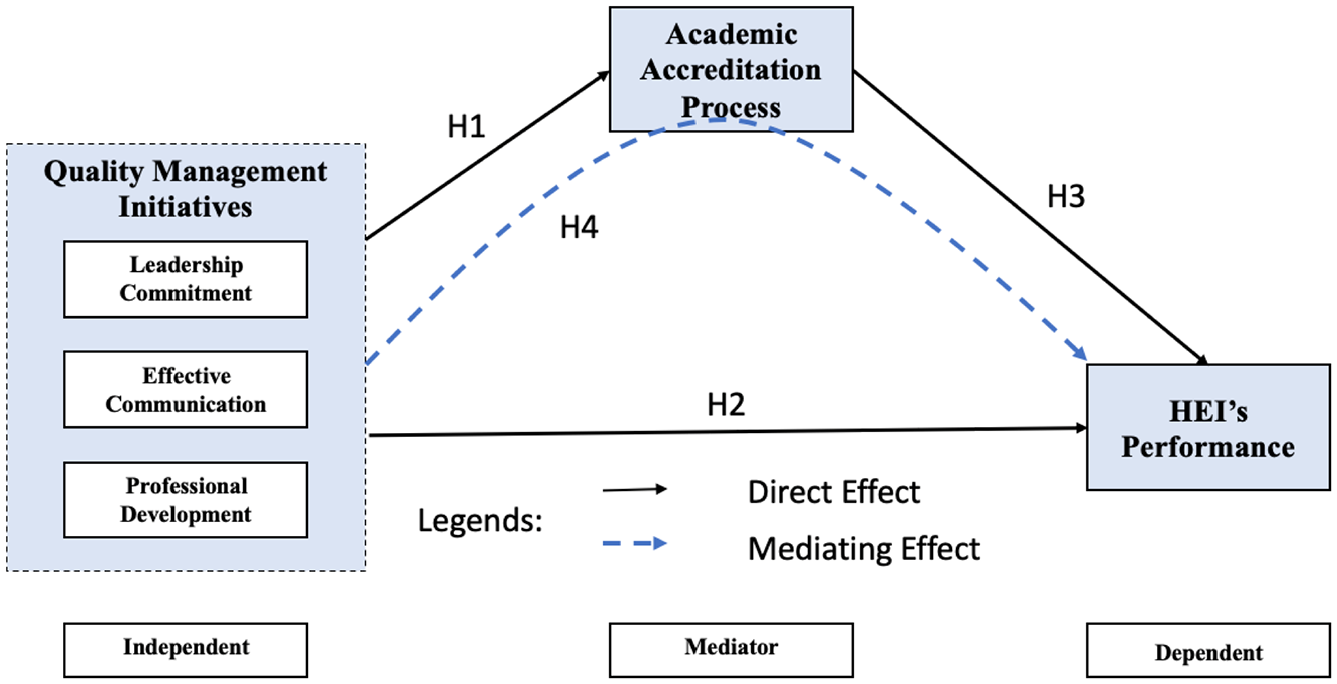
A mediating conceptual framework.
Within the context of this current study, institutional theory offers a valuable framework for understanding how HEIs respond to external pressures and norms by embracing academic accreditation. This necessitates the development and implementation of specific quality management initiatives to enhance organizational performance and competitiveness within the higher education sector. These quality management initiatives assist institutions in aligning their practices with recognized quality standards established by local and international accreditation bodies. Academic accreditation serves as a means of conferring legitimacy and recognition upon these institutions, ultimately enhancing their performance. The effectiveness of accreditation methods in increasing an institution’s legitimacy and reputation has been demonstrated in recent research (Bozoğlu & Göktürk, 2023). This research highlights that accreditation signifies an institution’s compliance with the requisite quality standards and requirements (Hanh, 2020). Academic accreditation, during these initiatives, assumes a pivotal institutional role, exerting coercive, mimetic, and normative pressures that, in turn, strengthen the performance of HEIs. Hence, academic accreditation, while serving as a mediator, provides the mechanism through which HEIs can enhance their performance based on their quality management initiatives.
Research Method
Research Design
Given the research objective of gathering participants’ opinions and perceptions regarding quality initiatives, the academic accreditation process, and HEI performance, a quantitative research design was utilized. Data were collected through a survey questionnaire.
Population and Sampling
The study encompassed a population of 76 higher education institutions (HEIs) located across the seven emirates of the United Arab Emirates: Abu Dhabi, Dubai, Sharjah, Ajman, Umm Al-Quwain, Ras Al Khaimah, and Fujairah. All of these HEIs are officially recognized and accredited by the Ministry of Education and are listed on the official website (Ministry of Education, 2023). Since the unit of analysis was at the organizational level, the study’s respondents included faculty members and administrators employed within these institutions. To reach these individuals, we collected their email addresses from the official websites of the higher education institutions and sent them online survey link. In the absence of a formal sampling frame, we employed a snowball sampling technique, asking respondents not only to complete the survey themselves but also to forward it to their contacts who met the specified criteria.
Regarding the sample size, our goal was to exceed the minimum requirement of 200 responses. To establish the minimum sample size for this study, we followed the recommended 10:1 ratio by Hair et al. (2021), which suggests having at least 10 responses per indicator in the questionnaire. Since this study comprises 20 indicators, the minimum sample size requirement was determined accordingly.
Instrumentation
The variables of the study were operationalized using reliable and valid measurement scales from previous empirical research. As these scales were sourced from diverse studies conducted in various contexts, some scale items were adjusted to ensure questionnaire harmony and consistency. Following these adaptations, we reaffirmed the reliability and validity of the scales through assessments involving Cronbach’s alpha, composite reliability, confirmatory factor analysis, Fornell and Larcker’s (1981) criterion, and the Heterotrait–Monotrait (HTMT) ratio, as detailed in section “Results.”
The independent variable, quality management initiatives, has been conceptualized as a multidimensional construct with three facets: leadership commitment, effective communications, and professional development. The measurement instrument for leadership commitment is adapted from Taylor and Wright (2003), effective communication from Sharma and Patterson (1999), and professional development from Gore et al. (2017). The mediating variable, academic accreditation, is adapted from Makhoul (2019). As for the dependent variable, HEI performance, we relied on a subjective measurement scale adapted from Zangoueinezhad and Moshabaki (2011) and Meier et al. (2015). In the existing literature, it has been measured both subjectively and objectively. Ball and Halwachi (1987) argued that objective measures rely on a variety of indicators, such as research output, student enrollment, student retention rate, graduates’ output and employability, financial performance, and many more. On the other hand, subjective performance relies on respondents’ perception of the extent to which the institution has achieved its various stated strategic and financial goals. The rationale for selecting a subjective measurement tool for HEIs performance stems from the difficulties associated with obtaining objective data on students and organizational records. Universities typically refrain from publicly disclosing such information. Previous studies assessing the objective performance of Higher Education Institutions (HEIs) often focused on a single or a few institutions. In contrast, our study gathered data from 76 HEIs, providing a more comprehensive and diverse perspective.
Questionnaire Development and Data Collection
The questionnaire was developed following the guidelines outlined by Zikmund et al. (2013). Respondents’ perceptions were assessed using a five-point Likert scale, with 1 indicating “strongly disagree” and 5 indicating “strongly agree.” Before conducting a pilot test involving 20 participants, the questionnaire underwent a review process, with two professors evaluating it for both face and content validity. Based on the feedback received from the face validity assessment and the results of the pilot test, a final refined version of the questionnaire with 20 items was sent via email to faculty members and administrators at the universities listed in our study. Given that the survey participants were faculty members and administrators with a proficient command of the English language, the questionnaire was developed in English. (See Appendix A).
A total of 831 responses were collected over four months, spanning from January 15, 2023, to May 15, 2023. However, it should be noted that many of these responses were incomplete, some lacked engagement, and there were also multiple attempts by the same respondents. Following an initial screening process, we retained 370 complete responses, resulting in a response rate of 44.5%. This response rate is considered acceptable for online surveys.
Data Analysis
The final dataset was analyzed using SmartPLS 4 software for Partial Least Square Structural Equation Modeling (PLS-SEM). The choice of the PLS approach was made due to the complexity of the model, which includes a second-order reflective construct, non-normal data distribution, and the presence of a mediator (Hair et al., 2021).
The study’s participant demographic breakdown revealed that a significant majority of respondents were male, accounting for 69%, while females made up the remaining 31%. It’s worth noting that this distribution of women is in line with the broader context of the UAE, where they constitute approximately 24% of the national workforce (Vij et al., 2023). In terms of age groups, most respondents (34%) belonged to the 36 to 50 years category. Following this, 25% of the respondents were aged between 25 and 36, 33% were between 18 and 25, and 18% were above 50 years of age. When examining respondents’ professional experience, the majority had accumulated over 15 years of experience (42%). This was followed by those with 11 to 15 years of experience (36%), 6 to 10 years (18%), and 1 to 5 years (4%). Regarding job roles, faculty members constituted the largest group of respondents at 49%, followed by administrators at 33%, and those with dual roles at 17%.
Results
Using the partial least squares approach of structural equation modeling, we analyzed the data to evaluate the validity and reliability of the measurement scales for the latent variables before proceeding to test the research hypotheses and the conceptual framework. During the measurement model phase, we assessed the reliability of latent variables through confirmatory factor analysis (CFA) and Cronbach’s alpha (α). Convergent validity was determined using both the average variance explained (AVE) and composite reliability (CR), while discriminant validity was evaluated using both the Fornell and Larcker (1981) criterion and the Heterotrait–Monotrait (HTMT) ratio. After confirming the reliability and validity of the measurement scale for the latent variables, we conducted path analysis using the bootstrapping technique with 5,000 subsamples to examine the statistical significance of the research hypotheses and the conceptual framework, as employed by other similar studies such as T. Iqbal and Ahmad (2022), Ahmad and Iqbal (2022), and Syed et al. (2020).
Assessment of Measurement Models
To assess the reliability of the latent variables, which encompassed leadership commitment, effective communication, professional development, academic accreditation, and HEIs performance, we conducted a confirmatory factor analysis (CFA). This analysis employed a factor loading threshold of .70 and applied a Cronbach’s alpha threshold of .60 (Hair et al., 2021). CFA determined the loading of each indicator onto its corresponding latent variable, revealing the strength of their association. Conversely, Cronbach’s alpha gauged the internal consistency among all the indicators (observed variables) and their respective latent (unobserved) variables. As presented in Table 1, all the factor loadings and Cronbach’s alpha values fairly surpassed the minimum threshold, confirming the reliability of the measurement models.
Convergent Validity and Reliability.
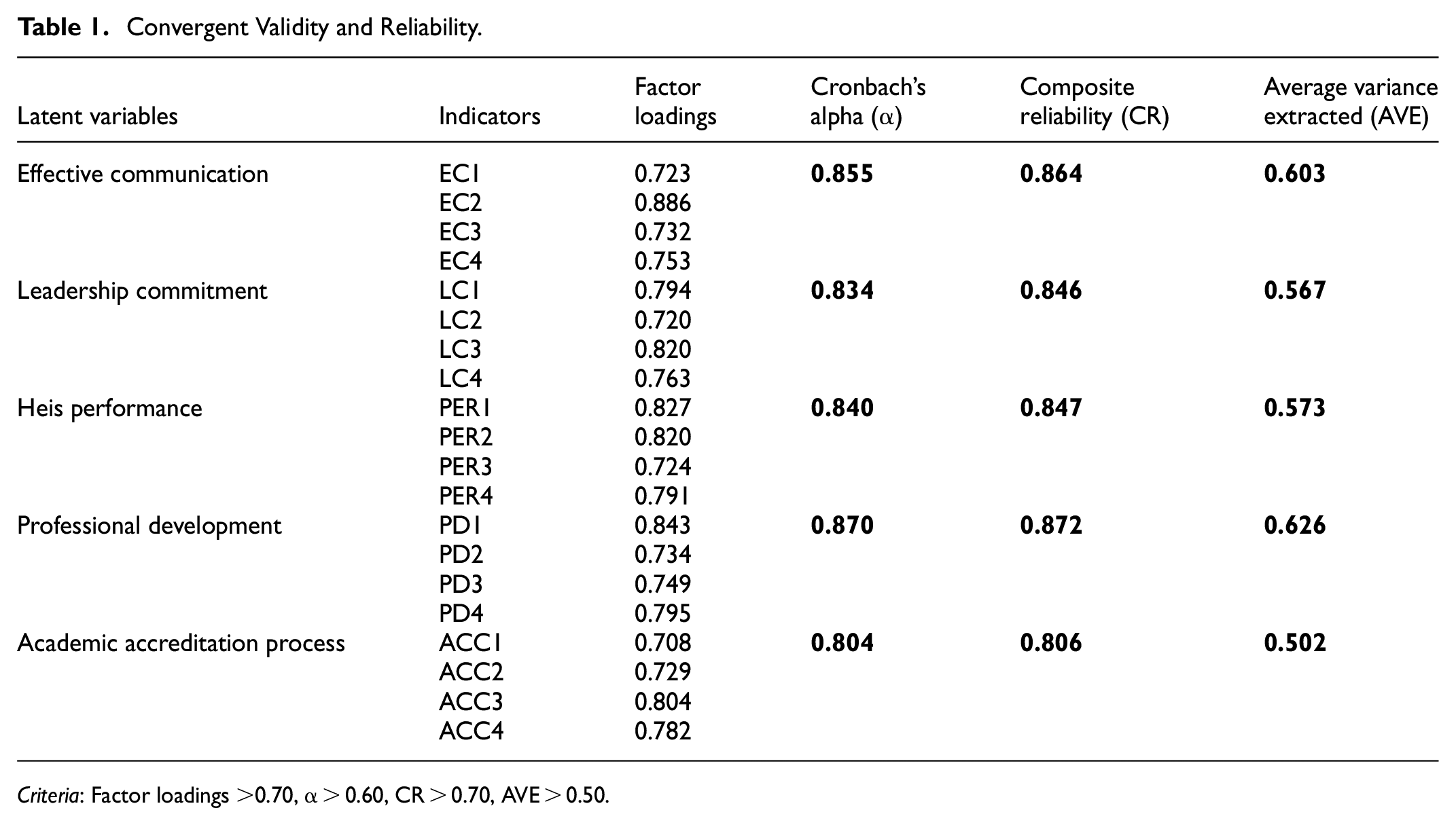
Criteria: Factor loadings >0.70, α > 0.60, CR > 0.70, AVE > 0.50.
To ascertain the convergent validity of a measurement scale, the following criteria must be met: Composite Reliability (CR) scores should be equal to or greater than 0.70, Average Variance Extracted (AVE) scores should surpass 0.50, and the CR score should exceed the corresponding AVE scores (Chan & Idris, 2017). As demonstrated in Table 1, our results satisfy all three of these criteria for each of the five latent variables. This confirmation affirms the convergent validity of the measurement model, underscoring that the selected indicators are statistically valid and indeed measure the respective latent variables.
Ensuring discriminant validity within the measurement model is an essential prerequisite in structural equation modeling, complementing the assessment of convergent validity (Hair et al., 2021). Discriminant validity, in contrast to convergent validity, focuses on evaluating multicollinearity and ensuring that the indicators (items or observed variables) measuring the same latent variable exhibit low correlations while remaining distinct from one another (Cheung & Wang, 2017).
Two widely employed methods for assessing discriminant validity in measurement models are the Fornell and Larcker (1981) criterion and the HTMT (Heterotrait-Monotrait) ratio. These techniques play a crucial role in confirming that the constructs being measured are indeed separate and not confounded by high intercorrelations among their respective indicators.
According to Fornell and Larcker (1981) criterion, it is expected that the variance extracted for each latent construct exceeds the correlations between pairs of latent variables within the structural model. Our findings met this criterion, as illustrated in Table 2, where all the variance extracted values (highlighted in bold along the diagonal) surpass the correlations in their respective rows and columns.
Discriminant Validity Through Fornell and Larcker (1981) Criterion.

Criteria: Bold diagonal values > values in corresponding rows and columns.
The HTMT (Heterotrait-Monotrait) ratio, on the other hand, represents a newer and more stringent criterion for assessing the discriminant validity of a model. It calculates the ratio of the square root of the average variance shared between two latent variables to the square root of the average variance unique to each construct (Henseler et al., 2015). To establish the discriminant validity of the model, each HTMT ratio should be below 0.90 as a lenient threshold, and preferably below 0.85 (Hair et al., 2021).
The findings of our study, as outlined in Table 3, demonstrate that all the HTMT ratios comfortably fall below the desirable threshold of 0.85. The highest value observed is 0.573, which pertains to the relationship between leadership commitment and effective communication.
Discriminant Validity Using HTMT Criterion.

Threshold: HTMT < 0.85 (Henseler et al., 2015).
Assessment of Structural Model
Once the reliability and validity of the latent constructs had been established, we proceeded to evaluate the structural model to determine the statistical significance of the path coefficients, including both direct effect and indirect effect (mediating), as well as the coefficient of determination (R-squared).
The results from the regression analysis, as presented in Table 4, provide valuable insights into the path coefficient (β) values, along with their associated t-statistics and p-values for the hypothesized paths outlined in the conceptual framework. This analysis includes bootstrapping results primarily focusing on the direct effects. These findings show that effective communication exhibits a noteworthy and positively significant impact on HEI performance, as evidenced by a t-statistic of 1.706 (p < .008). Moreover, this effective communication also exerts a substantial and positive influence on the academic accreditation process, supported by a computed p-value of .031, which falls below the predetermined significance threshold. Furthermore, leadership commitment demonstrates a positive and highly significant influence on HEI performance, boasting a p-value of .001. Similarly, it wields a significant positive impact on academic accreditation, with a p-value of .000, indicating its importance in both contexts.
Regression Analysis of Path Coefficients (Direct Effects).

Criteria: Significant at confidence interval; *90% (p < .10), **95%(p < .05), ***99% (p < .01).
Likewise, the factor of professional development emerges as a potent driver of HEI performance, backed by a p-value of .00, affirming its statistical significance. The t-statistics value of 4.039 further underscores its positive effect. Moreover, professional development also exerts a favorable and statistically significant influence on the academic accreditation process. Lastly, the analysis reveals that academic accreditation processes play a pivotal role in positively and significantly affecting HEI performance, as evidenced by a p-value of .00.
The statistics on the indirect effects (Figure 2), specifically the mediating role of academic accreditation in the relationship between quality management initiatives and the performance of HEIs, are presented in Table 5. In our study, ’quality management initiatives’ are conceived as a higher-order construct consisting of three distinct dimensions: leadership commitment, effective communication, and professional development. Instead of assessing it as a second-order construct, we opted to examine the individualized direct and mediating effects of each of these dimensions concerning their corresponding exogenous constructs. Structural equation modeling equally supports both first order and second order assessment for multidimensional constructs.

Structural model with path coefficient and R-squared.
Analysis of Mediating Effects.

Criteria: Significant at confidence interval; *90% (p < .10), ***99% (p < .01).
The results presented in Table 4 reveal that all three dimensions exert significantly positive direct influences on both academic accreditation and HEIs’ performance. Furthermore, academic accreditation serves as a mediator in the individualized relationships between leadership commitment, effective communication, and professional development with HEIs’ performance, as shown in Table 5. This indicates that academic accreditation plays a role in transmitting the effects of these quality management dimensions on HEIs’ performance. However, it’s important to note that while the individualized indirect effects of the three quality management dimensions are statistically significant, they do not display a level of strength that would allow us to assert complete mediation. Therefore, we conclude that academic accreditation partially mediates the connection between quality management initiatives and HEIs’ performance, doing so in a notably positive manner. This underscores the significance of quality management initiatives in enhancing HEIs’ performance and emphasizes the critical role that academic accreditation plays in this process.
An assessment of the coefficient of determination (R-squared) reinforces the findings regarding the impact of quality management initiatives and academic accreditation on the performance of HEIs. The results reveal that approximately 44% of the variance in HEI performance can be attributed to both quality management initiatives and academic accreditation, as shown in Table 6.
Analysis of Coefficient of Determination.

Beyond its influence on HEI performance, academic accreditation also serves as a dependent variable influenced by quality management initiatives (see Figure 1). This highlights that initiatives such as leadership commitment, effective communication, and professional development not only enhance institutional performance but also contribute to the ongoing academic accreditation process. Although the variance explained by these three initiatives in academic accreditation is approximately 15%, which may not be substantial in magnitude, it remains a significant finding. This suggests the existence of other variables that can further enhance the academic accreditation process of HEIs.
Discussion
The results of our study indicate that the performance of HEIs can be significantly improved through quality management efforts. Concurrently, HEIs should seek academic accreditation to ensure sustained performance. The accreditation process, serving as a mediator, supports and amplifies ongoing quality management initiatives, particularly those related to leadership commitment, communication effectiveness, and professional development.
In the pursuit of quality initiatives, the unwavering commitment of leadership takes center stage in achieving the institutional goals, acting as a pivotal catalyst. Under such initiatives, leaders actively encourage institutions to craft essential academic programs in alignment with industrial requirements and prompt them to secure academic accreditation (Nasim et al., 2020). They place significant emphasis on curriculum design, learning outcomes, and faculty development programs to ensure that graduates are equipped with the skills and knowledge demanded by the job market. Professional development programs are directed toward adopting pedagogical approaches and implementing technology to enrich the learning experience (Hanh et al., 2020).
Nevertheless, the execution of quality management initiatives in higher education within the UAE encounters a multitude of challenges. Resistance to change may emerge among staff and faculty members who are well-acquainted with traditional teaching methods (Singh et al., 2021). Consequently, surmounting such resistance necessitates effective communication and training to ensure that all stakeholders grasp the objectives and advantages of quality management. The implementation of standardized quality management practices poses its own set of challenges, as students from diverse cultural backgrounds may harbor varying expectations and preferences regarding teaching and learning methods. Furthermore, the absence of a uniform accreditation system across higher education institutions in the UAE hinders the successful rollout of quality management initiatives. (Cardoso et al., 2016) have contended that financial constraints constitute a major hurdle in the effective integration of quality management initiatives, as allocating resources for staff training, technology infrastructure, and continuous improvement procedures can strain budgets, particularly for smaller institutions. Given such operational issues, the success of quality initiatives fundamentally relies on the continuous commitment of the leadership.
Likewise, effective communication is pivotal for HEI performance. It fosters cooperation, coordination, and information sharing, ultimately enhancing organizational outcomes (Mendoza et al., 2019). In higher education, where multiple stakeholders are involved, communication is crucial for smooth operations and achieving institutional goals (Allui & Sahni, 2016) to achieve academic accreditation. Academic accreditation processes rely on clear and timely communication among various departments and individuals involved (Staub, 2019). Efficient communication channels facilitate the exchange of information, feedback, and ideas, streamlining the accreditation process (Makhoul, 2019). Effective communication enhances institutions’ ability to meet accreditation criteria and demonstrates a commitment to quality improvement.
Similarly, professional development significantly enhances institutional performance by bolstering the capabilities of faculty and staff. This leads to improved teaching effectiveness, better student outcomes, and overall institutional success (Weerasinghe & Fernando, 2018). Moreover, professional development initiatives facilitate the efficient implementation of academic accreditation processes by equipping educators with the knowledge and skills needed to meet accreditation criteria effectively (Kfuri et al., 2021). Through workshops, training programs, and conferences, educators can enhance their expertise, instructional techniques, and teacher efficacy, resulting in improved student outcomes and overall institutional performance. Furthermore, professional development ensures that academic personnel possess the necessary competencies to adhere proficiently to accreditation standards (Kotlyarova & Volchenkova, 2017). Engaging in continuous professional development empowers educators to refine their teaching methods, adopt innovative strategies, and align with accreditation requirements (Pirie et al., 2016). This, in turn, enhances an educational institution’s ability to meet accreditation standards and elevate the quality of education provided.
In addition, the findings indicate that academic accreditation processes play a positive role in mediating the relationship between quality management initiatives and the performance of HEIs in the UAE. High-quality accreditation methods have a significant impact on HEIs’ functioning, acting as a catalyst for organizational improvement (Alkelani et al., 2016). Though quality assurance systems and continuous improvement methods lay the foundation for enhancing institutional performance, the full benefits of these initiatives are only realized when they are successfully integrated into the accreditation processes. Accreditation processes serve as a comprehensive framework for assessing an institution’s quality standards and practices (Fernandes & Singh, 2022). By aligning quality management programs with accreditation standards, institutions establish a systematic approach to quality enhancement (Kooli & Abadli, 2022). Additionally, accreditation offers a structured approach to adopting and monitoring quality measures, resulting in improved performance across various aspects, including teaching and learning, student support, research, and governance.
In conclusion, the alignment of quality management initiatives with accreditation standards offers a systematic path to enhance overall institutional performance. These findings carry significant practical, theoretical, and social implications, as discussed below.
Our findings have several practical implications for higher education institutions. First, HEIs should prioritize the establishment of comprehensive quality management systems aligned with international accrediting criteria. This involves setting clear quality objectives, implementing rigorous quality assurance processes, and regularly monitoring and evaluating institutional performance. Incorporating quality management efforts into strategic planning can foster continuous improvement and enhance overall performance.
Second, fostering a culture of cooperation and active participation among every party involved holds paramount importance. In the context of HEIs, it is essential to establish transparent communication pathways, promote the active engagement of both faculty and staff in decision-making processes, and nurture a collective dedication to upholding standards of quality and excellence. Involving various stakeholders, including students, faculty, administrative personnel, and external partners, has the potential to spark the generation of innovative concepts, efficient solutions to challenges, and a profound sense of shared responsibility. All these elements significantly enhance the overall performance of the institution.
Third, investing in professional development opportunities for faculty and staff is essential. HEIs should allocate resources and provide support for ongoing pedagogical enhancements, research skills, and leadership development through courses, workshops, and conferences. Cultivating a culture of continuous learning within the academic community leads to improved teaching quality, increased research output, and enhanced overall institutional success.
Finally, HEIs should perceive academic accreditation processes as more than just compliance exercises. It should be viewed as a strategic opportunity for organizational improvement, utilizing accreditation procedures as a foundation for implementing quality measures. Accreditation provides a systematic framework for continuous enhancement, prompting institutions to assess their practices, identify areas for improvement, and implement evidence-based strategies to boost their performance. This recognition of the positive impact of accreditation underscores its value and reliability in enhancing HEI performance.
In terms of social implications, the impact of quality management initiatives, combined with academic accreditation, extends beyond educational institutions, influencing a wide range of stakeholders across society, such as students, parents, employers, funding agencies, regulatory bodies, and government entities. It serves as a means of communication to these stakeholders, signaling that an educational institution has met stringent quality benchmarks and is committed to delivering a superior standard of education. This enhanced reputation and recognition contribute to the institution’s competitiveness, attracting proficient students and faculty, ultimately ensuring its long-term sustainability. Institutions can further promote cooperation, coordination, and information sharing by prioritizing effective communication channels and procedures, leading to improved performance and expedited accreditation processes. Likewise, providing opportunities for professional growth to teachers and staff enhances their knowledge and skills, ultimately benefiting both institutional performance and the attainment of high-quality accreditation standards. Recognizing the strategic importance of certification in fostering continuous improvement and enhancing overall institutional performance underscores the pivotal role of high-quality accrediting procedures in this regard.
In addition, the findings of this study significantly contribute to the body of knowledge in quality management within the higher education sector. This study provides novel empirical evidence on the often-overlooked quality initiatives such as leadership commitment, effective communication, and professional development, and their impact on academic accreditation institutional performance. It also explores the mediating role of academic accreditation between quality management initiatives and HEI performance, shedding light on how these factors interact. In addition, it proposes and tests a conceptual framework based on institutional theory that provides a deeper understanding of how academic accreditation, as an institutional factor, functions within the complex dynamics of quality management initiatives and HEIs’ performance. Furthermore, this study provides the first empirical evidence from the geographical context of the UAE, which aspires to become a higher education hub; however, research on quality management in HEIs and accreditation is still very limited.
The scope of this research presents specific limitations that lay the foundations for future research. Firstly, this study was exclusively conducted in the UAE, and as a result, its findings may not be generalized to other countries with different socio-cultural contexts. This presents an opportunity for researchers to test the proposed conceptual framework in various cultural settings and draw cross-cultural comparisons. Secondly, our study relied on subjective measures to assess HEI performance, drawing upon participants’ perceptions regarding the achievement of organizational objectives. To enhance the robustness of future research, scholars are encouraged to explore the impact of quality initiatives and academic accreditation on HEI performance by incorporating objective performance measures, such as student enrollment, retention rates, graduation rates, research productivity, and financial indicators, where relevant. Thirdly, our research primarily adopted a quantitative research approach, which inherently limits the exploration of qualitative aspects and the comprehensive understanding of participants’ perspectives. Future studies could adopt qualitative or mixed methods approaches to provide a more holistic view of how quality management initiatives and accreditation processes influence HEI performance. Lastly, this study explored only three quality management initiatives: leadership commitment, effective communication, and professional development. Future research could investigate the effects of additional quality initiatives, such as continuous improvement, employee involvement and empowerment, process improvement, benchmarking, and Six Sigma, on the accreditation process and HEI performance.
Conclusion
Given the prevalent dearth in the literature, this study aimed to pioneer an examination of the impact of quality management initiatives, including leadership commitment, effective communication, and professional development, on the academic accreditation process and the performance of HEIs in the UAE. Additionally, it endeavored to explore the role of the academic accreditation process as a mediator between quality management initiatives and HEI performance. To achieve these objectives, data were collected from 370 employees of 76 HEIs located across the UAE. The findings suggest that quality management initiatives play a crucial role in enhancing the performance of these institutions. However, at the same time, HEIs should pursue academic accreditation to achieve sustainable performance, as the accreditation process, acting as a mediator, facilitates and augments the ongoing quality management initiatives, including specifically leadership commitment, effective communication, and professional development. These findings are aligned with existing scholarly evidence, as elaborated in discussion section.
Footnotes
Appendix
Measurement Scales.

|
|
|
| LC1 | Our leadership is very serious about maintaining and enhancing academic quality. |
| LC2 | Our leadership fosters a culture of continuous improvement in academic programs. |
| LC3 | Our leadership actively participates in accreditation activities and assessments. |
| LC4 | Our leadership actively participates in accreditation activities and assessments. |
|
|
|
| EC1 | Our institution communicates important information in a timely manner. |
| EC2 | Our institution’s communication channels within the university are clear and well-defined. |
| EC3 | In our institution, feedback mechanisms are in place to allow students, faculty, and staff to express their opinions. |
| EC4 | Our institution provides regular updates on changes or developments that may impact students, faculty, and staff. |
|
|
|
| PD1 | Our institution provides adequate opportunities for faculty and staff to engage in professional development activities. |
| PD2 | Our institution supports and encourages participation in external conferences, workshops, and seminars for professional growth. |
| PD3 | Our institution frequently provides professional development activities (workshops, trainings, certifications, and seminars) for the professional growth of the staff members. |
| PD4 | Our institution recognizes the achievements and contributions of faculty and staff who actively participate in professional development. |
|
|
|
| ACC1 | Our institution ensures that the accreditation process incorporates comprehensive and relevant standards and criteria. |
| ACC2 | Our institution values the involvement and representation of various stakeholders, including faculty, students, staff, and external experts, in the accreditation process. |
| ACC3 | Our institution places a strong emphasis on continuous improvement rather than merely meeting minimum standards in the accreditation process. |
| ACC4 | Our institution ensures sufficient and credible evidence, documentation, and data to support compliance with standards. |
|
|
|
| PER1 | Students at our institution express overall satisfaction with the quality of education, support services, and campus facilities. |
| PER2 | Our institution is recognized for the expertise and reputation of its faculty in their respective fields. |
| PER3 | Our institution ranking has improved in international and national university rankings. |
| PER4 | Our institution has successfully increased student enrollment in recent years. |

Funding
The author(s) received no financial support for the research, authorship, and/or publication of this article.
Declaration of Conflicting Interests
The author(s) declared no potential conflicts of interest with respect to the research, authorship, and/or publication of this article.
Data Availability Statement
Data sharing not applicable to this article as no datasets were generated or analyzed during the current study.