



Abstract
Higher education plays a pivotal role in driving social and economic development in Southeast Asia; however, systematic evidence on regional research patterns remains limited. This study conducts a bibliometric analysis of higher education research in Malaysia and Singapore from 2014 to 2024, focussing on three policy-relevant themes: digital learning, internationalisation, and graduate employability. Drawing on 8,339 Scopus-indexed publications and using bibliometric mapping with VOSviewer, the study examines keyword co-occurrence networks, thematic clusters, and citation impact, with the findings interpreted through the Research–Policy–Practice (RPP) nexus as an interpretive framework to qualitatively contextualise quantitative patterns. Results show that Malaysia produces more publications (6,195) but has lower average citations (11.18), while Singapore’s smaller output (2,144) achieves a higher impact (22.07 citations per paper). In digital learning, Malaysia emphasises blended learning and inclusive access under the Education Blueprint, whereas Singapore advances AI-driven and immersive technologies as part of its Smart Nation initiative. Internationalisation research highlights Malaysia’s role as an affordable regional hub and Singapore’s elite, quality-driven positioning; yet both systems exhibit weak cross-border collaboration despite ASEAN integration goals. Employability studies show Malaysia prioritising soft skills, digital literacy, and mental health support, while Singapore foregrounds lifelong learning and micro-credentials under SkillsFuture. By applying the RPP lens, the study explains how national priorities shape scholarly trajectories and inform institutional practice. It calls for stronger Malaysia–Singapore collaboration, harmonised digital standards, and employability strategies that integrate mental health, social equity, and technological upskilling to build more resilient and inclusive higher education systems in Southeast Asia.
Plain Language Summary
Universities in Southeast Asia are rapidly changing with digital technology, international student mobility, and new demands for job-ready graduates. Yet little is known about how research reflects these trends. This study analysed 8,339 research papers on higher education in Malaysia and Singapore (2014–2024) using bibliometric mapping to identify significant themes and their links to national policy. We found clear contrasts. Malaysia produces more papers (6,195) but with lower citation impact, while Singapore publishes fewer (2,144) but more influential studies. Malaysia’s research focuses on blended learning and digital access, shaped by the Higher Education Blueprint, while Singapore explores AI-driven and advanced teaching technologies under Smart Nation. Malaysia positions itself as an affordable hub for over 130,000 international students; Singapore targets elite global talent. Graduate employability research in Malaysia emphasises soft skills and mental health, while Singapore focuses on lifelong learning and micro-credentials. The study calls for stronger Malaysia–Singapore collaboration, shared digital standards, and integrated mental health and employability strategies to build inclusive, competitive universities.
Introduction
Higher education has undergone a profound transformation across Southeast Asia over the past two decades, driven by rapid technological advancement, ambitious government reforms, and deepening global interconnections (Chan, 2018). Among the region’s systems, Malaysia and Singapore stand out as policy-driven innovators. Both countries have aggressively pursued digital learning, internationalisation, and graduate employability as cornerstones of their higher education agendas (Ponomarenko et al., 2019; Yoong et al., 2017). The COVID-19 pandemic further accelerated these shifts, forcing universities to adopt online teaching models, blended learning ecosystems, and AI-enhanced tools to sustain academic continuity during unprecedented disruption (Leoste et al., 2021). Beyond the immediate shift to remote instruction, this period marked a deeper transformation in higher education, during which universities began rethinking curricula, assessment methods, and digital infrastructures to support long-term hybrid learning strategies. Studies show that this transition not only fostered innovation in pedagogical design and technology integration but also exposed persistent inequalities in digital access, staff preparedness, and institutional capacity to deliver inclusive, high-quality online education.
Digital technologies have reshaped how knowledge is created, delivered, and assessed in higher education. Malaysia’s Ministry of Higher Education launched the Malaysia Education Blueprint (Higher Education) 2015 to 2025, emphasising digital inclusion, technology-enabled pedagogy, and Industry 4.0 skill development (Bujang et al., 2020). Singapore, under the Smart Nation initiative, has positioned its universities, such as the National University of Singapore (NUS) and the National University of Singapore (NTU), at the forefront of online learning, massive open online courses (MOOCs), AI-supported assessment, and immersive technologies (Tan & Gopinathan, 2020). Yet both countries continue to wrestle with persistent challenges: unequal access to high-quality digital infrastructure, inconsistent instructional design, and the need to ensure academic integrity and quality assurance in digital delivery.
Concurrently, internationalisation has become a defining strategy. Malaysia aims to cement its role as a regional education hub, particularly for ASEAN and Muslim-majority countries (Aziz & Abdullah, 2014). Supported by English-medium instruction, transnational branch campuses, and joint-degree programmes, the country enrolled over 130,000 international students before the pandemic (ICEF Monitor, 2023). Singapore, while enrolling fewer students overall, targets elite global talent, leveraging its high-performing universities and selective international partnerships to remain competitive in global rankings (OECD, 2023). Both nations, however, face enduring challenges: sustaining quality assurance frameworks, improving cross-cultural integration and student well-being, and adapting to the post-pandemic reconfiguration of global student mobility.
A third defining priority is graduate employability, as both governments seek to align academic training with labour market dynamics. Malaysia reports a graduate employability rate of approximately 85%, but many graduates, particularly from the arts and humanities, struggle to translate their education into marketable skills and sustainable employment (Beh & Wong, 2024). Singapore, in contrast, performs strongly in global talent competitiveness indices; its graduates enjoy high employment rates and competitive salaries (Ng, 2013). Yet even Singapore faces the future-of-work challenge of continuously updating curricula, fostering university–industry collaboration, and embedding soft skills, resilience, and lifelong learning pathways to meet rapidly changing labour demands (Koh, 2020).
To understand and guide these transformations, bibliometric analysis offers a powerful lens. It systematically maps publication patterns, identifies emerging research clusters, tracks citation influence, and reveals collaboration networks (Aria & Cuccurullo, 2017; Donthu et al., 2021). In the higher education field, bibliometrics not only illuminate topic evolution and scholarly impact, but also provide evidence for policy–research alignment, helping governments and institutions detect gaps, benchmark progress, and strengthen international partnerships.
This study aims to conduct a comparative bibliometric analysis of higher education research in Malaysia and Singapore between 2014 and 2024, focussing on three interrelated themes: digital learning, internationalisation, and graduate employability. It examines how national policy frameworks such as Malaysia’s Education Blueprint 2015 to 2025 and Singapore’s evolving Smart Nation and SkillsFuture initiatives shape research trajectories and influence scholarly impact. By integrating publication data, thematic mapping, and policy analysis, the study seeks to illuminate not only differences in volume and effect but also the structural barriers to cross-border collaboration and the absence of shared digital standards that constrain regional knowledge integration. Specifically, the study addresses three research questions: (i) How do Malaysia and Singapore differ in topic prominence, citation structures, and research trajectories from 2014 to 2024? (ii) How are these patterns associated with national policy orientations, such as inclusive expansion or AI-enabled lifelong learning? (iii) To what extent do limited cross-border collaboration and the absence of shared digital standards constrain regional research integration and practice improvement?
Comparative bibliometric studies have become an essential means of understanding how knowledge about higher education is produced and circulated across national systems (Marginson, 2022; Teichler, 2017). Such studies move beyond counting publications to examine how globalisation, policy reform and institutional priorities shape research agendas. Yet much of this work remains descriptive and rarely connects the field’s intellectual structure to how research informs policy and practice.
The present study addresses this gap by applying the RPP nexus (Li & Mahadi, 2024; Wahab et al., 2025) to bibliometric mapping. The RPP lens assumes that academic knowledge, government policy, and institutional action form a dynamic, bidirectional system rather than a simple linear pipeline. Using this framework allows us to ask not only what topics dominate higher education research but also why—how policy priorities influence scholarly output and how this, in turn, feeds back into practice. Situating the Malaysia–Singapore comparison within this model extends the global literature by examining how an upper-middle-income system (Malaysia) and a high-income, technology-oriented system (Singapore) pursue digitalisation, internationalisation and employability under distinct governance logics. These insights offer transferable lessons for regions beyond ASEAN facing similar pressures to balance equity and global competitiveness.
Methodology
Bibliometric Approach
This study applies a bibliometric analysis to examine the structure and evolution of higher education research in Malaysia and Singapore between 2014 and 2024, with particular attention to digital and online learning, internationalisation, and graduate employability. Bibliometrics is a set of quantitative techniques that maps scientific knowledge by analysing publication and citation data to uncover relationships among authors, institutions, and themes (Culnan, 1987; Garfield, 1979; Zupic & Čater, 2015). Such methods enable systematic, replicable, and objective exploration of large literature sets, revealing thematic patterns, intellectual trajectories, and collaboration networks (Donthu et al., 2021). In higher education, where policy and practice evolve rapidly, bibliometric analysis has become an increasingly valuable tool for identifying research gaps and aligning scholarly production with institutional and national priorities.
This approach is particularly appropriate for comparing Malaysia and Singapore because both countries have implemented policy-driven transformation agendas, notably the Malaysia Education Blueprint 2015 to 2025 and Singapore’s evolving Smart Nation and SkillsFuture initiatives that aim to digitise education, internationalise universities, and improve graduate outcomes. Mapping how scholarship reflects these agendas provides evidence on the RPP nexus and reveals where regional collaboration or policy refinement may be needed.
Data Source and Retrieval
Data for this study were retrieved from the Scopus database, which provides broad coverage and robust filtering tools and is widely used in education-related bibliometric research (Martín-Martín et al., 2018; Mongeon & Paul-Hus, 2016). It has also been used in previous higher education mapping studies because of its strong indexing of journals in pedagogy, policy, and social development.
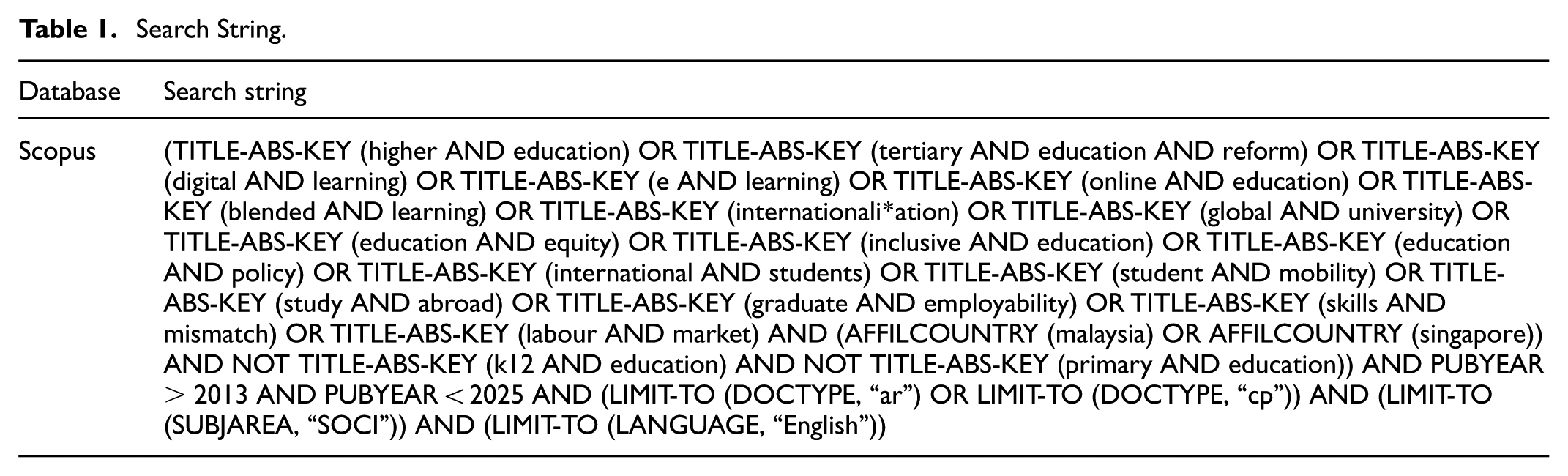
A structured search strategy was developed to capture literature on higher education and its three focal themes. Keywords targeted digital and online learning (e.g., “e-learning,”“blended learning,”“online education”), internationalisation (e.g., “internationalisation,”“student mobility,”“study abroad”), and graduate employability (e.g., “employability,”“skills mismatch,”“labour market”). The query was restricted to publications with author affiliations in Malaysia or Singapore to enable national comparisons.
To maintain relevance and comparability, only journal articles and conference papers were included, as these are primary channels for peer-reviewed scholarly communication and citation analysis. The search was limited to English-language publications because English is the dominant language of academic exchange in both countries and ensures reliable keyword analysis. Publications focussed solely on K-12 or primary education were excluded to retain a precise higher education scope. The time window (2014–2024) reflects a decade of policy implementation following the launch of Malaysia’s Higher Education Blueprint and Singapore’s SkillsFuture and Smart Nation agendas.
After applying these filters, the search returned 8,339 documents. The complete Boolean string, inclusion/exclusion criteria, and database filters are provided in Table 1 to promote transparency and reproducibility (Zupic & Čater, 2015). Recording the exact query, field restrictions (TITLE-ABS-KEY), and time cut-offs ensures that other researchers can replicate or update the dataset.
Search String.
Data Cleaning and Analytical Techniques
The bibliographic records were exported in CSV format and first inspected in Microsoft Excel to verify field completeness, remove duplicates, and flag records with missing author or affiliation data. Maintaining data integrity at this stage is critical for accurate co-authorship and country-level analyses (Donthu et al., 2021).
Using the thesaurus file function in VOSviewer, keyword harmonisation was conducted through an iterative process that combined automated clustering and manual verification. Frequently occurring keywords were reviewed to identify spelling variants, singular/plural forms, and closely related concepts, which were merged into unified terms based on semantic equivalence. Non-informative or generic terms (e.g., “study,”“approach,”“framework”) were removed after manual inspection to avoid distorting thematic structures. Both the original and harmonised keyword lists were retained to support transparency and reproducibility, in line with recommended practices in science mapping (Zupic & Čater, 2015).
Two complementary bibliometric techniques were employed. First, performance analysis examined publication output, citation counts, and source outlets to assess productivity and scholarly impact at the national level (Donthu et al., 2021). This allowed comparison between Malaysian institutions’ quantity-focussed publication trends and Singaporean institutions’ emphasis on citation impact. Second, science mapping using VOSviewer visualises keyword co-occurrence networks, thematic clusters, and intellectual linkages. Mapping enabled the detection of dominant topics such as digital pedagogy, international student mobility, and employability frameworks and their evolution across the decade.
By combining these approaches, the study moves beyond simple output counts to provide a structural and thematic understanding of how national higher education agendas are reflected in the scholarly landscape. This design also supports the RPP nexus perspective, linking observed publication trends to policy priorities and their potential influence on institutional strategies.
Within this analytical framework, the RPP nexus serves as an interpretive lens for connecting bibliometric outputs to higher education systems. “Research” is represented by publication volume, citation impact, and thematic clusters identified through performance analysis and keyword co-occurrence mapping. “Policy” refers to national strategic agendas, such as Malaysia’s Education Blueprint and Singapore’s Smart Nation and SkillsFuture initiatives, which contextualise the interpretation of dominant themes. “Practice” is reflected in the institutional orientations implied by highly visible research topics, including digital pedagogy, internationalisation strategies, and employability frameworks. Through this linkage, the RPP nexus informs how bibliometric patterns are examined beyond descriptive mapping.
Ethical Considerations and Data Management
This study relied exclusively on publicly available bibliographic records retrieved from the Scopus database. As no personal, sensitive, or identifiable human data were collected, formal ethics approval was not required. Nevertheless, the research adhered to principles of integrity and responsible data use, including transparent reporting of search strategies, cleaning procedures, and analytical tools.
All raw metadata files and processed datasets were stored in an institutional repository and backed up on secure cloud storage to prevent data loss. Intermediate files (e.g., keyword thesaurus lists and cleaned CSV datasets) were archived to allow future verification or replication. Version control was maintained during the cleaning and analysis stages to ensure traceability of changes.
Results
Between 2014 and 2024, a total of 8,339 documents on higher education in Malaysia and Singapore were indexed in Scopus. Of these, Malaysia produced 6,195 publications, while Singapore contributed 2,144. Despite Malaysia’s larger output, Singaporean papers exhibit a higher citation impact, averaging 22.07 citations per document, compared to 11.18 for Malaysian publications (Table 2). This suggests that Singapore’s research output, although smaller in quantity, achieves greater international visibility and scholarly influence.
Number of Publications and Citations.

It should be noted that citation counts are reported at the national level and reflect publications authored by researchers affiliated with Malaysian or Singaporean institutions, including highly cited cross-disciplinary studies. These publications are included to ensure a consistent affiliation-based comparison and to capture overall institutional research visibility rather than thematic influence alone. Consequently, average citation indicators may obscure disciplinary and institutional heterogeneity. The present analysis, therefore, focuses on system-level patterns of research visibility and impact, rather than attributing citation performance to specific fields or elite institutions, which would require a different analytical approach.
Analysis of source outlets shows that both international and regional journals play an essential role (Table 3). Sustainability (Switzerland) leads with 171 papers and 4,664 citations, reflecting the integration of higher education with the sustainability agenda. Malaysian researchers frequently publish in regional journals, such as the Pertanika Journal of Social Sciences and Humanities (168 papers) and the Asian Journal of University Education (161 papers). In contrast, Singaporean authors more often target internationally visible outlets, such as Education and Information Technologies.
Most Published Journals and Proceedings in the Dataset.

Highly cited papers within the dataset include global reference works on AI in education and digital pedagogy (Table 5). The most cited article is Johnson et al. (2016) on the MIMIC-III database (5,715 citations), followed by Dwivedi et al. (2023) on ChatGPT (2,180 citations) and Dwivedi et al. (2022) on the Metaverse (1,658 citations). Several of these influential studies have shaped technology adoption and digital learning discourse, particularly in Singaporean research.
Overall, the performance analysis shows a quantity–impact contrast (Malaysia has a high output but lower citation; Singapore is smaller yet more influential). Science mapping identifies five thematic clusters, with digital learning and AI-enabled education emerging as the most dynamic. Internationalisation and employability remain strong but largely country-specific, with limited Malaysia–Singapore co-authorship. These descriptive patterns provide the foundation for the subsequent discussion, which interprets the findings in light of national policy frameworks and regional higher education goals. The keywords were grouped into five major thematic clusters (Table 4). The digital learning cluster is the most densely connected, with strong links to terms such as online learning, blended learning, and MOOCs. Malaysia-related records dominate keywords linked to access, inclusion, and digital pedagogy, whereas Singaporean records are more frequently associated with AI, adaptive systems, and immersive technologies.
Major Thematic Clusters from VOSviewer.

A temporal overlay analysis shows that terms related to digital and online learning surged during the COVID-19 period (2020–2021), while AI-related and immersive technologies emerged more recently (2022–2024). Internationalisation keywords such as student mobility and cross-border education remain persistent across the decade. Still, newer terms such as micro-credentials and lifelong learning have become more prominent since 2019, reflecting the influence of global upskilling and reskilling agendas. Co-authorship networks indicate limited collaboration between Malaysia and Singapore. Most links cluster nationally, with few cross-border nodes connecting the two systems. Collaboration strength between the countries is low (average link strength = X; insert once calculated), despite ASEAN-level ambitions for shared research frameworks.
Overall, the bibliometric analysis of higher education research in Malaysia and Singapore between 2014 and 2024 reveals three dominant themes: digital learning, internationalisation, and graduate employability.
Digital Learning
Digital learning is the most productive research area. Malaysian publications emphasise blended learning, inclusive access, and digital pedagogy, especially during the pandemic, while Singaporean studies highlight AI-enabled education, adaptive systems, and immersive technologies.
Thematic mapping confirms the centrality of digital education. Figure 1 displays a dense green cluster centred on keywords such as “e-learning,”“online learning,” and “blended learning.” These terms illustrate the dominant focus on digital and technology-enhanced teaching in higher education. The resulting network (Figure 1) comprises X nodes (keywords) and Y links (co-occurrences), with a modularity score of Z (to be inserted once calculated). The analysis further shows that Malaysian studies frequently emphasise access and engagement through blended and online formats, whereas Singaporean research highlights more innovation-oriented themes. This distinction reflects national policy orientations: Malaysia’s Education Blueprint (2015–2025) prioritises digital inclusion, while Singapore’s Smart Nation initiative promotes the integration of advanced technology.

Keyword co-occurrence network (2014–2024; VOSviewer visualisation; node size = keyword frequency; link thickness = co-occurrence strength).
Citation evidence further illustrates the trajectory of digital learning research. Table 5 shows that several of the most influential papers in the dataset address generative AI and immersive technologies, including widely cited works on ChatGPT (Dwivedi et al., 2023) and the Metaverse (Dwivedi et al., 2022). These contributions, while global in scope, have been particularly influential in shaping Singaporean research, which integrates AI-based systems and adaptive learning models earlier than Malaysia. Malaysian publications, by contrast, highlight blended learning and digital pedagogy, especially during the pandemic years.
Top Five Most Cited Papers (2014–2024).

The bibliometric evidence suggests that while Malaysia leads in volume and inclusivity, Singapore advances in technological sophistication and global academic reach. Digital learning has therefore become the dominant arena in which the two countries both converge, responding to regional and international pressures for innovation, while diverging in how they translate policy priorities into research outputs.
Internationalisation
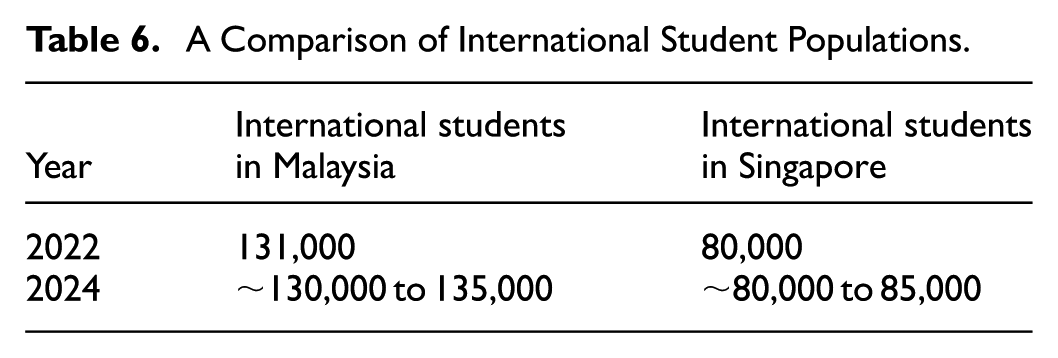
Internationalisation represents a second primary focus of higher education research in Malaysia and Singapore. Quantitative data confirm both countries’ strong commitment, but also highlight distinct priorities. Table 6 shows that Malaysia hosts approximately 130,000 to 135,000 international students in 2024, compared to Singapore’s 80,000 to 85,000. Malaysia’s larger intake reflects its positioning as an affordable regional hub, particularly attractive to students from Asia, the Middle East, and Africa. By contrast, Singapore enrols fewer students but targets an elite global segment, supported by strong international rankings and selective partnerships.
A Comparison of International Student Populations.
Bibliometric mapping reinforces these differences. In Figure 1, internationalisation-related keywords such as “student mobility,”“international students,” and “cross-border learning” cluster around Malaysia’s research agenda. These studies often emphasise inclusivity, affordability, and institutional branding. Singaporean publications, in contrast, frequently link “internationalisation” with “graduate employability,”“quality assurance,” and “SkillsFuture,” reflecting an orientation towards workforce readiness and global competitiveness. The two clusters show limited overlap, suggesting that despite shared goals, the research agendas diverge in both focus and framing.
Another salient feature is the limited cross-border collaboration between Malaysia and Singapore. Co-authorship networks show few joint publications, and keyword overlaps remain sparse. This lack of integration contrasts with both countries’ stated ambition to strengthen ASEAN-wide higher education cooperation. The gap highlights an opportunity for greater bilateral and regional collaboration, particularly through frameworks such as the ASEAN University Network.
Overall, the findings indicate that Malaysia’s internationalisation strategy is volume-driven and inclusivity-oriented, while Singapore’s is prestige-driven and quality-focussed. These different approaches have created complementary but fragmented contributions to higher education research in Southeast Asia. Without stronger cross-border cooperation, the region risks duplicating efforts rather than building a shared knowledge base.
Graduate Employability
As a core theme of the study, graduate employability provides a critical lens for examining how higher education research aligns with national policy priorities and labour-market objectives. Analysing publication patterns in this domain allows the study to assess how scholarly attention reflects policy-driven concerns in Malaysia and Singapore, particularly in relation to skills development, workforce readiness, and student well-being.
Graduate employability studies are prominent in both countries but follow parallel paths. Malaysia contributes research on soft skills, digital literacy, and mental health support, while Singapore emphasises lifelong learning, micro-credentials, and continuous upskilling frameworks. Employability rates differ: Malaysia 85.5% (2023) versus Singapore 93.8% (2023; Table 7). Thematic clustering further illustrates these contrasts (see Figure 2).
A Comparison of the Graduate Employability Rate.


Network visualisation map of the most frequent terms.
Citation analysis reinforces this divergence. Malaysian studies frequently discuss soft skills, digital literacy, and mental health support, often in connexion with national initiatives like the Graduate Employability Blueprint. Singaporean research, however, emphasises lifelong learning and micro-credentials, aligning closely with the SkillsFuture framework and its goal of embedding continuous upskilling into higher education curricula. This difference suggests that while Malaysia highlights the need to support vulnerable student groups, Singapore prioritises building a future-ready workforce through structured policy integration. These findings indicate that graduate employability research in Malaysia and Singapore has developed along parallel but divergent pathways. Malaysia contributes insights into the psychosocial challenges of employability, while Singapore advances innovation in skills-based frameworks and institutional practices. Both trajectories are valuable; however, the lack of cross-referencing between them limits the potential for a comprehensive regional strategy that integrates mental health, social equity, and technological adaptability into employability agendas.
In sum, these publication patterns directly address the study’s broader research questions by demonstrating how national employability policies shape scholarly agendas in Malaysia and Singapore. The contrast between Malaysia’s emphasis on soft skills and mental health and Singapore’s focus on lifelong learning and micro-credentials highlights how differing policy priorities are reflected in research trajectories and, by extension, inform institutional practices.
Discussion
This study identified three dominant thematic areas in higher education research in Malaysia and Singapore, that is, digital learning, internationalisation, and graduate employability. It examined these themes through the RPP nexus, which connects academic production to policy orientations and institutional responses. The RPP framework is applied in this study as an interpretive lens to contextualise bibliometric patterns within policy environments, rather than as a causal model intended to empirically test policy–research relationships. The analysis demonstrates that the differences between Malaysia’s inclusivity-driven agenda and Singapore’s quality- and technology-driven strategies are not merely bibliometric contrasts, but reflections of how national priorities influence the research–practice cycle. The following subsections interpret the findings thematically, outline their contribution to higher education bibliometric scholarship, and propose implications for policy and practice, followed by limitations and directions for future research.
Beyond descriptive differences, the observed contrasts in research output and citation impact can be understood in light of broader institutional and policy contexts. Malaysia’s higher education research system places strong emphasis on publication volume, inclusivity, and regional engagement, supported by performance indicators and funding mechanisms that reward output expansion. This orientation contributes to higher productivity but a more modest citation impact. In contrast, Singapore operates within a more selective and internationally competitive research environment, where institutional evaluation, global rankings, and grant schemes prioritise high-impact publications. These structural conditions shape academic work practices, collaboration choices, and publication strategies, helping to explain why Singapore’s smaller research output achieves a higher average citation impact.
Differences in research output and citation impact should also be understood in relation to broader research input conditions. Malaysia’s higher publication volume is supported by a large and expanding public higher education sector, where academic evaluation systems and promotion criteria often emphasise publication quantity. Singapore, by contrast, operates within a more selective and resource-intensive research environment, characterised by higher research funding per institution, denser concentrations of academic staff, and incentive structures that prioritise high-impact international publications. These differences in funding intensity, researcher density, and institutional incentives may help contextualise why Singapore’s smaller research output achieves a higher average citation impact, while Malaysia demonstrates stronger productivity but more modest citation performance. While a systematic comparison of research inputs lies beyond the scope of this study, acknowledging these structural conditions provides a more comprehensive interpretation of the bibliometric patterns observed.
Divergent Pathways of Digital Learning
The bibliometric evidence shows that digital learning is the most prominent theme in both Malaysia and Singapore, though the two countries approach it differently. Malaysia produced a larger volume of studies on blended learning and online pedagogy, while Singapore generated fewer but more highly cited works on artificial intelligence (AI), learning analytics, and adaptive systems. These patterns mirror national strategies. Malaysia’s Education Blueprint (2015–2025) emphasises access and inclusivity, encouraging universities to expand digital infrastructure and provide equitable opportunities across regions. Consequently, Malaysian research foregrounds digital access, blended learning, and engagement strategies. Singapore’s Smart Nation initiative promotes technological innovation and early AI adoption, reflected in the higher impact of studies on advanced digital systems.
These differences also manifest in practical orientation. Malaysian studies often investigate extending access for disadvantaged groups, aligning with social equity goals. In contrast, Singaporean work demonstrates how advanced digital technologies can enhance quality assurance and personalised learning, supporting global competitiveness. Over time, this has produced distinct feedback loops: Malaysia’s blended learning research has informed institutional programmes that integrate digital tools, especially after COVID-19; Singapore’s highly cited AI-based education research strengthens data-driven decision-making and lifelong learning discourses. Thus, digital learning research both mirrors and shapes national digital transformation agendas.
Internationalisation and Regional Integration Challenges
Internationalisation represents the second major focus. Data show Malaysia hosting 130,000 to 135,000 international students in 2024, compared with 80,000 to 85,000 in Singapore (Table 5). Malaysia’s larger intake reflects its affordability and accessibility; a priority articulated in the Higher Education Blueprint (2015–2025). Singapore, by contrast, targets a smaller, elite global cohort, supported by selective scholarships, institutional partnerships, and international rankings.
Research outputs follow these policy logics. Malaysian studies emphasise cross-border mobility, branding, and inclusive access, positioning the country as a regional hub. Singaporean studies integrate internationalisation with employability, quality assurance, and graduate outcomes, consistent with a prestige- and excellence-driven strategy. At the practice level, Malaysian universities expand bilateral agreements and ASEAN-focussed recruitment, while Singapore pursues global joint programmes and dual degrees, often with Western institutions.
Although the bibliometric mapping shows Malaysia and Singapore as the two most active producers of higher education research in Southeast Asia, their direct collaboration remains strikingly limited. The co-authorship network revealed only a small number of bilateral links, with Malaysia–Singapore co-authored papers forming less than 3% of the total dataset, far lower than the 30% to 40% cross-border collaboration commonly reported across the European Higher Education Area (OECD, 2021; Teichler, 2017). Network density is low, with most Malaysian authors collaborating domestically or with partners in China and Australia. At the same time, Singaporean scholars co-author primarily with the United States, the United Kingdom, and Europe. This pattern suggests that both systems are more globally than regionally integrated, a finding that echoes Teichler’s (2017) observation that internationalisation strategies in Asia often prioritise global rankings over regional partnerships.
Divergent Pathways to Graduate Employability
Graduate employability research reflects another axis of divergence. Singapore consistently reports higher graduate employment rates (93.8% in 2023) than Malaysia’s 85.5%, highlighting a more substantial alignment of education with labour-market needs. Malaysian studies often focus on psychosocial and structural barriers, with frequent keywords such as mental health, graduates, and unemployment anxiety (Figure 2). This aligns with Malaysia’s Graduate Employability Blueprint, which promotes soft skills, digital literacy, and student support systems. Singaporean studies emphasise skills adaptability, reskilling, and competency-based learning, echoing the SkillsFuture agenda of lifelong learning and micro-credentials.
Institutional responses reflect these orientations. Malaysian universities embed career counselling, soft-skill modules, and mental health support to address vulnerabilities, while Singaporean institutions prioritise industry partnerships, modular upskilling, and personalised digital learning pathways. Both models address national labour market needs but operate in parallel and isolated ways, missing opportunities to integrate equity, mental health, and technological adaptability into a unified regional employability framework.
Implications
Contribution to Higher Education Bibliometric Scholarship
The RPP nexus has been widely discussed in knowledge mobilisation studies but is rarely operationalised in higher education bibliometrics. By linking performance indicators and science-mapping results to national policy frameworks, this study demonstrates how bibliometric evidence can illuminate the feedback loops between research, policy, and institutional change (Tight, 2020). Malaysia’s inclusivity-oriented reforms under the Higher Education Blueprint and Singapore’s technology-driven strategies under Smart Nation and SkillsFuture show how distinct governance logics imprint themselves on the thematic structure and citation impact of scholarly output. This approach moves bibliometrics beyond descriptive trend reporting towards a more explanatory, theory-informed analysis of higher education systems, an emerging priority noted by Teichler (2017) and Marginson (2022) for understanding global knowledge production.
Beyond national comparisons, this study contributes to the bibliometric analysis of higher education by showing how policy agendas shape research trajectories within an emerging regional context. Existing mapping studies often focus on global trends or institutional productivity (Aria & Cuccurullo, 2017; Donthu et al., 2021), but few explicitly integrate the RPP nexus to explain why specific themes dominate. By combining performance analysis with science mapping and interpreting them against national strategies, this research demonstrates a policy-informed intellectual structure for Southeast Asian higher education, a perspective underexplored in scientometric work. It also provides comparative insight into how quantity-driven (Malaysia) versus impact-driven (Singapore) research systems evolve under different governance models.
Policy and Practice Implications
The findings carry several implications for higher education strategy in Malaysia, Singapore, and the broader ASEAN region. First, digital learning ecosystems require deeper and more sustained development. Although the COVID-19 pandemic accelerated technology adoption, much research still reflects short-term responses such as blended learning and emergency remote teaching. Malaysia could fully operationalise the MyDIGITAL blueprint by strengthening internet access and digital tools in rural universities. At the same time, Singapore could move beyond technology availability to emphasise pedagogical innovation and educator training within the Smart Nation 2025 plan. Shared regional quality standards for online programmes would facilitate credit transfer and recognition, and, as Haleem et al. (2022) emphasise, technology should enhance meaningful teaching–learning interaction. Joint initiatives such as open educational resources and AI-based language tools could help reduce learning gaps across Southeast Asia.
Second, digital competencies should be systematically embedded within employability frameworks. This practice-level orientation is evident in Malaysia, where higher education policies have been operationalised through structured knowledge transfer programmes that embed academics in community settings, strengthening applied teaching, soft skills development, and real-world problem solving alongside, rather than in place of, publication-driven outcomes (Firdaus et al., 2020). Malaysia’s Graduate Employability Blueprint and Singapore’s SkillsFuture initiative provide strong foundations but lack precise integration of digital skills as graduate outcomes, despite evidence that digital literacy is essential for future work (Thelma et al., 2024) and that mobile learning drives digital-economy capabilities (Liu, 2023). Embedding targeted micro-credentials such as data analysis, AI literacy, and digital marketing across disciplines is crucial (Al-Ansi et al., 2023).
Third, equity and mental health support need to be better aligned with employability goals. Malaysian research underscores the vulnerability of B40 students, while Singaporean studies note psychological pressure in competitive learning environments, yet current policies remain fragmented. Since mental health strongly influences graduates’ career readiness (Duggal et al., 2024), integrated systems of screening, counselling, peer programmes, and career guidance could help produce graduates who are not only technically competent but also emotionally resilient for future labour markets. Together, these actions would advance more inclusive and future-ready higher education systems and strengthen ASEAN-wide educational integration.
Finally, regional collaboration remains weak due to several structural barriers. First, policy incentives are nationally focussed: Malaysia’s Higher Education Blueprint (2015–2025) emphasises student recruitment and institutional visibility, while Singapore’s Smart Nation and SkillsFuture prioritise workforce development and global excellence rather than ASEAN integration. Second, funding and grant schemes rarely require Malaysia–Singapore partnerships, with both countries relying on national councils that offer few cross-border mechanisms. Third, ranking pressures, especially Singapore’s global league-table orientation, push universities towards Western partners instead of neighbouring ASEAN institutions (Hazelkorn, 2016). The lack of shared digital standards adds to this fragmentation: Malaysia targets digital inclusion (Bujang et al., 2020), while Singapore invests in AI-enabled, quality-driven platforms (Tan & Gopinathan, 2020). Without common frameworks for credit transfer, online quality assurance, or digital credential recognition, joint initiatives remain difficult. In contrast, Europe’s Bologna Process shows how shared standards can drive collaboration and knowledge transfer (Teichler, 2017). Strengthening the Malaysia–Singapore research corridor would require:
Bilateral and ASEAN-level funding mechanisms that explicitly support co-authored projects and comparative studies.
Shared quality standards for digital learning and micro-credentials, enabling smoother credit transfer and joint programme development (ASEAN University Network, 2021).
Policy reframing to value regional collaboration alongside global visibility, balancing the pursuit of rankings with ASEAN knowledge integration. By addressing these barriers, Malaysia and Singapore could move from parallel development trajectories towards a more integrated regional knowledge ecosystem, leveraging Malaysia’s inclusivity and Singapore’s technological sophistication to benefit ASEAN higher education.
Conclusion and Limitations
Malaysia’s digital learning research, shaped by the Education Blueprint (2015–2025), prioritises access, blended learning, and equitable provision, while Singapore, guided by its Smart Nation agenda, moved earlier into AI-enabled systems, learning analytics, and adaptive technologies. Internationalisation diverges similarly: Malaysia has positioned itself as an affordable regional hub, attracting over 130,000 international students, while Singapore, hosting about 85,000, pursues an elite global brand anchored in rankings, selective partnerships, and quality assurance. Employability outcomes also contrast: Malaysia reports an 85.5% graduate employment rate, supported by TVET and employability blueprints but challenged by persistent skills mismatches, whereas Singapore achieves 93.8% through the SkillsFuture framework, emphasising lifelong learning, micro-credentials, and workforce adaptability.
By interpreting these trends through the RPP nexus, the study shows how national strategies shape scholarly priorities and institutional responses. Looking forward, three imperatives stand out. Bridging the digital divide is essential, with Malaysia strengthening infrastructure and access, and Singapore advancing pedagogical innovation beyond technology provision. Embedding job-ready digital skills and mental health support within employability frameworks would help produce resilient graduates capable of adapting to fast-changing labour markets. Deepening Malaysia–Singapore and wider ASEAN research collaboration through shared digital standards, cross-border funding mechanisms, and policy incentives could transform parallel development trajectories into an integrated regional knowledge ecosystem. Current gaps, especially the limited bilateral co-authorship and the scarcity of longitudinal studies on digital transformation and employability, highlight the need for sustained, comparative, and policy-informed research. As higher education systems face rapid digitalisation and global competition, Malaysia and Singapore must balance technological innovation with equity, well-being, and inclusive access to build resilient, socially responsive, and globally competitive universities.
This study has several limitations that need to be acknowledged. It relied exclusively on the Scopus database, which, while comprehensive and widely used in comparative bibliometric research, may underrepresent regionally oriented journals not indexed by Scopus, as well as locally disseminated policy-related outputs and institutional publications. The English-language restriction may omit relevant scholarship published in Malay or Chinese. The time window (2014–2024) captures a recent and policy-relevant period but excludes earlier foundational work, and the keyword co-occurrence method may overlook nuanced conceptual relationships present in full texts.
Accordingly, the findings are context-specific and reflect the higher education research landscapes of Malaysia and Singapore during the selected period. Rather than statistical generalisability, the study offers analytically transferable insights for understanding how research, policy, and practice interact in comparable higher education systems. The reliance on a single database represents a deliberate methodological trade-off to ensure consistency, comparability, and metadata reliability in large-scale bibliometric analysis. Future studies could build on this work by integrating multiple databases (e.g., Web of Science or Dimensions) to improve coverage; incorporating selected grey literature or policy documents to capture context-specific dynamics; applying policy text mining or temporal lag analysis to empirically examine how specific policy initiatives shape research trajectories over time; conducting longitudinal thematic tracking beyond a single policy cycle; combining bibliometrics with qualitative policy analysis to better trace research impact; exploring co-authorship dynamics in greater depth to map collaboration potential; and extending the analysis to other ASEAN countries to develop a broader regional perspective on higher education development.
Footnotes

Ethical Considerations
Ethical approval was not required for this study because it did not involve human participants, personal data, or any intervention. The analysis relied solely on previously published and publicly accessible bibliometric records from the Scopus database.
Funding
The authors disclosed receipt of the following financial support for the research, authorship, and/or publication of this article: Acknowledgement to Ministry of Higher Education Malaysia for Fundamental Research Grant Scheme with Project Code: FRGS/1/2023/WAB04/USM/02/4.
Declaration of Conflicting Interests
The authors declared no potential conflicts of interest with respect to the research, authorship, and/or publication of this article.
Data Availability Statement
The bibliometric data used in this study were retrieved from Scopus. Access to the raw bibliographic data is subject to the licensing agreements of the respective database provider and may require a subscription or institutional access. Processed data and visualisation outputs generated during the study are available from the corresponding author upon reasonable request.