




Abstract
The share of electronic transactions in the global payments continues to increase all around the globe. In the recent years, cryptocurrencies (also known as a system of electronic transaction) have caught significant attention from governments, policymakers, and practitioners worldwide. Cryptocurrencies as an innovative method of exchanges without any physical form boast several potential benefits such as speedy transactions, cross-border usage, low transaction fee, transparency, high security, anonymity, and privacy, and thus are expected to bring huge revolution in the future economic system. This study aims to investigate the adoption factors of Bitcoin, a most known cryptocurrency in China. Based on Technology Acceptance Model, a research framework has been developed to test the proposed hypotheses. The data have been collected via a survey questionnaire from 385 Chinese respondents. The findings show that the perceived ease of use and the perceived usefulness have a positive relationship with the intention to use Bitcoin. The perceived usefulness mediates the relationship between the perceived ease of use and the intention to use Bitcoin. Furthermore, the results reveal that the transaction processing and the perceived ease of use have significant impacts on the perceived usefulness. However, the security and control shows an insignificant effect on the perceived usefulness. This study contributes to the growing literature of Bitcoin and offers valuable information to individual users (payees), fund managers (investors), and companies/businesses (receiving Bitcoin as a payment method). Research implications and limitations are also discussed.
Keywords
Introduction
The innovation of internet technologies like internet of things strengthens and boosts the experience of smart contracts and may lead to new economic paradigm (Kshetri, 2017; J. Y. Lee, 2019; Nadeem, Liu, Pitafi, et al., 2020; Shahzad et al., 2018). The rapid technological advancements have facilitated the development of digital currencies, which are controlled and regulated by the digital communities (Carrick, 2016). The novel technological developments and financial economics have raised the demand of cryptocurrencies (Félix & Pablo, 2012) and facilitated the trust building among people all around the world (Shahzad et al., 2018). Cryptocurrencies could be attractive due to several technological and financial advantages. For instance, cryptocurrencies offer peer-to-peer transactions, real-time and speedy transactions with electronic history, cross-border usage, low transaction costs, privacy, anonymity, among others (Baur et al., 2018; Philippas et al., 2019). The significant demand of cryptocurrencies raised the volume of cryptocurrencies market from 1.5 billion U.S. dollars in 2013 to over 795 billion U.S. dollars in 2018 (Xie, 2019). There are more than 2,000 cryptocurrencies (Arias-Oliva et al., 2019), and some of the known cryptocurrencies are Ripple, Ethereum, Litecoin, Bitcoin, and so on.
Bitcoin, a well-known cryptocurrency, has gained a great deal of media, governmental, and scholarly attention for the past few years. The idea of Bitcoin, as an alternative currency, was presented by Satoshi Nakamoto in 2008, which allows to send/receive payments immediately without the involvement of governments, financial institutions, or any other third party (Nakamoto, 2008). Bitcoin circulates globally without any physical form or government support, but there are some digital rules and regulations to operate (Segendorf, 2014). The composition form of Bitcoin is no more than bits, totally in intangible form (Van Alstyne, 2014). In a short span of time, Bitcoin has caught wide attention due to high-profit opportunities, dramatic changes in price, transparency, and several other prospective benefits of technology it provides (Dastgir et al., 2019). The traditional modes of the financial systems, however, feel reluctant to acknowledge Bitcoin because it is not owned, regulated, or supported by the most of the governments (Hern, 2013). Therefore, the issues regarding the acceptability of Bitcoin may undermine the preferences to use Bitcoin. However, it is also reported that the acceptance rate of Bitcoin continues to rise due to the active involvement of merchants to pay their obligations directly or through service providers (Neroth, 2013). The growing popularity of Bitcoin with the passage of time could have significant impacts on the future value and use of Bitcoin. Considering this background, it would be of great importance to investigate the intention to use Bitcoin.
The literature on Bitcoin is nascent despite that the past few years have witnessed growing research interest in Bitcoin. A large number of these studies relied on secondary sources of data (Baig et al., 2019; Chaim & Laurini, 2019; Dastgir et al., 2019; A. S. Hayes, 2017) to probe into the Bitcoin phenomenon. Nevertheless, the studies on human-centered approaches are limited in literature and good quality journal papers are needed (Alshamsi & Andras, 2019). The perception of the potential Bitcoin users is essential to predict their intention to use Bitcoin. Therefore, it is important to shift gear toward human-centered approaches to study the phenomenon of Bitcoin. Due to the limited number of studies on human-centered approaches in Bitcoin literature, scholars are encouraged to investigate the individual perception about Bitcoin (Bonneau et al., 2015). To the best of the authors’ knowledge, the extant literature reveals only few journal-level publications focusing on human-centered approaches of Bitcoin (Alshamsi & Andras, 2019; Nadeem, Liu, Pitafi, et al., 2020; Shahzad et al., 2018). Our study employs Technology Acceptance Model (TAM), which is the most well-known model applied in the information system research and explains the reasons of widespread adoption of new technologies by the users. The present study is distinct from the past studies on human-centered approaches of Bitcoin by extending the TAM via the investigation of the impacts of security and control and transaction processing which have not been considered before in the Bitcoin literature. A survey has been conducted to collect responses of the individuals to investigate their intention to use Bitcoin.
This study employs several adoption factors (perceived ease of use, perceived usefulness, transaction processing, and security and control) to examine the individual’s intention to use Bitcoin in Mainland China. The users of the technology do not know about the complex system running behind that technology; therefore, the purpose of this study is not to delve into the technical aspects of the Bitcoin but to probe into the individual intention to use Bitcoin by focusing on these adoption factors. The core objectives of the current study are as follows: (a) to examine the impacts of the perceived ease of use on the perceived usefulness and the intention to use Bitcoin, (b) to investigate the impacts of transaction processing and security and control on the perceived usefulness, and (c) to explore the mediation role of perceived usefulness between the relationship of the perceived ease of use and the intention to use Bitcoin. Figure 1 shows the proposed framework of the current study.

Proposed research framework.
Chinese Context and Bitcoin
It is worthwhile to elucidate about the Chinese market to better understand the research context. China, the second largest economy of the world, initially regulates the Q coins (Shahzad et al., 2018) which were created from online games and can be used as a medium of exchange for goods and services (Cook, 2014). However, with the growing popularity and anonymity of the Q coins, the Chinese government banned the trade of Q coins in China. Regarding Bitcoin, it is reported that Bitcoin is widely traded in China (Fang et al., 2018; Nguyen et al., 2019), and Bitcoin investment (in trading volume) in China exceeded that in the United States in 2011 (Ponsford, 2015). CoinDesk, a news website about cryptocurrencies, reports that two largest Bitcoin exchanges (Okcoin and Huobi) in China have announced to stop dealing with Bitcoin and closed their transaction dealing between Renminbi (RMB) and Bitcoin (Shahzad et al., 2018). The Chinese government also banned the Bitcoin transactions by financial or any other institutions (Nadeem, Liu, Pitafi, et al., 2020; Shahzad et al., 2018). Thereafter, the Bank of China, a leading banking chain in China, denied to accept Bitcoin and rejected the claims against Bitcoin as it was not regulated by the Chinese government (Ponsford, 2015; Yiyao & Changxin, 2013). To date, the banks and financial institutions in China are prohibited to deal with Bitcoin transactions. However, it is reported that China’s Bitcoin ban means that people in the country can hold cryptocurrencies but cannot legally use exchanges to swap them for traditional currencies (Bambrough, 2019).
The ban on Bitcoin in China in 2013 has generated a sharp price variation in the global money market, which also shaped the uncertainty about the use of Bitcoin all around the globe (Farmer, 2014). However, it is reported that cryptocurrency trading continued in China and the users switched to Japan- and Hong Kong-based foreign exchanges to deal in cryptocurrencies (Shobhit, 2019). Although Bitcoin is banned in China, the people who aim to deal in cryptocurrencies find possible ways out. For instance, Parker (2018) reported that people can trade in cryptocurrencies on messaging application, namely, “Telegram” (encrypted messaging application), which is banned in China but can be accessed via VPNs (Virtual Private Networks). He further added that “there was even some trading on WeChat, China’s massively popular but heavily monitored messaging app.” Practitioners also argue that literally individuals have no restrictions to deal in Bitcoin, and the culture of Bitcoin is thriving in China and the Chinese individuals are continuing to use Bitcoin to deal between themselves and for gaming purposes (Cocco et al., 2017; Shahzad et al., 2018). China is the second largest market of Bitcoin and the use of Bitcoin in China can have a significant impact on its future use and value. Therefore, this study aims to investigate the intention of the Chinese individuals to use Bitcoin.
Theoretical Framework and Hypothesis Development
TAM
TAM has been proposed by Davis (1989). Later on, TAM was further extended by Featherman and Pavlou (2003), Venkatesh and Davis (2000), and Venkatesh et al. (2003). TAM was derived from the “Theory of Reasoned Action” (Fishbein & Ajzen, 1980), which described changes in the behavior after the acceptance of new technologies. The behavioral intention of the individual to use the actual system is mainly driven by two constructs of TAM. The perceived ease of use and the perceived usefulness are essential constructs of TAM, helping to build user intention to adopt new technologies (Roca et al., 2006). TAM is a wide-ranging model to predict the individual willingness to adopt and use new technologies (Folkinshteyn & Lennon, 2016) and has been widely practiced in the information system, education, and several other disciplines to understand the adoption trends of innovative technologies (Baker-Eveleth et al., 2006; Ndubisi, 2006; Pan et al., 2005; Venkatesh & Davis, 2000). The present study employs the TAM and adds transaction processing and security and control as the adoption factors of Bitcoin to investigate the intention of individuals to use Bitcoin in the Mainland China.
Perceived Ease of Use and Intention to Use Bitcoin
The perceived ease of use is defined as the degree to which an individual has confidence to use/operate a particular technology/system by utilizing less effort (Davis, 1989). Individual beliefs about the perceived ease of use are based on several factors related to the use of computer. For instance, such factors include computer playfulness, self-efficacy, and the role of the computers to reduce anxiety level and external control (Shahzad et al., 2018). It is found that familiarity and sufficient experience to use computer may boost self-efficacy of the individual and lessen the anxiety associated with the early adoption of modern technologies (Abu-Shanab & Haider, 2015; Almuraqab, 2017; Venkatesh & Bala, 2008). Some studies have validated the positive relationship between the perceived ease of use and the behavioral intention in different research contexts (L. Chen & Aklikokou, 2020; Wang et al., 2020). Scholars argued that there is a need to lower the technological entry barrier to engage with the cryptocurrencies (Fröhlich et al., 2020). According to Miau and Yang (2018), Bitcoin networks include a variety of computing devices (i.e., laptops, smart phones, mainframes) that can be easily accessible and used. This leads to our first hypothesis:
Perceived Ease of Use and Perceived Usefulness
Davis (1989) noted that when other conditions remain unchanged, the applications that end users find easier to use are more acceptable than those they feel more difficult. When individuals think that technology is effort-free and easy to use, they perceive it useful for themselves (Bhatiasevi & Yoopetch, 2015; S. H. Kim, 2014). In other words, the technology would be more useful for the users if it is easier to use (Elkhani et al., 2014), and this argument is supported by Bhatiasevi and Yoopetch (2015). A recent stream of literature showed a positive relationship between the perceived ease of use and the perceived usefulness (L. Chen & Aklikokou, 2020; Lu et al., 2019; Wang et al., 2020). Our study assumes that the perceived usefulness will be enhanced if individuals think the Bitcoin system is free of efforts to use. Therefore, it is proposed as follows:
Transaction Processing and Perceived Usefulness
Modern information systems have often been characterized in terms of their data structure capabilities and transaction processing (McAfee, 2002). Bitcoin transaction processing boasts some payment-related transaction advantages related to the Bitcoin system (Abramova & Böhme, 2016) providing such facilities to its users as the 24/7 accessibility, low transaction fee, speedy transactions, decentralization system, and international remittances (Nadeem, Liu, Pitafi, et al., 2020). Bitcoin is faster than any other payment method because it provides a direct online payment facility between the users (Shahzad et al., 2018). In addition, decentralization is an additional feature of the Bitcoin system, which is independent from security trade-offs and several other monitoring authorities. Krombholz et al. (2016) reported that the majority of the Bitcoin users claimed that the decentralization characteristic is one of the main reasons they start to use Bitcoin. Bitcoin system allows cross-border usage and requires less time, while the traditional payment system follows several procedural formalities delaying the transactions (Singh et al., 2013). To overcome this delay and to grab several potential advantages, e-commerce businesses rely on cryptocurrencies such as Bitcoin (Böhme et al., 2015).
Due to its highly liquid form, cryptocurrencies reduce the authentication and transaction costs (Huhtinen, 2014). Conventional payment systems (e.g., debit/credit card) charge a certain amount of fee (Androulaki et al., 2013), while the Bitcoin system has a lower transaction fee as compared with other existing payment mechanisms, which makes it useful for retailers and consumers and moreover the transactions could be unlimited (Alshamsi & Andras, 2019; Kasahara & Kawahara, 2017). It is also reported that Bitcoin system protects the users from monopoly pricing and no one can charge monopoly fee even if the system becomes a monopolist (Huberman et al., 2017). Among other advantages, Bitcoin can be used for small transactions and purchase of everyday items (Kasahara & Kawahara, 2016). It is reported that one can send a very small fraction of amount (0.00000001 Bitcoins) to others (Popper, 2017). Bitcoin system also records the payment history of its users, and this feature of Bitcoin helps its users to review their transaction history (Félix & Pablo, 2012; Shalini & Santhi, 2019). Last but not least, the Bitcoin system shows Bitcoin balance in the user’s local currency and allows to connect mobile device with the web wallet by scanning Quick Response (QR) code (Alshamsi & Andras, 2019).
The above literature and arguments lead to our third hypothesis:
Security and Control, and Perceived Usefulness
Security is defined as the events, conditions, or circumstances with the possibility to cause economic hardship to network resources or data in the form of restriction, modification, disclosure of data, violation of privacy, fraud, abuse, and waste and denial of services (Balta-Ozkan et al., 2013; Han & Yang, 2018; Yang et al., 2016). Several scholars defined security as the protection of data/systems from intimidation interference and unlawful alteration/loss or embezzlement (Bailey & Pearson, 1983; Santhanamery & Ramayah, 2018). The online payment systems require rigorous and fool-proof security arrangements to protect their users from any sort of loss. Individuals participating in online transactions have deep concerns about the overall security arrangements of the systems that they use for receiving or paying money. The high/low level of security of an online system leaves a positive/negative impact on the users, which leads to acceptance/rejection of the said system. Therefore, every online payment system shows strong commitment to its security arrangements to avoid any uncertain events.
Regarding Bitcoin, scholars defined security and control as the overall security arrangements of the Bitcoin system (Abramova & Böhme, 2016). Bitcoin system is considered secure compared with other existing payment mechanisms (Kasahara & Kawahara, 2017), and it provides a secure and immediate services of international fund transfer (Kawase & Kasahara, 2020). It is reported that one essential aspect of Bitcoin is the mining process, which describes the overall security, stability, and reliance on the payment system (Nakamoto, 2008). It is also revealed that Bitcoin has performed well without major setbacks since its launch (Bentov, 2017).
Although Bitcoin system is considered to be safe, there are threats that may tremble the trust of users in Bitcoin security arrangements (Conti et al., 2018) and control system and may decrease its perceived usefulness. For instance, Bitcoin is a valuable and prime target for hackers because of the huge hits of Bitcoin (Apostolaki et al., 2016).
Although it is reported that it is unlikely to hack Bitcoin due to blockchain technology (Reiff, 2019), however, on the other hand, it does not mean that it is necessarily a safe investment, and several types of risks are associated with it during the trading process (Apostolaki et al., 2016; Krombholz et al., 2016; Reiff, 2019). For example, there are chances of losses of keys due to device failures and losses or thefts of Bitcoin wallets (Krombholz et al., 2016) and exploitations by criminals through viruses and trojans (Folkinshteyn & Lennon, 2016). All the above can shake confidence of the users and reduce the perceived usefulness of Bitcoin. Therefore, it is proposed as follows:
Mediation Effect of Perceived Usefulness
In their study on the implementation of mandatory information systems, Massey et al. (2001) reported that different groups of population have diverse opinions about the perceived ease of use and the perceived usefulness with regard to the adoption of innovative technologies. On the basis of action identification theory, Vallacher and Kaufman (1996) suggested that the perceived ease of use may not be as significant in a later period of technology that is utilized in the formation of individual behavioral intention because of its usefulness. However, it is very essential in the formation of individual’s previous adoption behavior (Abu-Shanab & Haider, 2015; Venkatesh et al., 2003). The study of Davis and Venkatesh (2004) revealed that the impact of the perceived ease of use on the perceived usefulness will be higher and stronger as the user will get a better understanding and capability to complete sophisticated objectives (i.e., the perceived usefulness) grounded on the evidence from previous activities (i.e., the perceived ease of use).
This study hypothesized that the perceived ease of use positively affects the perceived usefulness and that the perceived usefulness significantly predicts the intention to use Bitcoin. Logically, it is possible that the perceived usefulness mediates the effect of the perceived ease of use (independent variable) on the intention to use Bitcoin (dependent variable). Based on TAM, the present study posits the perceived usefulness as a mediator between the perceived ease of use and the intention to use Bitcoin. Accordingly, the perceived ease of use will influence the perceived usefulness and finally affect the intention to use Bitcoin. As noted, the perceived ease of use is positively associated with the perceived usefulness because the perceived ease of use allows an effortless use of a particular system. Subsequently, the perceived usefulness is positively related to the intention to use Bitcoin through usefulness. This idea suggests that the perceived usefulness may be a transformational platform that could lead the perceived ease of use toward the intention to use Bitcoin. Thus, the following hypothesis is made:
Perceived Usefulness and Intention to Use Bitcoin
The perceived usefulness is defined as the degree to which an individual assumes that the use of particular technology or system would be helpful and beneficial for him or her and may boost overall performance of any given activity (Davis, 1989; Davis et al., 1989). The extant literature shows that the perceived usefulness has a continuous effect on the behavioral intention to use technology in future (Almuraqab, 2017; L. Chen & Aklikokou, 2020; Venkatesh et al., 2003; Wang et al., 2020). Practitioners argue that the perceived usefulness is an essential factor determining the adoption of novel technologies (Tan & Teo, 2000). The use of cryptocurrencies can be influenced by the perceived usefulness affecting the adoption of cryptocurrencies (Shahzad et al., 2018). Thus, the following hypothesis is proposed:
Research Methodology
Measurement Items
The measurement items for this study were adapted from past published studies. Some suitable amendments were made for the present research. All the items were measured via a 5-point Likert-type scale, ranging from 1 = strongly disagree to 5 = strongly agree. The perceived usefulness and the perceived ease of use both consisting of five items were in light of Davis (1989), Adams et al. (1992). and Venkatesh and Davis (2000). The scales of security and control (three items) and transaction processing (four items) were based on Abramova and Böhme (2016) and Krombholz et al. (2016). Finally, the intention to use Bitcoin including six items was measured according to Z.-J. Chen et al. (2016) and Shahzad et al. (2018). The questionnaire can be found in the Appendix.
Sample and Data Collection
A survey was conducted to collect data for the investigation of the individual’s intention to use Bitcoin. The focus of this research was to study individuals engaged in online gaming and enjoying the experiences of using digital currencies in Hefei, the capital city of Anhui province of China. Several tasks were performed for the survey. First, an English questionnaire was designed, and three professors in management studies were invited and requested for reviewing it. The survey items were modified considering their valuable suggestions. Second, as the target respondents of the current study were Chinese, so it was necessary to design questionnaire in Chinese for their easy readability and understandability. For this purpose, the questionnaire was translated into Chinese in accordance with the criteria of back-translation proposed Brislin (1980) applied by recent studies (Nadeem, Liu, Ghani, et al., 2020; Younis et al., 2020). The Chinese questionnaire was again translated back into English by two native Chinese speakers. No semantic difference was found by comparing the original questionnaire and the translated back questionnaire. Finally, the Chinese questionnaire was used for data collection. Before the data sampling, a pilot study was conducted on 50 respondents who had been briefed about the study purpose to ensure the validity and reliability of the questionnaire. The findings of the pilot study showed that the values of Cronbach’s alpha (CA) and composite reliability (CR) were higher than threshold values. Finally, these 50 respondents were excluded from the final dataset.
Efforts were made to reduce the response error through the introduction of the purpose and importance of the study (Bertot et al., 2010; Pasek & Krosnick, 2010). The respondents were assured that their identities will be kept confidential and the responses will be used for analyses only. The questionnaires were submitted only to those respondents who had information and prior experience in using the Bitcoin system. The data were collected from students, faculty members, administrative staff, and citizens in internet cafes, coffee shops, offices, and markets. About 450 questionnaires were distributed and 415 questionnaires were received within the period of 3 months. Forty questionnaires were discarded as they were incomplete or filled improperly. Finally, 385 questionnaires were finalized for our analyses. This study followed the approach of Armstrong and Overton (1977) to examine the potential non-response bias issue. According to this approach, the first 25% responses and the last 25% responses of all the variables were examined. The findings revealed that t-statistics for the difference in all variables’ means were not significant, suggesting that non-response bias was not a problem in this study. Table 1 shows the demographic information of the respondents.
Demographic Information of the Respondents.

Data Analysis and Results
Reliability and Validity
The reliability and convergent validity were assessed via the confirmatory factor analysis (CFA). The factor loading values of all the items were higher than the threshold value of 0.60 as proposed by Fornell and Larcker (1981). CA, CR, and the average variance extracted (AVE) were also measured, and the findings shown in Table 2 reveal that the values of CA and CR are higher than 0.70 as suggested by Hinkin (1998) and Nunnally (1978). Similarly, the AVE values are higher than the threshold value of 0.50 as suggested by Bagozzi and Yi (1988). Overall, all the findings imply that the research model demonstrates good reliability and convergent validity.
Results of Confirmatory Factor Analysis.

Note. CA = Cronbach’s alpha; CR = composite reliability; AVE = average variance extracted.
The discriminant validity of the model could be identified through the results of Table 3. The square root values of AVE greater than the intercorrelation among constructs indicate good discriminant validity (Kanwal et al., 2019; Zulfiqar et al., 2019). Table 3 shows that all the square roots of the AVEs for all constructs are higher than the intercorrelation constructs, authenticating the discriminant validity of the model.
Means, Standard Deviation, and Correlations.

Note. The mean is assessed based on average factor scores; SD and correlations are from the second-order CFA output. NA = not available; CFA = confirmatory factor analysis; AVE = average variance extracted.
p < .05. **p < .01.
The bold values are the square root of the AVE.
The common method bias (CMB) was employed. First, the method factor approach was adopted in light of Liang et al. (2007). The findings of this approach show that the average of the substantive factor was 78%, whereas the average of method factor was 1.14%, suggesting that CMB is not an issue in the current dataset. Second, Harman’s single-factor approach was used (Podsakoff et al., 2012). The results have revealed that all the five factors produced with Eigenvalues are higher than 1.0 and account for 71.48% of the variance. The first factor explaining only 15.78% of the variance is less than the suggested value of 50%. Therefore, the nonexistence of CMB issues in the current dataset was proved. In addition, the collinearity diagnostics test was performed to examine multicollinearity issues, and the variance inflation factors (VIFs) for all variables were less than the standard value of 5 as suggested by Hair et al. (2011), meaning that multicollinearity was not an issue for the current study.
Measurement and Structural Model
The model fit was analyzed through three types of model fit measures such as incremental fit measures, absolute fit measures, and parsimonious fit measures proposed by Hair et al. (1998). Table 4 shows that the measurement model (MM) values (Tucker–Lewis index [TLI] = 0.95, incremental fit index [IFI] = 0.96, comparative fit index [CFI] = 0.96, normed fit index [NFI] = 0.92, root mean square error of approximation [RMSEA] = 0.04) and the structural equation modeling (SEM) ones (TLI = 0.93, IFI = 0.94, CFI = 0.94, NFI = 0.89, RMSEA = 0.06) are within the suggested range. Hence, the model fit values assure that the model is valid.
Comparison Measurement Model and Structural Model.

Note. df = degrees of freedom; SRMR = standardized root mean square residual, RMSEA = root mean square error of approximation, NFI = normed fit index; PNFI = parsimonious normed fit index; CFI = comparative fit index; IFI = incremental fit index; TLI = Tucker–Lewis index; SEM = structural equation modeling; MM = measurement model.
Mediation Test
To analyze the mediation effect of the perceived usefulness, two different approaches were employed. First, the bootstrapping method on 5,000 samples produced a bootstrap of 95% confidence intervals (CIs) for the indirect effects between the independent and the dependent variables. Practitioners suggested that if the upper level confidence (ULC) and lower level confidence (LLC) do not contain zero, CIs are significant (A. F. Hayes, 2013). Table 5 indicates that the perceived usefulness mediates the relationship between the perceived ease of use and the intention to use Bitcoin (0.0023, 0.0269) because the ULC and LLC did not contain zero. Hence, H5 is validated.
Bootstrap and Sobel Test Results for Mediating Relationship.
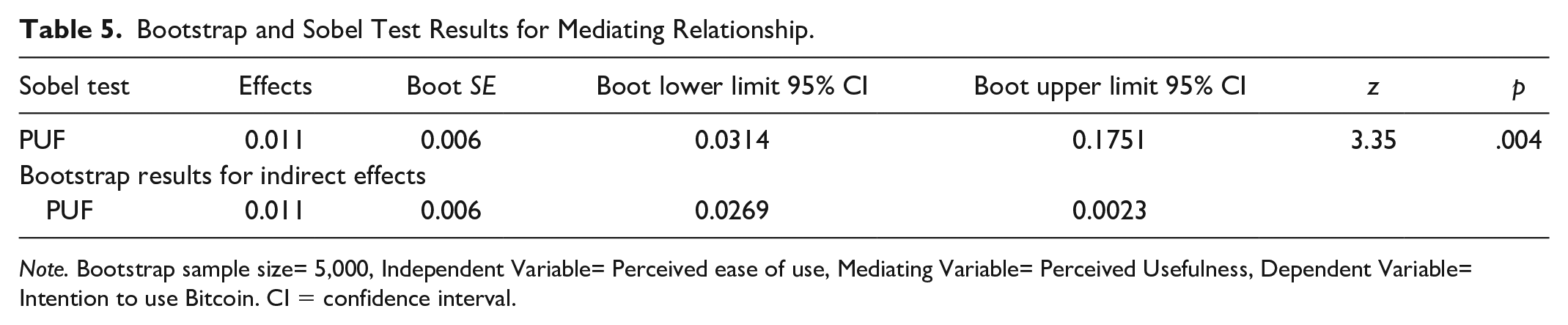
Note. Bootstrap sample size= 5,000, Independent Variable= Perceived ease of use, Mediating Variable= Perceived Usefulness, Dependent Variable= Intention to use Bitcoin. CI = confidence interval.
Second, the Sobel (1982) test results specified the indirect effect of perceived ease of use on the intention to use Bitcoin through perceived usefulness (z = 3.35 for 95% confidence level) and the findings were reported in Table 5. To assess the level of confidence, the present study tested the ULC and the LLC (MacKinnon & Luecken, 2011). For H5, these results (ULC = 0.1751 and LLC = 0.0314) do not contain zero, and the value of z score was higher than the suggested value of 1.95. Thus, H5 is authenticated.
Hypothesis Testing
AMOS was conducted to test the proposed hypotheses, and the results were reported in Table 6 and Figure 2. Table 6 indicated that all the control variables have insignificant impacts on the intention to use Bitcoin. The results showed that the perceived ease of use has a significant effect on the intention to use Bitcoin (β = .101, t = 2.43, p < .05), so H1 is validated. The perceived ease of use casts a significant influence on the perceived usefulness (β = .171, t = 3.07, p < .01), so H2 is also validated. For H3, transaction processing has a significant effect on the perceived usefulness (β = .107, t = 2.28, p < .05), thus H3 is also supported. However, security and control have only insignificant effects on the perceived usefulness (β = .09, t = 1.91, p > .05), so H4 is not validated. Finally, the perceived usefulness shows a significant effect on the intention to use Bitcoin (β = .150, t = 3.39, p < .01). Thus, H6 is also validated. Table 5 summarizes the results and concludes that H1, H2, H3, and H6 are validated, but H4 is not validated.
Hypothesis Testing.
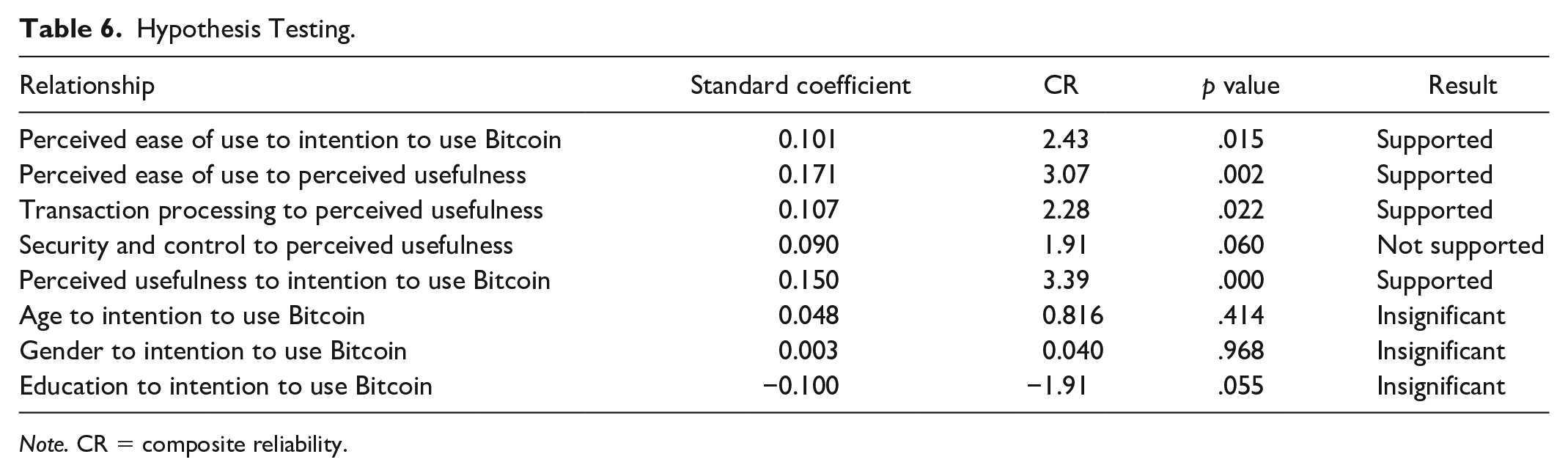
Note. CR = composite reliability.

Structural model.
Discussion, Conclusion, Implications, and Limitations
Discussion
The aim of this study was to investigate the individual’s intention to use Bitcoin via the data collected from the Chinese citizens. The results showed the significant effects of perceived ease of use on the intention to use Bitcoin and the perceived usefulness (H1, H2). The findings support the arguments that the technology has sufficient chances to be adopted by the users if it is easy to use, understandable, flexible, and useful, which are consistent with the past studies (Davis, 1989; Lu et al., 2019). For instance, Davis (1989) reported that the perceived ease of use of technology enhances the user’s intention to use new technology. Similarly, Venkatesh and Davis (2000) reported the positive relationship between the perceived ease of use and the intention to use technology. The findings for H2 show that the perceived ease of use has a significant influence on the perceived usefulness. Practitioners concluded that the perceived ease of use is a significant predictor of the perceived usefulness (Liu et al., 2005). Our findings are consistent with past literature verifying the technology will be perceived as more useful if it is easy to use (Bhatiasevi & Yoopetch, 2015; Elkhani et al., 2014).
The results for H3 show that transaction processing has a positive relationship with the perceived usefulness, consistent with prior literature (Elwell et al., 2013; Venkatesh et al., 2012; Zain et al., 2005). There are several plausible reasons. For instance, the Bitcoin system provides several transaction-related advantages such as low fee, fast transaction, decentralization system, extreme privacy, and cross-border usage (Elwell et al., 2013; Shahzad et al., 2018). It enables payment of small fraction of amount (even 0.00000001 Bitcoins), which is not usually supported by other payment systems (Popper, 2017). Bitcoin also saves the cost of credit card fees and charge backs. Similarly, unlike debit/credit cards, one can continue to make transactions without worries to apply for reissue/renew. Thus, all such features enhance its perceived usefulness.
H4 is rejected and the results showed that security and control have insignificant impacts on the perceived usefulness. Some justified reasons are provided. Security risks are negatively associated with trusting belief of the individuals (Eastlick et al., 2006; D. J. Kim, 2008), which enhances the reluctance to interact with technology (Ba et al., 2003; Gefen et al., 2003) and reduces the perceived usefulness. It is reported that security risks are significant concerns regarding the adoption of Bitcoin as a digital currency (Stark, 2013). First, scholars report that Bitcoin wallets are easy to target for hackers (Apostolaki et al., 2016) and the potential threats of hacking can lessen its perceived usefulness. Second, there are possible issues relating to the risk of data loss. For example, individuals mostly save their data via hard drives. If an individual stores Bitcoin wallet in the hard drive and the hard drive gets damaged and unable to access, the Bitcoin wallet will be lost. Besides, if the storage device/system is attacked by virus, it will also result in Bitcoin loss. Furthermore, the loss of key will also put users into trouble. Third, there is a lack of prescribed rules related to Bitcoin technology and it is not supported by the majority of governments nor by the third party. Moreover, there is no security and insurance backup for Bitcoin users, mainly because of the way Bitcoin functions, which makes it difficult for guarantors to authenticate the claims of theft. Fourth, once the individual makes the transaction through Bitcoin, it is irreversible. Contrastingly, the non-anonymous payment system does not have such limitations (Alshamsi & Andras, 2019; Luther & Olson, 2015). In sum, all such issues can reduce the perceived usefulness.
H5 proposed that the perceived usefulness mediates the relationship between the perceived ease of use and the intention to use Bitcoin, which is supported by prior studies (Santhanamery & Ramayah, 2018; Shahzad et al., 2018; Suki & Suki, 2011; Venkatesh et al., 2003). Perceived usefulness relates to extrinsic factors like effectiveness and efficiency, and thus it acts as a transformational platform that leads the perceived ease of use toward the intention to use Bitcoin. Finally, the results for H6 support our argument that the perceived usefulness positively influences the intention to use Bitcoin. The results are consistent with Y. Lee et al. (2003) and Lu et al. (2019). Perceived usefulness is a promoting factor of any technology, and scholars suggest that it is a strong predictor to adopt new technologies (Davis, 1989; Venkatesh & Davis, 2000).
Conclusion
Cryptocurrency such as Bitcoin has gained much scholarly attention and media coverage and hype. Bitcoin system provides several potential benefits and can cast a significant impact on future economic system. Nevertheless, the empirical studies about human-centered approach of Bitcoin are scarce. By employing TAM and several parameters, this research aims to investigate the individual intention to use Bitcoin through data from Chinese citizens. The findings showed that the perceived ease of use and the perceived usefulness have positive effects on the intention to use Bitcoin. The perceived ease of use is positively associated with the perceived usefulness. Furthermore, the results verify that the perceived usefulness mediates the relationship between the perceived ease of use and the intention to use Bitcoin. Furthermore, this study validates that transaction-processing-related advantages have significant impacts on the perceived usefulness. However, security and control shows an insignificant impact on the perceived usefulness of Bitcoin and attentions are called to address such issues through secure designs and practices.
Theoretical Implications
This study examined the intention of the Chinese individuals to use Bitcoin, and the findings contribute to identifying the factors regarding the adoption of Bitcoin. The studies on human-centered approach are scarce in Bitcoin literature. This research endeavors to address the important gap by using the TAM and the results are valuable additions in nascent but growing literature of Bitcoin. More specifically, this is the pioneer endeavor extending the TAM by incorporating transaction processing and security and control, and deepening our insights into Bitcoin security and control issues and transaction processing features.
The main contributions of this study are as follows. First, this is the pioneer investigation that extends the TAM considering the features of transaction processing. More specifically, this study conceptualizes the effects of transaction processing on the perceived usefulness of Bitcoin and the findings reveal a positive relationship between them. The study shows that transaction-processing-related advantages significantly enhance the perceived usefulness of Bitcoin. Second, security and control–related features are also essential to accept and use online payment mechanisms. Our study examines the impacts of security and control on the perceived usefulness of Bitcoin, and the results demonstrate only an insignificant relationship between them. The conceptualization of this study to examine the effects of security and control on perceived usefulness is an important contribution to Bitcoin literature. The findings provide a theoretical base for academics, which can extend our study and open new avenues for future research and debate.
Practical Implications
The findings of this study have several practical implications. First, the findings not only offer handful information to individuals (user/payee), fund managers (investors), and companies/business (receiving Bitcoin as a payment method) but also provide governments and financial institutions with implications to (re)design policies and enhance their services via blockchain technologies and effective measures of security. Second, misunderstanding about Bitcoin working and the knowledge and skills of Bitcoin users play a vital role to shape user perception about security (Alshamsi & Andras, 2019; Gao et al., 2016). This study suggests that the understanding, knowledge, and skills of new potential users should also be considered.
Third, Bitcoin system requires minimum cost and resources, and thus it is an effective system. Furthermore, Bitcoin is a cost-effective payment system in developing countries, where the banking system is also underdeveloped and unsecured, as compared with other traditional payment systems. Several countries such as the United States, Japan, India, Indonesia, and European Union announced the regulatory policies for Bitcoin. It implies that governments around the globe should start paying attention to the position of Bitcoin in the financial system and allowing it to interact with other market assets. This study proposes governments regulate cryptocurrencies by taking regulation cues from countries where cryptocurrencies have been used.
Fourth, security and privacy concerns are the most sensitive and essential issues for online payments. As compared with centralized systems, Bitcoin shifts most of the security-related responsibilities to end users, while several users lost their Bitcoin due to security breaches and poor usability issues (Krombholz et al., 2016). Thus, it requires a strong attention to guide users about usability issues (Alshamsi & Andras, 2019), and effective and efficient measures should be taken to solve usability issues of cryptocurrencies system for beginners as well as regular users. It is essential to guide users to avoid security breaches. This study suggests that tutorial videos may better help to solve this issue. Equally important, such videos should be made in different languages considering the diversity of users.
Fifth, developers should work to redesign Bitcoin system and efforts should be carried out toward more human-centered system and user-friendly system by considering the limitations highlighted by Alshamsi and Andras (2019).
Sixth, security risks and financial losses call for risk management approaches and insurance of the individual users of cryptocurrencies. Reports revealed that hackers stole cryptocurrencies worth of 1.7 billion U.S. dollars in 2018, a substantial amount and a big hit on the reputation of the new financial technologies (Zoe, 2019). Some wallet providers such as Coinbase and BitGO offer insurance protection to their users against certain types of security risks. However, there are no such insurance arrangements and policies for individual users of Bitcoin and several other cryptocurrencies. The wide use of cryptocurrencies and its theft by the means of hacking can give rise to a new era of insurance. Cryptocurrency insurance is a new phenomenon and the regulators are not sure how to deal with it because of the challenges to verify the claims against theft of cryptocurrencies (Abramova & Böhme, 2016; Zoe, 2019). Therefore, this study proposes that plans and strategies should be developed by taking suggestions from insurance companies, policymakers, and individual users to protect their interests and rights.
Finally, every Bitcoin owner has a private key or password that allows accessing the Bitcoin stored in the wallet. There is one huge risk associated with cryptocurrencies, which required deep attention. For instance, if the Bitcoin user dies and the heirs of the died person have no information about the private key or password to access the Bitcoins stored in the wallet, the Bitcoin will be lost forever. It is crucial to develop plans and strategies to cope with this issue. For instance, cryptocurrencies regulators can design mechanisms such as storing the will of the owner in electronic form (e.g., Electronic will/E-will).
Limitations and Future Research Directions
This study is subject to some limitations, which provide opportunities for future research which could extend our work in the following directions. First, data were collected from only one city of China, so these results indicate the intention of individuals residing in this city. For generalization, future scholars are recommended to collect data from other cities to test the research model. Besides, Krause (2016) reported that developing economies have a substantial potential to use innovative technologies to undermine the financial system of governments and to put more financial power and self-sufficiency in the hands of citizens. Thus, scholars can replicate this research model in other developing countries and can compare the results and observe the differences.
Second, researchers highlighted the negative aspects of Bitcoin (Krause, 2016), so future studies are recommended to investigate the negative aspects of Bitcoin. Third, the lack of regulations regarding cryptocurrencies may encourage black market and illegal activities as highlighted by Yelowitz and Wilson (2015). Future studies are encouraged to examine the dark aspects of cryptocurrencies use because they have the function of money laundering, tax evasion, financing of terrorism, purchase of illegal items, and so on.
Fourth, balancing usability and security issues is a huge challenge for human–computer interaction community (Eskandari, 2015; Sas & Khairuddin, 2015). Scholars are recommended to discuss these issues in the cryptocurrencies domain and can advise policies/guidelines to tackle such important issues. Besides, transactions are not immediate in Bitcoin and the transaction times vary. Future investigations can probe into it and examine users’ perception about it.
Fifth, several other factors not covered in this research, such as trust, hedonic motivation, and social factors, may be of importance for future investigations. Besides, it is recommended to investigate the role of subjective norms, which can play a critical role in this phenomenon. Finally, the future scholars are encouraged to consider several types of risks (financial risk, operational risk, etc.) associated with the use of cryptocurrencies.
Footnotes
Appendix
Questionnaire.
Acknowledgements
All the authors are grateful to editor, article editor, and anonymous reviewers for their helpful comments and suggestions during the review process.
Declaration of Conflicting Interests
The author(s) declared no potential conflicts of interest with respect to the research, authorship, and/or publication of this article.
Funding
The author(s) disclosed receipt of the following financial support for the research, authorship, and/or publication of this article: This research is supported by the National Natural Science Foundation of China (Project Nos. 72072167 and 72071193, and Project Fund No. WY2040150003).
