




Abstract
This study aimed to identify the association of perceived social norms with intention of early marriage practice among unmarried adolescent girls (13–17 years) in Kersa Demographic and Health Surveillance System. A community-based cross-sectional study was conducted during September–November 2019. Adolescent girls’ marriage intention was assessed using social norm measuring tools. The log-binomial model was used to identify factors associated with girls’ intention. Adjusted prevalence ratio along with 95% CIs was executed to determine the association of main independent variables with girl’s intention. A total of 859 adolescent girls participated in the study. The prevalence of intention to marry before the age of 18 years among adolescent girls was 44.47% (95% CI [0.41%, 0.48%]). The intention for an early marriage was higher among those with positive attitude toward early marriage, in those who believe that most people in their reference group conform to early marriage norms (empirical expectation), in those who believe that most people in their reference group expect them to conform to early marriage norms (normative expectation) and who fear sanction related to early marriage practices. Moreover, residence in urban areas and high educational level by girls and their parents was associated with reduced prevalence ratio. There is strong social norm in the community that promotes intention for an early marriage among adolescent girls in the study area. Hence, interventions that aim to reduce early marriage need to address local social norms.
Introduction
In patriarchal societies, marriage is considered an event of transition to adulthood, and the beginning of socially acceptable sexual life and childbearing (Ashley, 2019). Early marriage is a marriage that occurs when one or both partners are below the age of 18 years. The practice has been recognized as a global human rights violation under Article 16 of 1948. However, many young girls in low-income countries still enter into marriage at a very early age without any chance of exercising their right to choose while too young to take the role of being a wife and/or mother (Muthengi & Austrian, 2018; UNICEF, 2021). Early marriage affects the health and wellbeing of the young women and their offspring. It also impedes girls educational and employment opportunities (John et al., 2019).
Globally, more than 700 million girls got married before the age of 18 years, and of this, more than half occurs in South Asia, Latin America, and Sub-Saharan Africa (Yaya et al., 2019). If the present trends hold, 950 million women and girls will marry as a child by 2030 and this number reach 1.2 billion by 2050 (UNICEF, 2017). The Sub-Saharan Africa registers the highest rate of early marriage in the world (Koski et al., 2017). In Ethiopia, the prevalence of early marriage ranges from 26% in Addis Ababa to 87% in the eastern region of Amhara (Asrese & Abebe, 2014; Bezie & Addisu, 2019).
The determinants of early marriage are numerous in low-income countries including poverty (Madut, 2020), “protection” of family honor, customary (social norms), or religious laws that condone the practice (Marshall et al., 2016). In such societies, adolescent girls are expected to be supportive of early marriage practices despite being aware of the consequences, and some use it as an excuse to escape restrictions imposed on sexual initiation before marriage (Greene, 2019; Nicholas, 2021).
Recently, literature increasingly recognizes the important role of social norms and beliefs that play in sustaining early marriage practice (Bicchieri & Mercier, 2014; McDougal et al., 2018). The conceptual theory of social norm in this study developed based on reviewed literature and the theoretical background of Ajzen’s TPB (Theory of Planned Behavior) (Ajzen, 2020). The theory describes the main determinants that drive the decision of an individual to engage in certain behavior. According to this theory, behavioral intentions are determined by three factors: attitude toward the behavior, subjective norm/perceived norm concerning the behavior, and perceived behavioral control/self-efficacy. The immediate antecedent of behavior in the Theory of Planned Behavior is the intention to perform the behavior (early marriage); the stronger the intention, the more likely it is that the behavior to follow (Ajzen, 2020; Stefanik & Hwang, 2017). The people tend to follow a behavior if they believe that others in their group follow it due to a desire to suit in or imitate the behavior of others. A social norm is a rule that people follow because they believe that others do the same (Empirical expectations/descriptive norm) and/or believe others think they should do (Normative expectations/injunctive norm) (Bicchieri & Mercier, 2014; Cislaghi & Heise, 2016). In general, studies indicating strong early marriage norms have shown high levels of both empirical and normative expectations with participants reporting fear of sanctions when the norm is not complied with peoples’ greater control over the behavior of interest, and they strongly believe that they’re capable of performing the behavior if they so desire (Stefanik & Hwang, 2017). Besides, the social norm the TPB components attitude, and Perceived Behavioral control were also reported to associate with adolescent early marriage intention (Ajzen, 2020; Montazeri et al., 2016). Additionally, level of knowledge of adverse consequences of early marriage and background characteristics including age, education status, residence were reported to influence early marriage intention (Madut, 2020; Mpilambo et al., 2017).
Early marriage studies in Ethiopia are more focused on married girls, ever married women and certain family background characters such as income and education and do not address adolescent girls sufficiently in identifying whether it is due to an individually held belief or attitude or whether it is driven by a social norm. Hence, understanding these social norms is critical to determine who should be involved (target group) in the intervention for improving the well-being of girls (Bicchieri & Mercier, 2014). Therefore, this study aimed to identify the association of perceived social norms and other socio-demographic and economic factors with intention of early marriage practice among unmarried adolescent girls in Kersa HDSS of Eastern Ethiopia.
Methods and Materials
Study Setting and Design
A community-based cross-sectional study was conducted in Kersa Demographic and Health Surveillance System (Kersa HDSS), which is located in the eastern part of Ethiopia. The study was conducted during September–November 2019. Kersa HDSS site consists of 21 rural and 3 urban kebeles (the smallest administrative unit in Ethiopia). In the study area, there were 18 elementary, two secondary, one preparatory, and two religious schools. Health services are delivered through 6 health centers and 19 health posts in the HDSS catchment area. The HDSS had 26,061 households with a total of 5207 unmarried adolescent girls in the age group 13 to 17 years by the end of 2019 (Assefa et al., 2016; KHDSS, 2019). The Kersa DHSS population is predominantly Muslim and lives on subsistence farming, although some farmers cultivate cash crops. The society is patriarchal and traditional values and social norms dictate common practices (Kersa District Health Office, personal communication, December 28, 2020).
Population and Sampling Technique
Population
The study population constituted unmarried adolescent girls between the ages of 13 and 17 years, who had residence in the study area (Kersa HDSS) for at least 6 months. Girls who were critically ill and physically or mentally disabled at the time of data collection were excluded from the study.
Sample Size Determination
The sample size for the prevalence of intention was calculated using the single population proportion formula, assuming 50% early marriage intention in adolescent girls, with a total of 5207 unmarried adolescent girls, adding 20% non-response rate, and a design effect of 2; the minimum sample size calculated for this study was 859. Using Open Epi online, the sample size for factors associated with early marriage intention was computed, with a two-sided confidence level (1-alpha) of 95% and a power of 80%, based on the data from Steinhaus et al. (2019). As a result, the minimum sample size was set at 108. However, we used the larger sample size (859).
Sampling Procedure
In all, 21 rural and three small urban kebeles are found in KDS-HRC. To select the study participants from the study area, we used a multistage cluster sampling procedure. First, we classified the rural kebeles into three clusters (high land, middle land, and low land) and the urban kebele as one cluster. In the second stage, 8 kebeles (2 kebeles from each of the 3 rural clusters and 2 kebeles from the urban cluster) were randomly selected. Then, the total sample size was allocated for each selected kebele proportional to the number of their target population. The list of households found in the selected kebeles with at least one adolescent woman was obtained from the kersa HDSS. Then, households were drawn proportional to the size of the kebele population using a simple random sampling procedure based on the sampling frame obtained from KDS. Only one adolescent girl was interviewed from each selected household. In cases the selected household had more than one eligible study subject, one was chosen randomly by a lottery method.
Data Collection
Data were collected face-to-face using a structured pre-tested questionnaire by trained and experienced female field workers having diploma to master’s degree who were able to fluently speak the local language. The questionnaire was developed by utilizing standard measurement tools as described by Gerry mike 2015, to identify prevailing social norms in the study context. In addition, sociodemographic and economic characteristics, girl’s knowledge of early marriage consequences, access to school and mass media was accessed by using a household questionnaire. The questionnaire was originally developed in English and translated into the local language (Afan Oromo), then back to English to check consistency of translation. We pretested 5% of the questionnaire among unmarried 13 to 17 years girls who resides in a similar setting outside our study area, to test the appropriateness of the questions, language, flow, and understanding of the questions by potential respondents. Some questions and the translation were refined based on the feedback obtained during the pre-test. Data collectors and field supervisors were trained on the content of the questionnaire and on the field data collection procedures by researcher for 3 days prior to data collection. Data collectors were asked interviewees their convenient time and scheduled another visit if the first visit was not convenient and/or absent from home. Up to three visits were made if a respondent was not available on the first visit. The field supervisors closely supervised the data collection process moving home to home with data collectors and also checked each filled questionnaire for completeness on a daily basis. Informed consent was obtained from all participants. For participants below the age of 15 years, additional parental/guardian consent was sought. All interviews among participants took place in a private setting.
Variables and Measurements
Outcome Variable
In this study, intention for early marriage was the outcome variable. Intention was defined as the readiness/decisions of adolescent girls to marry early (even if she is <18 years) (Prawita et al., 2019). Intention was asked using a single question stated as “I have intention to marry even if I am <18” with a four-point Likert scale response: (1. “Disagree,” 2. “Somewhat disagree,” 3. “Somewhat agree,” and 4. “Agree”). During analysis, those responded disagree or somewhat disagree were categorized as “disagreed and coded as 0,” and those agree or somewhat agree were categorized as “agree and coded as 1” (Berhane et al., 2019).
Explanatory variables
The explanatory variables were assessed by using measurement tools adapted from previous literature (Ajzen, 2020; Mackie et al., 2015). Likert scale question was used to measure the social norm. Because Likert Scale questions are commonly used in survey research when we have attitude, belief, or behavior items, we employed them. We can readily operationalize personality traits or perspectives using Likert scale questions. In general, it is a rating scale that is used to analyze people’ ideas, attitudes, or behaviors by determining how much they agree or disagree with a specific question or statement on a certain issue (Pritha Bhandar, 2020). We considered five domain questions: girls attitude toward early marriage (four items), empirical expectation of early marriage (two items), normative expectation of early marriage (six items), sanctions related to early marriage practices (two items), and girls perceived behavioral control/self-efficacy of girls (four items) (Annex I: S1 Table ) (Berhane et al., 2019; CARE USA, 2014; Steinhaus et al., 2019; Sutton, 2017).
Attitude: it was defined as the tendency of girls to judge and respond in the form of beliefs and feelings toward early marriage. It was measured by 4 items using four Likert scale response; “I think girls should get married before age 18,”“In my opinion getting married before 18 years is beneficial,”“If a girl did not marry early, she would not be marriageable,” and “An older girl will not find a good husband.” The response ranges from “Disagree” (1) to “Agree” (4) and total girl’s attitude score ranged from 4 to 16. Dichotomous variable was created by summing all the items score using median split. Score below the median is taken as (negative attitude toward early marriage and (Positive attitude toward early marriage) otherwise (Berhane et al., 2019).
Social norm
Social norm has two components: it is a rule of behavior that individuals prefer to conform to it; on condition they believe that most people in their reference network conform to it (empirical expectation), and that most people in their reference network believe they ought to conform to it (normative expectation) (Bicchieri & Mercier, 2014; Costenbader et al., 2019).
Perceived behavioral control/
Socio-demographic and economic characteristics, including age, socioeconomic status, residence, educational status, and religion were assessed by standard questionnaires.
Data Management and Analysis
The questionnaires were double entered and cleaned using EpiData Version 3.1 then exported to STATA 14 statistical software for analysis. A complete case analysis was used to handle the missing data since the missing values of each variable were less than 1% and missing completely at random. The proportion and 95% confidence intervals for early marriage was calculated. We examined the associations between intention and each independent variable by calculating the prevalence ratio (PR) using a log-binomial regression model which is preferable in cross-sectional studies of common outcomes (prevalence rates above 10%; Martinez et al., 2017). Log-binomial regression (In cross-sectional studies with binary outcomes) provides correct estimates, and used as a better alternative for the analysis of cross-sectional studies with binary outcomes than logistic regression. The log-binomial model produces an unbiased estimate of the adjusted relative risk than Odds ratio (McNutt et al., 2003). The relative risk interpretation given to the odds ratio can be misleading as a result of an overestimation of the strength of association by OR as compared to RR, especially if used for the definition of policy priorities and development. PR is easier to communicate than POR and its meaning is more transparent (Chen et al., 2018; Tamhane et al., 2016). After checking for multicollinearity by examining the correlation matrix, adjusted PR (APR) along with 95% CIs was executed to determine the association of main independent variables with girls intention, and a p value < 0.05 was considered statistically associated. Log-likelihood ratio test and Akaike’s and Bayesian information criterion were used to select the final model. The Pearson chi-square and Hosmer–Lemeshow goodness-of-fit tests were used to test for model.
Result
Socio-demographic characteristics
All of 859 unmarried adolescent girls identified in this study were responded to the questioner making the response rate 100%. The mean age the respondents was 14.8 (±1.3) years with the range of 13 to 17 years. Most of the study participants were Muslims, 813 (94.6%), Oromo, 808 (94.1%) and rural residents 656 (76.37%). Overall, 810 (94.3%) girls reported school availability nearby and 353 (43.5%) reported the school to be with 15 minutes walking distance from their home. About quarter 219 (25.5%), of the study participants had no education and 318 (37.1%) were from poor households. Regarding parental education, about 513 (60%) of fathers and 497(57.9%) of mothers were illiterate (Table 1).
Background Characteristics of Unmarried Adolescent Girls Living in Kersa HDSS, Ethiopia, 2019.

Note.“Other” occupation: merchant, government employee, pity trader, daily laborer.
Knowledge of early marriage and access to mass media
In this study, 406 (64.34) of girls know the legal age of marriage, 716 (83.4%) know at least one health consequences of early marriage, among which 333(45.6%) mentioned “prolonged labor” followed by, “excessive bleeding after delivery” 216 (30.2%) as a health consequence. Majority, 480 (60.8%) mentioned school as source of information on early marriage. Furthermore, more than half of adolescents in this study 457(53.3%) do not follow mass media regularly (Table 2).
Background Characteristics of Unmarried Adolescent Girls With Their Early Marriage Intention in Kersa KDSS, 2019.

Personal attitude and social expectations (social norms)
The prevalence of intention to marry early among unmarried adolescent girls in this study was 382 (44.47%, 95% CI [0.41%, 0.48%]). More than half, 529 (61.6%) of the adolescent girls had positive attitude toward early marriage, agreed on presence of empirical expectation, 540 (62.9%), agreed on presence of normative expectation 441 (51.3%), and 505 (58.8%) had perceived behavioral control/self-efficacy over early marriage. Moreover, about 612 (71.3%) of unmarried girls approved presence of sanction toward early marriage practices in the community (Table 3 and Supplemental S1).
Personal Attitude and Social Expectations (Social Norms) of Adolescent Girls Living in Kersa HDSS, Ethiopia, 2019.

Factors Associated with Intention of adolescent girls
After adjusted analysis, the prevalence of intention to marry early was lower by 22% (APR = 0.78; 95% CI [0.69, 0.89]) among grade 1 to 4, and lower by 53 % (APR = 0.47; 95% CI [0.37, 0.60]) among grade 5 above completed, compared to non-educated girls. The prevalence ratio of intention to marry early was 1.70 times higher among rural residents compared to urban (APR = 1.70; 95% CI: [1.37, 2.12]), 1.29 times higher among those who had positive attitude toward early marriage (APR = 1.30; 95% CI [1.09, 1.52]), 1.95 times higher among those agreed with empirical expectations (APR = 1.95; 95% CI [1.59, 2.40]), 1.67 times higher among those agreed with normative expectations to early marriage (APR = 1.67; 95% CI [1.43, 1.96]), and 1.55 times higher among those who fear sanctions related to early marriage (APR = 1.55; 95% CI [1.29, 1.86]) compared to their counterparts (Table 4).
Factors Associated With Intention of Unmarried Adolescent Girls to Early Marriage living in Kersa HDSS, Ethiopia, 2019.
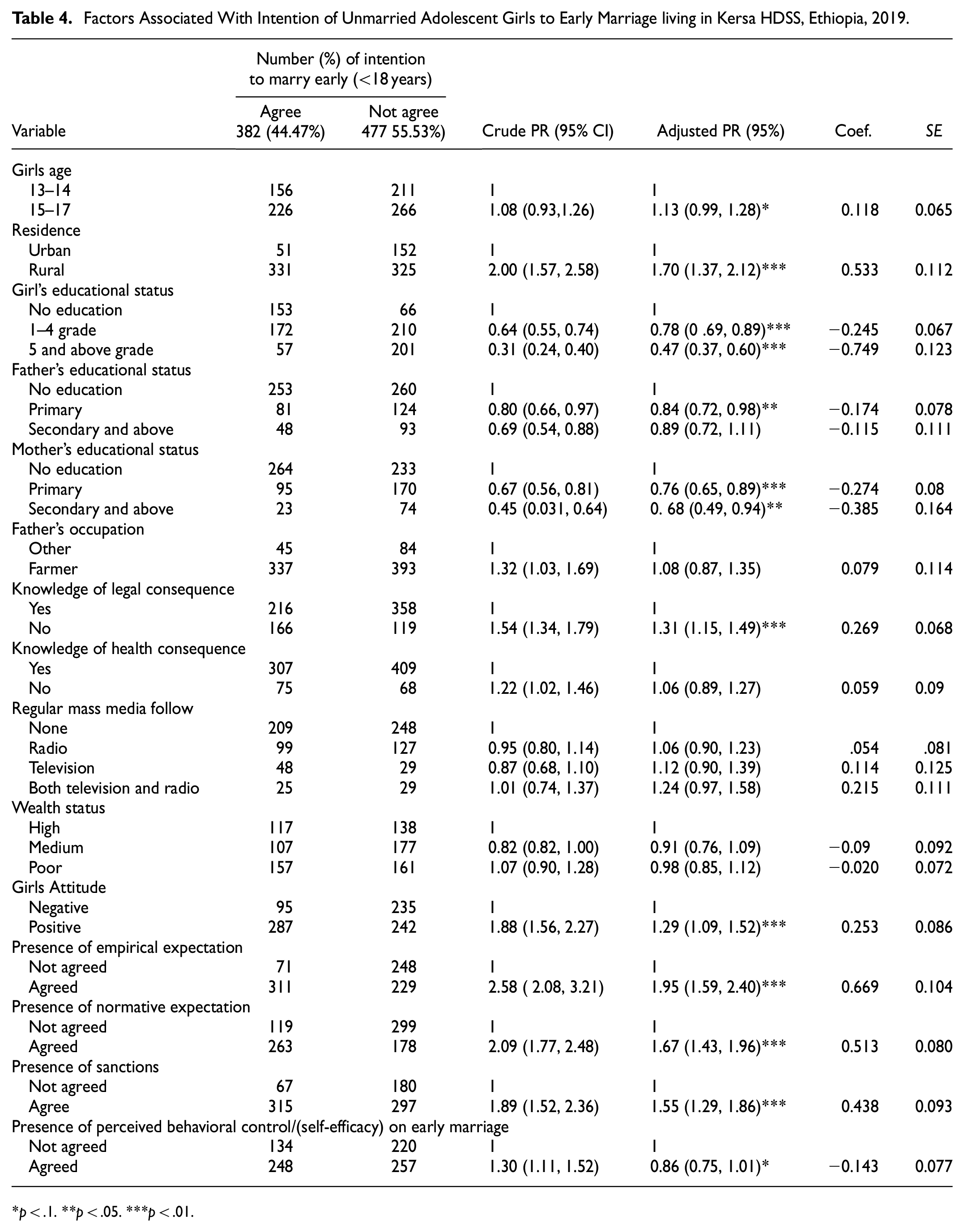
p < .1. **p < .05. ***p < .01.
Discussion
This study identified that the prevalence of intention to marry early among unmarried adolescent girls was 44.5%. Being rural, with no education, positive attitude to early marriage, agreed on presence of empirical and normative expectations, and presence of sanction to early marriage practice were statistically significantly associated with adolescent girl’s intention to marry early.
The immediate antecedent of behavior in the Theory of Planned Behavior is the intention to perform the behavior in question; the stronger the intention, the more likely it is that the behavior to follow (Ajzen, 2020). Similarly in this study we found that (44.47%) of unmarried adolescent girls had intention/readiness to marry early. In agreement with our study, various quantitative and qualitative studies have shown the persistence of support of early marriage by married and unmarried adolescent girls despite awareness of its negative consequences (Greene, 2019). Many teenagers want to get married at an early age due to social (Mpilambo et al., 2017), emotional (Montazeri et al., 2016), and sexual needs (Nicholas, 2021).
In this study, the prevalence of intention to marry early was lower by 53% among grade 5 above completed girls compared to those had no education. Similarly, high educational level of parent’s was associated with reduced prevalence ratio. This finding is in agreement with previous studies showing early marriage to be high among illiterates and primary level of education than secondary and higher level of education (Bezie & Addisu, 2019; Madut, 2020; Rumble et al., 2018). This shows, the more educated the girl, the mother, and the father are the likelihood of challenging early marriage is high. This may be due to the fact that education is clearly one of the factors that contribute toward changing social and traditional norms toward early marriage. Education also gives girls the ability to develop skills, knowledge and autonomy to make her own decision regarding the reproductive health including if, when and whom to marry (Jones et al., 2014).
Therefore, opportunities and scope of education beyond secondary would help to bring change in intention toward early marriage.
In this study, the prevalence ratio of intention to marry early was 1.70 times higher among rural residents compared to the urbans. As previous studies showed, girls living in rural areas are more subjected to early marriage than their counterparts (Berliana et al., 2021; Rumble et al., 2018). This might be, huge influence of social norms on the rural girls (Ashenafi, 2015), and females in rural areas having limited awareness and knowledge on negative health consequences of early marriages (Nasrullah et al., 2014).
About 61.58% of adolescent girls in this study had positive attitude toward early marriage. The direct determinant of behavioral intentions as explained in the TPB is the attitude toward the behavior. There is a positive relationship and influence on intention by controlling someone’s behavior to conduct/readiness to perform the targeted behavior such as early marriage (Ajzen, 2020; Montazeri et al., 2016). In this study, the prevalence ratio of adolescent girl’s intention to marry early was 1.29 times higher among those who had positive attitude compared to their counterparts. This has been sowed in previous studies also (Kumaidi, 2015).
This study demonstrated that 62.9% of respondents agreed on the presence of empirical expectation, 51.3% of girls agreed on normative expectation, 58.8% agreed on perceived behavioral control/self-efficacy on early marriage, and 71.3% of them agreed with presence of sanction toward early marriage practices. Moreover, the PR of intention to marry early was 1.95 times higher among those who agreed on empirical expectation toward early marriage, 1.67 times higher among those who agreed on normative expectation, and 1.55 times higher among those who fear sanction compared to their counterparts.
The girls perceived behavioral control/self-efficacy on early marriage was (58.8%) in this study. The greater the actor’s control over the behavior, the more likely it is that the intention are going to be carried out. When people have greater control over the behavior of interest, and once they strongly believe that they’re capable of performing the behavior if they so desire (McDougal et al., 2018). Studies indicating strong early marriage norms have shown high levels of both empirical and normative expectations with participants reporting that there are sanctions when the norm is not complied with (Bicchieri & Mercier, 2014; CARE, 2017). Accordingly early marriage may be a strong social norm that enforces early marriage intention in our study community.
Conclusions
Adolescent girls are under pressure to marry at an early age due to strong social norms around early marriage in this community. About 44.5% of the unmarried adolescent girls had intention to accept early marriage despite the country’s minimum-age-at-marriage legislation. This means that adolescent girls are still suffering the impacts of early marriage, which denies them the right to make choices about their sexual and reproductive health. Early marriage studies in Ethiopia, on the other hand, rarely address the role of social norms. As a result, understanding these social norms is critical to determine the need for priority programs targeted to tackle prevailing social norms relevant to the local context, and who should be involved (target group) in the intervention for improving the well-being of girls. This study also gives a clue for other researchers who interested in qualitative study to explore the various social norms related to early marriage practices with intervention among the reference group of girls, for an in-depth understanding to inform a better approach to combat early marriage.
Supplemental Material
sj-docx-1-sgo-10.1177_21582440231182352 – Supplemental material for Adolescent Girls’ Early Marriage Intention and its Determinants in Eastern Ethiopia: A Social Norms Perspective
Supplemental material, sj-docx-1-sgo-10.1177_21582440231182352 for Adolescent Girls’ Early Marriage Intention and its Determinants in Eastern Ethiopia: A Social Norms Perspective by Dureti Abdurahman, Nega Assefa and Yemane Berhane in SAGE Open
Footnotes
Author Contributions
All authors made substantial contributions to conception and design, acquisition of data, or analysis and interpretation of data; took part in drafting the article or revising it critically for important intellectual content; gave final approval of the version to be published.
Declaration of Conflicting Interests
The author(s) declared no potential conflicts of interest with respect to the research, authorship, and/or publication of this article.
Funding
The author(s) received no financial support for the research, authorship, and/or publication of this article.

Availability of Data
All data analyzed for this article are available with the corresponding author and can be obtained on reasonable request.
Supplemental Material
Supplemental material for this article is available online.
References
Supplementary Material
Please find the following supplemental material available below.
For Open Access articles published under a Creative Commons License, all supplemental material carries the same license as the article it is associated with.
For non-Open Access articles published, all supplemental material carries a non-exclusive license, and permission requests for re-use of supplemental material or any part of supplemental material shall be sent directly to the copyright owner as specified in the copyright notice associated with the article.
