




Abstract
This study examines self-efficacy and subjective norms (moral obligation, empathy, and perceived social support) as moderators of the effect networking competence has on social entrepreneurial intentions. Using Nigeria as a study area, a survey was conducted on 541 budding entrepreneurs, which were students with a high entrepreneurial propensity. With the use of Andrew Hayes’s PROCESS macro, a simultaneous regression analysis was performed to establish the interaction effect of the selected moderators. The results show a positive main effect of networking competence on social entrepreneurial intentions, statistically significant interaction effects of empathy and perceived social support, no interaction effect of moral obligation, and a poor self-efficacy fit. This study extends theories of entrepreneurial intentions and the mediation (additive) models of Mair & Noboa, Krueger, and Hockerts. Suggestions are that other studies should be carried out using self-efficacy among actual early-level entrepreneurs, with a likelihood that results could explain what role self-efficacy could have in predicting social entrepreneurial intentions.
Introduction
Whereas a dozen years ago the concepts of “social enterprise,” “social entrepreneurship” and “social entrepreneur” were rarely discussed, they are now making amazing breakthroughs on both sides of the Atlantic, especially in EU countries and the United States. They are also attracting increasing interest in other regions, such as Eastern Asia (especially South Korea, Japan, and Taiwan) and Latin America. (Defourny & Nyssens, 2010, p. 1)
“Where is Africa?” From numerous indications, social entrepreneurship and even the larger spectrum of entrepreneurial studies have not been adequately investigated in Africa (Hond & De Bakker, 2007; Kedmenec et al., 2015; Linan & Fayolle in Cavazos-Arroyo et al., 2017). Bird (1988) and Krueger and Brazeal (1994) had earlier asserted that there was definitely a need for contributions about the nature and forms social entrepreneurship takes in the African context and in understanding the perception of budding or potential African entrepreneurs. Social entrepreneurship is a topical issue (Bacq & Alt, 2018; Hockerts, 2018; D. Kim & Lim, 2017; Low & Macmillan, 1988) and this study is a contribution to the literature. More, Nigeria, in particular, is in dire need of social enterprises, enterprises that are not driven by profit but a need to create social good (Courpasson et al., 2008; Johnson, 2003). This need should not just be the case in Nigeria but also around the world (Hockerts, 2010; Weber, 1930). The global space in the recent past has been an expression of mercantilism, commerce, and traditional expansionist tendencies, where individuals, organizations, and nation-states have pursued a much more profiteering atmosphere rather than anything else (Gates & Gates, 2018; Oxfam, 2017; Rodrik, 2011; Weber, 1930). Even the intellectual community had moved the motive of the firm from the traditional profit maximization to a much more intensive, self-emphatic, and non-egalitarian notion of shareholders’ wealth maximization (Findlay & Whitmore, 1974).
Today, with many large philanthropic bodies, things are changing in the West and other climes as stated above, and the issue of predicting social entrepreneurial motives is now being given the attention it deserves (Dacin et al., 2010; Fowler, 2000; Hond & De Bakker, 2007; Mort et al., 2003; Peredo & McLean, 2006; Tan et al., 2019; Zaremohzzabieh et al., 2019). Africa should not be left behind, as it is important to note that Africa is projected to be the most strategic continent in just two decades to come (McKinsey Global Institute, 2016). The World Economic Forum (WEF) forecasts that in 2034, Africa would have 1.1 billion individuals at productive work; this would be the largest in the world, next to Asia. It further estimates that an additional 187 million Africans would move to cities in less than a decade from now (WEF, 2016); one can only imagine the level of consumption and the kind of market this would provide. In just a few years to come, Africans would be expending more than 2 trillion dollars on annual consumption, and Nigeria, a West African Nation alone would account for 30% of this. In South Africa and Morocco (North Africa), the earnings per household are already around US$20,000, which is the average in Europe also. In East Africa, countries like Kenya are already global leaders in electronic mobile transfers, and smartphone penetration has risen from 2% to 50% between 2010 till date; the earlier projection was to be a +25% by 2020 (WEF, 2016).
The global economy has gone through various phases of economic, industrial, and political revolutions. Whether one is in Somalia or Norway, being two extremes of economic welfare, there is no doubt that technological advancement has risen and would only get farther. The economic polarizations would also keep getting wider if nothing is done about it. For instance, recently, Bill Gates even questioned why he was so rich (Gates & Gates, 2018)—a rhetoric that should draw attention to the anomaly of one man having much more than another nation. At the 2018 WEF in Davos, Switzerland, an alarming discovery was that, although global wealth was on the increase, the gap between the haves and the have nots keeps getting wider (Oxfam, 2017; Woolcock, 1998). If the quest for mercantilism, business growth, market performance, and other purely commercial indices keeps being the basis for even academic assessment of the well-being of any nation or organization, then the world would only remain a place of unbelievable inequalities (Vuorio et al., 2018). To have a better understanding of this issue, one may look at a study conducted by Gomes et al. (2011), which showed that of the eight measures of performance for global manufacturing firms in Europe, social responsibility, which is the closest to social entrepreneurship, ranked the least.
Social entrepreneurship as an area in entrepreneurship is nascent, but a critical nexus between society and economics (Bornstein & Davis, 2010; Nicholls, 2006). Social entrepreneurial intentions as an import of the social entrepreneurship discourse is in itself the catalyst toward the formation of social enterprises and promotion of social good (Hockerts, 2015, 2017; Mair et al., 2006; Mair & Martí, 2007). Social entrepreneurship research in this era among scholars have focused on understanding the personalities behind, predictors of, and practices which make up social entrepreneurship and its intentions thereof (Crant, 1995; Hockerts, 2017; R. Hu et al., 2018; Izquierdo & Buelens, 2008; Obschonkaet et al., 2014; Obschonka & Silbereisen, 2012; Welsh & Krueger, 2013; Vuorio et al., 2018; Yunus et al., 2009; Zaremohzzabieh et al., 2019). It is the complexities of predicting these intentions that have led to this study.
Theoretical Basis for the Study
Ajzen’s theory of planned behavior holds that the major predictors of intention are perceived behavioral control (control beliefs), attitude toward a behavior, and subjective norms (Ajzen, 1991, 2002). In simple terms, perceived behavioral control is the skill or requirement needed to exhibit a behavior; attitude toward a behavior like self-efficacy is the self-wielding predisposition to commit or restrain one’s self from performing certain activities, whereas subjective norms are basic expectations from society to act in a certain way. With this premise, one can rightly posit that the capacity or competence to network is a pro-social skill which on its own can have a direct effect on social entrepreneurial intentions (Bacq & Alt, 2018; McMullen & Bergman, 2017), making it an element synonymous with perceived behavioral control. While self-efficacy is a clear stand-alone, the other subjective norm variables are moral obligation, as what the society expects; empathy, as what the society requires; and perceived social support, as what one expects society to give. Now, it is important to state that while these variables are clear predictors of social entrepreneurial intentions, the study of their interactions is lacking. The addictive mediation models where these variables serve as predictors are well researched on, and the works of Esfandiar et al. (2019), Hockerts (2017), Mair and Noboa (2006), and Krueger et al. (2000) stand out in the use of self-efficacy and subjective norms in predicting perceived feasibility and desirability, further predicting intentions and then action. Ajzen states that what is lacking are more evidence as to the interactive effects of these variables, especially with perceived behavioral control, subjective norms, and self-efficacy. According to Ajzen (2002, p. 667), Logically,
In clarifying this suggestion and extending theory, Ajzen implies that research efforts should attempt to test interaction effects of behavioral control as predictors, attitudes and self-efficacy as moderators, and social entrepreneurial intentions as an outcome variable. It is on this premise that we make an empirical effort to determine what interactions exist with regard to networking competence and the proposed moderators on social entrepreneurial intentions (Figure 1).

Research model.
The above is a moderated styled model for empirical research. It takes its bearing from the designs developed by Andrew Hayes (Montoya & Hayes, 2017). Here, moderating variables (moral obligation, self-efficacy, empathy, and perceived social support) are variables that are separate from the independent variable (networking competence) but attempt to affect the dependent variable with a combined effect. The moderators’ direct effect on the dependent variable is not as important as the direct effect of the independent variable on the dependent variable. The research crux is to determine the interaction effect of the independent and moderating variables on the dependent variables.
This study, therefore, aims to empirically determine whether the inclination of an individual to a network or group is a capital or an impediment to social entrepreneurial intentions, that is, the main effect of networking competence to social entrepreneurial intentions. Also, the study moderates the main effect with self-efficacy and the subjective norm variables of moral obligation, empathy, and perceived social support.
Social Entrepreneurial Intentions—Outcome Variable
The meaning behind the concept of social entrepreneurship like most other subjects in the behavioral and social sciences is easily debatable (Hill et al., 2010; Munoz et al., 2015; Sengupta, 2010). Nonetheless, social entrepreneurship is not lacking as an appeal to management scholars (Arasti et al., 2015; Ebrashi, 2013; Shaikh, 2012). Most of these scholars have discussed the concepts and explained the attributes of social entrepreneurship from three distinct areas: innovative ways of ensuring poverty reduction, to altruistic organizational interactions, and then to creative environmental sustainability (Mair & Martí, 2006; Mair & Noboa, 2006; Roemer, 1996; Welsh & Krueger, 2013). From the poverty reduction front, one would see social entrepreneurship as a means to provide for the disadvantaged and the not so well to do individuals within ones ease of reach (Yunus et al., 2009). As an aspect of organizational interactions, social entrepreneurship is the extent to which one should put the interest of other organizational actors in prime position before the narrowed mercantilist interest of profit maximization, while focusing on loyalty of customers or clients (Kannampuzha & Hockerts, 2019; Man et al., 2008; Seelos & Mair, 2004). These organizational actors include not only the customers but also fellow employees, suppliers, competitors, and potential customers. It simply implies that a socially entrepreneurial individual or firm should be one who is ready to put her interest last while making sure that others are not mistreated, all in a bid to maximize profit (Coutinho et al., 2018; Kaymak & Bektas, 2017; Yunus et al., 2009). Creative environmental sustainability is social entrepreneurship that prioritizes the fact that irrespective of the nature or kind of organization or enterprise one intends to set up or is already running, the environment in all its forms should be preserved (Alvord et al., 2004; Graafland, 2018; Hockerts & Wüstenhagen, 2010; D. Kim & Lim, 2017). This doesn’t just mean the physical environment only, it also could involve the legal environment, making sure that illegality is nipped; the cyberspace, emphasizing a healthy use of the cyberspace and even the economic environment, avoiding black market dealings, tax evasions, round-tripping, and other sharp practices inimical to the economic environment of an enterprise (Coutinho et al., 2018; Gabriel & Rodeiro-Pazos, 2018; Kaymak & Bektas, 2017).
With an understanding of what social entrepreneurship implies, Andrews (2001), Arasti et al. (2015), Stuetzer et al. (2016), and Hockerts (2017) assert that social entrepreneurial intention involves an inclination toward the practice of socially beneficial activities by starting a social enterprise, belonging to one, or furthering the course of any, for the good of all.
Networking Competence—Predictor Variable
It is expected that every budding entrepreneur should develop strong network skills. However, according to Ajzen (1985, 2002) and Rotter (1975), there are two prevailing opinions. While one group believes that the most pronounced trait of any soon-to-be successful entrepreneur is his ability to develop relationships which would aid his enterprise, another group claims that an entrepreneur is a deep thinker, introversive, and is nonsociable (Coviello & Munro, 1997). Networking competence has also been seen to mean different things to different scholars. Ritter and Gemünden (2003) see it from the aspect of inter-organizational linkages and interactions. They view networks in the context of things such as outsourcing, joint ventures, licensing, franchising, and cartel building; although they may be right in some sense, that is not the inference of this study. It is also rife to state that “social networks” in the context of this study should not be juxtaposed with “social media.” While the former is a physical relational activity or interaction among members of society (Aarstad et al., 2010; Baron & Markman, 2000; Coviello & Munro, 1997; Hasan, 2005; Klyver et al., 2008; Man et al., 2008; Putnam in Westlund & Bolton, 2003; Reynolds, 1991; Rockenbauch & Sakdapolrak, 2017), the latter, which is not the focus of this study, is a virtual relationship, which may exist or thought to be existing.
Other authors who have come close like Ferris et al. (2005) and Roemer (1996) have viewed networking competence from both individual interactions within an organization and individual interactions without, respectively. The former made their case from the standpoint of organizational politics, where they explained the networking ability of an individual as a part of a pooled political skill inventory having other parts as an interpersonal influence, social astuteness, and apparent sincerity.
Networking competence in this study takes its root from the seminal work of Chandler and Jansen (1992) which centers on the required competencies an enterprise founder should possess in a bid to survive in the business place. Networking competence is seen as an entrepreneurial competence possessed by an individual that emphasizes the individual’s inclination to have healthy interactive and negotiating prowess while pursuing or having the intention to pursue an enterprise (Ritter et al., 2004; Ritter & Gemünden, 2003a, 2003b). This view was revised over a decade ago by Man et al. (2008). They also took the import from the works of Chandler and Jansen (1992), Chandler and Hanks (1993), Roemer (1996), Dess et al. (1997), and Dobrow et al. (2012). These works gave direction to the literature on networking as an entrepreneurial competence.
In understanding how individual personalities and behavioral dispositions could predict social entrepreneurship, and whether the level of interaction among budding entrepreneurs propels them toward or repels them away from social entrepreneurial activities (Perry-Smith, 2006), we consider closely their ability to network or interact as a precursor to entrepreneurial intentions and processes (Barbat et al., 2014; Birley, 1985; Fernández-Pérez et al., 2014). There are arguments that entrepreneurs are divided along introversive and extroversive tendencies (Rotter in Nair & Pandey, 2006; Murnieks et al., 2014), but one would want to understand how these tendencies influence the choice of an individual’s inclination toward creating social value. Like social entrepreneurship, the issue of social networking has been sparsely studied.
We have decided to use social networking competence as an inclination borne out of either a conscious or unconscious expression of political skill or relational need (Chandler & Hanks, 1993; Ferris et al., 2005; Roemer, 1996). Individuals high in relational skill are usually inclined toward assisting others rather than egocentric and inward leaning toward themselves (Baker et al., 2011; Dufays & Huybrechts, 2014). Also as a new scale development effort, the political skill inventory contains social astuteness, interpersonal influence, apparent sincerity, and networking ability. Among these, networking ability is most fitting for this study, as also is the strongest construct on the scale, but this refers to members within an organization, which is not the focus of this study. This study defines networking ability as an entrepreneurial competence developed by Man et al. (2008), one of which for budding entrepreneurs is relational. Among other competencies, the relationship competence of networking is important in deciding the nature of entrepreneurial ventures that available social capital could be suggestive of (Coviello & Munro, 1997; Hietajärvi et al., 2015; Klyver et al., 2008; Rockenbauch & Sakdapolrak, 2017; Roemer, 1996). It is this predictive ability of social capital that informs the first hypothesis of this study, which is
HNETW: There is a statistically significant main effect of Networking Competence (NC) on Social Entrepreneurial Intentions (SENT) for budding entrepreneurs.
Subjective Norms—Moderators
As a part of this study, we do not intend to consider the direct effect of networking competence on social entrepreneurial intentions as a straight bet, but to show that other factors which may play a role in the possible relationship between networking competence and social entrepreneurial intentions have to do with the collage of networking emphasis and other causative dimensions of intentions. These dimensions are self-efficacy and subjective norms. The subjective norms are important as they have been seen to predict an individual’s inclination to social enterprise formation or duty (Mair & Noboa, 2006; Schmitt-Rodermund, 2007; Stuetzer et al., 2016; Thompson, 2009; Politis et al., 2016). These variables are self-efficacy of the individual, moral obligation of an individual toward the plight of the oppressed, feeling of empathy toward the disadvantaged, and perceived social support which one feels exist (Hockerts, 2015; Smith & Woodworth, 2012). It should also be stated that there has been an attempt to introduce other likely predictors such as social norms and individual social appraisal (Baierl et al., 2014; Hockerts, 2017). Politis et al. (2016) also tried following the steps of Ajzen’s Theory of Planned Behavior in predicting social entrepreneurial intentions, but while the study was not so different from the postulations of Mair and Noboa (2006), Politis et al. (2016) failed to clearly distinguish the profit from social intentions. Also, Tiwari et al. (2017) tried going the same path with Politis et al. (2016), that is, using the Theory of Planned Behavior of Ajzen. They ended up hypothesizing the Mair and Noboa’s model, but poorly adding creativity and emotional intelligence to models that had very poor fits (four models with their individual respective comparative fit index [CFI] below the pegged standard of 0.9, same with the normed fit index (NFI) for all the models, while also having a chi-square degree of freedom ratio above the upper limit of 5). For these cases, we rely on the Mair and Noboa’s model as moderating variables in the relationship between networking competence and social entrepreneurial intentions, and consequently state the following a priori expectations:
HMO: There is a statistically significant interaction effect of NC moderated by Moral Obligation (MO) on the SENT of budding entrepreneurs.
*HSEF: There is a statistically significant interaction effect of NC moderated by Self-Efficacy (SEF) on the SENT of budding entrepreneurs.
HEMP: There is a statistically significant interaction effect of NC moderated by Empathy (EMP) on the SENT of budding entrepreneurs.
HPSS: There is a statistically significant interaction effect of NC moderated by Perceived Social Support (PSS) on the SENT of budding entrepreneurs.
*Dropped hypothesis.
Method
Survey Participants
The participants used for this study were those who should have a high proclivity to become social entrepreneurs. These individuals should also be near or already facing career decisions (Bacq & Alt, 2018; Hockerts, 2017). While most studies on entrepreneurial intentions have adopted a convenience sampling, others have done so with the aim of targeting respondents who are young, with a higher certainty for self-employment, and with superior entrepreneurship education (Hockerts, 2018). Having these conditions in mind, the study sought a form of randomization by taking a spread of respondents across the three major higher institutional systems in Nigeria—a University, a Polytechnic, and a College of Education. For the University and College of Education, preliminary observation showed that their Faculties of Agriculture had the most number of entrepreneurship courses taken, and also boasts of more prospective entrepreneurs, whereas the Hospitality Management and Technology Unit of the Polytechnic was selected on the premise that most of its students showed entrepreneurial tendencies, which are factors to be considered in studies of this nature. To assess the opinion of the very best students, we conducted this study exactly 2 weeks after their resumption into their final year program. The intention of the team was to study 200 respondents in each of these institutions. From the University, we had 196 respondents representing 98% of the intended response; at the College of Education, it was 164 respondents representing 82%, whereas at the Polytechnic, it was 181 respondents representing 90.5%, all of which were conducted in 2018.
Measures
There were three classes of variables in this study: the predictor variable—networking competence of the budding entrepreneurs; the moderators—self-efficacy, empathy, moral obligation, and perceived social support; and the outcome variable—social entrepreneurial intentions. The question items measuring networking competence were adapted from the work of Man et al. (2008). Their paper dealt with measuring entrepreneurial competencies which had multiple latent constructs as one may find in the exploratory factor analysis (EFA) presented therein. The analysis showed that of the 53 items measuring entrepreneurial competencies, five valid items measuring relationship competence were adapted in assessing the level of networking competence. A sample item was “I enjoy negotiations on behalf of others.” The EFA loadings for networking competence showed that one question item loaded outside the factor and was consequently dropped from the scale. The confirmatory factor analysis (CFA) structure for the other four question items had loadings that were between 0.69 and 0.74, with a composite reliability (CR) of 0.810.
The moderators and outcome variables were measured using question items adopted from the work of Hockerts (2017). Although these constructs were initially developed by Mair and Noboa (2006) and refined by Hockerts (2015), their items were used by Hockerts (2017) with a higher level of statistical clarity. For self-efficacy, all three items unfortunately did not meet the divergent validity criterion. The three items cross-loaded unto other factors. These items were relaxed from the study. The empathy scales was made up of three items with a sample item being “I feel compassion for socially marginalized people.” One item was also dropped from the empathy scale for poor loading, whereas the other two had a CFA loading of 0.73 and 0.94, with a CR of 0.827. Of the four items measuring moral obligation, two items cross-loaded to other constructs and were removed, but the other two had a loading of 0.93 and 0.50, with a CR score of 0.829. A sample question item for moral obligation was “It is an ethical responsibility to help people less fortunate than ourselves.” The perceived social support scale had three question items, with two loadings appropriately under a single construct while one was dropped. The two items had a CFA score of 0.62 and 0.87, with a CR of 0.721. A sample question item was “It is possible to attract investors for an organization that wants to solve social problems.”
As the outcome variable, social entrepreneurial intentions had three items which all loaded on a single construct, having strong factor loadings on the CFA results of 0.76 to 0.95, with a CR of 0.898. A sample item for social entrepreneurial intentions was “I expect that at some point in the future I will be involved in launching an organization that aims to solve social problems.”
In addition, when one talks about entrepreneurial intentions, one variable that is brought to bear is perceived desirability (Yusoff et al., 2018; Zampetakis, 2008); nonetheless, because social entrepreneurial intentions is borne out of a feeling of improving one’s personality to do good and improve social life (Crant, 1995, 1996; Frank et al., 2007; T. Y. Kim et al., 2009; Young & Kim, 2015), perceived desirability is to be downplayed, as it focuses much more on capitalist intentions (Chandra, 2017; McMullen & Shepherd, 2006; Rockenbauch & Sakdapolrak, 2017).
Data Screening
To ensure that the instrument actually measured what was set, and responses thereof could be replicated, we did some validity and reliability tests. For the validity tests, the study ensured that the data met required standards of the convergent and discriminant validity. This simply means that the individual question items should load highly among themselves than the external loading of covariances among other constructs (Hurley et al., 1997). Also computed using the James Gaskin procedure were the average variance extracted (AVE) and CR scores, maximum shared variance (MSV), and average shared variances; these indices show high reliabilities in the data sets (Akaike, 1987; L. Hu & Bentler, 1999). As had been earlier shown, to ensure the construct validity of the instrument, the CFA test was conducted and the factor loadings are as presented in Figure 2 (Table 1).
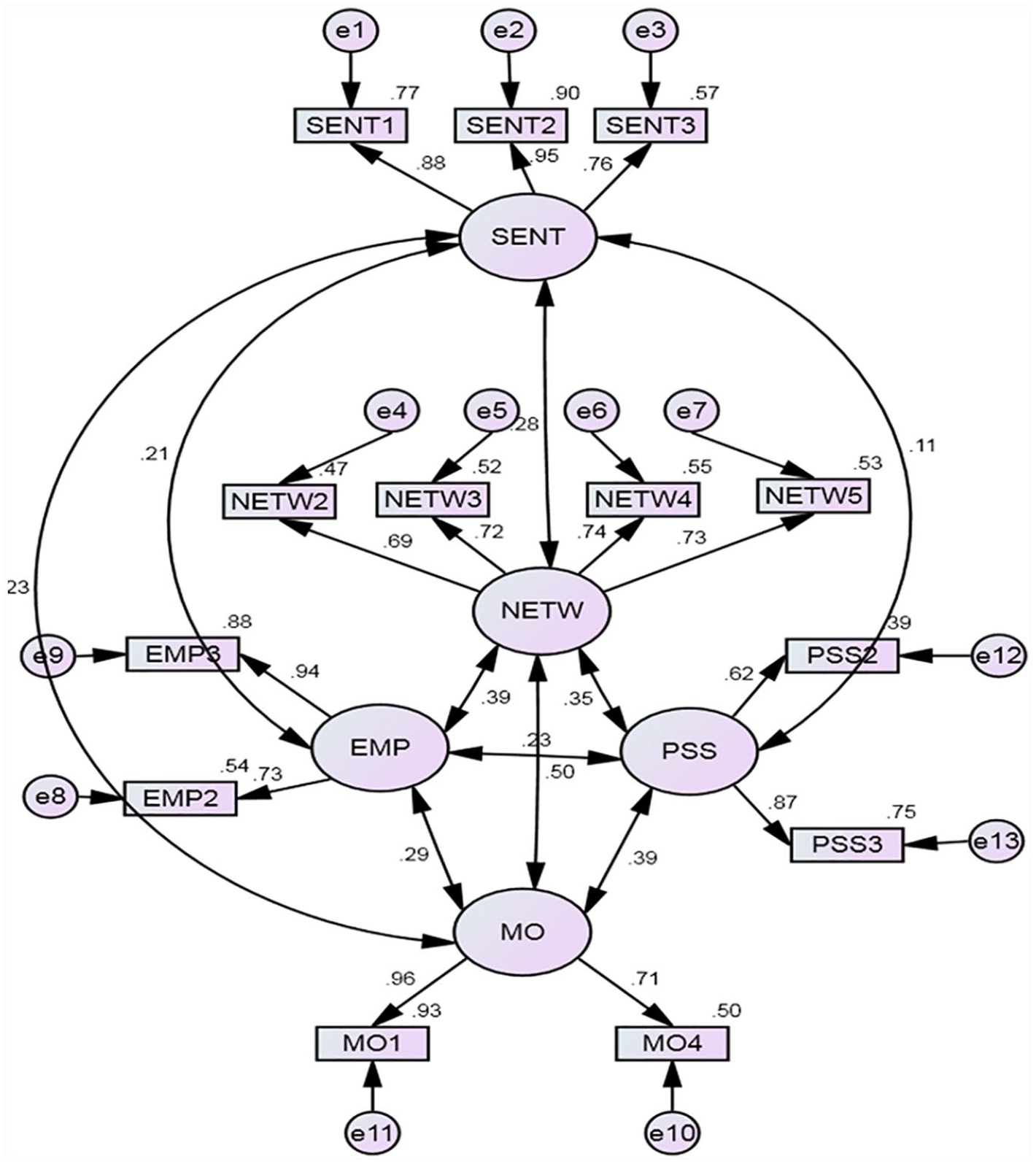
Structural equation modeling for confirmatory factor loadings.
Summary of Factor Loadings.

Source. AMOS 21.
Note. CR = composite reliability; AVE = average variance extracted; MSV = maximum shared variance; SENT = Social Entrepreneurial Intentions; EMP = Empathy; PSS = Perceived Social Support; MO = Moral Obligation; AMOS = Analysis of Moment Structures.
Bold diagonal values represent the composite reliability scores
The factor loadings here show that none of the individual question items loaded higher than the external factor loadings, which is very good. The CR loaded above the prescribed 0.7, the AVE all above 0.5 and also well above the MSV. These indices show that the scale met the standard requirements of the construct, convergent, and discriminant validity (Bagozzi & Yi, 1988). The fit for the proposed model was also very good, having the CFI at 0.985 above the 0.9 mark, root mean square residuals (RMR) at 0.028 well below 0.5, goodness of fit index (GFI) at 0.972, adjusted goodness of fit index (AGFI) at 0.954, incremental fit index (IFI) at 0.985, NFI at 0.967, and the root mean square error of approximation at 0.039 below 0.05 (L. Hu & Bentler, 1999). The tool for hypothesis test here is the moderated hierarchical regression analysis. This is done with the aid of the Process Plugin Script of Andrew Hayes. Also, the factor analysis, data cleaning, and reliabilities were done using the Analysis of Moment Structures (AMOS) version 18.
Results
For descriptive statistics, the correlations, means, and standard deviations are shown in Table 2.
Descriptive Statistics.

Source. Authors’ Research Output.
Note. SENT = Social Entrepreneurial Intentions; PSS = Perceived Social Support; MO = Moral Obligation; EMP = Empathy.
Significance at below .1
Significance at below .05
The above correlation shows a significant correlation among all the proposed effects to be studied. For the means and standard deviation, they are very good, as the sum of the three questions for social entrepreneurial intention has an average close to 4, on a 5-point scale. For networking competence, we have 15.9 for an average of four items, and for the others, we have just two items, implying that just one is less than 4.
Hypothesis 1
HNETW: There is a statistically significant direct effect of NC on SENT for budding entrepreneurs.
Of the five question items measuring networking competence, four loaded appropriately, whereas one was struck off. As for the three question items for social entrepreneurial intentions, they all loaded well and were used for the study. The direct effect was checked using the simple regression with the function stated as SENT = f (NC) + e. The result showed that there actually is a 26.1% predictive change of networking competence on social entrepreneurial intention, whereas the amount of explained variance is 6.8% of the dependent variable—social entrepreneurial intention.
Hypothesis 2
HMO: There is a statistically significant interaction effect of NC moderated by MO on the SENT of budding entrepreneurs.
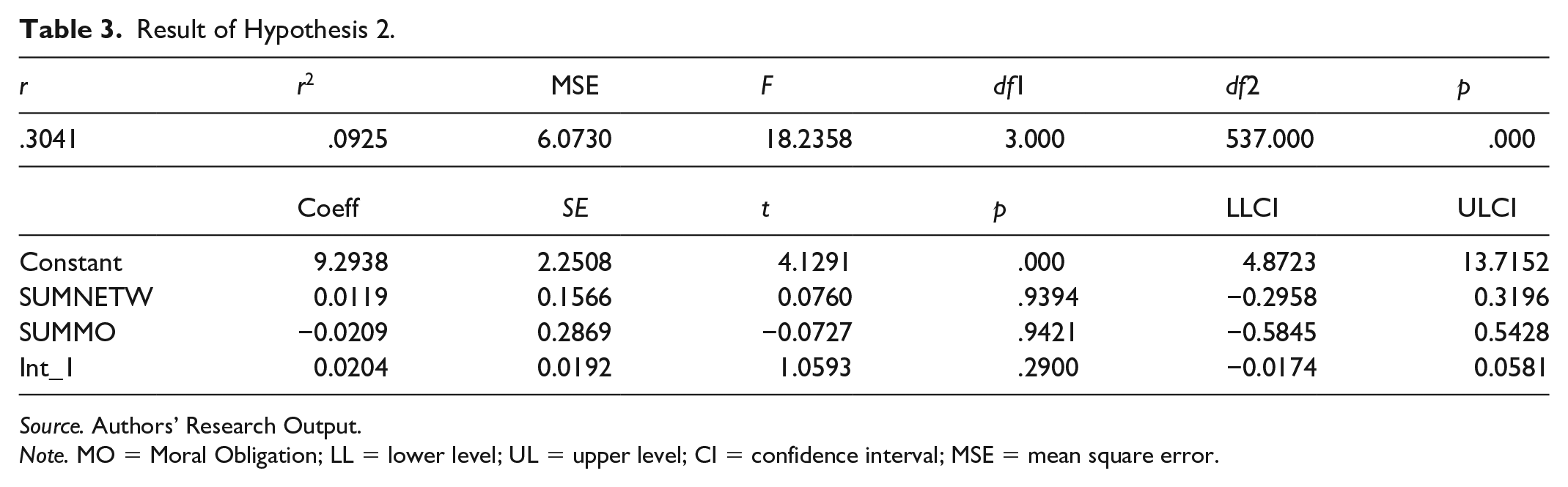
Here, as explained above, the NC scale is 4, SENT is 3, and the MO scale which should have been 4 is just 2 due to its extraction during the factor analysis. To establish the moderated effect, Andrew Hayes Script is used on the Process Macros (Table 3).
Result of Hypothesis 2.
Source. Authors’ Research Output.
Note. MO = Moral Obligation; LL = lower level; UL = upper level; CI = confidence interval; MSE = mean square error.
While the overall model is significant, with a p value below .05, the interaction effect (Int_1) of networking competence moderated by a moral obligation on social entrepreneurial intentions is not significant. Zero lies between the lower-level confidence interval and the upper-level confidence interval making a p value of .2900.
Hypothesis 3
HSEF: There is no statistically significant interaction effect of NC moderated by SEF on the SENT of budding entrepreneurs.
A rejection of the SEF scale on construct validity basis excludes the entire construct from the analysis.
Hypothesis 4
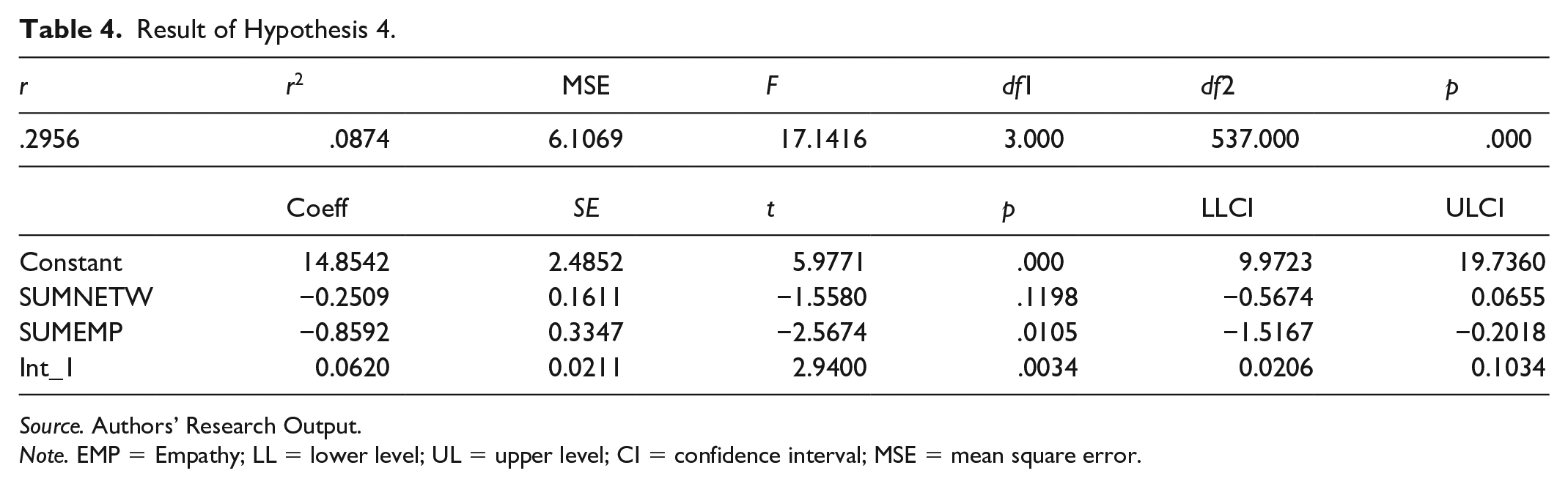
HEMP: There is a statistically significant interaction effect of NC moderated by EMP on the SENT of budding entrepreneurs (Table 4).
Result of Hypothesis 4.
Source. Authors’ Research Output.
Note. EMP = Empathy; LL = lower level; UL = upper level; CI = confidence interval; MSE = mean square error.
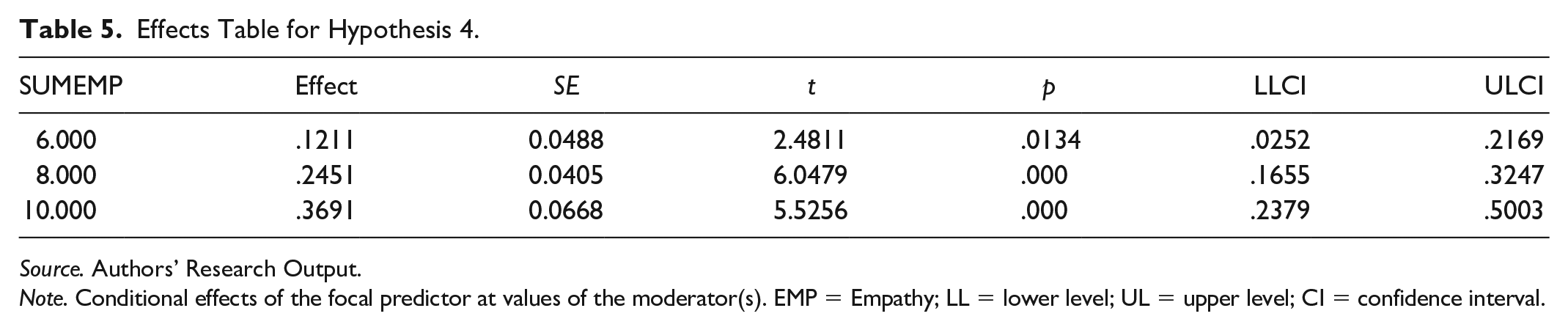
The moderation effect was both positive and significant. The interaction effect (Int_1) has a p value at .0034 below the lower threshold of .01. The interaction also has a 6.2% direction change on social entrepreneurial intention and a 1.4% increase in the variance explained by the moderated effect. Table 5 shows the post hoc test of the level of empathy that interacts mostly with networking competence.
Effects Table for Hypothesis 4.
Source. Authors’ Research Output.
Note. Conditional effects of the focal predictor at values of the moderator(s). EMP = Empathy; LL = lower level; UL = upper level; CI = confidence interval.
This shows that at all levels of empathy, there is a moderating effect with networking competence on social entrepreneurial intentions and that effect is positive, that is, 12.11% at a low level, 24.51% at a moderate level, and 36.91% at a high level.
This relationship is as shown in the simple slope in Figure 3.

Moderating effect of empathy.
Hypothesis 5
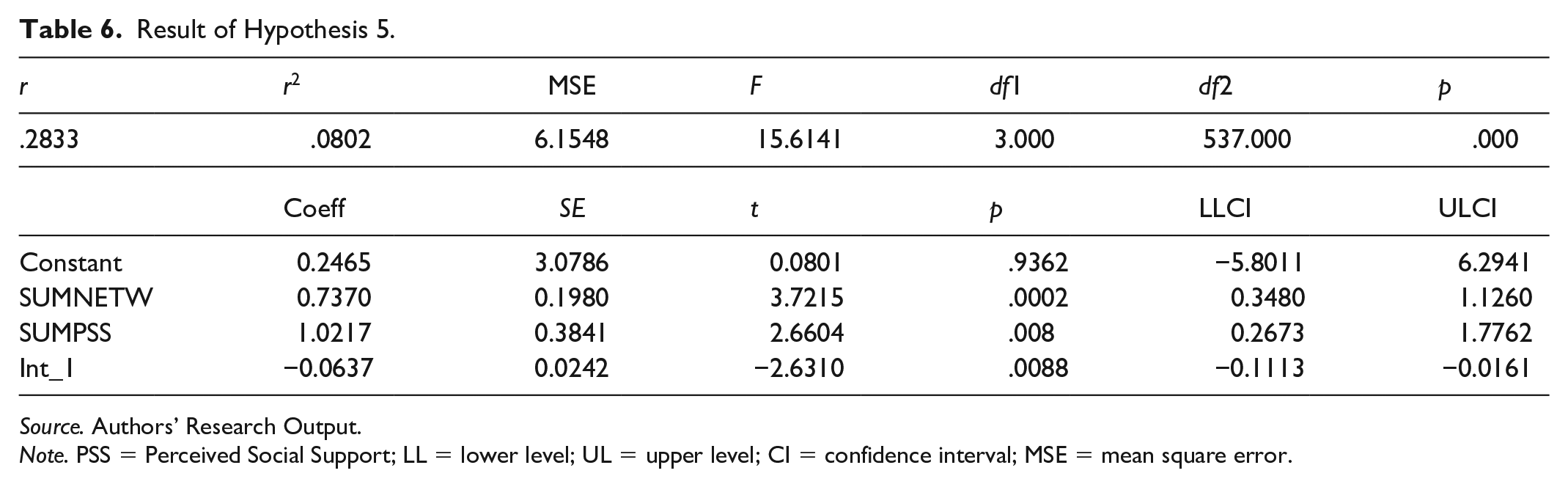
Hpss: There is a statistically significant interaction effect of NC moderated by PSS on the SENT of budding entrepreneurs (Table 6).
Result of Hypothesis 5.
Source. Authors’ Research Output.
Note. PSS = Perceived Social Support; LL = lower level; UL = upper level; CI = confidence interval; MSE = mean square error.
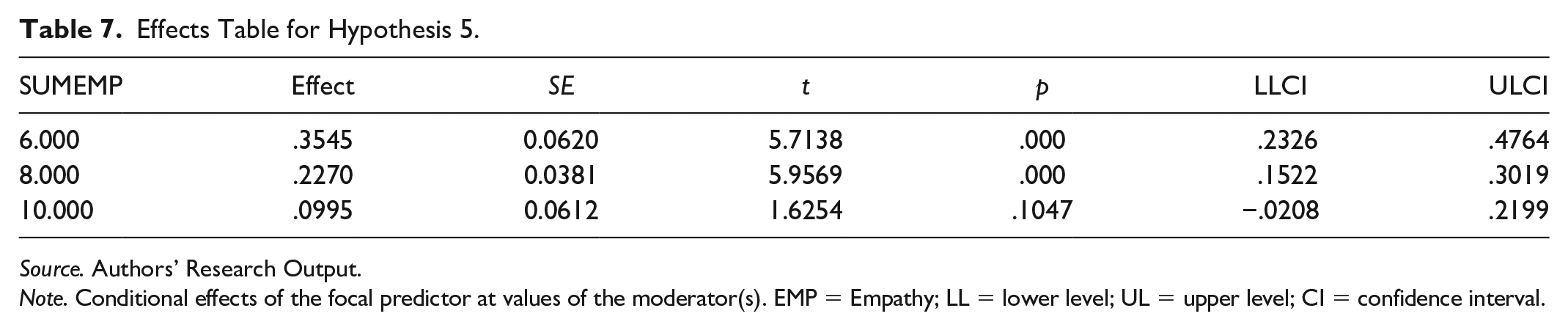
Here, the moderation effect was both negative and significant. The interaction effect (Int_1) has a p value at .0088 below the lower threshold of .01. The interaction also has a −6.37% inverse change on social entrepreneurial intention and a 1.19% increase in the variance explained by the moderated effect. Table 7 shows the post hoc test of the level of perceived social support that interacts mostly with networking competence.
Effects Table for Hypothesis 5.
Source. Authors’ Research Output.
Note. Conditional effects of the focal predictor at values of the moderator(s). EMP = Empathy; LL = lower level; UL = upper level; CI = confidence interval.
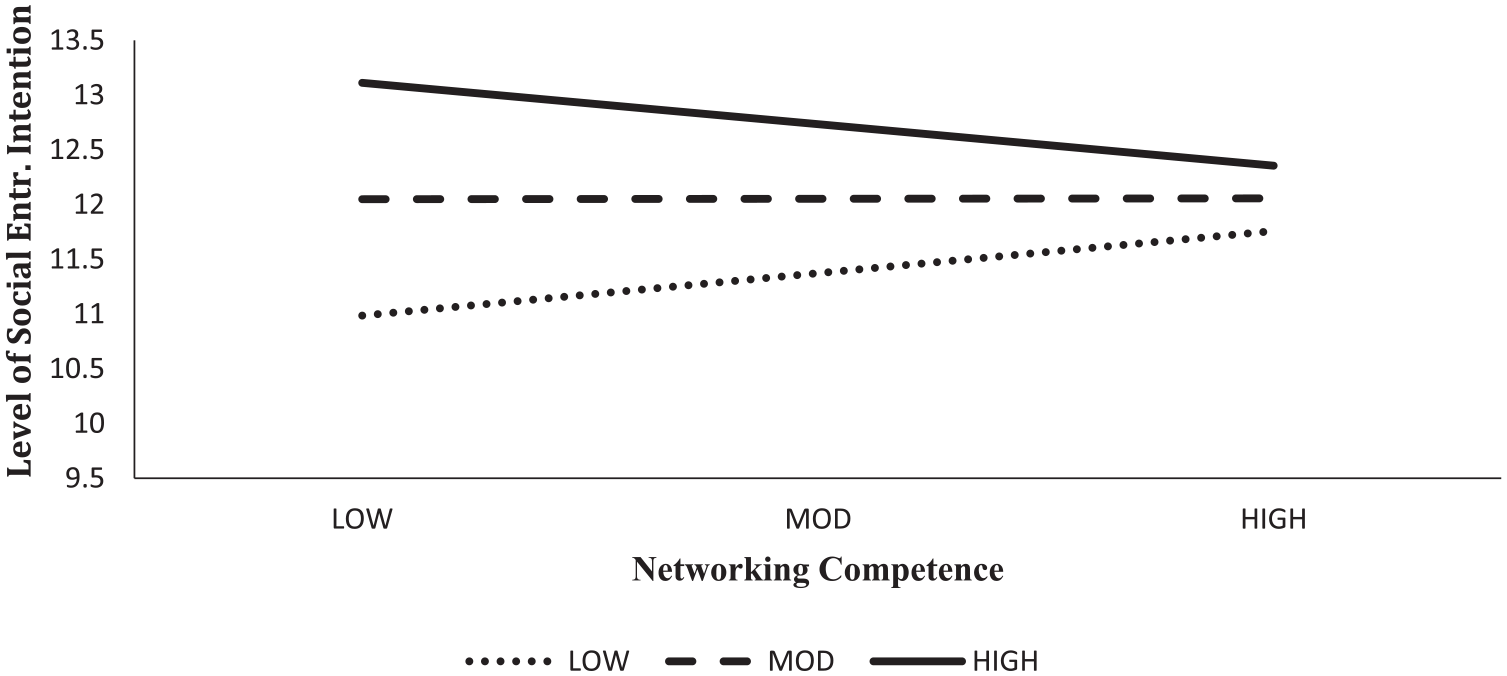
This shows that only the low and moderate levels of social support have a moderating effect with networking competence on social entrepreneurial intentions, and those effects are positive, but reducing also, that is, 35.455% at a low level and 22.7% at a moderate level. The high effect here is insignificant, having a p value of .1047.
This relationship is as shown in the simple slope in Figure 4.
Moderating effect of perceived social support.
Discussion
This study was hinged upon understanding the roles which subjective norms play in the relationship between an individual’s social interaction competence measured by the ability to network (networking competence) and the actual inclination of such individuals toward entrepreneurship. Hockerts (2017) did similar work using the subjective norms as antecedents of social entrepreneurial intentions as adapted from the work of Mair and Noboa (2006). In that study, prior experience was used as a predictor, whereas the antecedents were used as mediators; this study used the self-efficacy and subjective norms as moderators, taking an insight from the theory of planned behavior (Ajzen, 2002). Using these variables, we developed five hypotheses. The first was to establish the main effect between networking competence and social entrepreneurial intentions, whereas the next four were to establish the interaction effect of self-efficacy and these selected subjective norms on social entrepreneurship intentions.
For the first hypothesis, there was a significant and positive main effect between networking competence and social entrepreneurship intentions. This implies that an increase in an individual’s disposition to associate positively improves that individual’s intentions to engage in socially entrepreneurial ventures; this is supported by the findings of Aldrich et al. (1997), Johannissson (1998), and Yusoff et al. (2018), where they showed that an individual’s inclination to build strong social ties, in forms of network or peers, friends, and homogeneous groups, would help to foster an added drive toward entrepreneurial pursuit, whether in commercial or social forms (Estrin et al., 2013; Fernández-Pérez, et al., 2014). However, Rotter (1975) in his divergent view asserted that some individuals with a strong internal locus of control may as well become entrepreneurially driven. However, it is pertinent to note that today’s organizations are never built by single individuals without support from other important members of society, whether the entrepreneur is conscious of such social capital or not, most of which can be as close as family or peer group support.
For the second hypothesis which was to assess the interaction effect of moral obligation and networking competence on social entrepreneurial intentions, the result shows that there was no significant interaction effect of any nature. This implies that while networking competence has a direct effect on social entrepreneurial intentions, the combined effect with moral obligation becomes insignificant. This finding is supported by the fact that moral obligation as a subjective norm is environment based (Ajzen, 1991). On the basis of person–environment fit theory among the study population in Nigeria, there is an inference that the emphasis on moral obligation to help the poor and the downtrodden is hardly a consideration for young people (Hockerts, 2017; Obschonka et al., 2017; Obschonka & Silbereisen, 2012; Wood & Bandura, 1989).
On the third hypothesis, self-efficacy was dropped from the moderation model due to its poor fit. It is noteworthy that other studies have found self-efficacy not to have directly predicted social entrepreneurial intentions (Ip et al., 2017; Wang et al., 2016); however, in this study, self-efficacy was completely dropped so as to keep up with the assumptions needed for clear confirmatory analysis. Although Hockerts (2017) states the importance of self-efficacy in predicting intentions, Hsu et al. (2019) oppose with a submission that environment fit is much more crucial in moderating any relationship on intentions rather than self-efficacy.
On the fourth hypothesis, empathy as a subjective norm is shown to have a positive interaction effect on social entrepreneurial intention. This is supported by the findings of Niezink et al. (2012) and Forster and Grichnik (2013) where they showed that empathy as a subjective norm would interact positively on corporate volunteering intentions. This is also supported by the theory of planned behavior as explained by Ajzen (2002) who had earlier posited that the interaction of subjective norm variables and other variables of perceived behavioral control like networking competence should have interaction effect on intentions (Engle et al., 2010).
On the final hypothesis, there is a negative moderating effect of perceived social support with networking competence on social entrepreneurial intention. What this explains is that with a higher level of perceived social support, the intentions to engage in socially entrepreneurial activities are reduced. This can simply be attributed to the fact that individuals who perceive that social value is less created will be more inclined to providing such missing values. Perceived social support interacting with networking competence to reduce the level of social entrepreneurial intention should make policy actors aware of the fact that while describing the level of social actions and values being created in a society, such should be true as societal perception of social support coupled with a high-level networking interaction (alertness; Campos, 2016; R. Hu et al., 2018; Tang et al., 2012; Thompson, 2009) would only make individuals feel less predisposed in helping the marginalized and underserved.
Theoretical Implications
The findings of this study shed new theoretical light on the relatedness between social networks and social entrepreneurial intentions. With regard to the theory of planned behavior, behavioral disposition is a natural precursor of intention, which leads to action. In this study, we defined behavioral disposition as networking competence, which predicts social entrepreneurial intentions, further supporting the Ajzen’s postulation. This also implies that as intentions are precursors to action, targeted and specialized networking groups could be formed to groom intentions for behavior, which is geared toward the implementation of a targeted entrepreneurial action. This extends Ajzen’s contribution and links it to Krueger’s implementation model (see Esfandiar et al., 2019). For the null interaction effect of moral obligation and networking competence on social entrepreneurial intentions, while we had expected that there would be a statistically significant interaction effect, that was not the case, confirming the person–environment fit theory as seen in Hockerts (2018), which shows that the personalities of young students may be hardly aligned with an environment of moral responsibility. The negative interaction effect of perceived social support is in consonance with the social capital theory. On the basis of the theory, it is society that creates the incentives (capital) for individuals to become active in expressing certain behavior. So, when society appears to have a high proclivity to be socially entrepreneurial, young social entrepreneurs may decide to take a step back, but when social support is low, the intention to fill an obvious gap may be more daunting to budding entrepreneurs. It should also be noted that the resources in the social capital context are intangible, and whether this is given or not is simply a psychological state.
Practical Implications
Networking competence being a predictor of social entrepreneurial intentions implies that the level of relationship skill that simply exists between individuals leads to a higher burden to contribute to society. Individuals high on networking skills are mostly going to be inundated with the burden to help others than those who do not build strong social ties. So, support for strong social ties is recommended when social entrepreneurial intentions are needed. While academics and the government encourage business to maximize profit in other to create a multiplier effect on the economy, emphasis should also be geared toward cooperation rather than competition, networking, and linkage building rather than a stand-alone disposition, as it has been established that social goods are mostly products of relationship with others. Also, the fact that moral obligation as a moderator does not significantly affect social entrepreneurial intentions means that the social systems and structures within the society do not promote the importance of personal responsibility toward social ills. Without the sense of moral responsibility among young people, they would grow up to be highly egocentric individuals which would do no good to society. The most important aspect of the subjective norms that would improve the disposition of the prospective social entrepreneur is empathy. Direct acts to make young people feel empathetic toward the needy is very essential. A word on the plight of a dying world to an already relational audience would do very well in improving their social consciousness. Belief in social support should be handled with care. A thought that society would usually give support, rather than being an incentive, has become a disincentive, but individuals should know that it is not all that professes to render support ends up doing so. The socially conscious individual should do well to better the lot of the outside world irrespective of the fact that another group may have committed to be socially entrepreneurial.
Limitations and Insights for Further Studies
The findings in this study are subject to at least two limitations. First, there is every tendency that the respondents of this study may be much more likely to seek paid employment rather than entrepreneurial ventures, with a lesser likelihood for social entrepreneurial ventures engagement. This is owing to the fact that the Nigerian socioeconomic climate does not provide enough incentives for budding entrepreneurs. The consequence of this to this study is that we feel that if the climate is more entrepreneurial prone, the results would probably have been different. This does not, however, obfuscate the findings of this study as we, through convenient and purposeful sampling, were able to select respondents that had indicated high proclivity toward self-employment and superior training in entrepreneurship (Greve & Salaff, 2003; Heinonen & Poikkijoki, 2006; Hockerts, 2015, 2017; Shaikh, 2012). Second, this study paid no attention to the demographic distributions of the respondents of the study. Possible consequences of this are that there is no clear-cut stratification of results on the basis of measures such as gender, age, and educational qualification, among others. These issues have not been shown in the literature to be of any significant effect but could consequently form the basis for further studies (Poon et al., 2012; Zhao et al., 2005).
While there were no better means of addressing this issue, a major limitation was the lack of theoretical contribution with regard to self-efficacy. The fact that the self-efficacy scale was dropped is a gap that we hope that other studies would fill. It would be important that great care is given during the administration of questionnaire instrument and the data management process. It is our hope that studies in the future would account for the interactive effect of social capital and self-efficacy on social entrepreneurial intentions.
Conclusion
This study concludes that of the adopted subjective norms, empathy and perceived social support are supported by the studied sample. Also, the more an individual is inclined toward relational values like networking, the greater the individual develops social entrepreneurial intention, but when this relational inclination is moderated by moral obligation, it has no effect on the level or direction of social entrepreneurial intention of the individual; empathy produces a positive interaction, and perceived social support produces a negative interaction effect.
Supplemental Material
Main – Supplemental material for Self-Efficacy and Subjective Norms as Moderators in the Networking Competence–Social Entrepreneurial Intentions Link
Supplemental material, Main for Self-Efficacy and Subjective Norms as Moderators in the Networking Competence–Social Entrepreneurial Intentions Link by Anthony Igwe, Anastasia Ogbo, Emmanuel Agbaeze, James Abugu, Charity Ezenwakwelu and Henry Okwo in SAGE Open
Footnotes
Declaration of Conflicting Interests
The author(s) declared no potential conflicts of interest with respect to the research, authorship, and/or publication of this article.
Funding
The author(s) disclosed receipt of the following financial support for the research, authorship, and/or publication of this article: The authors support funding from the Tertiary Education Trust Fund (TETFUND) under the TETFUND Institution Based Research (IBR) Intervention. The approved research project number is TETFUND/DESS/UNI/NSUKKA/2018/RP/VOL.1. While the grant ref is UN/RC.250/TFC/BR/3.

References
Supplementary Material
Please find the following supplemental material available below.
For Open Access articles published under a Creative Commons License, all supplemental material carries the same license as the article it is associated with.
For non-Open Access articles published, all supplemental material carries a non-exclusive license, and permission requests for re-use of supplemental material or any part of supplemental material shall be sent directly to the copyright owner as specified in the copyright notice associated with the article.
