




Abstract
Despite various efforts to achieve women’s empowerment, many women in developing nations still face desperate situations. In countries where social welfare services for the poor do not exist, mothers are expected to support their children by any means possible, including by begging. This is the case in Ethiopia, where poor mothers, especially in urban areas, engage in begging to support their families. To learn more about the lived experiences of these women we conducted qualitative interviews with 17 mother beggars who were identified through purposive sampling. From the interviews, we identified the following themes: begging as a better option; begging as a solution to a crisis; begging as a family identity; and challenges of begging. Children were considered assets as well as burdens by the mother beggars, who believed that more money could be made by using children, while acknowledging the stress of looking after their children when begging. Understanding the realities of these situations can help determine suitable responses to the needs of poor mothers raising children in the absence of strong state welfare systems.
Introduction
For poor women who find themselves taking care of their children on their own, one of the easily available options for supporting their families is to engage in begging (Tatek, 2009). Many people in Ethiopia give alms as an expression of their religious obligations and this, consequently, attracts an increasing number of people to engage in begging (Demewozu, 2005). However, being a beggar in Addis Ababa, the capital and largest city in Ethiopia, is not simple. Beggars in the city face various challenges, including difficulties finding a place to live, the risk of arrest and imprisonment, lack of medical care, and the risk of violence from other people living on the streets as well as from community residents.
In Ethiopia, fully 24% of the population lived in poverty in 2016, the most recent year for which data are available (World Bank, 2020). According to CSA and UNICEF (2018), “some 13 million children are estimated to live in poor households in Ethiopia, two million of whom in extreme poverty” (p. 3). Women make up a high proportion of the poorest segment of society. Female-headed families are highly affected by poverty in both urban and rural areas (Dea, 2016; Muleta & Deressa, 2014; World Bank, 2020). Often poor women engage in the informal sector to make a living. However, many, especially mothers with children, turn to begging to support themselves and their families.
This study explores the experiences of mother beggars in Addis Ababa, Ethiopia. It utilizes a qualitative approach which explores how mother beggars construct livelihoods in the absence of state welfare support and is based on interviews conducted with 17 mother beggars. This study becomes significant because of the absence of in-depth studies on mothers who are beggars and the urgent need to address the poverty of women and children in Ethiopia.
Literature Review
Poverty in Ethiopia
In Ethiopia, specifically, and in Africa, more generally, rural and urban poverty reflect different causal factors. In rural Ethiopia, there is a strong association between chronic poverty and distance from towns, lack of physical assets, poor roads, and lack of education (Dercon et al., 2012). Alternatively, urban poverty in Ethiopia is often a result of unemployment, under-employment, low wages, and lack of education. Rural to urban migration contributes to an increase in urban poverty, urban congestion, and problems with access to basic services. Rural-urban migration has increased because of civil wars, drought, decreased earnings from agricultural production, and the death of adult providers (Nathan & Fratkin, 2018).
Compared to industrialized countries of the global north, welfare services are significantly more limited (or are nonexistent) in developing countries of the global south. Limited welfare services in African countries have aggravated problems of the poor (Igbinedion & Abusomwan, 2014). In Ethiopia, the government has used safety net programs to support people in poverty (Nathan & Fratkin, 2018).
The 1996 Developmental Social Welfare Policy, which was revised in 2014 and renamed the Social Protection Policy, is the key policy document regarding welfare in Ethiopia (Lavers, 2016). This policy gives the ultimate responsibility for taking care of the poor to local governments, with the national government playing a coordination role (Lavers, 2016). Efforts started under this policy have included a social insurance program (i.e., pension), a food security program, provision of basic services (i.e., health care), a national nutrition program, support to vulnerable children, health insurance, disaster risk management, support to persons with disabilities, support to older persons, urban housing and grain subsidies, employment promotion, and community-based social support. However, there have been significant challenges in implementing what the government has proposed in the policy document.
In 2005, the Ethiopian government implemented the Productive Safety Net Program (PSNP; Bahru et al., 2020). The PSNP provides cereals and food oil for beneficiaries after engaging them in different developmental activities in their neighborhood; by 2015, over 10 million people were beneficiaries. Foreign donors are the primary financial supporters of the PSNP, a sign of the Ethiopian government’s reliance on foreign aid to support the country’s poor (Lavers, 2016). Foreign consultants hired by donors have led the development of the plan to implement the PSNP effort (Lemma & Cochrane, 2019). The role of non-state actors in supporting the Ethiopian government is significant (Amdissa et al., 2015). Unfortunately, the Ethiopian government’s safety net program has been inadequate to address the needs of the country’s poor (Nathan & Fratkin, 2018).
Absent a strong governmental welfare system, families and charity/non-governmental organizations (NGOs) have assumed much responsibility for assisting those in poverty. Extended family members play a vital role in taking care of others in need (Devereux & Teshome, 2013). Often extended families offer to share their houses and meals with those members who are in a crisis. They also may provide in-kind and monetary support. In addition, assistance is offered to people in poverty by religious and non-governmental organizations. Many NGOs operate in Ethiopia and provide basic services, income-generating training, revolving loans, and educational and health-related material supports to people in poverty, especially the poorest of the poor (Devereux & Teshome, 2013). Many of the most marginalized and vulnerable segments of the society have been left out of Ethiopian investment and developmental activities (Lemma & Cochrane, 2019), making charity/NGO support for the poor invaluable.
Women and Poverty in Ethiopia
Among the poorest people in Africa, the majority are women and children, largely because of the historical place of women in society. Women in developing African countries, and in Ethiopia, in particular, are often in more desperate economic situations than are men. In Ethiopia, because educational and employment opportunities are limited, preference is given to men, making women’s economic situation very challenging, especially in light of the full load of child-rearing responsibilities they bear (Dea, 2016). As Moghadam (2005) suggested: “if poverty is to be seen as a denial of human rights, it should be recognized that the women among the poor suffer doubly from the denial of their human rights–first on account of gender inequality, second on account of poverty” (p. 1).
According to the World Bank (2020), the percentage of female-headed households in Ethiopia was 25.4% in 2016, a proportion that has shown only minor variation since 2000. However, the percentage of female-headed households in rural Ethiopia has increased by more than 10% since the beginning of the century, rising from 23.5% in 1999 to 39% in 2009 (Muleta & Deressa, 2014).
In both urban and rural areas, female-headed households are more likely to be poor than are those headed by males. In urban Ethiopia in 2004/2005, for example, poverty among female-headed households (35.8%) was higher than among male-headed households (33.1%; Jayamohan & Kitesa, 2014). In rural Ethiopia, the incidence of poverty is higher among female-headed households, and the proportion of poor female-headed households in 2009 was 35.3%. Muleta and Deressa (2014) argued that livestock and land ownership negatively affect the situation of female-headed households in rural Ethiopia.
According to Negesse et al. (2020), 66.1% of Ethiopian female-headed households experienced food insecurity. Moreover, female-headed households were 1.94 times more likely than male-headed households to develop food insecurity (Negesse et al., 2020). In urban Ethiopia, housing shortages, limited employment opportunities, and recent development-induced displacement further aggravate the problems faced by female-headed households (Megento, 2013).
Housing is one of the most challenging problems for poor people in urban Ethiopia, and women are affected the most. According to Hassan et al. (2010), “multiple intersecting forms of vulnerability – social, economic, and spatial–act as barriers to women in accessing shelter in Hawassa [a city in central Ethiopia]” (p. 477). The number of homeless women and children in Ethiopian cities is increasing (Nathan & Fratkin, 2018) and their presence on the streets is common (Kaime-Atterhog & Ahlberg, 2008). Recently it has become possible to find the second generation of homeless families on the streets of Ethiopian cities (Nathan & Fratkin, 2018).
In Ethiopia, as in other developing countries, poor people dominate the informal economic sector, which is an important income-generating strategy in towns and cities. There is an association between being poor, being a woman, and working in the informal sector, such that most of those engaged in the informal sector are women. However, work in the informal sector often offers very low pay and no benefits or social protections. During an economic downturn, those working in the informal sector are the most affected (Horn, 2010).
Countries that have a large gender gap in various spheres face difficulties in realizing development and prosperity (Dea, 2016). The way the Ethiopian society is organized leaves few avenues for women to contribute to social development. According to Geleta et al. (2017), about 90% of the women who participated in their study indicated that they do not take part in their family decision-making and that family income is mainly controlled by men. As Dea (2016) said about Ethiopian women: “the gender gap is reflected that women are less educated, less paid, highly vulnerable to health risks, unequally represented in politics and highly exposed for violence” (p. 33).
Government initiatives to mitigate poverty, such as the PSNP, have had limited results. According to Bahru et al. (2020), the PSNP has increased the frequency of children’s meals, although it has not enhanced households’ food security or children’s nutritional intake or dietary diversity. Further, despite the PSNP, women’s nutritional status remains poor, their chronic energy deficiency continues to be high, and their body mass index has changed little (Irenso & Atomsa, 2018). The support provided by both government and NGOs has been unable to address the problems of the country’s poor, especially women and children in female-headed families.
Begging as a Survival Strategy
In Ethiopia, poverty is believed to be the primary reason for begging (Tatek, 2009). According to Asrese et al. (2014) study of begging in Bahir Dar, Ethiopia, poverty, unemployment, and physical disability were identified as the principal reasons for begging. In contrast, Chinweuba (2019) reported that in Nigeria the primary reasons for begging were unemployment, poverty, lack of skills, and unequal economic opportunities.
Not only are different rationales offered for engaging in begging, but the legitimacy accorded to begging varies for different population groups within and between countries. For example, black beggars historically were considered as deserved compared to white beggars in South Africa (Ndlovu, 2016). In Quito, Ecuador, indigenous people have been considered legitimate beggars, and indigenous mothers are said to migrate with their children from rural villages to beg in the city (Swanson, 2007). In Ethiopia, persons with disabilities and the elderly are commonly seen as legitimate beggars. Persons with disabilities face many challenges, including negative attitudes, unemployment, and lack of access to health facilities (Tefera et al., 2017). Thus, begging often is their principal means of making a living and, consequently, a significant number of beggars in Ethiopia are persons with disabilities, including mothers (Murray, 2013). Similarly, in the absence of an adequate public or private safety net to support them in their old age, the elderly look for alms and are considered legitimate beggars.
Although begging may be one of the principal income-earning activities in which poor people are engaged, they are often involved in it because of the lack of alternatives, not out of desire. According to Namwata and Mgabo (2012), in Tanzania, most beggars are not happy about begging and consider it to be an immoral activity. The majority of beggars in Tanzania considered it a temporary activity, although some saw it as a way of life. Child beggars in Addis Ababa, Ethiopia, considered begging as something shameful (Tatek, 2009).
There is an interface between poverty, religion, and begging in Ethiopia (Tatek, 2009). In many religions, giving alms is considered to be respectful and the duty of a religious person (Swanson, 2007). Giving alms to beggars is supported by Orthodox Christian teachings and also is a pillar of Islam (Tatek, 2009). Many beggars can be found in Addis Ababa during religious holidays because the number of alms givers (people who give money, food, clothing, or other forms of assistance) is higher than on other days (Demewozu, 2005). The generosity of alms givers is thought to encourage beggars to beg.
Beggars use different strategies to convince alms givers to give to them. Some of these strategies include stating their problems, using begging songs, telling their stories, and writing notes that describe their problems and need for money (Tatek, 2009). Mentioning their level of poverty and exposing their physical disabilities were found to be among the strategies used by beggars in South Africa (Ndlovu, 2016).
In many countries begging is illegal (Swanson, 2007) and governments have taken different measures to stop begging (Evenett, 2014). The government of Nigeria, for instance, often evacuates beggars from cities, but they re-appear (Chinweuba, 2019). Similarly, in Ecuador, municipalities often arrest women and children who are engaged in begging (Swanson, 2007).
In Ethiopia, Proclamation No. 384/2004 of January 2004, which replaced the Vagrancy and Vagabondage Proclamation of 1947, considers “a person who is found in a public place or a public utility area or a place open to the public, betting or gambling; and a person is found loitering or prowling at a place, at a time, or in a manner not usual for a law-abiding citizen under circumstances that warrant alarm for the safety of persons or property in a vicinity as a vagrant.” Police have used this proclamation to arrest beggars in Addis Ababa during periods of unrest or when big conferences or meetings are being hosted.
Yet despite government actions, the number of beggars continues to increase in many countries. In South Africa, the number of beggars has increased since 1994 (Ndlovu, 2016). There are many beggars in marketplaces and other public spaces in the cities of Nigeria (Chinweuba, 2019). The same is true in Ethiopia; the number of beggars has increased over time, especially in the country’s cities (Asrese et al., 2014). Begging is generally more common in urban than in rural areas (Mgabo, 2012). Cities afford beggars a degree of anonymity as well as access to a reasonable number of potential alms givers (Evenett, 2014). There is a concern, however, that the concentration of beggars in cities can damage the image of Ethiopian society (Tatek, 2009).
Although there have been a few investigations of women beggars in Ethiopia, significant gaps in our knowledge remain. A study conducted in Hawassa, a town in southern Ethiopia, found that most women beggars were aged 25 to 34 (45.2%), were not married (47.4%), and had an average of 2.5 children. Fully 42.6% said they did not have any protection against forced sex while spending their night on the street (Alemu et al., 2019). A study conducted in Bahir Dar, a city in the country’s Amhara region, reported that most of the women beggars were 20 to 29 years old (40.4%). Among the mother beggars who took part in the study, 39.1% had a history of rape, 54.3% had their first pregnancy before the age of 18, and 54.7% experienced an unwanted pregnancy (Engdaw, 2020).
In summary, significant numbers of people continue to live in extreme poverty in Africa, generally, and in the continent’s Sub-Saharan region, specifically, despite the economic growth that has occurred. In Ethiopia, a variety of factors have contributed to poverty among the country’s urban and rural populations. Ethiopian women, especially those heading families with children, are particularly vulnerable to poverty, and their situations are worsened by the limited welfare services available to support the poor. For impoverished female-headed families that lack access to welfare services or employment opportunities, begging affords mothers a means of survival. Yet, although begging by mothers and their children is widely acknowledged in the country, little is known about the lives of mother beggars and their families. Therefore, this study examined the experiences of mother beggars in Addis Ababa, Ethiopia, to learn from their experiences and to suggest possible responses.
Methods
This study used a descriptive qualitative research approach to explore how mother beggars provide support to their children. Descriptive qualitative research emphasizes the provision of wide-ranging, descriptive summaries (Colorafi & Evans, 2016) that remain close to the data (Sandelowski, 2000). As such, the approach was very useful in allowing us to depict the experiences of Ethiopian mother beggars.
We used purposive sampling to select participants for the study. There were two selection criteria: (1) being a beggar for a minimum of 2 years and (2) having a child/children with them while begging. We initially communicated with 31 women beggars at three churches in Addis Ababa during a religious celebration day. Of the 31 women beggars contacted, 21 had children under their care and had engaged in begging for at least 2 years. After we reviewed the nature of the study and their rights as participants with them, 17 of the 21 mother beggars said they would be willing to take part in the study. About 4 of the 21 potential participants decided they did not want to complete the interview, saying they did not see the value of sharing their stories and were not comfortable talking about their child/children. Thus, our analysis was based on the responses of 17 mother beggars. The basic background information of the participants is presented in Table 1 (below).
Participants’ Demographic and Background Information.
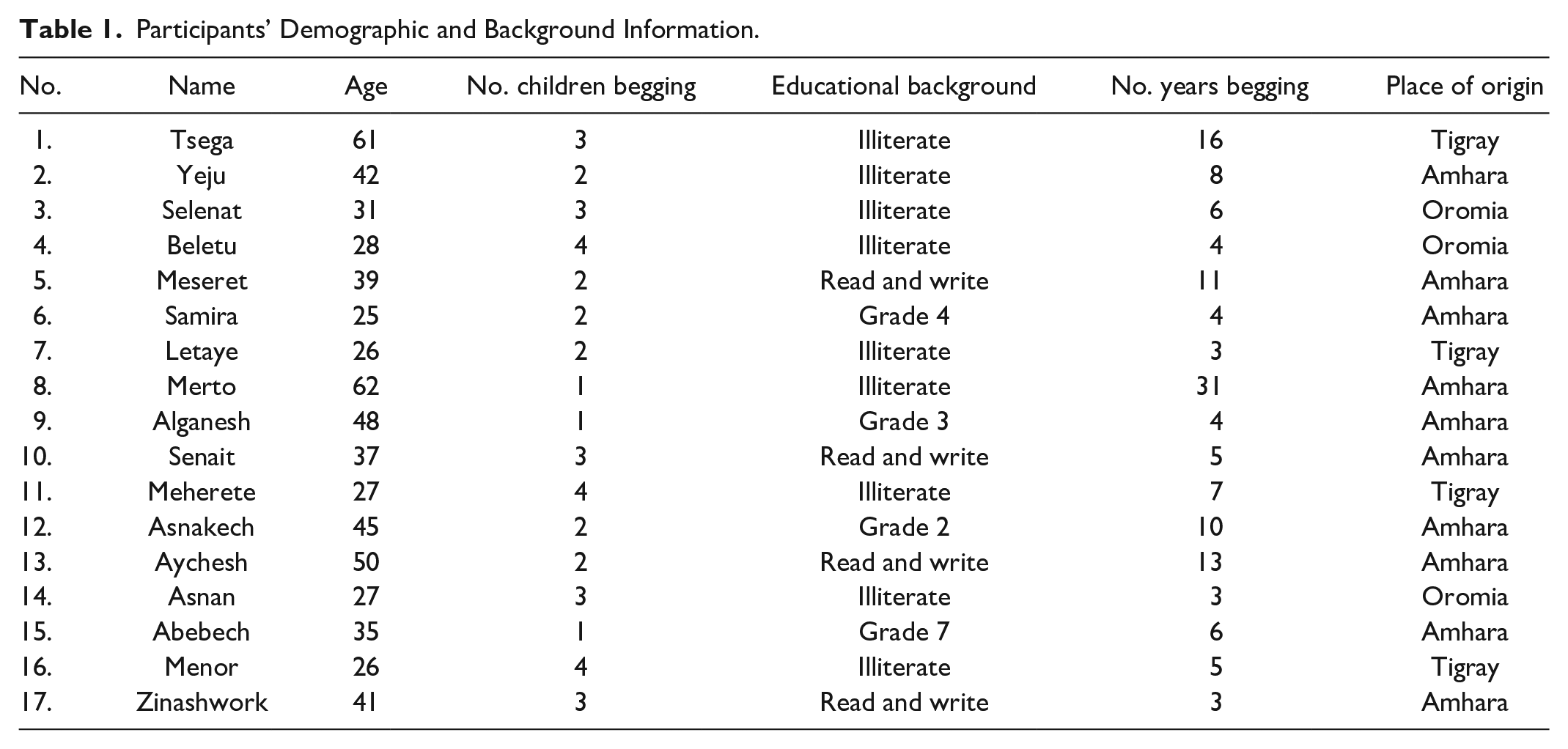
The age of participants ranged from 25 to 62 years (mean 38.2). These women had been engaged in begging for a minimum of 3 years and a maximum of 31 years (mean 8.2 years). They had between one and three children (mean 2.5). The two women over the age of 57 cared for their grandchildren or relatives’ children. Nine of the women were illiterate and eight had elementary educations. About 14 participants came from the northern part of Ethiopia (Amhara and Tigray regions), an area often affected by drought, shortages of farmland, and extreme poverty; 3 participants were from central Ethiopia (Oromia Region).
We developed a qualitative interview guide that asked about the participants’ life stories, including how they became beggars, their opportunities and challenges, a typical day for their child/children, what type of support they provide to their children, and their future aspirations. Probes were used to elicit more detailed information.
Before beginning the interview we informed each participant about the purpose and contribution of the research. We also told the participant about her right to withdraw from the interview at any point as well as to not respond to particular questions. This helped the participant to decide whether or not to take part in the interview.
After securing consent to participate in the study, we scheduled a time and location for the interview at the convenience of the participant. We conducted eleven interviews on church premises and six on street corners. All of the interviews were conducted in Amharic, a language common to and well-known by all of the participants. The second author, who is a woman, conducted all of the interviews.
Interviews lasted approximately 45 to 60 minutes. Interviews were voice recorded with the participants’ permission. In three cases participants were not comfortable with voice recording the interviews; in these instances, the second author took notes during the interviews. Immediately following each interview she drafted a memo to document what she observed. Pseudonyms were assigned to mask participants’ identities. The School of Social Work provided ethical clearance on behalf of Addis Ababa University.
Upon its completion, each interview was transcribed and translated from Amharic to English. We checked each other’s translations to ensure accuracy. If there was ambiguity about the meaning of statements, the second author went back and consulted with the relevant participant, who could be located fairly easily because the mother beggars had common areas where each usually begged.
Once all of the interviews were transcribed and translated, we began our analysis by manually combining and synthesizing the collected data into meaningful patterns and themes. We classified the data according to the type of information and brought similar stories together, so it was easier to categorize them into specific subjects and related themes. The first author developed the initial themes, which were then revised and reviewed by the second author. Then, as Colorafi and Evans (2016) suggested, we brought related themes together to create major themes. The major themes we identified are: begging as a better option, begging as a solution for a crisis, begging as a family identity, and challenges for mother beggars and their children.
Findings
In what follows we present the four themes identified by our analysis. For each theme, illustrative quotations are included to allow the mother beggars’ voices to depict their lives in their own words.
Begging as a Better Option
The mothers in this study did not become beggars without first trying different income-generating alternatives. Yet finding work that could accommodate their needs as a single parent and provide an income sufficient to support their families proved to be very challenging.
Being a housemaid is one of the jobs commonly available to Ethiopian women who have limited skills, experience, or education. However, even with few requirements, some of the mothers were not considered eligible for the job. Aleganesh reported:
Initially, I was trying to be a housemaid or a babysitter but because of my eye crying continuously I do not know the reason and I could not afford to go to the clinic to be checked. It makes me undesirable by the people who want to have a housemaid or a babysitter.
Others said they had been denied employment as a housemaid because they had their children with them. This happened to Asnakech:
I met with one woman who was willing to have me and she took me to her home and then gave food for me and my son. Therefore, I faced no more problems when I arrived and I stayed for two days. Within these two days, she told me I could take my son back if I desired to work with her and I felt sad. Hence, I had to leave her home and started this activity.
Abebech, who had 6 years of experience as a housemaid, could not find this kind of work when she had her son with her. She had a very negative attitude toward families who employed women as housemaids. She said it had been very difficult to be a housemaid even when her child was not with her. She said of her experience:
Even though I was employed as a housemaid all I got was the food, they said they could not pay me as I have yet to learn how to work. So they feed me and I work for them: it was only food for work. I served them that way for five years before I got to another house at a salary of Birr 25/month [about .55 USD or .47 €].
Although the Ethiopian government has devised income-generating activities to try to alleviate the problems of its citizens, officials have admitted that people make more money begging than as daily laborers. Many of the women beggars agreed with this assessment. Further, they reported that begging does not demand much physical effort. They also said it was possible to get something to eat from begging, without the need for cooking.
The mother beggars reported daily earnings of between 20 Birrs (bad days) and 200 Birrs (good days), which is better than daily laborers’ average pay of 70 Birrs per day. And this does not include what is earned by their children begging, which is often the same amount as their mothers’ or a little less if they are begging nearby under their mothers’ supervision. Hence, the amount earned each day may be doubled or tripled what is presented above depending on the number of children who were begging. And these earning do not take into account possible in-kind benefits of begging, such as donations of food and clothes.
Many of the mother beggars believed that being a beggar was a viable option, particularly considering how much money they could make each day. The tradition of giving alms as part of Ethiopian religious values reinforced the mother beggars’ perception of begging as a reasonable solution to their financial needs. Yeju indicated:
Currently, I beg together with my daughters. Begging has an advantage because relatively I earn a good deal of alms both in cash and kind. My children are the source of income. In most of the cases, starting from morning to night they beg. I don’t like begging since I am involved in it because of my bad economic status. At the same time, I don’t have any other alternative than to keep on begging. But I don’t know exactly for how long I will continue living with begging.
Mother beggars engaged in begging because they did not have other alternatives to support themselves and their children. On good days such as religious holidays, mother beggars could earn substantially more than they could make from other jobs available to those with limited education and skills, making begging an attractive option despite the risks that came with it.
Begging as a Solution for a Crisis
Harmful traditional practices such as early marriage, which continues to exist despite efforts to eliminate it, and negative early life experiences can create fertile grounds for crises. Beletu, for example, left her rural village since she could not live with her older husband whom she had been forced to marry when she was 12 years old. When she arrived in Addis Ababa, she found out about her pregnancy and turned to begging as a means of financial support.
In Ethiopia, a mother often has the primary responsibility for the care of the children during the marriage. If the marriage is dissolved, the burden of taking care of children typically falls solely to the mother, who now may lack whatever financial, practical, and emotional support was formerly provided by her husband. Finding themselves facing the crisis of single parenthood, some of the mothers interviewed said they started begging to fulfill their children’s basic needs. Senait explained:
I came here five years ago with my two kids because of the death of my husband. My husband was a farmer, and he does not have his land. He farmed for the owner of the land and they used to divide the product equally. Because of this after the death of my husband I had had nothing to feed my kids.
Similarly, Alganesh, a middle-aged woman born and raised in a rural area, said she met her first husband and the father of her first daughter through an arranged marriage. After several years she and her family left the rural area because her husband had a new job offer in a nearby town. Alganesh’s only responsibility during that time was to raise her child. Life was relatively easy for her but then her husband became sick and died. Without other relatives to go to for help, she left that town and moved to Addis Ababa to a friend’s place to find a job. Soon after arriving, however, she was advised that her friend could not help the family and that she should look for other alternatives. Thus, she ended up begging since she could not find other employment.
Marital abuse is another reality that mothers may experience. When husbands use alcohol or drugs, abuse can become very serious. The tragic irony is that if the abuser leaves, which can increase safety, the mother and children may be deprived of the family’s key income earner. Meseret indicated:
I never used to live here in Addis Ababa until I moved from my hometown, Debre Markos [a city in the Amhara region], trying to get away from my husband who got drunk daily and threatened to take my life. One day I got up, telling no one, and came to Addis Ababa in search of a better life for me and my kids. The challenges I faced when coming here were indescribable and horrific. Sometimes I and my children could eat nothing, not even a loaf of bread. All this happened to us since I had no relatives or family to help me out. Because I had no contact with anyone, begging was the only thing I could do; the only way to feed myself and two of my kids.
Samira’s story exemplifies how multiple layers of abuse can damage an individual’s life. Samira’s parents’ living condition was very poor during her early childhood. Unfortunately, her parents’ marriage did not last long. Samira’s parents divorced because of the strain of impoverishment and disagreements over family matters. Samira’s father remarried and started a new life. Her mother could not satisfy her material needs, so her father took Samira to live with him and his new wife. Samira reported that although she worked hard and took care of everything in the household, her stepmother took her for granted, showed her no gratitude, and abused her. The ongoing abuse by her stepmother and her desire to improve her living situation led Samira to decide to move to Addis Ababa to find opportunities, a decision she made without informing anyone. She found work as a housemaid and devoted her entire time to that work. Yet the same thing she experienced when she was with her stepmother happened again. The owners of the house in which she was working abused and sexually harassed her. This led her to make the difficult decision to leave her position and turn to begging.
Problems in their families were not the only crises that led the mothers to beg. In Ethiopia’s history, for example, drought has been a common threat. Many people can be displaced and forced to leave their place of origin either temporarily or permanently. Letaye’s comments illustrate the impact droughts can have on people’s lives. She explained her situation as follows:
I came to Addis Ababa since the amount of grain we used to produce every year was not enough to feed the family. In addition, drought is common in my birthplace Tigray. We used to get food aid either from the government or non-governmental organizations to survive. Finally, when I heard it is possible to come here and make a living with begging, I came here with my children.
The mother beggars described lives characterized by many difficulties, both man-made and natural. Lacking the resources to address these crises propelled the women who resided in rural areas to migrate to Addis Ababa. However, they found few ways other than begging to support themselves and their children in the city.
Begging as a Family Identity
According to the mother beggars, both the mother and her child/children engaged in begging considered it a family duty. When they begin begging, children usually spend their time under their mothers’ supervision and they are expected to immediately turn over to her any money they earn. Being accompanied by children can increase what mothers can earn begging; over time, if children beg on their own, they may even surpass their mothers’ earnings. Selenat reported:
The amount of money I often make is higher than other beggars whom I know since my children beg separately. They beg during the daytime in different corners and come to me at night to give me the money. They are very good at convincing almsgivers and often make more money as compare to me.
Merto moved to Addis Ababa over three decades ago hoping to obtain medical care. Unfortunately, by the time she sought treatment, it was too late to save her vision. Having come to Addis Ababa with hope, she instead found herself going blind. Since arriving in the city, Merto has supported herself and her family by begging. With her children now grown, she has begun to bring youngsters from her birthplace to stay with her. She required the children to assist her with begging or said she would send them back. Merto said that begging was not a bad thing; it was how she helped her children to grow up.
On Christian holidays mother beggars and their children may position themselves at different corners of a church or they may go to different churches and meet up in the evening. Senait said:
My children know what to do. Surprisingly, three of them are born within five years. That is a blessing for me. They are helping me at their level best. On monthly religious celebration days, we make more money by going our separate ways. So far my children are giving all the money they make to me so it is up to me how much can they spend per day.
Children are expected to do their regular duties in addition to engaging in begging. As Aychesh explained, children share what the mother has, or does not have as the case may be. When there was something to eat in the house her children would have breakfast; if not they just went out with an empty stomach. Aychesh’s son would take his mother and his niece to churches where there was a monthly religious celebration. If the church was too far, he might just take them to the taxi or bus station. He would then return home and go to school. Once at the church, Aychesh and her granddaughter would take a seat near the gate and beg alms from people. The girl played with other children or by herself near her grandmother; in the afternoon she might sleep. If people brought food to the church, Aychesh and her granddaughter might have a meal. If they were not offered a meal, they might buy some leftover food from a nearby restaurant or individual seller.
Challenges for Mother Beggars and Their Children
There are places where beggars, including mother beggars, have not been allowed to beg. Guards and police officers sometimes forced mother beggars to leave their places of begging. Especially if there were certain events in the city or important international people visiting, mother beggars could be forced to leave their usual begging sites. Yeju indicated:
There are police officers and guards who consider us as garbage. They think we are the ones who make the city ugly. Therefore, sometimes they hit us in front of our children. We are not considered citizens.
Adding to the mother beggars’ tribulations are youngsters in some neighborhoods who would steal their property. Sometimes the mothers gave these youths money to leave them alone. Meseret explained:
There are youngsters in this neighborhood who makes our life difficult regularly. They think we have money. Sometimes they ask us to give them money for ‘chat’ [a stimulant derived from a local plant] and a cigarette. In other times they will take it from us forcefully. It is very difficult to deal with them. Since they are born and grown up here, they think they own everything.
One of the main problems faced by mother beggars was finding a place for their families to stay at night. They often were exposed to different abuses because they did not have safe sleeping places. For example, Meseret indicated that:
We don’t have the luxury of choosing a place to spend a night. I choose a place that seems relatively safe, and sometimes people are kind enough to give us some clothes which keep us warm at night. We sleep in different places including a bus station and most of the time at the church.
The mothers whose families lived on the street in plastic shelters expressed a particular fear that their children might be sexually abused. Meseret stated:
Here you can see that many young girls get raped and become pregnant at an early age. It is good that I am living in a rental house even if it is dirty. Even if I am living in rental houses, I always pray that God keeps my children out of such incidents.
Yet even securing rental housing was not necessarily a solution. Aychesh, for example, lived in a very narrow single room. According to her, the house was very old and in very poor condition. She said she was frightened by the thought the house would fall like a house of cards. As she further explained:
When the rain comes, staying outside the room is better than staying inside. We fear that it would fall apart on us. All the rain gets inside. If it is heavy, there will be flooding in the compound and inside our house. It is meant not to be rented or for people to live in it.
Mother beggars admitted that it was very difficult to properly feed their children while begging. Children ate whatever they could get through begging. Sometimes, if they did not get food, they might be allowed to buy something like bread. Senait said:
I have never treated my children as children. I always focused on begging and sometimes I forget them. This sometimes makes me sick. I cry about their fate. If they hadn’t been born from me their life might be better. Sometimes I forget to give them even food, let alone clothing and other things.
Not surprisingly, children quickly learned how to survive on the streets. They were at risk of learning socially undesirable behaviors from their peers. This upset and frustrated the mothers. Fearing for their children’s future, some wished that their children would not grow up. Samira said:
I am afraid that my children are growing every day. I wish they would remain like this forever. I have seen many children grow up here with us and join street gangs. Some of them are in the street since they had been engaged in criminal activities.
Maintaining personal hygiene was another problem for the mother beggars as their access to clean water was limited. They may not have had time to take care of their or their children’s hygiene, and begging did not require it. As Zinashwork described:
Our children contract different diseases easily since we spend our days around garbage. Individual offenders come to our place and urinate. We also do not keep our hygiene very well since we are beggars. Look at me.
Both mother beggars and their children were often sick. Their living situations and their exposure to unhygienic conditions increased their vulnerability to various illnesses. When children got sick, the mothers would seek free medication from public clinics. At times they might be asked to buy the drugs from pharmacies, but often could not afford the medications. So, they simply would wait for the child to recover. Zinashwork explained:
One of my children gets sick regularly. For the first time, I took her to the public clinic. However, they have asked me to bring a support letter from the Woreda [lower administrative unit]. During that time I beg them and cried a lot. Finally, they have agreed to check her. However, they ordered me to buy expensive medication which I didn’t buy. Finally, she became ok. However, since then she gets sick so often.
Violence was another of the trials faced by the mother beggars. These women were not only abused by strangers when they slept on the streets, but also by relatives and acquaintances. Senait talked about her boyfriend, who also was a beggar. She believed that he earned more money than she did, but he did not give her any; rather, he demanded that she give him some of what she earned. He drank alcohol, chewed chat, and smoked cigarettes. Sometimes he left for weeks or months. However, when he spent time with her, they often ended up fighting and she would be seriously beaten.
Poverty and vulnerability led the mother beggars to feel insecure and hopeless. The variation in their daily income deterred them from planning for the future. Some feared what tomorrow might bring. Merto said: “I always feel that I might not have something to eat tomorrow. I don’t own any property here. I am living with begging. How can I plan for tomorrow?” Lacking other options, many of the mother beggars felt trapped in begging.
Discussion and Conclusion
Ethiopian women’s vulnerability to poverty is exacerbated by existing gender norms such as those that support harmful traditional practices, expose women across the life span to abuse within their homes, create expectations that mothers care for children on their own, and assign husbands’ rights to decision-making and control of family income. Limited access to education and restricted job opportunities also contribute to women’s vulnerability to poverty. Although informal economic activities are a source of employment for women with limited education and skills, the pay is very low. In the absence of a strong social welfare system, mother-headed families’ risk of extreme poverty is high.
The risk of impoverishment also can be linked to a number of community and environmental factors. In Ethiopia, droughts, for example, can act as push factors contributing to rural to urban migration. The perceived promise of opportunities in the city bolsters such migration patterns. The mother beggars in this study illustrated how both of these influences affected the women’s decisions to move to Addis Ababa, the capital of Ethiopa.
Having limited alternatives, people can end up begging, especially after they move to a city as single mothers accompanied by their children and without access to social supports. People do not jump into begging without considering other options. In particular, mothers who beg resort to it only after exhausting their alternatives. As Ogunkan and Fawole (2009) stated, begging is an activity in which people engage for survival. Having strong social ties is one asset in rural Ethiopia that assists people to survive during difficult times. When people leave their rural homes because of difficult circumstances and come to a new, unfriendly city, there often is no one to turn to for help. Begging becomes the only option available if jobs requiring minimal education or training, such as housemaid work, are unavailable. Demewozu (2005) argued that begging was the primary social problem resulting from urbanization in Addis Ababa.
Currently, the need for housemaids is very high in Addis Ababa. Even though more jobs are becoming available to women in Ethiopia, many are still excluded because of their physical appearance and/or the need to care for small children. Several of the mother beggars in this study had jobs as housemaids. However, all ultimately left their positions because of extremely low pay, excessive physical demands, inability to balance the work and their children’s care, and/or issues with their appearance. Without other options, the mothers turned to begging to support their families.
Mother beggars considered begging as a solution to fulfill their basic needs. Ethiopians are predominantly Orthodox Christian or Muslim. Both religions emphasize almsgiving and consider it a duty of the religious. People who are engaged in begging are motivated to continue begging because the amount of money they make can be better than that earned by daily laborers. Hence, many beggars accept begging as a viable income-generating strategy. The mother beggars interviewed described the ways in which bringing their children into the “family business” of begging could increase earnings. In this way, begging became part of their family identity.
However, begging in Addis Ababa is not free from challenges. Mother beggars and their children can face physical and sexual violations because of their living situations. When begging in certain neighborhoods, they can face threats of violence or robbery from local youth. Police may harass and move them from their usual begging sites when important international guests or large meetings are in Addis Ababa. The mother beggars interviewed feared for their children; they discussed concerns about their children’s health, safety, and futures. Yet they saw no way out.
Several structural changes are required, including some form of income assistance especially for people unable to work. In Ethiopia, this would be challenging to implement given the scarcity of resources and the extreme poverty of many citizens. According to Asrese et al. (2014), begging has psychological consequences. Begging is also a social problem that negatively impacts the surrounding community. This study suggests the need for a strong social welfare system in Ethiopia to decrease the number of people engaged in begging. Trying to discourage them from begging using legal measures will not bring significant change.
The current study is a first step and points to the need for additional qualitative and quantitative investigations. There is a need to analyze the scope and depth of the problem on a wider scale that would support the generalizability of findings. Comparing the realities of the different parts of Ethiopia might be helpful to come up with comprehensive policy responses. In future studies, including the viewpoints of other stakeholders like policy makers, service providers, and religious leaders could enrich our understanding of the situation. Developing an understanding of children’s exeriences also is important. As the field moves forward, the voices of mother beggars and their children must remain central.
Footnotes
Declaration of Conflicting Interests
The author(s) declared no potential conflicts of interest with respect to the research, authorship, and/or publication of this article.
Funding
The author(s) received no financial support for the research, authorship, and/or publication of this article.
