



Abstract
This study aims to explore professors’ job satisfaction and the factors that influence their satisfaction. Professors whose main duties were instruction, research, service, and advising (i.e., four types of responsibilities) were invited to participate in the study; the participants of the study (n = 117) completed a questionnaire survey, and interviews (n = 50) were also conducted to investigate their job perceptions. The study proposed a model that includes a second-order hierarchy of professors’ job satisfaction comprising four duties (i.e., instruction, research, service, and advising) and factors that influence job satisfaction. The results revealed that the participating professors tended to be moderately satisfied with their jobs and that the job satisfaction of full professors was greater than that of assistant professors. The order of four key duties that influenced professors’ overall job satisfaction were service, instruction, advising, and research. Furthermore, consistent with motivator-hygiene theory, the “university work environment” and the “nature of academic job” were the two factors that significantly influenced the job satisfaction of the participants. Of these two factors, the “university work environment” had a greater influence in predicting the participants’ job satisfaction, especially for higher-ranked professors. The study findings suggest that universities can increase the job satisfaction of professors by enhancing their professional development activities; improving their work environment, equipment, and support; providing more regulatory flexibility; and implementing teacher grievance mechanisms and reward systems that meet the needs of professors.
Introduction
A professorship is the dream job of many doctoral students because such employment has traditionally been regarded as an autonomous and influential role at the top of the academic hierarchy (Larsson & Alvinius, 2019). However, in the previous decades, globalization, individualization, and neoliberalism have influenced the academic work environment, and the higher education sector must overcome various fundamental challenges (Bauman & Donskis, 2014; Pucciarelli & Kaplan, 2016). Given the challenges posed by the aforementioned trends, the university governing bodies of several countries have introduced accountability and evaluation systems to manage and improve the academic performance of universities. In an increasingly demanding academic environment, professors must meet increasing stringent accountability requirements related to instruction, research, and service duties (Chamundeswari, 2013; Shin & Jung, 2014). Professors’ job satisfaction may influence their ability to cultivate talent and is vital to their efforts to accomplish the tasks required of educators (Hee et al., 2020). Job-related dissatisfaction may result in professors being less productive and less dedicated to their institutions (Ahsan et al., 2009). The job satisfaction of professors is a complex matter that warrants further exploration.
Earlier studies have explored job satisfaction among university faculty (Larsson & Alvinius, 2019; de Lourdes Machado-Taylor et al., 2016) and have proven that job satisfaction can be used to mediate workload, performance, organizational commitment, and so on (Janib et al., 2021; Ngirande, 2021). However, little research has hitherto explored professors’ job satisfaction with their work tasks. In the changing academic environment, professors face the challenges of maintaining different identities (Dugas et al., 2020; Yang et al., 2021). Professors’ job satisfaction should be considered in relation to certain tasks they have faced. Moreover, research has explored the factors that influence job satisfaction among academics (Ababneh & Hackett, 2019; Castellacci & Viñas-Bardolet, 2021; Duong, 2016; Ghasemy et al., 2021; Hee et al., 2020; Yoon, 2020). However, most research samples have included a range of types of academics and with a wide array of duty sets, and little work has been limited only to professors whose duties include instruction, research, and service tasks. The factors that influence the job satisfaction of professors who perform all kinds of duties still need to be explored.
On the basis of the aforementioned context, the current study explored the job satisfaction of professors who undertake various duties and investigated the factors that influence their job satisfaction. The study proposed a model with a second-order hierarchy of faculty job satisfaction that comprised four duties (i.e., instruction, research, service, and advising) and the factors that influence job satisfaction. We only invited professors whose main duties were instruction, research, service, and advising. Our participants were from Taiwan, where professors are assessed through evaluation and promotion systems. A study into the experiences of faculty members in Taiwan, which has a different faculty system, may lead to valuable insights for other countries. Moreover, a mixed methods design was adopted to collect in-depth information and interpret results on the basis of motivator-hygiene theory, which enabled us to explore the factors influencing the job satisfaction of professors.
The subsequent sections of this article are organized as follows. The second section defines the job satisfaction of professors and discusses the related studies and motivator-hygiene theory. The third section introduces the methodology and data set of the present study. The fourth section presents the findings of the current study, including professors’ overall job satisfaction, the factors that influence their job satisfaction, and the model of how factors influence professors’ overall job satisfaction. The fifth and final section discusses the results and highlights opportunities for further research.
Literature Review
Job Satisfaction
Job satisfaction has been defined as people’s internal feelings about, emotional states associated with, and attitudes toward their jobs (Armstrong & Taylor, 2014; Chamundeswari, 2013; Jakada, 2019; Kuwaiti et al., 2020). When an individual has a job that they enjoy doing and derives a sense of achievement from accomplishing tasks in their workplace, they are said to have high job satisfaction (Saba, 2011; Umaru & Ombugus, 2017). Job satisfaction has also been defined as a pleasurable or positive emotional state resulting from the appraisal of one’s job experience (Larsson & Alvinius, 2019; Locke, 1976) or as a feeling toward some specific aspects of a job and toward the effect one exerts on an organization’s productivity and performance (Awang et al., 2010). A job consists of multiple distinct tasks with varying levels of enjoyment, complexity, and importance. A job satisfaction assessment should focus on the overall level of job satisfaction and the affective or motivational properties of individual tasks to understand how experiences with individual tasks contribute to overall job satisfaction (Taber & Alliger, 1995). Therefore, job satisfaction should be measured by considering the satisfaction derived from individual tasks. Overall job satisfaction should comprise the job satisfaction associated with individual tasks.
Job Satisfaction of Professors
Universities are responsible for cultivating professional talent in various fields. Professors are arguably the most prolific human resources trainers, and they have a substantial influence on students’ success and on the creation of a productive workforce (Kuwaiti et al., 2020). Thus, professors determine the quality of higher education and play an essential role in a country’s educational development. University professors’ job satisfaction is therefore a critical concern when seeking to improve the quality of higher education.
Traditionally, universities have defined the role of professor according to the three domains of responsibility: instruction, research, and service (Houston et al., 2006). The professional life of university professors is predominantly framed by their performance in knowledge creation and knowledge transmission through the processes of research and teaching, respectively (Houston et al., 2006). Professors are required to prepare teaching materials, evaluate students’ assignments, and monitor students’ progress (Hee et al., 2020). They are also required to remain updated on current knowledge, to conduct research, and to publish papers. Sometimes, they offer professional services and consultations for the benefit of society depending on their knowledge and assume administrative positions and duties for their university. Therefore, the job satisfaction of professors includes their appraisal of their job experience in terms of instruction, research, and service.
Researchers have investigated the job satisfaction of academic faculty and staff (de Lourdes Machado-Taylor et al., 2016; Larsson & Alvinius, 2019). Lacy and Sheehan (1997) used data from “The International Survey of the Academic Profession” to examine aspects of academics’ satisfaction with their jobs across eight nations. They found that academics in those eight nations were generally satisfied with their positions at the university, but it appears that differences in job satisfaction reflect individual differences particular to the circumstances for academics in each country. Teichler et al. (2013) analyzed data from “The Changing Nature of the Academic Profession (CAP)” in 2007 and, compared to the date of “The International Survey of the Academic Profession” in 1992, found that the job satisfaction of academics was quite high on average and rising in most countries. Du et al. (2010) investigated job satisfaction among 1,770 university professors from different levels, types, and academic fields of Chinese universities, finding that the overall job satisfaction levels were close to moderate (Mean = 3.25. On a scale 0–5). de Lourdes Machado-Taylor et al. (2016) found Portuguese academics were satisfied with their academic professions (Mean = 6.30, on a scale 0–10) but not very satisfied in general. Nebojša et al. (2020) surveyed 489 professors from universities and colleges in Serbia, Slovenia, and Bosnia and Herzegovina, and they reported that the university professors in these three countries had a moderate level of job satisfaction.
However, few studies have explored professors’ satisfaction with the various aspects of their jobs, namely instruction, research, and service. Some professors report enjoying their instructional duties but are dissatisfied with the administrative work; alternatively, they may be satisfied with their research tasks but dissatisfied with the support that they receive in their instructional duties. Because job satisfaction refers to a worker’s feelings toward specific aspects of a job (Awang et al., 2010), the current study not only examined the overall job satisfaction of professors but also their satisfaction with specific professional duties. The professors who participated in this study were recruited from Taiwanese academic institutions according to Taiwan’s University Act; the professors’ duties were divided into four key areas of responsibility: instruction, research, service, and advising. The area of advising was originally integrated with instruction, but the areas were separated to distinguish advising duties from teaching duties. The area of advising mainly entails duties associated with the mentorship of students, such as providing students with guidance regarding their life and career planning. To summarize, this study explored professors’ general job satisfaction and their satisfaction with each of four key areas of professional responsibility determined by Taiwanese academic policy: instruction, research, service, and advising.
Factors Influencing Professors’ Job Satisfaction
Many higher education researchers have determined the factors that influence professors’ job satisfaction in academia. Factors related to the academic work environment, including the university atmosphere, school management, relationships with colleagues, and evaluations, exert significant effects on the job satisfaction of university professors (Hee et al., 2020; Yoon, 2020). Some researchers have suggested that professors may experience dissatisfaction with their salaries or fringe benefits (Duong, 2016; Hee et al., 2020). Others have found that professors’ satisfaction with their work hours and with their department heads were the strongest predictors of their overall job satisfaction (Byrne et al., 2012). Other major sources of professors’ job satisfaction are related to the aspects of academic work, which include supervising, mentoring, teaching, and interacting with students, as well as conducting research and disseminating knowledge through publications (Da Wan et al., 2015). Bellamy et al. (2003) determined that autonomy and flexibility were the most critical factors that influence job satisfaction. Mgaiwa (2021) demonstrated that academic freedom, participative decisions, teamwork, supervision, and resources are significant predictors of academic job satisfaction. Shin and Jung (2014) noted that the high social reputation of scholars and social and academic autonomy are also main sources of job satisfaction. Ghasemy et al. (2021) found that a joint consideration of workload and autonomy is important in positively contributing to job satisfaction. Ismayilova and Klassen (2019) discovered that teaching self-efficacy was the strongest predictor of job satisfaction among several investigated predictors. Uwannah et al. (2022) also examined several predictors, and they reported that workload was the strongest predictor of job satisfaction among female employees. Moreover, job autonomy, skill variety, and role conflict impact faculty job satisfaction, organizational commitment, and trust (Ababneh & Hackett, 2019). In addition, job security is another essential factor: tenured professors and other academics with permanent contracts are, on average, more satisfied with their jobs than those who are employed temporarily (Castellacci & Viñas-Bardolet, 2021; Lee, 2021). Based on this literature, we developed a list of factors that could potentially influence professors’ job satisfaction and examined underlying trends among these items to identify the main factor that influences professors’ job satisfaction.
Some studies that have investigated professors’ job satisfaction have also investigated its relationship to demographic and professional variables, including gender, race, age, rank, professional areas, and institution type (Hesli & Lee, 2013; Kessler et al., 2014; Machado-Taylor et al., 2014; Settles et al., 2021; Smagina, 2020; Webber & Rogers, 2018). Of these variables, gender has been the most commonly explored, but the results of the studies have not been consistent. Some studies have found that male and female professors do not differ significantly from one another in their job satisfaction levels (Mumford & Sechel, 2019), whereas other studies have found female professors to be less satisfied, especially when work–family balance is considered (Al-Smadi & Qblan, 2015; Webber & Rogers, 2018). Dorenkamp and Ruhle (2019) noted that work–life conflicts act as stressors that reduce job satisfaction. Regarding age, younger faculty members have generally exhibited lower job satisfaction than experienced faculty members have (Duong, 2016). Professors’ ranks have been determined to be another key factor that influences their job satisfaction: full professors tend to exhibit higher job satisfaction than professors of other ranks (Hesli & Lee, 2013; Teichler et al., 2013). Machado-Taylor et al. (2014) demonstrated that scholars who were at the beginning of their careers and those who were older (≥61 years old) exhibited greater job satisfaction. However, Mgaiwa (2021) reported that age, sex, work experience, academic rank, and marital status exhibited non-contributory significant predictive power for job satisfaction. A professor’s academic discipline is another factor that has been discovered to affect job satisfaction, but findings have not been consistent. Al-Smadi and Qblan (2015) determined that college professors’ job satisfaction is significantly affected by college type; professors at scientific colleges reported higher job satisfaction than professors at other types of colleges. Moreover, the type of university at which a university professor is employed also influences their job satisfaction (Du et al., 2010). Some researchers have indicated that professors working at top-ranked universities or departments tended to exhibit greater job satisfaction relative to those from other universities (Hesli & Lee, 2013); however, others have observed no significant relationship between job satisfaction and being from a higher ranked (i.e., research ranking) or older university (Mumford & Sechel, 2019). Moreover, professors’ research productivity is positively correlated with their job satisfaction (Albert et al., 2018).
To explore whether professors’ demographic characteristics and other work-related variables affect their job satisfaction, the present study recorded each participating professor’s gender, rank, professional area(s), institutional type, working hours, teaching load, and number of publications and compared them against their job satisfaction levels to determine which of these variables were correlated with the professors’ job satisfaction.
Motivator-Hygiene Theory
Motivator-hygiene theory, which was proposed by Frederick Herzberg in 1959, is a foundational theory used by researchers to analyze the job satisfaction of academics. Higher education researchers have employed Herzberg’s theory as a framework to define the factors that influence the job satisfaction of academic professionals. Higher education researchers accept Herzberg’s argument that job satisfaction is determined by extrinsic and intrinsic factors, and they have discovered numerous factors that are similar to those that Herzberg identified through his theory (Waltman et al., 2012). Herzberg classified the job-related factors that influence job satisfaction into two types, namely hygiene-related factors, which are the extrinsic factors that prevent dissatisfaction, and motivational factors, which are the intrinsic factors that result in satisfaction (Lacy & Sheehan, 1997).
Hygiene factors represent the physiological needs that employees want and expect to be fulfilled, and these factors are associated with the work environment of an employee (Lacy & Sheehan, 1997). When hygiene factors are present in a workplace, employees are not dissatisfied; however, when hygiene factors are absent, employees become dissatisfied. Hygiene factors play a role in pacifying employees and preventing them from becoming dissatisfied. According to Herzberg, hygiene factors include pay, company and administrative policies, fringe benefits, physical working conditions, status, interpersonal relations, and job security.
Motivational factors are the job factors that represent the psychological needs that are perceived as an additional benefit by employees and motivate them to improve their performance. These factors are associated with the actual content of the work undertaken by employees (Lacy & Sheehan, 1997). Employees are satisfied when motivational factors are present in a workplace; however, when these motivational factors are absent from the workplace, employees become not satisfied. Motivational factors play a role in inspiring employees and generating positive satisfaction. According to Herzberg, motivational factors include recognition, a sense of achievement, growth and promotional opportunities, responsibility, and meaningfulness of work.
The study interprets the results based on hygiene and motivational factors proposed by the Motivator-hygiene theory to define the factors influencing professors’ job satisfaction.
Method
To explore whether university professors are satisfied with their job and what factors influence their job satisfaction, the study used mixed methods design for simultaneous triangulation of quantitative and qualitative data sources with a survey and interviews.
Participants
A total of 117 professors participated in the questionnaire survey, and 50 of them were also participated in one-to-one interviews. To improve the representativeness of the samples, participants were purposely invited from various disciplines, genders, ranks, and university types (Table 1). We used simple random sampling to recruit the participants. Under Taiwan’s University Act, the three ranks for professors are assistant professor, associate professor, and full professor, which correspond to entry-, mid-, and senior-level professorships, respectively. A Ph.D. degree is required for appointment to these three ranks, and doctoral students who have yet to obtain a Ph.D. but are teaching in colleges and universities are referred to as lecturers. We invited professors with assistant professor, associate professor, and full professor three ranks who undertook the four duties of instruction, research, service, and advising to participate in our study.
Comparison of the Study Sample and Taiwan’s Total Professorial Faculty.

We asked participants whether they would be comfortable performing an interview as well as a questionnaire, and we sent all of them a questionnaire to complete as well as scheduling an interview with those who were willing. Because we only included professors who replied to our invitations and send questionnaires only to those who agreed to participate in the study, the questionnaire response rates were 100%. The questionnaire survey and interview participants were both invited based on diverse academic disciplines and backgrounds. Although the participants were selected based on professors’ willingness to participate, many professional areas can still represent the population of Taiwan’s academia.
Instruments
The researchers developed a questionnaire (Appendix A) which was reviewed by three higher-education specialists to ensure content validity. The questionnaire had three parts: demographic information, professors’ satisfaction with their working conditions, and the factors that could influence professors’ job satisfaction.
The items of demographic information included gender, rank, professional areas, institutional types, working hours, teaching loads, and numbers of publications. The study used all these items as demographic variables.
The researchers designed 32 items to collect professors’ satisfaction with their working conditions. These 32 items were divided into four categories: instruction, research, service, and advising. Each category included 7 to 9 items relevant to different duty requirements and situations; for instance, fulfilment from university service tasks, research autonomy, teaching evaluation systems, and the division of advising work. The participants were asked to respond on a 4-point Likert Scale (1 = very dissatisfied; 2 = dissatisfied; 3 = satisfied; 4 = very satisfied) to rate their satisfaction of these 32 items. The Cronbach’s alpha value obtained in the current study was .967 (n = 117), which indicated good reliability. The instruction component of the participants’ duties was assessed with eight questions and had a Cronbach’s alpha of .898. The research component was assessed with nine questions and had a Cronbach’s alpha of .896. The service component was assessed with seven questions and had a Cronbach’s alpha of .882. The advising component was assessed with eight questions and had a Cronbach’s alpha of .945. On the basis of these results, internal consistency and reliability were established.
In the part of the factors that could influence professors’ job satisfaction, the researchers designed 17 items which may influence academic job satisfaction based on the literature review, such as salary and welfare, promotion and evaluation systems, job reputation, and job security. The participants were also asked to respond on a 4-point Likert Scale (1 = very dissatisfied; 2 = dissatisfied; 3 = satisfied; 4 = very satisfied) to rate their satisfaction of these 17 items. The Cronbach alpha value obtained in the current study was .939 (n = 117), which indicated good reliability.
As for the interview instrument, the study developed a semi-structured interview protocol included four questions (Table 2). The four questions were about whether professors were satisfied with their work or not, which parts made them feel satisfied or dissatisfied, and whether they would choose to be a professor again if they could start over.
The Interview Questions the Current Study Used.

Data Analysis
For the items used to measure the job satisfaction of professors, the present study referenced the study of Cavicchia and Sarnacchiaro (2022) and Cavicchia and Vichi (2022), and Smart PLS 4 software was used to conduct a second-order factor analysis of 117 samples comprising responses to 32 questionnaire items designed to assess job satisfaction. Subsequently, the average scores of the retained items were used to determine the participants’ level of job satisfaction, and a t-test and an analysis of variance (ANOVA) were performed to examine the effects of demographic variables on the participants’ job satisfaction. Exploratory factor analysis (EFA) was conducted to identify the underlying structure of the 17 items pertaining to the factors that can influence job satisfaction. On the basis of the aforementioned results, Smart PLS 4 was employ to develop a model for exploring how the factors extracted through EFA influence job satisfaction.
Interviews were recorded with the permission of participants, and these recordings were transcribed in full. In order to promote trustworthiness of the study, the interview transcripts were checked by the participants when the transcription completed after every interview. This allowed participants to confirm, correct, or elaborate on the content of interview to ensure accuracy of participants’ comments. Reliability is enhanced by matching each participant’s opinions with their answers in the questionnaire.
Each transcript was read and analyzed by assigning codes indicative of: professors’ job satisfaction; the parts that professors felt satisfied; the parts that professors felt dissatisfied; the reasons why professors satisfied with their job; and the reasons why professors dissatisfied with their job. After all transcripts were read and coded, connections and classification were made between important information from different interviews to identify main themes at each code. Finally, both quantitative and qualitative data of the study were simultaneously triangulated to find the answers to the research questions. For example, we reorganized and reflected the interview results based on the results of the statistical analysis to find the detail reasons for the phenomenon found by the quantitative analysis.
Results
The findings were obtained through quantitative data analysis linked with qualitative data to identify the job satisfaction of the professors, the differences associated with their demographic variables, and the influencing factors.
Professors’ Overall Job Satisfaction
We employed 32 items to measure professors’ perceptions of their satisfaction. To ensure that all these items accurately measured the participants’ job satisfaction, we conducted a second-order factor analysis of 117 samples comprising responses to 32 questionnaire items designed to assess job satisfaction. The first order defined the four duties of instruction, research, service, and advising through 32 questionnaire items, whereas the participants’ overall job satisfaction was represented by the second order. Of the 32 items, the analysis results retained 18 variables with factor loadings of >0.7. Our variables were assessed per established standards, namely a recommended factor loading of >0.7 (Hair et al., 2010), a recommended composite reliability (CR) value of >0.7 (Gefen et al., 2000), and a recommended average variance extracted of >0.5 (Bagozzi & Yi, 1988). The model was well-constructed and highly reliable, as was indicated by the factor loadings, reliability, and validity of the reserved variables (Table 3). The most crucial variable influencing job satisfaction pertaining to the duty of instruction was “teaching-related professional development activities held by departments or universities.” The most crucial variables that influenced job satisfaction pertaining to the duties of research, service, and advising were all related to “the environment, support, and equipment” provided for fulfilling these duties.
Overall Results of Job Satisfaction Model.

In descending order of importance, the four duties that influenced the participants’ overall job satisfaction were service, instruction, advising, and research. The coefficients of each duty are presented in Figure 1.

Two-order hierarchy of overall job satisfaction.
In addition, the results showed that professors’ overall job satisfaction was 2.86. Based on a 4-point scale, an overall job satisfaction score of 2.86 could be regarded as above moderate satisfaction. When each factor was analyzed, findings indicated that professors were mostly satisfied with service duty (2.99), followed by research duty (2.96), advising duty (2.83), and, last, with instruction duty (2.64). The results of interviews documented that most professors were satisfied with their jobs. However, although they satisfied with the professor’s job, they still complained different parts of this job. When asked about the reasons why they satisfied with their jobs, most of them (44%) reported that they should be thankful for having the job, it is worse than some, but it still better than many. Some typical comments:
Still satisfied. I appreciated that I could have this job. The campus work environment is not so complicated when comparing to the business world, although the pay is not as much as working in business companies and the academic environment is changing.(A professor of business management) I am dissatisfied but can accept it. There are still lots of the systems can be improved, such as increasing the numbers of teaching faculty to decrease the teaching loads, and reducing the presentations and reports of research projects. (A clinical professor of medicine)
Moreover, among professors’ instruction, research, service and advising four duties, the quantitative data showed that professors were most satisfied with their service duties and less satisfied with their instructional duties. To catch more detailed information on this result, we analyzed the qualitative data. We found that in service duties, what made professors satisfied were the opportunities to meet and interact with people from the government, business, or other industries, and they thought they can have some impact on the society; what made them dissatisfied were the administrative duties in the universities which took them too much time, and increased their workload as well as pressure. Many of them complained about the demands of in-school adjunct service duties and problems of the social interaction of administrative responsibilities. As for the instructional duties, what made professors satisfied were the feedback and achievements of students, they believed they can give some help and have some influence on students; what made professors dissatisfied were the teaching evaluation system, and the situations that they cannot offer good quality teaching or cannot help students to deal with problems.
Demographic Variables and Professors’ Job Satisfaction
The study used gender, rank, professional areas, institutional types, working hours, teaching loads, and publication quantities as demographic variables to examine whether professors’ job satisfaction differed due to their different backgrounds. Because the participants were from diverse professional fields, these professional fields were classified into six clusters. The six clusters are as follows:
• Human sciences (arts, humanities, and architecture and building)
• Social sciences (education, social and behavioral science, journalism and information, business and administration, law, and social services)
• Natural sciences (life science; mathematics and statistics, agriculture, forestry, and fishery)
• Engineering sciences (computing, engineering, and transport services)
• Life sciences (veterinary medicine, health, and environmental protection)
• Others (security services and others)
The results of t-test and ANOVA analysis showed that only rank would cause a difference in job satisfaction, F (2, 112) = 3.974, p < .05 (Table 4). The result of post hoc analysis indicated that the professors with higher rank were more satisfied with their job, and full professors’ job satisfaction (M = 2.29, SD = 0.45) was significantly higher than assistant professors (M = 1.95, SD = 0.51).
ANOVA Test Results for Rank.
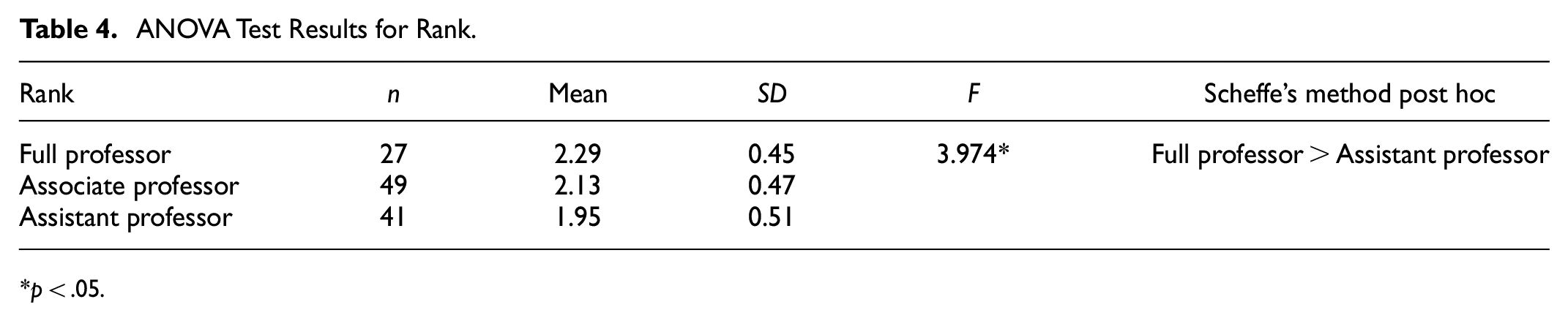
p < .05.
Interviews with professors and assistant professors were compared based on the results of quantitative analysis. The interviews showed that professors’ satisfaction came from their understanding and acceptance of the academic work environment. They were satisfied with the achievements that resulted from their efforts in different duties. They felt different tasks have both satisfied and dissatisfied parts. For example, they satisfied with the relationship and interactions with students but felt dissatisfied when students’ learning attitude became worse. Most of them said their satisfaction came from the feedback from their students (38%), and the research pressure is one of the big challenges during their career developing process (38%). Some of their dissatisfaction came from the pressure of being adjunct administrative directors (15%). Some professors said that although they were satisfied with their jobs, satisfaction was declining due to changes in the academic work environment (15%). Representative comments:
I am not 100 per cent satisfied with my work environment and work content, what I satisfied are that other people can still see the results of my efforts and my knowledge can be passed down through teaching. (A professor of animal science) I am ok with my job, what I dissatisfied are the problems caused by being the administrative director. In academia, the director is not like the manager or leader in the business world, and this vague situation makes the people who are the director have the difficulty of promoting things. (A professor of music)
As for assistant professors, the interviews showed that they were satisfied with the opportunity to obtain a professorial position. Most of their dissatisfaction came from the adaptation pressure of the academic work environment, such as the social relationships of the academic community, the evaluation and promotion systems, and the regulations of different duties. For examples, they need to prepare courses hard to get good teaching evaluation scores, they felt pressure for getting research papers published and applying for research funding, they cannot refuse administrative duties when senior professors ask them to undertake the work. Some commented as follows:
I am satisfied with my job, what I don’t like is the regulations of applying for research projects. I can’t do things according to my pass but need to following many red tape. (An assistant professor of law) I am only 40 per cent to 50 per cent satisfied with my job. I think it’s challenging to get along with others since most professors are more individual and have their characteristics. (An assistant professor of education)
The Factors That Influence Professors’ Job Satisfaction
Seventeen items were designed to assess factors that influence the job satisfaction of professors. To examine the underlying structure of these 17 items, EFA was conducted on the basis that eigenvalues must be >1 and factor loadings must be >0.7 (Hair et al., 2010) to identify the latent constructs underlying the measured variables (Table 5). A Kaiser–Meyer–Olkin (KMO) test revealed that the data were appropriate for factor analysis (KMO value = 0.902). The analysis indicated that 10 items fit the model; the 7 items that did not fit the model were omitted. Two factors, namely “university work environment” and “nature of academic job,” were revealed to explain 61.417% of the variance. “Regulation and support of industry-university cooperation” was the most crucial item in “university work environment,” followed by “professional development opportunities,”“accounting and funding system,”“teacher grievance mechanisms,” and “reward system.”“Nature of professor’s job” was the most crucial item for “nature of academic job,” followed by “job fulfilment,”“job attractiveness,”“job reputation,” and “respect from society.”
Factor Loadings, Mean Score, and Standardized Deviation of Factors Influencing Job Satisfaction.

The participants tended to give higher scores to the items related to “nature of academic job” (3.30) than to those related to “university work environment” (2.51). Among the items related to “nature of academic job,” the participants gave the highest scores to “nature of professor’s job” (3.40). Among the items related to “university work environment,” the participants gave the highest scores to “teacher grievance mechanisms” (2.68).
The results of interviews showed that the reasons professors were satisfied with their job included that they loved challenges of teaching and interacting with students, they liked doing research and sharing their professional knowledge, and they thought they could have some impact on students and societies. They loved the flexibility of time and work independently, particularly that they had the opportunities to do something they like. Some commented:
I love the independence and autonomy of this job. I can decide my research topics. I can still conduct my research even I didn’t get the research funding. (An associate professor in landscape architecture) The professionalism, knowledge pursuing and sharing, and the freedom, as well as the autonomy of this job, attract me most. (A professor in education) I love the good research atmosphere and relationship among colleagues of the university where I work. The university got much funding from the government. Therefore, I can be supported by lots of resources and get progressed. (A professor in electronic engineering)
The factors that reduced their job satisfaction included the pressures of the requirements to publish, taking adjunct administrative duties, and consulting with students who are regulated by the teacher evaluation and promotion systems. The changing academic work environment also imposed pressure, especially the prospect of diminishing job security in the future due to the low birth rate. The phenomenon of decreasing quality and learning attitude of students also made them feel depressed. Some of them resent the regulations of the academic and administrative systems and the culture of the universities they work. Several commented on these factors:
The biggest pressure of my academic working life is publication. I felt myself is a burden of the university where I work when I have no publications. (An associate professor in physical education) The work environment is changing, besides the pressures come from teaching and research, now the pressures come from recruiting students are increasing. (A professor in chemistry) I love the work content of professor job, but I don’t like the administrative duty and the culture of the department where I work. (A professor in music).
The Model of How Factors Influence Professors’ Overall Job Satisfaction
The current study used a second-order hierarchical model of participants’ job satisfaction and the factors extracted through EFA to develop a model for exploring how these factors influence job satisfaction. The results indicated that the two factors, “university work environment” (path coefficient = 0.773, p < .001) and “nature of academic job” (path coefficient = 0.177, p < .001), were both significant variables that explained 81.8% of the variance in the participants’ job satisfaction (R2 = 0.818). The results of a structural equation modelling analysis are presented in Figure 2.

Results of structural equation modelling of factors influencing job satisfaction.
In addition, a multi-group analysis of rank subgroups was conducted. The results indicated that the influence of the two aforementioned factors was statistically significant between full professors and associate professors, and between associate professors and assistant professors (Table 6). “Nature of academic job” had a smaller influence on the higher-ranked participants than on the lower-ranked participants, whereas “university work environment” had a greater influence on higher-ranked participants than on lower-ranked participants.
Results of Multi-Group Analysis of Rank-Stratified Subgroups.

Discussion
The present study explored the job satisfaction of professors and the factors that influenced their satisfaction, and it revealed that the participants of the current study were moderately satisfied with their job. This finding is supported by personal interviews and corresponds to those of other studies (de Lourdes Machado-Taylor et al., 2016; Du et al., 2010; Nebojša et al., 2020). Furthermore, the current study expands on the literature by providing findings that the overall job satisfaction of professors is determined by the total satisfaction that they derive from their roles in instruction, research, service, and advising. The individual influence of these four duties on overall job satisfaction varied slightly, with the influence levels of service and instruction being greater than those of advising and research. Thus, according to this study’s findings on the determinants of job satisfaction, university managers should increase the job satisfaction of professors by helping them develop their teaching skills; by improving their working environment; and by ensuring that they have access to the equipment and support that they need.
With regard to the factors that influence the job satisfaction of professors, the present study revealed that the overall job satisfaction of the participants was influenced by “university work environment” and the “nature of academic job.” The results indicated that the professors tended to give lower satisfaction scores for the items related to “university work environment” and higher scores for the items related to “nature of academic job.”“University work environment” was also revealed to have a greater influence than “nature of academic job” on the job satisfaction of the participants. These findings are consonant with motivator-hygiene theory and the findings of other studies (Da Wan et al., 2015; Lacy & Sheehan, 1997). “University work environment” corresponds to the concept of hygiene factors, which can easily lead to dissatisfaction with one’s job, and “nature of academic job” corresponds to motivating factors, which can increase work enthusiasm. Thus, university managers should address aspects of the “university work environment” that professors are dissatisfied with. That is, they can provide more flexibility with respect to the regulation of industry–university cooperation and accounting and funding systems, provide more professional development opportunities, and implement teacher grievance mechanisms and reward systems that cater to the needs of professors.
The present study revealed that higher-ranked professors tended to be more satisfied than lower-ranked professors with their jobs, which corresponds to the findings of Hesli and Lee (2013) and Teichler et al. (2013) but contradicts those of Mgaiwa (2021). This phenomenon could have occurred because full professors have already reached the top of the academic hierarchy, whereas assistant professors are lower in the hierarchy. Expanding on the literature, the present research revealed that the job satisfaction of higher-ranked professors was influenced more by the factor “university work environment,” whereas lower-ranked professors were influenced more by the factor “nature of academic job.” Therefore, university managers can increase the job satisfaction of professors by providing higher-ranked professors with more flexibility in relation to work regulations, thereby granting them more freedom to perform and fulfil their research and instruction duties. For lower-ranked professors, they should be given more opportunities to experience the sense of fulfilment and social effects associated with their work, which can be achieved by encouraging them to participate in projects related to the university’s social responsibility and implementing a reward system that enhances their professional commitment to higher education. As public intellectuals, professors can make cultural contributions and influence society (Peters et al., 2021). They can apply their professional knowledge to influence society and the younger generation by fulfilling service and instruction duties and building social and interpersonal networks that include diverse industries.
Furthermore, we collected qualitative information on the basis of quantitative findings. Through this mixed methods design, the factors that influence the job satisfaction and dissatisfaction of faculty members could be clarified. The interview results of the current study were similar to its survey results; specifically, they indicated that the job satisfaction of the participants varied depending on the duties that they undertook. Therefore, varying levels of support and assistance should be given with respect to different tasks to increase the job satisfaction of professors. For their teaching duties, professors focus on their interactions with students and student feedback, and their sense of achievement stems from their impact on students. Thus, university managers can improve the teaching effectiveness of professors by helping professors to understand the needs and learning status of their students through teaching feedback and providing them with professional development opportunities to help them overcome the challenges associated with the changing learning attitudes of students. For advising duties, which may be a component of a professor’s teaching duties in specific countries, adequate resources and professional support should be provided to professors if they are required to provide consultation services to students. For research duties, university managers should not only provide professors with research resources but also assist them in addressing the pressures and challenges of publishing research by implementing targeted professional development to increase their job satisfaction. Service duties are mainly associated with the conformity to expertise and a sense of achievement. Professors enjoy expanding their social and interpersonal relationships beyond the university but struggle to do so because of the pressures due to their adjunct administrative duties. Therefore, university managers can assign administrative duties according to the expertise of professors and provide positive support and incentives for them to undertake on-campus adjunct administrative tasks.
The findings of the current study may have implications for establishing an organizational climate that promotes the sustainable development of a university (Lăzăroiu, 2017). The sustainable development of a faculty comprising members who are satisfied with their job is dependent on the presence of a positive work environment, where reward and recognition systems are implemented in accordance with the needs of the faculty. A positive work environment causes minimal stress for professors with respect to regulations and requirements. It also provides them with opportunities to find meaning in their work and attain self-actualization. For example, the results of the current study indicated that the participants greatly appreciated student feedback and were willing to provide high-quality teaching. However, when teaching evaluation scores become a component of the framework for assessing teacher accountability, the professors’ motivation to provide high-quality teaching is likely to be replaced by the pressure to obtain high teaching evaluation scores. Their desire to help students to learn will be superseded by their desire to obtain favorable student ratings on their teaching evaluation questionnaire. Although achieving the requirements or goals set by their universities can enable professors to gain recognition for their ability, the sense of fulfilment is greater if they can focus on achieving the goals that they personally set. In a positive work environment that promotes job satisfaction among professors, faculty members can apply their skills, become more engaged in their jobs, become more motivated to develop their potential, and build their career reputation more effectively; this vision can be achieved by increasing the sense of fulfilment that they derive from their duties, and this sense of fulfilment is the most crucial intrinsic factor that leads to job satisfaction.
Conclusion
The current study adopted quantitative and qualitative methods to explore the job satisfaction of a sample of professors in relation to various job duties and the factors that influenced their job satisfaction. The results revealed that the participating professors, who were based in Taiwan, were moderately satisfied with their jobs. Among the participants, the job satisfaction of full professors was significantly higher than that of assistant professors. The factors that influenced the job satisfaction of the participants were divided into factors pertaining to “university work environment” and “nature of academic job.” The regulations and culture of a university, and opportunities for improvement were classified under the category “university work environment.” The sense of fulfilment derived by professors from student interactions and the impact of a professor on their society were classified under the category “nature of academic job.” The results relating to “university work environment” were more accurate than those relating to “nature of academic job” in predicting the job satisfaction of the participants.
The results of the current study align with the motivator-hygiene theory; that is, professors’ job satisfaction depends on motivational factors, and hygiene factors can only prevent job dissatisfaction among professors. These results can serve as a reference for university managers to establish a positive work environment and prevent faculty members from becoming dissatisfied with their jobs. Various measures can be implemented, such as enhancing professional development activities, work environments, equipment, and support; providing more flexibility with respect to regulations and support systems; and establishing teacher grievance mechanisms and reward systems on the basis of the needs of professors.
The primary limitation of the current study is its sample representativeness. Because the sample was dependent on the willingness of professors to participate, its results may be different from the general academic community of Taiwan. Future studies should extend the current study’s findings by exploring how universities can enhance their professional development activities and their work environments, equipment, and support; how regulatory flexibility can be increased; and how teacher grievance mechanisms and reward systems can be implemented on the basis of the needs and interests of professors.
Footnotes
Appendix A

| ➢ Personal information: | ||||
| • Gender: □Male □Female | ||||
| • Rank: □ Professor □ Associate Professor □ Assistant Professor | ||||
| • Institutional types: □Public general university □Private general university □Public vocational university □Private vocational university |
||||
| • Professional areas: | ||||
| • Working hours for a day: | ||||
| • Working hours for a week: | ||||
| • Numbers of the curricula in one school year: | ||||
| • Numbers of publications: journal papers: book chapters: conference papers: | ||||
| ➢ Please chose the satisfaction level for the items given below 1 = very dissatisfied; 2 = dissatisfied; 3 = satisfied; 4 = very satisfied |
||||
| 1 | 2 | 3 | 4 | |
|---|---|---|---|---|
| 1. Autonomy for delivering courses (including the title, time, and content of the course) | ||||
| 2. Curriculum matching professors’ skill-sets | ||||
| 3. Teaching support (TA, administrative resources) | ||||
| 4. Teaching-related professional development activities held by departments or universities | ||||
| 5. Teaching environment and equipment | ||||
| 6. The requirements of teaching accountability in teacher evaluation and promotion systems | ||||
| 7. Teaching evaluation systems | ||||
| 8. Fulfilment from teaching tasks | ||||
| 9. Research autonomy | ||||
| 10. The quantity and quality of research assistants | ||||
| 11. The requirements of research accountability in teacher evaluation and promotion systems | ||||
| 12. Research environment and equipment | ||||
| 13. Fulfilment from research tasks | ||||
| 14. Research subjects matching professors’ skill-sets | ||||
| 15. The flexibility to utilize research funding | ||||
| 16. The fairness of the academic review process | ||||
| 17. Professional development activities for research held by the departments or universities | ||||
| 18. Professional development activities for advising held by the departments or universities | ||||
| 19. The requirements of service accountability in teacher evaluation and promotion systems | ||||
| 20. Service environment, support, and equipment | ||||
| 21. Fulfilment from inner university service tasks | ||||
| 22. In-university service duties matching professors’ skill-set | ||||
| 23. Fulfilment from outside university service tasks | ||||
| 24. Outside university service duties matching professors’ skill-set | ||||
| 25. Professional development activities for service held by the departments or universities | ||||
| 26. The emphasis on advising duties and amount of support from the university | ||||
| 27. The division of advising work | ||||
| 28. The clarity and abundance of advising work support | ||||
| 29. Advising environment, support, and equipment | ||||
| 30. The requirements of advising accountability in teacher evaluation and promotion systems | ||||
| 31. Fulfilment from advising tasks | ||||
| 32. Advising duties matching professors’ skill-sets | ||||
| ➢ Please chose the satisfaction level for the items given below |
||||
| 1 | 2 | 3 | 4 | |
| 1. Salary and welfare | ||||
| 2. Promotion system | ||||
| 3. Evaluation system | ||||
| 4. The reputation of university | ||||
| 5. The reputation of the professor’s jobs | ||||
| 6. The respect of society | ||||
| 7. The nature of the professor’s jobs | ||||
| 8. Relationships among colleagues | ||||
| 9. Job security | ||||
| 10. Job attractiveness | ||||
| 11. The fulfilment of job | ||||
| 12. Reward system | ||||
| 13. The recruitment and appointment of teachers | ||||
| 14. Accounting and funding system | ||||
| 15. Professional development opportunities | ||||
| 16. Industry-university cooperative regulation and administrative support | ||||
| 17. Teacher grievance machinery | ||||
Acknowledgements
The author thanks the Taiwan Ministry of Science and Technology for funding the study and Dr. Meiling Chang, Dr. Carolyn Wallace, Ibrahim Bilim, Po-Lin Chen, and Yu-Chuen Huang for Research methods and writing consultation as well as Kristina McCue for English editing.
Declaration of Conflicting Interests
The author(s) declared no potential conflicts of interest with respect to the research, authorship, and/or publication of this article.
Funding
The author(s) disclosed receipt of the following financial support for the research, authorship, and/or publication of this article: This research was supported by the Ministry of Science and Technology in Taiwan through Grant numbers MOST 103-2410-H-034-031-SSS.
