




Abstract
Positive professor-student relationship is widely accepted to impact academic outcomes including teacher and teaching efficacy, students’ motivation, and their learning. This qualitative study explores the barriers to professor-student rapport experienced by foreign language (FL) faculty in Iranian universities. Employing in-depth interviews with 46 FL professors from public and private universities across Iran, the hybrid thematic analysis identified two core themes: (1) Personal-Socio-Cultural barriers (academic snobbery and instructor inauthenticity), and (2) Organizational-Institutional barriers (pressure to publish and gender sensitivity). The two themes and their sub-themes will be elaborated upon in this article. The article concludes by discussing the purposeful and potential solutions to overcome these barriers, including training programs focused on fostering authenticity and humility, re-evaluating publication metrics, and promoting a more open and inclusive academic culture.
Plain Language Summary
Recent studies on the effectiveness of professor-teacher relationship (PSR) have shown the importance of building a positive connection between learners and educator. Positive feelings that provide a sense of security and motivation that results in higher academic accomplishment, such as empathy, caring, and support from professors, can have a significant influence on students’ academic performance. Even though PSR has been getting more attention during the last decade, this field of study has not received enough attention in Iranian higher education. Few studies have addressed this emotional aspect, especially those that focus on the obstacles to PSR, and the lack of research in this area is felt strongly. This qualitative study aims to rectify that gap by investigating the opinions of Iranian foreign language instructors regarding the obstacles to building rapport and creating a professional relationship, as well as their practical approaches to overcoming these obstacles.
Introduction
The notion of rapport is gaining traction among educators, notably in higher education milieu (Bardorfer, 2024; Keeley et al., 2012; Mattanah et al., 2024; Schriver & Harr Kulynych, 2023). Educators play a vital role in cultivating and maintaining an empathetic and harmonious learning environment in higher education. Professor-student relationship (PSR), situating itself within immediacy behaviors like friendliness and flexibility, came into vogue parallel with the growing emphasis on faculty-student contact as an important factor in student motivation and involvement in educational settings (Chickering & Gamson, 1989; Richmond et al., 1987). PSR in higher education involves both formal and informal interactions, focusing on fostering personal connections and support, often with an academic focus (Snijders et al., 2022).
Swenson (2010) claimed that rapport distinguishes between a teacher and a lecturer. PSR makes such a valuable contribution to professor effectiveness and teaching excellence that it has become an indispensable element of a successful college classroom (Bardorfer, 2024; Buskist & Keeley, 2015; Haynes et al., 2024; Joseph, 2018). Subsequently, PSR enhances engagement, improves learning outcomes, reduces stress, increases motivation, and fosters positive classroom experience (Demir et al., 2019; B. N. Frisby et al., 2014; Meng, 2021; Wilson & Ryan, 2013; Zhang, 2023). Such prominence places PSR at the center of all aspects of successful higher education—language learning in particular. Given the role of second language (L2) learning in the globalization era (Zapadynska, 2023) and globalization of higher education as a relatively new phenomenon on the one hand, and the ubiquity of foreign language (FL) classroom anxiety (Horwitz, 2001; Yu & Kaur, 2024), on the other hand, establishing PSR is crucial for mitigating anxiety. This can be accomplished by creating a supportive and inclusive learning environment, developing a sense of belonging, and increasing students’ willingness and motivation to participate (Cai, 2021; Li, 2022; O’Mara et al., 1996; Shakki, 2022). While research emphasizes Western-centric perspectives on rapport, it remains unclear what potential challenges non-Western FL professors face to establish effective PSR and how they address them.
This study is an attempt to bridge this gap by probing into the perceptions of Iranian Islamic non-western FL professors on the factors that might hinder rapport building. By exploring the cultural norms, institutional constraints, and interpersonal dynamics, we simultaneously delved into the practical strategies to lift these barriers.
Literature Review
This section reviews key research on PSR in higher education and FL classrooms. It outlines how rapport contributes to student motivation, engagement, and learning, highlights the interpersonal demands of FL teaching, and identifies gaps in the existing literature, particularly the limited attention to PSR barriers in Iranian and non-Western contexts.
Rapport in Contemporary Higher Education
PSR, defined as “the degree of personal connection that a student feels toward the teacher” (Lammers & Gillaspy, 2013, p. 1) and “the affective glue that binds education relationships together” (Brookfield, 1990, p. 163), is widely recognized as crucial for successful higher education (Lowman, 1995). Contemporary psychological-educational research has documented the centrality of this notion to successful higher education (Dahmani et al., 2024; Mattanah et al., 2024; Schriver & Harr Kulynych, 2023). Undergraduates who experience rapport with their instructors are believed to enjoy the benefits including increased student engagement, motivation, attention, enjoyment of the subject matter, and improved academic performance (Benson et al., 2005; B. N. Frisby et al., 2014; Lammers et al., 2017; Wanders et al., 2020). Despite this evidence, some faculty may not fully appreciate the significance of positive interpersonal relationships in teaching excellence (Buskist & Keeley, 2015; Ryan & Wilson, 2015). In other words, such quality has been sacrificed for respect, teaching methods, curriculum and assessment. Roshanbin et al. (2022) scrutinized FL professors’ perceptions of PSR in Iranian universities, along with its antecedents and various dimensions. They found that mutual respect, trust, empathy, and positive emotional connection permeate in rapport competence categories-connectedness and professionalism as well as professorial ethics.
Student-centered frameworks such as the Teacher Behaviors Checklist (Buskist et al., 2002), emphasized the importance of interpersonal and personality variables in effective teaching (Keeley et al., 2006), echoing Lowman’s (1995) model, which focuses on interpersonal rapport as a key distinguisher between competent and outstanding college teacher. Buskist et al. (2002) highlighted qualities such as knowledgeability, enthusiasm (for subjects and students), flexibility, rapport, creativity, respectfulness, approachability and accessibility, positive attitudes, humor, and encouragement as essential for master teachers. These qualities contribute to a positive learning environment fostering student motivation and engagement (Meng, 2021; Zhang, 2023). As Haider et al. (2022) assert, in order to achieve instructional objectives and increase students’ motivation, it is important for faculty members to own professional competencies, especially positive relationship with their students. Furthermore, Outside-of-class interactions and discussions, both personal and subject-related, can contribute to social academic integration and enhance PSR (Roshanbin et al., 2022).
Rapport and Effective Foreign Language Teaching
While there is a wealth of research on teaching excellence in general education, there is a dearth of research on effective FL teaching and the FL teacher’s role in the teaching process. This is regrettable given the increasing importance of FL skills in our globalized world (Nickolaevna, 2019) and Iran is not an exception. Although FL learning is crucial for developing well-rounded individuals with strong language skills, social-intercultural competence, and a lifelong passion for learning (Nickolaevna, 2019), there is a paucity of research providing a contextualized description of effective FL teaching and learning in the context of Iran. Oskouei et al. (2018) exploring effective FL teaching from the perspectives of Iranian learners, highlighted the role of FL teacher and their rapport building with their students as a major contributing factor emphasizing that success in the FL classroom requires specific teaching approaches, personality traits, and behavior.
Positive relationships and interpersonal communication behaviors are of high importance to increase learner’ interest and motivation in all learning contexts, including FL teaching and learning (Amiryousefi et al., 2019). Accordingly, a learner-centered, low-anxiety classroom is essential for effective FL teaching (Çelik et al., 2013). Main anxiety factors include “fear of making mistakes,”“lack of vocabulary knowledge” and “fear of evaluation” (Sadighi & Dastpak, 2017). This can also be seen in Asian contexts due to cultural differences, linguistic difficulties, and perceived lack of necessity (Ahmed, 2015; Quasem, 2014).
Research has highlighted anxiety as a major negative influence on L2 acquisition (Teimouri et al., 2019). While negative teacher-student relationships can cause apprehension, face-threat and anxiety, rapport fosters face-support, participation, and desirable student outcomes (B. N. Frisby et al., 2014; Xie & Derakhshan, 2021). Culpeper and Kan (2020) argued that good rapport increases FL students’ engagement and helps them overcome language learning challenges. Accordingly, among potential sources of language learning anxiety, Young (1991) identifies instructor-learner interactions.
Interpersonal faculty competence such as rapport building, mutual trust, open communication, and effective feedback, can safeguard students from negative outcomes like emotional stress, demotivation, and conduct-related issues (Poling et al., 2022; Reyes & Von Anthony, 2021; Richards, 2022). Students who connect with their teacher and the material are more likely to build rapport and feel less alienated (Dong et al., 2021; Roshanbin et al., 2022). Shakki (2022) found that teacher-student rapport and teacher support significantly contribute to engagement among Iranian university EFL students.
Lack of rapport can lead to emotional exhaustion (Cui, 2022), decreasing productivity and successful performance as well as reducing a sense of achievement (Rumschlag, 2017). Wang et al. (2024) proposed “cultivation of interpersonal skills, empathetic training, and refined communication strategies” (p. 13), including PSR, to address emotional exhaustion. Therefore, it is imperative that the counter-productive factors and barriers be identified and dealt with on a global scale.
Despite of numerous studies on PSR, the researchers of present study noticed insufficient research in literature when it comes to Iranian higher education; there are few studies (see Shakki, 2022) that deal with this emotional quality, particularly on the factors that block PSR. Therefore, there is a need for theoretical and practical transparency considering barriers of rapport establishment in non-western academic contexts through conveying the voice of faculty members to provide solutions. This study aims to identify the voices of Iranian FL professors regarding factors hindering rapport establishment, offering a more thorough comprehension of the interaction of institutional, cultural, and individual factors. In light of the aforementioned objectives, the following inquiries are the focus of this investigation:
What potential hurdles do Iranian university foreign language professors face in building rapport with their students?
What recommendations do they have for overcoming these barriers?
Methodology
Participants
Participants were 46 Iranian FL professors, 20 female and 26 males, from five state universities across Iran, teaching various foreign languages (Arabic, Chinese, English, French, German, Persian, and Spanish) to undergraduate students. The participants were PhD holders with at least 5 years of teaching experience. They ranged in age from 32 to 65. The participants were selected using the purposeful snowball sampling method—also known as “chain-referral methods”—whereby information-rich professors were selected and interpersonal relations featured very highly (Browne, 2005). Patton (2014) explains that the information-rich cases are identified “from sampling people who know people who know what cases are information-rich, that is, good examples for study, good interview participants” (p. 243). Hence, snowball sampling is “respondent driven” (Heckathorn, 2002), where respondents identify other respondents for the researcher to contact. In order to maximize “variation sampling” and enhance the validity of our findings (Merriam, 2009), we chose our participants from faculty members with a wide range of teaching experience—between 5 and 25 years.
All participants received consent forms prior to the interviews to ensure adherence to ethical standards regarding privacy and data protection. The forms clarified the study’s objectives, the voluntary nature of participation, and the assurance of anonymity through the use of pseudonyms. The professors were fully informed about the study’s aims and participated voluntarily.
Design of the Study
We conducted a qualitative study, including in-depth interviews and a hybrid inductive-deductive thematic analysis to explore professors’ experiences, beliefs, and perspectives on barriers to PSR. Strauss and Corbin (1998) explained that qualitative methods “can be used to obtain the intricate details about phenomena such as feelings, thought processes, and emotions that are more difficult to extract or learn about through more conventional research methods” (p. 11). In-depth interviews were chosen to gain insights into participants’ attitude, emotions, values, knowledge, experiences, and feelings regarding the research topic (Jacob & Furgerson, 2012; Mears, 2012; Rubin & Rubin, 2005). Thematic analysis was used to identify patterned responses and meanings within the data (Braun & Clarke, 2006). A hybrid approach (Fereday & Muir-Cochrane, 2006; Swain, 2018) combined inductive analysis, whereby themes emerged from the data (Braun & Clarke, 2006; Patton, 2014), with deductive analysis, which considered pre-existing coding frame from the literature.
Data Collection Procedure
Interview questions were developed based on existing literature on rapport (B. Frisby, 2018; Granitz et al., 2009; Wilson et al., 2010). Three PSR researchers reviewed the questions for suitability, relevance, and clarity, leading to revisions. The modified questions were then pilot-tested with two FL professors (not involved in the main study) and more modifications were made (see the Appendix 1 for the interview questions).
Each of the professors was requested to answer open-ended questions to solicit their opinions and perceptions of the existing factors that are damaging PSR along with the workable solutions they would recommend. The semi-structured interviews were conducted face-to-face in the participants’ native Persian language. Each 30 to 40-min interview was recorded, transcribed, and professionally translated into English. Two researchers of the current study used member-checking during each interview to ensure data accuracy and enhance validity.
Data collection continued until thematic saturation was achieved, that is, when no new codes or insights emerged from successive interviews. After approximately 40 interviews, the researchers observed that the data had become repetitive, and additional interviews only confirmed already identified patterns and categories. To ensure saturation, six more interviews were conducted, which further substantiated the established themes and enhanced data richness. This process ensured that the final dataset was both comprehensive and representative of the participants’ perspectives.
Data Analysis
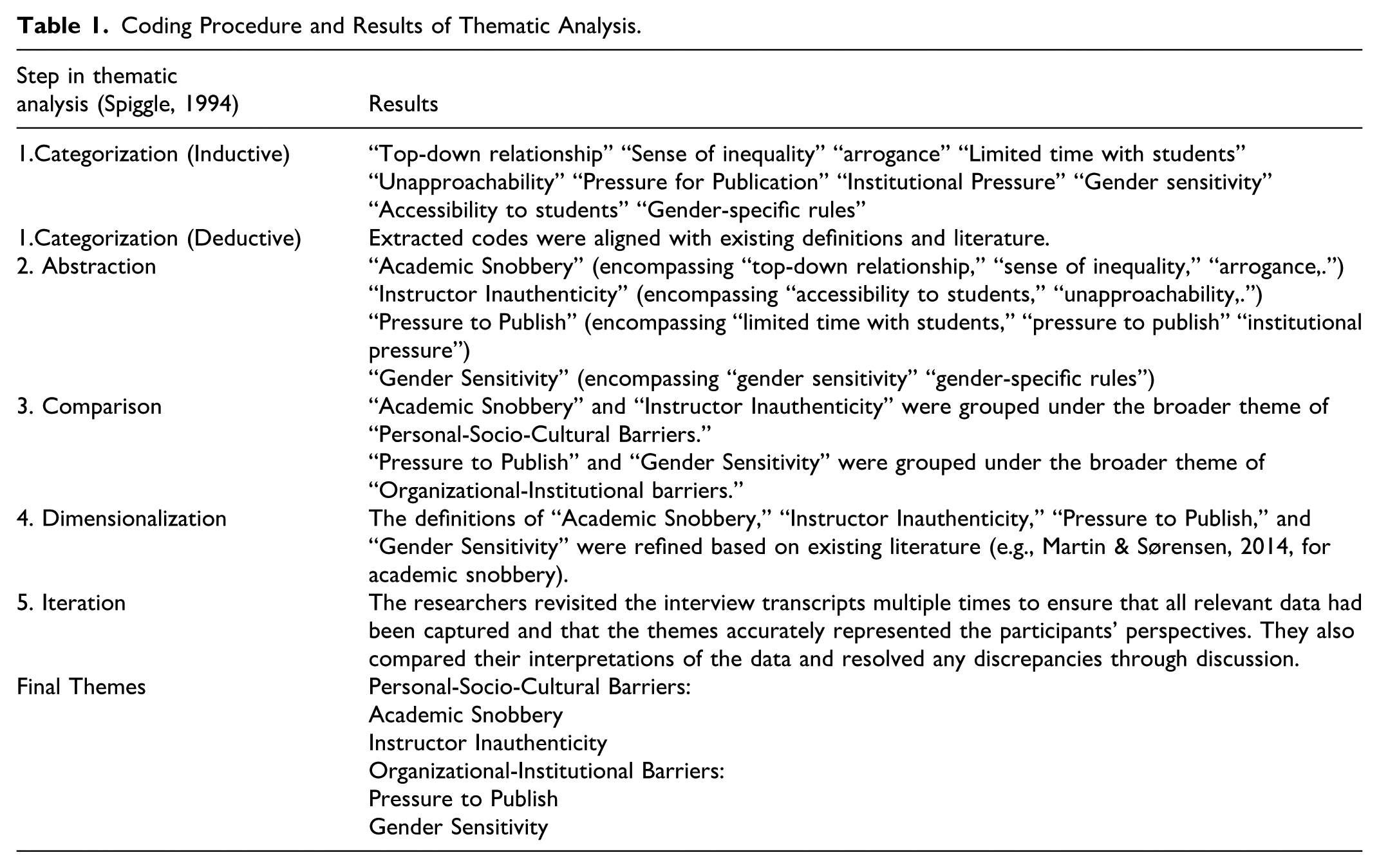
The collected data were analyzed through a hybrid thematic analysis, combining inductive and deductive methods, to explore professors’ perspectives on what constitutes barriers to effective PSR in Iranian universities. Thematic analysis is “a method for identifying, analyzing, and reporting patterns (themes) within data,” (Braun & Clarke, 2006, p. 79). We organized the collected data and put them into different categories based on their importance and recurrence in recorded responses. This involved a multi-stage coding process (Spiggle, 1994), through categorization, abstraction, comparison, dimensionalization, and iteration. Spiggle (1994) asserted that these operations are neither separate steps nor are they supposed to be employed in a sequential linear order. The operations allow the “researchers to organize data, extract meaning, arrive at conclusions, and generate or confirm conceptual schemes and theories that describe the data” (p. 493). The researchers went over the interview transcripts line by line several times, making sure to include both apparent and latent areas of significance. The first phase of data analysis was categorization, which involved coding meaningful “chunks” of data, whether phrases, sentences, or paragraphs, if they could “stand on their own” (Spiggle, 1994, p. 493). This phase can proceed inductively or deductively, both of which have been applied in the present study. The researchers then labeled the categories and derived patterns of codes (abstraction phase). In the next phase, similar categories were represented (comparison). Next, conceptual definitions from the literature were adopted to the new codes (dimensionalization). Subsequently the judges moved back and forth between the phases (iteration), and checked the themes to ensure their relevance to the codes that had been extracted (see Table 1 for details). Before producing the results, the three judges compared results again to determine whether the initial designation of three major categories might require revision. Furthermore, the research team verified that thematic saturation had been reached, as no novel themes emerged during the final rounds of coding. Each theme is discussed below.
Coding Procedure and Results of Thematic Analysis.
Findings
Barriers to Rapport Development
This subsection directly addresses the first research question by examining the barriers that Iranian FL professors encounter when building rapport with their students. The analysis of the obtained data revealed two themes: (a) Personal-Socio-Cultural and (b) Organizational-Institutional barriers. The themes and their sub-themes along with the identified strategies are further explored below.
Personal-Socio-Cultural Barriers
We named the first barrier theme Personal-Socio-Cultural, which acknowledges a climate of personal characteristics and attitudes toward work, social classes, social environment and interactions, cultural background and personal beliefs in the present study. Examination of these relatively interconnected factors revealed that they can be attributed to academic snobbery and instructor’s inauthenticity.
Academic Snobbery and Instructor’s Inauthenticity
Although academic snobbery and instructor inauthenticity are closely interrelated in shaping professors’ interpersonal attitudes, they represent distinct dimensions of the personal–socio-cultural barriers. In this study, academic snobbery reflects an outward display of superiority, status consciousness, and hierarchical distance that discourages egalitarian interaction with students. Instructor inauthenticity, by contrast, concerns the absence of genuine self-presentation that is manifested through emotional detachment, guardedness, and limited accessibility which prevents professors from forming meaningful personal connections. Since participants’ narratives revealed that these two tendencies often co-occurred in practice (i.e., snobbery frequently masking inauthenticity) they were presented together to highlight their conceptual overlap and shared consequences for rapport erosion, while maintaining analytical distinction between the constructs.
As a starting point, we adopted the definition from the Longman English Dictionary online (accessed on September 20, 2024) of snobbery as “behavior or attitudes which show that you think you are better than other people, because you belong to a higher social class or know much more than they do.” Arrogance, particularly individual arrogance, appears to exist as a social phenomenon among academics working in universities (see components of arrogance in Cowan et al., 2019).
In this study, professors asserted that arrogance among academicians in higher education can negatively impact faculty-student relationships and academic outcomes. Student attrition, discouragement from pursuing academic careers, and academic failure can be mentioned as negative consequences of such academic snobbery. This finding supports some previous studies (e.g., Demirbilek et al., 2022; Silverman et al., 2012). Yet there is relatively a paucity of research on this topic, maybe because we imagine that universities are free of snobs.
I always let them [my students] talk fearlessly, and never convey a sense of inequality. I mean there must not be a top-down relationship between us. I also allow them to compensate for their weaknesses which has always led to a positive change in them. (Reza, he, German professor, 43)
Social power was also perceived as a potential obstacle to rapport. As one participant noted, “Social power could act as an obstacle, but it depends on the faculty as to whether they use it to look down upon students. Some faculty tend to surround themselves by a cocoon and do not open up” (Masood, he, 45). Another professor emphasized the importance of avoiding hierarchical distance: “I always make sure not to establish a top-down relationship since this increases the social distance and results in negatively, yet my social rank and upper situation endure. Professors with friendly personality are more authentic and successful” (Maral, she, 40).
Academic snobbery and instructor inauthenticity emerged as significant barriers to building relationships and rapport, reflected in participants’ comments. These behaviors appear to arise from a belief in hierarchical relationships and self-importance, possibly originating from cultural influences aimed at creating specific impressions. Unapproachability, as an indicator of inauthenticity was also evident in the comments. Z. D. Johnson and LaBelle (2017, p. 8) characterized this by “not sharing personal stories,”“ignoring students outside of class,”“lack of office hours,”“not attempting to get to know students,” all of which can be seen in the comments provided:
Of course, this top-down relationship is present in our culture. This guru-disciple like relationship between teachers and students has always existed in Iranian culture. Teachers or professors hold this sacred status to them, one that is not easy to reach. This power rather prevents the intimacy to forge. (Saeed, he, Chinese professor, 40) Unfortunately, there used to be a considerable top-down relationship between teachers and students, which has been internalized in our culture though. When I was younger, I believed more in individuation. Everything starts from us, individuals form the society, and each individual should move towards authenticity. (Ashraf, she, Persian Language and Literature, 49) Intimacy is achieved differently in our country and this might be due to the limited time spent between professors and students. A problem which I face in my workplace is that sometimes I feel I am under my colleagues’ observation and they do not like this friendship. (Hossein, he, Russian professor, 43)
According to the opinions of the faculty members, Academic snobbery connotes a sense of superiority complex, overconfidence, and egotistic behavior. As it can be inferred, some of the academicians who act in line with their arrogance-oriented and self-centered perspectives, try to make others feel that they are very important by exhibiting a top-down relationship due to social class distance and hierarchy.
Participants viewed snobbish behavior as a multifaceted issue, stemming from both individual personality and broader socio-cultural factors. They suggested this tendency stems from academics’ self-perception of power and high social status and the belief that this way they could earn greater respect. This may be linked to personality traits developed over their careers and the belief that this is an element of their identity and well-being in their professional development—the more distant and unapproachable they are, the more impressive their image will be.
I never convey the sense of inequality. In order to establish a good relationship with students, there must not be a top-down relationship between us. Social class difference is considered a major problem in our society; as an illustration, the faculty might have the key to open and ride the lift but students do not. (Zahra, she, TEFL, 45) Unfortunately, there are professors who sit in their office doing nothing, but they will not make themselves accessible to students, or send them away and tell them to come back later. One of them said, this makes me more respected, which is a very wrong attitude, I think. (Ali, he, Arabic professor, 65)
The participants acknowledged that academic arrogance can manifest in faculty members’ unapproachability and a failure to address students’ social and emotional needs, hindering rapport development. They explained that viewing students as empty receptacles waiting to be filled with your knowledge can negatively impact the learning climate, preventing them from developing “connectedness”—positive emotions toward their course and a core element of rapport (Roshanbin et al., 2022). Elaborating on the elements of PSR, Roshanbin et al. (2022) highlighted the importance of faculty members demonstrating fallibility in a rapport-driven university environment.
Some faculty members behave aggressively when asked challenging questions by students, and this makes students disappointed and could result in failure in successful PSR. This attitude and behavior come from the belief that they see themselves Dr. know-it-all because they teach at universities. (Hossein, he, 43)
The participants in the current study noted that narcissism and underestimating students’ status can damage educational quality and lead to negative consequences such as students’ demotivation and lack of interest in the subject matter.
Being in an unfriendly climate, it is no surprise that they lose their interest in the subject matter and do not pursue the lesson objectives effectively. They might turn their back to the academic society if they do not feel valued and respected; this can conduce to inauthenticity in our profession. (Hamed, he, Persian as an L2 professor, 33)
Elaborating on the notion of authentic education, as a key in higher education, D. W. Johnson et al. (1991) and Taylor (1991) suggested that showing enthusiasm for the course subject, and engaging students with the subject matter are the key. In a similar way, Meyers (2008) valued relational learning or “working alliance” between educators and their students conducive to a warm relationship and climate as well as establishing rapport. Mohsen (he, 44), a German Language and Literature professor with 11 years of teaching experience, mentioned: “I am totally against the idea of misusing the social power that comes with being a faculty member. This (misuse) partly emanates from our socio-political culture in which the top-down relationship is dominant and accepted.”
The above examples suggest that snobbish behaviors arising from university culture amongst academics is believed to be associated with professorial status and the institutional power. This aligns with Martin and Sørensen (2014) finding that academic snobbery is linked to “a person’s university, field of study or position” (p. 2). These comments along with previous research, indicate that conceptions of power and social inequality vary across societies and class systems, reflecting diverse sociocultural backgrounds.
Unfortunately, professorship might cause a top-down relationship between the professors and students; however, this is just a mask worn by some professors fearing losing their power and authority. The problem is that maybe, I think, the masks that we wear, and that is the distance that subconsciously we create between students and ourselves. Because we are afraid that if students know that how my knowledge is common knowledge, I do not know, I am not special, you know, most of the time these behaviors that we have, these masks that we wear are for creating a territory for ourselves. (Mahshid, she, 40)
To the respondents, fear to lose power meant some professors valued their superior social status so much that they did their best to maintain it by projecting a feeling of uniqueness. They referred to a “mask” worn by academics helping them maintain their position and power. The participants viewed this deliberate inauthenticity as a significant barrier to establishing a close relationship with students. Similarly, in a study on faculty’s perception of rapport, many of the survey participants highlighted the importance of egalitarianism and that professor should not see themselves superior to the students (Roshanbin et al., 2022). This is of paramount importance as some predictors of PSR such as humility, trust, fallibility, kindness, knowledgeability, openness, and enthusiasm—key predictors of PSR—fall in the area of authenticity (De Bruyckere & Kirschner, 2016; Z. D. Johnson & LaBelle, 2017).
Organizational-Institutional Barriers
The second extracted theme was named organizational-institutional barriers revolving around pressure to publish and gender sensitivity. The two components of the theme are discussed in the following sections. We concluded that faculty burnout driven by chronic stressors namely administrative pressures and workload demands encourage physical fatigue alongside mental and emotional exhaustion, which could result in reduced sense of achievement and efficacy, job satisfaction, emotional connection, and rapport establishment.
I remember while being a student in Germany, one of the full professors of German who was a fan of the Portugal football team, was wearing a T-shirt in class on the due day. In Iran we cannot act so freely. (Ali, he, German professor, 48)
Pressure to Publish
Considering the accelerating globalization and commercialization of higher education, it is not surprising that one type of institutional pressure on academics concerns the authorship of scientific research papers. Shima, a 34-year-old female French professor with 5 years of teaching experience remarked:
As young faculty members, we are often caught in the whirlwind of tenure requirements, departmental expectations, and the desire to make a name for ourselves in our respective fields. The publish or perish mentality can become all-consuming, leaving us little time or energy for the most crucial aspect of our profession – our students.
In search of performative “academic identity,” which internationally lies in scholarly research (McCune, 2021), the professors mentioned that they are pressured to squeeze out as many publications as possible and this makes them lose their motivation to act as an authentic educator developing rapport-building skills. They mainly expressed their dissatisfaction with this unhealthy obsession with frequent publication and lacking time and motivation to invest in developing rapport with their students. Lucas (2006) pointedly referred to this pressure of publication as a fact of academic life, regardless of academic discipline. In the context of TEFL, one interviewee said:
I have seen faculties who do not care about students’ interests and just stick to writing articles and publishing them. Unfortunately, universities do not ask the faculty to make students interested and just require them to teach and publish. I haven’t been able to adapt to this situation, and I do not know how long I can go on surrounded by such unjust expectations. (Hossein, he, 43) I have been warned repeatedly by the officials to publish as soon as possible, or they would fire me from university; I never feel I am free to do something I never enjoy on a single day, since my mind is occupied with the burden of publishing. (Fereshteh, she, Russian professor, 32)
The pressure to publish is perceived as having alienated academic departments from investing in interpersonal rapport—a co-interpretive experience (Jorgenson, 1992)—and social-academic integration or “integrity,” a predicting factor of PSR (Buskist & Saville, 2001; Roshanbin et al., 2022) with their students. While Derakhshan et al. (2023) depicted the interconnection between emotionally supportive pedagogy and instructor well-being, the question remains how can an exhausted faculty create and nurture a positive teacher-student relationship? Another example is an extract from an interview with a Spanish Language and Literature professor who contended:
Although frequent and successful publication of research can bring attention to scholars and their institutions, the immense pressure on professors to increase the number of publications can lead to unethical practices such as plagiarism, duplicate publication, fraud, ghost authors, etc. The emphasis on publishing has also decreased the value of the resulting scholarship. (Shahram, he, Spanish professor, 35)
The phenomenon of “publish or perish” places professors are under a scanner to repeatedly publish in view of the fact that they are assessed and rated, based on the quantity of citations in scientific journals. Participants believed a great deal of this mass production contributes little to scientific advancement or a sense of personal achievement. Accordingly, Binswanger (2014) said, the more paper published, the less they are read.
The aforementioned examples suggest that professors feel obligated to publish regardless of the fact that they themselves exude passion for affective aspects of teaching and learning. They added that faculty could better connect with their students via office hours, campus involvement, attainable goals setting, engaging materials, and understanding students’ challenges—all key to rapport building. Moore (2022) mentioned “time commitment” as an important element required to build relationships and interpersonal skills in effective advising. Sarah (she, German professor, 52) maintains that “unfortunately, faculty members are seen as machines that are supposed to publish papers.”
Our participants also noted the rise of duplicate content due to institutional publication pressure. Explaining how this competition for productivity can lead to perverse incentives such as forgery and fraud, Fröhlich (2006) suggested “The higher the pressure to increase productivity, the more likely it is to resort to doubtful means” (p. 29). A Spanish faculty member (Sahar, she, 45) said:
Instead of spending time to develop significant research agenda that promotes knowledge in a field or solves a real societal problem, scholars have to struggle to publish whatever and however they can in order to demonstrate academic talent and win their institutions’ approval. This in turn is diverting faculties’ attention from their primary objective which is educating young people who will ensure social, economic, and environmental well-being, either at local or global scale, in the future.
These comments reveal that the “publish or perish” climate directly reshapes professors’ day-to-day conduct toward students. Several interviewees noted that constant performance evaluations based on publication metrics push faculty to prioritize research visibility over classroom interaction. This pressure manifests in reduced accessibility as professors, overwhelmed by publication demands, spend less time meeting students or providing feedback; emotional detachment, as they feel drained and unable to invest in genuine interactions; and mechanistic teaching behaviors, where instruction becomes limited to fulfilling formal duties rather than cultivating students’ curiosity or personal growth. As one participant put it, “Sometimes I skip informal talk or student questions because I have papers waiting to be reviewed” (Shahram, he, Spanish professor, 35). Such remarks illustrate that publication pressure is not merely administrative; it subtly discourages relational investment and authentic communication which is the very foundations of rapport.
The prevailing assumption is that professors’ focus on maximizing research productivity for top-rankings—seen as the primary measure of scientific excellence—conflicts with effective teaching of students and establishing rapport with them. To put it differently, they complained that universities were becoming non-stimulating competitive publication factories, implementing research-funding programs, in which professors are objectified and ridiculously forced to be active researchers rather than authentic educators. Notably, querying faculty about the factors motivating them to publish, Miller et al. (2011) reported that having publication in scientific journals is the key to utilitarian purposes such as academic tenure and recognition, salary increase, and job mobility.
This competition for publication was considered as “performance of nonsense” rather than genuine achievement. The academics believed that this pressure leads to “academic identity tension,” and worsens the higher up the academic ladder you go. Therefore, it seems their professional self is significantly affecting their ability to pursue the academic goals they had initially planned or envisioned. This creates a contradiction between staff perceptions and institutional pressure. Expecting faculty to fulfill both professional and performative identities can be counterproductive, impeding them to achieve professorial excellence, including building PSR. Binswanger (2014) cautions that true excellence is compromised at expense of intrinsic motivation—not being forced to publish.
Gender Sensitivity
Gender sensitivity emerged as a key subtheme related to PSR barriers, with both male and female professors expressing concerns. While mixed-gender classrooms are common, the Iranian context presents unique challenges. Both male and female professors reported low satisfaction with PSR due to restrictive gender-specific rules and regulations relatively influencing their interactions with opposite-gender students. They noted that social practices and cultural norms limit cross-gender social interaction. Mehdi (he, 47), an English Literature professor remarked: “In Iran, while being recruited, university warns us about gender sensitivity; thus, we have to be careful of our behavior, which is why I feel more comfortable with male students.” Furthermore, Ameneh (she, 38), a Chinese professor, added: “Professor-student relationship in Iran is easier when both genders are similar … too warm a relationship with female students might cause misunderstanding among colleagues and students.”
The professor also saw some of the strict university moral codes as hurdles to jump and restrict interpersonal closeness, affectionate communication, emotional connection, and personal expression with opposite gender students. Several participants reported being advised to avoid offering comfort, sympathy, or compassion, and to be very careful in their interactions with the students of the opposite gender type, both in-class and out-of-class. One professor described the caution required in opposite-gender interactions, noting, “I try to make eye contact. The female population may get offended. I try not to stare at them. These are young. They may misunderstand the signs. They are different from our generation. Definitely gender matters” (Farhad, he, Russian Professor, 48). They also attributed lack of intimacy with the opposite gender cultural norms and social practices that significantly restricts such interactions.
Considering gender sensitivity of our society, handling relationships with the opposite gender is difficult sometimes and this relationship and its boundaries should be clearly clarified. Once I used the verb “kiss” as an example in my Russian learning class; following this, I was dragged to university security officials. (Parinaz, she, Russian Professor, 48)
As shown, participants identified restrictive gender-oriented rules and regulations as barriers to developing positive professor-student relationships. Faculty are expected to obey the authoritarian rules and are discouraged from developing friendly relationships with the opposite sex, creating and environment of fear and caution. Islamic precepts and tight control have always been present in Iranian universities imposing restrictions on PSR when it comes to opposite biological sex. Although Islamic rules play an important role in educational context and constrain female-male interactions, the researchers attribute the obstacles mostly to political-bureaucratic nature of the higher education in authoritarian country—this limiting faculty’s freedom as they said.
Although gender sensitivity is rooted in broader social and cultural values, participants emphasized that its manifestation within universities is largely institutionalized through formal policies, administrative codes, and moral regulations that govern faculty–student conduct. For this reason, it was categorized under Organizational–Institutional Barriers rather than Personal–Socio-Cultural Barriers. The former captures restrictions and expectations imposed by the higher education system, while the latter refers to individual dispositions and culturally internalized attitudes shaping interpersonal behavior. Nevertheless, some overlap naturally exists, as institutional rules often reinforce social norms; hence, gender sensitivity represents a boundary case where personal beliefs intersect with organizational control.
Strategies to Address Barriers to PSR
The secondary aim of this study was to investigate professors’ recommendations for overcoming PSR barriers in their academic contexts. Participants noted that while faculty-student relationship is included in students’ ratings of instructors, universities often overlook its components and cognitive-affective learning outcomes. They advocated for a re-evaluation of the academic system and creation of a “culture” responsive to both students’ social-interactional needs and scientific advancement. Strategies to address snobbish behavior included pre-service training focused on teaching persona and goals, opportunities to learn from role-model instructors in either formal or non-formal settings, and requiring teaching-related professional development qualifications for faculty candidates. They emphasized the need for institutional authorities to assess candidates’ psychological suitability for professorial roles. The above-mentioned solutions can be seen in the following excerpt:
Addressing snobbish behavior among university faculty members should be done with tact and respect, as these individuals are often highly educated and may be sensitive to criticism. I believe professional development opportunities can help faculty members enhance their interpersonal and communication skills. They may benefit from workshops or courses on emotional intelligence, conflict resolution, or effective communication. (Ali, he, 65)
The professors expressed dissatisfaction with the status-quo ranking-focused higher education has failed to establish system, arguing that it fails to foster working alliance and authentic social-emotional connections with students. Recommended strategies to enhance teacher authenticity included organizing social-educational outings and cultural activities. These outings, both formal and informal, were believed to contribute to creating a sense of teamwork by addressing students’ social and emotional needs alongside academic learning. Fatima (she, Arabic professor, 44) said: “Outside university relationships effect positive change; group outings can provide individuals with the opportunity to talk to their professors about their problems.”
Participants identified heavy workloads and hectic schedules as significant constraints on building interpersonal relationships. They suggested that these constraints could be mitigated by organizing field trips such as going to the cinema, theater, or museum to foster connections between faculty and students. Larsen et al. (2017) attributed field trips in higher education to “stimulating interest and motivation in the subject” and “personal and social development of the students” considered as valuable retention strategies (p. 1). Simin (she, Chinese professor, 56) said:
Even in BA programs, if the university agrees, I can take 10 of them to a scientific outing, to a cinema. Then we can talk over coffees, say things different from university’s clichés. However, it is not possible, I do not know why. Now they have created this green space I sometimes hold my class on campus, and they enjoy it ….
The participants also highlighted the importance of playing music and holding classes on campus as a way to bring students and faculty closer to one another and enrich friendly relationship. Shahla (she, English professor, 45) said: “Music should also be played in the faculty to reduce or remove the boredom of long study hours and provide fun in the atmosphere. I sometimes tell students ‘Guys, let’s listen to a music on your phone’.”
Another strategy is the adoption of orientation sessions organized by universities and policy makers for faculty members and students to get to know each other and enjoy social integration. This would allow professors to balance their identity as a researcher with their role as authentic educators who prioritize interpersonal relationships with students. Lindbeck et al. (2008) supported this by saying, “For colleges and universities to develop successful, contributing faculty members, sustained orientation and on-going support for new faculty must become a part of each institution’s culture” (p. 10). This belief is reflected in Mary’s (she, Russian professor, 50) statement: “Such value-laden education requires professors’ commitment to instructing their (under)graduate students and establishing strong trust with them; I guess orientation sessions would be a great help to get to know each other and forge relationships.”
Participants believed that granting the academic community special privileges to foster harmonious student relationships and cultivate student interest would encourage them to invest more effort in building rapport with students. Over time, this practice would become ingrained in academic culture. This involves universities and education system open up to incorporating PSR as a crucial factor in defining an excellent professor. Mina (she, Spanish professor, 33) said: “I think that if they attribute privileges to outing arrangements, professors are all for it. Then later it becomes a part of culture because of that privilege.”
Analysis of the comments also revealed that faculty members’ own experiences with rapport as university students makes a valuable contribution to the way they do it as professors today. From an idealist philosophical perspective, Joseph (2018) pointed out that an excellent professor serves as a role model for students. Kamran (he, German professor, 41) said:
I might arrange or go on an outing with them, like going to a museum, but I never get into their personal life. One of my instructors would sometimes play football with us, go swimming, and so on, which was very useful to building a good relationship with his students.
This study revealed that holding classes on campus greenspace can foster rapport by creating a calming effect and relieving stress from heavy course loads and examinations. The underlying assumption is that using greenspace promote recreation, attention restoration, social integration, exchange of help, and personal-social identity development. Foellmer et al. (2021) suggested that exposure to Academic Greenspace, contributes to students’ satisfaction and an enjoyable ambiance. Their survey indicated that students feel a sense of belonging and experience reduced attention failure. They attribute this to the therapeutic nature of the area—identity-creating elements, emotional bonding and social interaction.
Concerning the necessity to publish research findings, they highlighted the importance of intrinsically motivated research engagement, rather than being forced to do. They advocated for a balanced approach encompassing all aspects of professional excellence, namely knowledge and credibility, deliver, and rapport. Amir (he, 52) said:
It is imperative that we seek a balance. We must work to find a way to fulfill our research obligations without sacrificing the quality of our interactions with our students. This means setting realistic expectations, managing our time effectively, and seeking support from our academic institutions.
One of the fresh academicians, Sara (she, French professor, 35) said: “Publish or perish is now a harsh reality in almost every Iranian university. As you are rated for writing articles, you should also be rated based on your level of communication and relationship with students.” The participants agreed that impactful rapport can be achieved by integrating research approaches from educational setting outside into their classroom, engaging learners both the research (related to learning objectives) and the researchers themselves (fostering connectedness—see Roshanbin et al., 2022). This, they suggested, frees up time and increases motivation to invest in PSR. They advocated for universities to proactively bring research into classroom, whereby both students and professors specialize in scientific disciplines without any stress. Xu (2014) stated, while academics should be actively involved in research, it is often conducted in isolation from daily practice.
The pivotal role of educators in outings was seen as crucial for diminishing counterproductive factors in PSR development, promoting interest and motivation, and mitigating gender sensitivity in Islamic communities through authentic learning environments. The study suggests that purposely-designed trips can foster academic success, friendships between professors and students (regardless of gender), engagement, enjoyment, shared experiences, and approachability, all of which play a crucial role in rapport building (Roshanbin et al., 2022; Rossetti & Fox, 2009).
Dealing with this issue (interactions with the opposite gender) involves university cooperation. We could recover the altered balance by organizing some university group trips. However, cultural limitations can stop these easily. To tackle the problem, credits should be allotted to faculty’s social activities and field trips; faculty would welcome the idea. (Hamed, he, 33)
The participants articulated that prioritizing faculty-student rapport in instructional settings, would motivate most scholars to adopt a more effective approach to rapport building. Larsen et al. (2017) valued the contribution of field trips in the early weeks of higher education as a predictor of social development, motivation, and interest stimulation.
Inspired by findings that the above-mentioned barriers are commonplace in Iranian universities, in the case of any given professor, we designed a constellation of constraints, which constitutes a specific anti-example (Figure 1).

Undesirable attributes which constitute an anti-example of PSR.
Our findings, lending support to prior studies (e. g., Demirbilek et al., 2022; Friedman & Weiser Friedman, 2019; Z. D. Johnson & LaBelle, 2017; Wang et al., 2024), offer a deeper insight into factors diminishing PSR and strategies for addressing them. In light of Buskist and Saville’s (2001, p. 3) recommendations to emphasize “the importance of rapport-building as creating a context for enhancing teaching and learning by contrasting it with its antithesis, alienation,” it seems that Iranian universities may not be immune to what some faculty members tend to do just the opposite of the suggestions provided for building rapport, even if they are unaware of the consequences.
Discussion
Analysis of the findings led to the emergence of two dominant barrier themes: Personal-Socio-Cultural and Organizational-Institutional barriers. The first theme included academic snobbery and instructor’s inauthenticity subcategories. The second main theme consisted of pressure to publish and gender sensitivity. Participants suggested alleviating these barriers through a comprehensive training program incorporating shared experiences, field trips, social-educational events and outings, music, campus green space classes, orientation sessions, privileges, and the integration of education and psychology coursework into faculty recruitment.
Academic snobbery, defined by Martin and Sørensen (2014) as “a sense of superiority or exclusiveness, often expressed with condescending comments or actions that reject others” (p. 67), poses a threat to PSR. Uninspiring instructors hinder PSR development (McCullough, 2022), while friendly professors contribute to student success (Roshanbin et al., 2022). Demirbilek et al. (2022) highlight the social harm of academic snobbery, particularly the disdaining behaviors that negatively impact students. Self-aggrandizement and self-promotion (Jones & Pittman, 1982; Schlenker, 1980) fuel this behavior. Martin and Sørensen (2014) argue that educational environments, particularly those with hierarchical structures, can breed snobbishness.
Conversely, trust and respect, essential for positive PSR (Granitz et al., 2009), are fostered by authentic, approachable instructors who share experiences (McCullough, 2022). The prevalence of overconfidence and arrogance in academia has been noted (Friedman & Weiser Friedman, 2019; Lynch, 2017), with some even viewing humility as weakness (Friedman & Weiser Friedman, 2019). Lynch (2017) argues that arrogance is a defining trait of the current age, while Moore (2022) emphasizes transparent humility as integral to trustworthy instructor-student relationships. Mihesuah and Wilson (2004) suggest that publications, fellowships, and awards can contribute to academic arrogance. Buskist and Saville (2001) highlight the importance of teaching identity and authenticity in PSR building, noting that approachability, passion, capability, and knowledge are key traits of authentic instructors (De Bruyckere & Kirschner, 2016; Z. D. Johnson & LaBelle, 2017), all contributing to PSR (Roshanbin et al., 2022). Chang and Diddams (2009) argue that authentic leaders build transparent relationships based on shared humanity, a concept favored by Walumbwa et al. (2008). By demonstrating care for students and love of what you teach (teaching authenticity), faculty members can achieve a good personal connection with students, which is conducive to successful rapport. An ideal instructor’s personality, characterized by emotional stability, conscientiousness, and openness, is highly valued for facilitating positive student-teacher interactions, enhancing educational experience, and increasing student satisfaction (Kim & MacCann, 2016).
This dissatisfaction with academia is not limited to Iran; European universities face similar challenges (Binswanger, 2014). Roshanbin et al. (2022) emphasize the importance of removing stress provoking factors in learning environments via maintaining eye contact, cracking jokes, in order to make class more fun and comfortable. Both Roshanbin et al. (2022) and Rossetti and Fox (2009) highlight the importance of out-of-class interactions for PSR. van Den Bogerd et al. (2018) found that university green spaces are valued by students. This study’s findings support the value of educational trips and off-campus activities for fostering rapport and interest (Larsen et al., 2017). The role teachers, content, and environment in learner motivation has been into the center of attention (Williams & Williams, 2011). Participants of this study recognized the motivating influence of positive relationships with educators (Farmer, 2018; Griffin, 2023), suggesting that outings and field trips can contribute to this. In line with our findings, Granitz et al. (2009) identified faculty personality and approach including approachability, availability, communication, fallibility, attention to students’ individuality and learning as crucial for rapport building. Authentic learning environments are linked to increased student engagement (Larsen et al., 2017), motivation (Villarroel et al., 2017), self-efficacy, and enjoyment (Aiken & Day, 1999; Hursen, 2016), all of which are associated with PSR. Herrington and Oliver (2000) also emphasized the importance of authentic environments in higher education.
Professors in this study felt that true professorship centers on disseminating knowledge and wisdom to students, not producing barely read papers. However, they are evaluated based on the publication quantity, not quality, making mass publication the sole measure of scholarly contribution.
Biswas and Kirchherr (2015) and Pooley (2018) referred to the fact that an average academic journal article is read by more or less 10 people,—citations do not imply that they have actually been read (Biswas & Kirchherr, 2015). Highlighting the notion of “nonsense,” Binswanger (2014) argued that the increase in the number of publications and citations does not guarantee the spread of scientific knowledge. Friedman and Weiser Friedman (2019) argue that teaching in these surreal academes is criticized and no longer honored, since meaningful research and impactful article are ones that have hardly been read, but published in a prestigious journal. Price (1963) predicted that the force on quantity over quality would lead to poor science, recommending reduced publication to improve quality—“we can start by publish less.” This echoes Binswanger’s (2014) call to fundamentally change research practices.
Gender sensitivity presents a significant challenge to PSR in Iranian universities (Kazemi, 2000). Discriminatory gender policies and strict Islamic precepts create barriers to male-female interaction. While Islamic rules play a role, participants attributed these obstacles primarily to the political-bureaucratic nature of higher education in this authoritarian context, limiting faculty freedom. Government authorities prioritize upholding Islamic principles, and post-revolutionary political necessities have further restricted male-female interactions. Faculty are expected to adhere to these rules and avoid overly friendly opposite-sex relationships. One way forward is to ask faculty to be modest toward the opposite gender.
To enhance the practical applicability of participants’ recommendations on managing hurdles to PSR, we suggest a multi-tiered faculty development model that integrates psychological, pedagogical, and institutional dimensions. First, universities can design modular training programs combining workshops, mentoring, and reflective practice sessions on emotional intelligence, humility in teaching, authentic communication, and inclusive interaction. These sessions should include shared experiential learning, such as role-playing, peer-observation, and collaborative field projects or social-educational events that bring professors and students together beyond the classroom. Second, mentorship and peer-coaching systems can pair senior faculty recognized for strong rapport skills with early-career academics to model authentic, student-centered teaching. Third, to mitigate publication-related stress, institutions can offer time-management and well-being seminars, along with revised evaluation systems that balance research output with interpersonal and pedagogical excellence. Fourth, gender-sensitivity and inclusivity workshops should employ scenario-based simulations to foster culturally respectful communication and comfort in cross-gender contexts. Finally, creative and community-oriented initiatives such as on-campus music sessions, classes in green spaces, group field trips, and university-supported outings can be embedded as rapport-building components of professional development, while orientation programs and the integration of education and psychology coursework into faculty recruitment ensure that interpersonal competence becomes an institutional norm. Embedding these relational and experiential strategies into ongoing professional development may promote sustainable behavioral change and a culture of authenticity and care in higher education.
Conclusion
The main goal of this study was to gain a better insight on how PSR barriers interfere with the development of an effective relationship between students and professors in higher education. Participants also offered some suggestions for how to get past these obstacles. The interview data, analyzed with a hybrid thematic approach, showed two core themes: Personal-Socio-Cultural Barriers and Organizational-Institutional barriers to rapport building. As a result, subcategories such as academic snobbery, instructor’s inauthenticity, pressure to publish and gender sensitivity were revealed to be the main barriers for rapport building in Iranian language learning and teaching context which calls the attention of policymakers and teacher educators to give more credit to this matter. According to the findings of the study, teachers can overcome the mentioned barriers to PSR through strategies like sharing experiences, organizing field trips, holding social-educational events and outings, playing music, holding classes on campus green space, adopting orientation sessions, and offering privileges, employing education and psychology courses as a faculty recruitment strategy.
Some participants were dissatisfied with the fact that the academics have not received sufficient training in rapport building in their own family interpersonal relations. One way forward to tackle this problem, some professors asserted that it was very important for the universities as authorities to provide consulting and mentoring services to teach communication skills to the faculty to raise their self-awareness of the significance of the issue. More importantly, they should take it into account the social skills, personality traits and mental health issue when recruiting/hiring academics. Accordingly, it was featured in the data that although student-instructor rapport is incorporated in the system of teaching evaluation, not specific criteria and recommendations were made to the professors in tertiary education community to apply to enhance their positive friendly relationships with graduate students. They said that if those items were added to the list and bring along scores for the faculty, they would definitely opt for it to create ample opportunities for improving their interpersonal relationships.
The corpus of the data also surfaced the importance of individualism and the manner in which they experienced inter-personal collaborative interaction with their relatives. As an efficient means to better engage students in a robust system, we advise higher education policy makers and teacher educators to place more emphasis on the development of positive, supportive learning environments in university classrooms and to increase teachers’ awareness of this issue through real changes toward the development of the professor-student interpersonal rapport.
This study offers implications for higher education in comparable sociocultural contexts by identifying major hurdles to the relationship between professors and students in Iranian universities. In order to promote a more approachable and encouraging learning environment, faculty development programs emphasizing emotional intelligence, communication, and student-centered teaching are necessary, as evidenced by academic snobbery and instructor inauthenticity. The pressure to publish emphasizes the need to update faculty assessment procedures to incorporate peer reviews and student input while striking a balance between research output and instructional efficacy. This balance can be achieved by adopting a dual-assessment model that weighs both research productivity and teaching quality. Institutions may combine peer reviews, student feedback on rapport, and evidence of pedagogical engagement (e.g., teaching portfolios or mentoring records) with research output in promotion criteria. Adjusting evaluation ratios (e.g., 60:40) between research and teaching would ensure that relational competence and instructional excellence are valued alongside publication performance, reducing “publish or perish” pressures while promoting holistic academic growth. Issues with gender sensitivity necessitate institutional changes, such as explicit policies, educational initiatives, and systems to guarantee inclusive and respectful interactions between teachers and students. These findings contribute to the global discourse on rapport-building by providing a culturally nuanced perspective on how institutional and socio-cultural factors shape PSR.
There were some limitations to this investigation. First off, although faculty perspectives offer valuable insights into the challenges of rapport building, the lack of student input limits the study’s ability to fully explore the student experience of these barriers. Including student voices might have provided a more comprehensive understanding of the reciprocal nature of rapport and offered clearer evidence of how faculty intentions align or misalign with student experiences. Second, there were just 46 participants in the sample, which makes it unrealistic to apply the findings found in this study to all Iranian FL instructors. Third, the study was entirely qualitative, so it is recommended that in order to cross-validate the themes identified in this investigation, bigger sample sizes and/or questionnaires to be used in future research. Furthermore, more investigation is needed to explore how Iranian university teachers are seen to have rapport by postsecondary education students. Thus, future research should explore student perspectives, assess the impact of intervention strategies, and compare rapport-building practices across different cultural contexts to enhance the overall quality of higher education.
Footnotes
Appendix 1
Acknowledgements
The authors would like to thank the anonymous reviewers and editors for their insightful comments and constructive suggestions, which greatly improved the quality of this paper. Special thanks are also extended to our colleagues for their valuable support throughout the conduct of this study.

Consent to Participate
All participants received consent forms prior to the interviews to ensure adherence to ethical standards regarding privacy and data protection. The forms clarified the study’s objectives, the voluntary nature of participation, and the assurance of anonymity through the use of pseudonyms. The professors were fully informed about the study’s aims and participated voluntarily.
Author Contributions
The first author was responsible for developing the main idea of the paper, designing the methodology, collecting, and analyzing the data. The second author contributed to data collection and analysis, provided supervision throughout the research process, and participated in the review and editing of the manuscript. The third author contributed to data analysis and was involved in the review and editing of the final version of the manuscript.
Funding
The authors received no financial support for the research, authorship, and/or publication of this article.
Declaration of Conflicting Interests
The authors declared no potential conflicts of interest with respect to the research, authorship, and/or publication of this article.
Declaration of Generative AI and AI-Assisted Technologies in the Writing Process
During the preparation of this work the authors used Chatgpt version 5 in order to improve the grammatical structures and lexical choices of several sentences in the manuscript. After using this tool, the authors reviewed and edited the content as needed and take full responsibility for the content of the published article.
Data Availability Statement
Data will be made available on a reasonable request.*