



Abstract
The purpose of the study is to contribute to the understanding of the impact of perception of fit and job satisfaction among administrative staff members at a university and to determine the fit component (Person-Organization fit, Person-Job fit) that predicts job satisfaction. This study used a correlational design with online survey data provided by 170 administrative staff members in a Midwestern university in the United States. Overall, administrative staff members were satisfied with their job. Regression analysis revealed that Person-Job fit was the stronger predictor for overall job satisfaction and satisfaction with the Work Itself, Pay, and Promotion Opportunities subscales. Age and years of service revealed statistically significant mean difference in satisfaction with the Promotion Opportunities facet. Male administrative staff members perceived to fit better than the female staff with their jobs. The study is limited to one university; therefore, the results are not generalizable. In addition, it relied on self-reported data and used standard multiple regression for analysis. Data were analyzed and the results confirmed the impact of perception of fit on job satisfaction, and that better fit leads to higher job satisfaction.
Keywords
Introduction
Organizational behavior practitioners and researchers have recognized the importance of “fit”—defined as “being in harmony with” or “being in agreement with” something else (Cho et al., 2016), in the discourse of organizational outcomes (Ingle et al., 2011; Kristof, 1996; Ostroff & Schulte, 2007). Research indicates positive relationships between fit and work attitudes (job satisfaction, job choice) (Cable & Judge, 1996; Gregory et al., 2010; Lauver & Kristof-Brown, 2001; Tak, 2011; Verquer et al., 2003) which in turn are related to productivity and turnover (Kaothan, 2018; Kharina et al., 2018; Koys, 2001; O’Reilly & Elfenbein, 2007).
One type of fit that has been studied is Person-Organization (P-O) fit, which assumes that people develop a perception of their degree of fit within organizations (Cable & Judge, 1996), and therefore, the more people joining an environment share the interests of the people already in the environment, the more likely the newcomers will experience satisfaction and work adjustment (Schneider, 2001). In other words, people consider themselves to have a good fit when they are similar to the existing employees who possess similar values (Sekiguchi, 2004). Traditionally, individuals seeking employment consider characteristics such as job descriptions, personal abilities, intelligence, and past work experience in selecting organizations where they prefer to work (Sarris & Kirby, 2005). However, human resource selection practices often focus on the identification and selection of people who best fit the existing organizational culture and thus share the values and norms of the organization (Gregory et al., 2010). Accordingly, fit is of interest to both employers and potential employees.
Fit on Job Satisfaction
Job satisfaction is one of the organizational outcomes of wide interest to both practitioners and researchers (Lu et al., 2005), because of the underlying assumption that satisfaction influences productivity (Mount & Muchinsky, 1978). Employees who find their job worthwhile and rewarding are more likely to do better and produce more than dissatisfied employees (Abdullah et al., 2007; Samad, 2011). People are more likely satisfied with most aspects of their jobs when they work with those with whom they have shared experiences and values (Mount & Muchinsky, 1978).
Using policy capturing method, Kristof-Brown et al. (2005) found a three-way interaction between Person-Job (P-J), Person-Group (P-G), and Person-Organization (P-O) fit and stated that higher levels of fit across all fit domains relates to higher levels of satisfaction for individuals with more years of organizational experience. The findings suggest that the different types of fit are less or more important to some people within the work environment (Ostroff & Schulte, 2007). Empirical evidence has shown that a high level of person-organization fit relates to organizational outcomes such as job satisfaction and organization commitment (O’Reilly et al., 1991). For instance, values congruence is a direct and significant predictor of job satisfaction, and employees are likely to report a higher level of satisfaction when there is a match in values between the employees and those of the organization (Amos & Weathington, 2008). Similar studies on fit confirmed a strong positive correlation between person-organization fit and job satisfaction (Karakurum, 2006; Liu et al., 2010).
The relationship between fit and job satisfaction has long been established in the field of education. However, research on fit in the higher education context has narrowly focused on students and faculty. Such studies lack depth and breadth (e.g., Amos & Weathington, 2008; Gilbreath et al., 2011; Schmitt et al., 2008), with little or no attention given to perceptions of fit and job satisfaction among administrative staff in institutions in higher education. More so, job satisfaction is an important factor to maintain the stability and productivity of operations in academic institutions (Fako et al., 2009). Zhang et al. (2004) studied job satisfaction among mid-level administrators in U.S. colleges and universities, finding that the administrators were satisfied with the organizational work environment such as organization structure, internal communication, political climate, professional development policies, evaluation procedures, promotion and advancement opportunities, and caring for personal concerns. Similarly, Murray and Murray (1998) reported that college chairpersons reported being most satisfied with the work itself, interpersonal relations, achievement, and responsibility and were least satisfied with salary, supervision, and opportunity for growth in a study to explore their job satisfaction and propensity to leave the institution.
Employees are the most important asset of an organization and when empowered have more intense affection toward the organization and experience higher levels of satisfaction, lower absenteeism and turnover rate (Stefanovska-Petkovska et al., 2014; Zhang et al., 2004). Public sector administrative employees reported higher levels of job satisfaction when they perceive to be part of a strategic planning process and have effective communication with their supervisor (Stefanovska-Petkovska et al., 2014). A study in the University of Bostwana showed that majority of employees were highly satisfied with the type of work they did, and males were significantly more satisfied than females (Fako et al., 2009). Furthermore, librarians in private universities in two states in Nigeria were satisfied with their jobs despite some constraints (Samuel et al., 2014).
The present study examined the perception of fit among administrative staff members in a Midwestern public university and the relationship of this perceived fit to job satisfaction. Ostroff and Schulte (2007) suggested the need for more research to understand how the different types of fit influence organizational outcomes, including the relative importance of the different types of fit and their synergistic effect on organizational outcomes. This study assessed both Person-Organization (P-O) and Person-Job (P-J) fit, which is important because people interact with their jobs, co-workers, and organization on a daily basis (Lauver & Kristof-Brown, 2001). Assessing both Person-Organization (P-O) and Person-Job (P-J) fit provides a more realistic picture of the influence and interaction of the different domains of fit (Ehrhart, 2006). Zhang et al. (2004) suggested that future research should examine the relationship between demographics and job satisfaction among mid-level administrators in higher education. Although the recommendation referenced mid-level administrators, a focus on administrators in higher education is relevant. This study is one of few studies examining both Person-Organization (P-O) and Person-Job (P-J) fit in a study. The study specifically examined the following questions:
What is administrative staff members’ level of perceived fit with the university environment and level of job satisfaction?
Does perceived person-fit with university environment predict job satisfaction among administrative staff members?
What characteristics of administrative staff members (e.g., level of education, age, years of employment, and gender) relate to job satisfaction and perceived fit with the university environment?
Hypothesis
Research Method and Procedure
The design of the study is correlational, examining the degree of relationship between two quantitative variables (Mertler & Vannatta, 2010)—that is, perception of fit and job satisfaction. The participants of the study consisted of administrative staff members in a mid-sized Midwestern public university in the State of Ohio. The University provides holistic and comprehensive educational experiences that enhance the lives of students, stakeholders, and the public it serves. The student population stands at about 21,000 with more than 800 full-time faculties. Administrative staff as defined by the inter-University Council of Ohio are non-teaching positions in institutions. It excludes those positions that teach, conduct research, or are generally exempted from overtime earnings under the federal Fair Labor Standards Act (Administrative Staff Council [ASC], 2012). The University has 643 full-time administrative staff members providing services in areas such as student academic advising and support, athletics/recreation sports, institutional support, and technology.
Data collection was through an online survey. The questionnaire was sent to all 643 administrative staff members through the Administrative Council of the university, and 231 staff responded. Participants consented their participation in the study. However, only 170 completed questionnaires were used for analysis after eliminating uncompleted questionnaires. Administrative staff members are specifically engaged in function areas that include academic departments, academic support, athletics and recreational sports, institutional support, student support, and technology. Within these functional areas, the administrative staff members hold positions such as unit or section directors, academic advisors, coordinators of student admissions, financial managers and accountants, marketing coordinators, coaching officials of soccer, football, and basketball, systems analysts, server managers and administrators, financial aid specialists, residence hall directors, clinic directors, and transfer advisor among many others (Issah, 2013, p. 50).
Measures
The Environment Fit and Satisfaction Survey (EFSS) was used for this study. The EFSS combined Saks and Ashforth’s (1997) General Perceptions of Fit Measure and the 2009 revision of the Abridged Job Descriptive Index (aJDI) and Abridged Job in General scale (aJIG) (Brodke et al., 2009). The EFSS consists of 103 items, divided into three sections: Section I is the Abridged Job Satisfaction index (aJDI), Section II is the Perception of Fit Questionnaire, and Section III measures demographics. The sections are as described below.
Section I: Job Satisfaction
The aJDI (Brodke et al., 2009) is a 90-item (five Subscales) instrument, widely used to measure job satisfaction and has data supporting its validity and reliability (Bozeman & Gaughan, 2011; Hinkle & Choi, 2009; Mclntyre & Mclntyre, 2010; Zhang et al., 2004). Participants responded to each word or phrase by selecting “Yes,” “No” or “?.” The responses were numerically coded as “Yes” = 3, “No” = 0, and “?” = 1. Each subscale calculated separately, with high scores indicating high satisfaction. The aJIG scale (Brodke et al., 2009) is an eight-item instrument that provides an overall job satisfaction measure. The reliability of the JDI was established by determining the correlations among the facets of job satisfaction. Cronbach’s alpha coefficients for each facet range from .88 to .92. The JDI validation was by correlating the facets with selected outcome measures such as intent to quit, job stress, and single-item measure of overall job satisfaction (Brodke et al., 2009).
Section II: Perception of Fit
The General Perceptions of Fit Measure (GPFM) (Saks & Ashforth, 1997) measures the perception of fit between administrative staff members and their work environment. The GPFM consists of eight items. The instrument is a global measure of employees’ perceptions of fit consisting of two subscales with four items each: Person-Job (P-J) fit and Person-Organization (P-O) fit. These items apply a 5-point Likert-type scale indicating one’s level of agreement: 1 = To a very little extent and 5 = To a very large extent. Subscale scores were calculated by determining the sum of items within each subscale. Saks and Ashforth (1997) found a high level of internal consistency of the two subscales: person-job fit coefficient α = .89 and person-organization fit coefficient α = .92.
Section III: Demographic Characteristics
Previous studies suggest that a variety of demographic characteristics exert potential influence on job satisfaction (Malik et al., 2009; Volkwein & Zhou, 2003; Zhang et al., 2004). The demographic section of the survey includes five questions about participants’ gender, highest level of education, length of service, and age.
Results
The number of completed questionnaires used for the analysis was 170, with a response rate of 30.6%; the majority of which (69.8%) were received from women. With regard to education, 62.4% of the participants either completed some postgraduate studies or had a Master’s degree and 7.6% had earned Doctorate degrees; only 4.7% had completed some college education or had Associate degrees. The age distribution of the participants ranged from 23 to 69 years, with a mean age and standard deviation of 43.59 and 10.77, respectively. The number of years participants provided service to the university ranged from 1 to 33 years. The mean and standard deviation of years of service was 10.34 and 7.50, respectively.
Reliability Statistics
As indicated, the Environment Fit and Job Satisfaction Survey (EFSS) measured the two primary variables in this study: Job Satisfaction and General Perceptions of Fit. Table 1 presents the reliability statistics and item numbers for each scale and subscale, and Table 2 presents the correlations among subscales. All the scales and subscales had high reliability, with reliability coefficients ranging from .72 to .86.
Reliability Statistics of Subscales.
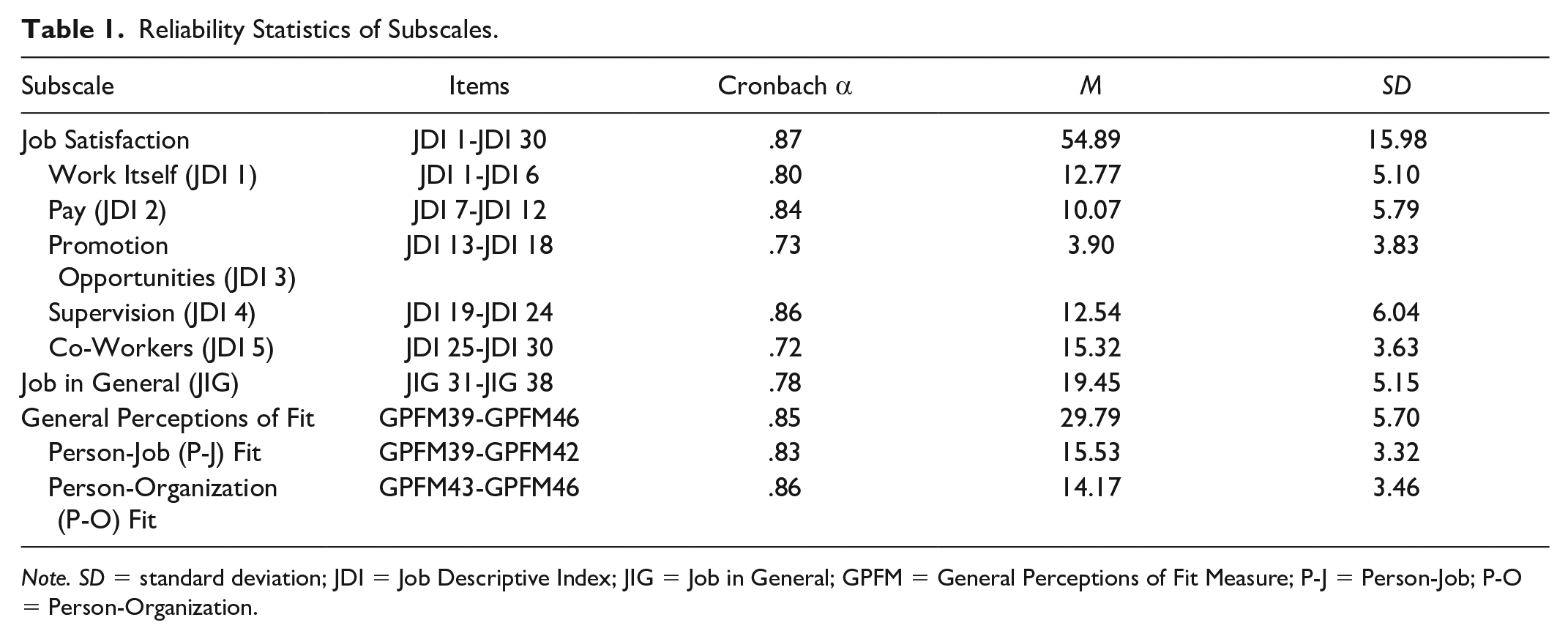
Note. SD = standard deviation; JDI = Job Descriptive Index; JIG = Job in General; GPFM = General Perceptions of Fit Measure; P-J = Person-Job; P-O = Person-Organization.
Correlations Among Subscales of Job Satisfaction.

Note. Correlations among the Subscales. JDI = Job Descriptive Index; JIG = Job in General; P-J = Person-Job; P-O = Person-Organization.
Table 2 presents correlations among subscales of job satisfaction. These correlations reveal that each JDI facet and the JIG measure distinct aspects of job satisfaction (Brodke et al., 2009). Moreover, no facet of the JDI correlates above .50. The Job in General correlated highly with the Work Itself (JDI 1) facet and the correlation is well below .80. These statistics according to Brodke et al. (2009) suggest that the JDI facets are distinct from each other and from the JIG.
Descriptive Statistics
Table 3 presents the descriptive statistics of the subscales of the Perception of Fit and Job Satisfaction measures, and Job in General measure.
Descriptive Statistics for Job Satisfaction (aJDI) and General Perceptions of Fit Subscales (n = 170).

Note. aJDI = Abridged Job Descriptive Index; SD = standard deviation; JDI = Job Descriptive Index; P-J = Person-Job; P-O = Person-Organization.
With regard to Job Satisfaction, the means of the subscales ranges between 4 and 19 relative to the mid-point score for each facet. From Table 3, the administrative staff members were highly satisfied with their coworkers (JDI 1), and above average level of satisfaction with work itself, pay, and supervision. However, administrative staff were least satisfied with promotion opportunities (JDI3) (M = 3.71, SD = 3.72), and pay (JDI2) (M = 10.10, SD = 5.77). With regard to General Perception of Fit, administrative staff members perceived to fit highly with their job and the university. The mean score of Perception of Fit for both subscales (P-J, M = 15.46, P-O, M = 14.00) were greater than the mid-point score (12) on perception of fit scale.
Primary variables relationships
Pearson (r) correlation revealed the relationships between Job Satisfaction and General Perceptions of Fit Subscales. Table 4 presents the results. All the correlations were positive and statistically significant, ranging between .18 and .66.
Correlation Between Perceived Environment Fit and Job Satisfaction (n = 170).
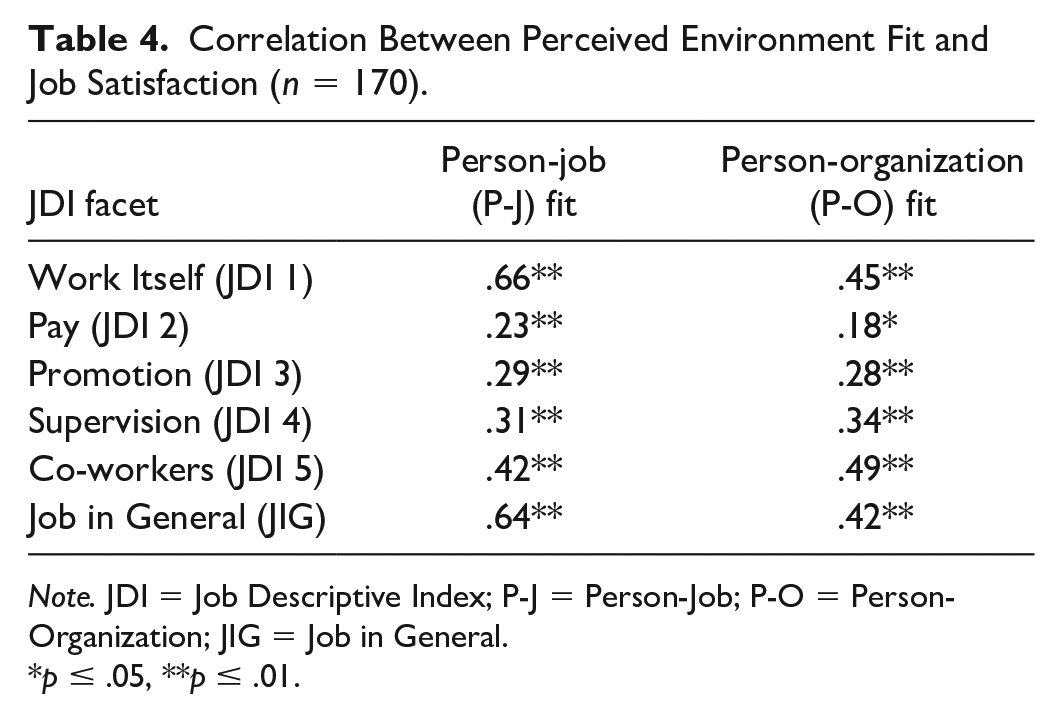
Note. JDI = Job Descriptive Index; P-J = Person-Job; P-O = Person-Organization; JIG = Job in General.
p ≤ .05, **p ≤ .01.
Strong positive relationships were found between Person-Job (P-J) Fit and satisfaction with Work Itself (JDI1) (r = .66) facet and Job in General (r = .64). Modest relationships were found for P-J Fit with Pay (JDI 2) (r = .23), Promotion Opportunities (JDI 3) (r = .29), Supervision (JDI 4) (r = .31), and Co-workers (r = .42). Person-Organization (P-O) fit had moderately positive relationships with all five facets of job satisfaction except Pay (JDI 2), with which it had a weak positive relationship. P-O fit also had a modestly strong relationships with overall job satisfaction, as measured by Job in General (r = .42). Both P-J Fit and P-O Fit had the weakest relationship with the Pay facet (r = .23, r = .18, respectively).
A regression analysis (using the enter method) (Corty, 2016) was conducted to find the predictors for each subscale. Tables 5 and 6 present results of the regression analyses.
Regression Models Using Person-Job and Person-Organization Fit to Predict JDI Facets, and Job in General (JIG) (n = 172).

Note. JDI = Job Descriptive Index; ANOVA = analysis of variance; JIG = Job in General.
Regression Coefficients for Models Using P-J and P-O Fit to Predict Job Satisfaction Subscales and Job in General (n = 172).

Note. JDI = Job Descriptive Index; P-J = Person-Job; P-O = Person-Organization; JIG = Job in General.
Results show that the two-factor (P-J Fit, P-O Fit) model significantly predicted all five facets of job satisfaction, and satisfaction with job in general (JIG). The F-ratios of the models ranged from 5.36 to 73.24. The results support the hypothesis (H1) that there is a relationship between perceived fit with university environment and job satisfaction among administrative staff members. The strongest prediction was for Work Itself (JDI 1) and Job in General, in which P-J Fit and P-O Fit accounted for 46% and 43% of the variance in the dependent variables, respectively. Of the six regression analyses, the Pay (JDI 2) facet showed the weakest prediction with only 6% of variance explained by the two factors.
Table 6 presents a summary of the regression coefficients. The results (Table 6) show that the two predictors (P-J Fit, P-O Fit) significantly contributed to the regression models, except the model predicting Pay (JDI 2). Only P-J Fit contributed significantly to the Pay (JDI 2) facet (β = 0.18, p = .032). Therefore, the 5% of variance explained in Pay (JDI 2) (see Table 5) is attributable solely to Person-Job fit. For the remaining regression models, P-J Fit was the stronger predictor for Work Itself (JDI 1) and Job in General (JIG). P-J fit and P-O fit similarly predicted Promotion Opportunities (JDI 3). On the contrary, P-O Fit was the stronger predictor for satisfaction with Supervision (JDI 4) and satisfaction with Co-workers (JDI 5).
Demographic Differences
Analysis of variance (ANOVA) results revealed no statistically significant mean difference in satisfaction with all subscales of job satisfaction, and Job in General scale. Level of education ANOVA results showed a statistically significant, F (2, 152) = 3.96, p = .021 mean difference in satisfaction with Promotion Opportunities (JDI 3) by age. A further analysis using a Scheffe post hoc test revealed satisfaction with Promotion Opportunities (JDI 3) for administrative staff aged 50 years and over was statistically significant and higher than the 20 to 34.5 and 35 to 49.9 age groups. ANOVA results also revealed a statistically significant, F (2, 167) = 3.33, p = .038 mean difference in satisfaction with the Promotion Opportunities (JDI 3) by years of service. A further analysis conducted using a Scheffe post hoc test showed that administrative staff members who served the university for 20 years and above have significant and higher level of satisfaction with Promotion Opportunities than those who served less than 20 years.
The results of independent sample t-test showed no statistically significant mean differences between male and female administrative staff members in any of the five facets of job satisfaction, or in satisfaction with Job in Generals. There was, however, a statistically significant mean difference between female and male administrative staff members with respect to Person-Job (P-J) Fit, t (168, 137.61) = 2.068, p = .040. The male administrative staff members perceived a higher level of P-J Fit than the female administrative staff.
Discussion
This study examined the relationship between perceived fit and job satisfaction among administrative staff members in a Midwestern public university, as well as the relationships between the subscales of the primary variables.
Level of Perceived Fit and Job Satisfaction
The study found that administrative staff members had a high level of perceived fit with their jobs (P-J Fit) as well as the university (P-O Fit). Furthermore, at the facet level, administrative staff members had the highest level of satisfaction with their Co-workers (JDI 5). The level of satisfaction with the Work Itself (JDI 1) and Supervision (JDI 4) was average. However, Promotion Opportunities (JDI 3) was above average level of satisfaction. However, administrative staff members were mostly unsatisfied with Promotion Opportunities and to some extent with Pay (JDI 2). This study supports findings by Schroder (2008), and ASC (2012), which revealed that administrative staff members were most dissatisfied with salary. The differences in the standard of satisfaction at the facet level are not surprising, because employees are perhaps satisfied with some aspects of their responsibilities but not others (Volkwein et al., 1998).
Perceived fit and job satisfaction
In the last two decades, organizational behavior researchers and practitioners have recognized P-O Fit as important as it relates to the traditional conception of P-J Fit (Saks & Ashforth, 1997). Not surprisingly, the findings of this study are consistent with findings of earlier research exploring the relationship between perceptions of fit and Job Satisfaction (Kristof-Brown et al., 2005; O’Reilly et al., 1991; Saks & Ashforth, 1997). Person-Job fit and Person-Organization fit yielded significant and positive relationships with all five facets of job satisfaction, and with overall job satisfaction. Although some relationships were modest, Person-Job fit yielded a strong positive relationship with satisfaction with the Work Itself (JDI 1) (r = .66) and Job in General (r = .64). Even though the relative contribution of the different facets to overall Job Satisfaction was not the focus of this study, the findings suggest that the Work Itself (JDI1) (r = .66) facet might be contributing more than the other facets to the relationship between Person-Job Fit and overall Job Satisfaction. This finding was not surprising because the Work Itself subscale measures participants’ satisfaction with the work and tasks they do, which are key components of Person-Job Fit (Lauver & Kristof-Brown, 2001). Sekine and Tatsuse (2011) concluded that intrinsic aspects of the job contributed more to overall satisfaction than any other facet of job satisfaction. Thus, an increase in the level of perceived Person-Job Fit among administrative staff members can lead to an increase in their level of satisfaction with the work itself and overall job satisfaction. Although Person-Organization Fit had significant relationships with all five facets of job satisfaction and overall job satisfaction, it had only moderately strong relationships with the Co-workers and Work Itself, and with overall job satisfaction. Of particular interest is the weak relationship found between both Person-Job Fit and Person-Organization Fit with the Pay facet. This is because pay is among the lowest ranked factors contributing to job satisfaction (Hashim & Mahmood, 2011). The results suggest that pay increase might in practical terms not have much influence on perception of fit among administrative staff members, and vice versa. University leaders should not assume that an increase in pay would compensate for poor job or university fit.
Perceived Person-Job and Person Organization Fit as Predictors of Job Satisfaction
In determining Person-Job and Person-Organization fit as predictors of job satisfaction, this study is consistent with findings of earlier research (see Cable & Judge, 1996; Kristof-Brown et al., 2005; Liu et al., 2010; O’Reilly et al., 1991; Saks & Ashforth, 1997). The present study found that Person-Job (P-J) and Person-Organization (P-O) Fit significantly predicted all five facets of job satisfaction and overall Job Satisfaction as measured by the Job in General scale. The predictors (P-J Fit, P-O Fit) explained 46% and 43% of variance in the Work Itself facet and overall Job Satisfaction, respectively. However, the regression coefficients revealed P-J Fit was the stronger predictor for satisfaction with Work Itself, Pay, and Job in General. P-J Fit is the stronger predictor because, as suggested by earlier research, employees’ evaluations of the work and tasks they do has a strong influence on job satisfaction. For instance, previous studies found that in a work environment, work itself was the most significant and strongest predictor of job satisfaction (Smerek & Peterson, 2007; Stefanovska-Petkovska et al., 2014). Person-Organization (P-O) Fit, on the contrary, has no direct link to the daily tasks and activities and therefore less likely influences employees’ job satisfaction (Lauver & Kristof-Brown, 2001). The findings of this study supports Lauver and Kristof-Brown’s (2001) assertion that employees can have the skills and competence required for a job and yet not share the values of the organization and vice versa.
The results revealed that P-J and P-O Fit significantly contributed to the models except predicting pay, where only P-J Fit was the significant contributor. Furthermore, the results of the study reveal the unique impacts of P-J Fit and P-O Fit on Job Satisfaction. According to the Need Press Theory, organizational/institutional environments have characteristics that can either ease or inhibit the needs of people. It thus emphasizes the importance of the match between the individual’s needs and the real environment’s ability to satisfy those needs (Murray, 1938). Herzberg’s two-factor theory identifies promotion, supervision, and co-workers as extrinsic facets of job satisfaction. These facets are characteristics of organizational/institutional environments (P-O fit).
Although P-J Fit was a stronger predictor than P-O Fit concerning satisfaction with Work Itself, Pay, and Job in General, P-O Fit was the strong predictor of satisfaction with Supervision and Co-workers. These findings lend support to recognition of the independent relationship and unique impacts of the different types of fit on organizational outcomes such as job satisfaction (Kristof-Brown et al., 2005; Lauver & Kristof-Brown, 2001; Van Vianen et al., 2011). Moreover, the results of this study also support the notion that employees are able to distinguish fit between their jobs and organization (Kristof-Brown et al., 2005; Lauver & Kristof-Brown, 2001).
Demographics and Perceived Fit, and Job Satisfaction
Not surprisingly, among the demographics used in the analysis, age and years of service to the university relates to job satisfaction, similar to the findings by Toker (2011) and Stefanovska-Petkovska et al. (2014). Satisfaction with Promotion Opportunities significantly differed by age among administrative staff members, with those 50 years and over being more satisfied with their Promotion Opportunities than those below 50 years are. Moreover, satisfaction with Promotion Opportunities also significantly differed by number of years of service; those with 20 years or more of service to the univer-sity had significantly higher satisfaction with Promotion Opportunities than those with less than 20 years of service. Whereas this finding is similar to Toker’s (2011) findings among university academic staff who served for 21 years and over, it is in contrast to the findings by Smerek and Peterson (2007) with respect to satisfaction with promotion opportunities. Smerek and Peterson (2007) contend that the significant mean difference is due to declined expectations by the older and long-service employees and that age and length of service negatively correlates to professional growth opportunities.
The present study found no statistically significant mean difference in job satisfaction with respect to the education and gender of the participants. This result is consistent with other studies showing a lack of significant association between education, gender, and job satisfaction (Mason, 2001; Saygi et al., 2011; Schroder, 2008; Worrel et al., 2006). Interestingly, however, t-test results indicated a statistically significant difference between female and male administrative staff members with respect to their perception of fit with their job. The male administrative staff members had a perception of a better fit with the job than their female counterparts did, because women are less satisfied compared with their male counterparts with their work itself (Stefanovska-Petkovska et al., 2014). Despite the growing workforce enforcement of anti-discrimination laws, policies, and changing social norms, gender remains a significant distinguishing variable among staff in the university environment (Brandon, 2011).
Implications for Practice and Future Research
Practice
Employers want to improve the quality of work life for employees because of the potential impact employee job satisfaction has on organizational variables such as performance, productivity, and turnover (Edwards et al., 2008; Samad, 2011). Therefore, in a university setting, administrators concerned with the effectiveness and vitality of their institution will be concerned with this phenomenon. Given the limited resources at every college and university, wisely using the resources available to affect job satisfaction will aid in the overall functioning of the institution (Smerek & Peterson, 2007). In addition, supervisors of administrative staff can use the Job Diagnostic Survey (Hackman et al., 1975) to assess the extent to which administrative staff members’ skills/competencies match the requirements of their responsibilities. Where there is a mismatch in knowledge or skills, training presents a straightforward strategy to improve fit (Kulick et al., 1987; Mount & Muchinsky, 1978).
Future research
Despite the study’s contribution to the organizational behavior literature, it has limitations. First, the study examined administrative staff members in only one Midwestern public university; thus, the ability to generalize the findings is limited to that institution. Future research should extend to other institutions in the study region and/or universities from other regions across the United States. Second, the study relied on self-reported data and used standard multiple regression. All these factors constrain the ability to make causal statements about the examined relationships, and the exclusive use of self-reported data may create the potential for common-method biases (Kim, 2012). Future studies should increase the sample size, the diversity, and the use of other methods of sampling and data analysis. Finally, future studies should attempt to investigate the compatibility between people and their work groups (Person-Group fit) (Kristof, 1996), because a super-ordinate perception of person-group fit may underlie other types of fit, such as Person-Organization fit (Seong et al., 2012). The work group can range from a small group of immediate co-workers to any identifiable sub-unit of an organization, such as functional department or geographic division (Kristof, 1996).
Conclusion
This study is one addition to the growing body of research studies highlighting the importance of the relationship between employees’ perceptions of fit with their jobs and organizations and their job satisfaction (see Cable & Judge, 1996; Kristof-Brown et al., 2005; O’Reilly et al., 1991). This study not only highlighted the relationship between perceptions of fit and job satisfaction, but examined the impact of the different types of fit (Person-Job, Person-Organization) on job satisfaction in a single study (see Kristof-Brown et al., 2005; Lauver & Kristof-Brown, 2001; Van Vianen et al., 2011). As important as the role of administrative staff members in higher education, a clear understanding of issues related to their level of satisfaction significantly contributes to the effectiveness and performance of colleges and universities (Volkwein et al., 1998; Volkwein & Parmley, 2000; Volkwein & Zhou, 2003). Therefore, a guide to choosing and motivating administrative staff members is essential (Gaziel, 2001), because an increase in their job satisfaction leads to them giving of their best services to management and job performance (Samad, 2011).
As the findings of this study revealed, the level of fit administrative staff members perceive concerning their job and their work environment is central to their overall level of job satisfaction. Interestingly, the use of pay to increase the level of job satisfaction among administrative staff members is probably ineffective because this study found that Person-Job and Person-Organization fit together explained the least amount of variance (5%) in satisfaction with the Pay facet. The results of the study support the hypothesis that there is a relationship between perceived fit and job satisfaction among administrative staff. According to the current study, a higher level of fit leads to a higher level of job satisfaction, which prior research has found to subsequently contribute to person and organizational outcomes such as performance, satisfaction, and turnover (Koys, 2001; Samad, 2011; Stefanovska-Petkovska et al., 2014; Zhang et al., 2004).
Footnotes
Declaration of Conflicting Interests
The author(s) declared no potential conflicts of interest with respect to the research, authorship, and/or publication of this article.
Funding
The author(s) received no financial support for the research, authorship, and/or publication of this article.
