




Abstract
Brand loyalty, that is, a consumer’s propensity to purchase a product or a brand continuously, is one factor that can be used to increase a company’s profits. Initially, consumers may do some evaluation before they decide whether or not to be loyal to a brand or a product. Previous research suggests that consumer perceived ethicality predicts brand loyalty through brand affect. The aim of this study is to examine if brand affect influences the relationship between consumer perceived ethicality and brand loyalty in Indonesian older adult consumers. This study involved 331 older adult bottled water consumers in Indonesia, who participated by completing a set of questionnaires. Mediation analysis results suggest that brand affect only partially influences the relationship between consumer perceived ethicality and brand loyalty. It can be concluded that a brand’s ethicality is a greater consideration than brand affection for older adult consumers to remain loyal toward a brand.
Introduction
Companies can increase their profits by encouraging their consumers to keep using and buying their products (Oliver, 2010). Consumer loyalty, that is, brand loyalty, brings benefits to the company such as reduced marketing costs, more new customers, and ever-increasing trade (Aaker, 1991). As keeping consumers’ loyalty is difficult, understanding brand loyalty then is useful when building a marketing concept strategy (Chaudhuri & Holbrook, 2001) and in encouraging the creation of oral—or word of mouth—recommendations (Reichheld & Schefter, 2000). In addition, the implementation of Corporate Social Responsibility (CSR) may also help increase brand loyalty. Although brand loyalty has been studied for some time, its relationship to older adult consumers has not.
The increasing number of older adults will constitute a challenge for a country’s economy (Drolet, Schwarz, & Yoon, 2011). Growth in the older adult population will create large market demand because they, as consumers, may have different needs compared with other consumer age groups, and companies must strive to create a product or brand to meet those needs (Moschis, 2012; Nataraajan & Bagozzi, 1999). Previous studies suggest that the older adult consumer segmentation is identical in population to other age categories, yet few studies have produced an in-depth understanding of older adult consumer behavior (Moschis, 2012). Therefore, there is a need for research related to how older adult consumers behave, make decisions, and choose a brand from those available in the market. Understanding the relationship between antecedents of brand loyalty on older adult consumers’ loyalty may provide important knowledge for both marketers and consumers. This may encourage marketers to create products or brands that suit the needs of older consumers.
Literature Review
Brand loyalty is a strong commitment by a consumer to purchase or repeatedly purchase a product, or use a brand or service consistently, without influence from situational factors or the marketing of a competitor’s product (Lin, Wu, & Wang, 2000; Oliver, 1999; Reichheld & Sasser, 1990). This behavior aligns with the main objective of a marketing strategy, that is, to encourage consumers to continue to buy a particular brand in the future (Kumar & Advani, 2005; Reichheld & Schefter, 2000). Chaudhuri and Holbrook (2001) divided brand loyalty into two dimensions: behavioral loyalty and attitudinal loyalty. Behavioral loyalty is the intention of an individual to consistently buy certain products (Quester & Lim, 2003). Attitudinal loyalty is the attitude and commitment of an individual to make repeat purchases of a particular product (Quester & Lim, 2003). In this study, both dimensions of brand loyalty will be measured.
Previous research into brand loyalty aimed to identify the factors that can affect consumer loyalty. Lin et al. (2000) identified several factors as principal differentiators that can affect brand loyalty. These include product attributes, post-sale services, marketing skills, quality or aesthetic perceptions, product line depth, and brand popularity. A study by Singh, Iglesias, and Batista-Foguet (2012) found a new and different factor that can affect brand loyalty. They argue that consumer perceived ethicality is a factor that can affect brand loyalty through the mediation of brand affect, and that brand trust features factors that can affect brand loyalty. This area became the focus of our research to examine the influence of consumer perceived ethicality toward brand loyalty in older adult consumers.
Consumer perceived ethicality is a construct introduced by Brunk (2012). Consumer perceived ethicality is the level of ethical perception that consumers have for a particular product or brand (Brunk, 2012). It implies a subjective impression of the consumer to the ethical behavior displayed by a product or brand and the extent to which a firm is able to actualise it in the form of real behavior (Brunk, 2012). In today’s business world, ethical consumerism is of particular concern to certain brands and products (Carrigan & Attalla, 2001; Shaw & Shiu, 2002). Consumers no longer only consider factors such as quality and price when buying or choosing a brand. They also consider innovation, and the ethical and social behavior of the brands on the market (Bussey, 2006). This has resulted in some brands being more able to describe themselves as ethical and clean, green, and socially responsible (Clegg, 2007). According to Maxfield (2008), consumers may hope for a brand to reflect their concern for ethical matters. Thus, a brand must be able to effectively communicate to customers the values that they hold (Szmigin, Carrigan, & O’Loughlin, 2007).
Ethical values promoted by companies—such as being honest, responsible, qualified, and reliable—encourage consumers to make purchases and commit to a brand (Singh et al., 2012). Previous research has revealed that companies with social concerns will encourage consumers to buy its products or brands (Murray & Vogel, 1997). Companies that behave in an ethical way may affect consumer buying behavior, whereas companies that have weaker ethical values will experience a reduced volume of consumer purchases (Mohr & Webb, 2005). This indicates that consumer perceived ethics have a positive influence on brand loyalty.
However, research conducted by Deng (2012) found different results. Deng’s study found that, although the level of ethical behavior displayed by a company influenced 44% of consumers to make a purchase, only 12% of consumers display actual buying behavior toward a brand. Conversely, 56% of consumers stated that ethical behavior displayed by a company had no effect on their buying behavior. This indicates that consumer perceived ethicality had no significant effect on brand loyalty. Thus, it is necessary to conduct further research to establish the relationship of consumer perceived ethicality to brand loyalty, particularly among older adult consumers. As older adults are also more likely to give to charity and participate in social activities, we argue that consumer perceived ethicality influences brand loyalty in older adult consumers (Aguiar & Hurst, 2008).
Singh et al. (2012) suggested a model to explain the relationship between consumer perceived ethicality and brand loyalty. They suggest that brand affect influences the relationship between consumer perceived ethicality and brand loyalty. According to Chaudhuri and Holbrook (2001), brand affect is the ability of a brand to obtain a positive emotional response from consumers. Positive emotions can be feelings of happiness, contentment, and pleasure when using a brand or product (Chaudhuri & Holbrook, 2001; Singh et al., 2012). Consumers who perceive that a product is involved in ethical behaviors are more likely to have a positive emotional response to that brand (Glomb, Bhave, Andrew, Miner, & Wall, 2011; Payne, Storbacka, Frow, & Knox, 2009). This indicates that a brand that is able to display ethical behaviors will bring about a positive emotional response in consumers who use the brand. Therefore, consumers will be more likely to repurchase and make a commitment to use the product or brand in the future (Chaudhuri & Holbrook, 2001; Dick & Basu, 1994; Matzler, Bidmon, & Grabner-Krauter, 2006; Ranganathan, Madupu, Sen, & Brooks, 2013). In Figure 1, we suggest that brand affect influences the relationship between consumer perceived ethicality and brand loyalty.

Mediation analysis model.
Method
Participants and Procedures
The participants for this study were 331 Indonesian consumers who were members of older adult communities and groups (M age = 64.19, SD = 6.51). All respondents received a set of self-report questionnaires that included all necessary information and informed consent.
Measurements
Brand loyalty was measured using four items from Chaudhuri and Holbrook (2001). The items were “I will buy this brand the next time I buy bottled water,” “I intend to keep purchasing this brand,” “I am committed to this brand,” and “I would be willing to pay a higher price for this brand over other brands.” We used six items from Brunk (2012) to assess consumer perceived ethicality. These items included “This brand respects moral norms,” “This brand always adheres to the law,” “This brand is a socially responsible brand,” “This brand avoids damaging behavior at all cost,” “This brand is a good brand,” and “This brand will make a decision only after careful consideration of the potential positive or negative consequences for all those involved.” We also used three items of brand affect from Chaudhuri and Holbrook (2001). The items were “ I feel good when I used this brand,” “This brand makes me happy,” and “This brand gives me pleasure.”
We used the 7-point Likert-type style ranging from 1 = strongly disagree to 7 = strongly agree. All materials were translated into Bahasa Indonesia using a procedure from Sousa and Rojjanasrirat (2011). We also conducted a pilot test to ensure that all items were reliable and valid and made corrections to improve readability and understanding.
Data Analysis
We used mediation analysis with bootstrapping to test our hypothesis using PROCESS macro IBM SPSS Statistics version 22 (Hayes, 2013). We centered all scores to reduce collinearity (Dawson, 2014). We used mediation analysis to investigate the influence of brand affect in the relationship between consumer perceived ethicality and brand loyalty in older adult consumers. We expect that older adult consumers’ perception toward brand ethical behavior creates their affection toward the brand. As the result, they intend to buy the product again in the future.
Results
Table 1 shows all variables’ means, standard deviations, correlation, and scale reliabilities (Cronbach’s α). All reliabilities for all variables were satisfactory, α = .89 for brand loyalty and α = .91 for both consumer perceived ethicality and brand affect. All variables were also correlated to each other. Table 1 also shows that consumer perceived ethicality has a significant positive correlation to brand loyalty (r = .70, p < .05). Brand affect variables also have a significant positive relationship to brand loyalty (r = .58, p < .05). Furthermore, consumer perceived ethicality variables have a significant positive correlation to brand affect (r = .60, p < .05). These three correlation coefficients demonstrate that the higher the score for consumer perceived ethicality and brand affect, the higher the score for brand loyalty.
Means, Standard Deviations, Correlations, and Scale Reliabilities.
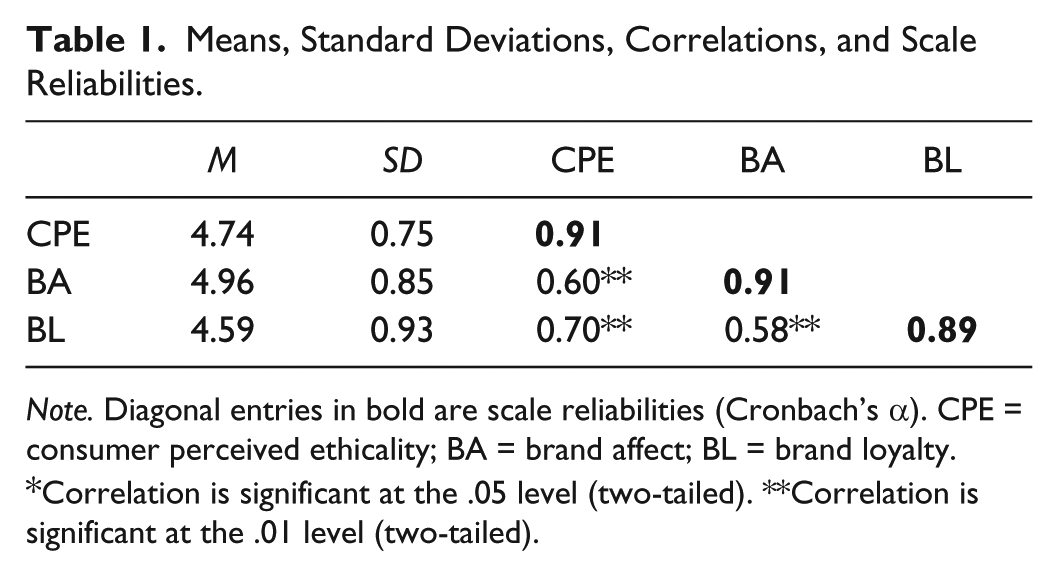
Note. Diagonal entries in bold are scale reliabilities (Cronbach’s α). CPE = consumer perceived ethicality; BA = brand affect; BL = brand loyalty.
Correlation is significant at the .05 level (two-tailed). **Correlation is significant at the .01 level (two-tailed).
Table 2 shows the mediation analysis results using PROCESS macro in SPSS IBM version 22 (Hayes, 2013). Both relationships were positive and significant between consumer perceived ethicality and brand affect (β = 0.602, SE = 0.075, t = 8.004, p = .000, lower level confidence interval [LLCI] = 0.454, upper level confidence interval [ULCI] = 0.750), and between brand affect and brand loyalty (β = 0.277, SE = 0.071, t = 3.930, p = .000, LLCI = 0.139, ULCI = 0.416). Consumer perceived ethicality also significantly predicted brand loyalty (β = 0.544, SE = 0.076, t = 7.121, p = .000, LLCI = 0.393, ULCI = 0.694). The indirect effect result from consumer perceived ethicality to brand affect to brand loyalty was also significant (β = 0.167, SE = 0.037, LLCI = 0.098, ULCI = 0.243). The results indicate that brand affect partially mediated the relationship between consumer perceived ethicality and brand loyalty.
Mediation Analyses From Consumer Perceived Ethicality to Brand Affect to Brand Loyalty.

Note. CPE = consumer perceived ethicality; BA = brand affect; BL = brand loyalty.
Discussion
This study investigated the role of brand affect in mediating the relationship between consumer perceived ethicality and brand loyalty. This is important so that business could provide consumers with valuable information through CSR, for example, to help to improve consumers’ loyalty to the product. The mediation analysis results suggest that brand affect was a partial mediator of the relationship. The study’s findings are similar to previous findings that consumer perceived ethicality is one factor that can affect brand loyalty through the mediation of brand affect (Kabadayi & Alan, 2012; Singh et al., 2012). This indicates that older adult consumers who perceive ethical behavior in a brand will be more likely to be loyal to the brand if they also have a positive affect toward the brand.
In contrast to the findings of Singh et al. (2012), we found that there was a positive and significant direct effect relationship between consumer perceived ethicality and brand loyalty. We argue that affection was not a particularly important influence in determining older adult consumers’ loyalty toward the bottled water brand. The ethical behaviors demonstrated by the bottled water brand may be enough to improve older adult consumers’ loyalty, as these consumers have a tendency to give donations to charity (Aguiar & Hurst, 2008). We assume that older adult consumers may find it easier to make a donation by buying the product than donating directly to the cause or charity.
The findings of this study promote the importance of CSR. We argue that the CSR activities conducted by a company may improve consumers’ loyalty, as consumers may be more likely to perceive these activities as a positive behavior. Therefore, it is important for a company to conduct its business in an ethical way. In addition, consumer affection, and particularly the affection of older adult consumers, should be considered. Marketers need to take this into consideration when seeking to influence older adult consumers through advertising. Older adult consumers’ positive affection can be built up over time, increasing their brand loyalty in the future.
A limitation of this study was the use of self-report questionnaires to collect data on brand loyalty. For future research, an experimental design could be used to objectively measure commitment and loyalty toward a brand. Furthermore, the results of this study could not be generalized, as the data were only collected at one point (cross-sectional method). Future research should also consider a comparison between age categories to prove that consumer perceived ethicality can predict brand loyalty.
The results of this study indicate that consumer perceived ethicality has a positive and significant relationship to brand loyalty. Thus, the more ethical the behavior displayed by a brand, the more older consumers will commit to use that brand.
Footnotes
Acknowledgements
The authors would like to thank all translators, editors, and reviewers for providing language support and valuable input for this article prior to submission.
Declaration of Conflicting Interests
The author(s) declared no potential conflicts of interest with respect to the research, authorship, and/or publication of this article.
Funding
The author(s) disclosed receipt of the following financial support for the research, authorship, and/or publication of this article: The authors received a grant from the Directorate of Research and Community Service, Universitas Indonesia (No. 717/UN2.R3.1/HKP.05.00/2017) for publication purposes.
