




Abstract
We strived to examine the combined effects of drivers and consequences of customers’ satisfaction particularly in quick-meal restaurants besides examining the interaction effect of social trust on the association between customers’ satisfaction and brand loyalty. Offline survey was conducted to approach the respondents of fast-food visitors. The valid data were assessed and analyzed through structural equation modeling and moderation step-by-step approach. The findings demonstrate that restaurant stimuli—food, service, atmosphere, location, price, and a variety of food—have robust effects on customers’ satisfaction and eventually on brand loyalty. Social trust has rigorous effect on the association between customers’ satisfaction and brand loyalty. Customers with high social trust have a positive strong bonding with restaurants than those holding low social trust. Theoretical and practical implications have been deliberated and offer some valuable recommendations along for future scholars.
Keywords
Introduction
Since 1980, the restaurant sector has grown substantially. From 1980 to till to date, the sales of the restaurant industry have increased drastically from US$42.8 billion to US$536.7 billion (approx.), which is more than 10 times (Goyal et al., 2019). Extant hospitality research has facilitated in getting comprehensive understanding of the factors that lead to of customers’ satisfaction with hotels/cafeterias/restaurants (Ivkov et al., 2018). In some of these studies, researchers have focused extensively on the customers’ dining behavior, because food is a vital element to comprehend one’s society or culture (Goyal et al., 2019; Konuk, 2019; Ryu & Han, 2010; Zhang et al., 2019), while other researchers have been interested in identifying the important service dimensions of restaurant, which include menu, cleanliness, style, price, ambience, location (Prendergast & Man, 2002), chef, service staff, and atmosphere (Emir, 2016). These service dimensions determine the dining behavior and revisit intention of the clientele. Moreover, the studies on restaurants (Namin, 2017) have reached to the conclusion that menu (ÖZDEMİR & NEBİOĞLU, 2018) and atmosphere (Dutta et al., 2014) affect customers’ satisfaction. Based on the conclusion of aforementioned studies, there is a need to comprehend the potential impact of quality of food, quality of service, atmosphere, price, as well as variety of food on customers’ satisfaction regarding fast-food restaurants.
Cultivating the brand loyalty attained paramount importance as far as the service sector is concerned, especially where service providers render services with minor distinctions and fight in turbulent environment, particularly in the fast-food industry (Santouridis & Trivellas, 2010). Earlier studies have extensively focused on antecedents of loyalty, such as service quality (So et al., 2013), word of mouth (WOM; Nikhashemi et al., 2015), customers’ engagement (Rather & Sharma, 2017; Sharma & Rather, 2017), and customers’ satisfaction (El-Adly & Amjad, 2018; Hwang et al., 2019). However, very few studies have focused particularly on indirect impact of drivers of customers’ satisfaction in explaining customers’ repeat patronage (Konuk, 2019). Due to paucity of studies in this field, a need has been felt regarding the academic assessment of cues related to food with the purpose of elucidating customers’ repeat patronage in fast-food restaurants from the theoretical as well as practical viewpoint besides the role of facilitator of customers’ satisfaction among restaurant stimuli (drivers: food quality, service quality, atmosphere, price, and variety of food) and brand loyalty. Moreover, numerous studies have examined the impact of brand trust on consumers’ behavioral intentions (Alhaddad, 2015; Song et al., 2019), but researchers have paid less attention to the impact of social trust on individual behavior (Chen & Wan, 2020), though it has significant impact on consumers’ dealings with restaurants (Robbins, 2016). Therefore, understanding how social trust of the customers impacts their intentions of revisiting the restaurants offering fast food.
Bearing in mind the collective viewpoints of cue utilization theory, S-O-R theory, expectation disconfirmation theory, and dual entitlement source, this research study fundamentally aims at filling the slot in the existing body of literature by exploring the combined effects of drivers and impact of customers’ satisfaction on brand loyalty in research models pertaining to setting of restaurants offering fast food. More specifically, this study has encompassed the factors that bring back the customer to fast-food restaurants for another meal, the effect of factors on customers’ satisfaction, the direct impact of customers’ satisfaction on the loyalty to the brand, the indirect outcome of factors on brand loyalty via customers’ satisfaction, and effect of social trust on the association among satisfaction and loyalty of patrons.
Our research theoretically extends to the literature of hospitality marketing and consumers’ behavior by examining the combined effects of drivers and impact of customers’ satisfaction on brand loyalty. In addition, the study validates the interactive effect of moderating variable social trust on customers’ satisfaction, which helps strengthen the association between customers’ satisfaction and brand loyalty. Furthermore, the study extends current literature by demonstrating that customers’ satisfaction mediates between drivers (food quality, service quality, restaurant atmosphere, price, and variety of food) and outcome variable (brand loyalty). Moreover, the findings of this study offer suggestions to fast-food restaurateurs to devise some effective strategies to keep the customers satisfied by incessantly evaluating their feedback. For government, this study offers insight that customers’ brand loyalty and customers’ satisfaction are influenced, to some extent, by societal trust; therefore, governments need to devise some strategies to increase the individual’s general trust of the society.
The remaining part of the study is presented as follows: The second section discusses the hypothetical background and formulation of hypotheses. The third section presents the adopted procedure, analysis, and major findings. The fourth section provides the final discussion on results as well as draws the conclusion followed by outlining the practical and theoretical implications, limitations, and future directions for forthcoming researchers.
Hypothetical Background and Formulation of Hypotheses
Food Quality
Food quality is a distinct feature as far as experience of dining in a restaurant is concerned (T. J. Lee et al., 2012; Serhan & Carole, 2019). It pertains to those characteristics which significantly impact intentions of consumers’ behavior as regards dining in a restaurant (Serhan & Carole, 2019). Presenting quality food is particularly vital when it comes to pleasing the target market. It increases the eternal achievement of the restaurant (Campbell & Fairhurst, 2016). Food quality is conceded as one of the determining factors of customer philanthropy; therefore, it facilitates the business in increasing the market share (Ryu & Han, 2011). Food quality is perceived to be a fundamental element in stipulating the accomplishment of the restaurant industry (Rashidin, Javed, Liu, & Jian, 2020). Mattila (2001) expressed three fundamental reasons for customers to visit their marked restaurant, which include food quality, service, and atmosphere. According to Truong et al. (2017), quality of food was the most vital characteristic among all restaurant dimensions offered to the customers and represents a pragmatic association with satisfaction of customers and their loyalty to the brand. In a restaurant setting, food quality is determined on the basis of its freshness, temperature, and getting flawless food on every occasion (Andaleeb & Conway, 2006; Daries-Ramón et al., 2018).
According to Olson (1972), concurring the cue utilization theory, the clients utilize innate and adventitious cues for evaluating worth of a particular product. Particularly, in case of foodstuff, the innate signs entail shape, look, and shade, in addition to a structure that can be altered only by altering the physical characteristics of a food. On the other hand, adventitious cues include brand, price, store name, origin of product, and nutritious value as well as production details rather than physical composition of a product (Teas & Agarwal, 2000). In addition, Namkung and Jang (2010) argued that criteria of the quality of food entail fitness, freshness, flavor/deliciousness, as well as presentation of food.
According to Jacoby (2002), the theory of stimulus-organism-response (S-O-R) accentuates that improvement in the assessment of internal procedure of the organism is elicited by an impetus that influences the reaction (Sandor Czellar, 2003). Referring to this theory, features of food entails shape, flavor, and look act as impetus and are capable of influencing customers’ innate assessments, and ultimately satisfaction of customers and their loyalty to the brand.
Therefore, we hypothesize the following:
Service Quality
Basing on the field wherein it is utilized, one can define service in a variety of ways. Kotler and Keller (2009, p. 789) explained service as “any intangible act or performance that one party offers to another that does not result in the ownership of anything.” It is also defined as total features and the attributes of the product and services that satisfy the real or implied needs of the customers (Kotler et al., 2002). The quality of service is described “as a perception of the customers about the services which may meet or exceed his/her expectations” (Zeithamal et al., 1996, pp. 31–46). It is considered as a momentous feature of restaurant dining. Service quality is equally important as food quality (Bujisic et al., 2014) and plays a vital role in building up the perception to re-patronage (Pantelidis, 2010). Regarding the restaurant setting, studies have emphasized that service quality is an imperative determinant of customers’ satisfaction (Ivkov et al., 2018) and re-patronage (Weiss et al., 2004). In turbulent market environments, service quality is identified as a decisive element for the success of fast-food restaurants as it has a remarkable impact on consumers’ behavior because it induces either satisfaction or dissatisfaction (Wong & Fong, 2010). Hence, improvement in service quality helps fast-food operators compete, retain the existing customers, and attract new customers (Zeithaml & Bitner, 1996). Earlier researches have accentuated the role of service for determining patron’s satisfaction, which customer encounters at the restaurant setting (dimensions: friendly staff, courteous, quick service line, waiting time, etc.; Bujisic et al., 2014), in addition to the consumer’s behavioral intention to revisit (Kandampully et al., 2015). Thus, we can extrapolate from previous findings that enhanced service quality results in a contented customer (Meesala & Paul, 2018), which leads to brand loyalty.
In the light of S-O-R theory, service quality traits like friendly staff, courteous, quick service line, and waiting time as stimulus may affect their associated internal evaluations (customers’ satisfaction) and external responses (brand loyalty). Therefore, we hypothesize the following:
Atmosphere
In restaurant industry, atmosphere is perceived as a very crucial element (Kivela et al., 1999; Qin & Prybutok, 2009), because it influences a customer’s emotions, expectations (Kranzbühler et al., 2018; Wall & Berry, 2007), and dining experience (Dutta et al., 2014). According to Bitner (1990) and Daries-Ramón et al. (2018), customers initially look upon the atmosphere to take any services; the buildup perception about the services may affect the customer’s reaction to the services delivered in the restaurants (Bitner, 1990; Daries-Ramón et al., 2018). The perceived atmosphere draws cognitive responses, which further influences the patron beliefs about a place, services, staff, and products (Bitner, 1992). Moreover, if the opinion of a customer is high about the atmosphere of the restaurant, his or her hopes about the service could also be high (Daries-Ramón et al., 2018). The perception about the restaurant services cape directly influences customers’ satisfaction (W. G. Kim & Moon, 2009). According to Longart et al. (2018), in a restaurant setting, after food quality, variety of food, and price, atmosphere is considered as a major element that differentiates one service provider from another. Thus, we can say that the atmosphere has become really essential in restaurant settings, because customers tend to be provoked by atmospheric stimuli, such as lights, ambiance, style, cleanliness, comfortable seats, aesthetic elements, music, and noise (C.-H. S. Liu et al., 2014; Pei & Ayub, 2015), which subsequently increases the behavioral intention or repeat patronage (Wakefield & Blodgett, 1994). Furthermore, Daries-Ramón et al. (2018) and Rashidin, Javed, Liu, and Jian (2020) endorsed that perception about physical surroundings is a direct marker of a customer’s satisfaction. In this manner, customer’s satisfaction is directly linked with the facets of constructive behaviors.
Consistent with the S-O-R theory, environmental factor is an impetus which prompts innate responses of individuals to that ambience. As far as a service setting is concerned, atmospheric features serve as incitements for customers’ reactions (Lin & Mattila, 2010). As regards the organism, the clients come across three diverse kinds of emotional situations: dominance, excitement, and pleasure. Nevertheless, merely the passionate condition of satisfaction of the customers was explored in this research study. Thus, we hypothesize the following:
Price
Price has been perceived as an imperative factor in elucidating the behavior of the customers. It can be defined as “what the customer paid to get the product or services” (Zeithaml, 1988). It is an influential and persuasive tool to attract customers to buy from a particular brand. Similarly, Rao and Monroe (1989) considered price as a tool that tells the customers about the worth of the product. Customers usually estimate the value of the product or services offered via price (Javed et al., 2018).
Customers’ perception about the price is explained by equity theory as “parties involved in social exchanges compare the ratios of their inputs into the exchange to their consequences from the exchange” (Bechwati et al., 2009, p. 2009). Alternative hypothetical basis of price is the principle of dual entitlement. According to this principle, “in an economic transaction, the buyer is entitled to a fair price, and the seller is entitled to a fair profit” (Haws & Bearden, 2006, p. 304). According to this principle, by ignoring the one party’s prerogative, the perception of inequitableness comes to the light (Bolton et al., 2003). Furthermore, when purchasers’ reference price is less than the retail price, they may ultimately appraise this price as discriminating (Xia et al., 2004). In this research study, the equity theory and principle of dual entitlement have been utilized as a hypothetical base to comprehend clients’ satisfaction with price of fast-food items. Hence, referring to these theories, the mentioned price of the food items will be considered satisfactory if it delivers reasonable gains to the enterprise. Moreover, compliant with the S-O-R theory, realistic, according to clients’ internal assessment, adequate and rational costs of food may govern clients’ satisfaction as well as brand loyalty with fast-food restaurants.
In the restaurant industry, the price of the items on the menu varies from restaurant to restaurant. Due to intense competition in the restaurant industry, the customers may develop internal reference prices (Campbell & Fairhurst, 2016). The price embedded in the customer’s mind works as a base for comparing the real prices with the expected prices (Grewal et al., 1998). The restaurant must charge for the services offered in accordance with what the people are willing to pay, or provide the services at competitive prices bearing in mind the customers’ expectations (Saul et al., 2018; Yuksel & Yuksel, 2002). Empirical studies examined the association between price and customers’ satisfaction and behavioral intentions of re-patronage. Oliver and Swan (1989) considered the price as an antecedent of customers’ satisfaction. They also identified that the customer makes a comparison of his or her existing payment with the expectation, assessing whether the actual compensation is higher or lower than what he or she contemplates is essential. If he or she observes a balance in price / value trade off, he or she tends to be gratified by the amenities offered by the restaurant. Klassen et al. (2015) conducted a study, wherein they found that 62% of the students believed that price is the most imperative reason for making a decision to dine out from a particular restaurant. In addition to this, Bolton and Lemon (1999) found a direct link of price with customers’ satisfaction. Once customers are certain that they are getting paramount quality of product or service, they tend to be loyal in the long run. It is in line with this prediction. Therefore, we hypothesize the following:
Variety of Food
Diversity-seeking conduct is part and parcel of human nature when it comes to consumption of any product or service (Ratner et al., 1999). Customers are frequently in search of a wide range of alternatives when it comes to a product or service (Hoyer & Ridgway, 1984). Consistent with the optimal stimulation level theory, thanks to repeat product procurement, direct diversity-seeking conduct ensues with the purpose of diminishing monotony as well as to increase the level of stimulation. The accessibility of a variety of products/services got paramount importance particularly in the restaurant industry (S. Lee et al., 2020; Thomas, 2013). In the context of hospitality sector, it is recognized as diversity in menu (Josiam et al., 2014). It is in line with Huang et al. (2015) study, wherein he viewed the significance of variety-seeking in the service sector. Zandstra et al. (2000) conducted a study on the consumption of meat sauce at dinner time at home that lasts for almost 10 weeks at dinner time. The results indicated that as the days passed, it became the cause of boredom among the family members and diminished their consumption. Another research study undertaken by Lähteenmäki and van Trijp (1995) revealed that sandwiches with diverse stuffing are expected to bring some diversity to the flavor. In addition, the study involving consumption of eight sandwiches having different stuffing indicated that it would provide extreme diversity to the customers as far as taste is concerned. Numerous studies pointed out that variety of food (Park, 2004) greatly influences a patron’s perception about the restaurant setting (Meesala & Paul, 2018), which consequently influences the customers’ satisfaction and repeat-restaurant patronage (Nield et al., 2000). Therefore, we hypothesize the following:
Brand Loyalty
The notion of brand loyalty has transformed with the passage of time (Ahn & Back, 2018). Earlier, it was considered a univariate measure in terms of repeated buying behavior (Cunningham, 1961). Subsequently, it was felt as a complex multidimensional construct (Alfian et al., 2019). It is elucidated as “a deeply held commitment to re-buy or re-patronize a preferred product/service consistently in the future, thereby causing repetitive same-brand or same brand-set purchasing, despite situational influences and marketing efforts having the potential to cause switching behavior” (Oliver, 1999). Moreover, the present study measured the brand loyalty by the suggested three dimensions of brand loyalty, which are behavioral loyalty, affective loyalty, and attitudinal loyalty. The first approach to brand loyalty is affective loyalty as admiration or conformity propensity, which is comprehensively manifested in favor of a brand than rival brands in the market. The second approach of brand loyalty is cognitive/evaluative loyalty with brand. It refers to the positive evaluation of a specific brand by the customer on the set criteria (Rather, 2017; Rather et al., 2018). The third approach to brand loyalty represents behavioral loyalty for an explicit brand which deals with the upbeat reaction for buying as well as consumption activities (Chaudhary et al., 2018; Rather et al., 2019). From behavioral perspective, in the case of restaurant setting, loyalty demonstrates the number of visits (Rather & Hollebeek, 2020).
The concept of brand loyalty is relatively more important for services sector, especially for those who provide services with minor distinctions and contend on dynamic environment, particularly in fast-food industry (Khorasani & Almasifard, 2018). In fact, the loyal customers are willing to expend chunks of money for the foodstuffs or amenities offered by the restaurant without giving due consideration to the price. This cohesive bonding between customer and restaurant places a positive impact on its profitability (Flavián & Guinalíu, 2006). That is why restaurants use defensive marketing strategies to grab more market share and profits by establishing the brand loyalty (Ergün & Kitapci, 2018).
Customers’ Satisfaction
Customers’ satisfaction is among the fundamental concepts being utilized to elucidate consumers’ conduct. In line with theory of expectation disconfirmation, customers’ satisfaction is abstracted as “the psychological state resulting when the emotion surrounding disconfirmed expectations is coupled with the consumer’s prior feelings about the consumption experience” (Oliver & Swan, 1989, p. 29). Consistent with this definition, when customers’ prospects are met, satisfaction ensues, else disappointment arises (Namkung & Jang, 2007). Customers’ satisfaction has cognitive as well as affective elements (Bigné et al., 2008). Cognitive element entails rational valuation of the acquired product, while the affective element entails sentiments, for example, cheerfulness and pleasure, causing the fulfillment of the anticipations (Yu & Dean, 2001). Empirical studies have reached to the conclusion that customers’ satisfaction is a resilient forecaster of revisit intentions (Javed et al., 2018; Rather et al., 2018). Particularly in the hospitality context, customers’ satisfaction has a positive impact on customers’ revisit intentions (Otto et al., 2020; Rather, 2017). Bearing in mind the theory of expectation disconfirmation and S-O-R paradigm, it is foreseen that exceedingly contended clienteles are more probable to visit the restaurant again and again. Therefore, we hypothesize the following:
As debated earlier, the current study employed four theories as theoretical foundation which provide base for hypotheses: theory of S-O-R paradigm, theory of cue utilization (Olson & Jacoby, 1972), theory of expectation disconfirmation, and source of dual entitlement. Capitalizing on these theories as well as the literature review, the established theoretical framework exhibited in Figure 1 discovered that quality of food, service, price, atmosphere, location, and variety of food are modeled as drivers of customers’ satisfaction, and brand loyalty is the outcome.
Proposed framework.
The Moderating Role of Social Trust
The earlier literature studied brand trust and its impact on individual intentions to make purchase (Rather et al., 2019; Rather & Hollebeek, 2019). It is referred as customer’s “confidence on exchange partner’s reliability and integrity” (Morgan & Hunt, 1994) and is acknowledged as an association to the pragmatic attributes, such as brand proficiency, reliability, trustworthiness, restraint, and objectivity (Morgan & Hunt, 1994). It impacts their subsequent loyalty as well as commitment as it represents the actor’s aspiration to pursue the affiliation (Martínez & Rodríguez del Bosque, 2013). Scholars have gradually become more concerned about the influence of social trust on individual’s behavior (Chen & Wan, 2020). It fosters everyday interactions, exchanges, and transactions (Robbins, 2016). This term is referred as “general conviction about the honesty, truthfulness, and faith in the people.” It does not suggest that an individual places trust on others because they know each other personally, but it signifies a broader spectrum how people can be trusted in general, and without trust, social bonding is unfeasible (Chalabi, 1996).
Numerous service organizations (in the context of restaurant setting) are operating in the society. There are two classical schools of thought who viewed social trust differently; the social psychological thought believes in individualism, while the societal school of thought believes in collectivism. According to social-psychological school of thought, trust is an essential element of an individual’s personality traits (Liang & Ju, 2016), because an individual’s learning about trust starts from his or her home, and this childhood socialization changes with the passage of time as the experience is gained (Uslaner, 2000). Moreover, social trust is reliant not only on the reciprocity of experience, but is also closely associated with the subjective feelings and the kind of the personality that an individual has (Uslaner, 1999). Scholarly studies found that individual’s “belief in just world” is greatly associated with interpersonal trust and subjective well-being (Enache & Dumitrof, 2017). Faith in people and faith in the world are primary features of “belief in just world.” The societal school of thought viewed that trust is not the characteristic of an individual but that of a society (Mahdavi & Daryaei, 2017). The focus of this approach is on how people evaluate the society, wherein they live, rather than their personality. Moreover, it is the top-bottom phenomenon that is developed by society and daily experience that recommends acting in a credulous and distrusting way (Abdul Shukor et al., 2019). Consumer who has been deceived in shops, exploited at workplace, served unjustly, betrayed, or lied by acquaintances on daily basis (Hardin, 1998) has low social trust and infers that people cannot be trusted in general, which will ultimately affect his or her specific trust (use preexistent schemas) (Brewer, 2008). It is in line with earlier studies that generalized trust and specific trust are causally interrelated (Freitag & Traunmüller, 2009; Newton & Zmerli, 2011).
Applying this notion in the perspective of current research study, we argue that low-trust clientele remains satisfied with a restaurant when restaurant has failed to meet some standard of honesty once. But, if this happens more than once, he or she might switch the restaurant, and this “moral yardstick” further decreases his or her social trust (Boix & Daniel, 1998; Krammer, 2019). However, the decision could be different if the customer possesses some personality traits, such as high tolerance level, faith on people, cooperative, optimistic, and forgiver nature. In addition, Tone et al. (2019) found that specific personality traits are strongly associated to an individual’s behavior. To this edge, in case of any negligence, a customer fully cooperates with a restaurateur and does not get disappointed immediately with the services (Thielmann et al., 2020). The customer is still satisfied with the restaurant setting and plans for repurchase and talks favorably about the restaurant with others. Thus, we deduce that customer who possesses this sort of personality is less affected by the prevailing societal factors that lower the social trust of an individual, but still believes that people can be trusted in general (His/her relational trust is less affected by his/her general trust) (Robbins, 2016). This trust could ultimately lead toward long-term commitment, greater share of wallet, and positive WOM. Complementing the aforementioned arguments and literature, we can state that consumer having high social trust further strengthens the association between customers’ satisfaction (i.e., satisfaction with restaurant stimuli) and loyalty with restaurant than having low social trust. Consequently, we assume the ensuing hypothesis:
Method
Measurements
Bearing in mind the perspective of current study, slight modifications were made in the scale of the indicators of extant studies, which include food quality, service quality, restaurant atmosphere, price, variety of food, customers’ satisfaction, brand loyalty, and social trust. A three-item scale was used to measure perceived food quality, perceived service quality, perceived restaurant atmosphere, price, and customers’ satisfaction (Trafialek et al., 2020). A two-item scale was used to measure variety of food (Trafialek et al., 2020; Xi & Shuai, 2009). Moreover, a six-item scale was used to measure brand loyalty (Sunaryo, 2019) and further conceptualized into three dimensions such as behavioral, affective, and cognitive loyalty. Regarding the social trust, standard survey question was asked in this study to measure the individuals’ trustworthiness about society around them (Javed et al., 2018; Newton, 2001; Rashidin, Javed, Chen, & Jian, 2020). The question stated, “By and large, are you of the opinion that you can trust majority of the people or you can’t be so cautious while making a deal with the people?” (Delhey & Newton, 2003). Moreover, the scale was adapted in the context of restaurant, drawn from societal school of thought and social psychological school of thought: the role of individual’s personality traits and the role of society/social system in building individual’s general trust. First, the role of individual’s personality traits in building trust on society was gauged by proposed two-item scale adapted from Delhey and Newton (2003), a two-item scale of tolerance adapted from Delhey and Newton (2003), and a two-item scale of general faith on people adapted from Rosenberg (1957), whereas the role of social system in building trust (Restaurants are operating in society/part of society) was measured by proposed two-item scale on perception about current societal conditions adapted from Delhey and Newton (2003) and a proposed two-item scale of social network of individuals adapted from Delhey and Newton (2003).
Scale Validation
We certified our scales and measurement model using multiple methods. First, according to Bloemer et al. (1999), we implemented exploratory factor analysis (EFA) to endorse the fundamental factors with the help of varimax rotation and extricated eight features: food quality (FQ), service quality (SQ), restaurant atmosphere (RA), price (PR), variety of food (VR), customers’ satisfaction (CS), brand loyalty (BL), and social trust (ST). Majority of the factor loadings (FLs) were greater than 0.80 apart from SQ3 (FL = 0.521), related to service quality “courteous staff,” which was consequently excluded for further proceedings. Moreover, eigenvalues, that is, 2.366, 1.524, 1.616, 3.242, 3.920, 2.451, 2.323, and 3.125, of factors progressively elucidated 72.434% of the total variance. The scale utilized for measuring the abstract variables was 5-point Likert-type scale, ranging from 1 (strongly disagree) to 5 (strongly agree). In addition, two professors of hospitality warranted the face and content validity of the scale items. Besides, we undertook a pilot study by collecting data from 100 respondents who frequently visit restaurants. The resulting Cronbach’s alpha (α) values were FQ = 0.880, SQ = 0.790, RA = 0.777, PR = 0.832, VR = .880, CS = .843, BL = .865, and ST = .784. The Cronbach’s alpha (α) test revealed all scores over and above 0.70 that verified adequate reliability. In a nutshell, statistical method has been used for drawing all our results, consequently building our confidence regarding the findings along with their generalizability.
The questionnaire contained two sections entailing four close-ended questions. The first section took care of the demographic characteristics of the respondents. The second section tackled the research paradigms comprising 35 close-ended questions.
Survey and Sampling Procedures
The data were collected on convenient basis. The participants were approached at McDonald, KFC, and others fast-food restaurants located in four big cities of Punjab province (i.e., Islamabad, Lahore, Multan, and Faisalabad). Five doctoral candidates were trained for conducting the survey. In line with the critical incident method on the basis of the survey research of Seckler et al. (2015), an open-ended question was put at the start of the structured questionnaire that urged the respondents to first of all go through a statement prior to filling out the questionnaire: “Please think a moment that you are feeling satisfied when you visit fast-food restaurant. Try to explain your experience with the fast-food restaurant performance as you recall it.” This question aimed at receiving the descriptions of consumers’ experiences with fast-food restaurants. The data collection took place between January and February 2020, and completing a questionnaire took approximately 15 to 20 min. Out of total 475 questionnaires, the respondents returned 432 questionnaires, which represents a response rate of 90%. The incomplete questionnaires were discarded, resulting in a total of 400 usable responses. For utilizing structural equation modeling (SEM) method, Black et al. (2020) suggested that a sample must consist of 100 respondents, whereas Kline (2005) considered a sample of 200 respondents to be sufficient. Thus, the sample of our study meets this threshold for vindicating the utilization of SEM.
Data collection involved the convenience sampling. Although there are some concerns about sampling technique regarding generalizing the results, this technique has been used for data collection in prior studies (Javed et al., 2018; Rashidin, Javed, Liu, & Jian, 2020; Rather, 2017; Rather et al., 2018). However, convenience sampling is applicable under two conditions: for fact-finding studies, and when measurement objects pertain to the applicants (Elbeltagi & Agag, 2016). The authors made use of measurement items pertaining to the respondents; therefore, this research study satisfies the prerequisites to validate the use of convenience sampling.
Data Analysis and Outcomes
Background information of the respondents
Table 1 illustrates the background information of the respondents. Majority of respondents is male. The sample entails 400 people, consisting of 176 (44.0%) women and 224 (56.0%) men. The representation of age group 18 to 30 years was 48.5%, which was greater than that of the other age groups: 31–45 years (34.5%) and above 45 years (17%). The percentage of 18 to 30 years age group is higher than that of other two groups because majority of this age group was employed or connected with the businesses as evident from the collected data. As regards the profession, service respondents had major proportion (30.50%) in comparison to business (28.25%), students (26.0%), unemployed (8.25%), and others (7.00%). Respondents were also asked about the restaurants they visit frequently. Three possible options were given to them, that is, McDonalds, KFC, and others (local/national). The results indicated that majority of the respondents visited restaurants other than (locals/nationals) McDonalds and KFC with a higher percentage of 45.5%, while the remaining 29.5% and 25.0% of the respondents visited McDonalds and KFC, respectively. Moreover, the findings also revealed that over half percentage (68.0%) of Pakistani inhabitants have low trust on the society around them (need to be careful), followed by 32.0% having high social trust (e.g., high generalized trust on society).
Background Information of Respondents.

Common Method Bias
Due to collection of date involving only a single source, using common method bias (CMB) might not be appropriate. Harman’s single-factor test has been employed (Podsakoff et al., 2003) for the purpose of identifying dubious amount of covariance among the variables. The score of EFA demonstrates that first factor explained variance of 22.324%. Therefore, factor test exhibited the dearth of any single construct that can profess bulk of the shared variance. For a sturdy CMB, the authors made use of common latent factor (CLF) method recommended by Podsakoff et al. (2003). We supplemented a common variable and connected it to all the pragmatic variables (i.e., exogenous and endogenous) in the fundamental associations. The values devoid of common factor and involving common factor acknowledged irrelevant variances among the comparative models. The CLF method established the poor corroboration of CMB issue in accordance with the prior test.
Measurement Model
The study performed statistical analysis by using SPSS Amos Graphics version 21. We followed two-stage procedure of Anderson and Gerbing’s (1988) for statistical analysis in SEM. By employing this approach, we initially evaluated the dependability and legitimacy using measurement model. Afterward, we executed path analysis by the structural model. The basic premise behind using this approach is prior testing of the structural association between constructs. We initially assessed the reliability and validity of latent constructs.
We employed confirmatory factor analysis for evaluating the dependability and legitimacy of the unobserved variables. The output generated by confirmatory factor analysis signposts a better model fitness (χ2/df = 1.874, root mean square residual [RMR] = 0.05, incremental fit index [IFI] = .943, Tucker–Lewis index [TLI] = .95, comparative fit index [CFI] = 0.960, parsimony CFI [PCFI] = .830, parsimony normed fit index [PNFI] = .810; root mean square error of approximation [RMSEA] = 0.034) (Hu & Bentler, 1999). The fit indices illustrate that the unobserved variables are perfectly measured by their items. Reliability was tested using the scores of Cronbach’s alpha and composite reliability (CR). Table 2 shows that all unobserved constructs’ CR scores range from 0.82 to 0.95, and they are above the cutoff level of .70 (Hair et al., 2011). The α scores too exceed the recommended threshold level of 0.70. They range from 0.808 to 0.950. With regard to the convergent validity, we followed Fornell and Larcker (1981) approach. The factor loading score of all items must be above 0.70 as well as significant. The table vividly exhibits that all items have factor loadings above 0.70 with loadings ranging from 0.701*** to 0.984*** and are significant at p < .001. The average variance extracted (AVE) are above the suggested threshold >0.50 with values ranging from 0.586 to 0.87 (Fornell & Larcker, 1981), consequently establishing the convergent validity (Hair et al., 2010). Moreover, the discriminant validity was ensured by employing two tests. First, the square root of average variance extracted or diagonal value must exceed the correlation among the constructs at the resultant rows and columns (Fornell & Larcker, 1981). Second, the correlation midst the variables should not exceed 0.85. Table 3 exhibits that square root of average variance extracted/diagonal values is above correlations between variables at subsequent rows and columns, and the correlations values are below the recommended value, thus we got discriminant validity.
Measurement Model.

Note. CR = composite reliability; AVE = average variance extracted; SFL = standard factorized loading.
Discriminant Validity.

Note. VIF = variance inflation factor; FQ = food quality; SQ = service quality; RA = restaurant atmosphere; PR = price; VR = variety of food; CS = customers’ satisfaction; BL = brand loyalty; ST = social trust.
Bold-faced value showing discriminant validity.
Structural Model
The results of measurement model indicate a good model fitness. The structural model was tested by SPSS Amos Graphics version 21.0. The results of structural model demonstrate goodness of fit (χ2/df = 1.524 CFI = 0.95; NFI = 0.93; IFI = 0.94; TLI = 0.97; AGFI = 0.86; PCFI = 0.83; RMSEA = 0.04; SRMR = 0.04). The fit indices are in reasonable and acceptable range (Schreiber, 2008; Zulfiqar et al., 2019). Thus, these results demonstrate that structure of proposed research model efficiently illustrate the association between latent constructs (Sinkovics et al., 2016).
Hypotheses testing (path analysis)
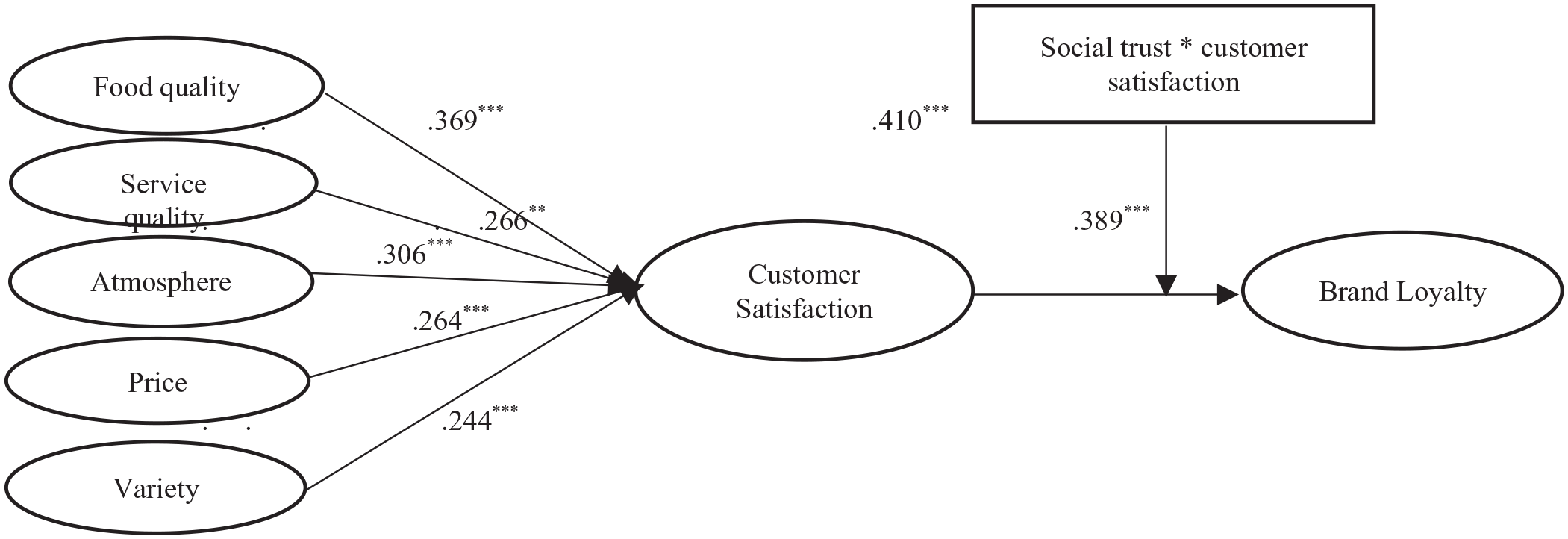
SEM technique with maximum likelihood estimation has been employed to evaluate the assumed association. After following first step of Anderson and Gerbing (1988) approach of statistical analysis, we carried out second step and executed the path analysis by the structural model. Accordingly, we first plaid multicollinearity in SPSS, which is an important assumption prior to test the research model in SEM. Table 4 designates that all prognosticator variables had variance inflation factor (VIF) ranging 1.013 to 1.237. It shows that no multicollinearity exists among the predictor variables as they satisfy the suggested criteria of <3. The path coefficients have been displayed in Figure 1. The results of hypothesized relationship have been presented in Table 4. Table 4 demonstrates that food worth has a pragmatic effect on customers’ satisfaction (β = 0.369, t = 4.986, p < .001); therefore, we accepted H1. Service quality has profound significant impact on customers’ satisfaction (β = .266, t = 2.396, p < .01), as a result we accepted H2. Restaurant atmosphere has gained support as it has positive significant impact on satisfaction of customers (β = 0.306, t = 4.358, p < .001), so we accepted H3. Price (β = 0.264, t = 3.635, p < .001) and variety (β = 0.244, t = 3.545, p < .001) exert a pragmatic significant effect on satisfaction of customers, so H4 and H5 gained support. Customers’ satisfaction exerts robust consequence on brand loyalty (β = 0.389, t = 6.436, p < .001); therefore, H6 is supported.
Directly and Moderating Effects.

Note. RMR = root mean square residual; IFI = incremental fit index; TLI = Tucker–Lewis index; CFI = comparative fit index; PCFI = parsimony CFI; PNFI = parsimony normed fit index; RMSEA = root mean square error of approximation.
p < .05. **p < .01. ***p < .001.
Moreover, according to Taheri et al. (2019), PROCESS macro 3.2 was employed for SPSS 23.0. We employed Model 4 stipulating 5,000 bootstraps samples on a bias-corrected method with 95% confidence interval (CI) for mediation effects (Hayes, 2013). The findings of indirect effect is present particularly when the confidence interval doesn’t overlap with 0. Food quality significantly indirectly affects brand loyalty (βFQ→CS→BL = 0.0157, [CI: 0.0050, 0.0291]) via customers’ satisfaction. Moreover, the indirect effect of service quality affects brand loyalty (βSQ→CS→BL = 0.0177, [CI: 0.0058, 0.0330] via customers’ satisfaction. Price significantly indirectly affects brand loyalty (βPR→CS→BL = 0.0704, [CI: 0.0153, 0.1691]) via customers’ satisfaction. Moreover, the indirect effect of restaurant atmosphere affects brand loyalty (βRA→CS→BL = 0.0779, [CI: 0.0178, 0.1803] via customers’ satisfaction. Variety of food significantly indirectly affects brand loyalty (βVR→CS→BL = 0.075, [CI: 0.012, 0.167] via customers’ satisfaction. Thus, these results confirm the mediating role of customers’ satisfaction in fast-food cues (i.e., food quality, service quality, restaurant atmosphere, price, and variety of food) and customers’ loyalty with fast-food restaurants.
The predictive power of R2 explained that the total variance in outcome variable is due to predictor variables. The results show that variance in customers’ satisfaction is due to restaurant stimuli (FQ: 0.76, SQ: 0.73, RA: 0.53, PR: 0.36, VR: 0.62). The results also show 28.4% variance in brand loyalty. Our R2 results are greater than the recommended threshold level of Falk and Miller (1992) > 10%.
Moderating effects
To test the contingent effects of social trust through interaction effects, we used IBM SPSS version 23.0. Using the moderation step-by-step, we initially examined the direct impact of prognosticator variable on resultant variable and then main direct effects of interaction of contingent with predictor variable on outcome variable. We found that direct effects of customers’ satisfaction on brand loyalty are positively significant (F = 128.098, p < .001), and main direct effects of customers’ satisfaction and social trust (customers’ satisfaction × social trust) on brand loyalty are also positively significant (β = .410, t = 8.7755, p < .01). Moreover, after getting the substantial interaction impacts, suggestions of Aiken et al. (1991) were followed to examine the nature of interactions by allocating the data of contingents in two groups—high and low—with the help of mock variable. We observed the simple main impacts of customers’ satisfaction on brand loyalty at both high and low level of social trust. We found that customers’ satisfaction has positive significant impact on brand loyalty when customers’ social trust is high (β = 0.203, t = 4.048, p < .001), and customers’ satisfaction has an insignificant impact on brand loyalty when customers’ societal trust is low (β = .106, t = 2.881, p > .01). Therefore, social trust positively moderates the relationship at higher level of social trust; thus, we accepted H7.
Discussion and Conclusion
Prior studies on restaurant setting have conferred that customers’ satisfaction is a vital determinant of brand loyalty (S. M. Lee et al., 2019). In the context of fast-food industry (Naderi et al., 2018), the restaurant-induced stimuli play a crucial role in creating customers’ satisfaction (Segson & Tan, 2018), which in turn establishes brand loyalty (Y. Liu & Jang, 2009). In Pakistan, fast-food industry is rapidly growing over the last decade. Fast food restaurants are found in every nook and corner. In the salad day of millennium, brand loyalty is a big challenge for fast food operators. Thus, this study on brand loyalty adds noteworthy value to the restaurant industry. The study examined the combined effects of drivers and impact of outcome of customers’ satisfaction on brand loyalty drawn from previous literature.
Our findings suggest that restaurant-induced stimuli, for instance, restaurant atmosphere, food quality, service quality, price, and variety of food, have profound repercussions on satisfaction of clients. These outcomes commensurate with (Dutta et al., 2014; Ryu & Han, 2010) empirical studies. It demonstrates that these fast-food cues are very crucial for fast food restaurant customers and have paramount impact on their satisfaction. Our study findings also validate that customers’ satisfaction significantly influences brand loyalty. This result also completely agrees with prior empirical research findings (S. M. Lee et al., 2019). At this point, customers decide about either re-patronage or discontinuity. Moreover, the findings revealed that customers’ satisfaction acts as a strong mediator between restaurant stimuli and consumers’ behavioral intentions. Any negligence in aforementioned stimuli hurts the customers’ satisfaction and ultimately brand loyalty with restaurants. In addition to this, results demonstrate that (β = 0.389***) 38.9% satisfied customers become brand loyal. Furthermore, we explored the indirect impact of customers’ satisfaction on the association among the restaurant stimuli (i.e., food quality, service quality, restaurant atmosphere, price, and variety of food) and brand loyalty. We found that customers’ satisfaction significantly and positively affects the association between restaurant stimuli (i.e., food quality, service quality, restaurant atmosphere, price, and variety of food) and loyalty to the brand. This finding is in harmony with prior research studies (Konuk, 2019; Segson & Tan, 2018).
Finally, our last results deal with social trust. They reveal that Pakistani inhabitants’ social trust is not so high, as greater percentage (72%) of the people believes that they need to be careful while dealing with others, and only 28% people believe that people can be trusted in general. This finding is consistent with World Value Survey Report, which indicated that only 22.2% Pakistani citizens believe that people can be trusted in general, whereas 73.8% respondents believe that people need to be careful while dealing with others (World Values Survey (WVS)). Moreover, our results about moderating variable social trust suggest that consumers’ social trust positively moderates the relationship at higher level between customers’ satisfaction and brand loyalty. Consumers rely on their preexistent schemas of having beliefs about the general trustworthiness of people; thus, the general trust (social trust) has an impact on their specific and relational trust (Brewer, 2008; Costa et al., 2018; Robbins, 2016) about their restaurants. It is in line with Robbins (2016) who stated that social trust is central to the development and maintenance of specific/relational trust. Based on the conceptualizations of societal school of thought, findings suggest that the consumers who possess low social trust hold a view that people cannot be trusted in general and tend to switch to other restaurants easily in case they get dissatisfied once or twice with the services rendered by a particular restaurant. For example, applying this notion in the context of restaurant sector, customers may have come across diverse experiences from different sources like friends sharing a pic with a bug in food and news or TV channels breaking a news that a particular restaurant is being sealed due to providing unhygienic food, using sub-standard products (dead meat, poor quality oil, etc.), and untidy kitchen (cockroaches and mouse are found there). Such experiences affect already built up specific/relational trust (faith on people) on quick-meal restaurants (operating in society), consequently affecting their satisfaction and brand loyalty with their mostly visited restaurants. As far as social psychological school of thought is concerned, customers respond to diverse scenarios, such as mistakenly threw a drink/food on customer or a bug is found in food. Such situations are dealt differently depending on the customer’s personality traits (tolerance, understanding, cooperative, optimistic, low anxiety, forgiver nature etc.) that sequentially impacts loyalty to the brand (J. Kim et al., 2008). Thus, the response to any situation in a restaurant setting is decided by customer’s personality traits (Possessing these positive personality traits leads to high generalized trust) along with the trust gained from the society (Uslaner, 1999). Our findings suggest that customers who hold positive social trust have strong bonding with restaurants and make maximum effort that their relational trust is less affected by their general trust.
Implications
Theoretical Implications
From a theoretical standpoint, it is the first research study to experimentally evaluate the combined repercussions of drivers and impact of customers’ satisfaction on brand loyalty. The extant literature has comprehensively examined the drivers of customers’ satisfaction (Costa et al., 2018; Dutta et al., 2014) and fundamental indicator of economic success i.e., brand loyalty (Alkhawaldeh & Eneizan, 2018; S. M. Lee et al., 2019; Trafialek et al., 2020). Numerous studies have been conducted in the context of fast-food industry loyalty (Namin, 2017), but the combined effects had not been explored yet. Hence, this research study adds to the existing literature by understanding the potential influence of restaurant stimuli (food quality, service quality, atmosphere, price, and variety of food) on customers’ satisfaction and brand loyalty through customers’ satisfaction (indirect effect). Overall, the results imply that quality of food and service, restaurant atmosphere, price, as well as variety of food have significant influence on customers’ satisfaction because customers’ satisfaction with these cues plays a critical role in explaining the repeat patronage. Second, as far as S-O-R theory is concerned, an extrinsic impetus (food quality, service quality, and restaurant atmosphere) affects organism (customers’ satisfaction) which in turn influences response (brand loyalty). Consequently, this study adds to the friendliness as well as customer conduct literature by investigating the collective impacts of drivers and clients’ satisfaction on brand loyalty to bestow more understanding into the level to which theories supplement each other in elucidating repeat patronage.
Third, this article fosters the comprehension of customer conduct in fast-food restaurant setting. It discloses the impact of customers’ satisfaction as a result of fast-food cues on the loyalty to the brand. The findings of current article confirmed the positive effect of customers’ satisfaction on loyalty to the brand. It is in line with earlier cited articles (Lu et al., 2015; Otto et al., 2020), verifying that customers’ satisfaction is an important predictor of brand loyalty. Referring to expectation disconfirmation and S-O-R theory, we can conclude that extremely gratified clienteles thanks to their innate assessment are more probable to do repeat patronage than less satisfied customers.
Fourth, the mediation analysis established a fractional intermediary stimulus of customers’ satisfaction among restaurant stimuli (i.e., food quality, service quality, restaurant atmosphere, price, and variety of food) and brand loyalty. This result seems to be in line with previous studies (Konuk, 2019; Segson & Tan, 2018). This mechanism implies that enhancing FQ, SQ, RA, PR, and VR can influence CS, which in turn increases brand loyalty. Finally, we pay to literature by evaluating the impact of social trust with regard to fast-food industries because prior literature recognized that it fosters everyday interactions, exchanges, and transactions (Robbins, 2016). With its significance in behavioral dynamics (Chen & Wan, 2020), the present study took an initiative and verified the regulating role of social trust in customers’ satisfaction and brand loyalty. This study extends the effect of social trust as a moderating variable, interactions with customers’ satisfaction, to add significantly to the existing literature of social trust. The findings imply that consumer’s social trust (generalized trust) affects his or her connection with restaurant (specific trust), because customer’s moral yardstick of general trust on society affects his or her specific trust with restaurant. It is in line with previous cited articles (Freitag & Traunmüller, 2009; Newton & Zmerli, 2011). The present study reinforces to the literature by assessing the interaction effect of social trust and customer satisfaction in strengtheing the bonding with brand loyalty.
Practical Implications
This research study educes valuable insights to restaurant managers and government with discernible offers.
The findings of the present research testified the vital role of food quality. Referring to the cue utilization theory, clients utilize intrinsic (visual attractiveness) as well as extrinsic cues (nutritional content) with the purpose of judging the quality of a distinct product. Consequently, it is worth mentioning that taste, nutritional content, oblivious attraction, and cheekiness must be enhanced. Thus, fresh as well as delicious menus must be provided in the hotels/restaurants. Eye-catching food demonstrations of the menus must not be overlooked. For instance, serving skillfully garnished food on appealing crockery has the potential to augment the graphic presence of the menus or list. This can also enhance clients’ professed food quality. Furthermore, fast-food restaurants can indicate the nourishment principles of the food on the menu/list board with the purpose of persuading the healthiness of the food items. In the same way, brochures offering information regarding food production standards may be made available on the tables with the aim of increasing clients’ know-how of the food items. Intrinsically, clients’ professed quality estimations could be heightened. In Pakistan, as more people are tending to al fresco, dynamically communicating product offerings to the clients and delivering food as assured to retain the variety-seeking consumers represent a realistic strategy of fast-food restaurants.
Patron’s acuities associated to food prices must be given due consideration while fixing the menu prices. Thus, while fixing the prices of the food items, the prices of same food items of other restaurants in the same area must be given due consideration. Henceforth, alike price levels will result in increasing customers’ perceptions of the menu prices. To put it another way, when clients’ professed food quality is great, and if they find that food menu prices are very reasonable, they will be definitely convinced that the selected menu is worth buying. This conclusion will bring about high gratification and ultimately augment brand loyalty. Moreover, if restaurants want to increase the price of food menu, it is acceptable to increase the price of food menus. As far as the dual entitlement principle is concerned, the adequate details must be elucidated to the clients regarding the increase in price with the purpose of gaining the confidence of the consumers. Moreover, judicious price advertisings in fast-food menus can facilitate in enhancing the perceptions of the consumers and can bring about higher customers’ satisfaction. Moreover, advertising proposals, like rebate as well as vouchers, also have the potential to inspire clienteles to visit fast-food restaurants again and again.
The findings highlighted that service quality has attained paramount importance. Referring to S-O-R theory, service quality attributes, such as friendly staff, courteous, quick service line, and waiting time, act as stimulus for customers’ internal evaluations (customers’ satisfaction). Therefore, restaurant should provide good services and reduce time between order placement and order fulfillment with an aim of providing quick service. In service setting, atmospheric features serve as impetuses for customers’ reactions (Lin & Mattila, 2010). Our findings imply that restaurant’s atmospheric elements have contributed significantly to the satisfaction of the consumers. Thus, heightened cleanliness, layout, and comfortable environment should be provided. Particularly, restaurant cleanliness and food safety matter a lot after Covid 19. Today, customers are more concerned about how their food is handled. It means that customers will have less patience for workers who are not using gloves, mishandling of food as well as other cleanliness indicators. Therefore, restaurants should implement strict sanitary regulation to protect both workers and customers, acknowledging that the safety of their customers is their first priority. In addition, restaurants should make their environment more charming by concentrating on interior as well as exterior look. Similarly, sound and serene environment may enhance the customers’ perceived quality evaluation.
The findings of present study emphasized the pivotal role of customers’ satisfaction for keeping lasting associations among the restaurants and their clienteles. Henceforth, restaurateurs must regularly keep track of the satisfaction of their clienteles. In case of any dissatisfaction, restaurateurs should resolve the issues. Appropriate complaint management procedure will definitely facilitate in enhancing clients’ satisfaction and inspire revisit intentions as well as brand loyalty. Moreover, surveys can aid in comprehending the consumers’ perceived food quality, service quality, price, and atmosphere regarding fast-food restaurant. In addition, customers’ recommendations must be gathered to arouse their repeat patronage.
With regard to social trust, our findings imply that fast-food operators should ensure the safety standards of foods, disclose the menu information, and permit to often visit the kitchen, which will strengthen their specific as well as general trust. The study also gives insights to the government about the social trust that has a momentous influence on consumers or customers’ connections with a particular restaurant. In the context of the restaurant, the government can augment the customers’ general trust toward the society by activating the Pakistan Food Testing Authority to constantly regulate the food safety standards in restaurants and permanently close those restaurants that play with the health of people by using substandard products.
Limitations and Future Directions
No study exists without limitations. Our study underlies the following limitations and offers directions to future researchers. First, the study has made use of random sample data. The forthcoming investigators can employ elongated data or use another design like experimental design. Second, this study’s context is general. The future study could categorize restaurants into upscale, medium scale, and low scale restaurants and assess the differences. Third, future research studies can include other emerging constructs investigated in restaurant contexts, which include restaurant-based customer engagement, value co-creation, service innovation, service value, and customer or consumer experience, with the purpose of examining the analytical capability of the model (Hollebeek et al., 2019; Rather et al., 2019; Rather & Hollebeek, 2020). Fourth, the study used only social trust as a contingent. The future scholars can consider WOM (positive and negative WOM) as a contingent to investigate how it influences the association amid satisfaction of the customers and loyalty to the brand. To cut a long story short, the present research study is restricted to the fast-food enterprise. The upcoming research studies may explore other service enterprises, such as hotel industry, to augment the robustness of the model.
Footnotes
Acknowledgements
The first and second author are thankful to University of International Business and Economics (UIBE) authorities for the research fund and financial support during PhD research studies.
Ethical Approval
All procedures performed in studies involving human participants were in accordance with the ethical standards of the institutional and/or national research committee and with the 1964 Helsinki declaration and its later amendments or comparable ethical standards.
Informed Consent
Informed consent was obtained from all individual participants included in the study.
Declaration of Conflicting Interests
The author(s) declared no potential conflicts of interest with respect to the research, authorship, and/or publication of this article.
Funding
The author(s) disclosed receipt of the following financial support for the research, authorship, and/or publication of this article: Supported by “the Fundamental Research Funds for the Central Universities” the Belt and Road research database construction project of UIBE (TS4-10).
