




Abstract
In this paper, we study a distribution-free multi-period newsvendor problem with advance purchase discount (APD). In addition to the regular-order placed at the beginning of each period, a decision-maker (DM) can also commit to an advance-order from the upstream supplier and receive discounts. The goal of the DM is to maximize total profits, and in this problem, the DM only has access to past demand data. To solve this problem, we apply an online method based on the theory of prediction and learning with expert advice to propose an explicit online ordering solution by using the fixed-stock policy as expert advice. With the properties of the gain function, we derive a theoretical result that guarantees, for any given advance-order quantity, the newsvendor’s cumulative gains achieved by the proposed online ordering solution converge to those from the best expert advice in hindsight for a sufficient large horizon. In addition, we extend the problem to the discrete case and obtain the corresponding explicit strategy and performance guarantee. Finally, numerical studies illustrate the effectiveness of the proposed solution, and the newsvendor’s total profits are comparable to the best expert advice. Sensitivity analysis also shows the robustness of the proposed solution.
Introduction
Inventory management is one of the classical operations management problems which has attracted wide attention from industry and academia. A decision-maker (DM) needs to minimize the costs or maximize the profits by choosing an ordering quantity in the inventory problem. In real life, the sales of newspapers, electronic products, and blood product control are typical examples (Bravo-Moreno, 2019).
Since the classical newsvendor problem was pioneered by Arrow et al. (1951) and Morse et al. (1951), there has attracted considerable literature on this topic (Khouja, 1999; Pedroza-Gutiérrez & Hernández, 2020; Yan et al., 2011; J. Zhang et al., 2021). The classical newsvendor problem assumes the probability distribution of the demand is fully known. The optimal decision is known as a critical quantile of the inverse cumulative distribution of the demand. However, the reality is that DM often does not know the demand distribution in advance. Thus, some research assumes only the mean and standard deviation of the demand is known and uses the minimax approach, a common approach for modeling demand uncertainty in the literature, to study this problem. Scarf (1958) considers a distribution-free newsvendor problem, and show a
When there is no assumption on inherent demand distribution, and the DM only has access to the historical demands, many pieces of research propose data-driven approaches to this problem (Gallego & Moon, 1993; Huh & Rusmevichientong, 2009; Levina et al., 2010; Li et al., 2017). Levi et al. (2007, 2015) apply the sample average approximation (SAA) to the newsvendor model and multi-period inventory model. They use samples from the inherent demand to build empirical distribution and establish uniform bounds on the number of samples to guarantee the SAA is near-optimal. Also, with historical demand data, Bookbinder and Lordahl (1989) use the bootstrap method to ensure the inventory re-order levels by estimating the fractile of the inherent demand distribution. Huh et al. (2011) use the well-known Kaplan-Meier estimator from statistics to study a data-driven inventory control problem with censored demands. They prove that the proposed policies almost surely converge to the optimal solutions. Other studies include Ban and Rudin (2019), B. Chen et al. (2019), Gan (2019), and Huh and Rusmevichientong (2009). Following this stream of research, this paper investigates a distribution-free multi-period newsvendor problem with advance purchase discount. In such a case, there is no statistical assumption on the inherent demand, and the DM only has access to the past demand data and gains feedback. By using a new method of online prediction with expert advice from computer science, this study modifies the regular-order strategy with the gained feedback from different experts’ advice. In addition, the whole process does not need to solve the specific distribution of the potential demand function, which is also the main difference between this study and the above studies. Thus, this study enriches research on data-driven newsvendor problems.
Many studies have addressed the inventory problem with advance purchase discount and they mainly focus on sellers who provide end consumers within a supply chain. As Gan et al. (2019) summarize, there are many reasons for suppliers to do this, such as savings in operating costs (Gilbert & Ballou, 1999), soliciting information directly from the buyers or shaping competition in the downstream market. Gilbert and Ballou (1999) study a supply chain consisting of a steel distributor and some customers, and show that careful balancing of advance order time and price discounts can lead to lower costs for all channel members. Cachon (2004) studies a supply chain coordination problem involving advance purchase discounts, and he also considers the risk allocation of participants in the supply chain. Dong and Zhu (2007) consider the issue of inventory ownership in a supplier-retailer supply chain, and they find that Pareto improvements can be achieved when inventory ownership is transferred from the individual to the share, and sometimes vice versa. Chintapalli et al. (2017) find that when supplier’s production cost is lower for advance orders, an advance purchase discount contract alone does not achieve the supply chain coordination, but the ones with a pre-specified minimum order do. Cvsa and Gilbert (2002) and J. Y. Chen et al. (2017) show that advance purchase discount from the supplier can shape the downstream competition and benefit participants other than retailers in a supply chain with one supplier and two retailers. Cho and Tang (2013) find the retailer’s advance selling is better than other strategies, such as regular and a mix of advanced and regular strategies. Tang and Girotra (2017) use real data to study an advance purchase discount contract considering the retailer’s information acquisition cost and the wholesaler’s limited information about the cost, and they find that advance purchase discount contract can incentivize retailers to share demand information with dual-purchasing wholesalers. Ganet et al. (2019) extend the research of Scarf (1958) and introduce an advance purchase discount into Scarf’s model. They show that for any given advance order size, an advance-order dependent
In this paper, we apply the Weak Aggregating Algorithm (WAA) to this distribution-free multi-period newsvendor problem. The Weak Aggregating Algorithm (WAA) is an online algorithm, first proposed by Kalnishkan and Vyugin (2008) and is improved from Vovk’s (2001) Aggregating Algorithm (AA). In current literature, some research has applied WAA to study the multi-period newsvendor problem. Levina et al. (2010) first apply the WAA method to the multi-period newsvendor problem and propose an online explicit ordering solution. In addition, they show a theoretical guarantee of cumulative profits. Y. Zhang et al. (2014) extend this problem to a non-stationary demand and propose a competitive ordering policy. Y. Zhang and Yang (2016) consider a two-product muti-period stationary newsvendor problem. Y. Zhang et al. (2019a) extend the two-product multi-period stationary newsvendor problem to a non-stationary case with budget constraints. They show that their policy is competitive with the best expert advice. Y. Zhang et al. (2019b) study a discrete newsvendor problem with order value-based free-shaping. Based on the return loss function, they obtain online ordering strategies and show the threshold of the order value-based free-shipping significantly affects the cumulative losses. Y. Zhang et al. (2020) extend the research of G. Zhang (2010) and learn a multi-period newsvendor problem with quantity discounts.
Different from the above research, we consider the impact of advance-order on the regular-order decision in the distribution-free multi-period newsvendor problem and find the optimal regular-order decision under different advance purchase contracts. Meanwhile, with the inspiration of the WAA, we first obtain the explicit online ordering solution for this problem. Then, we derive a theoretical guarantee which ensures that for any given advance-order quantity, our online ordering solution convergences to the best expert advice for a sufficient large horizon. The remainder of this paper is organized as follows. The Weak Aggregating Algorithm is introduced in Section 2. In Section 3.1, we formulate our online ordering solution and theoretical guarantee of its cumulative gains under the condition of continuous distribution. Based on Section 3.1, we continue to discuss the discrete distribution in Section 3.2. Numerical studies are carried out in Section 4. The paper concludes in Section 5.
Weak Aggregating Algorithm
The online ordering solution will be obtained by applying the Weak Aggregating Algorithm in this distribution-free multi-period newsvendor problem with advance purchase discount. The Weak Aggregating Algorithm (WAA) proposed by Kalnishkan and Vyugin (2008) is an online prediction and learning method with expert advice. It makes the decision based on advice from a pool of experts and aims to develop an algorithm to compete with a benchmark set of “experts” who can be free agents or strategies. Given a set of experts who give decisions at the beginning of each period, the DM makes ordering decisions by merging these decisions in a certain way, then meets the demand and gets the feedback. The WAA is similar to the Aggregating Algorithm proposed by Vovk (2001) but uses a learning rate parameter that is proportional to
In WAA, an initial weight distribution will be set on an expert set when the planning horizon starts. In each period, the weights will be recomputed and assigned to each expert according to the feedback from the previous period and the level of trust DM (newsvendor in this problem) has in each expert. We denote the experts set by
- Initialize the cumulative gains
- In each period
1. The experts’ weights are recomputed:

where
2. Experts give the decisions
3. The newsvendor make the decision

4. The demand
5. The cumulative gains are updated:
Analytic Results
In many industries, ordering in advance to get discounts is a widely-used method for suppliers and retailers. In this section, we incorporate the advance purchase order into the multi-period newsvendor problem and develop ordering solutions by the WAA framework, as mentioned above. Before the start of the planning horizon, a sourcing contract for advance order between the supplier and the retailer is confirmed, and a fixed size of advance orders will be shipped to the retailer for each period. We assume there is only one product is considered. Let
Online Ordering Solution for the Continuous Case
Based on the assumption and notations above, given advance order size

To obtain an explicit ordering decision

by applying the WAA to stationary expert advice with advance purchase discount, the online ordering solution for regular order in period

where

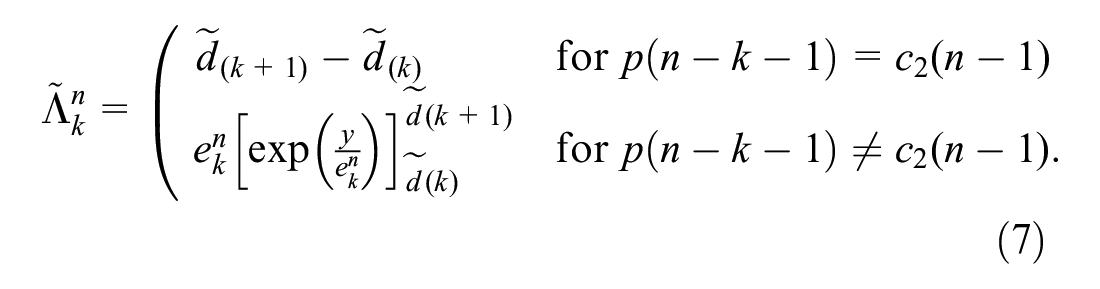

Based on the order statistics demand, we have

Similarly,

Hence, we get the explicit online ordering solution
Base on the following lemma from Levina et al. (2010), the theoretical guarantee for ordering solution (5) is obtained.


We can see that the average performance of newsvendor utilizing the WAA is at most an order of
Online Ordering Solution for the Discrete Case
The online ordering solution and theoretical guarantee obtained by the above cases have an assumption that the product is infinitely divisible, that is, the demand and the total orders (regular ordering quantity plus advance ordering quantity) in one period can be any values in [0, B]. This section considers a more realistic situation where the total ordering quantity and demand in one period are discrete integers in [0,B].
Same as

and

When there is no salvage value and shortage cost, the online ordering solution can be presented as function (12) according to the procedure of WAA with stationary expert advice. Based on the lemma 3.3 in Levina et al. (2010), theoretical guarantee can be obtained in Theorem 3.4.
With the advance purchase discount factor, the regular ordering quantity for discrete multi-period newsvendor problem in period n is given as follows:

where
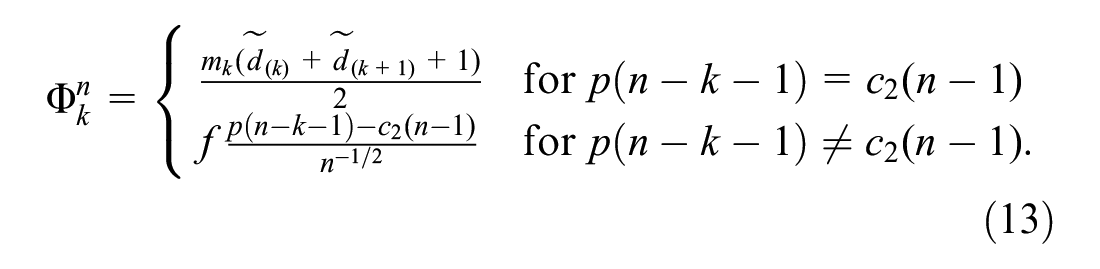


where

similarly,

□


The proof of Theorem 3.4 can be easily obtained by Lemma 3.3.
Numerical Studies
In this section, we carry out numerical studies to illustrate the competitive performance of our proposed online ordering solution. In our setting, we set
Finding the Optimal Z
In this section, we consider two demand distributions mentioned above and the situation with (without) shortage cost and salvage value. Figures 1 to 4 show the cumulative gains under different advance order sizes and planning horizon

Graphs of

Graphs of
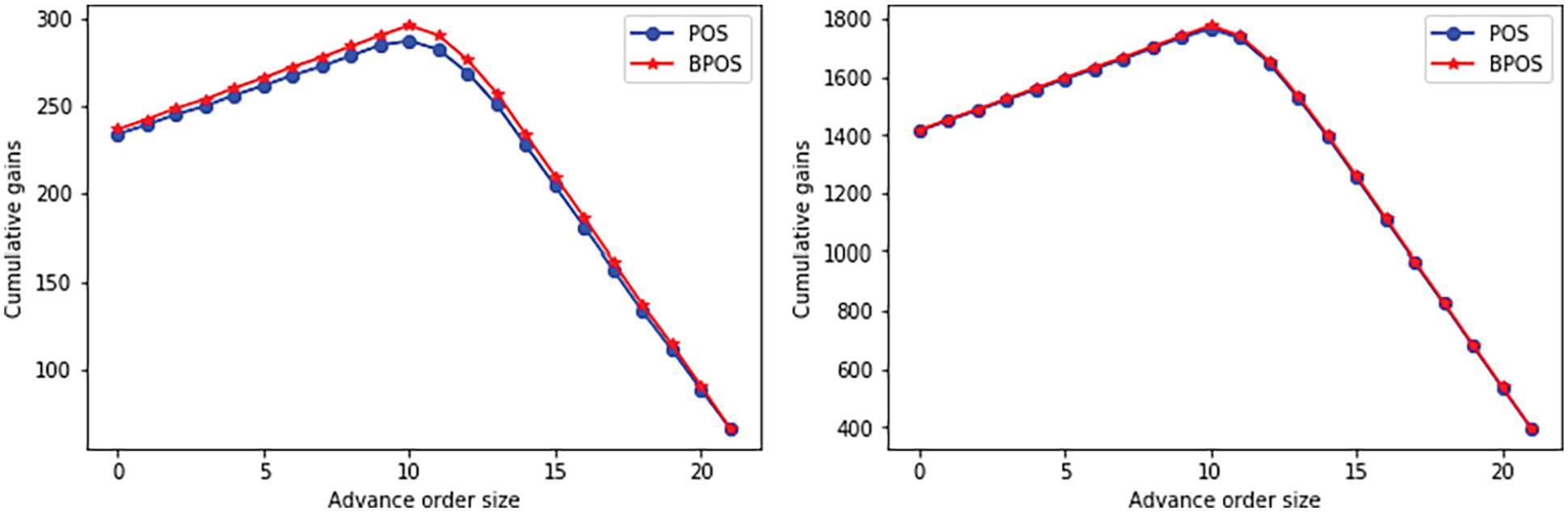
Graphs of

Graphs of
Competitive Performance of POS and POSC Versus BPOS and BPOSC
To clearly show the performance of
Results for Uniform Distriubtion Where Advance Order Size is 0, 4, 8, and 12 and

Results for Uniform Distriubtion With Shortage Cost and Salvage Value Where Advance Order Size is 0, 4, 9, and 14 and


Ratios with

Regular order quntity changes over time where

Regular order quntity changes over time where
Sensitivity Analysis
In this subsection, we perform a sensitivity analysis on the demand distribution first, and then on the ratio of

Changes in cumulative gains over time under normal demand distribution where SD (standard deviation) in {2, 4, 6, 8} and

Under normal distribution, the Cumulative gains of shortage cost and salvage value are considered where SD (standard deviation) in {2, 4, 6, 8} and
Cumulative Gains and Ratio Under Different Demand Distribution Where

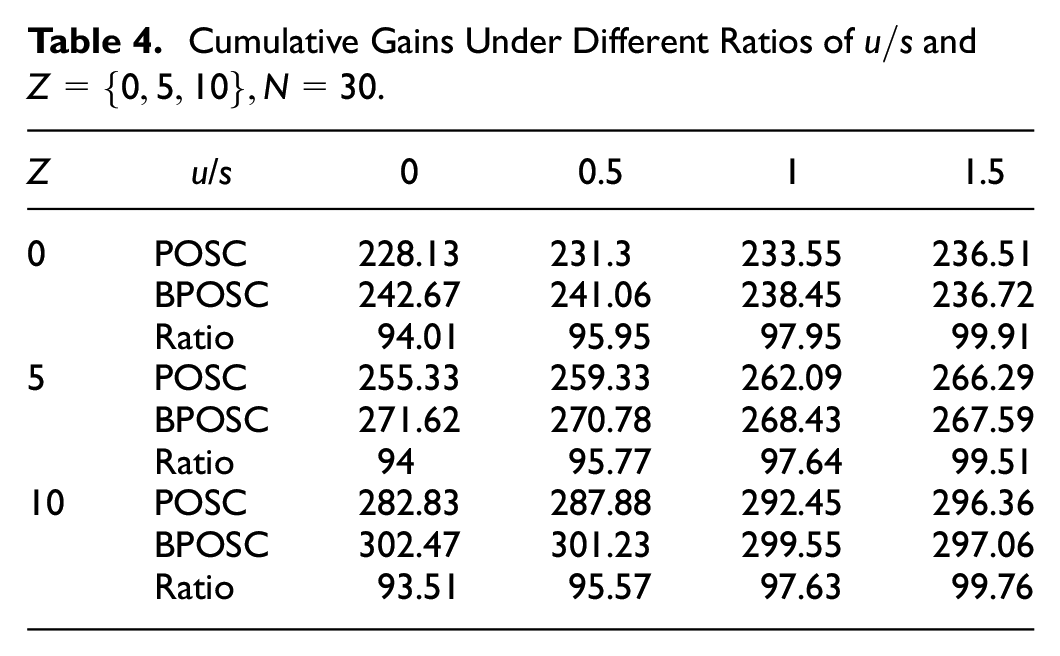
Next, we test how cumulative gains are affected by different ratios of

Changes in cumulative gains over time under different ratios of

Changes in cumulative gains over time under different ratios of
Cumulative Gains Under Different Ratios of
Conclusions
In this paper, we study a distribution-free multi-period newsvendor problem with advance purchase discount, which widely exists in real life. We design an explicit online ordering solution for this problem using the weak aggregating algorithm from computer science. Taking the best fixed-stock policy determined in hindsight as the benchmark, we prove that the proposed online solution can theoretically guarantee that the cumulative gains are competitive to the benchmark. More importantly, the results obtained in this study can provide a reference for industrial managers who need to order perishables continuously for a long time when the demand distribution is unknown. Finally, it is interesting to expand this problem to the multi-product case and integrate some other practical factors into the problem in future research.
Footnotes
Appendix
Proof of Theorem 3.2. Under the setting above,
Without loss of generality, we let
Defining
Subsituting to the Lemma 3.1 and equation (8), we get
where the second inequality is obtained by replacing
Declaration of Conflicting Interests
The author(s) declared no potential conflicts of interest with respect to the research, authorship, and/or publication of this article.
Funding
The author(s) disclosed receipt of the following financial support for the research, authorship, and/or publication of this article: This research was supported by youth project of humanities and social science research program of Chongqing Education Commission of China(23SKGH266).
