




Abstract
This study compares university students’ performance in traditional learning to that of online learning during the pandemic, and analyses the implications of the shift to online learning from a faculty’s perspective. The Quick-Response Research method using Google Documents was used with 104 faculty members chosen on convenience sampling in five Saudi traditional (face-to-face) universities that shifted to online learning during the COVID-19 outbreak. Results showed that the performance of university students has been better via this method than traditional learning. Classroom activity was shown to positively affect overall student performance. Moreover, the adaptation of technology positively affected the validity of using online learning and student performance. We also found that time management and technology self-efficacy are mandatory to improve remote learning.
Introduction
This paper focuses on the impact of the pandemic in the education sector. It is reported that over 1.5 billion learners around the world have seen their education disrupted due to COVID-related school closures (Chaka, 2020). The Kingdom of Saudi Arabia was not spared. In March 2020, Saudi authorities decided to suspend face to face studies in schools and universities—as a preventive measure to control the rapidly spreading COVID-19 virus—and the recommend online/virtual delivery mode of classes (Moawad, 2020). Thus, in the middle of the second semester, the Saudi Ministry of Education implemented online learning via the Internet regardless of the lack of prior opportunities to learn to use online media for teaching were inadequate (Aljaber, 2018).
Suddenly, as a faculty member at King Saud University, this author/researcher and colleagues had to switch to teaching students remotely through Learning Management Systems (LMS) online platforms. An LMS, also known as a course management system or a virtual learning environment, is a system that many faculty members must adopt to improve student learning and overall course management (McGill & Klobas, 2009). Thus, faculty members have to adapt their teaching patterns (e.g., new LMS tools/features) and learn how to use the system efficiently and effectively (Moawad, 2020).
This emergency experience is new for many faculties in this and other Saudi universities, which used to operationalize traditional teaching methods, that is, through the face to face attendance of students and faculty members at the university. Accordingly, faculty members have been given online learning training on how to implement online teaching by online teaching experts through the university’s electronic platforms to teach students remotely through the Internet (Rucker & Frass, 2017). This study aims to analyze the implications of the shift to online learning from a faculty’s perspective. The following main research questions help to guide this study:
First, how was the performance and behavior of undergraduate students influenced by online learning during the COVID-19 pandemic?
Second, did the shift to online learning influence instructors?
Literature Review
Inevitable crises and disasters can profoundly affect the educational sector. Previously, the emergency procedure was to stop the educational process completely. However, today’s technological developments have provided solutions to help overcome the sorts of difficulties encountered in an emergency, including online learning as an educational option. For example, having developed a national plan for continuing education in emergencies, Saudi Arabia aims to maintain the entire pedagogical system fairly and effectively through online learning via the Internet (Moawad, 2020).
In Saudi Arabia, the recent transfer of education to online delivery has not been optional. The COVID-19 pandemic has, for example, forced educators to convert university courses to online learning, with the most significant challenge likely being the mass transfer of all students and all staff to digital platforms on the same day (Chaka, 2020). It was a significant challenge for universities that urgently needed to prepare the modules that support online teaching and learning, such as Blackboard and Microsoft Teams, and provide rapid training for staff and students in using these modules.
Online Learning Challenges and Classroom Participation
Online learning is defined as an educational strategy in which the learner is geographically distant from the teacher, and the entire educational process is conducted across the Internet and communication networks (Ali Ta’amneh, 2021). Despite the advantages of online learning, there are still numerous challenges for students, administration, and faculty, whether in regular environments or emergencies. For instance, there is a need for an integrated infrastructure and qualified and trained human staff to support this type of learning. Furthermore, computers supported by communication networks and a fast internet connection must be available to teachers and learners. Thus, this kind of learning system may be challenging to implement in developing countries owing to a lack of technology and auxiliary tools (Osuji & Amadi, 2020).
Other challenges involved in the implementation of online learning include the lack of focus among some students and infrequent opportunities for them to communicate, which can then restrict the exchange of cultures, experiences, and knowledge (Fathelrahman, 2019).
In terms of faculty and staff, online learning is challenged by the amount of successive and rapid technological developments that teachers must learn and master as part of the system so they can use these as teaching tools. Ensuring that faculty acquires the appropriate skills and motivation is an important challenge in online learning as well. This difficulty is attributed to several factors, including the lack of possible interaction between the teacher and the learners, problems related to the access of some students to the virtual classroom, and—more importantly—the type of feedback provided by online faculty. Factors such as these may hinder faculty members from ensuring that all students have acquired the skills and learned the necessary information for each lesson (Aldiab et al., 2019). Both classroom engagement and interaction play an essential role for online faculty. For example, learner-teacher interaction, learner-content interaction, learner-learner interaction, and independent learning are highly dependent on physical classroom activity (Alkhalaf, 2021). During the pandemic, learner-teacher interaction was prioritized using learner management systems (LMS). Therefore, we postulate the following hypotheses:
H1a. Classroom activity positively affects the validity of using online learning.
H1b. Classroom activity positively influences student performance.
Online Learning and Commitment
By examining the strategic goals of online learning, college facilitators, faculty, and instructors find that while online education thus targets learners, develops their skills, encourages student participation, and promotes scientific innovation, its full implementation remains underdeveloped (Andrade et al., 2020). Some universities have adopted a flexible education system in higher education, such as online learning, which can efficiently respond to atypical circumstances. At present, online learning is one of the best options on offer for university learners (Andrade et al., 2020).
The removal of temporal and spatial barriers leads to greater flexibility in dealing with emergencies and crises, provides educational opportunities that benefit a larger portion of students on a reasonable budget, and thus helps students save a considerable amount of time (Aldiab et al., 2019). All these are solicited merits that encourage faculties to apply online learning. Online learning also contribues to raising the cognitive, scientific, and intellectual levels of learners, especially as it provides more or less the same content available through traditional methods of education in terms of materials and learning outcomes. Moreover, it allows both students and faculty to work using modern technology; accordingly, they have to rely on themselves to seek information through available resources (Daumiller et al., 2021). Online learning also saves a considerable amount of time for faculty (and students) in terms of transportation and related costs, given that the system does not require either faculty or students to move to their place of study, allowing them to learn from home. Finally, online learning neither requires significant equipment nor a large number of employees to create and deliver content (Andrade et al., 2020). We postulate the following hypotheses about student and staff commitment.
H2a. Commitment positively affects the validity of using online learning.
H2b. Commitment positively influences student performance.
Online Learning and Technology Adaptation
LMS involve managing, monitoring, and evaluating the educational process through cooperative work between the teacher and the learner (Aldiab et al., 2019). Apart from LMS, content management systems (CMS) and learning content management systems (LCMS) are also popular. CMS depend on a web application or software used by one or more people to publish data and digital content. This type of system provides space for storing content, participation in content preparation with other educators, and displaying it. It then allows the original publication and further documents to be downloaded. LCMS allow professionals to create, modify, and develop learning content and interact with learners (Turchynova et al., 2021). Although CMS and LCMS have their advantages, Saudi university education relies on LMS in online learning.
However, in emergencies, more than one alternative method can be used, including “School-in-a-Box,” the “Home School Program,” “CATCH UP Education,” and “Open School” (Creed & Morpeth, 2014). Even so, online learning and online classes have begun to establish their position as alternative solutions where technological capacity is available (Osuji & Amadi, 2020). Even in “normal times,” educational institutions worldwide are increasing their use of LMS. Aldiab et al. (2019) confirmed that most Australian, British, Canadian, United States, and Saudi universities are using LMS that rely on information and communication technology, and LMS are the most common in Saudi universities, with 90% using blackboards within the systems. Therefore, we postulated the following hypotheses:
H3a. Technology adaptation positively affects the validity of using online learning.
H3b. Technology adaptation positively influences student performance.
Online Learning Validity and Student Performance
Class attendance, prior performance, and final grading were considered indicative of student performance. Network coverage, device type, lecture time of day, socio-economic status, and digital competence affected synchronous lecture participation and attendance. This is consistent with the findings of our study. Asadi et al. (2019) found that university student performance through online learning was better than via traditional methods, specifically with regard to interaction and participation and in their subsequent marks. While Malinovski et al. (2012) and Sher (2009) emphasize that student interaction while participating in online learning is enhanced, Bowers (2019) and Alhih et al. (2017) found that students are reluctant to accept online learning and find it hard to engage with. Moreover, Aldhahi et al. (2021) reported that many students felt disconnected, distracted, bored, or socially disconnected during tutoring. Moreover, some of them disliked the rigidity of the curricula (Aldhahi et al., 2021). Flexible pedagogy and updating course materials is necessary to improve the perceived authenticity of a user-friendly university e-course, rather than just replacing the physical workspace with a virtual one in which the same sources, presentations, and timetable remain unchanged. The last hypothesis postulates the following:
H4. Student performance positively affects the validity of using online learning.
Methodology
The sudden onset of the outbreak prompted the use of the Quick-Response Research method that relies on collecting data relatively quickly, making it suitable for use in unplanned events resulting from crises and emergency situations (Mackey et al., 2012; Oulahen et al., 2020). As a result of this method, data are collected before they disappear or before they are affected by rapidly changing conditions (Palen et al., 2009). The data were collected in the during the mandatory cessation of on-campus classes and a period of online learning.
Participant Sample
This was a cross-sectional descriptive study exploring the factors that influence residents’ speciality choices undertaken at our institution. The study population consists of faculty members from Saudi universities. About 5 universities out of 42 were selected because they are the oldest in the country and have many locally based students and faculty members. All the universities selected used traditional face-to-face and online teaching during the COVID-19 pandemic. Accordingly, a convenience sampling of 150 faculty members was chosen for this study, and the survey was administered online. From the 150 sent emails, 110 staff members returned complete and incomplete responses. After exploring the data, 104 were deemed complete and ready for statistical analysis.
Instrument
A questionnaire comprising 20 items was created based on the published literature. This included comparisons of student performance during both traditional and online learning; commitment to attending lessons; levels of participation; and interaction in class and examinations marks.
Data Collection and Statistical Analysis
After validating the questionnaire, it was sent out to all participants. Suggestions made were incorporated into the final draft. SPSS version 25 was used for measuring exploratory factor analysis (EFA) while SmartPLS was used to assess confirmatory factor analysis and to retrieve the measurement model. PLS-SEM uses nonparametric bootstrapping to measure the significance of estimated path coefficients (Becker et al., 2011). Based on path analysis, t-values are generated to calculate the corresponding statistical significance. The reliability and discriminant validity for each construct were measured. The conceptual model is illustrated in Figure 1.

Conceptual model.
Following Hair et al. (2019) and Fornell and Larcker (1981), the standardized root mean square residual (SRMR), as well as RMStheta, were used to determine the fitting of the estimated model. An online semi-structured interview followed the survey. The findings reported were discussed using thematic content analysis.
Ethical Considerations
After the consent of the proposal and the questionnaire by the Research Ethics Committee at the Deanship of Scientific Research at the King Saud University (KSU), questionnaires were sent electronically to the study sample. Faculty member (including adjunct faculty) participants were requested to refer to official paper and electronic documents (records of students’ attendance and grades, and students feedback questionnaire while keeping metadata anonymous and confidential) and use their personal judgement/experience to complete the questionnaire.
Results
Participants were made up of 104 faculty members. The EFA was sufficient for all questionnaire items, with the exception of one question, which did not score an adequate factor loading: “Online students had more opportunities to socialize with each other.” This was consequently dropped from the conceptual model.
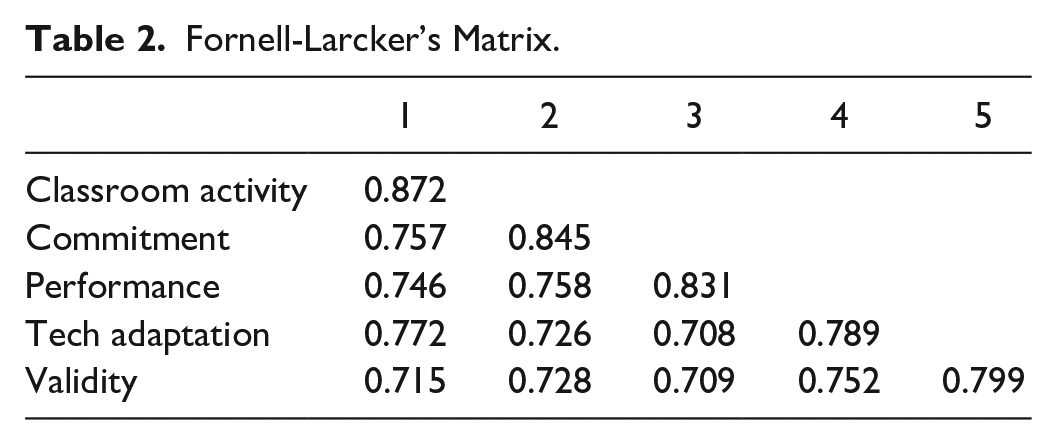
We calculated the reliability measures for all constructs using Cronbach’s Alpha, rho alpha, composite reliability, and average variance extracted (AVE; Table 1). We also evaluated the convergent validity using factor loadings. As Fornell and Larcker’s matrix illustrates, all constructs were well higher than 0.50 (Table 2). The outer weight, VIF, and outer loading for each construct were all acceptable as well (Table 3).
Reliability Measures for Each Construct.

Fornell-Larcker’s Matrix.
Outer Loadings, Weight, and VIF for Each Indicator.

Model fit was estimated using CFI, NFI, RMSEA, and SRMR (Hair et al., 2019; Hair & Sarstedt, 2019). Because the value of SRMR was 0.11, NFI was 0.599, and RMStheta value was 0.239, the conceptual model fit was accepted. Figure 2 shows the structural model.

Structure model.
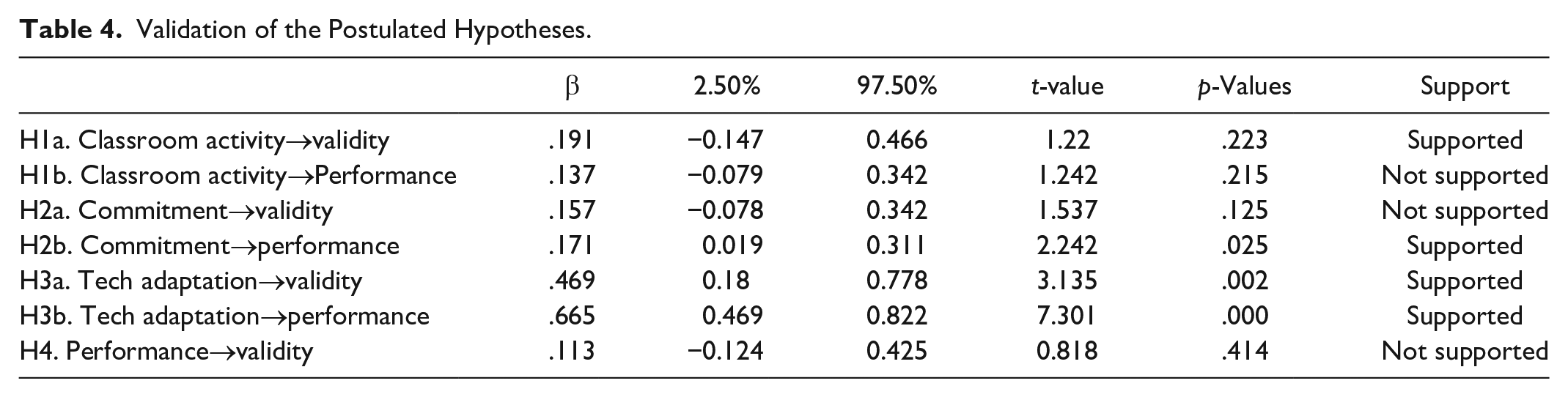
From the perspective of university faculty members, students performed better during online learning, as evidenced by their attendance, participation and interaction, and examination marks. Students who took all or part of their classes online performed equally well compared to the traditional/face to face mode of teaching. The first hypothesis postulated that classroom activity positively affects the validity of using online learning (H1a) and influences student performance (H1b). The positive relationships were not supported (β = .191; p = .223 and β = .137, p = .215, respectively).
The second hypothesis stated that commitment positively affects the validity of using online learning (H2a) and influences student performance (H2b). Although H2a was not supported (β = .157; p = .225), postulating that classroom activity positively affects overall student performance was supported (β = .17, p = .025). We also assumed that technology adaptation positively affects the validity of using online learning (H2b) and influences student performance (H3b). Both H3a and H3b were supported (β = .469; p = .002 and β = .665; p < .001, respectively).
However, Faculty members seem to consider student performance, and a cause-effect relationship does not govern the validity of using online learning. Therefore, the fourth hypothesis assuming an effect of student performance on the system validity was not supported (β = .113, p = .414). Table 4 illustrates the validation of the postulated hypotheses.
Validation of the Postulated Hypotheses.
An online semi-structured interview followed the survey. A qualitative analysis was conducted. Most faculty believe that online teaching will be taking over, “I believe that Universities will increasingly adopt online teaching.” Faculty also agree that it is more economical for them to shift to online teaching. “I recommend online teaching, although it is more challenging in terms of input.” Some faculty may have reservations about giving recommendations for an approach that, for them, is still uncertain. The key points the staff raised are illustrated and mapped in a calibrated word cloud (Figure 3).

Word cloud showing the primary themes the staff raised regarding online learning.
Discussion
This study aimed to assess how the performance and behavior of undergraduate students were influenced by online learning during the COVID-19 pandemic. Student engagement, expectations, time management, and other pedagogical skills were key parameters used in evaluating the validity of online teaching for many colleges during outbreak.
Arthur-Nyarko et al. (2020) found that students preferred online learning using digital materials to traditional learning and that students switch between mobile phones, tablets, laptops, and desktop computers according to place of residence when attending each lecture. Ienca and Vayena (2020) found that online learning helped, and will continue to help, to overcome the negative effects of the COVID-19 pandemic. The authors explained that modern technology can help societies to adapt and overcome these negative effects. In our study, university students’ performance in online learning during the COVID-19 pandemic was better that than during traditional learning. Classroom activity positively was shown to affect student overall performance. Moreover, the adaptation of technology positively affected the validity of using online learning and influenced student performance. Besides, we found that time management and technology self-efficacy are mandatory to improve remote learning.
We also aimed to examine whether the shift to online learning influenced instructors or not. Previous effort aimed to assess students’ sense of presence (feeling of exerting control, interacting with and getting immersed into real/virtual environments), behavioral, emotional, social, and cognitive engagement with synchronous online teaching, together with the need for socialization. Also, we measured technical preparedness (receiving adequate guidance, technical support, and having satisfactory hardware and internet access) and academic performance during synchronous e-learning in a sample of 1,288 medical students. It was found that online learning provides easily accessible learning materials, saving time, effort, and money, improving technical and self-learning skills, taking the necessary safety measures and precautions, interaction without timidness, and getting higher academic grades (Al Zahrani et al., 2021). Alammary et al. (2021), found attitudes toward e-learning, self-efficacy, and perceived reliability influenced student willingness to adopt e-learning.
Active staff participation and learner-instructor interaction in online learning are considered to be major challenges. These can be attributed to a lack of communication amongst students and a lack of concentration while engaging in online learning (Bissessar et al., 2021; Black et al., 2020). Although the current study found that the interaction and participation of Saudi students improved through online learning, this point remains controversial.
Referring to the results of this study, although the participation and interaction of students in online learning is better than during traditional learning, this point is not supported in other studies, and it is, therefore, useful to further explore this factor. Faculty members should find innovative ways to motivate students in attaining a more positive e-learning experience.
Home-based online learning at different network modules (e.g., Blackboard, MS Teams, Moodle, or Zoom) lacks teacher supervision, peer support, and classroom environment constraints. It is governed by students’ self-discipline, self-management, metacognitive awareness, and students’ self-efficacy in participating in live online learning activity (Alghonaim, 2021). Through the official e-training platform at King Saud University (KSU), a number of digital courses have been offered in online teaching and dealing with the various educational platforms. Students, faculty, and support staff have benefited from this training, with the total number of completion certificates awarded being 15,504. Saudi universities have relied heavily on Blackboard to deliver online teaching during the COVID-19 pandemic (Al-Nofaie, 2020; Hassan et al., 2021), and “Blackboard Learn” topped Twitter in Saudi Arabia at the beginning of the digital shift (Bhaumik et al., 2020). The Zoom platform was also made freely accessible in online teaching settings.
Summary
Online teaching and learning are now necessary for education worldwide (Xhaferi & Xhaferi, 2020). As online learning is a novel concept for Saudi university students, they showed great enthusiasm through heightened participation. Students not attending the university campus but following lessons at home gave them a feeling of comfort that increased their work and productivity, in line with the findings of Meyer (2012). Some lecture times were changed according to the students’ wishes, allowing for maximum flexibility.
Recent studies have shown that Saudi education could adapt quickly to these changes and experienced a rapid transformation. For example, Mann et al. (2020) found that 85% of teachers were open to the change to online delivery and willing to develop their skills accordingly. In the same study, 23% of the participants reported having taken relevant digital courses prior to the pandemic which had made online teaching an already familiar process.
Students became more independent during online learning because they were not restricted by the operation of the camera. This may have given them more confidence to talk and express themselves and it also created a greater sense of freedom in terms of seating position and movement. Students have a lot of free time as a result of the pandemic curfew, and attending lessons remotely and completing assignments has proved to be a productive way of spending free time. These factors may have contributed to students achieving a more positive performance through online learning. Additionally, the COVID-19 pandemic has created a turning point in education in other ways.
Pedagogical Implications
Online learning is an excellent resource during the COVID-19 pandemic. Indeed, it serves as a useful alternative to traditional methods of teaching, but the question remains as to how successful this type of learning can be for courses that require practical and laboratory work. This is a serious consideration for professionals who must find appropriate solutions to such a challenge. It is especially important given that the pandemic has demonstrated a need for learning which can be flexible and adaptable.
According to the Saudi Press Agency (SPA, 2020), this latest development has prompted the Saudi Minister of Education to state in an official meeting that, “online learning and e-learning will not be the same after the COVID-19 pandemic; it will be a future strategic choice and not just an alternative in an emergency.” In fact, online learning via the internet was not well received in the Saudi education system before the onset of the COVID-19 pandemic. As there used to be only one university that specializes in this type of university education, this way of learning is relatively new for school officials and for Saudi society in general. Thus, graduates from this e-university have limited job opportunities compared to college graduates from traditional learning systems (Alfahid, 2020). However, it seems that the situation will change as a result of the COVID-19 pandemic, which has forced students from all Saudi universities to switch to online learning using modern technology.
Conclusion
This study reveals the importance of online learning since, clearly, the performance of students has been better via this method than traditional learning. During the COVID-19 pandemic student commitment to class attendance online has increased, along with participation and interaction, and marks. Despite all the negative effects of COVID-19, the compelling events that made us switch to online learning have proven that this experience can be successful. Moreover, it has been proven that online learning can be a good educational option if the conditions and structure are available based on the appropriate infrastructure. This situation could change the policies of international organizations, including higher education institutes.
In terms of faculty and staff, online learning is challenged by the amount of successive and rapid technological developments that teachers must learn and master as part of the system so they can use these as teaching tools. Ensuring that faculty acquires the appropriate skills and motivation is an important challenge in online learning as well. This difficulty is due to several factors, including the lack of possible interaction between the teacher and the learners, problems related to the access of some students to the virtual classroom, and—more importantly—the type of feedback provided by online faculty. Factors such as these may hinder faculty members from ensuring that all students have acquired the skills and learned the necessary information for each lesson (Aldiab et al., 2019).
Footnotes
Acknowledgements
The author wishes to thank the anonymous reviewers for their useful comments on the earlier draft of this research article.
Declaration of Conflicting Interests
The author declared no potential conflicts of interest with respect to the research, authorship, and/or publication of this article.
Funding
The author received no financial support for the research, authorship, and/or publication of this article.
Ethical Approval
This manuscript has not been published or presented elsewhere in part or in entirety and is not under consideration by another journal. All study participants provided informed consent, and the study design was approved by the appropriate ethics review board (KSU.REC. 4673855). We have read and understood your journal’s policies, and we believe that neither the manuscript nor the study violates any of these.
