



Abstract
Hotels’ sustainable performance has become a key issue in tourism. We examine the role of ambidextrous green innovation (GI) and its relationship with sustainable performance, considering the mediating effect of green competitive advantage and moderating effect of green absorptive capacity. Data were collected through a questionnaire survey of Spanish hotels. We utilize variance-based partial least squares structural-equation modelling (PLS-SEM) for analysis. We find that ambidextrous GI significantly impacts the economic, social, and environmental aspects of sustainable performance. Additionally, green competitive advantage mediates the relationship between ambidextrous GI and sustainable performance, while the moderating effect of green absorptive capacity strengthens the impact of ambidextrous GI on environmental performance. However, green absorptive capacity does not significantly moderate the associations between ambidextrous GI and social and environmental performance. To enhance hotels’ sustainability, further investigation into the interaction between tangible and intangible resources and ambidextrous GI is indicated. This study offers valuable insights for hotel management to enhance sustainable performance.
Keywords
Introduction
Recent years have seen an upsurge in scholarly discourse and concern about sustainable development (Hsueh, 2019). However, despite the argument over whether or not to be green, companies have acknowledged the need to react effectively to the apparent trade-off between sustainable and green views and economic success (Shehzad et al., 2022). While environmental sustainability is often seen as a business aim, the link between environmental preservation and industrial strategy has traditionally been perceived as a trade-off between sustainable performance and financial gains.
Consumers’ growing environmental consciousness worldwide has encouraged the hotel sector to adopt eco-friendly practices at all stages of its processes. The need for eco-friendly business practices has arisen, and green management has become a crucial company resource (Haldorai et al., 2022). This shift toward sustainability necessitates the adoption of green management as an essential organizational asset, driven by increasing societal and stakeholder pressures to abandon environmentally harmful practices in favor of those that promote sustainable development amidst dwindling natural resources and urgent climate change concerns (Albort-Morant et al., 2018; Davenport et al., 2019). As Wijethilake (2017) delineates, sustainable development is grounded on three foundational pillars: environmental, social, and economic sustainability, focusing on the conservation of natural resources, societal well-being, and financial viability, respectively (Guerrero-Villegas et al., 2018). Recognizing the critical importance of sustainable development within the hospitality sector, scholars have highlighted the imperative of evaluating the industry’s triple bottom line—economic, social, and environmental performance—to foster sustainable growth that balances environmental benefits, societal impacts, and economic opportunities (Haldorai et al., 2022). Consequently, the research area emerges as distinct, compelling, and crucial for its comprehensive approach to sustainability in the hospitality industry.
First, green innovation (GI) is a strategy that organizations can use to optimize their environmental performance and gain a competitive advantage (Wang & Juo, 2021). Ambidextrous GI refers to an organization’s ability to balance exploratory and exploitative forms of innovation (Wang, Xue, Yang, 2020). By adopting sustainable practices, businesses can improve their sustainable performance in various ways, such as reducing costs, enhancing brand reputation, creating new market opportunities, mitigating regulatory risks, and expanding innovation capabilities (Shehzad et al., 2022; Úbeda-García et al., 2022). Research has shown that GI can reduce energy, water, and air-related emissions while improving energy and resource efficiency (Xie et al., 2019). Green practices are essential for enhancing a company’s reputation and achieving financial success (Zameer et al., 2022). Studies have also investigated GI as a predictor of sustainable performance, including environmental performance (Rehman et al., 2021; Úbeda-García et al., 2022; Zameer et al., 2021), sustainable performance (Shahzad et al., 2020), and sustainable corporate development (Abbas & Sağsan, 2019). However, research on how ambidextrous GI can foster sustainable performance (i.e., economic, social, and environmental) in the hospitality industry is scarce. Moreover, Haldorai et al. (2022) emphasized the need for further research on the factors that influence hotels’ sustainable performance. Therefore, this study sought to assess the impact of ambidextrous GI on sustainable performance.
Second, in response to growing environmental concerns, businesses are increasingly recognizing the importance of incorporating sustainability into their decision-making and management practices (Wang & Juo, 2021). The goal is to enhance their green innovation (GI) capabilities and improve long-term performance. Green competitive advantage is becoming a crucial element that potentially mediates the relationship between GI and sustainable performance. This advantage enables companies to surpass competitors by adopting sustainable practices, which can lead to various benefits, including cost reductions, revenue enhancements, and a stronger market presence (Shehzad et al., 2022; Úbeda-García et al., 2022). Innovating toward environmentally friendly products or processes not only boosts environmental performance but also attracts eco-conscious consumers and stakeholders, thereby increasing market share, reputation, and profitability (Kivimaa & Kautto, 2010). Such advantages also extend to social benefits, fostering ethical commerce and community development, enhancing employee and customer satisfaction, and contributing to social and environmental sustainability by reducing emissions and resource consumption (Xie et al., 2019; Zameer et al., 2022). While the correlation between GI, green competitive advantage, and environmental performance (Rehman et al., 2021; Úbeda-García et al., 2022; Zameer et al., 2021) has been established, research on the mediating role of green competitive advantage, particularly within the context of ambidextrous GI and its impact on sustainable performance, remains limited. Recognizing this gap, this study aims to investigate the intricate dynamics of how green competitive advantage could mediate the relationship between ambidextrous GI and sustainable performance, shedding light on an under-explored area of sustainable business strategy.
Finally, green absorptive capacity (GAC) is a critical organizational capability that enables firms to grasp, absorb, and utilize new information. This allows firms to adapt to dynamic environments (Gluch et al., 2009; Pacheco et al., 2018). GAC can strengthen the link between Green Innovation (GI) and sustainable performance in several ways. First, an organization’s economic performance may be improved by incorporating GI into its operations and plans if its GAC is high. This is because resource efficiency and product quality can be enhanced, resulting in reduced costs (Zhou, Qin, Wang, et al., 2021). Second, GAC can help a company build socially responsible practices that meet the requirements and expectations of its stakeholders, including customers, employees, and the wider community. This can improve an organization’s social performance by fostering positive relationships with stakeholders and enhancing its reputation. Third, GAC can assist an organization in developing eco-friendly practices that reduce its environmental impact (Wang et al., 2022). This can improve an organization’s environmental performance by lowering its carbon footprint and promoting resource sustainability. However, the role of other organizational capabilities, such as resource orchestration capability (Shehzad et al., 2023; Wang, Xue, Yang, 2020), competitive capability (Ar, 2012), and social media competence (Benitez et al., 2018), in moderating innovation has been thoroughly investigated. Wang et al. (2022) emphasized the importance of GAC, a firm’s internal competence that gathers, customizes, and executes knowledge assets to establish GI, which is primarily neglected and requires further exploration. Therefore, this study sought to determine whether GAC moderates the relationship between ambidextrous GI and sustainable performance.
In light of the aforementioned arguments, this study aimed to answer the following research questions:
RQ1. Does ambidextrous GI significantly stimulate sustainable performance?
RQ2. Does green competitive advantage mediate the relationship between ambidextrous GI and sustainable performance?
RQ3. Does GAC moderate the relationship between ambidextrous GI and sustainable performance?
This study aims to bridge the knowledge gap regarding the relationship between ambidextrous GI, green competitive advantage, green absorptive capacity, and sustainable performance. Furthermore, the study is expected to provide useful insights for hotel management on how to achieve green development objectives using ambidextrous GI and green competitive advantage by establishing GAC. The research utilized PLS-SEM was used to analyze the variable relationships in a survey of 386 Spanish hotel employees. This study aims to provide significant organizational consequences and theoretical advancements on how ambidextrous GI and green competitive advantage can enhance a firm’s sustainable performance in developed countries.
Literature Review and Hypothesis Development
Theory Background
This study takes an approach based on the green theory. Dyer (2017) and Eckersley (2021) have proposed a comprehensive conceptual framework known as green theory, which encompasses various disciplines. This study proposes that ambidextrous GI is associated with various aspects of sustainable performance, with these relationships mediated by green competitive advantage and moderated by GAC. Green innovation, a critical component of green theory, plays a pivotal role in driving sustainable performance and competitive advantage in organizations (Ribeiro & Steiner Neto, 2021; Shahzad et al., 2020; Tjahjadi et al., 2020). It is shaped by factors such as eco-innovation, cleaner production, corporate social responsibility, knowledge management, and green market orientation, which subsequently affect sustainable performance and competitive advantage (Huong et al., 2021; Nasrollahi et al., 2020; Zameer et al., 2020). The dynamic role of green competitive advantage strengthens the relationship between green innovation and sustainable competitive advantage (Nasrollahi et al., 2020). Green innovation, consisting of exploitative and exploratory GI, drives sustainable performance and competitive advantage (J.-W. Huang & Li, 2017; Küçükoğlu & Pınar, 2015). It is influenced by organizational identity, creativity, and capability (Ribeiro & Steiner Neto, 2021; Song & Yu, 2018). Green innovation leads to improved environmental and organizational performance (J.-W. Huang & Li, 2017) and is positively related to a firm’s competitive advantage (Gürlek & Tuna, 2018). The complexity of the relationship between green innovation and financial performance is illustrated, with the intensity of green innovation being positively related to firm profitability (Aguilera-Caracuel & Ortiz-de-Mandojana, 2013). Additionally, the role of organizational learning in mediating the relationship between green innovation and competitive advantage has been emphasized (Tu & Wu, 2021). These findings underscore the importance of green innovation in achieving sustainable performance and competitive advantage and highlight the necessity for organizations to prioritize and invest in green innovation initiatives.
Figure 1 presents the research model.

Research model.
Ambidextrous GI and Sustainable Performance
Corporate sustainability performance, a multidimensional concept impacted by cultural and legal factors, is characterized by long-term goal achievement, balanced management processes, and a strategy that encompasses social, environmental, and economic dimensions (Abbas & Sağsan, 2019). This performance can be evaluated by considering the interconnectedness of these dimensions and is crucial for creating long-term value (Oncioiu et al., 2020). Despite this, the connection between corporate sustainability performance and financial performance is intricate and has produced mixed findings on the impact of sustainability practices on financial performance (Pham et al., 2021). Moreover, the influence of environmental sustainability on various aspects of firm performance has been found to be positive (Gupta & Gupta, 2020). The Triple Bottom Line (environment, society, and economic performance) for sustainable development performance was introduced by Elkington (1994). Moreover, similar concepts for sustainable performance have been employed by numerous studies (Abbas & Sağsan, 2019; Shahzad et al., 2020; Yusliza et al., 2020). Based on the existing literature, we also investigated the three dimensions of sustainable performance (i., environment, society, and economic performance).
Environmental performance refers to “preserving the natural environment, ensuring clean water and air, least consumption of natural resources, producing environment-friendly products, and the reduction of dangerous gases and liquid emissions” (Lucas, 2010).
Social performance “concentrates on enriching organizational relationships with humans and society and promotes human wellbeing by un- understanding their needs” (Guerrero-Villegas et al., 2018).
The economic approach of “organizational sustainable development relates to maximizing profits by increasing sales and reducing operational costs” (Yusliza et al., 2020).
GI is a term used to describe the creation and use of innovative concepts, items, and technologies that benefit the environment. This may include various activities, such as creating eco-friendly consumer items, efficient industrial techniques, sustainable agriculture methods, and renewable energy technology. Shehzad et al. (2023) and Wang, Xue, Yang (2020) emphasized the significance of ambidextrous GI and suggested that if businesses are interested in meeting ecological concerns and requirements, they should participate in exploitative and exploratory GIs concurrently. The two basic kinds of GI—exploitative and exploratory—can be used to classify the many ecological innovations being created and put into practice. Exploitative GI refers to “the development of incremental improvements to existing technologies or products that are already on the market” (Chen et al., 2014). Rather than developing wholly new solutions, this innovation often focuses on lowering environmental effects or boosting the sustainability of current goods or processes (Shehzad et al., 2023). Likewise, exploratory GI focuses on creating new goods or technologies that differ significantly from those already on the market (Wang, Xue, Sun et al., 2020). Some technological advancements could be extreme and have the power to upend established markets or sectors. To achieve sustainability and lessen environmental consequences, exploitative and exploratory GI are crucial (Úbeda-García et al., 2022). Exploratory GI has the potential to provide more major discoveries and industry-disrupting innovations than exploitative GI, which may enhance the current solutions.
Previous research has demonstrated the significant impact of ambidextrous green innovation, a concept that encompasses both exploratory and exploitative green innovation, on sustainable performance. Lyu et al. (2022) and Shehzad et al. (2022) found that ambidextrous green innovation mediates the relationship between ambidextrous leadership, green intellectual capital, and sustainable performance. Additionally, Asiaei et al. (2023) explored the roles of green innovation strategy and green intellectual capital in promoting ambidextrous green innovation, with the latter study emphasizing the mediating role of ambidextrous green innovation in the relationship between green intellectual capital and environmental performance. Hotel companies can use green ambidexterity to integrate environmental issues into their plans, while bolstering their competitive advantage (Chen et al., 2006). This strategy is accomplished by implementing technologies to improve the sustainability of the hotel industry (Calza et al., 2017).
Green supply chain management relies heavily on GI to enhance performance and agility by utilizing the expertise and advanced technology of its workforce (Lopes et al., 2017). Both environmental sustainability and GI are rapidly expanding research areas (Leal-Rodríguez et al., 2018). According to Galdeano-Gómez et al. (2013), environmental sustainability involves modifications to manufacturing methods to decrease negative environmental impacts. It is the most effective method for increasing GI because it satisfies consumer demands (Albino et al., 2009). Firms are motivated to produce environmentally friendly goods because of both GI and environmental responsibility (Dangelico, 2017). Prior studies have found that firms adopting sustainable ecological strategies are likely to produce green product lines, improving environmental sustainability (Albino et al., 2009).
Sheth et al. (2011) distinguish between two perspectives on economic sustainability: financial performance and societal economy. Corporate sustainable performance has been extensively studied due to concerns about financial stability, insolvency, and job loss following the global economic collapse (Choi & Ng, 2011). Cost-saving strategies include investing in research and development on environmental issues, implementing eco-friendly processes and products, and implementing eco-friendly management (Hojnik & Ruzzier, 2016). Cost reduction, energy efficiency, and raw material utilization are consistently important supply side variables for environmental operations and business success (Triguero et al., 2013). Prior research has also found that green innovation stimulates favorable economic growth (Przychodzen & Przychodzen, 2015). A literature review in this area shows that green product innovation is positively significant for organizational profitability, whereas green process innovation is not considered important (Li et al., 2017).
According to Galdeano-Gómez et al. (2013), businesses consider social sustainability in their economic performance by focusing on human development, communication, job creation, equitable opportunities, well-being, and security solutions. Organizational capabilities and internal growth initiatives are essential for GI (Alam et al., 2022; Y.-C. Huang et al., 2016; Shehzad et al., 2022). Employees can be encouraged to adopt environmentally friendly behaviors and attitudes (Y.-C. Huang et al., 2016). Additionally, customers are willing to pay more for environmentally friendly and innovative products that promote environmental performance and reduce energy use, waste, and natural risks (Horbach et al., 2013). However, the influence of consumer expectations, human capital, and internal business capacities on social sustainability is debated in borderline situations.
Despite tremendous advances to explain important GI impacts in the literature, the processes behind the ambidextrous GI-sustainable performance links remain unclear. Thus, we propose the following hypotheses:
Mediating Role of Green Competitive Advantage between Ambidextrous GI and Sustainable Performance
The term green competitive advantage describes the strategic benefit that businesses may reap by implementing eco-friendly policies and procedures. It entails incorporating environmentally friendly practices into a company’s basic business plan to benefit the environment and business. Following Barney (1991) and Porter (1980), green competitive advantage in the hotel industry is defined in this study as “[a firm’s] environmental strategies that successfully develop and implement environmental and sustainability practices that its competitors cannot replicate,” which is similar to the definition in a prior study by Kuo et al. (2022).
In numerous ways, GI can assist businesses in gaining a competitive edge in the green market: First, GI may assist businesses in lowering their waste, energy, and resource-consumption-related expenses. Businesses may increase operational effectiveness, decrease waste, and use less energy by using sustainable practices and technology, resulting in considerable cost savings (Wang & Juo, 2021). Second, to address environmental challenges, governments globally are enforcing environmental norms and standards more often. Third, businesses that promote sustainability and align with employee values are increasingly in demand. Companies that commit to GI are better able to attract and retain top people who are committed to environmental concerns and want a positive influence (Porter & van der Linde, 1995). Fourth, ambidextrous GI may assist companies in entering new markets by providing green goods and services that satisfy the rising need for sustainable solutions. Businesses that are pioneers in implementing environmentally friendly innovations stand to reap the most benefits from doing so (Wang, Xue, Sun, et al., 2020).
Although it is evident that GI has significantly helped firms to gain green competitive advantage, research on the impact of ambidextrous GI remains in its infancy. Consequently, the following hypothesis is proposed to examine the link between the variables:
In today’s highly competitive marketplace, it is often assumed that corporations embrace green practices to present themselves as ecologically sustainable. Firms may enhance their total sustainable performance by gaining a green competitive advantage, which includes economic, environmental, and social components. Economic sustainability is a company’s potential to create long-term profitability and economic development while producing value for its stakeholders (Wang & Juo, 2021). Environmental sustainability involves a company’s influence on the environment and its capacity to reduce negative externalities, including pollution, deforestation, and declines in biodiversity (Haldorai et al., 2022; Yusliza et al., 2020). Green practices enable businesses to lower their carbon footprint, save resources such as water and energy, and lessen the environmental impact of their operations (Zameer et al., 2021). Social sustainability is a company’s influence on society and its potential to promote health, well-being, equality, and cohesiveness (Shahzad et al., 2020; Yusliza et al., 2020). Previous research has primarily focused on exploring the relationship between competitive advantage and financial/firm performance. The findings of Anwar (2018) and Udriyah et al. (2019) suggest a positive impact of competitive advantage on firm performance, while Kaleka and Morgan (2017) find a similar relationship between competitive advantages, such as pricing and service advantages, and market performance for UK manufacturing exporters. Dang and Wang (2022) also argued that sustainable competitive advantage can contribute to long-term corporate success. However, despite the positive association between green competitive advantage and sustainable performance, empirical research on the link between green competitive advantage and various aspects of sustainable performance (environmental, economic, and social) is limited. Consequently, we propose the following hypotheses:
Green competitive advantage refers to a company’s capacity to gain a sustainable advantage via environmental sustainability. This implies that a firm may set itself apart from rivals by exhibiting greater environmental performance while providing economic and social advantages (Zameer et al., 2021). Green competitive advantage can interact with ambidextrous GI to help firms establish sustainable performance.
The principle of green competitive advantage holds that incorporating environmental sustainability into business practices can result in long-lasting success, leading to improved performance in environmental, economic, and social areas. Anwar (2018) explored the role of competitive advantage as a moderator in the influence of business model innovation on the performance of small and medium-sized enterprises (SMEs). The study found that competitive advantage partially mediates the relationship between business model innovation and firm success using a structural equation model (SEM) to analyze data from Pakistan. Setyawati et al. (2017) and Mohsenzadeh and Ahmadian (2016) also investigated the link between innovation and corporate performance, with competitive advantage mediating the association between the two. Despite numerous studies on enhancing company performance through competitive advantage, no research has examined the effect of green competitive advantage on sustainable firm performance. Wang (2019) suggested that green innovation initiatives taken by organizations can help them gain a competitive edge and improve their green performance. The benefits of green competitive advantage extend beyond financial gains. By reducing waste and enhancing energy efficiency, organizations can save money while generating new revenue streams. Investing in the well-being of employees and the community can also strengthen a company’s reputation as a socially responsible corporate citizen, thus enhancing its social performance (Abbas & Sağsan, 2019). Thus, green competitive advantage mediates the relationship between ambidextrous green innovation and sustainable performance. Without a green competitive advantage, an organization may be unable to fully realize the benefits of its environmental sustainability initiatives and achieve long-term sustainable performance. Although the mechanism and mediating role of green competitive advantage in the GI-sustainable performance relationship is supported, empirical research on how green competitive advantage mediates ambidextrous GI and specific aspects of sustainable performance, such as environmental, economic, and social performance, is lacking. Consequently, we propose the following hypotheses:
Moderating Effects of Green Absorptive Capacity
An organization’s green absorptive capacity (GAC) may be considered to be a mechanism for learning that prompts the incorporation of outside expertise (Riikkinen et al., 2017). A company’s absorptive capacity includes collecting and absorbing external information and internally organizing and utilizing it (Chen et al., 2006). These two processes result in the firm’s capacity to discover new information and capitalize on current knowledge (Rothaermel & Alexandre, 2009). The literature has paid growing attention to GAC in recent years, especially concerning environmental information, because of its ability to absorb and disseminate green knowledge inside organizations.
GAC facilitates leveraging internal knowledge capital by providing access to external information. New GI information may be difficult and unique to the organization, and the diffusion of new knowledge, particularly external knowledge, has little direct impact on GI (Russo & Fouts, 1997). Therefore, organizations need to increase their GAC to effectively apply GI throughout the knowledge transformation process. Moreover, new knowledge of green strategy comes from various sources, and organizations must find, assimilate, and commercialize it with existing knowledge to enhance their long-term performance (Hong et al., 2019).
GAC enhances a company’s ability to recognize and use external information, thereby improving firm performance and creating a competitive advantage through innovation. This relationship is supported by Chen et al. (2014) and Karna et al. (2016). A well-established GAC leads to increased innovation performance and sustainable growth, as shown by the connection between ambidextrous GIs and sustainable performance.
Methodology
Research Context and Sample and Procedure
Data were gathered from hotel GMs and HODs in the Canary Islands (Spain) between December 2022 and March 2023 using a convenient-sampling technique. The following are the primary factors that led us to choose the Canary Islands. First, the Canary Islands are well-known and popular tourist destinations in Europe, attracting visitors from all over the globe. Second, while there is an increasing tendency toward diversification, the archipelago is mostly known for its sun and beach tourism and is located in the Atlantic Ocean close to the African shores. Third, its thriving tourism and hospitality business generates 35% of the regional GDP and 40.4% of regional employment, with over 15 million visitors visiting the location each year and around 90 million overnight stays (González-De-la-Rosa et al., 2023). In short, this research intends to provide more rigorous empirical and theoretical foundations to enhance the existing understanding of the antecedents of sustainable performance in a major tourist destination from a hotel viewpoint.
Before data collection, we conducted a pilot test to assess the reliability and validity of a scale designed for data collection from three-, four-, and five-star hotels. It involved training university research students from hospitality management, business, and tourism disciplines on ethical data collection practices and communication with hotel management. The main goal of the pilot study was to verify the scale’s reliability and refine the data-gathering process based on the pilot outcomes to ensure that the scale accurately reflects the management practices across different hotel categories. Regarding the sampling methodology, it was noted that high-end hotels constituted approximately 75% of the destination’s accommodations. Consequently, our study concentrates on these specific hotels. The researchers opted for hotels categorized as three, four, and five stars at the chosen destination and subsequently initiated communication with them to solicit their involvement. As per Hinkin (1998) recommendation, the researcher conducted a pilot study to establish the reliability and validity of the selected items in the Spanish context. The study included a survey of 45 hotel managers to collect information to conduct a pilot test. Preliminary examination indicated that the internal consistency of the variables was within the acceptable range, with a value ranging from 0.754 to 0.903. This finding satisfies the minimum criterion of 0.7, as stipulated by Hair et al. (2014). After considering the results of the pilot study, a comprehensive survey was conducted.
Because managers can make strategic decisions, they were deemed ideal responders for this study’s non-probabilistic convenience sample of managers. A total of 570 questionnaires were disseminated to management-level personnel, who were believed to be knowledgeable about company policy and practices. These individuals were invited to engage in data collection after obtaining official clearance. Data were gathered through diverse techniques, such as online surveys and self-administered approaches. A total of 417 questionnaires were collected, of which 31 were deemed incomplete or inconclusive. Following the exclusion of invalid questionnaires, 386 acceptable responses were obtained, resulting in a response rate of 67.72%.
Measurement of Constructs
We utilized measurements developed by previous studies to ensure the validity and reliability of the measures. All items were assessed on a five-point Likert scale, with 1 representing “strongly disagree” and 5 representing “strongly agree.”Exploitative green innovation and Exploratory green innovation were captured using four items in both cases from Wang, Xue, Yang (2020; e.g., “Our firm actively improves current green products, processes” and “Our firm actively adopts new green products, processes and services”). Green competitive advantage was measured using 4 items from Chen and Chang (2013; e.g., “The company has the competitive advantage of low cost about environmental management or green innovation compared to its major competitors”). Environmental performance, Economic performance, and Social performance were measured using five items in each case from Yusliza et al. (2020; e.g., “Improved compliance with standards,”“Decrease in costs for materials purchasing,”“Improved overall stakeholder welfare”). Green absorptive capacity was measured using five items from Zhou, Govindan, Xie, et al. (2021) and Gluch et al. (2009), for example, “My company can effectively apply new external green knowledge to commercial demands.” Furthermore, the current study uses hotel category, size, and age as control factors to examine the contextual impact of these variables.
Demographic Characteristics
Of the total respondents, 127 (32.9%) were from hotels with a three-star rating, 122 (31.6%) were from four-star hotels, and 137 (35.5%) were from five-star hotels. Moreover, the respondents were asked about the size of their hotel. The results show that 90 (23.3%) were from hotels with less than 100 employees, 99 (25.6%) were from hotels with 100 to 200 employees, 90 (23.3%) were from hotels with 201 to 500 employees, and 107 (27.7%) were from hotels with more than 501 employees. Regarding the age of the hotels, with 94 (24.4%) of them less than 5 years old, 104 (26.9%) between 6 and 10 years old, 87 (22.5%) between 11 and 20 years old, and 101 (26.2%) older than 20 years.
Common-Method Bias (CMB)
According to Podsakoff et al. (2003), a singular survey’s data can contain CMB. Two different statistical approaches were employed. Initially, the computation of CMB values was conducted utilizing Herman’s single-factor test, following Podsakoff and Organ (1986). According to Podsakoff and Organ (1986), the test establishes if a certain factor accounts for most of the data variance. According to Herman’s single-factor approach, a validity criterion is met only if the total variance is less than 50%. The study’s findings indicate that the total variance is 33.50%, eliminating the possibility of CMB. Second, full collinearity is used for CMB as studies have shown that data are free of CMB problems if the value of full collinearity or variance inflation factor (VIF) is less than 3.3 (Kock, 2015). The data presented indicate collinearity below a threshold of 3.3, suggesting the absence of any CMB-related concerns.
Data Analysis
This study used the PLS-SEM technique, an established management and social-science research approach for analyzing complicated interactions among numerous variables (Shehzad et al., 2022). It is an advantageous method for investigating and evaluating associations between variables that could be difficult to measure or that might not follow a normal distribution (Hair et al., 2014). Ringle et al. (2018) indicated that PLS-SEM was especially well-suited for research that used latent variables, small sample sizes, and exploratory analysis. PLS-SEM is a statistical method that offers a significant benefit in its ability to manage intricate models that contain numerous variables and multiple constructs. This renders it particularly advantageous for management research, which frequently encompasses complicated associations between variables (Hair et al., 2014). Additionally, it has been observed that PLS-SEM exhibits greater flexibility compared to other SEM techniques and is capable of accommodating non-normal or non-linear data, rendering it a viable option for research in domains such as marketing and organizational behavior (Baquero, 2023; Shehzad et al., 2022). Thus, we concluded that PLS-SEM was the most suitable method for this research and consequently employed Smart PLS 4 to evaluate the study’s model.
Measurement Model Results
Table 1 shows the results of the PLS-SEM analysis used to evaluate the reliability and validity of the measurement model. The theoretical framework comprises multiple first-order constructs: green competitive advantage; GAC; environmental, economic, and social performance; and a single second-order construct, ambidextrous GI (exploitative GI and exploratory GI).
Reliability and Validity Results.

First, concerning each construct, we evaluated the first-order measures (items) and their related loadings, VIF, composite reliability (CR), and average variance extracted (AVE). The loadings for the items demonstrate the degree of correlation between each item and its corresponding construct. According to Hair et al. (2014), loadings exceeding 0.6 are deemed reliable construction indicators. The VIF is a statistical measure used to assess the presence of multicollinearity among variables. A VIF value of less than 3.3 indicates the absence of multicollinearity. The coefficient of reliability (CR) evaluates the dependability and consistency of a construct’s internal components. A CR value exceeding 0.7 is indicative of satisfactory reliability. According to Hair et al. (2014), the AVE refers to the extent to which a construct explains the variance in the items, and a value greater than 0.5 indicates appropriate convergent validity. The results suggest that the constructs exhibit acceptable reliability and convergent validity, as evidenced by the loadings surpassing the recommended threshold of 0.6 and VIF values remaining below 3.0. Moreover, all the constructs exhibit elevated CR values, which suggests favorable internal consistency and dependability. Finally, the AVE values for all the constructs are more than 0.5, showing strong convergent validity.
The study’s discriminant validity was assessed using the heterotrait-monotrait (HTMT) ratio and Fornell-Larcker criteria. To maintain discriminant validity for the HTMT ratio, the criterion recommends that the HTMT values be less than 0.85 (Henseler et al., 2015). Tables 2 to 4 show that all constructs satisfy this requirement, demonstrating their discriminant validity. According to the Fornell-Larcker criteria, each construct’s square root of the AVE should be higher than the correlation coefficients between that construct and other constructs (Fornell & Larcker, 1981). All constructs satisfy the criterion, thus signifying their discriminant validity. Both the Fornell-Larcker criterion and HTMT ratio support the discriminant validity of the first-order measures.
Discriminant Validity Results for First Order Measures.

Reliability and Validity Results.

Discriminant Validity Results for First Order Measures.

Subsequently, the measurement model was investigated to produce a second-order factor: ambidextrous GI. The current study’s model determined two dimensions of ambidextrous GI: exploitative and exploratory GI. We examined the measurement model, comprising a second-order construct, namely ambidextrous GI, and five first-order constructs: green competitive advantage, GAC, and environmental, economic, and social performance.
The results in Tables 1 and 3 verify the measurement-model criterion in the second order, as earlier indicated. Consistent with Hair et al. (2014), the factor loading of every item is greater than 0.60 and the AVE value for all the latent variables (LVs) is greater than 0.50. Furthermore, it can be observed that the CR value for all the LV constructs exceeds the threshold of 0.70, indicating that the measurement model exhibits a high level of internal consistency and reliability. According to Table 5, the HTMT value for all the second-order LVs is below 0.85, and each construct’s square root of the AVE is higher than the correlation coefficients between that construct and other constructs, indicating that the discriminant-validity criterion has been met. Figures 2 and 3 show measurement model for first and second order constructs. To summarize, the PLS-SEM analysis offers proof of the reliability and validity of the measurement model, indicating that the constructs are well-defined and precisely measure the intended variables.
Discriminant Validity Results for Second Order Measures.

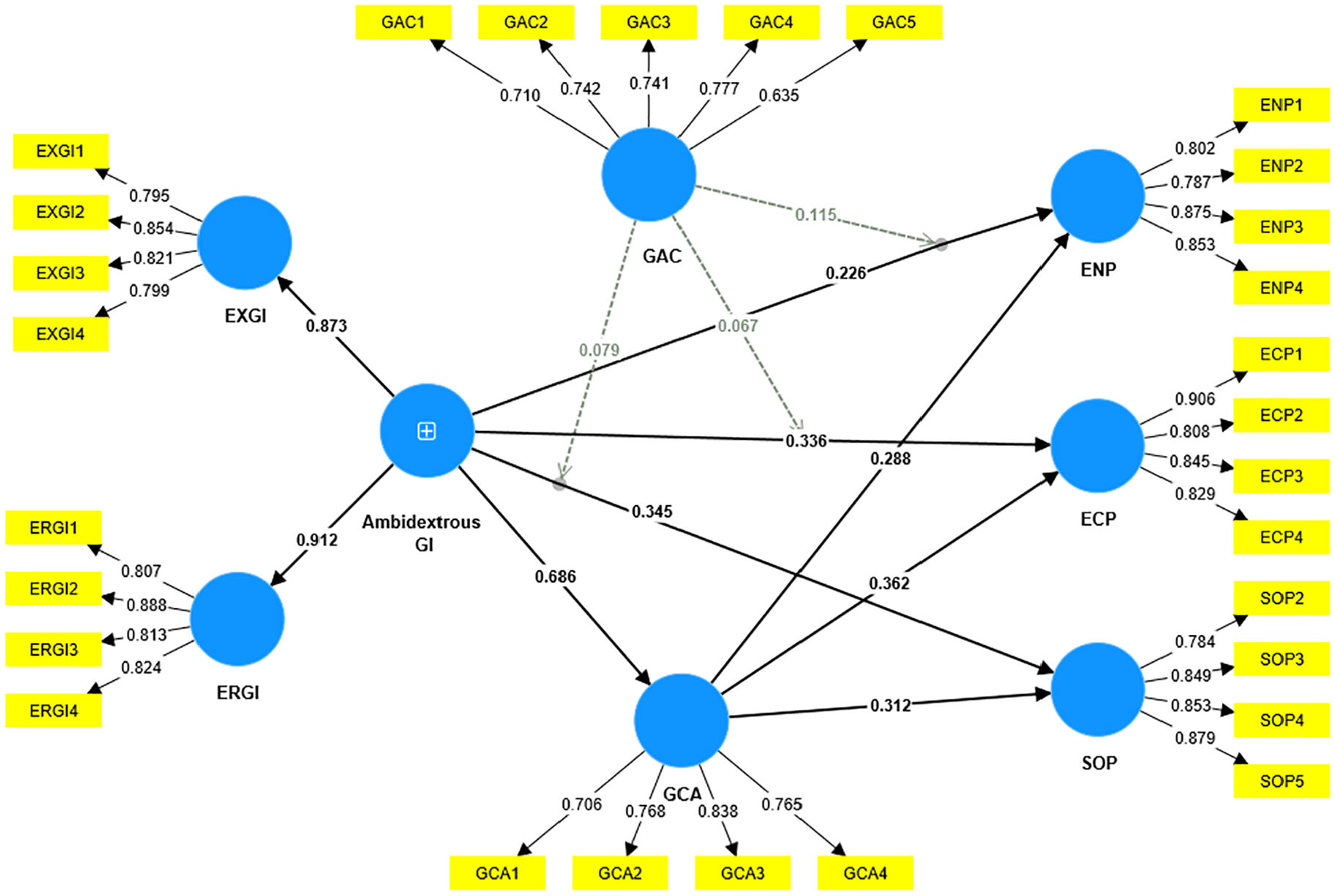
Measurement model for first order constructs.

Measurement model for second order constructs.
Model Robustness
Before performing the hypothesis tests, it is preferred to assess the robustness of the model by evaluating various metrics such as the determination coefficient (R2), effect size (f2), predictive relevance (Q2), and model fit. The coefficient of determination specifies the variation in dependent variables that can be attributed to independent variables. There is no hard and fast rule for R2 values; however, 0.25, 0.50, and 0.75 are considered low, moderate, and substantial, respectively (Hair et al., 2014). Table 6 shows that R2 values for the four endogenous variables are within the moderate range. Effect size illustrates how removing an exogenous variable impacts an endogenous variable.
Effect Size (F2), Coefficient of Determination (R2) and Predictive Relevance (Q2).

Regarding f2, we followed Cohen (1988), who maintained that f2 > 0.02, 0.15, and 0.35 represented low, moderate, and large effect sizes, respectively. F2 effect size for the variables in the current study, indicating a range of lower to higher levels. This finding provides evidence for the robustness of the model. The predictive relevance should be greater than zero. According to Hair et al. (2019), Q2 values greater than 0.50, 0.25, and 0 indicate models with large, medium, and small predictive relevance, respectively. Table 6 shows that all Q2 values are more than zero and are in the small to medium predictive-significance range. Moreover, we utilized the standardized root mean squared residual (SRMR) to verify the adequacy of the model. According to Hu and Bentler (1998), an SRMR value lower than 0.08 indicates an acceptable level of model fit. The SRMR value for our model is 0.063, indicating that the model fit criteria are met.
Endogeneity Tests
We employed the Gaussian copula method to evaluate potential endogeneity, following the approach outlined by Hult et al. (2018). Initially, we determined whether the composite scores of the endogenous variables were normally distributed. Consequently, we conducted a Kolmogorov-Smirnov test on the scores of the latent variables used as independent variables in the partial regressions of the PLS path model. The results showed that these scores were non-normally distributed, allowing us to use the Gaussian copula method. We then generated a Gaussian copula for the latent construct and included it as a predictor variable in the regression model. As none of the coefficients’ Gaussian copula terms were statistically significant (p > .05), endogeneity was not a concern.
Hypothesis Results
The study involves seven direct, three mediating, and three moderating hypotheses. The significance and path coefficient were employed to examine the hypotheses. The results of the hypotheses are shown in Figure 4 and Table 7.
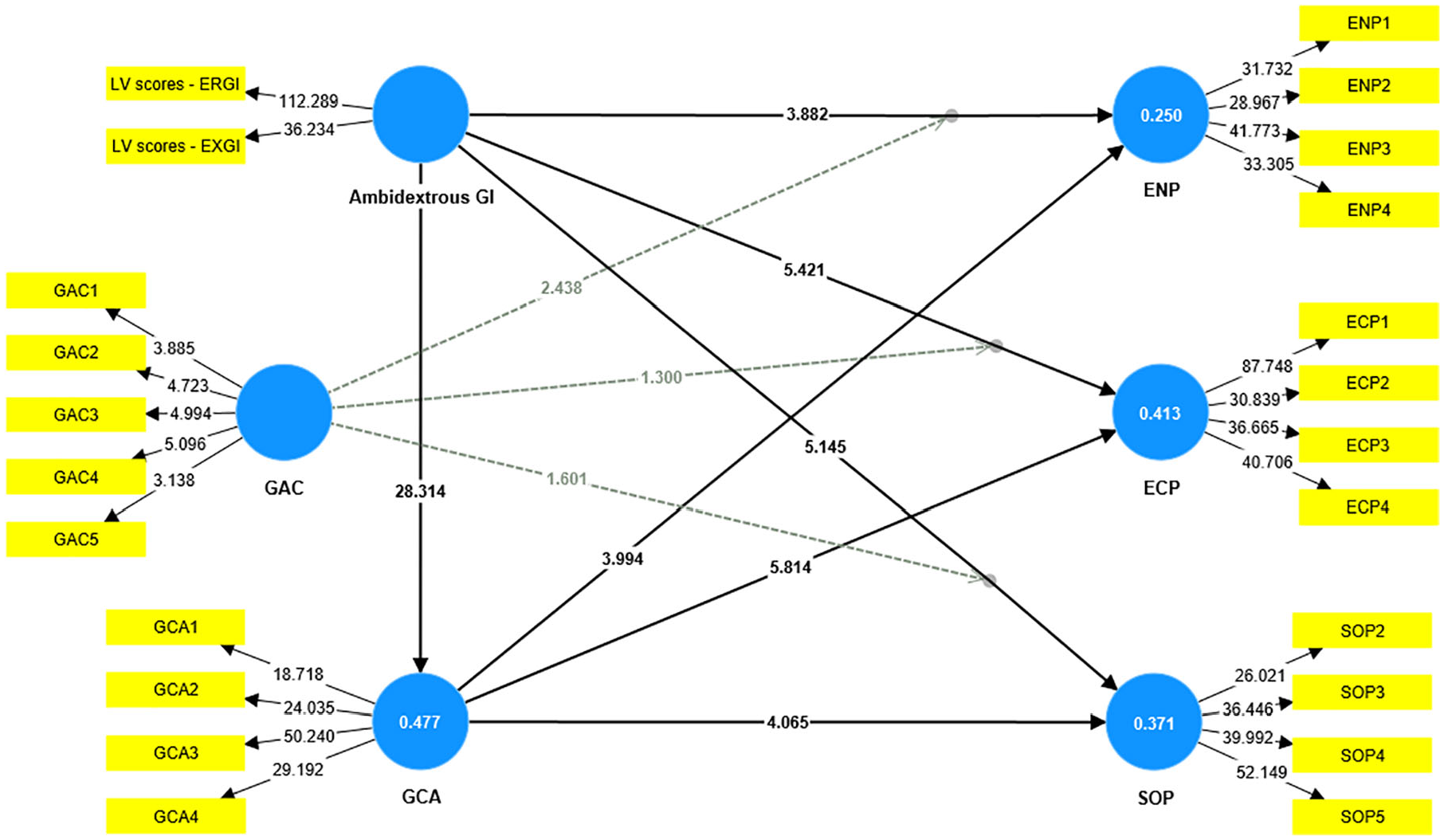
Structural model.
Hypothesis Results.
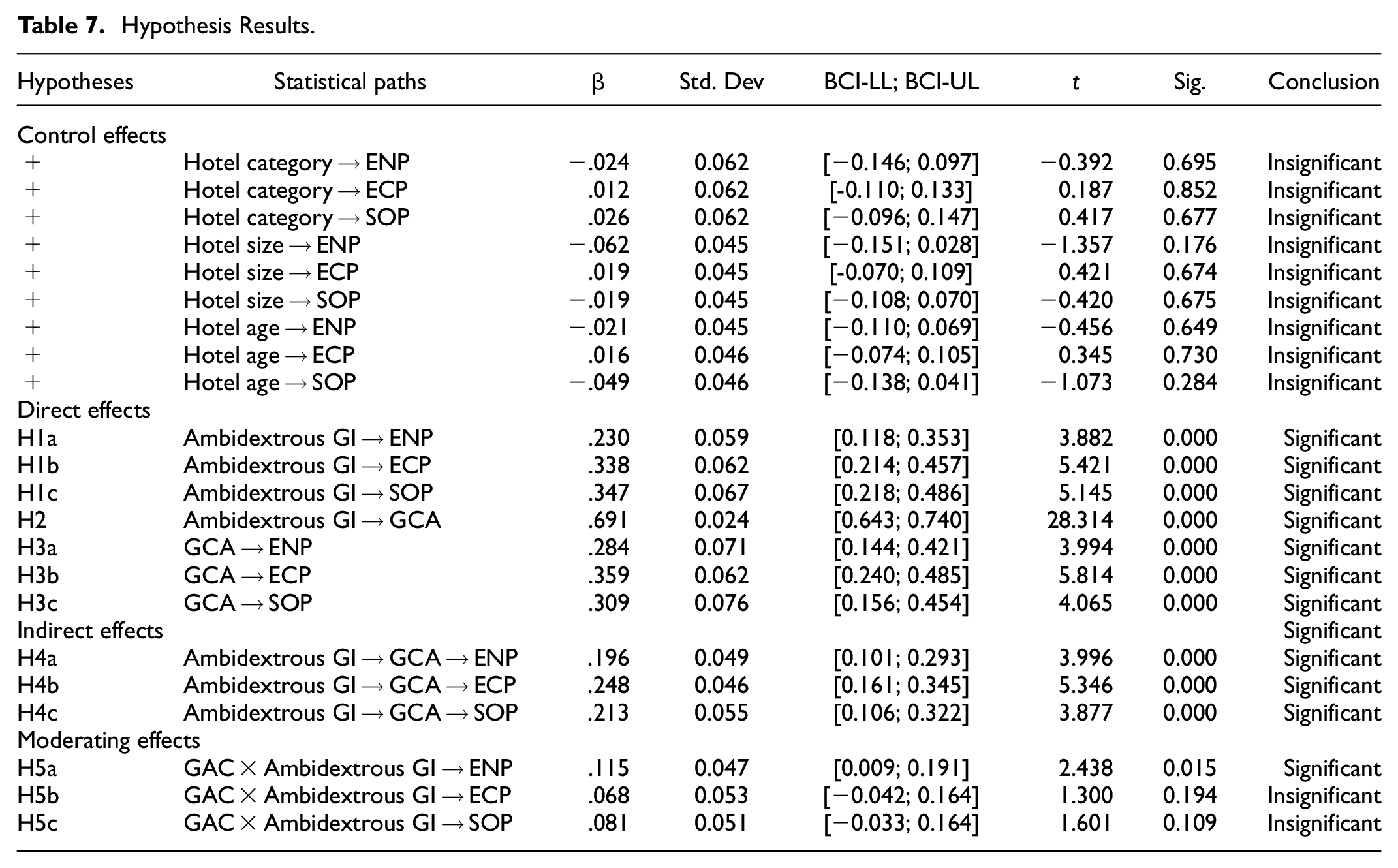
Before assessing the impact of the study variables, we examined the control roles of hotel category, size, and age concerning the different aspects of firm performance. The results indicate that the control variables have no significant impact on the different aspects of a firm’s sustainable performance, demonstrating that ambidextrous GI, green competitive advantage, and GAC do not vary among firms in terms of hotel category, size, and age.
Next, following Hair et al. (2019), we used 5,000 bootstrapping resamples to assess the structural model. First, the direct relationships between the constructs were assessed. The results demonstrate that ambidextrous GI is positively related to ENP (β = .230, p < .001), ECP (β = .338, p < .001), and SOP (β = .347, p < .001). Therefore, the results support H1a, H1b, and H1c. Moreover, for H2, the study proposed a positive effect of ambidextrous GI on green competitive advantage. The results reveal that ambidextrous GI is positively and significantly associated with green competitive advantage (β = .691, p < .001). Therefore, H2 is supported. Next, the study proposed positive effects of green competitive advantage on the three aspects of sustainable performance: ENP, ECP, and SOP. The results show that green competitive advantage significantly impacts these aspects: ENP (β = .284, p < .001); ECP (β = .359, p < 0.001); and SOP (β = .309, p < 0.001). Thus, H3a, H3b, and H3c are supported.
Next, to assess the mediating hypotheses, following Preacher and Hayes (2008), we bootstrapped specific indirect effects. For H4a, H4b, and H4c, the results revealed that ambidextrous GI → GCA → ENP (β = .196 and p < .001), ambidextrous GI → GCA → ECP (β = .248 and p < .001) and ambidextrous GI → GCA → SOP (β = .213 and p < .001) were significant, thus supporting H4a, H4b, and H4c. Additionally, we analyzed the variance accounted for (VAF) and investigated the mediating effect of green competitive advantage on the relationships between ambidextrous GI and the three dimensions of sustainable performance: ENP, ECP, and SOP. According to established criteria, values of the VAF below 20%, in the range 20% to 80%, and exceeding 80% are classified as indicative of no mediating effect, partial mediation, and full mediation, respectively. Mediating effect falls under partial mediation, with VAF values of 46.050%, 42.336%, and 38.043%. Therefore, it can be concluded that partial mediation is supported for hypotheses H4a, H4b, and H4c.
Moreover, for H5a, H5b, and H5c, we proposed moderating effects of GAC on the relationships between ambidextrous GI and the three aspects of sustainable performance. The results reveal that GAC significantly moderates the association between ambidextrous GI and ENP (β = .115, p < .05) but has insignificant moderating effects on the relationships between ambidextrous GI and ECP (β = .068, p = .194) and SOP (β = .081, p = .109). Thus, H5a is supported, whereas H5b and H5c are not. Table 8 and Figure 5 present the moderating-effect results.
Variance Accounted For.


AGI*GAC on ENP.
Discussion and Conclusion
Firms’ sustainable performance requires process improvements at all levels of the organizations, from operational to management. However, research by Úbeda-García et al. (2022) and Zameer et al. (2021) showed that GI significantly improved a firm’s sustainable performance but required abundant capital resources and time and was not always successful. In our research, we expanded on the findings of the existing studies and highlighted how focusing on GI might be beneficial in obtaining a green competitive advantage and enhancing a company’s reputation to improve sustainable performance. The strengthening of a green competitive advantage is partially based on the ideas presented by Xie et al. (2019) and Zameer et al. (2021), who suggested that green process innovation might significantly enhance businesses’ environmental and financial success. Therefore, this study established that ambidextrous GI was crucial in enhancing sustainable performance to improve environmental, economic, and social performance.
The study’s results validate that possessing ambidextrous GI positively affects the three dimensions of sustainable performance in the hotel industry: environmental, economic, and financial. Interestingly, the effect on social performance is more pronounced than those on environmental and economic performance. From a broader viewpoint, our results are consistent with those of Úbeda-García et al. (2022) and Zameer et al. (2021). One probable explanation is that, owing to the influence of hotels on the environment and local communities, sustainability is becoming more essential in the hotel sector. By implementing ambidextrous GI, hotels can effectively tackle environmental concerns, including mitigating their carbon footprint and water usage. This approach can also yield economic benefits by decreasing expenses and elevating their brand image as environmentally conscious firms. Moreover, by integrating social considerations into their sustainability strategy, hotels can potentially improve the welfare of their staff, patrons, and the neighboring community (Úbeda-García et al., 2022). This may include offering staff professional development and training prospects, endorsing regional enterprises and vendors, and participating in philanthropic undertakings and volunteerism to foster connections with the local community. The hotel business must adopt a balanced strategy that considers the social, environmental, and economic aspects of sustainability to function ethically and sustainably.
Second, among the various organizational factors, GI is considered to be one of the most important factors that can increase organizational competitiveness (Abbas & Sağsan, 2019), and management scholars strongly advocate for a thorough investigation into the significance of green competitive advantage antecedents in enhancing sustainable organizational performance (Zameer et al., 2021; 2022). This study undertakes a comprehensive analysis of the literature, emphasizing the crucial significance of ambidextrous GI and green competitive advantage in improving sustainable performance as a feasible strategy and viable substitute for companies to meet the hotel industry’s various requirements in developed countries. According to Zameer et al. (2021), “green process innovation” is a crucial aspect that helps businesses make environmentally responsible decisions. Our research indicates that adopting ambidextrous GI can serve as a viable strategy to enhance a company’s competitive advantage in sustainability. Furthermore, it plays a crucial role in facilitating improvements in environmental performance. The results of our study are consistent with those obtained by Abbas and Sağsan (2019), Shahzad et al. (2020), and Zameer et al. (2021), which suggest that companies’ adoption of GI can have a significant effect on enhancing their competitiveness and sustainable performance.
Several studies have suggested that competitive advantage can mediate the relationship between various organizational factors (Mohsenzadeh & Ahmadian, 2016; Setyawati et al., 2017; Wang, 2019). However, none of these studies have explored the mediating effect of green competitive advantage on the influence of ambidextrous GI on the diverse facets of a firm’s sustainable performance, including environmental, economic, and social performance. The present study validated the mediating effect and expanded the existing literature by investigating the mediating function of green competitive advantage in the association between ambidextrous GI and sustainable performance. The empirical results indicate a partial mediation effect of green competitive advantage on the connections between ambidextrous GI and various dimensions of sustainable performance, including environmental, economic, and social performance. The results show that ambidextrous GI not only directly affects sustainable performance, but also indirectly affects performance in the economy, society, and environment by establishing a green competitive advantage. The findings of Zameer et al. (2021) are supported by our research, which shows that a company’s ability to successfully utilize natural resources and transition to an ecologically friendly organization is enhanced by green competitive advantage. One potential explanation for the study’s results is that businesses acquire an edge in the market by creating exploitative and explorative inventions that positively affect the economy and environment. This enables them to distinguish themselves from competitors and attracts customers to prioritize environmental sustainability. Firms possessing a green competitive advantage are expected to attain superior environmental, economic, and social performance owing to their ability to operate sustainably and responsibly.
This study investigated the moderating effect of GAC on the relationship between ambidextrous GI and various dimensions of sustainable performance, including environmental, economic, and social performance. The findings from the moderation analysis indicate a significant impact of GAC on the relationship between ambidextrous GI and Environmental Performance. However, GAC has no significant effect on ambidextrous GI or the two aspects of sustainable performance (economic and social performance) in hotel firms. This highlights how organizations with a high level of GAC may attempt to include environmental knowledge, competencies, and skills to promote environmental performance while disregarding the capacities and resources required for economic and social performance.
Theoretical Implications
First, this study makes a significant contribution by thoroughly reviewing the literature and emphasizing the critical importance of improving hotel firms’ sustainable performance as a novel strategy and practical response for them to successfully satisfy tourists’ various needs for goods and services. The present study contributes to the literature by examining the associations between ambidextrous GI, green competitive advantage, and sustainable performance. Its novelty lies in its utilization of green theory, based on which firms endeavor to attain a competitive edge and sustainable performance through their intangible resources (Abbas & Sağsan, 2019; Shahzad et al., 2020).
Second, according to the literature, organizations are pressured to find business practices that improve their economic and environmental performance (El-Kassar & Singh, 2019). In the literature on hospitality, the advantages of using ambidextrous GI and its impact on environmental performance have been addressed (Úbeda-García et al., 2022). However, research on whether ambidextrous GI predicts sustainable performance has been insufficient. The present study contributes to the literature by empirically examining the importance of ambidextrous GI in accelerating sustainable performance within a hotel business. Consequently, it broadens and deepens GI research by establishing how ambidextrous GI supports and impacts hotel enterprises’ sustainable performance. According to recent studies, attaining a green competitive advantage is frequently regarded as an essential foundation for firms’ success (Anwar, 2018; Zameer et al., 2021). Firms’ sustainable performance is primarily contingent on their green competitiveness, as noted by Shehzad et al. (2023) and Wang, Xue, Sun, et al. (2020). Given the significance of green competitiveness, our study determines that green competitive advantage is a partial mediator in the correlations between ambidextrous GI and various facets of a company’s sustainable performance, specifically environmental, economic, and social performance. The findings presented in this study support the claim made by Zameer et al. (2021) regarding the mediating role of green competitive advantage in the association between GI and firms’ environmental performance. This study significantly contributes to the literature on the interaction between these constructs.
This study’s primary contribution is its confirmation of the moderating impact of GAC on the correlation between ambidextrous GI and firm sustainable performance. GAC assists businesses in dealing with environmental pressures by learning, absorbing, and applying novel knowledge. According to Wang et al. (2022), the capacity to recognize and assimilate novel information and utilize it for business objectives is a crucial prerequisite for executing an effective environmental management plan. Ambidextrous GI requires firms to pay attention to both internal and external green information; however, how external knowledge is integrated into internal knowledge is determined by GAC. According to Gluch et al. (2009), GAC refers to the capacity to comprehend and assimilate novel information, thereby facilitating knowledge exchange and integration among enterprises. How GAC explains the mechanism through which ambidextrous GI affects sustainable performance in the hotel industry remains unclear, although earlier research has noted that absorptive ability is a critical factor in producing and converting knowledge. Considering its significance, we confirm that GAC favorably affects the association between ambidextrous GI and hotel sustainable performance. Thus, the study enhances the comprehension of sustainable performance and broadens the literature on green theory in the tourism industry. Our study contributes new perspectives to the literature on ambidextrous GI practices by examining the mechanism through which these practices impact sustainable performance.
Practical Implications
In addition to the theoretical implications, the research has practical implications for management strategy making and policy development. First, our research reveals that green ambidexterity is essential for hotels to function sustainably. To improve sustainable performance, we thus propose that green process, product, and service innovation should be initiatives targeted at decreasing or eliminating adverse environmental, economic, and social effects. Second, adopting ecologically friendly ideas into the lifecycle of services will mitigate a company’s negative impacts on the environment, economy, and society. On the one hand, ambidextrous GI increases company competitiveness; on the other hand, ambidextrous GI is essential for enhancing sustainable performance to attain carbon-neutrality objectives. Thus, the results have important management ramifications for managers, allowing them to emphasize ambidextrous GI more to gain a competitive edge and align their companies’ achievements with regulatory requirements.
Third, the findings suggest that hotel companies should increase their utilization of resources and skills to become more competitive as this would help the businesses operate more sustainably. It is recommended that policymakers formulate policies that are conducive to business operations in the hotel industry, thereby fostering competition among firms in the country. This approach would enable firms with a competitive edge to allocate more resources toward sustainable development. Thus, hotel enterprises and policymakers are strongly encouraged to collaborate to achieve sustainable environmental development and attain the long-term objective of carbon neutrality. The present study underscores the significance of ambidextrous GI in enabling organizations to attain sustainable performance through green competitive advantage. Through ambidextrous GI, companies can implement novel technologies that empower their employees to generate services of superior quality that are also eco-friendly, thereby promoting sustainability across the environmental, economic, and social domains.
Study Limitations
The findings of this study should be interpreted in light of its limitations, which also open up avenues for future research in this field. The study was conducted within a specific national setting, namely, the hospitality sector in Spain. Thus, the findings are not generalizable to other cultural contexts or industries. Therefore, caution is advised in generalizing the findings. To authenticate the suggested model, forthcoming research endeavors could examine its efficacy in diverse sectors and different countries’ contexts. Second, diverse methods of gathering data, such as interviews, open-ended inquiries, and the grounded-theory methodology, might be considered for subsequent studies. Third, the present study solely investigated the impact of ambidextrous GI on hotels’ sustainable performance. Future research could explore how tangible and intangible resources (such as green human-resource management and top-management green commitment) interacted with ambidextrous GI to improve hotel sustainability. Finally, the PLS-SEM approach was adopted in this study to demonstrate the impact of ambidextrous GI on sustainable performance through green competitive advantage and the moderating effect of GAC on this mechanism. Previous research has extensively confirmed the usefulness of PLS-SEM analysis in the management domain, facilitating a comprehensive understanding of the conceptual model (Hair et al., 2014). However, the efficiency of hierarchical regression analysis in management has been thoroughly validated in earlier research (Shehzad et al., 2023), and it is highly effective for studying the influencing processes among the variables in the model (Gefen et al., 2000). Therefore, prospective research endeavors may employ it to investigate the model’s influence pathway.
Footnotes
Acknowledgements
N/A
Declaration of Conflicting Interests
The author declared no potential conflicts of interest with respect to the research, authorship, and/or publication of this article.
Funding
The author received no financial support for the research, authorship, and/or publication of this article.
Ethical Approval
The present research was conducted according to the guidelines of the Declaration of Helsinki and approved by the research program committee of the International University of La Rioja (IRB Approval No. UNIR-IRB/FEC/2022-11/04)

Data Availability Statement
The data will be available on request.