




Abstract
In recent years, the phenomenon of the sharing economy has emerged strongly as a system of exchange and consumption of goods and services among individuals, mainly through digital platforms. The development of information and communication technologies and the need for a new consumption and ownership culture have been the driving forces behind this economy. However, there has been little research into people’s motivations to participate in collaborative consumption, especially among young people, who are most likely to use such a consumption model. Therefore, this paper develops an explanatory model, based on self-determination theory, to understand the motivations to participate in the sharing economy of young people, who make up the millennial generation. The model was tested using a sample of 272 people in this population segment, who expressed an interest in this type of consumption. The results confirm that participation in collaborative consumption is motivated by factors such as sustainability, enjoyment of the activity, and economic benefits.
Keywords
Introduction
In recent years, the so-called sharing economy has been modifying the way in which people share and carry out transactions in digital environments (Sutherland & Jarrahi, 2018). Moreover, this emerging economy has disrupted traditional business to business and business to consumer models (Muñoz & Cohen, 2017). Basically, the sharing economy allows individuals to participate in activities that make their possessions accessible to others through different online platforms (Botsman & Rogers, 2010; Gansky, 2010).
The sectors in which the emergence and development of this form of consumption have taken place are very diverse, for example, providing access to idle resources such as transport (e.g., Bla, Bla Car) or accommodation (e.g., Airbnb). In this way, it has been pointed out that consumer preferences are varying, moving from ownership to experience and access (e.g., Bardhi & Eckhardt, 2012).
According to Frenkena and Schor (2017, p. 4), “there has been widespread ambiguity and even confusion about the term sharing economy among academics and the public alike,” with a unified definition lacking (Muñoz & Cohen, 2017). Different proposals have been made, such as the one by Breidbach and Brodie (2017), which defines the sharing economy based on four elements: access instead of ownership (Bardhi & Eckhardt, 2012); use of platforms that allow the exchange of products and services (Fraanje & Spaargaren, 2019); monetary rewards for sharing resources (Cusumano, 2015), and multiple interdependent economic actors (Jaakkola et al., 2015). However, it has also been pointed out that the concept of sharing economy is an “umbrella” concept that encompasses diverse practices, sectors, and organizational forms, including for-profit and non-profit initiatives (Acquier et al., 2017).
The motivations that lead to participation in the sharing economy have been studied in different works (e.g., Bucher et al., 2016; Gullstrand Edbring et al., 2016; Hamari et al., 2016; Hawlitschek et al., 2018; Möhlman, 2015; Tussyadiah, 2016). In general, motivations differ among users and providers, as well as among different types of shared goods and socio-demographic groups (Böcker & Meelen, 2017).
Bucher et al. (2016) conclude that attitudes to sharing are driven by socio-hedonic, moral, and monetary motivations. In this sense, Hamari et al. (2016) conducted a study based on self-determination theory, using a sample of users of the Sharetribe collaborative consumption service. The results showed that participation in this form of consumption is motivated by factors such as sustainability, enjoyment of the activity, and economic benefits, also pointing to a possible gap between attitudes and behavior, which shows the above do not necessarily lead to action. More recently, Hawlitschek et al. (2018) conclude that economic benefits, trust in other users, modern lifestyle as well as the expectation of effort and ecological sustainability are the main factors that lead to the use of this type of platform.
The study by Hamari et al. (2016) suggests the need to test their model in other population groups. Taking as reference the categorization made by Brosdahl and Carpenter (2011) and following Strauss and Howe (1991), the so-called “millennial” generation is composed of individuals born between 1982 and 2000. This generation provokes great interest among researchers in relation to consumption, since it is the first that has developed entirely in a digital environment (e.g., Bolton et al., 2013). In this sense, it is a generation in which advances in information technologies have influenced notably its forms of communication and entertainment (Bolton et al., 2013). From this point of view, authors such as Bucher et al. (2016) point out, following Botsman and Rogers (2010), the so-called “Generation Y,” are expected to be more open to new forms of collaboration and consumption and, therefore, more “permeable” to sharing economy activities. However, some studies regarding this generation have shown somewhat contradictory results. Thus, Godelnik (2017) suggests that although this generation adopts the concept of exchange of property for access, it also maintains many buying habits. In this context, through this study, we intend to contribute to the knowledge of the behavioral patterns of Generation Y or millennials regarding collaborative consumption, identifying motivations, and determining the explanatory relationship between motivation and behavior. To achieve these objectives, the model proposed by Hamari et al. (2016) is tested on a sample of young people who have shown an explicit interest in the sharing economy, having attended a talk about it in the university environment. Millennials are considered an important consumer segment in collaborative consumption (Hwang & Griffiths, 2017). The relevance of this study lies in the importance of analyzing the motivations and consumption behavior of this generation, which has already reached adulthood. Particularly as this generation plays a key role in shaping trends from both a social and economic point of view (Godelnik, 2017). Despite the relevance and growing interest in the study of millennials’ behavior in the so-called collaborative consumption, different authors have indicated that research on this subject is still scarce (Hwang & Griffiths, 2017). Thus, this study aims to contribute to the understanding of the consumption motivations of this generation, which is the main group of users of services linked to the collaborative economy (Mittendorf, 2018).
This paper begins with a conceptual approach to collaborative consumption and the sharing economy and a description of the main explanatory theories, such as the theory of planned behavior and self-determination theory, focusing their application to the millennials from the perspective of generational theory. After that, the research model is presented, as well as the main hypotheses applying the model proposed by Hamari et al. (2016), indicating the main aspects related to the research design and the methodology used. Finally, based on the results obtained, the main conclusions of the study are presented.
Collaborative Consumption Among Millennials: Theoretical Contextualization
Different definitions have been used regarding the concept of “sharing economy” (e.g., Breidbach & Brodie, 2017; Habibi et al., 2016; Reinhold & Dolnicar, 2018). In fact, Dredge and Gyimoäthy (2015) identify the existence of at least 17 related concepts. According to Fraanje and Spaargaren (2019), collaborative consumption can be understood as a subset of the sharing economy, defined as “people coordinating the acquisition and distribution of a resource for a fee or other compensation” (Following Belk, 2014, p. 1597). On the other hand, Möhlmann (2015, p. 194) specifies the activities implied in this form of consumption, pointing out that “cooperative consumption “takes place in organized systems or networks, in which participants conduct sharing activities in the form of renting, lending, trading, bartering, and swapping of goods, services, transportation solutions, space, or money”. In our case, starting from the model proposed by Hamari et al. (2016), we will consider that “collaborative consumption is a peer-to-peer based activity of obtaining, or sharing access to goods and services, coordinated through community-based online services” (Hamari et al., 2016, p. 4).
The study of motivations in the sharing economy has been carried out based on different theories, such as the theory of planned behavior (Bucher et al., 2016) and self-determination theory (Hamari et al., 2016). Specifically, the self-determination theory, proposed by Ryan and Deci (2000), establishes the existence of two types of motivations: intrinsic and extrinsic motivation. The former is characterized by the self or inherent satisfaction that the activity causes, and the second by carrying out an activity to obtain a reward or satisfy an external demand. In the field of collaborative consumption, this theory allows an analysis of motivations involved in participating in this form of consumption related to external aspects (e.g., economic benefits) or internal ones (e.g., enjoyment). In our case, we will follow the structure proposed by Hamari et al. (2016) that applies self-determination theory taking into account the sustainability, enjoyment, reputation, and economic benefits perceived. According to this scheme, the first two motivations would be intrinsic in nature. This means that motivation arises mainly from the satisfaction produced by the activity itself. The latter two are of an extrinsic type, so that the motivation derives from external factors.
A generational approach could be incorporated when implementing this scheme in young people, between 18 and 35 years of age. Generational theory, first introduced by Mannheim (1952), considers that people born in the same time interval are a generation with its own traits. Generally speaking, people belonging to the same generation share conditions and experiences that make up aspects such as thoughts, values, and beliefs (Benckendorff et al., 2010; Donnison, 2007). In particular, the so-called Generation Y is considered as being digital native (Prensky, 2006).
Nevertheless, there is still much debate about the estimation of birth years that make up this generation. Sometimes using different denominations, authors have considered that the period of birth of Generation Y is 1982 to 2002, and that the millennial generation corresponds to a specific subgroup of this generation born between 1985 and 1999 (Benckendorff et al., 2010). Under whichever denomination, millennials or Generation Y, our interest in these youngsters as an object of analysis is based their characteristics or distinctive features regarding their consumption habits and the way in which they differ from previous generations.
With respect to consumption, Benckendorff et al. (2010) has indicated that this generation is characterized by beliefs, values, and motivations related to fun, self-discovery, and friendship. In terms of spending, compared to previous generations, the millennial generation would be characterized, among other things, by satisfying short-term desires and being dependent on credit. Other authors attribute features such as the demand for connectivity on a constant basis as well as community-based rather than individualistic needs as well as their interest in improving and respecting the environment (Hanks et al., 2008). Data on millennials’ attributes reveal they are of great interest to investigate their behavior in collaborative consumption factors, such as sustainability, enjoyment, reputation, and economic benefits, following the model presented by Hamari et al. (2016).
Research Model and Hypothesis
Figure 1 shows the theoretical model and the dependent variable, which is the intention to participate in collaborative consumption. This variable is determined from a set of variables following the approach of the self-determination theory, according to the scheme proposed by Hamari et al. (2016), which distinguishes intrinsic motivations (enjoyment and sustainability) from extrinsic ones (economic benefits and reputation) following the contributions made on motivation by Lindenberg (2001). In our case, we apply the relation of hypotheses proposed by Hamari et al. (2016):

The proposed theoretical model.
Sustainability
Previous studies have shown mixed findings regarding the role of sustainability in millennials’ consumption (Sahelices-Pinto et al., 2021). Thus, while some studies suggest that millennials are concerned about environmental issues, other studies do not find a clear relationship between attitudes and behavior, as is the case, for example, in a study conducted by Naderi and Van Steenburg (2018).
In the study carried out by Hamari et al. (2016), the perceived sustainability significantly predicts attitudes toward the collaborative consumption, although a direct association with behavioral intentions is not detected. As for research on certain areas of activity, in particular, the case of collaborative travel, Tussyadiah and Pesonen (2016), in a study of the factors favoring and discouraging collaborative consumption, conclude that sustainability is one of the driving factors.
However, in Möhlmann’s (2015) study on satisfaction determinants with a collaborative consumption option and the likelihood of reusing this option, the hypothesis of positive environmental impact being influential was rejected in both cases. Along the same lines, in a study of the Airbnb platform, Yang and Ahn (2016) do not observe a relationship between the motivation regarding sustainability and users’ attitudes toward this platform. However, millennials have been considered more socially, culturally, and environmentally aware than other generations (Lee et al., 2019). Taking this into account as well as the model proposed by Hamari et al. (2016), our hypotheses considers the sustainability factor as being one of the main predictors of attitudes and behavioral intentions toward collaborative consumption:
H1a: The perceived sustainability of collaborative consumption positively influences attitudes toward collaborative consumption.
H1b: The perceived sustainability of collaborative consumption positively influences behavioral intentions to participate in collaborative consumption.
Enjoyment
Hamari et al. (2016) conclude that enjoyment positively influences the intention to participate in collaborative consumption. Likewise, this factor positively affects attitudes toward this form of consumption. Authors such as Bucher et al. (2016) identify this motivation as socio-hedonic, that is, the social component and its relation to the enjoyment of participating in collaborative consumption activities is considered one of the proposed constructs in the model, concluding that these types of motives are those that influence in a significant way attitudes related to sharing. In a study conducted by Barnes and Mattsson (2017) in the case of a car-sharing website, the authors also highlight the role of enjoyment and perceived usefulness in the intention to rent. Additionally, Hwang and Griffiths (2017) suggest that the degree of enjoyment and pleasure that millennials perceive is key to the attitude and emotional responses to collaborative consumer services.
Taking this into account, it can be argued that:
H2a: The perceived enjoyment of participating in collaborative consumption has a positive influence on attitudes toward collaborative consumption.
H2b: The perceived enjoyment of participating in collaborative consumption positively influences the intention to participate in collaborative consumption.
Reputation
Recently, trust and reputation in the sharing economy, in particular in Airbnb (Ert et al., 2016), have been studied, pointing out the difference between the two concepts and the way in which they influence consumers’ decisions. Indeed, previous studies have indicated the importance of personal reputation in the context of sharing economy platforms, given the relevance of personal interactions in this area (Mauri et al., 2018). In general terms, the reputation of sharing economy platforms arises from the reviews that consumers make once they have used the service or activity. It is, therefore, an external factor. Hawlitschek et al. (2018) point out that trust in other users is also one of the aspects that leads to participation in this type of platform.
In the study by Hamari et al. (2016), it was initially considered that the perceived reputation of participating in this form of collaborative consumption positively influences both attitudes and behavioral intentions, although ultimately none of the hypotheses were confirmed. Therefore, we will consider that:
H3a: An increase in perceived reputation from participating in collaborative consumption has a positive influence on attitudes toward collaborative consumption
H3b: An increase in perceived reputation from participating in collaborative consumption positively influences behavioral intentions of participating in collaborative consumption.
Economic Benefits
The economic benefits are part of the set of extrinsic motivations that are studied in the present analysis. Specifically, studies on motivations to use these platforms point to the relevance of economic benefits (Hossain, 2020). For example, in the case of the Airbnb platform, previous studies have highlighted the importance of the economic factor in motivating its use (Guttentag, 2019). In previous research, including Hamari et al. (2016), we observe the relevance of this factor, usually considered in terms of cost saving. In this study, economic benefits are a motivating factor that influences the intentions of participating in collaborative consumption. Likewise, Hawlitschek et al., (2018) agree that economic benefit is a factor that leads to the use of these platforms and, analyzing, especially, the case of millennials, Godelnik (2017) suggests that economic benefits are one of the main motivations for their participation in the sharing economy. Taking all this into account, we can hypothesize that:
H4a: The extrinsic reward perceived from participating in collaborative consumption positively influences attitudes toward collaborative consumption.
H4b: The extrinsic reward perceived from participating in collaborative consumption positively influences the intention to participate in it.
Attitudes
Literature on consumers’ behavior recommends separating the aspects related to their attitudes from those of their behavior. However, attitude has been identified as the main determinant of behavior (Ajzen, 1991). However, in research by Hamari et al. (2016), the authors conclude that attitude does not necessarily translate into action. This is the case for the construct referring to sustainability. The opposite occurs in the case of economic benefits, which do affect behavioral intentions but do not significantly affect attitudes toward collaborative consumption according to the authors’ results. In our case, and following the model proposed by Hamari et al. (2016), we propose that:
H5: Attitudes toward collaborative consumption positively influence the behavioral intention to participate in collaborative consumption.
Design of Research and Methodology
Sampling Method and Research Instrument
The target population of this study focuses on young millennials, who are the most likely to participate in collaborative consumption. To do so, this study used a convenience sample obtained from people attending a talk on the collaborative economy held at the University of La Laguna (Tenerife, Spain).
The target population of this study focused on those attending a talk on collaborative economics held on 1st April 2016 at the University of La Laguna (Tenerife, Spain). It was a talk open to the general public, although most of the attendees were university students. The objective, as previously mentioned, was to test a model based on the self-determination theory in an audience that is becoming involved in new consumption decisions and shows an explicit interest in this alternative behavior. A total of 272 responses were collected from people aged between 19 and 35 by means of a self-administered questionnaire completed before the lecture was held. Structured self-administered questionnaires were chosen because they have a higher response rate and the researcher’s interference is minimized (Oppenheim, 1992).
To verify that the sample size is sufficient, G*Power (Faul et al., 2009) was used, which suggests that for testing the proposed model (six constructs), a minimum sample of 146 individuals is required for a statistical power of 0.95. Thus, it can be safely concluded that the sample size used (272) is much larger than required for the purposes of this study.
Based on an adaptation of the proposal by Hamari et al. (2016), a structured questionnaire was designed following the methodologies used by Churchill (1979) and Nunnally (1978). From a literature review, items of scales used and tested in self-determination theory models (Table 1) were adapted to the case of collaborative consumption. A 7-category Likert-type measurement scale was chosen as the most appropriate for item assessment. Finally, the questionnaire included demographic variables, such as gender, age, and knowledge of sharing economy platforms. A group of five experts in collaborative consumption and academics confirmed the apparent validity of the questions. Prior to the main data collection, a pilot test was conducted with 50 people randomly selected to ensure the appropriateness of the research instrument.
Source of the Items Used in the Measurement of Model Constructs.

Source. Hamari et al. (2016).
At the beginning of the questionnaire, respondents were informed that “collaborative consumption or sharing economy can be defined as a system in which goods and services are shared and exchanged between individuals through digital platforms (from private chauffeurs, handicrafts and dry cleaners to lodging or monetary loans). It is a traditional way of sharing, exchanging, lending, renting and gifting redefined through modern technology and communities.”
Sample Profile and Descriptive Analysis
The gender distribution of the resulting sample was 59% female and 41% male. By age, 85% were between 20 and 25 years old and 15% between 26 and 35 years old. In addition, Table 2 shows respondents’ knowledge level of sharing economy platforms, as well as their level of participation as client and/or offeror. It is worth noting that most of the sample knew of the existence of sharing economy platforms. There were only 5.5% that knew of no platform, 83.8% knew of some platforms related to car sharing, 74.6% of accommodation, 36% of crowdfunding, 31.3% of knowledge, 25% of coworking, 19.1% of products, and 4.8% of tools or machinery.
Characteristics of the Sample in Relation to the Collaborative Economy.

Before testing the proposed theoretical model, it was considered useful to perform a descriptive analysis of the responses obtained from the variables studied (Dyer et al., 2007), which is shown in Table 3. From the analysis, the existence of important positive attitudes toward collaborative consumption can be seen. In all items of this construct, the mean is greater than 5.18. It is also possible to observe a high level of agreement with the perception of economic benefits (mean of all items over 5.04). The perception of a sharing economy involving sustainable consumption is also high (item means between 4.77 and 5.32). The intention of participating in collaborative consumption, although positive, is in a somewhat lower range (item means between 4.65 and 5.01), as well as the enjoyment with the activity that is in a range between 4.66 and 5.32. The construct that obtains the lowest level of agreement is reputation (item means between 3.64 and 4.86).
Descriptive Statistics of the Variables.

Note. SD = strongly disagree; D = disagree; DS = disagree somewhat; N = neither agree nor disagree; AS = agree somewhat; A = agree; SA = strongly agree.
Analysis and Results of the Model
The data analysis method chosen was structural equations using the Partial Least Squares (PLS) technique (Fornell & Cha, 1994). The factor loadings are higher than 0.707 indicating that at least 50% of the variance of the construct is reflected in the indicator (Chin, 1998). Construct reliability is always greater than 0.7, which is required in the initial stages of the research and higher than the stricter value of 0.8, required in basic research (Nunnally, 1978).
As for the average variance extracted (AVE) for each of the construct’s indicators, it should be greater than 0.5, indicating that 50% or more of the variance of the indicator is explained (Fornell & Larcker, 1981). This condition is verified in all cases (Table 4). In addition, Cronbach’s alpha coefficient has also been calculated to confirm the internal consistency of the indicators and in all cases, they are greater than .7, which is the reference value.
Confirmatory Factor Analysis of the Measurement Model.

To ensure discriminant validity, we have compared the square root of the AVE (i.e., the diagonal values of Table 5) with the correlations between constructs (i.e., the elements that are outside the diagonal in that table). All the constructs are reflective and are related more to their own measurements than to other constructs (Table 6). In addition, cross-factor loadings have been analyzed and found to be non-significant in relation to factor loadings (Chin, 1998).
AVE and Correlations Between Model Constructs.

Note. The diagonal shows the square roots of AVE.
Cross-Correlation Table.

An analysis of the causal relationships in the structural model is shown in Figure 2, including the explained variance of the constructs (R2) and the standardized coefficients (β).
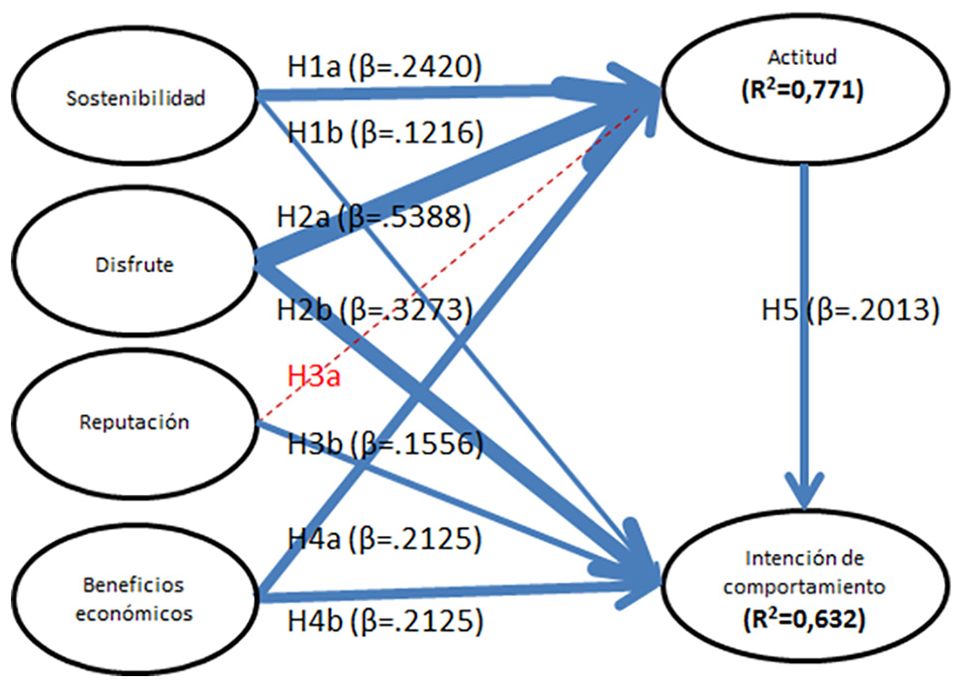
Relaciones causales estimadas en el modelo structural.
Table 7 shows the hypotheses presented, the coefficients of the trajectories and the t-values observed with significance level obtained in the bootstrap test. In addition, we also show the direct, total effects and the proportion of the variance explained, as well as the Q2 of the constructs.
Structural Model.

Note. ns = not significant.
Significance level: *p < .05. **p < .01. ***p < .001.
Regarding the explained variance (R2) of the latent variables “Attitude toward collaborative consumption” and “Behavioral intention,” the structural model shows an adequate predictive power, given that they explain 77.19% and 63.2%, respectively of the variance. An adequate predictive relevance is also found when Q2 is greater than zero (Chin, 1998).
Therefore, in relation to the hypotheses proposed in the model, we can conclude that hypotheses H1a, H2a, and H4a are confirmed, which establish that the attitude toward collaborative consumption is directly and positively affected by the perception of being sustainable (β = .2420, p < .001), by the perceived enjoyment (β = .5388, p < .001) and affected by expected economic benefits (β = .2125, p < .001). However, the expectation of increased reputation does not significantly affect the attitude toward collaborative consumption (H3a).
In addition, we confirm hypotheses H1b, H2b, H3b, and H4b, which establish that the intention to consume in a collaborative way is influenced directly by the perception of sustainability (β = .1216, p < .05), by enjoyment ö = .3273, p < .001), by reputation (β = .1556, p < .001) and by economic benefits (β = .1204, p < .05). Finally, attitude also has a significant positive effect on behavioral intention (H5, β = .2013, p < .01).
Conclusions
Our work has contributed to filling a gap in literature on the sharing economy by analyzing certain behavioral patterns of Generation Y or millennials regarding collaborative consumption, identifying motivations as well as determining the explanatory relationship between motivation and behavior. To achieve these objectives, we started from the model proposed by Hamari et al. (2016) and conducted a survey of a sample of university students who have shown an explicit interest in the sharing economy.
The results obtained in this study indicate that intrinsic motivations are a determinant of attitude (H1a and H2a not rejected), whereas for extrinsic motivations, reputation is not positively reflected in attitude (H3a rejected) but the expected economic benefits of the exchange are (H4a not rejected). Moreover, we observe that both the intrinsic and extrinsic motivations explain intention to participate in collaborative consumption (H1b, H2b, H3b, and H4b not rejected), with enjoyment being the main factor that affects this construct in all cases. Likewise, attitude, as expected, positively influences collaborative consumers’ intentions (H5 not rejected). Reputation is shown as one of the factors that influences behavioral intention, although it is not a factor that is reflected in attitude toward this form of consumption. In this case, we find a gap between attitude and behavior.
The results suggest that, in the case of the millennials, enjoyment is the most influential factor in attitude toward collaborative consumption, with greater impact than that identified in previous studies on the general population (Hamari et al., 2016). Similarly, while in the study presented by Hamari et al. (2016), economic benefits positively affect behavioral intention but not attitude, in our case, we observe that benefits influence both constructs. Moreover, unlike the results in Hamari et al. (2016), sustainability affects both attitude and behavioral intention. Reputation, which in the study by Hamari et al. (2016) was not shown to be a determining factor in attitude or behavioral intentions, however, in our case, it was observed to affect behavioral intentions, but not attitude.
Differences found in the results obtained after applying the same model proposed by Hamari et al. (2016) to the millennials could be linked to the characteristics of this generational group. This would explain the relevance in the analysis presented here of the enjoyment factor as the main determinant of both attitude and behavioral intention. As we pointed out initially, elements such as self-discovery and enjoyment have been identified as two distinctive aspects of the consumption patterns of this generation. This finding is in accordance with Hwang and Griffiths (2017) in considering enjoyment as a key aspect of millennials’ attitudes toward collaborative consumption. Similarly, and in a general way, this result is also consistent with the findings of Barnes and Mattsson (2017).
As for the sustainability factor, the fact that this motivation affects both attitude and behavioral intention is in line with community-based interests that, according to different authors, prevail in this generation over individualistic approaches. Concern about improving the environment is one of the differential features that is usually associated with this generation, which can then be transferred to this form of consumption. In this regard, it has been noted that millennials tend to be pragmatic about the environmental impact of their consumption decisions (Hwang & Griffiths, 2017). Overall, however, the results of this paper with respect to sustainability partially differ from the results of Hamari et al. (2016), as well as other studies such as Yang and Ahn (2016).
In general terms, we observe the importance of intrinsic motivations in both attitude and intention toward using collaborative consumption. With respect to the constructs, economic benefits, and reputation, we observe that in this generational group, economic benefits affect both attitude toward collaborative consumption and the intention to use it. The relevance of this influence on attitude toward collaborative consumption could be related to the values and beliefs associated with collaborative consumption and centers on the positive consideration that a lower economic cost generates. Similarly, previous studies have indicated the importance of the economic factor in the motivations for using collaborative consumption platforms (Hossain, 2020; Guttentag, 2019).
The influence of reputation as a determinant of attitude or intention of use is also different from the results of Hamari et al. (2016), whose hypotheses referring to this construct as an explanatory factor of attitude and intention toward the collaborative consumption were rejected. In this study, we observe that reputation affects behavioral intention but not attitude. This could be explained considering that reputation can be conditioned by benefits in social terms, of status, for example, among peers, endowing participants with a more “utilitarian” sense, which leads to action but does necessarily imply a positive disposition toward collaborative consumption itself. In this sense, previous studies have shown the relevance of personal reputation in collaborative consumption (Mauri et al., 2018).
Practical Implications
The results of this study have different practical implications for collaborative consumption platforms. The existence of differences in the motivations for using these platforms in the millennial generation compared to the general population leads us to recommend that collaborative platforms should target this segment of consumers in a differentiated way. In this sense, it is important to emphasize aspects related to enjoyment, sustainability, and the economic benefits of using these platforms. Similarly, the role of reputation should also be considered by collaborative consumption platforms, given that the results have shown a relationship with behavioral intention of this group of consumers.
Theoretical Implications
This study involves the application of the model of Hamari et al. (2016) to the case of millennial consumers. Self-determination theory, a theory used in the analysis of consumers’ motivations in different studies on this generation (e.g., Jain & Mishra, 2020; Paulin et al., 2014) has proved useful in reflecting differences in the motivations of millennial consumers to use collaborative consumption platforms. In general, it has shown the relevance of intrinsic motivations in attitude and intention to participate in this type of consumption and, specifically the importance of economic benefits in the case of extrinsic motivations.
Limitations and Future Lines of Research
Regarding the study’s limitations and future lines of research, we must bear in mind that participants were predominantly university students from the same university. This implies that the sample may be made up of groups of friends or colleagues who share similar concerns and interests. Therefore, it would be interesting to replicate the study in other population groups to generalize the results. This may require adaptations or adjustments to the model of Hamari et al. (2016), for example, in context variables, such as cultural factors (Schewe et al., 2013). Likewise, issues related to the role of values in collaborative consumption in this generational group could be incorporated into future work, furthering previous research on this aspect (e.g., Piscicelli et al., 2015).
Footnotes
Declaration of Conflicting Interests
The author(s) declared no potential conflicts of interest with respect to the research, authorship, and/or publication of this article.
Funding
The author(s) received no financial support for the research, authorship, and/or publication of this article.
