




Abstract
Self-regulation is a process that may affect the degree of peer rejection but may also be determined by the degree of peer rejection, whereby the degree of acceptance/rejection can influence the processes that lead to the strengthening or weakening of self-regulation. In this study, we concentrate on self-regulatory mechanisms (self-regulated behavior and strategies for emotional regulation) in peer-rejected students compared to non-rejected students. With the aid of structural equation modeling, we identified models of self-regulation mechanisms in three groups of students according to their acceptance/rejection. These groups differ in the degree of peer rejection, the structure of the regulation of emotional relations, and the degree of self-regulation behavior. The results suggest that peer-rejected students do not form a monolithic group from the perspective of self-regulation mechanisms, as it is possible to identify diverse structures of relations between the self-regulation mechanisms that probably depend, inter alia, on the degree of peer rejection.
Keywords
Introduction
The peer group plays an important role in an individual’s life and mediates a unique experience of group interaction for an individual (Bukowski et al., 2018; Reitz et al., 2014). The acceptance of an individual within a peer group, which largely takes place at school, is so significant that it can affect their subsequent social functioning in the next stages of development, that is, during adolescence and adulthood (McElhaney et al., 2008; Williams & Nida 2011). According to Baumeister et al. (2005), for an individual to be accepted into a social group and effectively find their place in it, they are equipped with a capacity of self-regulation, which can be defined as the ability of an individual to control and change emotions and behavior in an adaptive direction (Baumeister & Vohs, 2007). Self-regulation, which includes volitional, cognitive, and behavioral processes, contributes to positive adaptation, which can affect the quality of social relationships (Blair & Diamond, 2008; Raffaelli et al., 2005). Failure to self-regulate can affect the development of social and emotional problems, but it can also be associated with peer social rejection (Trentacosta et al., 2009). Failure in self-regulation can act as a factor influencing peer rejection and on the other hand peer rejection can act in the opposite direction and cause a failure in self-regulation. Our previous research (Hladik & Hrbackova, 2021) shows that peer-rejected pupils are not a homogeneous group and that there are intergroup differences between peer-rejected pupils, especially in the degree of behavior self-regulation.
It is likely that the process between peer rejection and self-regulation may be different for a group of rejected students (here, moreover, it may differ according to the level of rejection) and non-rejected students. The differences between rejected and non-rejected groups of students will allow us to better explore the sequences that act as protective factors or risks in the face of peer rejection.
Peer-Rejected Children
The quality of peer relationships in the context of a child’s peer rejection can have an impact on their emotional, cognitive, behavioral, biological, and neural functioning (DeWall & Bushman, 2011; Leary, 2010). Peer rejection interferes with the individual components of human experience, perception, and behavior. It significantly affects the mental health and well-being of an individual (Maner et al., 2007); it can lead to feelings of loneliness and depression (McDougall et al., 2001; Schwartz et al., 2008), anxious (Pickering et al., 2020) or suicidal thoughts (Boeninger et al., 2010; Rigby, 2003), antisocial behavior (Kotchick et al., 2001), or aggression (Lansford et al., 2010; Twenge et al., 2001). At the same time, it threatens the sense of a meaningful existence, the perception of hope, or the need to belong and control (Gonsalkorale & Williams, 2007; Williams, 2009). Long-term exposure to peer rejection can lead to impaired regulation of emotions, including poor emotional awareness, and an increase in rumination (King et al., 2018; McLaughlin et al., 2009; Parker et al., 2006). Lack of connectedness and participation in a peer group reduces self-efficacy (McLaughlin-Volpe et al., 2005). Social rejection can be very painful for individuals (Baumeister et al., 2002); in this context, MacDonald and Leary (2005) speak of so-called “social pain” as a painful, physiological consequence of social rejection (Eisenberger & Lieberman, 2005; Onoda et al., 2010).
A number of factors can lead to peer rejection, but the most consistently related factors, especially in the long run, are aggressive and socially closed off behavior (Youngblade et al., 2009). Children who appear shy, anxious, or closed off in a group of peers may experience more peer rejection. At the same time, however, behavior externalization may be the reason for their rejection (Killen et al., 2013). Antisocial behavior may be one of the causes of peer rejection, with low levels of self-regulation generally associated with higher levels of antisocial behavior in childhood and adolescence (N. I. Eisenberg et al., 2005). Individuals with low levels of self-regulation may be more prone to peer rejection through their behavior, which may, in turn, affect their efforts to reintegrate socially (Baumeister et al., 2007). Rejection is a risk associated not only with at-risk groups (at risk of social exclusion), but also with non-risk groups due to differences from others (Harrist & Bradley, 2002). In general, we can talk about the reasons for social rejection, which are given by individual differences (interpersonal rejection), and intergroup specifics (e.g., ethnicity, nationality, socioeconomic status, sociocultural difference, gender, religion, etc.), which focus on the specifics of exclusion in the context of in-group and out-group attitudes (Bierman, 2005; Killen et al., 2013).
Self-Regulation in the Context of Peer Rejection
There is no doubt that peer rejection affects the social life of individuals, as each individual has an inherent need to belong to, establish, and experience close and positive relationships. This need to belong is characterized by an effort to form and maintain a minimum number of meaningful and positive interpersonal relationships. It is a fundamental human motive and a starting point for understanding social interaction and the specifics of interpersonal relationships (Baumeister & Robson, 2021; Leibovich et al., 2018).
In the school environment, the need to belong manifests itself in the extent to which students feel accepted, respected, supported, and included by their classmates; it plays an important role in the mental health and well-being of students (Arslan, 2021). It is also about feelings and perceptions of oneself as a full-fledged part of school life (Arslan & Duru, 2017). Using a sample of high school students, Arslan (2021) found that social inclusion and exclusion in school is a significant predictor of student loneliness. Loneliness mediates the connection between social exclusion and subjective well-being and partially mediates the effect of social exclusion on adolescent mental health problems.
Self-regulation plays an important role in satisfying the need to belong (Baumeister et al., 2005; Finkel & Campbell, 2001; Tangney et al., 2004). Baumeister et al. (2005) showed in six experiments that exclusion or rejection causes a decrease in self-regulation. Specifically, they found that self-regulation is significantly impaired in people who have just received news of social rejection or future exclusion. This complex individual, internally structured mechanism can generally be defined as an individual’s ability to control and possibly redirect their emotions, attention, and behavior toward adaptive goals (Posner & Rothbart, 2000). Since self-regulation is broadly understood as an individual’s effort to change their own response (Baumeister et al., 1994), it can be assumed that social rejection and the thus unsatisfied need to belong may be a catalyst for self-regulation. It can also be assumed that an individual who is exposed to peer rejection will be motivated to increase self-regulation for the purpose of peer acceptance.
Similarly, this complex process is considered by motivation theory, which assumes that if an individual is needed to belong, his/her drive for social acceptance will not be as strong as in the case of social rejection or exclusion. In the case of social rejection or exclusion, it can be assumed that the individual will make some effort to satisfy this fundamental need and achieve social acceptance (Baumeister & Robson, 2021; Shah & Gardner, 2008). However, Baumeister et al. (2005) also point to the opposite effect, that is, peer rejection can adversely affect an individual’s self-regulation. In this case, what occurs is the opposite—selfish and self-defeating behavior (Baumeister et al., 2005; Wood et al., 2002). At the same time, it has been found that the promise of future acceptance can play an important role in motivating reintegration (DeWall et al., 2008). The social environment and its response to possible undesirable behavior of an individual indicating a low level of self-regulation may support self-regulation or, conversely, stagnation and inability to develop self-regulation (Blair & Diamond, 2008; Vavrova et al., 2015).
The regulation of behavior, attention, and emotions becomes more important during adolescence, as it can significantly affect interpersonal relationships within a social group (Papp & Witt, 2010). Self-regulation is specific in that it can direct one’s own desires, inclinations, and behaviors toward compliance with societal norms and social roles (or prioritizing long-term goals) (Bauer & Baumeister, 2011). The regulation of emotions is a process that affects which emotions are manifested in an individual; when, in what way, and how intensely they are manifested; for how long the individual experiences them; and how they express them. This process provides the basis for behavioral regulation and, as one of the forms of response to the social environment, enables adaptive functioning in society (Gross, 2015).
The regulation of emotions can be categorized as so-called explicit (intentional) and implicit (automatic), or completely unconscious (cf. Braunstein et al., 2017; Gross, 2015). The theoretical framework for emotional regulation was provided by Gross (1998), who describes five basic areas of emotional regulation: situation selection, situation modification, attention focusing, cognitive change, and response modulation. Individuals who are accepted by a social group show a higher degree of emotion regulation (Kim & Cicchetti, 2010). Conversely, the more students experience loneliness and distress associated with social rejection and the lower their awareness of their own values and importance, the more often they use maladaptive emotional regulation strategies (e.g., self-blame, rumination, catastrophizing, blaming others, suppressing external emotions, suppression of thoughts, cognitive and behavioral avoidance, denial, worrying, etc.; cf. Hladik & Hrbackova, 2021; Garnefski et al., 2001; Marroquín et al., 2017).
Kim and Cicchetti (2010) conducted research on a sample of children (ages 6–12) from low-income families who were treated normally or maltreated. The children were assessed for emotion regulation, as well as internalizing and externalizing symptomatology, and were nominated by peers for acceptance and rejection. A longitudinal analysis revealed that maltreatment risk factors are related to emotion dysregulation, which contributes to later internalizing and externalizing symptomatology, directly as well as indirectly through negative peer relations. Conversely, higher emotion regulation predicted higher peer acceptance over time. These results suggest that being accepted or rejected by peers contributed to different pathways of internalizing and externalizing symptomatology. Adaptive regulation of emotions requires awareness of one’s own emotions and their context, and awareness of the goal one wants to achieve. It also includes the choice of strategy as a means to an end (Gross & Jazaieri, 2014). Adaptive strategies for regulating emotions can include, for example, cognitive reassessment, thinking about possible solutions, planning steps to solve problems, specific actions leading to solutions, or acceptance (cf. Aldao et al., 2010; Schäfer et al., 2017).
Adaptive emotion-regulation strategies are used by individuals with a positive attitude to school life, while individuals with an ambivalent or negative attitude to school life use maladaptive emotion-regulation strategies. In this case, there is repeated thinking about the situation (or exaggeration), and re-describing and analyzing the negative experience to a greater extent (Hladik & Hrbackova, 2021). Research (cf. Hladik & Hrbackova, 2021) shows that self-regulation must be perceived in the context of the social environment, which significantly affects the quality of social relations. Evidently, self-regulation is influenced by peer relations; however, the resulting effect is mainly induced by the quality and nature of mutual interactions with peers (King et al., 2018). These are therefore two interacting processes, the trajectories of which can significantly affect the position of the individual and, at the same time, the relationships within the social group. Individuals differ in the breadth and diversity of regulatory strategies in the context of (not only) their peer rejection but also in the degree of flexibility with which they can choose appropriate strategies or change them.
For this reason, in our research, we are interested in whether it is possible to identify groups among socially rejected pupils that differ with regard to the hierarchical relationships of self-regulatory mechanisms and whether this process differs from the group of students who are non-rejected from the class. In this way, we can better understand the similarities and differences in sequences and processes that lead from rejection/acceptance toward weakening/strengthening of self-regulation.
Methods
Research Aims
The research aimed to identify and describe models of self-regulation mechanisms in groups of peer-rejected students and to compare these models with a model of self-regulation mechanisms in non-rejected students. The objective was to verify the assumption that some peer-rejected students can be identified as groups that differ from non-rejected students in the hierarchical relations of self-regulation mechanisms.
Participants
The research was conducted on a sample of 1,625 students. The students were randomly selected from lower-secondary schools in the Czech Republic. In the research sample, 103 students who formed a group of peer-rejected students (z-score at intervals from −5.24 to −1.01) were identified using a sociometric test and standardized z-score (girls: n = 34; boys: n = 69; average age = 13.2 years). For data analysis, the group of peer rejected students were compared with 1,397 (counted after the removal of invalid cases) non-rejected students (z-score higher than −1.00). The non-rejected group of students consists of 688 girls and 709 boys, with an average age of 13.1 years. Participants verbally provided informed consent for the research.
Research Tools and Procedure
A sociometric test was used for the identification of the social inclusion (rejection) level of each student in the class. The test consisted of six unfinished sentences which the students were asked to complete according to their preferences, for example, “My friends in the class include . . .” (positive choice), “My friends in the class do not include . . .” (negative choice). The students could not choose themselves. The number of choices was not limited in any way. The difference between the positive and negative choices indicated the social preference index for each student according to the procedure of Coie, Dodge, and Coppotelli (1982). Peer status was determined according to the standardized z-score. Due to the different number of students in the classes, the raw scores of positive and negative choices in the sociometric test had to be converted to z-scores, as stated above. A z-score is a standardized value with nil as a mean value and with −1 and 1 as 1SD. Values in the interval from −1 to 1 or greater means acceptance. Values less than −1SD means rejection. The z-score allows inquiry on the intensity of peer-rejection. The lower the z-score value, the higher the intensity of peer-rejection is.
The Cognitive Emotional Regulation Questionnaire (Garnefski & Kraaij, 2006) and ERQ Questionnaire (Gross & John, 2003) were adapted for measuring the self-regulation of students’ emotions. These research methods aim to identify the modes or strategies of emotional self-regulation that students use in unpleasant or stressful situations at school. The adapted version contained 18 items. Responses were recorded on a five-point scale, whereby 1 = “almost never” and 5 = “almost always.” A higher score represents greater use of a specific strategy (Cronbach’s coefficient α = .75). Based on an exploratory factor analysis, five factors were identified which explain 51.65% of the variance. The identified factors were the strategies of rumination (F1), acceptance and positive reappraisal (F2), positive refocusing (F3), blame (F4), and a factor related to the suppression of emotional manifestations (F5).
The Means-Ends Problem Solving Technique (MEPS) was used to assess students’ self-regulation. The MEPS (Platt & Spivack, 1989) focuses on interpersonal cognitive problem solving which refers to students’ level of self-regulation skills. In this part of the study, the students were asked to complement the central part of a short story. They know that the beginning of the story presents a certain problem (e.g., “You and your classmate had agreed to work on a group task together, but they chose to work with someone else in the end”) and that the end of the story brings a successful solution to the problem (e.g., “The end of your story is that you work with the classmate you agreed to work with in the end.”). The students are asked to supplement the middle part of the story with 5 to 10 sentences so that it would end as provided in the assignment. The students’ answers were evaluated using a 4-point scale of 0 to 3, where 0 = a completely irrelevant answer and 3 = a completely relevant answer indicating the student’s ability to successfully regulate their behavior. The students complemented a total of five stories. The students were able to obtain a maximum of 15 points, where a higher score corresponded to a greater degree of use of self-regulation skills during interpersonal cognitive problem solving (Cronbach’s coefficient α = .81).
ANOVA was used to find statistically significant differences among groups of students. The model was tested using structural equation modeling with AMOS by applying a maximum likelihood estimate to assess the relations among the variables.
Results
Although the study is focused on self-regulation mechanisms in peer-rejected students, results from non-rejected students are also presented. This comparison, which indicates the difference between peer-rejected students and non-rejected students, is useful for a complex assessment of the research problem. Based on structural equation modeling, two groups of peer-rejected students were identified by the model structure of the self-regulation mechanism. These two groups of peer-rejected students and the group of non-rejected students differ in their degree of peer rejection and level of behavioral self-regulation. From the point of view of peer rejection and self-regulated behavior, these are independent groups (Table 1).
The Values for Self-Regulation, Peer Rejection, and Emotional Regulation in Three Groups of Students.

The students in the first group have a very low level of self-regulated behavior (M = 1.10), that is, these students are unable to regulate their behavior. The level of self-regulated behavior of the students in the second group is much higher (M = 5.21); however the level of self-regulated behavior of the non-rejected students is even higher (M = 7.10). The students in the second group can be expected to regulate their behavior more successfully, yet since 15 is the maximum attainable number of points, and in comparison to non-rejected students, their level of self-regulation is still quite low. The average degree of peer-rejection in non-rejected group of students is M = 0.30. A value higher than −1 (the standardized z-score) means non-rejection and a value less than −1 means peer-rejection. The students in the first group were rejected more in their classes (M = −2.15), whereas the students in the second group were rejected less (M = −1.92). This supports our earlier finding that a greater degree of peer rejection causes a decline in the level of their self-regulated behavior (Hrbackova, 2018). Differences among groups of students in emotional regulation are not too high, and moreover are not statistically significant. Even though the differences in the level of emotional regulation are not statistically significant, emotional strategies can be structured different in the groups of students, as stated below.
The above-described three groups of students are identified by different structures of self-regulation mechanism relations. These relations can be defined using three models. A model of the structure of self-regulation mechanism relations was created for each group, according to a good fit of the model and its meaningfulness. Following Kline (2011), these parameters were monitored during the verification of the functionality of the models: χ2/df, p-value, GFI (goodness of fit index), CFI (comparative fit index), RMSEA (root mean square error of approximation), PCLOSE (p-value of close fit), and RMR (root mean square residual).
In all models, peer rejection is the basic determinant (the exogenous variable), whereby the structure of relations, via strategies of emotion regulation (predictors), is directed to self-regulated behavior (the endogenous variable).
The structure of self-regulation mechanism relations in the first group of peer-rejected students, which is characterized primarily by a low degree of self-regulated behavior and a higher level of peer rejection, is demonstrated in Figure 1.

The structure of self-regulation mechanism relations: first group.
This structural model provides a good model fit with the fit indices: χ2/df ratio = 0.949, p = .504; GFI = 0.936; RMR = 0.108; CFI = 1.000; RMSEA < 0.001; and PCLOSE = 0.623.
The structure of self-regulation mechanism relations is not particularly complex. As Figure 1 shows, predictors are linked to one another in direct effects. Peer rejection directly affects suppression of emotional manifestations (β = .332). Rumination is directly influenced by suppression of emotional manifestations (β = .372) and directly affects acceptance and positive reappraisal (β = .439). Acceptance and positive reappraisal have a direct effect on two modes of emotional regulation: blame (β = .480) and positive refocusing (β = .678). Self-regulated behavior is directly influenced by blame (β = .109) and positive refocusing (β = .191). The strength of the direct effects is relatively high. Both peer rejection and emotional regulation strategies figure in the model as strong predictors; only in the case of blame and positive refocusing can the strength of the effect on self-regulated behavior be considered lower). The indirect effects of predictors are not very strong in this model. The greatest indirect effect was noted in the influence of rumination on positive refocusing (β = .298) and rumination on blame (β = .211). Suppression of emotional manifestations indirectly influences acceptance and positive reappraisal (β = .163) and peer rejection indirectly influences rumination (β = .123). Other indirect effects are relatively low.
The second group consists of students whose peer rejection index is not so low, that is, these students are not as peer-rejected in the class as students in the first group. These students’ self-regulated behavior is on a higher level; hence, it can be expected that these students’ ability to regulate their behavior will be better (Figure 2).
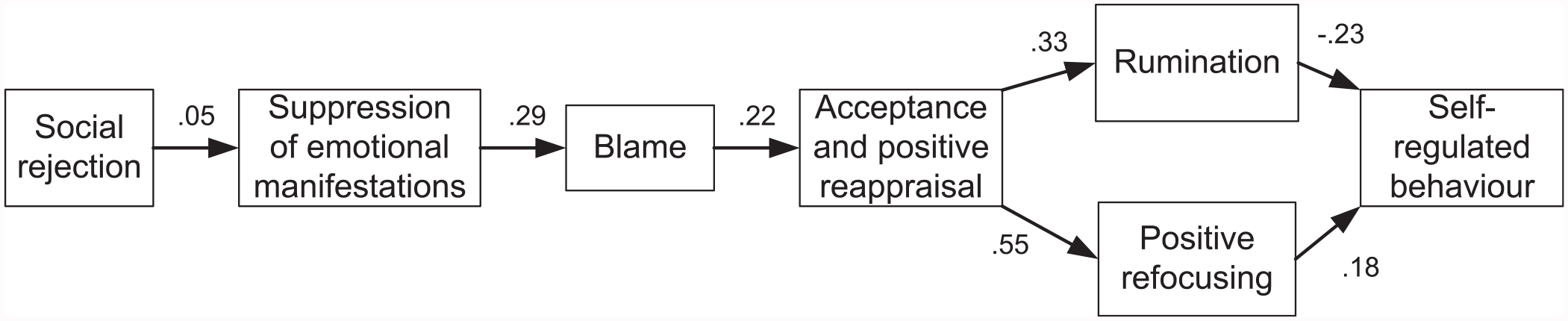
The structure of self-regulatory mechanism relations: second group.
This structural model provides a good model fit with fit indices: χ2/df ratio = 0.957, p = .495; GFI = 0.933; RMR = 0.097; CFI = 1.000; RMSEA < .001; and PCLOSE = 0.617.
Like in the first group, the basic determinant is peer rejection, which directly impacts suppression of emotional manifestations (β = .047). The strength of the peer rejection effect on the suppression of emotional manifestations is weak. Contrary to the first group, peer rejection appears as a weak predictor of self-regulation mechanisms. Evidently, the strength with which peer rejection acts on self-regulation mechanisms is not constant, but depends on the degree of peer rejection. The higher the degree of peer rejection, the stronger its influence on self-regulation mechanisms. Suppression of emotional manifestations directly influences blame (β = .290), which directly influences acceptance and positive reappraisal (β = .217). Acceptance and positive reappraisal directly affect positive refocusing (β = .550) and rumination (β = .330). Self-regulated behavior is directly influenced by positive refocusing (β = .183) and rumination (β = −.234). The strength of the direct effects is not as high as in the first group. It may be expected that, in this model, individual self-regulation mechanisms are more influenced by other factors as well. The strongest predictor in the model is acceptance and positive reappraisal with a positive impact on positive refocusing and rumination. Both regulation strategies influence self-regulated behavior in yet another way. Higher values of positive refocusing lead to higher values of self-regulated behavior. In other words, the more students apply positive refocusing, the better they can regulate their behavior. Low values of rumination lead to higher values of self-regulated behavior, that is, the less students apply the strategy of rumination, the better they can regulate their behavior. The indirect effects of predictors are low.
The non-rejected group consists of students who can be considered accepted by their schoolmates in the class. These students’ self-regulated behavior is at the highest level in these groups. It can be expected that most of these students have a sufficient ability to regulate their behavior (Figure 3).

The structure of self-regulatory mechanism relations: non-rejected group.
This structural model provides an adequate model fit with these fit indices: χ2/df ratio = 6.215, p < .001; GFI = 0.983; RMR = 0.101; CFI = 0.809; RMSEA = 0.061; and PCLOSE = 0.059. Some parameters of the model fit are not excellent (the χ2/df ratio is higher than 5 and the p < .001) but rather acceptable.
The basic determinant is peer rejection, which directly impacts blame (β = −.077). The strength of the effect of peer rejection on blame is weak but their initial relationship in the model is clearly seen. The more is a student accepted, the less they blame others. Acceptance and positive reappraisal, which is directly affected by blame (β = .150), simultaneously influence positive refocusing (β = .326) and suppression of emotional manifestations (β = .178). Positive refocusing is a direct path to self-regulated behavior (β = .133). Self-regulated behavior is also directly affected by rumination (β = .119), which is directly influenced by suppression of emotional manifestations (β = .140). The indirect effects of predictors are low. The strongest predictor in the model is acceptance and positive reappraisal. Other predictors are not as strong as in the two groups of peer-rejected students.
Discussion
To date, there has been no relevant empirical information on self-regulation mechanisms focused on peer-rejected students. It cannot be expected that peer-rejected students form a monolithic group with identical characteristics. However, in cases involving self-regulation, certain similarities may certainly be presumed, especially concerning our earlier findings, which suggested that self-regulation is linked to the degree of peer rejection (Hrbackova, 2018). We have established that peer-rejected students differ from one another in the structure of self-regulation mechanisms. We have successfully identified two groups of peer-rejected students, which we compared with a group of non-rejected students to verify the functionality of the model of the structure of self-regulation mechanisms. Moreover, the groups differ in two important parameters. The first group (n = 51) comprises students who were strongly rejected by their classmates; their peer-rejection index is very low and their self-regulation behavior is also very low (M1.gr. = 1.10). These students form the most deprived group. The second group of students (n = 52) is also rejected by their peers, but not to such a degree; their peer-rejection index is not as low as that of the first group and the level of their self-regulation behavior is higher (M2.gr. = 5.21). The third group consists of non-rejected students, who achieve the highest level of self-regulation compared to the other groups (M3.gr. = 7.10, p < .001).
Both models for peer-rejected students differ in the structure and strength of predictors. In the first group, the role of peer rejection plays a greater role in the structure of self-regulation mechanisms. The structure of the models also differs in the effect of the two modes of emotional regulation. While in the first group, rumination is closer to the beginning of the chain of relations and has a direct impact on acceptance and positive reappraisal, blame is at end of the hierarchy of relations associated with self-regulation mechanisms, thus directly impacting only self-regulated behavior. People with problems often find their minds occupied by those problems. This preoccupation, or rumination, is sometimes considered a problem in its own right, especially when the preoccupation is undesired. Sometimes rumination even creates vulnerability to more distress (Carver & Scheier, 2001). In the second group, on the other hand, the strategy of emotional regulation plays the opposite role. Blame is linked to suppression of emotional manifestations and has a direct impact on acceptance and positive reappraisal. Rumination is at end of the chain of relations and directly impacts self-regulated behavior, thus having the opposite effect from rumination in the first group. This means that the more the students ruminate about a problem, the less they can regulate their behavior.
Our finding is consistent with prior research (Nolen-Hoeksema et al., 2015) showing that rumination is one emotion-regulation strategy associated with a failure of self-regulation. The findings of Ward et al. (2003) suggest that in addition to its negative effects on thinking and problem solving, self-focused rumination can inhibit instrumental behavior by increasing uncertainty, leading to further rumination and behavioral paralysis. The strategy of suppressing emotional manifestations is prevalent in both groups at the beginning of a “self-regulation path.” Concealing one’s emotions is an understandable strategy for peer-rejected students. However, this linkage varies in both groups, as we see above. The strategy of emotional regulation acts as a kind of “mediator” between peer rejection and self-regulated behavior. Research on emotional suppression suggests it is associated with an increase in rumination (Liverant et al., 2011) and a decrease in inhibitory control (Joormann & Gotlib, 2010). For example, McRae et al. (2011) observed significant down-regulation of emotional experience when participants were reappraising and when they were using expressive suppression.
The effect of peer rejection is very strong in the first group especially due to rejection by their peers, which determines the structure of the model. Thus, peer rejection is a relatively strong primary determinant in the first group (β = .33). In this context, self-regulation mechanisms are more or less dependent on social exclusion. Self-regulation mechanisms therefore do not act as supportive or inhibiting factors (cf. Baumeister et al., 2005), but rather the opposite.
Since students in the non-rejected group demonstrated a higher degree of self-regulated behavior, the model of their self-regulation mechanisms seems to be more effective. The resulting model suggests that the more accepted students are, the less they blame others, which leads to acceptance and positive reappraisal, and their level of self-regulation increases due to the focus on positive change. This is in contrast to the rejected-student model, which suggests that the less accepted students are, the more they suppress expressions of emotion, leading to rumination and subsequent failure to self-regulate, despite efforts at positive refocusing.
The sequence of relationships between the predicted variables indicates different structural patterns (depending on the level of exclusion) that should be taken into account in prevention or educational intervention programs. A model for non-rejected students could show us what practices could be incorporated into programs aimed at reducing the potential risk of rejection and associated comorbidities. At the same time, in a model of rejected students, we can reveal which risk factors may cause a failure in self-regulation.
One of the risk factors is the intensity of peer rejection to which the student is exposed. When peer rejection is more intense, it has a stronger impact on the regulation of behavior. If the student is not exposed to strong peer rejection, then there is no such weakening of behavioral regulation. Students with special educational needs (hereafter SEN) can be considered a group at risk as they are more rejected, have a poorer social reputation (more aggressive, more isolated, and less prosocial) and their teachers consider them to be less socially competent (Monjas et al., 2014). Research consistently reveals that students with SEN in regular classrooms are accepted less, rejected more, and victimized more than their peers without disabilities (Monjas et al., 2014). Certain disorders, such as Attention-Deficit/Hyperactivity Disorder (ADHD), have been known to co-occur with both peer difficulties (Hoza et al., 2005) and emotion regulation difficulties (Shaw et al., 2014).
Emotional regulation plays a key role, especially when there is a stronger effect of peer rejection. Our research suggests that suppression of emotional expression, ruminating, and blaming act as risk factors that can cause blocking of self-regulation; on the other hand, acceptance, positive reappraisal, and positive refocusing act as protective factors that promote self-regulation. Intervention programs could therefore use training in strategies that aim for positive reappraisal and focus on positive change. At the same time, they can use emotional work and non-violently teach students how to express emotions in a way that is not burdened by emotional stress. There is ample evidence that emotional distress leads to failure of self-regulation (Sayette, 1993; Tice et al., 2001; Wegener & Petty, 1994). It is highly probable that the emotional response of a person who experiences it will be of equal or greater intensity, which in turn will have an impact on the need for more regulation of the provoked state, or a blockage in regulation capacity.
In their research, Baumeister et al. (2005) assumed that thwarting the need for belonging would lead to emotional distress, which would subsequently trigger various behavioral effects. In empirical tests, they repeatedly found behavioral effects but no evidence of emotional stress or a mediating role for emotions. These findings suggest that much of self-regulation is a costly, effortful, and fragile process. The benefits that flow from social acceptance can make people usually willing to tolerate the costs and sacrifices that self-regulation requires. However, peer rejection or exclusion can make an individual unwilling or unable to make the effort required for effective self-regulation when social acceptance and its rewards are not forthcoming (Baumeister et al., 2005). Carver and Scheier (1990) explain that people may experience a variety of emotions when making decisions, but emotions themselves play no role in guiding behavior. Research suggests (Louro et al., 2007) that emotions are influenced by distance from the goal and progress toward it. Positive emotions arise when people believe they are making reasonable progress toward their goals; negative emotions arise when people believe they are not making reasonable progress toward their goals (Carver & Scheier, 1990).
Our research has shown that models of self-regulation mechanism relations have a hierarchical structure, based on the premise that components influence one another in succession, that is, from one to the next. This carries the risk of simplifying and reducing the reality, which is certainly more complex. Only further research will show why the structures of these models differ, especially in the roles of blame and rumination strategies. The results of our research suggest that the more accepted students are, the less they blame others, which leads them to accept and positively reassess the situation. If they focus on positive refocusing, self-regulation can be strengthened.
Conclusion
In this study, we focused on the self-regulation mechanisms of peer-rejected students and compared them with non-rejected students. This resulted in three models with different structural patterns depending on the exclusion rate. The first two models showed different patterns of emotion-regulation relationships, although both involved a group of rejected students. Rejected students are very diversified group where common features are very difficult to find. Each of these students experiences school reality differently and is influenced by different conditions and factors. Each of them sometimes chooses consciously, but often unconsciously, a strategy to deal with a sense of unpopularity, indifference, or ostracization. Self-regulation mechanisms are an integral part of this strategy. The presented research shows that very strong peer rejection is a significant predictor that determines the form of the process involved in weakening or strengthening self-regulation.
These models suggest which factors can be considered risk factors for failure of self-regulation in the face of peer rejection. It is obvious that the higher the intensity of peer rejection, the stronger its impact on the regulation of student behavior, especially through non-adaptive strategies for regulating emotions. These are mainly strategies of suppressing the expression of emotions, blaming, and ruminating, which act as inhibitors of self-regulation. On the other hand, the model developed for non-rejected students suggests which factors can be considered protective in promoting self-regulation. These are, in particular, acceptance, positive reappraisal, and a focus on positive change. However, these may be associated with other factors that reinforce emotion regulation, such as distance from goals and progress toward them. Understanding which hidden factors may influence the sequence of emotion regulation strategies might be a subject for further investigation. Self-regulation ought to be viewed as a relatively fragile process and a mechanism that must be reinforced by the external environment. In the case of peer-rejected students, this help from outside is particularly crucial.
Footnotes
Declaration of Conflicting Interests
The author(s) declared no potential conflicts of interest with respect to the research, authorship, and/or publication of this article.
Funding
The author(s) disclosed receipt of the following financial support for the research, authorship, and/or publication of this article: This research was supported by the Czech Science Foundation [GA ČR 17-04816S]; and Tomas Bata University in Zlín, Faculty of Humanities [RO60211011025/2102].
Ethical Approval
The research was carried out in accordance with the ethical principles of Tomas Bata University.
