




Abstract
We extend the mental accounting perspective to build models on product quality matching strategy, which is effective in resolving the conflict between traditional and online channels. We consider that perceived values of high-quality and low-quality products belong to different mental accounts, and construct three product quality matching strategies for a dual-channel supply chain. Comparing the profit of each member, we find that (1) the strategy where the traditional channel distributes premium products, while the e-tailer sells low-quality products, is most conducive to the manufacturer; (2) the profit elasticity of the e-tailer is larger than that of the traditional retailer; (3) traditional retailers should sell more price elastic products, and e-tailers should sell the product with lower price elasticity; and (4) the manufacturer has more monopoly power if consumers have a higher degree of acceptance for the online channel that distributes premium products.
Keywords
Introduction
The dual-channel supply chain combining online and offline channels has become the dominant supply chain management mode in the internet era. The competition between online and offline channels is intense because of corporate interests. Many scholars have focused on designing price strategies (Boyaci, 2005; Chen et al., 2012). In recent years, some scholars have begun to analyze the resolution of channel conflicts from the perspective of quality control by considering the effect of product quality on price (Chen et al., 2017; Jing et al., 2020; Shen et al., 2018).Based on the cognition of mental accounts in behavioral finance (Thaler, 1985), we believe that consumers form different mental accounts based on different quality goals. These quality goals are not specific technical indexes, such as hardness, validity, and smoothness, but rather, psychological satisfaction. When producers capture psychological satisfaction, they can make corresponding production decisions and use corresponding distribution channels. In other words, there exists a behavior that matches the quality perceived by consumers with the actual quality of the producer’s products in supply chain management. Our study is based on the idea of a quality mental account matching between producers and consumers based on quality matching. It constructs three scenarios where (1) traditional and electronic channels sell homogeneous products, (2) traditional channels sell high-quality products, and electronic channels sell low-quality products, and (3) traditional channels sell low-quality products, and electronic channels sell high-quality products. The matching strategy for quality matching is analyzed through optimization.
A product-quality matching strategy is rarely observed in business arenas. Moreover, some large companies have adopted product quality matching strategies. Tesla, the largest electric automobile manufacturer in the world, sells its top supercar Model S exclusively through its physical stores only, whereas other models such as Model 3 are sold online (Consumer Reports, 2018). In addition, some online and offline companies have sold products of different quality levels for developed and developing areas, based on the product consumption level and residents’ dietary preferences. These situations have existed for a long time in an incomplete market, where the total supply is not sufficient for meeting consumer demands. The supply side makes a rational decision based on regional, consumer, and online/offline differences. This quality-matching approach, before the prevalence of dual-channel supply chains, also appeared in direct sales and retail. For example, in 1998, Land’s End and Levi Straus sold lower-quality products through factory outlets, whereas higher-quality items were distributed to retail outlets (Gasgoo, 2019; Shi et al., 2013).
Existing research has rarely focused on product quality matching in dual-channel supply chain management. Further, scholars who study quality (Chen, 2017; Jing et al., 2020; Shen et al., 2018) focus mainly on the behavior of controlling production. However, the mental account contributes to matching products of different quality with different reference qualities of consumers in supply chain management. Our study can help resolve conflicts with dual-channel supply chain channels. Further, few attempts have adequately explored the product quality matching strategy in a dual-channel supply chain. We present a new perspective on the issue of product quality matching strategy for a dual-channel supply chain that comprises both internet and offline retailing channels. Thaler, who was awarded the Nobel Memorial Prize in Economic Sciences, proposes the mental accounting concept that consumers form different mental accounts according to different goals when making decisions (Thaler, 1985). Kahneman and Deaton (2010), both Nobel laureates, find that annual income and day-to-day emotional well-being are only correlated until income reaches around $75,000. After that point, increasing income no longer produces more emotional well-being. If specific income is not considered, this research shows that the consumption goals of high-income groups are different from those of low-income groups. As a satisfaction factor for needs, product quality plays a role in consumption goals. Thus, it can be argued that mental accounts as a classification of consumption tendency are formed because of different consumption goals and that companies have used quality classification. Nonetheless, this quality matching method requires further research. In short, our research aims to provide new insights into resolving conflicts between dual-channel supply chain channels by integrating consumer reference quality with strategic interactions between manufacturers and retailers through the perception of mental account insights. We aim to address the following research questions. From a mental account perspective, how does consumer acceptance of online channels affect manufacturers? What are the product-matching strategies of manufacturers in the dual-channel supply chain of online and traditional retail? What is a retailer’s service strategy?
To study the quality allocation strategy of a dual-channel supply chain, we assume that product quality is divided into high-quality and low-quality. There is no simple linear substitution relationship between the two qualities of products. Consumers put low-quality products with a basic usage function in their basic value accounts. Consumers put high-value products with added value, such as emotional maintenance, personal development, enjoyment, and leisure value, in premium mental accounts. Consumers classify products into different mental accounts according to their perceptions of products of different qualities. Specifically, this study focuses on three product quality matching strategies: traditional retail channels and electronic retail channels selling homogeneous products (Scenario Benchmark), traditional retail channels selling high-quality products and electronic retail channels selling low-quality products (Scenario High-Low), and traditional retail channels selling low-quality products and electronic retail channels selling high-quality products (Scenario Low-High). We build a corresponding basic mathematical model and analyze the profit-seeking of supply chain members, the applicability of consumers, and the possible long-term risks of quality matching.
This study makes the following four contributions. First, it offers a new perspective—mental accounting—to study the quality of the product matching strategy in a dual-channel supply chain. Second, it classifies the basic categories of quality matching and constructs a new compact model using a dual-channel consumer demand function. Third, our conclusions corroborate the quality matching phenomenon in reality. In other words, the strategy where the traditional channel distributes premium products while the e-tailer sells low-quality products is most conducive to the manufacturer. Further, the profit elasticity of the e-tailer is larger than that of the traditional retailer under this strategy. Finally, the mathematical model of this study is resolved by applying the reverse induction method to game theory. First, from the perspective of mental accounting, a dual-channel consumer demand function is constructed using consumer utility theory. Second, this study focuses on dual-channel retailers’ sales and profit-increasing strategies under different quality levels by applying the reverse induction method in game theory.
The remainder of this paper is organized as follows. Section 2 reviews relevant research and specifies the research gap. Section 3 presents the modeling procedure of a dual-channel supply chain under three scenarios. Section 4 provides an in-depth discussion of the mathematical models. Finally, Section 5 concludes the study.
Literature Review
The subject of quality matching strategy comprises a set of problems that has existed in dual-channel supply chains (Pal et al., 2021; Saha, 2016; Saha et al., 2016) for a long time but has not been solved theoretically. Previous studies on how to coordinate channel conflicts (Saha, 2016; Saha et al., 2016) between traditional retailers and e-tailers have mainly focused on price-based coordination mechanisms (Sarkar & Pal, 2021, 2022), such as discount contract (Cai et al., 2009), wholesale price compensation contract (Kurata et al., 2007), two-part pricing contract (Boyaci, 2005; Chen et al., 2012), the surplus profit-sharing mechanism (Ranjan & Jha, 2019), price discount coordination mechanism (Yu et al., 2019). However, the price-based channel coordination mechanism may lead to double markup pricing and information distortion issues, owing to the relative interest independence of participants. In solving this problem caused by price, some researchers (Obredor-Baldovino et al., 2021; Souri et al., 2021; Zarafshan et al., 2021) consider the product quality perspective. Due to the compatibility of product quality to consumers, it can more effectively solve the problem of channel conflict. This is the main focus of this study, and we explain it by reviewing out the mental account literature. Based on the features of product quality compatibility, Juran et al. (1999) state that quality is the satisfaction of need and applicability and propose a trilogy of quality processes, namely quality planning, quality control, and quality improvement. Liu et al. (2018) show that the manufacturer’s quality strategics can brings more initiative and help them to choose more timing scenarios. In addition, in the long run, research on product quality will also help us promote green development (Mandal & Pal, 2021; Sana 2020; Saha et al., 2021) and green supply chains (Barman et al., 2021; Pal & Sarkar, 2021). These studies show that product quality can introduce channel conflict, and product quality matching serves as a tool to resolve conflicts of interest in the supply chain, which is now gradually distributed from the practice field to the academic field.
However, there has been little solid evidence to explain the phenomenon mentioned in Section 1 in that the product quality matching strategy affects dual-channel supply chain performance from mathematical models and how this affects supply chain performance. At present, there is scant research on this problem, but it has provided some inspiration. First, from the perspective of the supply chain, the sales methods of the manufacturer, traditional retailer, and e-tailer are affected by the quality of products, post which, corresponding countermeasures are formulated. The research by Xu (2009) and Shi et al. (2013) shows that manufacturers tend to provide low-quality products in decentralized channels. Further, market demand is influenced by both the retail price and product quality. Modak et al. (2018) states that the quality and price of products change directly with a change of the supply chain. Giri et al. (2017) indicate that under the influence of retail price and product quality on market demand, manufacturers and retailers would adopt a fixed value-added strategy on the wholesale price of suppliers. Chen et al. (2017) illustrates the effects of the quality sensitivity parameters of different channels on price and product quality, as well as profits and consumer surplus. Second, from the research on the quality difference strategy, although the dual-channel supply chain is not involved, the problems of product quality and information asymmetry have been described. Liu and Zhang (2013) analyze the dynamic pricing strategy of the two enterprises under quality difference. Their research shows that consumers adopt asymmetric strategic behaviors for companies with different product qualities. Parlaktürk (2012) theorize the dynamic price setting when a company sells quality differentiated products to two strategic consumers and find that there is a game equilibrium of pricing and buying between enterprises and consumers. Ha et al. (2016) study a supply chain with manufacturer encroachment in which product quality is endogenous, and customers have heterogeneous preferences for quality. They find that a manufacturer offering differentiated products through two channels prefers to sell high-quality products directly. Contrary to conventional wisdom, product quality matching does not always benefit either the manufacturer or retailer. Li et al. (2018) discuss customer returns and pricing strategies in a manufacturer-led Stackelberg supply chain, and they assume that the manufacturer sells a high-quality product through an independent retailer and considers whether to open a direct channel to sell a similar but lower-quality product. Chen et al. (2011) study the mechanism design of portfolio purchase auction based on quality assignment. They emphasize that identifying competent suppliers and the corresponding quality assignment are crucial because the buyer’s quality selection affects the buyer’s utility and supplier’s cost. Third, some research on the quality differences in dual-channel supply chains focuses on product quality matching from the perspective of economics because quality assignment exists in the incomplete market environment. For example, Zhang et al. (2021) investigate a dual-channel supply chain with a retailer and a manufacturer that manufactures a high-quality product and a low-quality one. The manufacturer can distribute high- and low-quality products directly, and they find that the manufacturer’s optimal distribution strategy depends on the product type.
Unfortunately, previous work has not furnished an answer to the phenomenon mentioned in Section 1. As the cognitive label of the mental account has a cognitive “matching effect” on consumption decisions, high- and the low-consumption groups have different consumption goals for the product, resulting in different quality cognition. Consumers who are influenced by consumption goals can form different quality classifications. The concept of mental accounts in behavioral finance can help producers formulate corresponding quality matching strategies. To illustrate the difference in mental accounts brought about by this quality classification, we cite an example from Thaler (1985). Suppose Mr. S likes a sweater in the mall that costs $125 but does not want to buy it because it is too expensive. However, he was very happy when his wife bought the sweater and gave it to him on his birthday. In this example, Thaler tells the reader that when Mr. S wants to buy a sweater, he only considers the basic function of the sweater, whereas his wife thinks more about emotional maintenance expenses. This implies that Mr. S’s wife did not consider the basic value function of the sweater when purchasing it but considered the emotional function of buying it as a gift. Mental accounts can have an effect on decision-making behavior. Constructing a dual-channel mental account to analyze consumers’ utility in purchasing decisions can help them make purchasing decisions. This quality goal is not a specific technical index, such as hardness, validity, and smoothness, but rather, psychological satisfaction. When producers capture psychological satisfaction, they can make corresponding production decisions and create corresponding distribution channels.
These studies provide a foundation for analyzing product quality matching strategies in dual-channel supply chains. The theory of mental accounting provides an innovative perspective for understanding the consumption side of the supply chain. Thaler (1999) concludes that mental accounts should mainly include the evaluation of decision-making results, the classification of specific accounts, and the framework and frequency of account evaluation. Mental accounts have different effects on consumers’ attitudes in different economic periods; therefore, consumption on consumers’ behaviors are different (Sarmento et al., 2019). According to the literature review, it can be seen that (1) product quality is an important factor affecting the development of a dual-channel supply chain, involving four members: the supplier, traditional retailer, e-tailer, and consumer; (2) consumer heterogeneity determines the demand for products of different quality across channels; and (3) the cognition of mental accounting provides a brand-new perspective for analyzing product matching strategies in a dual-channel supply chain. Thus, in a dual-channel supply chain, it is necessary to study the behavioral characteristics of all supply chain members. Based on the perspective of mental accounts, this study builds mathematical models based on consumer utility theory. It analyzes suppliers’, traditional retailers’, and e-tailers’ profits under different product quality assignment strategies. Finally, an in-depth discussion is provided.
Mathematical Models
To reflect the choice problem under the product quality matching strategy, this study chooses a mathematical model based on consumer utility theory. We choose this method over the functions used in most studies. Although linear demand functions are widely used, consumer utility is affected by multiple mental accounts rather than a simple linear relationship. Studying consumer behavior and choices through consumer utility based on multiple mental accounts can make the production and sales of enterprises more efficient. For the assumptions of the research environment, we refer mainly to the study by Li et al. (2014). When assuming market size, they assume two basic forms, H and L, based on comparing the output size. Similarly, we divided the research environment into two categories, high-quality and low-quality, following the examples (Thaler, 1985) presented in the literature review. Therefore, we assume that consumers consider both basic and additional mental accounts when making purchase decisions. One is the psychological account of high-quality products, and the other is the psychological account of low-quality products. The functions of the two are different. Consumers will place the perceived value v of low-quality products in the basic mental account
To facilitate the analysis of product quality matching strategies, we further assume that the products provided by the manufacturer are divided into three scenarios:
(i) Benchmark scenario
(ii) Scenario
(iii) Scenario
The consumer utility function is determined by value perception and the price paid. The consumer utility functions of products purchased in traditional and electronic retail channels are as follows:



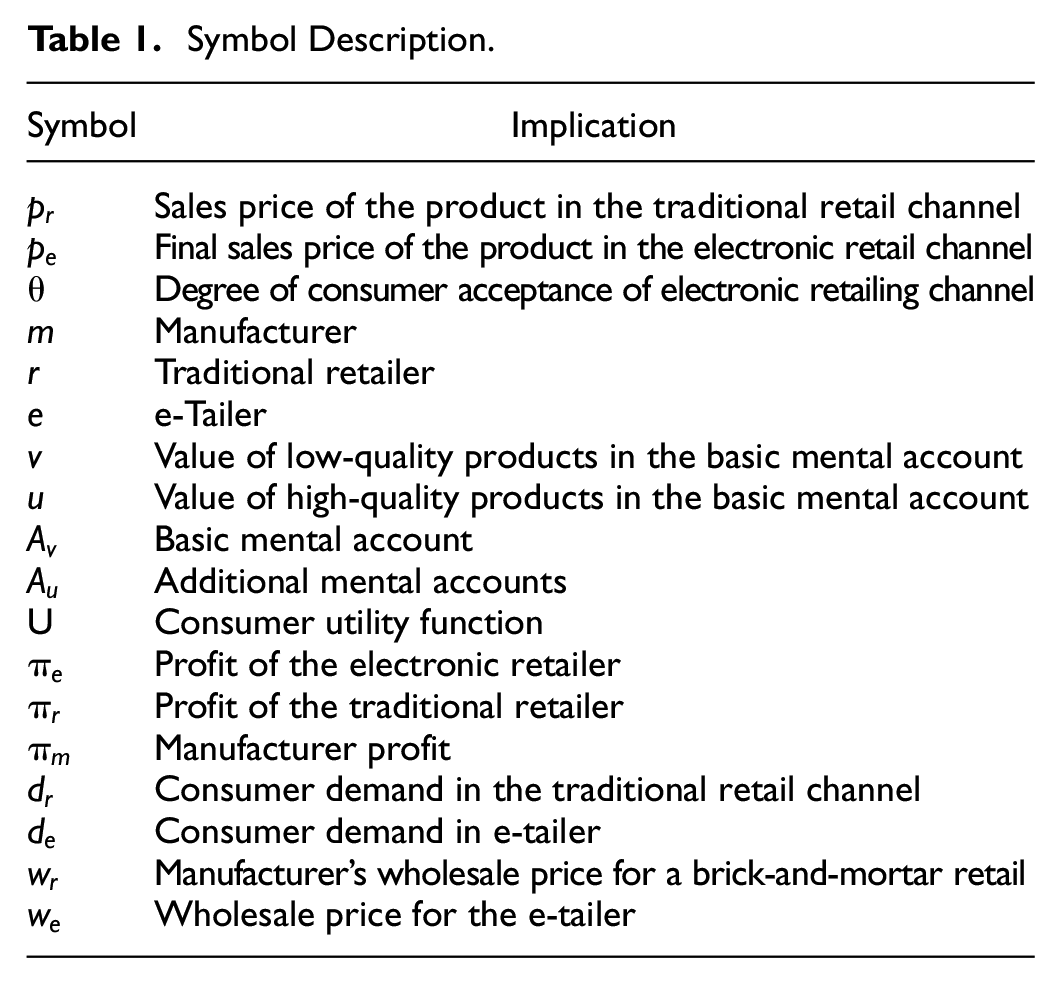
The following notations are used in the model:
Symbol Description.
Scenario
In Scenario



Online retail and traditional retail dual-channel supply chain structure diagram.
The profits of the traditional retailer, e-retailer, and manufacturer can be expressed as follows:



where
Equations (6) and (7) are the quadratic concave functions of


We then solve the optimal pricing of traditional retailer and e-retailer and the optimal wholesale price offered by the manufacturer based on the reverse induction method. Equation (8) is a quadratic concave function relating to


By substituting equations (11) and (12) into equations (9) and (10), the optimal market prices of traditional retailer and electronic retailer can be obtained as follows:


Equations (13) and (14) are substituted into equations (4) and (5), respectively. The optimal customer demand in Scenario


By substituting equations (13), (14), (11), and (12) into equations (6), (7), and (8), the optimal profits of the traditional retailer, the e-tailer, and the manufacturer in Scenario



Scenario
In Scenario


Based on the reverse induction method, the optimal pricing of the traditional retailer and e-tailer can be obtained as follows (see Appendix 1 for details):


where
The wholesale prices offered by the manufacturer to the traditional and electronic retailers are:


The optimal profits of a traditional retailer, e-tailer, and the manufacturer are:


Scenario
In scenario


Based on the reverse induction method, the optimal pricing of the traditional retailer and e-tailer can be obtained as follows (see Appendix 2 for details):


The wholesale prices offered by the manufacturer to traditional retailer and e-retailer are:


The optimal profits of a traditional retailer, e-retailer and manufacturer are:



Discussion
Based on the results of the above three models, this section analyzes the optimal choice of the traditional retailer, e-tailer, and manufacturer in the quality matching of a dual-channel supply chain from the perspective of the participants in the dual-channel supply chain. Here, we discuss the best options for manufacturers, retailers, and consumers. The model comparison of this section is presented in Appendix 3. The relevant description in the Appendix contains an explanation of the model formula.
Optimal Product Quality Differentiation Strategy
We compare the optimal profits gained by the manufacturer, namely
Through comparative analysis,
The manufacturer obtains the lowest profit when there is no quality difference and both traditional retailers and e-tailers sell identical quality products. A product quality-matching strategy must be selected in a dual supply chain when the manufacturer produces both high- and low-quality products. The manufacturer obtains better profits when the traditional retailer sells high-quality products and the electronic retailer sells low-quality products. In addition, the O2O model can be further combined to explore the emotional maintenance value, personal development value, hedonic value, and other value concepts of offline transactions actively. Meanwhile, online transactions further highlight the price advantage of similar products of a particular brand, thereby obtaining a win-win situation both online and offline.
Impacts of Product Quality Difference on Retail Profits
We further discuss the elasticity of retailers’ profits, which is influenced by product quality differences. We define the elasticity of the retailer’s profit as

Effect of the degree of the consumers’ acceptance of the electronic retailing channel.
Figure 3 shows the influence of the production cost coefficient of premium products on the relative profit elasticity. Additionally, we can derive that

Impact from production cost coefficient.
Overall, the consumers’ degree of acceptance of the electronic retailing channel is inversely proportional to the relative profit elasticity between channels
This proposition indicates that with the emergence of “Internet +” creativity, e-tailers can improve consumers’ acceptance of online sales through three aspects, which are conducive to a rapid increase in the profit margins of e-tail channels. (1) Provide more information. For example, by providing product, company, and comment information, checking the product’s price, applicability, specifications, and services; (2) provide more guarantees. Since consumers tend to satisfy their own psychological needs, electronic sales channels can provide better logistics, quality assurance, and after-sales services; and (3) provide more convenience. For example, electronic sales channels should provide more comparisons between product brands, models, and price ranges. However, because providing more information, assurance, and convenience requires strong financial strength, if the e-tailer does not reach the threshold, their return also faces the risk of low-profit probability. At the same time, although traditional retailers are affected more by the internet, if they can provide better comprehensive services, their profit margins will be higher. For example, in terms of consumers’ emotional maintenance value, personal development value, hedonic value, and other values, traditional retailers can meet the needs of consumers’ development value and hedonic value through appearance customization services. Traditional retailers can meet consumers’ needs for hedonic leisure values by adopting customized services. They can maintain consumers’ emotions through cooperative customized services and meet consumers’ emotional maintenance value, personal development value, enjoyment, and leisure value needs by converting customized services. All these strategies help traditional retailers improve their profit margins.
Impacts of Product Quality Difference on Price Elasticity
According to equations (22), (23), (31), and (32), we can compare the fluctuation in the price paid by consumers for heterogeneous products. Specifically, we focused on the relationship between
Impacts of Production Cost Coefficient and Online Channel Acceptance.

This proposition indicates that traditional sales channels should choose products with higher price elasticity, such as fur coats, high-quality jewelry, and luxury brand clothing. Simultaneously, traditional sales channels should also pay attention to products with obvious demand and quantity elasticity, such as supply closely related to daily needs. As price elasticity in electronic sales channels is less than that in traditional sales channels, sales activities should focus on products with fewer price differences, for example, books, special medicines, and private items.
Predicting the Effect of Quality Distribution on Price Volatility From a Risk Perspective
The effectiveness of a product quality matching strategy in aligning the interests of traditional retailers and e-tailers is limited by consumer acceptance of internet shopping. In the long run, acceptance of the internet will increase. Thus, it is necessary to analyze the effect of a product quality matching strategy on retail price volatility. According to equations (22), (23), (31), and (32), we take the partial derivative of
If the manufacturer adopts the
Concluding Remarks
The purpose of the current study was to explore quality factors underlying the performance of dual-channel supply chains. We apply the mental accounting perspective in behavioral finance to analyze the dual-channel supply chain management decisions of three supplier product quality matching strategies. We determine the profit-seeking decisions of supply chain members and consumers. The results, such as the manufacturer’s product quality matching strategy and e-tailer’s profit elasticity are larger than those of the traditional retailer, have practical implications. In addition, the manufacturer’s product quality reverse-matching strategy can make it easier to control the market. Nonetheless, it might increase the burden on consumers.
Compared with previous studies that have focused predominantly on the relationship between price and reference quality (Gavious & Lowengart, 2012), our results highlighted the active role mental accounts play in promoting product quality matching of dual-channel supply chains. For instance, some studies believe that a reference price is an internal price that consumers use to compare actual prices (Fogel et al., 2004). Although consumer choice is influenced by the reference quality relative to the reference points in one mental account (Hardie et al., 1993; Tereyağoğlu et al., 2018), it is possible that the quality judgment of multiple accounts can better explain the quality matching strategy in a dual-channel supply chain. This strategy can be found in the work of Tesla and Haier. The results from our study also highlight the product quality reverse matching strategy as an indication of control capability improvement of the supply chain.
Although we resolve the quality matching problem of manufacturers with dual-channel supply chains based on mental accounts, how consumers compare expected quality and price within each account remains a difficult issue. We assume this to be a multi-account linear relationship, partially addressing the non-substitutional relationship between mental accounts. However, its complex nonlinear relationship requires further investigation. Simultaneously, an increasing number of manufacturers are beginning to establish their own direct sales channels, and it is also important to analyze the quality matching problem in a more complex system structure. In addition, we omit the additional cost of offline shopping for consumers, and future extensions can add this endogenous variable to mental accounts to consider consumer behavior comprehensively.
Footnotes
Appendix 1
Proof: In the case of
(1) Consumers choose to go to an electronic retail store to buy, that is
Solve:
(2) Consumers choose to buy from traditional retail stores, that is
Therefore, consumers choose to buy in traditional retail stores.
When
Through the analysis of (1) and (2), in the case where traditional channels sell high-quality products and electronic channels sell low-quality products, in order to coexist traditional sales channels and electronic retail, the condition
Proof: The profits of traditional retailers, e-tailers, and manufacturers are as follows:
Reverse induction is used to solve the optimal pricing of traditional retailers, electronic retailers and the optimal wholesale prices of manufacturers.
Since
Substituting equations (4) and (5) into equations (1) and (2) respectively, we can get
It has been verified that equations (6) and (7) are quadratic concave functions with respect to
Substitute equations (4), (5), (9), and (10) into equation (3), and it has been verified that equation (3) is a quadratic concave function with respect to
Substitute equations (11) and (12) into equations (9) and (10) to obtain the functions of
It has been verified that when
Substitute equations (11), (12), (13), and (14) into equations (6), (7), and (8), respectively, to obtain the functions of
It has been verified that equation (17) is a quadratic concave function with respect to
Substitute equation (18) into equations (13) and (14) to obtain the optimal pricing of traditional retailers and e-tailers as shown in equations (19) and (20), respectively. Substitute equation (18) into equations (11), (12). Obtain the optimal wholesale price provided by the manufacturer to traditional retailers and electronic retailers as shown in equations (21) and (22).
It is found that in the traditional situation, the optimal pricing of traditional retail stores is greater than the optimal pricing of electronic retail stores, and the wholesale price provided by manufacturers to traditional retail stores is greater than the wholesale price of electronic retailers.
Substituting equations (19), (20), and (18) into equations (4) and (5), respectively, the optimal demands of traditional retailers and e-tailers in traditional situations can be obtained as follows:
Substituting equation (18) into equations (15), (16), and (17), respectively, the optimal profits of traditional retailers, e-tailers, and manufacturers in traditional situations can be obtained as follows:
In this case, to make
The calculation of
Appendix 2
Proof: Under the
(1) Consumers choose to buy in electronic retail stores, that is,
Solve:
(2) Consumers choose to buy in traditional retail stores, that is,
Therefore, consumers choose to buy in traditional retail stores.
The solution of the above formula is
Through the analysis of (1) and (2), when traditional channels sell low-quality products and electronic channels sell high-quality products, the condition of
Proof: The profits of traditional retailers, e-tailers, and manufacturers are as follows:
Reverse induction is used to solve the optimal pricing of traditional retailers, electronic retailers and the optimal wholesale prices of manufacturers.
Substituting equations (4) and (5) into equations (1) and (2) respectively, we can get
It has been verified that equations (6) and (7) are quadratic concave functions with respect to
Substitute equations (4), (5), (8), and (9) into equation (3), and it has been verified that equation (3) is a quadratic concave function with respect to
Substitute equations (10) and (11) into equations (8) and (9) to obtain the functions of
It has been verified that when
Substitute equations (10), (11), (12), and (13) into equations (1), (2), (3) to obtain the functions of
It has been verified that equation (16) is a quadratic concave function with respect to
Substitute equation (17) into equations (12) and (13) to obtain the optimal pricing of traditional retailers and e-tailers as shown in equations (18) and (19):
Substitute equation (17) into equations (10) and (11) to obtain the optimal wholesale price provided by the manufacturer to traditional retailers and electronic retailers as shown in equations (20) and (21)
Substituting equations (18), (19), and (17) into equations (4) and (5), respectively, the optimal demands of traditional retailers and electronic retailers in the new situation are as follows:
Substituting equation (17) into equations (14), (15), and (16), respectively, we can obtain the optimal profits of traditional retailers, e-tailers, and manufacturers under the $LH$ situation as follows:
Appendix 3
We compare the optimal profits gained by the manufacturer, namely
Because
And because
we have
Evidence from the above.
2. By assigning
3. By assigning
Acknowledgements
We thank Wenhui Deng, Yuting Zhu, Qijuan Zhang, and Pengcheng Liu, who provided suggestions and technical help to further improve the study. We also thank scientific research and innovation team of Zhejiang Wanli University.
Author Contributions
All authors contributed equally to the article.
Declaration of Conflicting Interests
The author(s) declared no potential conflicts of interest with respect to the research, authorship, and/or publication of this article.
Funding
The author(s) disclosed receipt of the following financial support for the research, authorship, and/or publication of this article: This study is supported by The National Social Science Fund of China (grant no.22BJL129).
