




Abstract
Basic research is the driver of advanced productivity and is an important guarantee for the market competitiveness of enterprise. In order to understand the influence of basic research on the development of China’s digital economy industry, this paper, based on structural equation model by collecting data from 209 enterprises in digital economy industry, explores the relationship between enterprise participation in basic research and four factors: enterprise efficiency, perceived risk, priority, and technological innovation, together with function mechanism. The results show that, first enterprises can improve efficiency, reduce potential risk concerns, and enhance technology level by expanding business revenue, enlarging scale, and upgrading R&D institutions, thus promoting participation in basic research. At the same time, the government can provide more subsidies for enterprise R&D funds to reduce enterprise concern about the risk of basic research, and guide them to expand their investment in R&D and focus on basic research so as to expand their participation in this field. Secondly, the optimization of enterprise participation in basic research, the upgrading of R&D institutions and the number of invention patents have mutually-reinforced effect, while the expansion of enterprise scale help to reduce the constraint of return risk to a certain extent. Finally, this paper proposes some policies and suggestions to enhance enterprise participation in basic research from the perspective of promoting industrial development and social equity.
Keywords
Introduction
New-generation information technology develops rapidly with endless disruptive technology emerging. It enlightens many enterprises that basic research plays a decisive role in their survival and development in digital transformation. Therefore, an increasing number of enterprises are gradually joining the basic research industry. In 2017, Alibaba announced the launch of “Alibaba DAMO Academy” with an investment of 100 billion yuan for 3 years to engage in basic research and disruptive technology research. While this news aroused widespread concern, it also raised questions: Should enterprises engage in basic research? What factors affect enterprise participation in basic research? Where do enterprises that have participated in basic research on the digital transformation process go now? This study aimed to solve these problems.
Scientific research is typically classified into basic research, applied research, and experimental development. In 1950, the President of Harvard University, J.B. Conant, pointed out in the preface of the annual report of National Science Foundation that there was no clear boundary between basic research and applied research. Many scholars have also proposed new ideas. For example, Kline and Rosenberg (1986) proposed the “chain-linked model” of technological innovation. Ziman (2010) suggested a “central network model.” The most influential model is Pasteur’s quadrant model for scientific research by Stokes (2011), as shown in Figure 1. The upper-left corner in Figure 1 is the Bohr quadrant, which represents pure basic research. Basic research is experimental or theoretical work, mainly to obtain new knowledge about the potential basis of phenomena and observable facts without considering any specific application or use (Frascati Manual, 2015). The lower right corner is Edison quadrant, representing an experimental invention. This quadrant is not for pursuing new knowledge but for specific practical purposes, such as Edison’s team (Lim, 2004). The lower-left quadrant represents the accumulation of knowledge without considering practical applications and preparation to acquire certain research capabilities. The upper-right quadrant represents applied basic research, and its main feature is to combine pure basic research with pure applied research.

Pasteur quadrant model.
We search on Web of Science with “basic research” and “applied research” as the subject (as of April 15, 2021), analyze search results by using CiteSpace, and obtain the co-occurrence network as shown in Figure 2. The size of nodes in the figure reflects the frequency of theme. The connection between nodes represents the co-occurrence relationship, the thickness represents co-occurrence strength, and the color represents the time when the nodes are first collinear. The results show that apart from “applied research” and “basic research,”“R&D activity” also frequently appears. Relevant topics include “R&D investment,”“R&D strategy,”“R&D policy,” reflecting a strong correlation between R&D investment and basic research conducted by the enterprise.

Basic research and applied research theme co-occurrence map.
Science and technology are the primary drivers of modern economic growth. Research and Development (R&D) is a direct source of scientific and technological progress. R&D expenditure is an important indicator of R&D investment. It represents the actual expenditures spent by the whole society in the year for basic research, applied research, and experimental development. The R&D investment rankings released by the European Union in 2019 show only two enterprises from China (Huawei and Alibaba) are ranked among the top 50 global enterprises investing R&D. However, there are 22 U.S. enterprises.
Chinese enterprises only focus on applied research and experimental development. Still, they make insufficient investments in basic research and related knowledge reserves compared with enterprises in developed countries. Basic research accounts for only 3% of national basic research, while this number is 10% to 20% in innovative countries. According to data from the National Bureau of Statistics of China in 2019, the enterprise investment intensity in basic research remains about 0.1% to 0.2%, which is much lower than 5% in innovative countries. Small and medium-sized enterprises inevitably face scarcity of researchers, funds, and capability limitations when participating in basic research. This is largely due to a lack of platforms, a more complete and optimized policy environment, and the lagging return on investment in basic research (Prettner & Werner, 2016). Enterprise investment in basic research has also declined (Arora et al., 2018; Pisano, 2010), and enterprises have only invested more resources in applied research and technology development (Arora et al., 2019). Therefore, encouraging targeted participation in basic research has become a major concern in research industry, and relevant empirical analysis is urgently needed.
Scholars are active in exploring issues related to this field. Griliches and Mairesse (2022) found that the development and investment in basic research by enterprises led to new challenges in the funding and management method of the government. Arnold et al. (1998), based on previous researches and relevant data, demonstrated that the investment in basic research brought higher direct revenue than traditional investment methods. Yao et al. (2019) held that technological innovation is the key driver of enterprise development, and more attention should be paid to the role of technological innovation.
Although there are many literatures studying enterprise participation in R&D, there are few empirical studies on the participation of enterprise from digital economy industry in basic research. In order to comprehensively understand the status quo of the development of digital economy industry, as well as the willingness and problems of digital economy enterprises to participate in basic research and provide targeted assistance to enterprises that are willing to participate, we investigate 209 typical enterprises in the field of digital economy in Zhejiang Province to analyze the impact of the enterprises’ efficiency, perceived risk, priority, and technological innovation on their participation in basic research (short as “participation degree”). Structural Equation Model (SEM) is used to measure the relationship between participation and these four influencing factors, as well as function channel, and targeted measures for government to further motivate enterprise participation in basic research are also proposed.
The novel contributions of this study are as follows: (1) The influencing factors of enterprise participation in basic research is discussed from a multidimensional perspective and the interaction path between each influencing factor and enterprise participation, which is a comprehensive expression of existing research results. (2) The model results negate the direct impact of enterprise efficiency on participation and observe the indirect effect of perceived risk and technological innovation factors on enterprise participation. Moreover, the degree of participation provides feedback on enterprise efficiency, perfectly explaining the Matthew effect in enterprise participation in basic research. (3) This study first uses SEM to construct a enterprise participation model in basic research and then revises the model based on the fitting results and revision index. The evaluation indicators of model fitting have all obtained ideal results, indicating that the constructed model is feasible and robust.
The remaining chapters of this paper include: the second part presents theoretical hypotheses by combing with references; the third part is data collection and sample characteristics analysis; the fourth part is model construction, correction and testing; and the fifth part is conclusion and outlook.
Data Collection and Sample Characteristics Analysis
This study used a questionnaire to collect the data. It is designed after referring to relevant enterprise R&D investment and innovation performance theories (Lai et al., 2015; Z. Zhao & Zhou, 2022). Interviewees with a sufficient understanding of enterprise are targeted, which mainly include middle and high-rank managers, enterprise legal persons, technical directors, and persons familiar with enterprises and external organizations.
A total of 226 questionnaires are distributed, and 213 are retrieved with 209 valid. The response rate for the valid questionnaires is 92.48%. Enterprises chosen are mainly from Hangzhou, Ningbo, and other places where technology is more developed (Su, 2021). In terms of the nature of ownership, the investigated enterprise includes state-owned enterprises, private enterprises, foreign-funded enterprises, and Sino-foreign joint ventures. State-owned enterprises and private enterprises account for relatively large proportion. Regarding the founding time, 9.9% are founded within 2 years, 20.7% 2 to 5 years, 23.1% 6 to 10 years, and 46.3% more than 10 years. Regarding the number of employees, nearly half of the enterprises had less than 100 employees, and enterprises with 100 to 299, 300 to 399, and over 2,000 employees account for more than 10%. Although samples are not obtained randomly, the coverage is relatively wide and representative in the industry.
Model Construction and Empirical Analysis
Twelve potential factors in the questionnaire that affect participation are analyzed based on the descriptive statistics and contingency table analysis. Four dimensions are summarized: enterprise efficiency, perceived risk, priority, and technological innovation. After refining and logically deducting from relevant literature, we propose hypotheses and establish an initial structural path model between the four dimensions and enterprise participation. AMOS software is also used to empirically test the structural path model and relevant theoretical hypotheses and revise the model through SEM.
Analysis on the Influencing Factors of Enterprise participation in Basic Research
Generation of Forecast Indicator
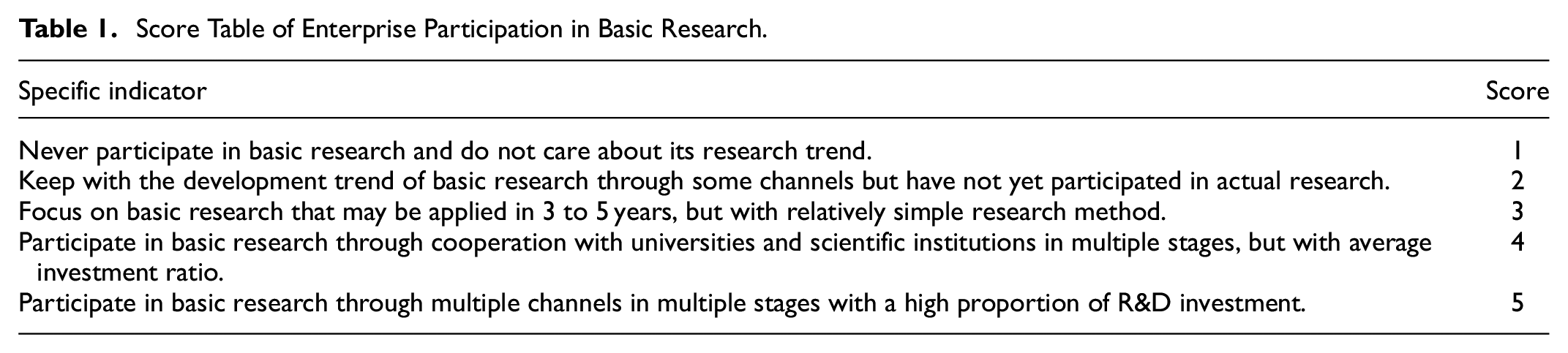
Based on preliminary analysis of questionnaire data and relevant references on participation in basic research, we obtain the existing 12 indicators influencing enterprise participation in basic research, including annual enterprise revenue, enterprise scale, technical status, independent innovation capability, R&D institution level, proportion of R&D to revenue, number of invention patents, basic research priority, diversity of participation channel, capability, and fund limitation (i.e., whether the lack of relevant researcher and fund limit their R&D capacity), revenue risk limitation (i.e., whether R&D technology direction is correct, whether the product will have greater market risk in the future after successful R&D, or whether it is more economical to obtain technology from the exterior), and development planning limitation (i.e., whether it is available or whether it focuses on basic research). The Likert 5-level scale is used to score enterprise participation from low to high.
The specific stage and forms of basic research, and the proportion of R&D funds invested in basic research are also considered. Then, we quantified enterprise participation in basic research, and the scores corresponding to specific indicators are shown in Table 1.
Score Table of Enterprise Participation in Basic Research.
Factor Dimensionality Reduction
We conducted reliability and validity tests and principal factor analysis on 12 potential influencing factors and found that these factors can be streamlined and dimensionally reduced.
Tables 2 and 3 show an alpha coefficient of.796 > .7, indicating good reliability. The KMO value is 0.791 > 0.7, Bartlett sphere test value is 978.990, and significance level is .000. Therefore, the null hypothesis that rejects the independence of each variable is independent, and there is a strong correlation between the variables, indicating that the overall reliability and validity of the data are in a highly acceptable range.
Reliability Analysis Table of Enterprise Participation Influencing Factor.

Validity Analysis Table of Participation Influencing Factor.

After collecting data from 209 questionnaires, SPSS software is used to perform factor analysis, to explain the rationality of factors obtained and the maximum variance orthogonal rotation method is adopted. As shown in Table 4, the abscissa is factor number, and ordinate is eigenvalue. When four common factors are extracted, the total contribution rate reaches 80.570%. After the fourth stage, the eigenvalues of the factors are smaller, with little contribution to explaining the original variables.
Cumulative Contribution Rate Table of Participation Influencing Factor.

The annual revenue, scale, and R&D institution level are the prerequisites to measure whether an enterprise can conduct basic research, which can be called enterprise efficiency factor; insufficient funding, revenue risk limitation, and development and plan limitation are unfavorable conditions for an enterprise to conduct basic research, which can be called perceived risk factor; the revenue proportion of R&D institution, the diversification of participation channel and the degree of attention paid to basic research can measure how much the enterprise invests in basic research, which can be called priority factor; the technology level, independent innovation capability and the number of invention patents can be used to measure the progress of basic research, which can be called technological innovation factor. These four factors are finally selected after combining with actual meaning of extraction factors.
Table 5 shows that four factors affect enterprise’s participation surveyed in basic research:
Rotational Orthogonal Factor of Enterprise Participation in Basic Research.

Table 6 shows that most surveyed enterprises are in the digital economy industry, attaches importance to basic research and pursue more advanced independent technological innovation. The descending sequence of weighted average scores corresponding to the main factors is: priority, technological innovation, enterprise efficiency, and perceived risk.
Statistical Table of Influencing Factor Effect Index on Enterprise Participation in Basic Research.

The enterprises investigated are evenly distributed in scale and engage in different aspects of digital economy. The average score of enterprise efficiency factor is not high, perceived risk factor is the lowest, priority factor is the highest and the average score of science and technological innovation factor is the second highest. It can be learned that there is no significant relationship between enterprise participation in basic research and enterprise efficiency, but it is closely related to priority and technological innovation of enterprises, the most important of which is priority factor.
Construction of SEM of Influencing Factors on Enterprise participation
Theoretical Hypothesis
We analyze and reduce the dimensionality of above factors to obtain 4 factors and 12 measurement variables and introduce them into the SEM on enterprise participation in basic research. Based on the literature, the following hypotheses are proposed:
(1) Enterprise Efficiency Factor
Garcia-Quevedo et al. (2018) used bivariate probit model and found that financial constraints have the greatest impact on the probability of quitting innovative projects during the conception stage. Through empirical research, Coad et al. (2021) found that enterprises have different R&D strategies. The data do not necessarily conform to the stereotype that “young” enterprises invest in basic research while “veteran” enterprises invest in applied research. Mañez et al. (2015) discovered that large-scale enterprises have a lower risk of completing the R&D cycle than small-and-medium-sized enterprises. Moreover, their innovation behaviors also reveal higher sustainability. Additionally, Bloom et al. (2017) showed that management capability is an important prerequisite for R&D investment. In summary, this study makes the following assumptions.
H1a: Enterprise efficiency has a positive impact on participation.
H1b: Enterprise efficiency has a negative impact on perceived risk.
H1c: Enterprise efficiency has a positive impact on technological innovation.
(2) Perceived Risk Factor
Initiating an R&D event is often costly and may cause potential risks that partly investment is difficult to recover once quit midway. Lang (2009) showed that R&D return rate dropped sharply in recent years, and R&D risks have risen accordingly. Y. Wang et al. (2016) found a three-period lag between basic research and productivity growth. Additionally, business cycles introduce uncertainty and volatility, which stifle the willingness to experiment and invest in innovation (Bloom, 2007; Webb et al., 2017) The risk constraint often leads to limited enterprise participation while government financial support to enterprise can effectively alleviate enterprise worry about risks. In summary, this study makes the following assumptions.
H_2: Perceived risk has a negative impact on participation.
(3) Priority Factor
Y. Zhao and Song (2017) found that government institutions can indirectly promote economic growth by investing in R&D, and improving human capital, enterprise understanding and absorbing capacity of external knowledge, independent innovation capability, and basic knowledge development capability. Lai et al. (2015) made efforts on 7 factors that influence R&D investment decisions and discusses the specific allocation of internal strategic resource for enterprise R&D investment behavior. Furthermore, enterprises that continue to pay attention to basic research are generally more inclined to participate in relevant research (Z. Zhao & Zhou, 2022). In summary, this study makes the following assumptions.
H3a: Priority has a positive effect on technological innovation.
H3b: Priority has a positive effect on participation.
(4) Technological innovation Factor.
Czarnitzki and Thorwarth (2012) found that high-tech enterprises have larger premiums for basic research, whereas low-tech industries have no premium. Their survey sample included high and low-tech enterprises, and found a positive correlation between technology level and basic research in progress. Suzuki et al. (2017) suggest that enterprise participation in R&D events in the host country generally increases and strengthen research capability of local university. X. Wang et al. (2018) found that government subsidies promote green technological innovation in the transition of enterprise, but inhibit technological innovation of veteran enterprise. In summary, this study makes the following assumption.
H_4: Technological innovation has a positive effect on participation.
Model Construction
Based on above assumptions, we used AMOS software to draw the model path diagram, establish the model on participation influencing factors, and operate the initial path diagram of the model, as shown in Figure 3.

Initial model path diagram.
The fitting results are presented in Table 7. The initial fitting model’s chi-squared value (degrees of freedom) 2.414 < 3 with a good fitting effect. However, the initial model’s GFI, NFI, and RFI values are lower than the reference value of 0.9, and the model needs further improvement.
Initial Fitting Result Table.

Model Modification and Verification
SEM Modification and Verification of Influencing Factors on Enterprise Participation
This section uses a correction index to adjust the relevant and causal paths to further modify the model, and add path higher correction index. The model is constructed by using AMOS software. Table 8 shows model fit results, and it is found that the revised model revealed better fit.
Fitting Result Table of the Revised Model.

The revised model is shown in Figure 4.

SEM standardized path coefficient diagram.
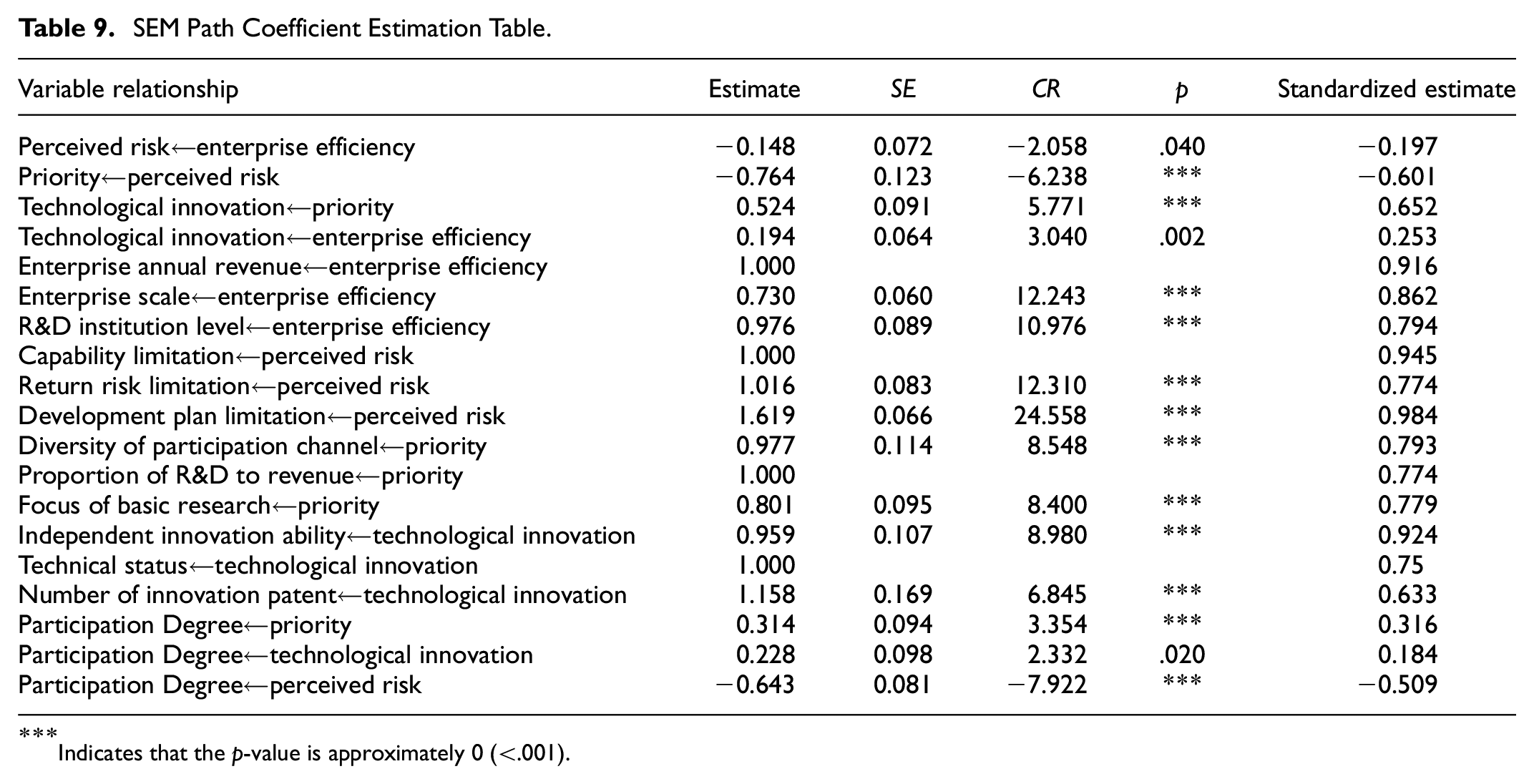
Figure 4 shows that six out of seven paths passed test. The path of enterprise efficiency to participation fails to pass the test because enterprises with different efficiencies often adopt different strategies in basic research based on their development. Additionally, we find that reducing perceived risk can increase enterprise R&D investment, and is negatively correlated with priority. The revised path parameter estimation results are shown in Table 9.
SEM Path Coefficient Estimation Table.
Indicates that the p-value is approximately 0 (<.001).
The SEM path analysis results show that all hypothetical p-values are less than .05. Therefore, perceived risk, priority, and technological innovation level can have a direct and important impact on enterprise participation. This result is consistent with the conclusions of Coad et al. (2021).
Specifically, when p approaches 0, priority has a significant positive impact on technological innovation and enterprise participation, and the path coefficients are .652 and .316 respectively. This shows that an enterprise paying more attention to basic research is conducive to improving its technological innovation and promoting its participation in basic research. Meanwhile, perceived risk has a significant negative impact on the degree of priority and participation, with path coefficients of −.601 and −.509 respectively. When enterprises are concerned about the risk of research investment due to limited capacity and funding, their priority for basic research and research participation decreases significantly.
When p is less than or equal to .01, enterprise efficiency has a significant positive impact on technological innovation. The path coefficient is .253, indicating that enterprise revenue and scale growth can further improve technological innovation. Technological innovation has a significantly positive impact on participation, with path coefficient of .184. Improvements in technological innovation can promote the formation of a virtuous circle of “improvement-more investment-further improvement” to boost enterprise technological innovation.
This study also tests model fitness and the results are shown in Table 10 below.
Fitness Test Table.

Table 10 reveals that the structural equation model constructed in this paper has a good absolute fitness, is fully supported by the sample data. The results shown are in accordance with actual situation of observed data, with good model fitness and robustness.
The direct, indirect, and overall effects of the potential variables output by AMOS software are shown in Table 11 for the modified model.
Effect Table Between Potential Variables in SEM (Standardized Result).

Note. The parameters given in the table are standardized, and the direct effect is path coefficient in the model.
Basic research has revealed that enterprise efficiency, priority, and technological innovation positively impact enterprise participation. However, there is little discussion on the quantitative relationship and function method. The traditional linear regression method cannot simultaneously deal with the relationship between potential variables, observable variables, and errors. The SEM used in this study can handle potential variables and observed variables simultaneously, analyze the causal relationship and effect between variables, and allow for the existence of measurement errors between the independent and dependent variables.
In the SEM, the magnitude of path coefficient of variable reflects the degree to which a change in one variable causes the change in other variables. For example, Table 10 shows that the enterprise participation factor is positively affected by the enterprise efficiency, priority, and technological innovation factors, with overall effects of 0.199, 0.436, and 0.184, respectively, and is negatively affected by the perceived risk factor with an overall effect of −0.601. Among them, perceived risk factors and technological innovation factors play a completely intermediary role in influencing enterprise efficiency factors on enterprise participation. Additionally, technological innovation and priority factors partly play mediating roles in influencing priority factors and perceived risk factors on enterprise participation. The results are generally consistent with the proposed hypothesis and verify that it is reasonable.
Conclusion Analysis of Factors Influencing Enterprise Participation
Combined with above model, we analyze factors influencing enterprise participation in basic research and find other potential variables. As a result, enterprises can improve their performance by increasing operating revenue, expanding scale, upgrading R&D institutions, and reducing risk while improving technological innovation and promoting participation.
Additionally, the government can increase R&D funding subsidies to mitigate enterprise worry about the risks of participating in research, motivate enterprise to expand R&D investment, and focus on basic research to give them more priority. As a result, this can increase their participation in basic research, which is also the innovative highlight of this study. This provides a reference for governments on how to effectively increase enterprise participation in basic research.
Additionally, by observing the relationship between variables, it is shown that the optimization of enterprise participation, upgrading of institution-level R&D, and the number of invention patents are mutually promoted. Enterprise expansion helps reduce the risk to a certain extent.
Combined with previous analysis, we propose the following suggestions.
(1) Promote sound and stable development of digital economy. Comparing different enterprises, it is found that enterprises with higher revenues are not necessarily more engaged than others enterprises, but enterprises with larger scale are significantly more involved in basic research than smaller scale enterprises. At the same time, enterprises will only participate in basic research after they have fulfilled basic operation needs, otherwise they are not motivated to participate.
(2) Promote social equity and narrow the gap between industries. From the empirical results, it can be seen that priority factor has a greater impact on the participation in basic research than enterprise efficiency factor, and different revenue of different industries also dampen enterprise participation. On the one hand, revenue gap brings unfair feelings and generate negative emotions. On the other hand, low revenue enterprise seeks transformation when faced with other profitable industries. The different development level of our industries is still the main factor that hinders the economic development, which needs to be regulated by the government through measures such as taxation and transfer payments.
Conclusion
This study investigates enterprise investment in basic research and analyzes the potential factors influencing enterprise participation to deepen the understanding. First, by collecting and analyzing data from 209 questionnaires, we performed factor analysis and dimensionality reduction to extract 4 main indicators affecting enterprise participation in basic research: enterprise efficiency, perceived risk, priority, and technological innovation. Then, by combining 12 measurement variables, the relationship and action mechanism between enterprise participation and 4 influencing factors are obtained through SEM.
We found that, first, since enterprises with different efficiencies often adopt different basic research strategies based on their development, the direct path of enterprise efficiency to enterprise participation fails to pass the test, denying the stereotype of previous studies. Additionally, a reduction in perceived risk can expand enterprise R&D investment, directly impacting priority.
Second, enterprise participation is positively affected by enterprise efficiency, priority, and technological innovation, with a total effect of 0.199, 0.436, and 0.184, respectively. Under the negative influence of the perceived risk factor, the total effect is −0.601. Perceived risk factors and technological innovation factors play a completely mediating role in influencing enterprise efficiency factors on participation. Technological innovation factors play partial mediating roles in influencing priority and perceived risk factors on enterprise participation.
Third, in spite of the improvement of technological innovation, there is no significant improvement in enterprise participation and this does not mean that technological innovation has no effect on participation. The results of SEM structural equation model in this paper show that perceived risk plays a negative role on participation, while priority contributes most to participation, which is also consistent with the previous findings, implying that the government should focus on promoting basic research and attracting enterprises to participate, and the expansion of enterprise scale also helps to reduce perceived risk to some extent.
Finally, our research has important implications for formulating enterprise development plans and government policies. Basic frontier research is one of the main drivers of technological progress. The risks of basic research often imply considerable long-term and higher social returns. Enterprises can improve their basic research by optimizing their performance, reducing potential risk concerns, and enhancing technological innovation. The government can stimulate enterprises to participate in basic research through policy guidance, financial support, and the promotion of cooperation.
There are limitations to this study because data are obtained only from enterprises in the digital economy of Zhejiang Province (China). Therefore, in the future, data from different countries, fields, and industries could be collected, and other mathematical methods for analysis could be adopted.
Footnotes
Declaration of Conflicting Interests
The author(s) declared no potential conflicts of interest with respect to the research, authorship, and/or publication of this article.
Funding
The author(s) disclosed receipt of the following financial support for the research, authorship, and/or publication of this article: This work was supported in part by National Natural Science Foundation of China (Nos. 72272046 and 71802065), Ministry of Education, Humanities and Social Science Project (No. 22YJC630024), and Beijing Great Wall Scholars Programme (Grant No. CIT&TCD20190320).
