




Abstract
The objective of this study is to examine the factors affecting the budget deficit by using a panel dataset of 66 countries from 1996 to 2020. In the first stage regressions, the current study employs fixed and random effect models to estimate the impact of institutional quality and other economic variables on the budget deficit. In the second stage regression, pooled mean group (PMG) and mean group (MG) estimation method is employed for estimating the long-run and short-run coefficients for the effect of institutional quality and other economic variables on the budget deficit in a heterogeneous panel dataset. The empirical estimates confirm that GDP per capita is positively and significantly associated with the budget deficit in the long run. Further, inflation rates and trade openness also have positive and significant impacts on the budget deficit in the long run. Moreover, the results show that, in the long run, the population growth rate is negatively associated with budget deficit. As far as institutional variables are concerned, the empirical findings show that an increase in corruption in government institutions leads to a significant increase in the budget deficit. However, political stability, improved bureaucratic quality, democratic accountability and the rule of law lead to a reduction in the budget deficit. The current study will help policymakers and practitioners to better understand the determinants of the budget deficit and to design the policies for the improvement of institutional quality which, in turn, may control the level of a budget deficit.
Jel Codes: H5, H6, H3, H4
Introduction
Fiscal policy, as a tool of economic development, is considered very important for attaining macroeconomic strength and stability. In many countries, financial development is allied with government loans from the domestic and international lending sources (Aghevli, 1975; Aghevli & Khan, 1977; Metu et al., 2019). In general, it is considered that high budget deficit may lead to lower economic growth, higher inflation rate, crowding out of private investment and current account deficit (Chaudhary & Abe, 1999). The empirical findings in existing literature shows that public debt is negatively related to the economy’s long run fiscal balance so deficits might be harmful for the wellbeing of community because the debt burden is shifted to the future generation (Alesina & Perotti, 1996b).
The governments in developed and developing countries are generally dependent on the deficit financing because of their incapability to utilize the local assets and to widen narrow tax base (Tanzi, 1982). Theoretically, reliance on monetary instruments may lead to an increase in the supply of money and eventually the huge inflation rate over long period of time (Antonelli & De Bonis, 2019; Clements et al., 2022; Ezema & Orji, 2015; Gupta, 2006; Hassan & Kalim, 2012; Maltritz & Wüste, 2015; Metu et al., 2019). Inflation and budget deficit have close relation as the Central bank, in general, is also lacking independence, so a persistent deficit could also increase inflationary pressure (Fatás & Mihov, 2010). Although several studies have investigated the determinants of budget deficit but still identifying the main factors of the large fiscal deficits necessitates an in depth analysis by considering the economic and particularly institutional dimension of budget deficit for a global sample which is generally ignored in existing literature.
Initially, it was considered that fiscal deficit may be affected only by economic variables but with the further research, it was recognized that quality of governance institutions may also affect the fiscal deficit (A. Arif & Hussain, 2018; Aslam, 2016; Awe & Funlayo, 2014; Blundell et al., 2020; Clements et al., 2022; Eminer, 2015; Estrada et al., 2014; Van & Sudhipongpracha, 2015; Zulfiqar, 2018). Generally, the macroeconomic theory alone might not be able to define the problem of budget deficit (Alesina & Perotti, 1995; Azzimonti et al., 2016). This was realized because deficit should be low during the period of high economic growth as per economic theory but it was observed that deficit was high even in the prosperous years as after the first oil crisis in 1973 many industrialized nations had been facing the problem of huge budget deficits. Further, even similar economic shocks in various countries resulted in the debt and deficits of different magnitude. Therefore, the existing economic theory alone may not be sufficient for describing the differences in levels of deficits and debt in different countries.
Several studies (Henisz, 2004; Sabir & Qamar, 2019) have suggested that the institutional scrutiny may help to improve the consequences of any policy action taken by the public authority. Therefore, the institutional and political determinants like law and order condition, corruption and political stability may also be considered as an explanatory variable in the economic simulations and modeling to trace their effect on the budget deficit (Fatas & Mihov, 2003; Fatás & Mihov, 2010; Woo, 2003).
Large budget deficit can be the result of poor institutional quality which is further a source of the mishandling of public resources (Schwartz et al., 2020). In such circumstances, the budget deficit results not only in low economic growth but high inflation and crowd out private investment as well. The literature related to economic and political determinants of budget deficit reveals that merely economic factors may not determine the budget deficit of a country. The studies found significant impact of the institutional variables such as corruption, political stability, and law and order condition on budget deficit (Safdar & Padda, 2017).
High budget deficits is considered a challenge for several reasons First, high budget deficit leads to a problem in decision making as it becomes difficult to foresee the magnitude and timing of fiscal policy so it may lead to inefficiency. Second, the budget deficit instability may also lead to government spending volatility and the deformity created by temporary measures to meet these spending fluctuations as the quality of public service provision like health or education may also be reduced.
Although, studies in the existing literature are available that examine the impact of institutional quality on budget deficit however, the studies that specifically explored the impact of the institutional quality on budget deficit are generally not available easily. Moreover, the current literature typically overlooks the problem of slope heterogeneity in the panel data set and models which may results in unreliable estimates about the impact of economic and institutional variables on budget deficit. Hence, it requires to further explore the impact of institutional quality on budget deficit as persistent and high budget deficit is in general a worldwide concern, and the effects may differ across countries. The current study is an attempt to cover up the holes and adds value to the existing literature by using a global panel data set and considering slope heterogeneity in panel data set. The previous studies have overlooked the problem of the slope heterogeneity for the cross-sectional units so the present study grabs the subject of slope heterogeneity by using pooled mean group and mean group estimation methods. Therefore, the objective of this study is to explore the impact of institutional quality on the budget deficit by using a global panel dataset of 66 countries. The study meets this objective initially by considering slope homogeneity in panel data set and employing standard panel estimation techniques. Subsequently, the study considers slope heterogeneity in the panel data set and employed pooled mean group and mean group estimation methods for tracing the impact of institutional quality on budget deficit.
The rest of the paper is organized as follows: Section 2 present the hypothetical and empirical literature on budget deficit. Section 3 presents the methodology and data. Section 4 describe the empirical results and last section concludes the study.
Literature Review
Budget deficit and its volatility is one of the most debated issues among policy makers and practitioners. High budget deficits may adversely affect welfare as the total debt burden is inversely associated with the fiscal balance in the long run which may affect the welfare of future generation (Alesina & Perotti, 1996b; Alesina & Rodrik, 1994; Persson & Tabellini, 1994). High budget deficit may also increase inflationary pressure on the economy as the central bank lacks independence in several countries (Fatás & Mihov, 2010). Several countries around the world during the past few decades are facing the issue of high budget deficits along with major challenges in the form of macroeconomic instability caused by huge fiscal deficit. The issue of budget deficit and its determinants have been widely investigated both theoretically and empirically. The researchers and academicians have explored the factors responsible for the high deficits however the studies that explored the impact of governance and institutional quality on budget deficit are limited. The current section provides a survey of empirical literature on budget deficit and its main determinants. There are several studies in existing literature (Alesina & Perotti, 1996a, 1996b) that argued economic theory alone is inadequate for dealing with the issue of budget deficit instability, so the inclusion of political and institutional variables is important for determining the factors which may lead to high budget deficit and adversely affect the economy. Therefore, in modern times, the quality of political and governance institutions have received considerable attention, like political stability, government size, government fragmentation, budgetary procedures, etc.(Roubini et al., 1989).
We can find studies which (Badinger & Reuter, 2017b) also have a similar view that countries with more rigorous fiscal rules have higher fiscal balances and lower deficits and lower output volatility (Badinger & Reuter, 2017a). The governance institutions also proved their legitimacy as a relevant tool for attaining desirable outcome. Similarly, another study (Afonso et al., 2018) analyzed the connections between fiscal policy, output growth and financial stress within a background of a VAR model on a panel of four nations: the USA, the UK, Germany and Italy. The study finds that financial stress deteriorates the fiscal position and have a negative effect on output growth.
However, another study (Banday & Aneja, 2019) proposes that the negative shock to the budget deficit leads to a reduction in current account balance whereas the positive shock to the budget deficit leads increases current account balance. Though, higher growth shocks and substantial variation in the interest rate and exchange rate may be a reason for the great variation in the deficits. There are also few studies in the literature that find no evidence of a relation between fiscal rules and deficit problem as one study which is focusing on the twin deficit problem, (Badinger et al., 2017) finds no robust evidence or relation between fiscal and current account deficit.
On the other side of the story, there are several studies in the existing literature which advocate that quality of institutions may influence economic growth which directly or indirectly have effects on budget deficit stability (North, 1990; Bjørnskov & Foss, 2013; U. Arif & Ahmad, 2020; Nissan et al., 2011). Similarly, few studies discusses in detail the relationship between efficiency of institutions and public governance because public institutions and public governance determine how government and public agents run a country.
The relation between efficiency of institutions and public governance is important to improve the efficiency of the government expenditures. Public governance is very much important because it could change incentives for economic agents in allocating public resources which may increase or decrease budget deficit (Brousseau et al., 2011; Kaufmann et al., 2000; North, 1990). Therefore, it may be a reason to assess the role of government in economic growth and the problem of high budget deficit through governance quality in the recent literature (Cooray, 2009; Dzhumashev, 2014).
Better quality of public governance avoids corruption and stabilizes fiscal policy to have balanced budgets (Albuquerque, 2011; Delavallade, 2006; Fonchamnyo & Sama, 2016). The economic and political literature on budget deficit also provides evidence that lower institutional quality is related to volatility of public investment and deficit (Mounts & Sowell, 2005; Grigoli & Mills, 2014). Similarly, studies also provide evidence that the quality of public governance increases the marginal productivity of public expenditures (Batra et al., 2003; Dzhumashev, 2014).
Though, from the comprehensive analysis of the literature, we found that studies are available which examine the impact of political and governance institutions on budget deficit; however, the studies which specifically traces the impact of institutional quality on the size of budget deficit for a global sample are not easily available. Moreover, the current literature typically overlooks the problem of slope heterogeneity in panel data set which may lead to unreliable and inconclusive estimates. So, the current study attempts to fill up this gap in literature by investigating the impact of quality of governance institutions on the size of budget deficit for a global panel of 66 countries. Further, the current study also tackles the issue of slope heterogeneity in panel dataset which is generally ignored in previous studies.
Methodology and Data
Model Specification
The objective of this study is to explore the effect of quality of governance institutions on the size of budget deficit for a global sample of 66 countries over the period of 1996 to 2020. The theoretical discussion in earlier sections established that the budget deficit has an association with macroeconomic factors and institutional quality. Accordingly, the current study attempts to investigate the presence of any empirical support for the impact of quality of governance institutions on budget deficit. So the research question of this study is also to examine the political and institutional factors which may affect the budget deficit.
Alesina and Perotti (1995), Persson and Tabellini (1994) and the empirical work of Woo (2003) and Henisz (2004) have provided the foundation for this study. The focus of the current study is on impact of the quality of institutions for the size of budget deficit. So the current study focused on economic as well as institutional variables to examine their influence on budget deficit. The empirical equation which traces the impact of economic and institutional variables on budget deficit is specified below:

In the above equation budget deficit for the country i and for the period t is shown by
So, the aim of the current study is to examine the determinants influencing the budget deficit as proposed in the above section. To explore this research question the present study used budget deficit as percentage of GDP as dependent variable to investigate the effect of different economic, political and institutional determinants on it. For the country specific effect, the population growth is used as a control variable and is expected to have a positive association with the budget deficit.
Further, the study also used several economic and political variables as independent variables to explore their impact on budget deficit. The economic variables include GDP per capita, inflation rate, and trade openness which is measured by the ratio of trade to GDP as macro-economic indicators to determine budget deficit. In addition, the panel regression models of the current study have also used several institutional variables that are mentioned in Table 1.
Data Sources and Description of Variables.

Data
The objective of the study is to explore the influence of economic and institutional variables on budget deficit. The present study is using panel data set of 66 countries from 1996 to 2020. The selection of cross sectional units depends upon the availability of data set for the budget deficit, institutional and other economic variables. The current study has selected 66 countries from the World Bank listed countries. The selection of countries depends on the availability of data for institutional variables so we have not considered all those countries for which data on institutional quality was not available. Further, we also excluded those countries for which data on institutional quality was available but data on macroeconomic indicators was not available. Therefore, on the basis of data availability for the economic and institutional variables, the current study is using a panel dataset of 66 countries over the period of 1990 to 2020 for investigating the impact of institutional quality on the size of budget deficit.
The variables with their description and data sources used in the current study are presented in Table 1. The data on macroeconomic variables is collected from World Development Indicators (WDI) and institutional variable from International Country Risk Data Guide (ICRG).
The data on GDP per capita, inflation rate, population and trade openness (i.e., ratio of sum of export and import to GDP) is taken from WDI. Secondly, the data on institutional quality is collected from the International Country Risk Guide. A higher value of an index shows better quality of institutional variables which include bureaucratic quality, accountability, control of corruption in government institutions and law and order conditions. The higher the value of an index, the greater will be the quality of institutions and vice versa.
Estimation Procedure
Testing for Slope Heterogeneity
The Swamy test, which was later modified by (Pesaran & Yamagata, 2008), is used to check the slope homogeneity. The test estimates and compares the two models involving a restricted model based on fixed effects estimator and the unrestricted model based on cross-sectional specific ordinary least square regression. The null hypothesis of slope homogeneity can be rejected if p-value of the test statistics is less than .05 and the alternative hypothesis will be accepted.
Testing for Stationarity
If cross sectional dependence exists in the panel data set the second generation panel unit root test can be used. So Pesaran (2007), cross sectionally augmented, IPS test is used to test the unit root in this study.
Testing for Co-integration
Westerlund (2007) cointegration test is used to check cointegration in the presence of cross-sectional dependence in panel data set. The main objective is to check whether or not there is error correction for an individual cross-sectional unit or for all cross-sections to conclude about the cointegration. If probability value is less than 5% then the null hypothesis of no cointegration can be rejected and the alternative hypothesis will be accepted.
Estimation Technique
The research question of this study is to examine the factors influencing the budget deficit. In the first stage regressions, the current study employs fixed and random effect model to estimate the influence of institutional quality and other economic variables on budget deficit. Based on the assumption of no slope heterogeneity, we employed both of these models on the panel under consideration. Finally, to choose the best model, the Hausman test statistic is utilized. The null hypothesis of the Hausman test is that the preferred model is random effect model. We would reject the null hypothesis if the p-value is less than .05 and concludes that the fixed effect model is preferred
In the second stage regression, pooled mean group (PMG) and mean group (MG) estimation method is employed for estimating the long-run and short-run coefficients for the effect of institutional and other variables on budget deficit in heterogeneous panel dataset (Pesaran & Smith, 1995). In the mean group estimation method, the regression model for each cross sectional unit is estimated for taking the average of coefficients. The pooled mean group estimation method gives varying intercepts and slope coefficients for each cross-sectional unit, however the coefficients are identical for all cross sectional units in the long-run. Hausman test helps to choose between the MG and PMG (Pesaran et al., 1999). If p-value of the test statistics is less than .05 then the null hypothesis (i.e., PMG is better than the MG estimator) can be rejected and the alternative hypothesis will be accepted.
Results and Discussion
The estimation procedure starts with testing the slope heterogeneity among the cross sectional units. Table 2 shows the statistics for slope heterogeneity test which shows that the probability value is significant and less than 5% so we reject the null hypothesis of slope homogeneity. So slope heterogeneity prevails in the panel date set which implies that the slope coefficients of each cross section are not homogenous so there is need to tackle this issue while estimating the institutional impacts on budget deficit.
Slope Coefficients Heterogeneity Test.

Note. “*** indicates significance level at 1%”
Pesaran (2007), cross sectionally augmented, IPS test is used to check the unit root. Table 3 shows that which variable is stationary at level and which are at first difference. Gross Domestic Product is not stationary at level as the p-value is insignificant at level while at first difference GDP is stationary. Similarly, trade openness and budget deficit is stationary at first difference. The unit root test shows that population growth rate and inflation rate are stationary at level.
Unit Root Test (Pesaran (2007)).

Note. *** shows 1% significance level.
In the current study we employed Westerlund (2007) cointegration test to conclude about the long run relationship among the variables. Table 4 shows the Westerlund test for Co-integration and the result shown here are for the panel of 66 countries over the period of 25 years. The test result is presented in Table 4 for group mean (G) and panel (P) tests statistics to evaluate null hypotheses of no conintegration. The table shows that p-values are highly significant in Gt and Pt at 1% significance and for Ga and Pa, p-values are significant at a 10%. So, we accept the alternative hypothesis that cointegration exists among variables for the panel of countries.
Westerlund Test for Co-integration.

Note. “*,**, and *** indicate significance level at 10%, 5%, and 1% respectively.”
The next step is to analyze the institutional impacts on budget deficit and to estimate the long run and short run coefficients for the impact of institutions and other variables on budget deficit. In the first stage regressions by ignoring the presence of slope heterogeneity, the current study employs fixed and random effect model (FEM & REM) to estimate the impact of institutional quality and other economic variables on budget deficit. The empirical estimates for the fixed and random effect models are reported in Table 5. In the second stage regression, pooled mean group (PMG) and mean group (MG) estimation method is employed for tackling the issue of slope heterogeneity and estimating the long-run and short-run coefficients for the effect of institutional quality and other economic variables on budget deficit in heterogeneous panel dataset. The empirical estimates for the long run and short run are reported in Tables 6 and 7 respectively.
Budget Deficit and Institutional Quality: Global Sample, 1996 to 2020, Fixed and Random Effects Models.

Note. a, b, and c indicate coefficient is significant at 1%, 5%, and 10% level respectively. Standard errors are in parentheses.
Budget Deficit and Institutional Quality: Global Sample, 1996 to 2020, Pooled Mean Group and Mean Group Estimates.
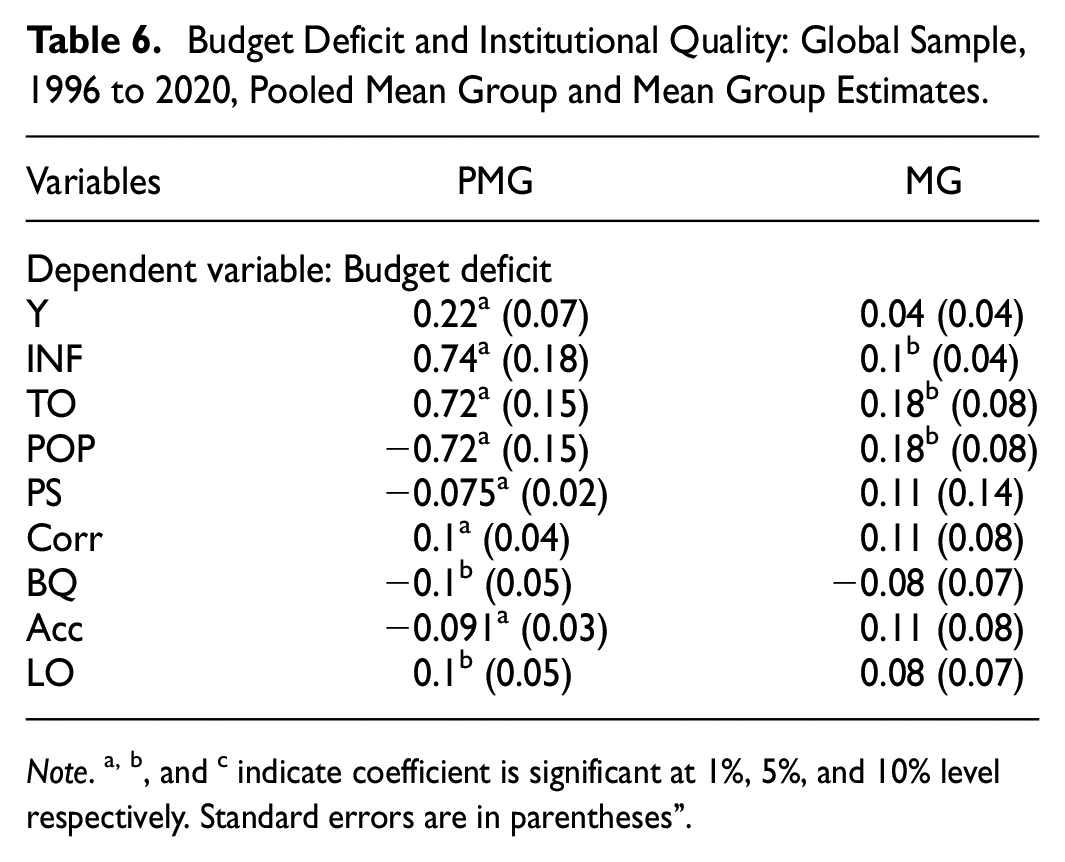
Note. a, b, and c indicate coefficient is significant at 1%, 5%, and 10% level respectively. Standard errors are in parentheses”.
The Short Run Dynamics for the Effect of Institutional Quality on Budget Deficit.

Note.a, b, andc indicate coefficient is significant at 1%, 5%, and 10% level respectively. Standard errors are in parentheses”.
The empirical estimates of fixed and random effect model are reported in Table 5. The p value of Hausman test statistic is less than .01 which implies that fixed model is preferred to the random effect model for tracing the impact of economic and institutional variables on budget deficit. The results show that GDP per capita is positively and significantly associated with budget deficit. However, inflation rate and trade openness also have positive and significant impact on budget deficit. Further, the table shows that population growth rate is negatively associated with budget deficit. As for as institutional variables are concerned, Table 5 shows that increase in corruption in government institutions leads to significant increase in budget deficit however, political stability, improved bureaucratic quality, democratic accountability and rule of law leads to a reduction in budget deficit.
The result presented in Table 5 needs a reassessment as the result may be biased and unreliable if there is problem of slope heterogeneity in panel data set. Table 2 shows the statistics for slope heterogeneity test which shows that the probability value is significant and less than 5% so we reject the null hypothesis of slope homogeneity. Therefore, the study also employed pooled mean group and mean group estimation methods to tackle the issue of slope heterogeneity and the results are reported in Table 6. The Hausman test helps to choose between the MG and PMG regression model. If p-value of the test statistics is less than .05 then the null hypothesis (i.e., PMG is better than the MG estimator) can be rejected and the alternative hypothesis will be accepted. The p-value of Hausman test statistics is greater than .05 which implies that PMG is better for tracing the impact of economic and institutional variables on budget deficit.
The results presented in Table 7 show that that GDP per capita is positively and significantly associated with budget deficit in the long run. The positive impact of GDP per capita on budget deficit implies that countries with high level of development may have high budget deficit. Poor fiscal management and failure to internalize spending decisions may lead to higher deficit and accumulation of debt burden.
Further, inflation rate and trade openness also have positive and significant impact on budget deficit in long run. The inflation rate measures the extent of economic uncertainty that affects government expenditure and revenue which in turn affects the level of budget deficit. Higher inflation may also affect the magnitude of budget deficit via higher nominal interest payments, hence, higher inflation rate may result in higher budget deficit. Moreover, the results show that budget deficit increases as the level of trade openness increases and exposure to more external shocks results in higher budget deficit. External shocks may result in greater fiscal instability, particularly in developing countries. The variations in the prices of export and import may affect the budget deficit either through export profits or through import tariffs and export taxes.
Further, the table shows that, in the long run, population growth rate is negatively associated with budget deficit. A large population results in financing government expenditure by spreading the cost across a large pool of taxpayers, which offers the benefits of increasing returns to scale. Accordingly, results in providing the goods and services in a more stable manner and consequently results in less budget deficits.
As for as institutional variables are concerned, Table 6 shows that increase in corruption in government institutions leads to significant increase in budget deficit however, political stability, improved bureaucratic quality, democratic accountability and rule of law leads to a reduction in budget deficit. The quality of governance institutions is very much important for fiscal policy and have an imperative effect on fiscal deficit when the institutional structure offer the desired regulation to constrain fiscal policy. The governments, in which political arrangement is such that the bureaucratic quality is low and the stability conditions are also unfavorable, may encounter hurdles in implementing policies on the fiscal side. This adversely affects the ability of the government for a timely response to economic shocks and may results in greater fiscal deficit. The law and order situation and poor accountability may create a situation in which fiscal authorities cannot promptly adapt to changes in economic conditions, that indirectly leads to higher budget deficit.
The comparison of the results presented in Tables 5 and 6 shows that the results of FEM and PMG are the same in terms of sign however the magnitude and significance of the coefficients which traces the impact of institutional variables on budget deficit is improved after tackling the issue of slope heterogeneity. Table 7 shows the short run dynamics about the impact of institutional and economic variables on budget deficit. The Table shows that GDP per capita, inflation rate and trade openness have positive and significant impact on budget deficit however magnitude of the coefficient is smaller in the short run. Further, the increase in population growth rate have a negative and insignificant effect on budget deficit. Table 7 shows that increase in corruption in government institutions leads to significant increase in budget deficit in the short run. Further, improved bureaucratic quality, democratic accountability and rule of law leads to a reduction in budget deficit in short run .The table shows that, the coefficient of error correction term, which is the speed of adjustment, is significant and negative and speed of adjustment from short run to long run equilibrium is 0.39.
Conclusion
The objective of this study is to examine the factors affecting the budget deficit for panel dataset of 66 countries from 1996 to 2020. In the first stage regressions by ignoring the presence of slope heterogeneity, the current study employs fixed and random effect model (FEM & REM) to estimate the impact of institutional quality and other economic variables on budget deficit. Further, the study also employ pooled mean group (PMG) and mean group (MG) estimation method for tackling the issue of slope heterogeneity and estimating the long-run and short-run coefficients for the effect of institutional quality and other economic variables on budget deficit in heterogeneous panel dataset. The empirical estimates confirm that GDP per capita is positively and significantly associated with budget deficit in the long run. Further, inflation rate and trade openness also have positive and significant impact on budget deficit in long run. Moreover, the empirical estimates confirm that, in the long run, population growth rate is negatively associated with budget deficit.
The results show that increase in corruption in government institutions leads to significant increase in budget deficit in both short run and long run. Further, political stability, improved bureaucratic quality, democratic accountability and rule of law leads to a reduction in budget deficit in both short run and long run.
The results shows that the quality of governance institutions is very much important for fiscal policy and have an imperative effect on fiscal deficit when the institutional structure offer the desired regulation to constrain fiscal policy. The governments, in which political arrangement is such that the bureaucratic quality is low and the stability conditions are also unfavorable, may encounter hurdles in implementing policies on the fiscal side. This adversely affects the ability of the government for a timely response to economic shocks and may results in greater fiscal deficit. The law and order situation and poor accountability may create a situation in which fiscal authorities cannot promptly adapt to changes in economic conditions, that indirectly leads to higher budget deficit.
Footnotes
Declaration of Conflicting Interests
The author(s) declared no potential conflicts of interest with respect to the research, authorship, and/or publication of this article.
Funding
The author(s) received no financial support for the research, authorship, and/or publication of this article.
