




Abstract
This paper empirically examines the political factors behind the different fiscal consolidation paths across Spanish regions over the period 2004 to 2017. Spanish regions provide an interesting case study due to both the strong fiscal decentralization and the deep impact of the so-called “Great Recession” on subcentral budget constraints in Spain. The estimates confirm that governments react to fiscal imbalances by reducing expenditure growth, but this reaction depends on the electoral budget cycle and the results of elections. Fiscal consolidation tends to stop in election years and is boosted by changes in the incumbent. By contrast, neither ideology nor fragmentation of government systematically affects the dynamics of fiscal adjustment.
Introduction
The conventional theory on the political costs of fiscal austerity argues that governments face electoral costs when they reduce budget deficits by cutting spending or raising taxes. Conversely, an expansion of deficits increases the odds of electoral success insofar as voters reward short-run benefits and do not understand the future costs implied by the government’s budget constraints (Buchanan & Wagner, 1977). However, the empirical evidence on the electoral effects of austerity is less conclusive than the conventional theory implies. Many governments that have engaged in austerity have been re-elected, and governments with more lax policies have been driven from power (Alesina et al., 2019). Moreover, the influence of political factors on deficits has received increasing attention in the economic literature over the past two decades, both theoretically and empirically (Alesina & Tabellini, 1990; Persson, 2001; Persson & Svensson, 1989; Roubini & Sachs, 1989a, 1989b). In particular, research has examined governments’ willingness to take unpopular decisions and comply with fiscal targets depending on divided control (Clingermayer, 1991; Poterba, 1994), institutional and fiscal rules (Bohn & Inman, 1996; Rose, 2006; Von Hagen, 1991), right-wing versus left-wing governments (Pettersson-Lidbom, 2001), political budget cycles, and changes of incumbents (Drazen & Eslava, 2005; Persson & Tabellini, 2003; Shi & Svensson, 2006).
Most of this empirical research has used national-level data. However, an increasing number of studies are focusing on state or local governments, benefiting from richer and more homogeneous data sets than cross-country studies (Borge, 2005). Relying on regions involves controlling for many institutional or cultural aspects that are difficult to deal with when using cross-country data.
In this context, the analysis of the Spanish case is particularly interesting for two reasons. First, the regional decentralization in Spain is very strong. According to the OECD decentralization database (http://www.oecd.org/tax/federalism/fiscal-decentralisation-database.htm), Spain is in the world top five in both tax and expenditure on regional decentralization. Moreover, Spain ranked second in 2010 in the Regional Authority Index (RAI) defined and computed by Hooghe et al. (2016). Second, Spain is one of the countries that has been most affected by the so-called “Great Recession.” In particular, the fiscal deficit and public debt have risen sharply since 2008 (Mussons-Olivella, 2020). While the regional public debt expressed as a percentage of the national GDP was below 10% in 2008, it was over 25% in 2014. In 2016, only Canada was above the OECD countries with regional fiscal tiers. Regional fiscal consolidation has become a serious concern in Spain since 2012, when new legislation on budgetary stability was approved, paying particular attention to the regional fiscal tier (Lago-Peñas, 2015). Although the rules on regional budgetary adjustment are uniform, the cross-sectional pattern of deficits is far from homogeneous, and one can hardly explain it relying on economic and financial arguments only (Zabalza, 2021). Using a panel data set of the 17 Spanish regions over the period 2004 to 2017, we show that the electoral cycle and changes of governments can be a matter for fiscal consolidation while ideology and strength cannot.
The paper is organized as follows. Section 2 reviews the literature on the political and institutional determinants of fiscal consolidation. Section 3 presents the dynamics of the regional public finances in Spain over the period 2004 to 2017. Section 4 develops the econometric analysis and discusses the results. Section 5 concludes.
Literature Review
A large theoretical and empirical literature has explained the differences in fiscal consolidation paths and the persistence of budget deficits. The political determinants of fiscal imbalances lean on different kinds of arguments that we try to sum up in this survey and that we incorporate into our empirical model: the political business cycle, the potential effect of ideology, the types of political systems and institutional factors, and the decision-making process. Table 1 summarizes the empirical articles discussed below.
Main Empirical Articles Explaining the Political Determinants of Fiscal Imbalances According to Different Kinds of Arguments and Levels of Government.
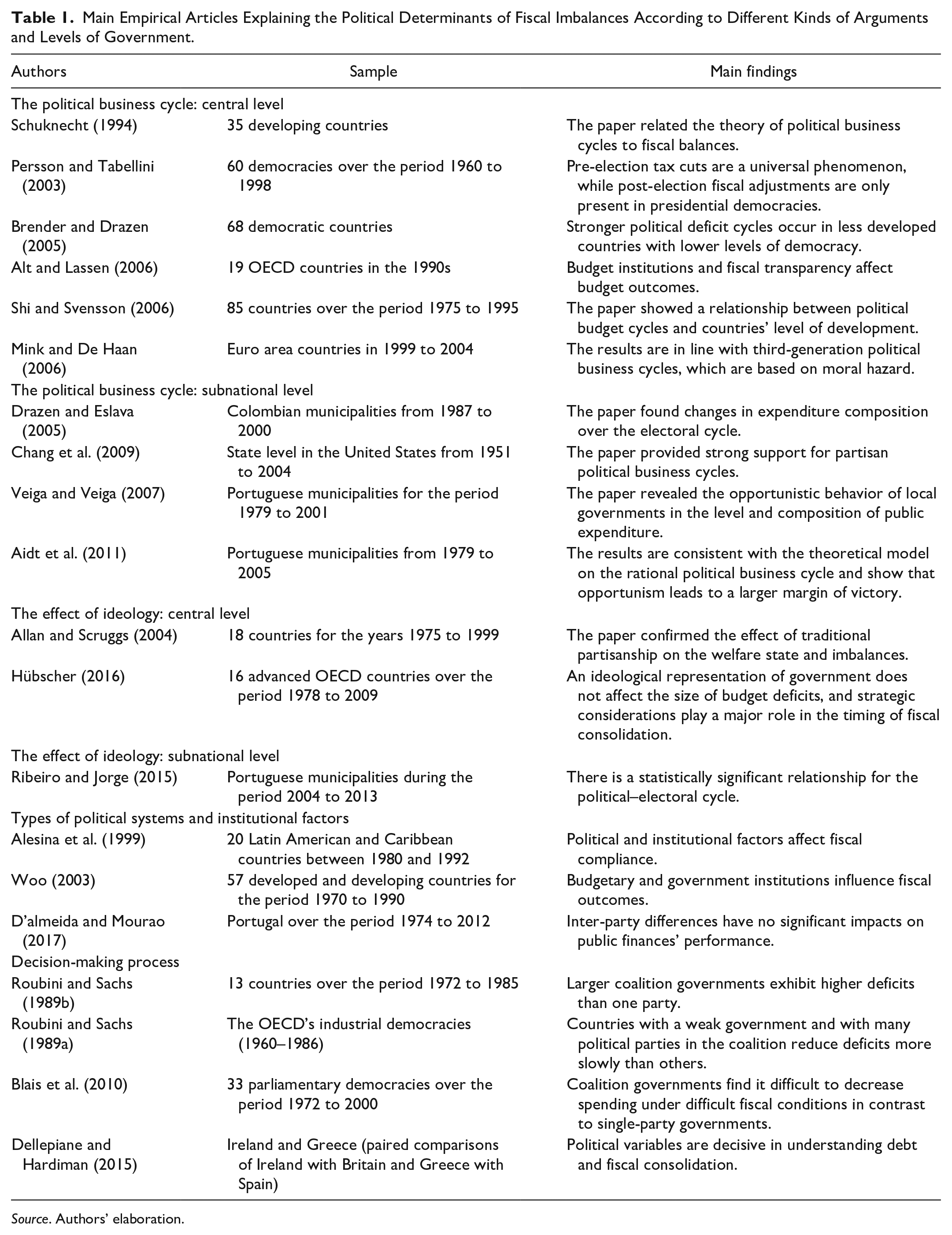
Source. Authors’ elaboration.
The Political Business Cycle
The so-called first-generation models of the political budget cycle emphasize the incumbent government’s intention to secure re-election by maximizing its expected vote share at the next election. Subsequent papers developed adverse-selection-type models, which emphasize temporary information asymmetries regarding politicians’ competence level in explaining election cycles in fiscal policy. Under these models, all types of government will incur excessive pre-election deficits, regardless of their level of competence (Mink & De Haan, 2006).
The degree of responsiveness of fiscal policy to the economic cycle has been the subject of many empirical debates. Brender and Drazen (2005) and Persson and Tabellini (2003) found no pre-election changes in either public spending or deficits/surpluses for a wide sample of developed and developing economies. By contrast, Schuknecht (1994) and Shi and Svensson (2006) concluded that spending increases significantly before an electoral process, returning to a balanced budget after the elections. Alt and Lassen (2006) identified a persistent pattern of electoral cycles in low-transparency and politically more polarized countries.
Using data for subnational governments, Drazen and Eslava (2005) found changes in expenditure composition over the electoral cycle for Colombian municipalities, while Aidt et al. (2011) and Veiga and Veiga (2007) showed that the political business cycle affects the level of fiscal deficit for Portuguese municipalities. The opportunistic behavior of state governments was also reflected in the results of the study by Chang et al. (2009) for the United States.
The Effect of Ideology
A second array of papers has investigated the potential effect of ideology. Allan and Scruggs (2004) confirmed that right-wing incumbents are more prone to making spending cuts than left-wing governments. Hübscher (2016) obtained a different result when examining the political factors that determine the capacity of governments to implement fiscal reforms in times of austerity. Ribeiro and Jorge (2015) investigated whether the political–ideological situation of Portuguese municipalities affects their debt level, and they showed a statistically significant political–electoral relationship. The paper by D’almeida and Mourao (2017) did not support this result at the central level.
Types of Political Systems and Institutional Factors
A third group of papers has investigated how political systems affect the behavior of policy makers. Alesina et al. (1999) suggested that political and institutional factors affect fiscal compliance for 20 Latin American and Caribbean countries. Persson and Tabellini (2000) found that large fiscal imbalances have occurred in countries with proportional electoral systems—rather than presidential ones—and in countries with coalition governments and unstable governments. Woo (2003) noted that social polarization, political factors, and institutional structures have a significant impact on the explanation of fiscal deficits.
Decision-Making Process
The seminal papers by Roubini and Sachs (1989a, 1989b) focused on disagreement among various decision makers. They argued that the decision-making process is often fragmented among several political agents and that spending increases due to political pressures will be much smaller with more fragmented political power. Further empirical studies on the impact of political variables on budget deficits have confirmed the previous arguments. Blais et al. (2010) corroborated the argument that coalition governments find it difficult to decrease spending under difficult fiscal conditions but also to increase it even in a more favorable context because each member of the coalition has veto power. Dellepiane and Hardiman (2015) reviewed the results of fiscal consolidation in Ireland, Greece, the United Kingdom, and Spain between 1980 and 1990 and concluded that policy variables are decisive in explaining the fiscal consolidation process.
Finally, Table 2 summarizes the main empirical papers that have focused on the political factors that affect fiscal consolidation in Spain. The influence of the electoral cycle was confirmed by Delgado-Téllez et al. (2017) and Leal and Lopez-Laborda (2015). Lago-Peñas et al. (2017) showed that compliance with fiscal targets increases in post-election years with a change of incumbents and ideological coincidence of regional and central governments. Finally, Artes and Jurado (2018) indicated that single-party majority governments lead to lower deficits.
Main Empirical Articles Explaining the Political Factors That Affect Subnational Fiscal Consolidation in Spain.

Source. Authors’ elaboration.
Regional Public Finances in Spain 2004 to 2017: Some Stylized Facts
The dynamics of regional public finances from 2004 to 2017 can be divided into four periods, according to the evolution of the deficit (Figure 1) and both expenditures and non-financial revenues (Figure 2).

The dynamics of regional deficit over the period 2004 to 2017 expressed as a share of regional GDP.
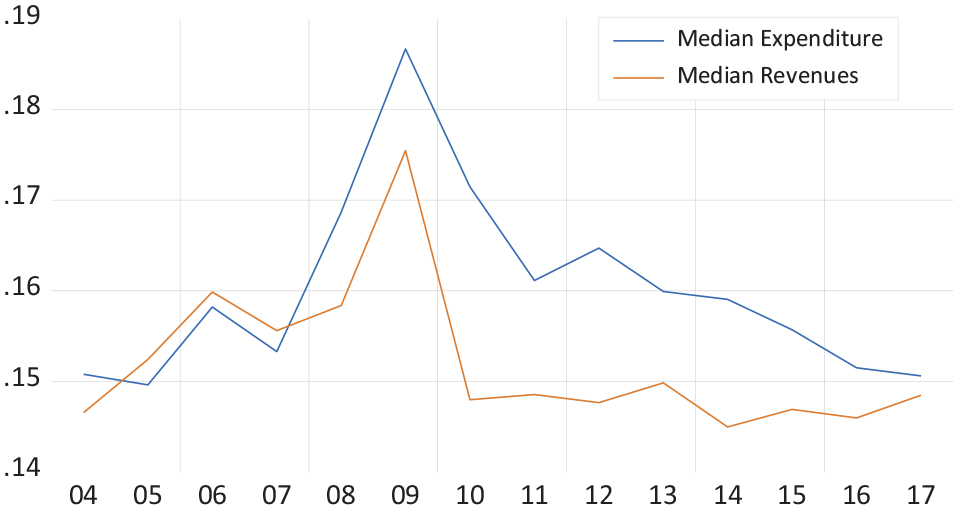
The dynamics of median regional public expenditure and revenues over the period 2004 to 2017 expressed as a share of regional GDP.
Between 2004 and 2007, both revenues and expenditures expanded, yielding a slight surplus for the median region. Balanced budgets were the rule. In the 2-year period 2008 to 2009, three factors explain the observed jump in expenditures, revenues, and deficit ratios over the regional GDP. First, the drop in the nominal GDP increased all the ratios. Second, the response of most regions to the recession was to increase the expenditures to boost the demand. Third, in 2008 and 2009, the central government granted resources in advance as if nothing were happening. At this point, it is important to bear in mind that most regional taxes are collected by the Spanish Tax Agency. The central government transfers advances to regional governments. Once final information on the actual tax collected is known (2 years later), it compensates for positive or negative differences between advances and actual revenues. See Lago-Peñas et al. (2017) for an in-depth review of this evolution and a critical review of the Spanish regional fiscal framework.
In 2010, the revenues dropped sharply as the central government was already aware of the depth of the crisis and its effect on public revenues. Granted advances collapsed, and regional expenditure cuts started. However, the latter were not enough to compensate for the negative effect of the Great Recession on tax collection. The median regional deficit crossed the threshold of 2% of the GDP, around one-eighth of the total regional expenditure. Since 2012, fiscal consolidation has focused on the expenditure side, progressively reducing the regional deficit to a median of 0.5% of the regional GDP in 2017. Revenues have not been relevant to the explanation of the deficit reduction since 2010, mostly due to limited tax autonomy. All the available empirical evidence shows that spending cuts have accounted for most of the regional fiscal consolidation in Spain. Moreover, the estimates made by the Independent Authority for Fiscal Responsibility (AIREF) for the year 2016 show that the net effect of accumulated changes in regional tax rates and tax benefits was close to zero (AIREF, 2016).
Econometric Analysis
To estimate the response of regional governments to deviations in deficits, we adopt the methodology suggested by Buettner and Wildasin (2006). This methodology relies on the seminal contributions by Dahlberg and Johansson (1994) and Holtz-Eakin et al. (1989), with the difference that the VECM includes the deficit under the hypothesis of stationarity. See also Esteller and Solé-Ollé (2005) for a discussion.
The starting point is a simplified version of the government budget constraint:

where E is the expenditure, R is the non-financial revenues, and D is the deficit. Our attention focuses on the expenditure’s reactions as the fiscal consolidation in Spanish regions relies on the expenditure side, as we demonstrated above. Moreover, it is difficult to quantify revenues from discretionary tax choices with the available data on the Spanish fiscal federalism framework.
To measure the impact of political variables on the fiscal consolidation process, we add a vector of four variables (POL) affecting the impact of Dt−1. The list of regressors includes Change of incumbent, Coalition, Ideology, and Elections. In preliminary estimates, we also test the effect of the ideological coincidence of the central and regional governments, but the p-values were very high. Moreover, the results hold when Coalition is replaced with a dummy variable to identify incumbents supported by a parliamentary single-party majority. In a further step, we merge the variables Coalition and Ideology to create a new variable, Right_majority, to focus on the responses of the rightist majoritarian incumbents. Table 3 reports the definitions and data sources, and Table 4 summarizes the basic descriptive statistics. All the estimates are based on a yearly panel data set from 2002 to 2017 for the 17 Spanish regional governments.
Variable Definitions and Data Sources.

Descriptive Statistics.

The interactions between political variables and deficits capture the impact of the former on the response of governments to fiscal imbalances. As usual, the four political variables are also included in levels to avoid biases in the estimates of the interaction terms. Hence, the estimated specification is the following:

Several additional comments on the econometric methodology are required. First, the individual fixed effects are redundant (non-significant) according to a Wald test of the preliminary specifications (p = .15), but the period fixed effects are highly significant (p < .001) and thus are included in the estimates. Given both the structure of the panel (a small N dimension and quite a large T dimension) and the low statistical significance of the individual effects, the panel ordinary least squares (OLS) method would be a better option than generalized method of moments (GMM) estimators (Beck & Katz, 2011). Moreover, Allison et al. (2017) and Moral-Benito et al. (2019) demonstrated the poor finite properties of panel GMM estimators in the case of small values of N. However, in Table 6, we replicate estimates including individual effects and implementing the difference-GMM Arellano–Bond estimator (Arellano & Bond, 1991) to avoid the so-called Nickell bias due to the inclusion of individual effects in autoregressive models (Nickell, 1981).
Second, the use of first differences and the inclusion of both the lagged endogenous variables on the right-hand side of the equation and the period fixed effects avoid autocorrelation problems. Third, both the Breusch–Pagan test and the Pesaran CD test detect the existence of cross-sectional dependence and the Lagrange multiplier test identifies cross-sectional heteroscedasticity. Hence, we replace the panel OLS (POLS) residuals with panel-corrected standard errors (PCSE) following the proposal by Beck and Katz (1995). Fourth, we perform the version of the Hausman test for endogeneity proposed by Davidson and Mackinnon (1993) on the three fiscal variables on the right-hand side of the equation. Significant endogeneity problems are clearly discarded. Finally, heterogeneity in slopes, especially for the main variable DEF, is not a relevant problem either.
The econometric results are reported in Table 5. In columns (2) and (4), interest payments are subtracted from variable E to check for potential bias in the results due to differences in the cost of the debt stock. As argued above, most of the fiscal adjustment relies on expenditure cuts (non-financial revenues are not relevant to the explanation of expenditure dynamics) and the vector error correction model (VECM) works as expected: past fiscal imbalances push down expenditure. In other words, the higher the deficit in year t − 1, the higher the probability of adjustments in expenditure. By contrast, changes in revenues do not affect expenditure.
Panel OLS Estimates of Equation (2). Period 2004 to 2017.

Note. In parenthesis, t-statistics using PCSE. In both columns (2) and (4), expenditure excludes interest payments.
p, **p, and *p indicates statistical significance at .01, .05, and .10 levels, respectively.
Concerning the political variables, they are not significant in levels, but both Change and Elections are significant when interacting with deficit. The interpretation of this econometric result is that political variables themselves do not affect changes in expenditure, but they influence the effect of past imbalances on expenditure. Adjustments in expenditure to reduce the deficit are set aside in election years. The coefficient for the interaction
Regarding the statistical irrelevance of the interaction of deficit with Ideology and Coalition, the results hold when both variables are replaced with Right_majority (columns 3 and 4). Finally, including interest payments in the definition of E does not change the main results either.
As mentioned above, we also use the Arellano–Bond estimator as a robustness check, including individual effects. The instruments are the lagged values of deficit, expenditure, and revenues and a set of time period dummies (Table 6). The results are close to those in Table 5. Column 1 replicates column 3 in Table 5. In column 2, dummies in levels are excluded. Hence, the interactions capture the total effect of the corresponding variables. Finally, in column 3, irrelevant variables are set aside to increase the efficiency of the estimate. The statistical significances are very similar to those in Table 5, but the coefficient for DEF increases, involving a stronger correction depending on the deficit in the previous year. In sum, ideology and governments’ political support do not systematically matter for fiscal consolidation dynamics but the electoral cycle and changes of governments do.
GMM Estimates of Equation (2). Period 2004 to 2017.
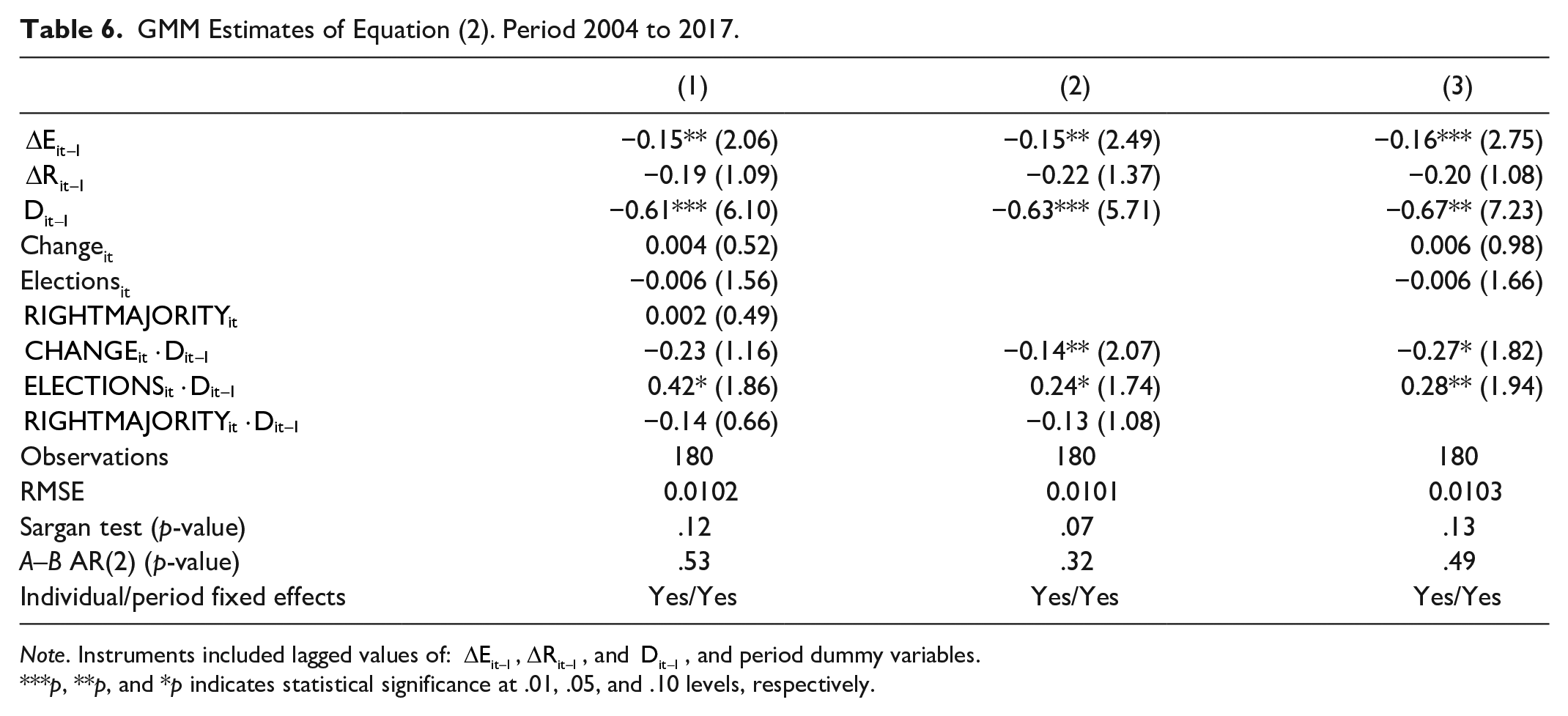
Note. Instruments included lagged values of:
p, **p, and *p indicates statistical significance at .01, .05, and .10 levels, respectively.
Conclusions
In this paper, we assess the determinants of the response of Spanish regional governments to fiscal imbalances following the standard methodology proposed by Buetter and Wildasin (2006). After providing a brief review of both the theoretical and the empirical literature on the political determinants of fiscal imbalances, we examine the dynamics of regional public finances in Spain over the period 2004 to 2017 to measure the impact of political variables on the fiscal consolidation process.
Insofar as most of the fiscal adjustment is based on spending cuts, our attention is focused on this variable. The results confirm that past fiscal imbalances push down expenditure and that this effect depends on politics. Confirming the electoral budget cycle hypothesis, fiscal consolidations tend to stop in electoral years. Moreover, when elections involve changes in incumbents, both the expenditure adjustment and the fiscal consolidation are boosted. Interestingly, the effect of both political variables is not direct but conditioned on the size of the fiscal deficit: they only modify the fiscal adjustment path, boosting, or stopping it. By contrast, the ideology of the incumbent and the political support of the incumbent do not systematically affect choices relating to expenditure dynamics.
Concerning future research, we plan to complement the methodological approach used in this paper with an analysis of changes in fiscal policy stances, following Ramey (2011), and then to check whether those exogenous policy shocks are explained by the political factors considered in this paper.
Footnotes
Acknowledgements
We thank Alejandro Domínguez Lamela for his usual superb research assistance. The usual disclaimer applies.
Declaration of Conflicting Interests
The author(s) declared no potential conflicts of interest with respect to the research, authorship, and/or publication of this article.
Funding
The author(s) disclosed receipt of the following financial support for the research, authorship, and/or publication of this article: The authors acknowledge financial support from the Spanish Ministry of Science, Innovation and Universities (grant number AEI/FEDER CSO2017-85024-C2-2-P).
