




Abstract
The Coaching Life Skills in Sport Questionnaire (CLSS-Q) is a 5-factor 36-item scale developed in the English language to assess the extent to which coaches are intentional in their approaches to teaching life skills through sport. To allow for usage of the CLSS-Q in Portuguese-speaking countries, the purpose of this study was to investigate the cross-cultural adaptation and the psychometric properties of the Portuguese version of the CLSS-Q (P-CLSS-Q). In Phase 1, the scale was cross-culturally adapted through consecutive stages of translation and back-translation, expert feedback, committee revision, and pretesting. In Phase 2, 753 youth sport coaches (i.e., 376 Brazilians and 377 Portuguese) completed the questionnaire. After randomly splitting participants into two independent samples, the translated and cross-culturally adapted questionnaire was subjected to an exploratory factor analysis and a confirmatory factor analysis. Other analyses were also applied to verify the instrument’s psychometric properties. The results led to a 5-factor 30-item scale with indications that the P-CLSS-Q has some evidence of validity in measuring the extent to which coaches intentionally teach life skills through sport in Portuguese-speaking countries. Future studies are needed to further investigate the psychometric properties of both the CLSS-Q and the P-CLSS-Q in other sociocultural contexts where coaches have varying levels of exposure to the concept of life skills and its implication for coaching practice.
Keywords
Introduction
In contemporary society, youth sport is touted as a form of organized physical activity conducive to human and character development (Weiss, 2016). The potential of youth sport to facilitate development derives from the presence of features such as the social norms in place, the sense of belonging that can be fostered, and the adults (e.g., coaches) who can exert a positive influence on youth (Gould & Carson, 2008). The competencies youth develop from their participation in sport can be transferred to other life domains (i.e., school, home, community) and are often referred to in the literature as life skills (Gould & Carson, 2008; Pierce et al., 2017). Examples of life skills include respecting others, working as a team, being a good leader, demonstrating empathy, establishing goals, and persevering in an activity, among others.
Youth sport coaches have been identified as having a key role to play in facilitating youth’s acquisition of life skills in sport (Bean et al., 2018; Pierce et al., 2017). Turnnidge et al. (2014) argued that youth sport coaches can adopt either a reactive and unplanned approach (i.e., implicit) or a proactive and planned approach (i.e., explicit) to teaching life skills. The implicit approach is based on the premise that life skills are naturally learned by youth when they experience the inherent demands of sport as well as positive relationships with coaches, peers, and parents in sport. Conversely, the explicit approach considers that life skills and their transfer should be intentionally planned, taught, and facilitated through concrete strategies. In efforts to move beyond the inherent limits of viewing the teaching of life skills as an implicit/explicit dichotomy, Bean et al. (2018) created a continuum comprising six levels of intentionality, with the first two levels implicit in nature and the last four levels explicit in nature. These levels are (a) structuring the sport context; (b) facilitating a positive climate; (c) discussing life skills; (d) practicing life skills; (e) discussing life skills transfer; and (f) practicing life skills transfer. The levels were organized incrementally to illustrate that as coaches progress to more intentional strategies to teach life skills, they move up the continuum while also continuing to implement strategies from the previous levels. In other words, coaches operating at Level 4 also demonstrate behaviors from Levels 1, 2, and 3. For a more detailed explanation of each level, please see Bean et al. (2018).
To our knowledge, the Bean et al. (2018) continuum is the first model detailing specific coaching behaviors that coincide with different levels of intentionality in the life skills teaching process in sport. Some studies have used the Bean et al. (2018) continuum to understand how coaches teach life skills and their transfer (e.g., Kramers et al., 2021; Santos et al., 2020), with such efforts showing that getting coaches to use more explicit strategies to support life skills development and transfer is a challenging endeavor. Despite the challenges, recent research has demonstrated how coaches’ use of explicit life skills teaching approaches is associated with greater positive developmental outcomes for youth (e.g., Bean et al., 2016; Holt et al., 2017). Thus, moving forward, empirical research is needed to further elucidate how exactly youth sport coaches address the development and transfer of life skills in their coaching. For such empirical research to be conducted, valid and reliable instruments are needed that measure the extent to which youth sport coaches are, deliberately or not, teaching life skills through sport.
Recently, Camiré et al. (2021) developed and validated the Coaching Life Skills in Sport Questionnaire (CLSS-Q), which is based on the Bean et al. (2018) continuum. The CLSS-Q is a 36-item instrument using a 6-point scale through which coaches self-report the extent to which they agree with statements assessing their degree of intentionality in teaching life skills. From the stem “As a coach, I,” example items include “Foster an inclusive environment” (Item 4); “Describe to athletes what life skills are” (Item 19); and “Incorporate life skills into my coaching plan” (Item 23). Camiré et al. (2021) demonstrated that the CLSS-Q presents adequate construct validity evidence in terms of convergent and discriminant validity (i.e., above .50) and internal consistency reliability (i.e., above .70).
Based on Camiré et al.’s (2021) suggestion for expanding the CLSS-Q for use beyond English-speaking countries, the purpose of this study was to investigate the cross-cultural adaptation and psychometric properties of the CLSS-Q for use in Portuguese-speaking countries (Portuguese version of the CLSS-Q [P-CLSS-Q]). A cross-cultural adaptation and validation of the CLSS-Q to Portuguese is warranted, given the relatively incipient concept of life skills in Portuguese-speaking countries (Ciampolini et al., 2020; Santos et al., 2018) and the rapidly growing interest around this topic in Brazil (e.g., Ciampolini et al., 2020) and Portugal (e.g., Santos et al., 2020). Despite the numerous lexical differences between the Portuguese language in Brazil and Portugal (Barreiro et al., 1996), this study is novel in structuring a single questionnaire that can be utilized in both countries to measure the extent to which coaches teach life skills through sport. A Portuguese-language CLSS-Q will help expand the concept of life skills to sport organizations, as previous studies suggested that coaches in those two countries lack in life skill–related formative opportunities (e.g., Gaion et al., 2020; Santos et al., 2017), which has lead to the use of few explicit strategies to teach life skills (e.g., MacDonald et al., 2020; Palheta et al., 2021).
Method
Study Design
The study was conducted in two phases. First, the guidelines proposed by Beaton et al. (2000) were followed to conduct the cross-cultural adaptation of the CLSS-Q. Second, the translated and cross-culturally adapted questionnaire was subjected to an exploratory factor analysis (EFA) and a confirmatory factor analysis (CFA). Data were collected after clearance was received from the first and second authors’ university ethics board.
Phase 1
Cross-cultural adaptation
A group of eight scholars was assembled to oversee the process of translating and cross-culturally adapting the CLSS-Q from English to Portuguese. The group included seven full-time university professors with previous experience in scale development and validation, as well as one PhD candidate. Seven were native Portuguese speakers (four spoke English as their second language) and one was a native English speaker. From this group of eight, one informed (i.e., previous contact with the questionnaire and the topic) and one uninformed (i.e., no previous contact with the questionnaire and the topic) scholar were each tasked with independently translating the CLSS-Q to Portuguese. Both translators then met to resolve minor discrepancies between their translated versions to create a single translation. Discrepancies mainly included the use of synonyms, with discussions focused on identifying the word that best fit the target population. Then, two native English speakers (i.e., not part of the group of eight scholars) who spoke Portuguese as their second language were subsequently invited to back-translate the single Portuguese translation to English. They were both uninformed (i.e., no previous contact with the questionnaire and the topic), with one holding a master’s degree in kinesiology and the other holding a bachelor’s degree in health sciences. No major differences were found between the original version and the two back translations; thus, no adjustments were made.
Next, an expert committee was formed to enhance the cross-cultural equivalence of the single Portuguese translation for the items to be clear and relevant in both the Brazilian and Portuguese cultures. This committee included five new members, in addition to the group of eight scholars, as well as the two Portuguese to English translators. Of the five new members, three were full-time university professors and two were directors of national sport federations in Brazil. The expert committee met to discuss semantic, idiomatic, experiential, and conceptual equivalence to create a questionnaire that would apply to both Brazilian and Portuguese youth sports coaches. One of the changes discussed and applied was the exclusion of the personal pronoun “I” in all item examples (e.g., demonstro rather than eu demonstro). The committee also discussed the importance of using a more colloquial language throughout the instrument to help coaches relate the items to their daily behaviors (e.g., incluo rather than incorporo; encorajo rather than ofereço encorajamento). Other minor changes were made to enhance fluidity.
The updated version of the (Portuguese) translated CLSS-Q was then tested with 30 youth sports coaches from the sports of basketball, volleyball, indoor soccer, judo, and tennis. Each coach independently completed a paper-pencil version of the questionnaire and was individually interviewed by the first author for around 10 min to comment on item relevance, item clarity, and possible improvements. In general, the coaches perceived the items as relevant and clear but did suggest two improvements: (a) condense the explanation before each factor of the questionnaire and (b) highlight in the explanation before each factor that coaches should frame their answers based on their actual rather than ideal coaching behaviors. The expert committee met on one last occasion to discuss the coaches’ feedback and integrate their suggestions.
Phase 2
Participants
The total sample comprised 753 youth sport coaches from Brazil (n = 376) and Portugal (n = 377). Coaches’ mean age was 36.2 ± 10.08 years and 80.08% of participants were male. Coaches had an average of 7.97 ± 7.51 years of coaching experience in the youth sport context and worked with team (n = 621) or individual (n = 132) sports (i.e., track and field, basketball, soccer, gymnastics, martial arts, swimming, surfing, tennis, volleyball). To split the total sample into two independent samples, the “RAND” function in Excel was employed to generate unique random numbers to reorder the data set (the lowest to the highest number). The first 50% of the data set was used to run the EFA and the other 50% to run the CFA. Please see Table 1 for participant demographics. Item means and standard deviations for each sample are presented in the Supplemental Table.
Participant Demographics.

77 missing data on age in the total sample, 35 in Sample 1, 42 in Sample 2, 53 in the Brazilian sample, and 24 in the Portuguese sample.
Analyses
Exploratory analyses
Given that the CLSS-Q is a new scale (Camiré et al., 2021) and that it has yet to be tested in other cultures, an EFA was conducted to assess theoretical dimensionality. An EFA was conducted using maximum likelihood with a direct oblique rotation (oblimin). Based on previous research (Camiré et al., 2021), the factors of the questionnaire are to some extent correlated with one another. Thus, we chose to apply the oblimin rotation rather than a varimax rotation (Hair et al., 2014). Initially, we tested the Kaiser-Meyer-Olkin (KMO) and Bartlett’s indices. We conducted an eigenvalues analysis based on Kaiser criterion (<1) and Cattel criterion (screen plot graphic display) suggesting the number of factors to retain. In addition, factor retention decisions were based on the theoretical definitions of the original CLSS-Q (Camiré et al., 2021). The criteria to include items in the exploratory model were factor loadings above 0.4 (Hair et al., 2014); no cross-loading up to 0.4; and no factor with less than three items (Costello & Osborne, 2005). These criteria were applied until a suitable factor structure (e.g., six, five, and four) for each sample was found.
Confirmatory analyses
A CFA was conducted on Sample 2, the total sample, the Brazilian sample, and the Portuguese sample. To perform this analysis, the “lavaan” package (Rosseel, 2012) in the R statistical language (R Core Team, 2018) was used. Factor loadings above 0.5 were used as cutoff points to retain items (Kline, 2016). The covariances between measure error items were also analyzed. In the case of high covariances between measure errors that could disturb the model, decisions were taken by analyzing both factor loadings and by verifying an item’s theoretical construct, meaning, and interpretation. Finally, model adequacy was tested through the most recommended fit indices (Jackson et al., 2009): chi-square (χ2), degrees of freedom (df), chi-square ratio (χ2/df), Tucker–Lewis index (TLI), relative noncentrality index (RNI), root mean square error of approximation (RMSEA), comparative fit index (CFI), standardized root mean square (SRMS), and expected cross-validation index (ECVI).
Convergent validity, discriminant validity, and composite reliability (CR)
To verify the scale’s convergent validity, we analyzed the average variance extracted (AVE) with a cutoff point of 0.5 (Hair et al., 2014). This analysis assesses the degree to which two measures of the same concept are correlated. Discriminant validity was assessed by comparing the AVE with the average shared squared variance (ASV), considered adequate if AVE > ASV. This comparison allowed us to identify the degree to which two conceptually similar concepts are distinct. Finally, CR was calculated using reliability measures derived from the CFA, with values greater than .7 considered satisfactory (Hair et al., 2014).
Invariance analyses
Invariance tests were used to verify homogeneity across the countries (i.e., Brazil and Portugal) and across genders (i.e., male and female). The first model (configural) tested if the constructs had the same pattern of free and fixed loadings. The second model (metric) constrained factor loadings to be equivalent in the two groups. Both models were compared (configural × metric) to verify the adequacy of the model when increasing in restrictiveness. To do so, we ran a CFA for each model (configural and metric). We used the “anova” function to compare both models (Rouder et al., 2016), which takes the models’ objects as arguments. This method better addresses substantive questions in data analysis and offers a richer and more insightful view of the nested data structure (Rouder et al., 2016). If the resulting p value is less than .05, the more complex model (metric) is adequate. To run this analysis, the “lavaan” package (Rosseel, 2012) in R was used.
Temporal stability and internal consistency
To analyze the items’ reliability, temporal stability (14-day test–retest) and internal consistency tests were used (Hair et al., 2014) based on the results from the CFA (M3). The sample comprised 37 coaches selected through a nonprobabilistic sampling technique (26 Brazilian and 11 Portuguese coaches) aged from 18 to 49 years (M = 26.97; SD = 7.67). Spearman correlation was applied for test–retest reliability to verify the scale’s temporal stability. The items’ internal consistency was estimated based on the average interrelations between all the individual items (Drost, 2011) using Cronbach’s alpha (Cronbach, 1951). Values above .70 (p < .05) were considered indicators of suitable CR (Nunnally & Bernstein, 1994).
Results
Exploratory Analyses
For Sample 1, a 5-factor structure was found. However, Item 4 (foster an inclusive environment) and Item 11 (use athletes’ mistakes on and off the field as teaching opportunities) showed low factor values (<0.4) and were excluded from the model. The new model was tested without Items 4 and 11, and the model indicated adequate structure (KMO = 0.940; p < .001) with all factor loadings greater than 0.4 and with internal consistency greater than 0.7. Please see Table 2 for EFA scores. The five factors explained 59.421% of the variance and commonalities’ mean of 0.53. Except for Item 36, which loaded and was retained on the discussing life skills transfer factor, all other items loaded on their original factor.
Exploratory Factor Analysis Scores.

Note. F1 = structuring and facilitating a positive sport climate; F2 = discussing life skills; F3 = practicing life skills; F4 = discussing life skills transfer; F5 = practicing life skills transfer.
Confirmatory Analyses
The first step consisted of testing the original 36-item scale with Sample 2. Although this model (M1) presented satisfactory fit indices (see Table 3), Items 4 (0.39), 5 (0.46), and 11 (0.41) did not present satisfactory factor values. In addition, high covariance was found between Items 30 and 31 (> 65) and Items 33 and 34 (> 100). Thus, Items 4, 5, 11, 31 (due to a lower factor loading compared with Item 30), and 34 (due to a lower factor loading compared with Item 33) were excluded. After running another analysis (see Figure 1), all items presented factor loadings over 0.5 as well as M2 presented adequate fit. Please see Table 4 for indices of model fit.
Indices of Model Fit.
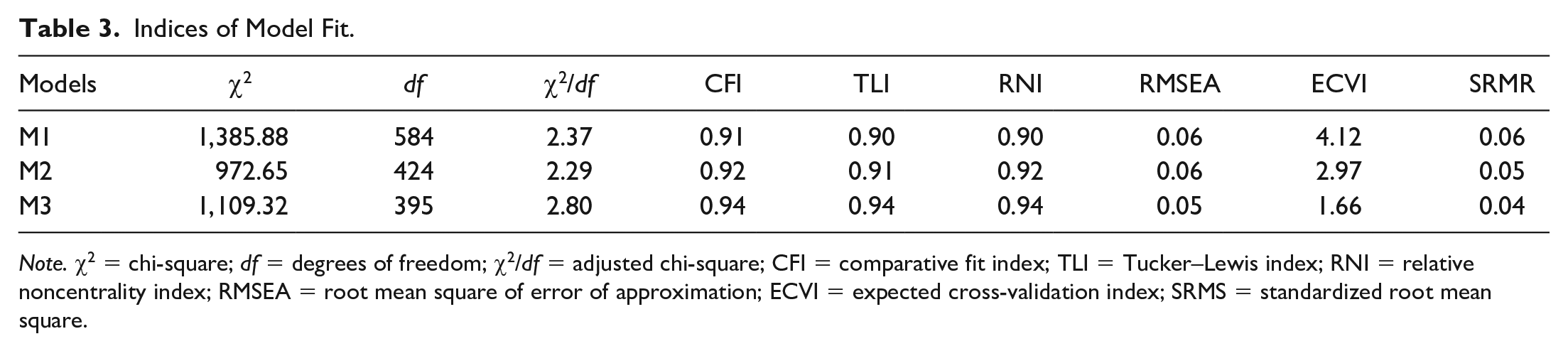
Note. χ2 = chi-square; df = degrees of freedom; χ2/df = adjusted chi-square; CFI = comparative fit index; TLI = Tucker–Lewis index; RNI = relative noncentrality index; RMSEA = root mean square of error of approximation; ECVI = expected cross-validation index; SRMS = standardized root mean square.

Standardized coefficients and correlation between factors of the scale’s cross-national Model 2 (based on Sample 2).
Convergent Validity, Discriminant Validity, and Composite Reliability.

Note. AVE = average variance extracted; ASV = average shared squared variance; CR = composite reliability; F1 = structuring and facilitating a positive sport climate; F2 = discussing life skills; F3 = practicing life skills; F4 = discussing life skills transfer; F5 = practicing life skills transfer.
To verify the evidence found in Sample 2 based on CFA, the total sample was also tested in the CFA based on M2. In this new test, M2 presented adequate fit and all items showed factor loadings greater than 0.5; however, high covariance was found between Items 8 and 9 (>100), and Item 9 was excluded (see Figure 2). Model 3 (M3) was tested and presented good fit and satisfactory factor loadings. In M3, Item 8 presented a factor loading of 0.494. We decided to retain this item as it was just below our cutoff point of 0.5. Considering the similarities between M2 and M3, the higher values of fit indices for M3, and the larger sample of M3, this model was considered the most suitable for our final cross-cultural model. Therefore, M3 contained 30 items distributed across five factors and will be referred to as the P-CLSS-Q.

Standardized coefficients and correlation between factors of the scale’s cross-national Model 3 (based on total sample).
Convergent Validity, Discriminant Validity, and CR
AVE results showed satisfactory convergent validity for F2, F3, F4, and F5. F1 was the only factor to not present satisfactory convergent validity. The AVE values were all higher compared with the ASV values. This indicates that the factors are discriminant from each other. Finally, CR values were all higher than .8, which indicates good internal consistency. Please see Table 4.
Invariance Analyses
The configural invariance of the P-CLSS-Q (M3) was examined between Brazil and Portugal (χ2 = 1,334.14; df = 680; χ2/df = 1.96; CFI = 0.94; TLI = 0.94; RMSEA = 0.05; SRMR = 0.05), with the model showing acceptable fit between the samples from the two countries, indicating that the proposed structure remained stable for both groups. The model with fixed constricted factor (metric) weights also showed acceptable fit (χ2 = 1,366.64; df = 703; χ2/df = 1.94; CFI = 0.94; TLI = 0.94; RMSEA = 0.05; SRMR = 0.05). No difference was found when comparing the structural invariance of the models across the countries (χ2 = 0.09). Furthermore, when comparing the configural (χ2 = 1,379.54; df = 680; χ2/df = 1.02; CFI = 0.94; TLI = 0.93; RMSEA = 0.05; SRMR = 0.04) and metric invariance between male and female (χ2 = 1,415.12; df = 703; χ2/df = 2.01; CFI = 0.94; TLI = 0.93; RMSEA = 0.05; SRMR = 0.05), no difference was found either (χ2 = 0.05).
Temporal Stability and Internal Consistency
Spearman correlation for test–retest reliability showed moderate correlate values (especially for Factor 1 items) and strong correlate values for other items. Item 2 presented a low and nonsignificant value. Most of the items from Factor 1 did not show acceptable values for internal consistency, and Item 2 presented a very low value. Items from other factors showed satisfactory internal consistency (see Table 5).
Item Temporal Stability and Internal Consistency.

p ≤ .001; * p ≥ .05.
Discussion
To expand the use of the CLSS-Q to Portuguese-speaking countries, this study aimed to investigate the cross-cultural adaptation and psychometric properties of the P-CLSS-Q. As life skills development continues to receive further attention across Portuguese-speaking countries, the P-CLSS-Q may help researchers assess the extent to which coaches teach life skills through sport using a variety of implicit and explicit strategies. This is the first validated questionnaire that can be used in Portuguese-speaking countries to achieve this purpose, which has numerous implications for research and practice. Our findings showed how the five dimensions of the original CLSS-Q were maintained, both in EFA and CFA, with six items excluded due to low fit indices or high covariance scores in CFA. We found adequate validity and reliability evidence in terms of convergent validity, discriminant validity, CR, and invariance analyses. In general, Factor 1 did not present adequate temporal stability and internal consistency scores (especially for Item 2) as the other factors. This study provides support for an exhaustive translation process having been conducted and presents initial indications that the P-CLSS-Q has some evidence of validity for examining the extent to which coaches intentionally teach life skills through sport in Portuguese-speaking countries.
When comparing the English and the Portuguese versions of the CLSS-Q, analyses for both scales led to a 5-factor solution, meaning that Levels 1 and 2 of the Bean et al. (2018) six-level continuum were combined. These results suggest that coaches in Canada, Brazil, and Portugal perceive that structuring the sport context (i.e., Level 1) and facilitating a positive climate (i.e., Level 2) refer to similar processes. This is consistent with previous work indicating the coach’s fundamental role in setting rules and promoting a positive climate (Santos et al., 2017; Vella et al., 2011). The results do not indicate that the Bean et al. (2018) continuum is inadequate, but do imply that the coaches surveyed do not see a clear delineation between both levels.
The exclusion of six items from the original CLSS-Q may be the result of cultural and social differences between English- and Portuguese-speaking countries. The cross-cultural adaptation of questionnaires is a difficult endeavor that requires researchers to thoroughly reflect on the best fit for the target population, especially when facing terms and expressions that do not have a direct translation (Su & Parham, 2002). For example, Rigoni et al. (2018) faced the same issue when cross-culturally adapting the Youth Experience Survey for Sport to Portuguese when they had to exclude 15 of the 37 items from the original instrument. Given that questionnaire development and validation is an ongoing process, future research is needed to continue gathering evidence regarding the psychometric properties of the P-CLSS-Q through other types of analyses (e.g., exploratory structural equation modelling (ESEM), item response theory, and Bayesian approaches).
Another aspect to consider is how temporal stability and internal consistency analyses found inconsistent scores across the items, which may have been influenced by coaches’ understanding (or lack thereof) of the concept of life skills and its translation to “habilidades para a vida.” It is worth mentioning that during the test–retest procedure, most of the 37 coaches indicated how exposure to the initial test made them critically reflect on their coaching practice, which may have influenced how they scored themselves at retest 14 days later. This may be due to the novel nature of life skills in both Portugal and Brazil. Although life skills have been discussed in English-speaking countries since at least the 1980s (e.g., Danish, 1983; Danish et al., 1993), the first studies on life skills in Brazil and Portugal were conducted in the last few years (e.g., Ciampolini et al., 2020; Santos et al., 2018). With these notions in mind, future studies are needed to further investigate temporal stability scores in other sociocultural contexts where coaches have varying levels of exposure to the concept of life skills and its implication for coaching practice.
Moreover, recent studies conducted in Portuguese-speaking countries (e.g., MacDonald et al., 2020; Santos et al., 2020) evaluating life skills–focused coach education programs could have benefited from the use of the P-CLSS-Q. For example, the P-CLSS-Q could have been applied in conjunction with the on-site observations prior to, during, and after the coach education program delivered by MacDonald et al. (2020), to complement data regarding coaches’ intentionality to teaching life skills. Also, in Santos et al.’s (2020) 2-year program intended to promote surfing coaches’ continuous progression toward higher levels of intentionality, the P-CLSS-Q could have contributed to identifying the extent to which coaches perceived themselves becoming more explicit throughout the program. In sum, the P-CLSS-Q allows researchers to move the research agenda further by including an analysis of the life skills teaching process through Portuguese-speaking coaches’ lenses. This entails moving beyond blindly accepting the sport-for-good narrative and using the P-CLSS-Q to assess coaches’ levels of intentionality in teaching life skills.
Limitations and Future Research
Although a study strength lies in the use of both Brazilian and Portuguese samples, it is important to note as a limitation that 80% of the sample was male. Also, the small sample of coaches for the temporal stability analysis might have influenced the results. To overcome these limitations, future cross-cultural and psychometric research on the CLSS-Q needs to consider gathering a larger sample of coaches for the temporal stability analysis and more female coaches for the EFA and CFA. As a suggestion for future research design, the P-CLSS-Q can be integrated and used in evaluation and longitudinal studies conducted in Portuguese-speaking countries: Specifically, given that the P-CLSS-Q measures the process of teaching life skills, it represents a suitable measure to be employed before, during, and after coach education interventions aimed at getting coaches to integrate life skills into their curricula (e.g., Gaion et al., 2020; Santos et al., 2017). P-CLSS-Q data gathered from multiple time points can allow researchers and coach developers to better understand how coach education interventions can progressively meet coaches’ learning needs. Furthermore, for administrators at sport federations, the P-CLSS-Q can offer useful information federations can use to track how their coaches evolve in their life skills teaching behaviors over time. Aligned with other methods of data collection (e.g., interviews, observations, and other questionnaires), the P-CLSS-Q can be a powerful tool to assess program quality.
Conclusion
This article cross-culturally adapted and validated the CLSS-Q for use in Portuguese-speaking countries. The analysis conducted led to a 5-factor 30-item scale (i.e., P-CLSS-Q) that assesses coaches’ intentionality to teaching life skills through sport. The findings of this article demonstrate that the P-CLSS-Q has adequate psychometric properties and may contribute to the research agenda in terms of investigating the intentionality of coaches’ life skills–related behaviors on the ground. Yet, further research can contribute to the ongoing process of validating the P-CLSS-Q by conducting other analyses as well as collecting data with Portuguese-speaking coaches with different demographic backgrounds.
Supplemental Material
sj-docx-1-sgo-10.1177_21582440211024224 – Supplemental material for Cross-Cultural Adaptation and Psychometric Properties of the Portuguese Coaching Life Skills in Sport Questionnaire
Supplemental material, sj-docx-1-sgo-10.1177_21582440211024224 for Cross-Cultural Adaptation and Psychometric Properties of the Portuguese Coaching Life Skills in Sport Questionnaire by Vitor Ciampolini, Fernando Santos, Ricardo Teixeira Quinaud, Martin Camiré, Maurício de Oliveira Migliano, Juarez Vieira do Nascimento and Michel Milistetd in SAGE Open
Supplemental Material
sj-pdf-2-sgo-10.1177_21582440211024224 – Supplemental material for Cross-Cultural Adaptation and Psychometric Properties of the Portuguese Coaching Life Skills in Sport Questionnaire
Supplemental material, sj-pdf-2-sgo-10.1177_21582440211024224 for Cross-Cultural Adaptation and Psychometric Properties of the Portuguese Coaching Life Skills in Sport Questionnaire by Vitor Ciampolini, Fernando Santos, Ricardo Teixeira Quinaud, Martin Camiré, Maurício de Oliveira Migliano, Juarez Vieira do Nascimento and Michel Milistetd in SAGE Open
Footnotes
Acknowledgements
We would like to acknowledge the important contribution of the individuals who participated in the expert committee and the translation processes of this study.
Declaration of Conflicting Interests
The author(s) declared no potential conflicts of interest with respect to the research, authorship, and/or publication of this article.
Funding
The author(s) disclosed receipt of the following financial support for the research, authorship, and/or publication of this article: This study was financed in part by the Coordenação de Aperfeiçoamento de Pessoal de Nível Superior—Brasil (CAPES)—Finance Code 001 and by Portuguese National Funds through the FCT – Fundação para a Ciência e a Tecnologia, I.P., under the scope of the project UIDB/05198/2020 (Centre for Research and Innovation in Education, inED).
Ethics Statement
All procedures performed in this study involving human participants were in accordance with the ethical standards of the Federal University of Santa Catarina Research Committee (approval number 3.822.901).

Supplemental Material
Supplemental material for this article is available online.
References
Supplementary Material
Please find the following supplemental material available below.
For Open Access articles published under a Creative Commons License, all supplemental material carries the same license as the article it is associated with.
For non-Open Access articles published, all supplemental material carries a non-exclusive license, and permission requests for re-use of supplemental material or any part of supplemental material shall be sent directly to the copyright owner as specified in the copyright notice associated with the article.
