




Abstract
This study investigates the sentiments of Bucharest city visitors resulting from their interaction with various attractions perceived as being “creative.” The online reviews displayed on TripAdvisor were collected as a database for our research, covering the July 2016 to July 2022 period. The data were processed using R software and NVivo software intended for text analysis and the investigation of the sentiments’ distribution. The findings suggest that creative offer spurs positive and very positive sentiments among travelers. Tourists experienced joy and trust during their tourism products and services consumption. The creative products are encountered especially in restaurants and escape rooms and are less correlated with heritage, arts, museums, or architecture. These findings are very useful for local entrepreneurs, local authorities, and policymakers in order to find solutions to include more creative products and services in the city tourism offer. Even if the present research is limited to Bucharest city, a future investigation could address the creativity dimensions of other destinations in Romania and abroad, highlighting the specific tourist attractions that boost various sentiment types among tourists.
Introduction
Tourism destinations are trying to reinvent themselves and look for solutions to become more creative and, thus, attract various tourists. Destinations struggle for creativity and creative ideas and the implemented solutions and initiatives become a joint effort supported, unconditionally, by visitors. These creative destinations share cultural assets, artistic and historical endowments, providing profound experiences to tourists which are eager to visit and consequently, offer them increased visibility (Dean & Suhartanto, 2019).
Discussions about creative tourism among theoreticians, policymakers, organizations, and authorities emerged rapidly and literature embraced this concept rapidly. Creative tourism refers to both generating context for relevant and unique experiences where tourists learn, acquire knowledge and apply it, but also to support sustainable and innovative communities that are design-makers of these experiences and might benefit economically from delivered tourism activities and services (Sarantou et al., 2021). Creative tourism brings benefits to local communities as it contributes to the preservation of natural and cultural heritage, balances the relationship between locals and visitors and provides financial resources (Blapp & Mitas, 2018). The interaction between tourists, suppliers, and local communities through the exchange of thoughts, philosophies, and abilities boosts creative tourism (Wattanacharoensil & Sakdiyakorn, 2016). The policies to support creative tourism are particularly noticeable in cities (Richards, 2014) as they bring benefits and support economic growth through creative and talented people that work in the industry (Richards, 2020). Through their creative tourism offers, cities are able to provide creative production together with creative consumption, cosmopolitan culture, and creative clusters (Rabazauskaitė, 2015) that generate multiplier, external effects (Florida, 2012; Lucas, 1988).
Bucharest is a tourist destination for foreigners attracted by various cultural and natural heritage (i.e. Palace of Parliament, Cotroceni Palace, “Grigore Antipa” Natural History Museum, Romanian Athenaeum, “Dimitrie Gusti” Village Museum, Stavropoleos Church, Herastru Park, Cismigiu Garden, National Art Museum, Vacaresti Nature Park, Old Town, bookstores). As compared with other European capital cities, the number of foreign tourists is still limited but their interest in visiting the city is mostly related to previous communist heritage, business motivation, nightlife, shopping centers, gastronomy, sightseeing, concerts, and so on. If some neighboring capital cities such as Sofia and Budapest are part of the UNESCO Creative Cities Network (UCCN), and while other Romanian cities such as Cluj-Napoca and Sibiu have submitted bids to join the UCCN, Bucharest remains full of contradictions. According to “The Cultural and Creative Cities Monitor 2019” on “Creative Economy,” “Bucharest ranks 10th in its group of 20 ranked European cities thanks to its 4th position on New Jobs in Creative Sectors” (European Commission, 2019).
Nowadays, tourists become more active and involved in their visiting experience, thus destinations need to come with offers that entail them in the creation process. Modern travelers have new needs and desires and want to be actively involved in tourism activities, to be able to interact with the destination, explore the touristic spaces, learn and commit to the dedicated tourism activities. Consequently, tourism businesses are stimulated to respond to tourists’ demands and to create exclusive and interesting offers (Pawlusiński & Kubal, 2018).
This paper utilized sentiment analysis as a branch of big data application on the secondary data released over a period of 6 years, collecting the data from the TripAdvisor platform. The consumers’ evaluations of the creative tourism products and services in Bucharest cover the July 2016 to July 2022 period. This paper aims to investigate the perception of travelers about creative products and creativity endeavor of Bucharest tourism providers and the sentiments experienced by travelers during these specific experiences. The rest of the paper is organized as follows. Section 2 provides an insight on literature review that depicts both creative tourism experiences and creative tourism, and sentiment analysis, respectively. Section 3 presents the used method with data collection and data processing subtopics. Section 4 addresses the results and discussions. Section 5 presents the conclusions and further implications of the research.
Literature Review
Creative Tourism Experiences
The concept of creative tourism has been largely discussed and has different definitions and perspectives. Tourism is considered creative because tourists perceive destinations, sites, and experiences as being creative, innovative, original, and inspired. It is not just the perspective of the providers to consider themselves creative, but more the perception of the visitors which are living creative experiences, namely: authenticity, education, engagement, escape, fulfilment, interactivity, involvement, learning and knowledge acquirement, memorability, novelty, participation, peace of mind, recognition, recreation, reflection, sightseeing, uniqueness, usefulness (Ali et al., 2016; Chan et al., 2022; Dias et al., 2021; Hung et al., 2016; P. Q. Li & Kovacs, 2022; C. H. Liu, 2020; Richards, 2020; Tan et al., 2013; Wang et al., 2020; Zhang & Xie, 2019).
Tan et al. (2013) underlined those creative experiences are comprised of “outer interactions” (i.e., with the environment, “people,” and “product/service/experience”) and “inner reflections” (i.e., “consciousness/awareness,” “needs,” and “creativity”); as novelty is provided during travel, tourists are looking for usefulness. Richards (2020) appreciated that tourists’ creative experiences are connected to interaction, engagement, active participation, meaningful contact with residents, novelty, and learning. Through memorable and authentic experiences, tourists are better satisfied as they not only learn about cultures, but also acquire knowledge, become involved in local activities (i.e., dances, traditional cuisines), and in the creation process through the interaction with locals (Wang et al., 2020).
Ali et al. (2016) identify the following dimensions of creative tourist experiences: “escape and recognition, peace of mind, unique involvement, interactivity, and learning” that exert a positive impact on tourists’ memories, satisfaction, and behavioral intentions. Zhang and Xie (2019) found that tourists are looking for experiences such as authenticity, emerging from learning and interaction with creative products, sightseeing, self-improvement, escape, relaxation, social contact, and gaining knowledge.
Chan et al. (2022) mentioned that the specific components of creative tourism experiences are “recreation, education/knowledge, escape, involvement and peace of mind.”Wang et al. (2020) identified two meaningful dimensions of creative tourist experiences, namely: memorability and authenticity which provide a competitive advantage to the destinations. Unique and creative experiences are positively related to memorability and visitors with memorable experiences have a higher probability to revisit the destinations (Hung et al., 2016).
C. H. Liu (2020) asserted that creative experiences expressed through “interactivity, learning, opportunities for escape, uniqueness,” influence travel authenticity and shape the travelers’ peace of mind and their revisit desire. Moreover, travelers’ participation in tourism creative activities supports their personal development and learning fulfilment (Dias et al., 2021). P. Q. Li and Kovacs (2022) suggested that creative experiences are gained through both active and passive participation, meaning throughout interaction and participation, but also sightseeing. From these experiences, creative tourists acquire knowledge, informally and formally, through meaningful interaction with residents and participation in various activities, but also from their engagement in “conscious and unconscious learning activities.” Creative tourism not only enriches the tourist experiences, but also contributes to the development of cities and regions and stimulates other industries and economies (Huang et al., 2019).
In shaping the tourist experience, the co-creation dimension becomes important (Richards, 2020). Thus, tourists participate, interact, co-create, and learn from these creative experiences (Wang et al., 2020). Moreover, the literature suggests that in creative tourism, visitors are not passive anymore and they need to be involved in the process and, thus, become simultaneously co-creators, co-producers, and co-consumers (Rabazauskaitė, 2015; Richards, 2011, 2020; Ross, 2020; Wang et al., 2020). Through creative tourism, visitors are living an experiential travel as they participate, design, and become engaged in their experiences (Wang et al., 2020). Through this “experiential involvement” in different activities such as cooking, music or writing, tourists interact with each other and with locals, reflect and discover new cultures (Catalani, 2013) and new ways to consume tourist products. Tourists become co-producers of their own tourism experience, provide collaborative practices, and contribute actively to the local life (Rabazauskaitė, 2015). Consequently, the role of tourists is much more complex, as they do not just visit the sites, but become “co-makership” and exchange skills and knowledge with other visitors (Richards, 2011).
Thus, in the current context, when discussing creative tourism, simultaneously, the concept of creative tourists emerges. Creative tourists should be regarded as mixed producers that participate in the creation process, but their input is rather subjective and feeling-centric, that, in the end, delivers creative experiences (Tan et al., 2014). Tourists can develop their creative skills as they are directly involved in the creative, expressive, and transformative experience (Duxbury et al., 2021). Creative tourism supports tourists’ creativity through interactive activities such as cooking, farming, planting, and product harvesting (Farsani et al., 2019).
The emotional dimension of tourism experiences is essential for destinations, managers, theoreticians, and policy makers, and it should be a focal point when designing future strategies and policies. Creative tourism provides a different perspective to the tourists as they interact emotionally and socially with the local communities and thus, they become a part of the specific culture and live the typical experiences of the residents, and they are not just outsiders (Juzefovič, 2015). Lee (2015) identified a positive relationship between emotions and creative experiences which, in the end, supports the revisit intention. The revisit desire for a specific creative destination increases as the tourists are feeling cool, satisfied by the visit experience, and are feeling attached to the tourist site (Chen & Chou, 2019).
Sentiment Analysis
As social media platforms and other UGC websites become more and more popular, sentiment analysis turn into a practical tool for theoreticians, marketers, and policy makers to identify the perspectives, and feelings of visitors (Mehraliyev et al., 2020). The extant volume of unstructured data generated by visitors also created the necessity of text analytic tools that explore the individuals’ sentiments toward certain aspects of interest (Geetha et al., 2017).
Sentiment analysis aims to process the unstructured textual data to find the attitudes of consumers toward specific topics, products, or services presented in the text (Mehraliyev et al., 2020). This type of analysis reveals positive, negative, and neutral sentiments in travelers’ reviews, and it represents a valuable tool to evaluate their satisfaction or dissatisfaction (Baniya et al., 2021)
The sentiment analysis technique is used by researchers to extract and evaluate the sentiments of customers at the sentence level (Hu et al., 2021). This technique was previously applied using the online reviews from TripAdvisor to identify the tourists’ emotions and sentiments originating from their interaction with service robots (Orea-Giner et al., 2022), to evaluate the experience dimensions of visitors in Angkor Wat Cambodian heritage sites (Baniya et al., 2021), to analyze the Chinese tourists’ sentiments regarding Australian destinations (Y. Liu et al., 2019), or to improve text summarization of online hotel reviews (Tsai et al., 2020). Other researchers used data from Twitter for sentiment analysis and, thus, to identify halal tourism trends (Ainin et al., 2020), to analyze if the perceived customers’ sentiments are in line with the hotel ratings (Geetha et al., 2017), and to understand public sentiment on cruise tourism during the COVID-19 pandemic (Y. Lu & Zheng, 2021).
The literature appealed to other UGC websites for sentiment analysis studies. Teles da Mota and Pickering (2020) assessed nature-based tourism on Flickr. Nakayama and Wan (2018) studied the presence of any association between the culture of origin and expressions on Japanese restaurants using Yelp reviews. Mehraliyev et al. (2020) also used Yelp data to study the effect of sensory experiences on restaurant customers’ online reviews. Park et al. (2020) investigated the customer feedback comment from an online hotel reservation service. M. Surugiu et al. (2022) analysed visitors’ opinions on Romanian museum activities, using data from Facebook. Gharzouli et al. (2022) evaluated the quality of hotel services from hotel reviews out of Chennai, India. Gitto and Mancuso (2017) determined the passengers perceived level of services in five airports extracted from Skytrax blog. Jiang et al. (2021) figured out Hong Kong’s online destination image from tourists’ sentimental comments provided on Baidu AI platform. Zhang et al. (2022) explored the sentiments toward virtual tourism based on the current COVID-19 crisis situation from Sina Weibo platform. Zhang et al. (2020) investigated how air pollution influences tourists’ experiences in Beijing based on a large sample of Weibo posts. Zhu et al. (2021) examined guests’ Airbnb accommodation experience in Los Angeles based on www.insideairbnb.com reviews.
Starting from the above discussions, the authors propose the following hypotheses for the research:
Hypothesis 1: The creative dimension of Bucharest’s tourism offer is experiential and involves sightseeing and memorability.
Hypothesis 2: Bucharest is perceived as a creative destination, triggering positive sentiments.
Methodology
In order to understand visitors’ attitudes about destinations and not just a specific element (i.e. hotel, service, price, information), a tourist sentiment analysis for a specific region or country can be applied (Ainin et al., 2020; Y. Liu et al., 2019). Various studies in the tourism literature deployed sentiment analysis to identify visitors’ perceptions and attitudes on defining tourism destinations, collecting big data from different travel and tourism user-generated content (UGC) websites. These UGCs provide important insights into tourism expectations and experiences starting from the comments, expressions, and emotions specified by visitors.
Creativity and creative tourism represent an interesting topic to investigate travelers’ emotional polarity or the intended emotional communication (Gitto & Mancuso, 2017). Thus, sentiment analysis provides the perspective needed to recognize the sentiment expressions and strength of the expressions (Gitto & Mancuso, 2017) and the relationship between creative tourism and sentiments.
Data Collection
For this study, we collected the data from TripAdvisor platform. We extracted the comments that included the words “creative” and “creativity.” The TripAdvisor platform has been previously used as a database in the tourism and marketing field to perform sentiment analysis. TripAdvisor comprises more than 1 billion reviews and opinions and customers trust this platform to collect information. On the other hand, TripAdvisor is a valuable marketing tool for tourism operators and businesses. Travelers may provide feedback on TripAdvisor through ratings, snippets, and long-form reviews that describe, in detail, their experiences.
A filter was applied to only include Bucharest’s tourism attractions. Secondly, the reviews were filtered by the words “creative” and “creativity” standing in the comments. It resulted in 417 comments that included 405 words “creative” and/or “creativity” in the text. We mined the comments from 116 restaurants, coffee and tea shops, bistros, bars and clubs, brasseries, dessert and creative workshops; 16 escape rooms, fun and game locations; 7 tour companies; 5 shopping centers and bookstores, 5 museums, theatres, and monasteries; 4 hotels and hostels; 2 art galleries that fitted the previous description. A total number of 37.084 words resulted from the travelers’ reviews. The consumers’ reviews cover the period from July 2016 to July 2022.
Data Processing
The initial step was data compilation of all the reviews previously collected from TripAdvisor. Various authors (Hai-Jew, 2017; Pudaruth et al., 2018; Renganathan & Upadhya, 2021; C. Surugiu et al., 2021; M. Surugiu et al., 2022; Tetzlaff et al., 2019) used R and NVivo software to collect data from various platforms and employ sentiment analysis. First, we used R software to adjust the database and to create a corpus. R software includes various packages for Natural Language Processing (NLP). Different R packages were used, that is, tm, snowball, RColorBrewer, syuzhet, and ggplot2. The R corpus was cleaned before performing the analysis. Cleaning the text data involved removing special characters, and whitespaces, converting the text to lower case, and removing the most common words. Through the stemming process some words were reduced to their root form to simplify them for the analysis.
The subsequent step was to count the word frequency and to classify popular topics. A word cloud was displayed to envision and analyze qualitative data based on the word frequency found in the text body. Other frequent additional words present in the world cloud provide further information in the analysis. Next, we performed the correlation technique to identify what pairs of words are related and how strongly. Through this analysis, we identified the words which appear repeatedly in correlation with the most frequently present words in the reviews. Thus, the framework around those specific words was further depicted.
The sentiment analysis technique automatically processed the written thoughts and ideas to categorize various knowledge and perspectives of the consumers (Orea-Giner et al., 2022). The UGC websites allowed tourists to express their feelings, opinions, experiences, and, as a consequence, the online-recorded texts increased substantially. The sentiment analysis deployed in the present research is constructed on eight classes of emotions (anger, anticipation, disgust, fear, joy, sadness, surprise, and trust) and two sentiments classes (negative and positive). The sentiments can be represented using a numeric scale, to underline the power of the sentiments identified in the reviews. Syuzhet package was used to generate sentiment scores based on the sentiment extraction tool from the NLP. The summary statistics of the Syuzhet vector were displayed. The Syuzhet, Bing, and Afinn lexicons categorized words into positive or negative sentiments with numeric values (Kim, 2022). Bing lexicon is a binary dictionary and afinn and syuzhet lexicons are weighted dictionaries. The sentiment trajectory is displayed on the plot, with the representation of time on the x-axis from the beginning to the end and the polarity scores on y-axis (Misuraca et al., 2020). Further, in order to study how reviews are structured and how the positive and negative sentiments appear across the text, we plotted the values in graphs. After data transformation and clean-up procedures, the total number of instances of words associated with one of the eight emotions identified in the text was plotted.
The second used software was NVivo 12 (Windows) which offers intuitive qualitative data analysis. Even if some steps of the sentiment part analysis are similar to R software, NVivo package provides additional insights on some aspects of the analysis. The word frequency analysis and word cloud were performed both “with synonyms” and “with generalizations,” respectively. A text search query was applied to identify the context of specific words in association with other comments. We auto-code datasets by items to identify both themes and respectively, sentiments, based on sentences. Thus, broad themes and sentiments were identified based on linguistic processes and a specialized sentiment dictionary. We also run the auto-code sentiment to identify expressions of sentiment in a specific text. NVivo creates a coding matrix and the entire process uses a scoring system (very negative, moderately negative, neutral, moderately positive, very positive). In the end, a matrix coding query was performed to prospect the coding intersections between sentiments and frequently used words in the reviews. Also, several charts were displayed, coding different items with sentiments.
Results and Discussions
Text Analysis
As part of the text analysis, the most frequently mentioned words in the reviews are “creative,” “place,” “food,” “great,” and “experience.” These suggest that travelers had good or great experiences during their trip in Bucharest. As most of the customers experienced creativity in restaurants and assimilated structures, the food was generally appreciated, and secondly the accommodation rooms. The analysis of the most frequent words with generalization identified are “creative,” “imagination,” “fancy,” “artifacts,” “activities,” and “good.” These show that Bucharest tourist product is perceived not only as creative, but also fancy, as it stimulates the imagination. Also, travelers appreciated Romanian culture (artefacts), activities and dishes (gastronomy). It is not a surprise that “creative” is a frequently addressed word, as we filtered the reviews based on it. The analysis didn’t identify negative prefixes to change the meaning of the word “creative.” Most consumers feel good about their travel experience in Bucharest and some of them appreciated it as being “great” or “fancy.” The word clouds delivered a suggestive visual representation of the usage frequency of the word “creative” as its presence in the plot is the highest (Table 1 and Figure 1).
Word Frequency.


Word cloud of Bucharest creative travel experience.
Even if the word clouds provide differences in the usage frequency of various terms, these are not sufficient data to conclude on the correlations among different terms and to build some meaningful ideas and results. Some interesting patterns and insights of the collected data within the reviews were identified using the auto-code themes in NVivo. The auto-code theme results identified the most frequent word association. Thus, “creative” is mostly seen in correlation with “menu,” “arts,” “puzzle” (“creative puzzle” & “creative mind puzzle”), “skills,” “publications.” The “experience” is associated with “great,” “overall”/”whole,” “foodie” and “atmosphere” with “lacking,” “mysterious,” “great,” and “romantic.” For customers, the “menu” is “creative” and “tasting,” while the food is “excellent,” “exceptional,” and “outstanding.” Most of these associations are positive as travelers perceived their trip in Bucharest as providing great experiences covered with creativity, mystery, and romance (Figure 2).

Hierarchy chart of the autocode themes results.
The consumers’ reviews are mostly underlining the creativity of the food and menu and appreciate them as “excellent,” “fresh,” “great,” “delicious,” “amazing,” and so on. Thus, their perceptions are positive: “super delicious and creative food”; “excellent, tasty and creative food”; “great food, quick service, creative menu”; “a must visit for a creative menu”; “great atmosphere and creative food”; “creative business with very creative food”; “great services and creative food”; “a very beautiful place with creative food.” Still, some reviews are negative: “couldn’t praise the creative food”; “not very creative menu”; “completely non-creative list”; “common experience in Bucharest unfortunately.” Also, travelers appreciated the escape rooms and consider them as “awesome gameplay, smart, original and creative puzzles”; “captivating and fun creative puzzles”; “really impressed by all creative puzzles”; “very nice decorations and creative puzzles.” The arts and places are also considered creative: “creative arts, wonderful people to talk to”; “amazing creative place.”
Based on the above discussion, the authors conclude that the first hypothesis (H1: The creative dimension of Bucharest’s tourism offer is experiential and involves sightseeing and memorability) was partially validated (Figure 3).
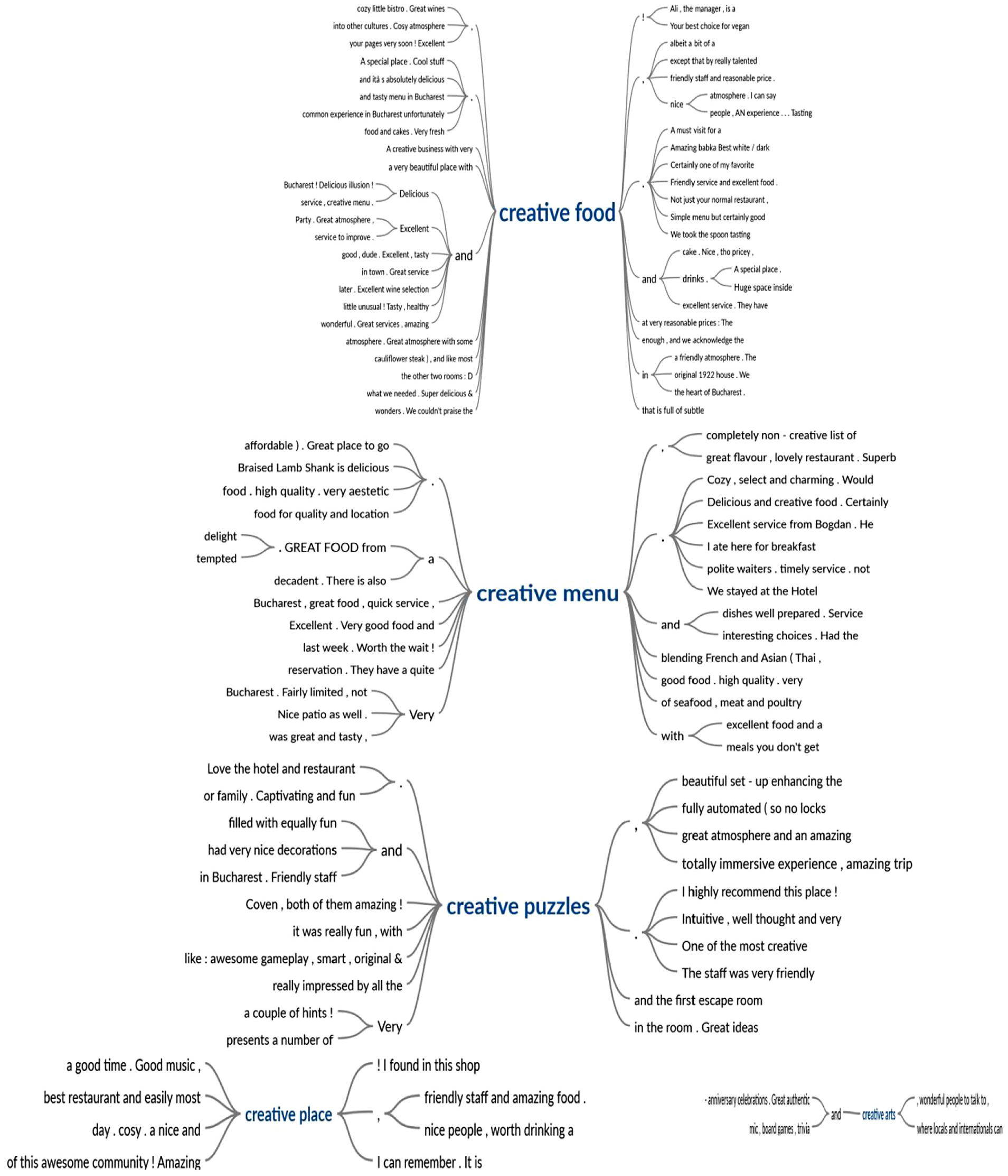
Text search query.
Analysis of the Sentiments’ Distribution
One of the main purposes of the present research is to identify and understand the customers’ sentiments from the reviews. The first element of the Syuzhet vector has the value of 7.45 and it indicates the amount of the sentiment scores of all expressive words in the first response in the document. The median value in the summary statistics of the Syuzhet vector is 5.672 which is above zero and it indicates that the overall average sentiment across all the responses is positive (Table 2).
Syuzhet Vector Summary Function of the Sentiments’ Distribution.

The below plot pictures the polarity score distribution of the reviews. We used the plot function to visualize the polarity score distribution of the document collection. The reviews contain both positive and negative sentiments from the beginning to the end of the text, and positive sentiments still prevail. In all comments, the sentiment takes rather a positive turn with two high peaks (Figure 4).
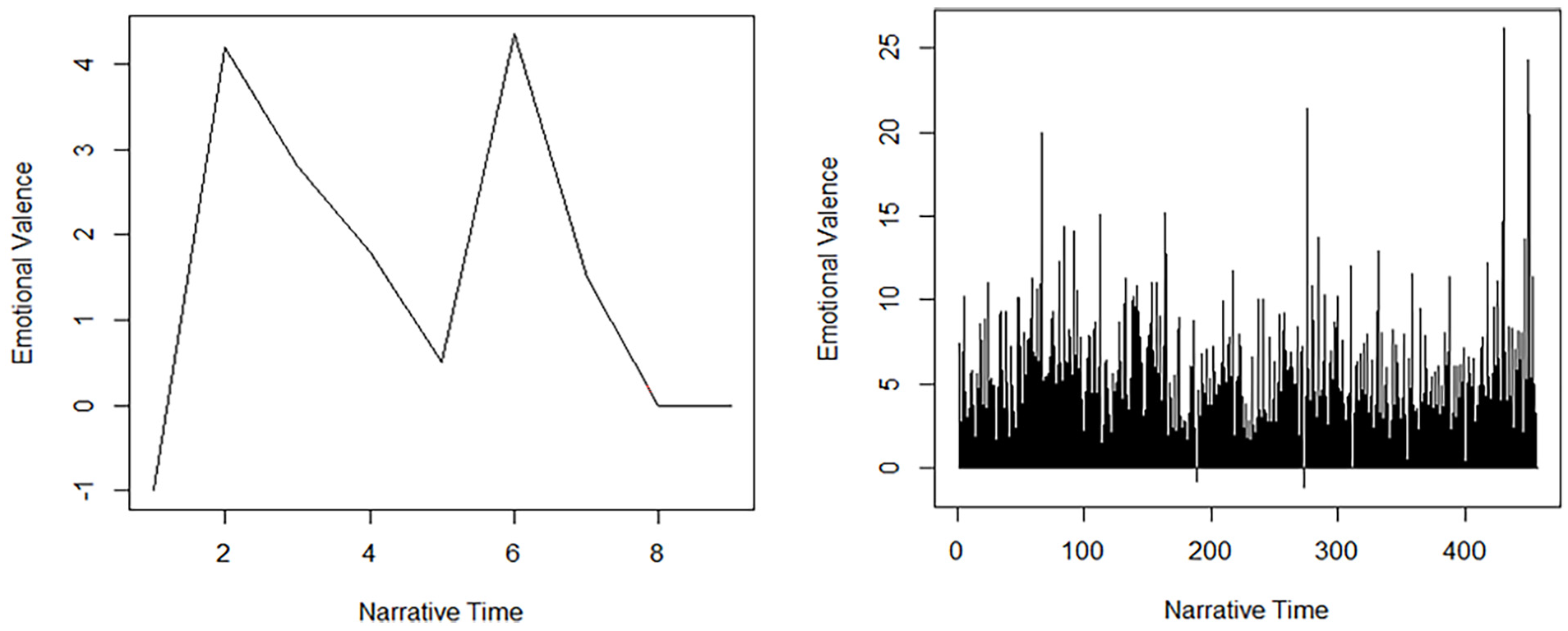
Plot trajectory of the sentiments.
The analysis of the sentiments underlines that they are positive and consumers perceive moderately positive and very positive the city of Bucharest. From all the sentiments, 85.5% are positive (56.1% moderate positive and 29.4% very positive). This underlines that the creative experience of Bucharest is positive. When consumers are not satisfied with the product, they tend to underline very negative feedback and, thus, 8.5% of the sentiments are registered in this repertoire (Figure 5).

Coding references count/autocode sentiment results.
The dominant sentiments in “creative” item are very positive and positive with more than 2% of all sentiments expressed in the reviews. For items “experience” and “Bucharest,” the sentiments which prevail are very positive and positive with approximately 1%. Regarding the “place,” “food,” and “service” items, the sentiments that occur most often are moderately positive and positive with a frequency below 1%.
Creative offers generate positive and very positive sentiments among travelers which enriches their experience in the city. Thus, their travel experience is also very positive and positive in Bucharest, considering the reviews which are comprised of appreciations regarding creativity. Including creativity in the tourism offer boosts travel involvement in various activities. Bucharest is also perceived with very positive and positive sentiments proving that travelers enjoy their contact with various attractions and sites within the city. These results are in line with the findings of Huang et al. (2019) that underlined that creative tourism develops a favorable attitude among tourists and their willingness to recommend it to others. Tourists measure the creativity of the environments by their facilities, accessibility, catering, and overall satisfaction (Chan et al., 2022).
Even if restaurants’ offer is creative and the food and services are associated with positive sentiments and moderately positive, some problems are encountered, such as “all fluff with no real creativity” of the offer or with the employees’ services, “the service was so very slow,” “waiters not service oriented, at times downright unfriendly,” and “their staff is totally unprepared to deal with customers.” Other tourists considered that those creative places are “a trap for the pretentious, tasteless, wealthy people” or “sometimes it is excellent, sometimes just weird, sometimes actually bad” (Figure 6).

Sentiments coding by item.
The previous query of the most frequent words in the text exposed the following: “creative,” “Bucharest,” “experience,” “food,” “menu,” “place,” “restaurant,” and “service.” These specific words were correlated with the sentiments (positive, moderately positive, very positive, negative, moderately negative, and very negative). For all coded words, the sentiments that consumers associate with are positive, followed especially by moderately positive ones. The Matrix Coding Query revealed that, in the previously mentioned context, the “creative,” positive sentiments (45.86%) registered the highest percentage, followed by very positive sentiments (28.1%) and moderately positive sentiments (17.76%). Thus, the creative offer provided by Bucharest tourism settlements generated positivity and satisfaction among consumers. Also, for “experience,” the positive and very positive sentiments prevail with 46.08 and 24.51%, respectively. The highest percentage of negative sentiments, in total expressed sentiments, was encountered for “restaurant,” with the following percentages: 7.33% for negative ones, 4.67% for those very negative, and 2.67% for moderately negative. Even if consumers perceive the creativity of the tourism product, some other aspects of the offer are inducing negative sentiments and thus reduce consumers’ satisfaction (Table 3).
Matrix Coding Query, by Raw (%).

From the previous cited frequently used words in the reviews, “creative” involved the highest percentage of positive (27.31%), very positive (33.75%), and moderately positive sentiments (20.85%), followed by “food” and “place.” The word “creative” was encountered also associated with the highest percentage of negative (21.82%), moderately negative (28.85%), and very negative sentiments (15.52%), followed also by “place” and “food.”
Based on the above discussion, the authors conclude that the second hypothesis (H2: Bucharest is perceived as a creative destination, triggering positive sentiments) was validated (Table 4).
Matrix Coding Query by Column.

The visual representation of the emotions in the reviews plotted in the figure bellow indicated the number of instances of words associated with “joy,” “trust,” “anticipation,” “surprise,” “sadness,” “fear,” “anger,” and “disgust.” As emphasized in the bar plot, positive emotions are the first frequently identified in the survey text. The emotion “joy” registers the highest frequency in the text, more than 25% of all meaningful words, and it is associated with positive emotions. The second most frequent emotion is “trust,” also a positive emotion, associated as well with more than 25% of all meaningful words. The short bar is for “disgust” which represents less than 2.5% of all meaningful words and it is linked with negative emotions. Overall, words associated with positive emotions such as “joy,” “trust,” “anticipation,” and “surprise” represent more than 85% of all meaningful words in the reviews (Figure 7).
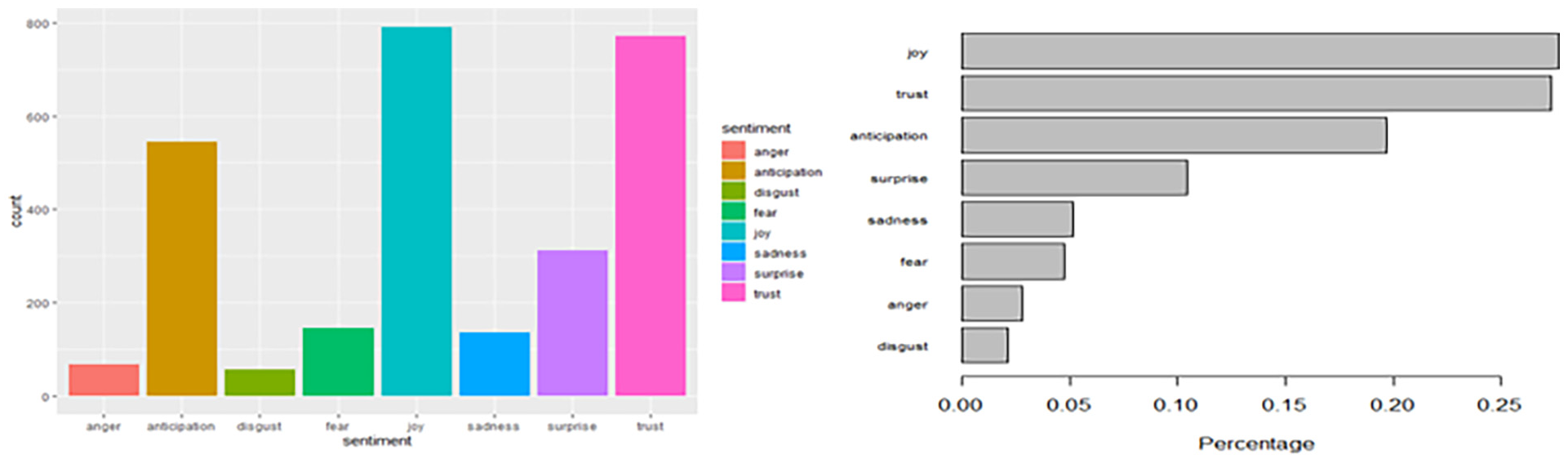
Bar plot of the count of words associated with each sentiment (absolute numbers vs. percentage).
Emotion scores are useful because they allocate numeric values to each of the eight emotions in the text and allow us to understand that consumers feel joy when they experience Bucharest’s tourism products and also surprise mostly associated with the creative display of the provided services. Moreover, travelers trust the destination and its providers. These sentiment reviews’ evaluation is extremely important for the tourism providers and policymakers in order to get a real insight into the satisfaction level of the customers and identify real problems of the destination. These reviews underline travelers’ experience and impact the emotions, feelings, and desires of others (Choe et al., 2017). Consequently, TripAdvisor, like other social media platforms, provides travelers with the opportunity not just to share information, but also emotions and experiential moments (Munar & Jacobsen, 2013).
Discussions
The author formulated two hypotheses for the research, namely:
Hypothesis 1: The creative dimension of Bucharest’s tourism offer is experiential and involves sightseeing and memorability.
Hypothesis 2: Bucharest is perceived as a creative destination, triggering positive sentiments.
The first hypothesis was partially validated. Travelers are finding Bucharest as an experiential destination as “experience” is frequently mentioned in their reviews. Sightseeing is mainly related to heritage, which was not perceived as creative. The travelers’ reviews revealed that consumers speak often about the creative offer related, especially about the products provided by restaurants and escape rooms. The heritage interpretation displayed in the museums, art galleries, and architecture is not so often associated with creativity. The providers are not coming with a creative interpretation of the destinations’ cultural heritage. This is why creative entrepreneurs, such as artisans, managers, or marketers, need to support the development of innovative places (Zhou et al., 2020).
Creative tourism provides an active perspective to travelers (Pawlusiński & Kubal, 2018). They become much more involved in the tourism act and their sentiments and emotions are more prominent during their stay. Word frequency and word cloud plots identified plain occurring themes in the text, such as “experience,” “place,” “food,” “menu,” “restaurant,” and “service.” Consequently, travelers are living a creative experience in Bucharest and most frequently creative products are encountered in restaurants, as the food and the menu are considered great, delicious, and very aesthetic. The second creative places within Bucharest are those provided by escape rooms that deliver “creative puzzles.” These word associations developed through correlation supported context understanding around the most important themes that are “creative food,” “creative menu,” “creative puzzle,” “creative place,” and “creative arts.” Therefore, after living these creative experiences, travelers are willing to share with others their sentiments, emotions, and feelings as they are not passive anymore. Thus, travelers make reviews, add comments, and post online content and actively participate in the creation and distribution of travel-related stories (Choe et al., 2017).
The findings suggest that travelers also search for new experiences and fancy activities. They want a change and something real during their holidays. Even if the creative tourism offer is limited in terms of the variety of spaces, they still appreciate it as “amazing,” “excellent,” “extraordinary,” or “great.”
Even if creativity has a subjective dimension for travelers, they identified creative tourism offers in a limited number of locations, mostly related to food and beverage. Bucharest’s creative tourism offer is more comprehensive than restaurants and bars. Creative entrepreneurs need to present their offers via the TripAdvisor platform. They also need to address a valuable niche market of creative foreign tourists. They are searching for innovative, different, and attractive offers. Travelers are looking for interactions and experiences, and those types of places are bars, discussion spaces, or art hubs, which can be promoted among foreigners.
For Bucharest, creative industries generate added value and represent one important development vector for the city. Thus, the need to boost creativity in tourism businesses represents a significant policy dimension. Furthermore, these fields need support for future sustainable development, especially the start-up tourism businesses, providing them with tools, knowledge, and best practices.
This study also underlines the need for qualitative insights into Bucharest’s tourism offer, which emphasize quite interesting correlations between “creative”/“creativity” and “places,” “food,” “dishes,” “artifacts,” and “activities.”
The second hypothesis was validated. The findings revealed that Bucharest is perceived as a creative tourist destination, which trigger positive, very positive, and mostly positive sentiments (92%). The experience of tourists was positive and very positive (71%). Likewise, the sentiments for Bucharest were positive, very positive, and mostly positive (88%). Travelers trust Bucharest as a tourist destination as it brings them “joy” and “surprise.” Nevertheless, the entrepreneurs cannot neglect the negative sentiments of the travelers as they provide valuable insights on what should be improved in the future and about the limitations of their offer.
Conclusions and Policy Implications
Tourist cities are dynamic destinations, and the task of consumers’ perceptions assessment is a difficult one. Nevertheless, big data sentiment analysis represents a useful approach for investigating tourist attitudes and opinions from subjective texts (Zhang et al., 2022). This paper underlines that creative tourism offers spur positive sentiments among travelers. That is why the entire destination might benefit from the creative display of the resident suppliers. Thus, travelers begin to trust tourism destinations as they feel joy during their tourism consumption.
Creativity and creative tourism products increase satisfaction, loyalty, and tourists’ positive feedback. Still, the loyalty for a creative tourism attraction is determined by the overall tourist experience (C. Lu et al., 2021). Thus, it becomes extremely important to evaluate the consumers’ sentiments in regard to creative products and to acquire more knowledge about perceived destination image. Thus, researchers developed sentiment analysis which reveals the feelings, emotions, and feedback of people. Also, through sentiment analysis, data researchers identify the relationship between travelers and tourism providers (Jiang et al., 2021).
Our investigation suggested that travelers’ sentiments, correlated to the Bucharest experience and its creative products and services, are positive or very positive. City tourism displays joy and trust among travelers which indicates a high level of satisfaction. The negative sentiments regard especially the staff within the restaurants as their services are slow or unfriendly or “not quite as helpful or courteous.” Even if the entrepreneurs develop creative products which represent a delight for consumers, they also need to take into consideration the display and the overall delivered service. For a low number of customers, the menu is not very creative, while they also complain about “lacking atmosphere inside,” “a pretty common experience,” or “way overrated and overpriced.”
Therefore, sentiment analysis remains an important tool to process and classify the opinions of customers and the quality of the provided services (Gharzouli et al., 2022). More and more sentiment analysis will need to be advanced in the tourism and travel field to capture the attitudes and experiences of visitors in tourism destinations. Smart technologies concentrate on delivering enhanced personalized and unique customer experiences and, consequently, new tools need to be embarked to capture them (Mehraliyev et al., 2020).
Managerial Implications
Policymakers and planners support the development of creative tourism in cities as it provides both economic and social benefits and it contributes to sustainable and soft development opportunities (Greenwood & Dwyer, 2017). This paper also provides some managerial implications for managers and policymakers in regards to supporting creative initiatives in tourism, starting from the analysis of tourists’ sentiments and emotions when facing creative experiences.
In order to increase tourists’ attachment and memories for a tourism destination, managers should develop creative experiences, focusing on “uniqueness, interactivity, escape, peace of mind and learning” (Y. Li & Liu, 2020). The diversity of tourism resources and attractions is also necessary as it has the potential to attract talents that enhance creativity and regional development (Cruz, 2014).
Creative tourism involves the production and implementation of inspired ideas and capitalization of tourism destinations’ cultural heritage (Wattanacharoensil & Sakdiyakorn, 2016). The current research revealed that Bucharest’s heritage is less associated with creativity. Travelers’ reviews don’t mention too often that museums, galleries, and other cultural attractions provide creative products or services. Activities such as dancing, crafts, painting, and culinary ones sustain creative tourism (Blapp & Mitas, 2018) and, consequently, entrepreneurs and policymakers could create such events in Bucharest to capitalize on the specific tourism offer. Interpretation, storytelling, and participative co-creation boosts attractiveness among tourists as they will perceive the city as being creative (Ross & Saxena, 2019). The involvement of artists in the city development is beneficial as the artists love their work and are aware of their contribution to generating creative places (Valek, 2020).
The creative dimension of culture and art needs to be more capitalized. The intensive capital investments need to rehabilitate and conserve cultural heritage. The historical buildings need not just rehabilitation and consolidation but also a new vibe to re-enter in the cycle of creative business approach and to reconvert the spaces for the needs of travelers and the general public.
Moreover, creative strategies need to be adapted to the realities of each tourism destination taking into consideration the local context, resources, and space meaning when defining the vision, creating the design and implementing the programs (Richards, 2020). Tourism development is also maintained by creative entrepreneurs which consider themselves place-makers as they support the expansion of attractive destinations for both tourists and residents (Nieuwland & Lavanga, 2021). Similarly, creative and skilled employees are needed as they represent a real capital investment (Greenwood & Dwyer, 2017). The collaboration between various stakeholders from different sectors is necessary because they have access to several resources needed in the process (Dias-Sardinha et al., 2018). The managers must provide quality and should pay attention to the motivational factors, to promote and create a friendly and nice environment with supportive employees that are continuously innovating (C. Lu et al., 2021).
It is also important to underline that creativity might boost travelers’ loyalty which is extremely important for the long-term development of the destinations. In order to increase tourist loyalty in creative destinations, it is imperative to support the quality of the places. The creative experience within a specific tourist attraction should concentrate on boosting firstly, loyalty and secondly, motivation (Suhartanto et al., 2020). Nowadays, a new vibe and energy are emerging from the younger generation (Generation Z), which is looking more often for creative hubs and new experiences.
For policymakers and tourism suppliers it becomes difficult to create and implement meaningful strategies for a sustainable creative tourism (Jiang et al., 2021). Sentiment analysis becomes a longitudinal assessment tool of destination image using big data and secondary inputs from online travel websites (Jiang et al., 2021). The information regarding travelers’ satisfaction, extracted through sentiment analysis, could be further used to create strategies for tourism products and services development.
Limitations
The research presents some limitations. The conducted sentiment analysis specific to this research is limited only to Bucharest since this was entire focal point of the paper and it can be extended to other (main) cities from Romania and even to a regional level or an international one. Since the study only took into consideration the data collected from the TripAdvisor platform, it could prove as being beneficial for the research incorporating other social media platforms or other UGC websites in order to conduct an extended sentiment analysis, also enabling some comparisons between various platforms/websites. Taking into account only one platform may be considered as being prone to bias. However, several platforms limit the collection of data or only display limited data related to the users.
Serving both as a possible limitation and as a future research direction, an additional tool for the sentiment analysis can be inserted to test out differences and, thus, trying to improve the results’ accuracy. One such example may be the use of various emotion lexicons. The NVivo autocoding sentiment tool also presents some limitations with challenges such as identifying travelers sarcasm, double negatives, slang, dialect variations, idioms, or ambiguity within comments (QSR International, 2021). Considering this, the authors took some steps in order to improve the accuracy of the research as displayed in the data processing section of the current research.
Future Research
An extended research can be carried out by performing comparisons between cities, regions, or countries to highlight regional differences and other correlations can be made by taking into consideration for example, the income level of the targeted area. A more detailed analysis and comparison aimed at specific tourism attractions can also be carried out and a ranking of tourism attractions based on travelers sentiments can be determined. Also, a customer profile analysis can also be conducted to see whether the level of satisfaction is connected to his previous related experience (i.e. number of similar attractions visited). Another continuation of the current research may be based on finding out differences between the travelers sentiments before, during, and after the COVID-19 pandemic.
Even if the present research concentrate on the creative tourism offer of Bucharest city, a future investigation could tackle a comparison of the creative dimensions of the tourism offer of other big capitals, such as Sofia and Budapest, in order to capitalize on their best practices and policies, and to learn from their implemented plans and strategies. Moreover, an interesting insight is to find creative tourism offers in other Romanian destinations, such as Transylvania, Bucovina, or Maramures, where the creativity of local entrepreneurs fosters the possibility for enhanced creative tourist packages.
Footnotes
Declaration of Conflicting Interests
The author(s) declared no potential conflicts of interest with respect to the research, authorship, and/or publication of this article.
Funding
The author(s) received no financial support for the research, authorship, and/or publication of this article.
