




Abstract
Against the background of tourism recovery following the COVID-19 pandemic, this study explores how destination personality shapes tourists’ emotions and their behavioral intentions at heritage sites. A framework is constructed to evaluate these three variables based on the Cognitive-Affective-Conative (CAC) theory. The methodology combines user-generated content (UGC), sentiment analysis, geographic information systems (GIS), and structural equation modeling (SEM). Online reviews serve as the data source for assessing both perceived destination personality and tourists’ emotional experiences. The statistical findings demonstrate that the personality of a place significantly impacts the emotions experienced by tourists. Among personality dimensions, prominence and responsibility most strongly affect tourists’ behavioral intentions. The research provides valuable insights for tourism managers and policymakers with guidance for fostering sustainable and responsible tourism development.
Plain Language Summary
In the context of tourism recovery, the character of a place is an important factor in attracting tourists. However, previous research has ignored its relationship with visitors’ emotions and intentions. This research uses online reviews with place analysis and statistics to reveal how the destination influences visitors’ emotions and intentions. The data were collected from Google reviews to measure the places and the emotional experiences. The findings show that the character of a place has an impact on the emotions experienced by tourists. “Well-known” and “well-cared” are the important characters. Thus, heritage managers can use this low-cost method to see how to keep the sites popular.
Keywords
Introduction
The tourism industry has experienced substantial changes since the COVID-19 pandemic. Digital transformations have been accelerated, such as contactless payment and virtual traveling. Global competition is intensifying, driven by increasingly diverse traveler preferences, including nature-based, low-carbon, and responsible tourism (Adongo et al., 2024). In response, creating a good tourist destination image (TDI) in marketing, namely the impressions that a person has of a place (Gunn, 1972), has become essential for post-pandemic recovery, particularly in Southeast Asian economies that rely heavily on tourism. Based on the concept of TDI, different cities and destinations have built their own characteristics, which are referred to as their “personalities” that differentiate them from competitors. For example, Paris is associated with a strong brand related to romance or luxury (Dupain & Novitskaya, 2015); tranquility has emerged as a key personality trait attracting visitors elsewhere (Quintal et al., 2024). However, there are some problematic phenomena that have been observed: many destinations now project increasingly similar images. Misleading or similar promotional content may weaken consumers’ trust and attitudes toward these destinations (X. Li et al., 2020).
Many countries and cities are striving to create distinct brands in an increasingly competitive market. Their goals include not only differentiating the brand positioning of tourism cities but also deepening the emotional connections between people and touristic places. Destination management organizations (DMOs) need to understand tourists’ specific preferences, identify which personalities are most recognizable, determine how these traits shape perceptions, and evaluate their behavioral consequences. Researching these connections and identifying key factors that influence tourists’ behaviors can help enhance the perceived value of the destinations, encourage repeat visits, and stimulate positive word-of-mouth (WoM; Nella, 2022).
Especially nowadays, UGC from popular social media platforms, widely used for sharing experiences and promotional information, has been emphasized as a significant lens through which to explore the perceptions and feelings of tourists (Ha et al., 2023; Kar, 2021). With the evolution of the internet and communication methods since the 21st century, many organizations have begun using social media as a branding tool (Assaker, 2020; Ha et al., 2023). For example, the Tourism Authority of Thailand has launched dedicated Instagram accounts for this purpose. Such content can be interpreted as business intelligence for improving marketing decisions and maintaining competitiveness, particularly when promoted by official organizations or local agencies. UGCs contain various formats, such as ratings, complaints, and blogs (Lee et al., 2020; C. Liu et al., 2019). Researchers have tried to utilize them to develop predictive models, inform policy, and address destination-level challenges (Y. Zhang et al., 2024). Specifically, reviews (like Google Maps) capture consumers’ choices, trust, satisfaction, and attitudes, and have become a focal point of recent research (Mathur et al., 2022; Zervas et al., 2021). By analyzing this published content (Dabbous & Barakat, 2020; Du et al., 2022), site branding and experience enhancement can be achieved. Previous literature has also highlighted the potential use of reviews to examine tourists’ emotions, destination image, and behavioral intentions (Su et al., 2022; L. T. T. Tran, 2020; Yu & Zhang, 2020). And UGC emotions also play a crucial role in shaping tourists’ experiences and significantly influence users’ cognitive evaluations, behavioral responses, and decision-making (Hosany et al., 2020). Statista (2014) reported that tourists experience a range of emotions (excitement, control, knowledge, etc.) during their visits. Some real-time emotion sensors are invented to serve health/service sectors (Saadon et al., 2023; K. J. Wang et al., 2023). However, previous research has often overlooked the relationship among destination personality, tourist emotions, and behavioral intentions, particularly from a spatial perspective (Ekinci & Hosany, 2006; Gnoth et al., 2007; Hosany et al., 2007; Usakli & Baloglu, 2011).
Thus, this study tries to explore the correlations among destination personality, emotion, and behavioral intentions. It aims to address the following questions: (1) What are the relationships between destination personality, tourists’ emotions, and intentions? (2) How can these constructs be quantified and mapped using spatial methods? In an innovative approach, it employs several open-source tools for the quantification: sentiment analysis and machine learning by Orange, spatial interpretation via QGIS, and statistical methods by Statistical Product and Service Software Automatically—SPSSAU. It seeks to recognize specific feelings expressed and perceived personality of various places using lexicon-based data, and to predict emotional and personality patterns in areas surrounding key tourist sites. The significance of this research is multifaceted: a well-defined destination personality converts unique local attributes into competitive assets, which strengthen brand preference and increase revisit and repurchase intentions (X. Li et al., 2020). The findings also provide insights for promoting sustainable development in heritage cities and comparable tourism destinations.
Literature Review
Theoretical Foundation
“Brand personality” refers to a series of personified characteristics attached to a product or brand. Aaker (1997) defined the Brand Personality Scale (BPS), which includes five dimensions: sincerity, competence, sophistication, excitement, and ruggedness. Building on this framework, scholars have extended the concept to destination personality (Gunn, 1972; Hunt, 1975; Telisman-Kosuta, 1989): human personality traits associated with tourist places. Subsequent studies have applied the BPS to assess the personality traits of destinations and confirmed several key factors: excitement, sincerity, and conviviality (Hosany et al., 2007). Pan et al. (2017) pointed out that the original BPS neglected intangible place-specific qualities. In response, researchers have adapted or shortened the scale to fit various cultural and contextual settings (e.g., Davari & Jang, 2024; Jovanović et al., 2017; Kovacic et al., 2020; Kumar & Nayak, 2018; Papadimitriou et al., 2015; C. Zhang et al., 2019). Recently, a five-dimension scale was developed for World Heritage Sites (WHS): responsibility, exceptionality, prominence, identification, and attractiveness. It offers flexibility through the use of pre-trained language models and structured dictionaries (Hassan et al., 2024).
From a theoretical perspective, the Cognitive-Affective-Conative (CAC) theory is a psychological model that posits individuals’ intentions are shaped by cognitive beliefs and affective responses. In tourism, this theory has been widely used to provide insights into the complex interaction among affection, behavior, and cognition in shaping tourists’ experiences and behaviors. Recently, Tang et al. (2022) integrated the CAC theory with the Motivation-Opportunity-Ability model to explore the mechanism of environmental behaviors, confirming significant influences of motivation, knowledge, and opportunity. Yang et al. (2022) merged individualism and uncertainty avoidance into the CAC model and suggested that tourists’ affection mediated the relationship between conative and cognitive destination image. The application and development of this theory in tourism research are still under discussion, and more empirical studies are needed for further validation. Emerging studies increasingly integrate advanced tools: machine learning and computer graphics, to test the model (Alzboun et al., 2023).
Among alternative theories, Stimulus-Organism-Response is a micro-level theory in which environmental factors trigger internal states that produce approach or avoidance results. It focuses on sensory-driven responses, but less applicable to destination branding. Place Attachment Theory centers on a long-term emotional bond formed through across repeated visits, powerfully predicting loyalty. But this attachment is difficult to extract from UGC for rapid marketing adaptation. The Theory of Planned Behavior evaluates attitude toward the act, subjective norms, and perceived behavioral control. But these constructs have limited use for sentiment-based spatial analytics. Consequently, CAC offers the pathway for linking spatially sentiment to destination personality and, ultimately, to the revisit intentions that drive sustainable heritage-tourism strategies. Therefore, the theoretical foundation of this study is mainly based on CAC theory to examine the relationships among destination personality, emotion, and conation.
Hypothesis Development
Visitors’ emotional experiences are increasingly recognized as an indispensable part of branding (X. Liu & Zheng, 2024; Soon et al., 2023). The characteristic of a place was proven to be useful to increase consumers’ loyalty (Ghorbanzadeh & Rahehagh, 2021; Sung & Kim, 2010; Thomson et al., 2005). Destinations evoke emotions through attributes such as novelty, meaningfulness, cultural richness, and opportunities for learning (Hosany & Gilbert, 2010; Kim et al., 2012; Şahin & Güzel, 2020). Several studies proved a positive relationship between tourists’ emotions and the perceived destination images (Hosany et al., 2007; Kastenholz et al., 2020; San Martín & Rodríguez del Bosque, 2008). Tourists’ emotional experiences and destination personality also influenced each other. For example, Kovacic et al. (2020) found that the affective image of a destination is closely associated with its personality, particularly the traits of sincerity and excitement. Thus, to further confirm the relationship with the dimensions of responsibility, identification, exceptionality, prominence, and attractiveness (Hassan et al., 2024), this research hypothesizes:
The positive influences of destination personality on tourists’ intentions have been widely documented (H. Chen et al., 2024; Soltani et al., 2021; J. Wang et al., 2022; Yang et al., 2020). Suryaningsih et al. (2020) used Moderated Structural Equation Modeling (MSEM) to test the relationship between personality of destinations, self-image congruity, and behavioral intention. It showed that satisfaction and certain personality features can positively predict behavioral intentions in Serbia. Kovačić et al. (2022) examined the interplay between tourists’ individual traits, destination personality, and activity preferences, concluding that sincerity and ruggedness significantly shape tourists’ choices through their activity patterns. Based on a literature review, this research will test how personalities influence tourists’ intentions and proposes the following hypothesis:
Tourists’ intentions represent favorable or unfavorable willingness, including satisfaction, repurchase, loyalty, complaints, etc. Emotions can lead to specific responses in tourism. Different emotions may affect the decision-making process during the planning stage and leisure activities (Agyeiwaah et al., 2021). While on site, tourists can shift from frustration to delight depending on the situation (Göker & Çelik, 2022; Johnson et al., 2023). And these moment-to-moment feelings shape how memorable the experience is and whether intentions to revisit or recommend are formed (Hosany & Prayag, 2013; Mcintosh & Siggs, 2005). After the tour, positive emotions heighten tourists’ propensity to recommend the destination, return, or remain loyal (Bigné et al., 2005; Huang et al., 2012; H. Li et al., 2022). Conversely, negative emotions can breed risk perceptions; their frequency, timing, and intensity can deter future behavior (Torres-Naranjo et al., 2021). For example, Volo (2021) stated that fear can significantly influence tourists’ decision-making, leading to avoidance of certain destinations that are perceived as risky, while surprise can be double-edged: positive surprise enhances satisfaction, but negative surprise can reduce revisit intention (Neidhardt et al., 2015). Based on these findings, the hypothesis is proposed as two parts:
Tourists’ emotions may mediate the traveling process. Yao (2013) demonstrated that tourists’ emotional involvement mediates the effect of motivation on satisfaction, indicating that the affective dimension of a destination operates as a mediator. Similar mediation pathways between cognition and behavior have been confirmed in health and psychological research (Kiviniemi et al., 2018). Within the tourism context, the emotional mechanisms linking destination personality to intention remain under-explored. Thus, following the CAC framework, this study further proposed the hypothesis (Figure 1):

Variables in the framework.
Methodology
Sentiment analysis has been increasingly applied in the tourism sector, drawing on data from social media, blogs, and news outlets. It supports destination management by informing market segmentation, brand positioning, and growth strategies. Nevertheless, extant approaches have been criticized for questionable discriminant validity, omitted dimensions, inconsistent operationalization, and debatable covariates. And the application of machine learning and sentiment analysis in review collection presents several advantages over traditional methods, like questionnaires or interviews, which seldom capture the subtleties of natural language due to the complexity of language. Machine learning models trained for sentiment can understand context and misapplied words, providing a better understanding of customer sentiment. They can lower cost, accelerate data collection, and allow managers to react rapidly to customer feedback (Agarwal et al., 2016; Mitra & Mohanty, 2020). As large-scale UGCs have been considered a significant element in conceptualizing smart tourism, they have immense potential for increasing opportunities by combining with text-mining algorithms to produce accurate and flexible predictions of tourist behavior (N. Liu & Shen, 2020).
Based on the literature review, the research utilized a comprehensive approach involving machine learning, natural language processing, and structured dictionaries and rules to examine online reviews with George Town in Malaysia as a case study area. To quantify the three variables, the research methodology mainly followed previous research (Demšar et al., 2013; Hassan et al., 2024; Mehra, 2023). The main process is: data collection and cleaning, sentimental analysis, destination personality analysis by dictionary, tourists’ intention mapping by inverse distance weighted (IDW) method, and covariance-based structural equation modeling (CB-SEM; Figure 2). Statistically, SEM is widely used for testing measurement and hypotheses, specifying and estimating relationships, and analyzing complicated effects (Darda & Bhuiyan, 2022). Especially, CB-SEM can be used to test the fit of a theoretical model, whether the relationships among variables align with the model. The constructs in this research are reflective, namely, a latent factor structure with reflective indicators (Freeze & Raschke, 2007). The CB-SEM was selected for the confirmatory purpose of the model and to test the correlations among indicators (Hair et al., 2017).

Workflow.
Study Area
George Town is a famous destination in West Malaysia, renowned for its well-preserved colonial and multicultural architectural heritage. The city has been experiencing a boom in tourism since 2008 (UNESCO, 2008), which generates both benefits and burdens (Pei & Nor Azila, 2020). For example, tourism has brought some economic benefits to George Town by creating job opportunities and improving infrastructure and amenities for tourists. But several challenges have also been presented, such as overcrowding, transportation and living pressure, damages to heritages, etc. (Ghaderi et al., 2012). The influx of outsiders has intensified debates over cultural authenticity, resident displacement, and the commodification of historic properties. Municipal authorities now prioritize responsible tourism, heritage-sensitive conservation, and participatory planning that engages local communities (Mohaidin et al., 2017). Because of these competing pressures and highly salient heritage landscape, George Town offers an ideal setting in which to examine how tourists’ emotional experiences and place personality construct a heritage destination (Figure 3).

Location of George Town and selected samples.
Data Collection and Cleaning
Google reviews served as the primary data source for this research. Previous studies have proved the value of analyzing them in marketing and tourism (Guo et al., 2021). The data collection process focused on several popular destinations in George Town. In total, 23 main sites were chosen according to purposive sampling (site popularity). The collection period was between January 2023 and May 2023, during which 14,919 reviews were collected using a Python-based scraper (https://github.com/georgekhananaev/google-reviews-scraper-pro). Data cleaning was performed using Orange, an open-source machine learning software. After preprocessing steps, including conversion, removal, tokenization, filtering, stemming, and lemmatization, 12,513 valid records remained, accounting for 83.8% of the original dataset.
Computing Sentiments
This research computed both the polarity and various emotions to obtain the intention of tourists. Review polarity was categorized as “Neutral, Negative, and Positive” according to Hu and Liu’s (2004) sentiment lexicon. Polarity score were calculated as the difference between the total counts of positive and negative words, normalized by review length. Each review was then assigned a polarity label: positive (P), negative (G), or neutral (N). Following Mehra (2023), emotional polarity (S1) was determined as follows:

The emotion scores were then classified into six categories based on Ekman’s emotion wheel: anger, fear, joy, sadness, surprise, and disgust (Janocha et al., 2018). Quantification was performed with a Support Vector Machine (SVM) implemented in Orange’s Tweet Profiler widget. Orange is an open-source, Python-based platform for machine learning and interactive data visualization (Demšar et al., 2004; Dobesova, 2024). SVM offers the flexibility to extract precise features from any domain-specific corpus (Colneric & Demsar, 2020). Compared with bag-of-words or latent semantic indexing approaches, the trained Tweet Profiler has superior accuracy. For each selected site, average emotion scores were computed. Finally, a tourist-intention score was derived by summing emotional polarity (S1) and the surprise value; higher scores indicate a stronger propensity to revisit (Mehra, 2023).
Destination Personality
To quantify personality (PE), the research adopted the dictionaries compiled by Hassan et al. (2024). Each personality list contains seed words that capture the respective dimension: for example, “affected,”“protected,”“preserved,”“concerned,”“responsible,” and “controlled” signal responsibility, whereas “common,”“essential,”“valuable,” and “significant” indicate prominence. Lexicon matching was performed in Orange: the software counts the occurrences of dictionary words (n) and normalizes by review length (L; equation 2):

The resulting value reflects the intensity of each personality trait conveyed in tourists’ reviews. Site-level scores were obtained by averaging the five personality dimensions. With emotion, personality, and intention scores computed, their inter-relationships could then be examined. Normality was verified through skewness and kurtosis in Excel, both of which fell between −1 and +1, indicating an approximately normal distribution suitable for subsequent analysis (Hair, 2006).
Spatial Analysis
QGIS (Quantum GIS) was employed to visualize spatial patterns and trends in the computed emotion and personality scores. Unlike other commercial spatial software, QGIS is open-source and extensible through a large ecosystem of plugins (Moyroud & Portet, 2018; Rosas-Chavoya et al., 2022). Site-level averages were interpolated into a continuous raster surface, allowing the emotional and personality landscapes to be mapped across the study area. Inverse Distance Weighting (IDW) was selected for the interpolation: unknown values are predicted as a weighted average of the nearest sampled points, with weights decreasing as distance increases (Masoudi, 2021):


In equation 3, w i means the i-th weight of the point, d i means the distance from the unknown points to the known points, and p means the controllable parameter. In equation 4, z (x, y) means the location of the unknown point; N means the number of known points; the coordinate of the i-th point is (xi, y); and z means the values obtained by inverse function.
Structural Equation Modeling
Before running CB-SEM, a confirmatory factor analysis (CFA) was conducted to verify the measurement model. All analyses were performed with SPSSAU. For discriminant validity, standardized factor loadings had to exceed 0.6, AVE ≥ 0.4, and CR ≥ 0.6 (Lam, 2012; Truong & McColl, 2011). Model fit was evaluated with GFI, RMSEA, RMR, CFI, and other indices. The structural model supplied path coefficients, significance tests, and overall fit statistics. Acceptable fit required SRMR < 0.10 and other indices (NFI, CFI, NNFI) >0.90 (Hooper et al., 2008). Finally, emotion was examined as a mediator of the personality - intention link. Following Preacher and Hayes (2008), the direct (c′), indirect (ab), and total (c) effects were estimated; significance was inferred when paths a (X-M), b (M-Y), and c (X-Y) all yielded p < .05.
Results
Emotion and Personality Distribution
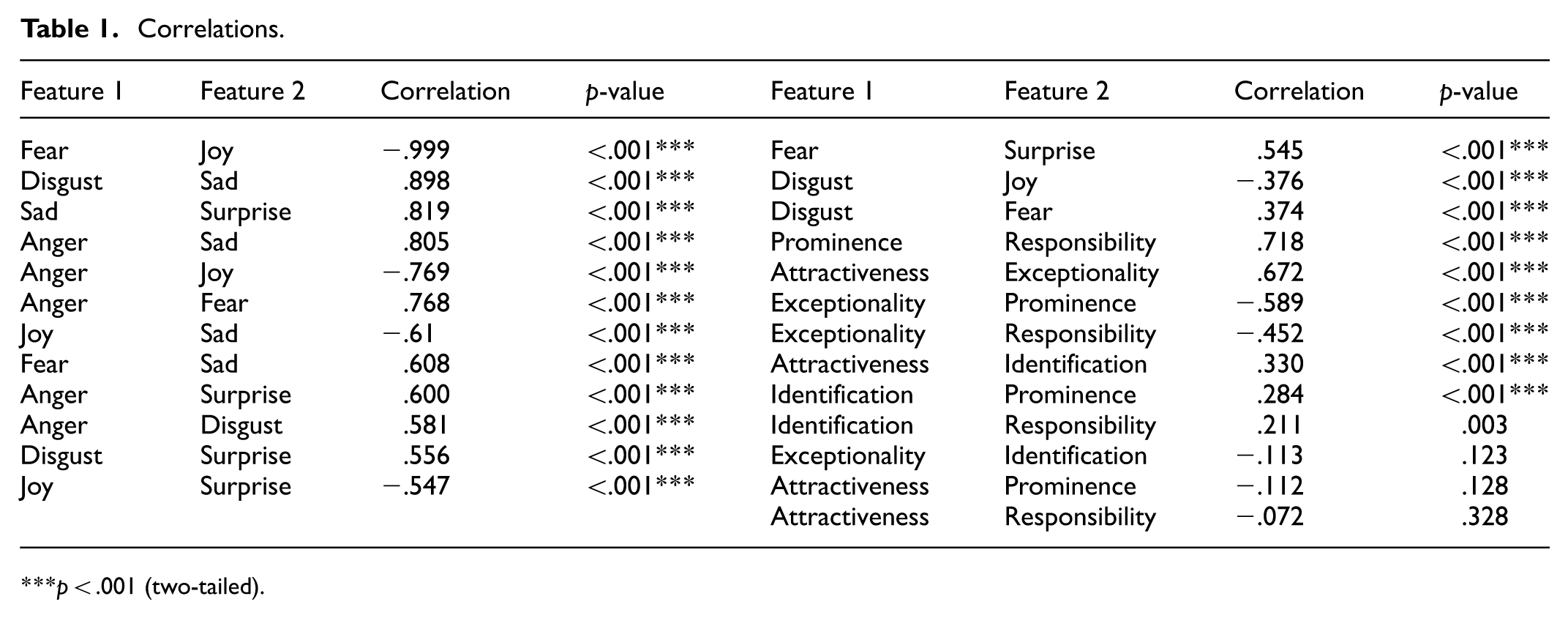
The IDW was utilized to draw raster data for the whole study area. In QGIS, the pixel size was set as 10 m. The interpolating is shown in Figure 4a and b (six emotions, five personalities, and tourist intention). It can be observed that the emotions of surprise, sadness, and fear were mainly concentrated in the center and east parts of George Town, showing an increasing trend from east to west. For the whole city, the average values of surprise, sadness, disgust, and anger were relatively low, indicating that negative emotions were not strongly expressed. Joy was the emotion with a high average value (0.995). It showed a dispersed pattern, with lower values concentrated in the center and higher values in the northern and southern parts. This showed that the central areas, such as the Han Jiang Ancestral Temple (traditional Chinese religious site), were the destinations perceived negatively by tourists. The correlation analysis (Table 1) showed that the negative emotions of surprise, sadness, fear, disgust, and anger were consistent with each other (p value < .001). However, the joy emotion was correlated negatively to the other emotions, which showed that the positive and negative emotions were totally opposite to each other.

(a) Spatial mapping for emotions. (b) Spatial mapping for the destination personalities.
Correlations.
p < .001 (two-tailed).
For the personality values, the ranking was: attractiveness > exceptionality > prominence > identification > responsibility, which meant that attractiveness (0.802) was the most distinctive feature. The spatial pattern identified was that identification and attractiveness showed an increasing trend from south to north; exceptionality, prominence, and responsibility showed a pattern changing from east to west. For the intention values, the distribution was not clear. A correlation was run to check the potential relationship among them. Table 1 showed that prominence and responsibility were strongly correlated (0.718); attractiveness and exceptionality were strongly correlated (0.672); exceptionality and prominence were negatively correlated with each other (−0.589); exceptionality and responsibility were also negatively correlated (−0.452); and between attractiveness - identification and identification - prominence, the correlations were moderate (0.330, 0.284).
SEM and Mediation Test
According to Table 2 (CFA results), several indicators within the personality and emotion variables contributed little to the model (factor loading < 0.6) and were therefore removed: identification, attractiveness, exceptionality, surprise, and disgust. After consultation with relevant experts and scholars, the emotions were reclassified into two groups: positive and negative. Following the deletion of these indicators, the revised model demonstrated good quality, with composite reliability (CR) exceeding 0.5 and average variance extracted (AVE) above 0.5. The Heterotrait–Monotrait ratio (HTMT) was below 0.9 (Afthanorhan et al., 2021), and additional fit indices met acceptable thresholds: GFI > 0.9, RMSEA < 0.10, RMR < 0.05, and CFI > 0.9. The refined variables satisfied discriminant validity requirements and were retained for path and mediation analysis.
CFA Results.

p < .05 (two-tailed). ***p < .001 (two-tailed).
Table 3 and Figure 5 confirm the relationships among the three variables; all indicators contribute significantly (p < .001). For the path personality - positive emotion (p = .221) and personality - negative emotion (p = .402),
SEM Results.

p < .05 (two-tailed). ***p < .001 (two-tailed).

Path test.
Then, Table 4 confirmed that negative emotion played a mediator role between personality and intention. Paths a (destination personality—negative emotion) and b (negative emotion—intention) were significant (p < .001), but path c’ (destination personality—intention) was not significant (p > .05). Bootstrapping, a procedure that resamples the data to simulate the sampling distribution, showed that the indirect path had a 95% CI of −0.285 to −0.043, which does not cross zero; thus, negative emotion fully mediates the relationship between destination personality and tourists’ intention. By contrast, the 95% CI for positive emotion ranged from −0.231 to 0.003, crossing zero. So, positive emotion did not mediate the process.
Mediation results.

Note. Estimator is ML.
Multiply. **p < .05 (two-tailed). ***p < .001 (two-tailed).
Discussions
Variable Relationships
Destination Personality and Emotion
Based on the SEM results, destination personality has a weak influence (−0.08 to 0.1) on tourists’ emotions at George Town sites. While the CAC theory shows a sequence from cognition (personality perception) to emotion, this research suggests a link may be more complex and indirect in a heritage tourism context. This weak effect partially aligns with C. F. Chen and Phou (2013), but contrasts with studies that found stronger direct relationships (e.g., Hosany et al., 2007). This discrepancy may be attributed to the nature of UGC: emotions in reviews are triggered by specific and momentary experiences (e.g., a long queue, a friendly guide) that may not be directly attributed to the overarching destination personality. Furthermore, in a culturally rich setting like George Town, emotions might be more strongly influenced by direct sensory experiences (e.g., street art) than by other abstract personality dimensions (V. A. Tran et al., 2025). Accordingly, it is suggested that tourism cities like George Town should focus more on diverse strategies to create an emotional connection with tourists. This can be achieved by promoting distinctive cultural and historical aspects, improving service quality, and creating memorable experiences. It is still important for tourism cities to understand the diverse needs and preferences of different tourist groups and to tailor their strategies accordingly. For instance, introverted people might prefer calmer destinations, while extroverted tourists might enjoy places offering exciting experiences (Neidhardt et al., 2015; Scuttari et al., 2016).
Personality and Intention
The confirmation that prominence and responsibility are the key personality dimensions influencing behavioral intentions reveals a critical duality for heritage destinations. The strong positive effect of responsibility underscores a paradigm shift in tourist values, aligning with the growing emphasis on sustainable and ethical consumption (Paskova & Zelenka, 2019). Tourists increasingly reward destinations that demonstrate “care” for their cultural and environmental assets. Conversely, the significant but comparatively less weight of prominence suggests its double-edged nature. While fame attracts visitors, it also carries the risk of over-tourism, which can weaken the experience and negatively impact intentions, as noted by I. Damnjanović (2021). The spatial analysis, showing negative correlations between exceptionality and prominence/responsibility, further hints at this tension: being exceptional might conflict with being widely prominent if not managed responsibly. Therefore, the challenge for heritage managers is not merely to promote prominence but to anchor it in responsibility. Strategies must evolve from generic promotion to managing visitor flows, ensuring authenticity, and transparently communicating conservation efforts, thus transforming potential negatives of fame into a sustainable competitive advantage.
Emotion and Intention
The analysis revealed a powerful impact of negative emotions on intention (β = −.784). This finding strongly supports the negativity theory in tourism, where negative experiences often have a more substantial impact on future behavior than positive ones (Neidhardt et al., 2015; Volo, 2021). The fact that negative emotions, like anger, fear, and sadness, formed a reliable construct in the model indicates that tourists’ dissatisfaction often stems from a combination of these feelings, likely triggered by service failures, overcrowding, or perceived disrespect to the heritage. The weaker direct effect of positive emotion (joy−0.05) suggests that in a heritage context, simply creating joy may not be sufficient to guarantee loyalty; it can be expected as a baseline. The critical task is the active prevention and mitigation of negative experiences. This goes beyond general service quality; it requires a proactive approach to identifying spatial and experiential negative points and addressing them directly. Cities such as George Town should minimize triggers of negative feelings by ensuring reliable, high-quality services, supplying accurate information to shape expectations, and promptly resolving any problems. Identifying context-specific emotional triggers can also guide destination marketing and management; for example, features that repeatedly evoke fear can be targeted for improvement (Schneider, 2010).
Emotion as the Mediator
The mediation analysis provides an insight of this study: negative emotion acts as a full mediator between destination personality and behavioral intention. These findings illuminate the emotional processes underlying tourism behavior. Whereas earlier studies stressed the direct role of destination attributes in shaping intentions (C. F. Chen & Phou, 2013), the present work highlights the influence of a destination’s personality (prominence and responsibility) on a tourist’s decision to return or recommend is almost entirely channeled through the emotional experiences. The non-significant direct path after accounting for the mediator underscores this. This result validates the affective component of the CAC theory in a spatial UGC context. It suggests that a destination’s personality traits are cognitive evaluations that must be felt to influence behavior. For example, a destination’s responsibility must translate into a feeling of safety, respect, or ethical satisfaction for it to positively affect intentions. Conversely, the prominence of a site can quickly lead to negative emotions, if it manifests as overcrowding. Therefore, local marketing cannot just communicate personality traits; it must manage experiences that reliably evoke the positive emotions aligned with those traits and, more importantly, systematically eliminate sources of negative emotion.
Methodological Constructions
This study serves as an example for an integrated UGC-spatial-analytical framework. By combining sentiment analysis, GIS interpolation, and SEM, we moved beyond describing what tourists feel to modeling where and how these feelings interact with perceived destination personality to drive intentions. The use of open-source tools demonstrates a reproducible and effective methodology for DMOs with limited budgets. However, this approach has limitations. The reliance on lexicon-based dictionaries, while robust, may miss nuanced or culturally specific expressions of personality and emotion that advanced natural language processing models could capture. Furthermore, the IDW assumes a smooth gradient of emotion/personality among review points, which may simplify the complex, patchy reality of urban emotional landscapes. Future research should validate this framework in different cultural and destination contexts (e.g., natural reserves) and integrate more advanced techniques like topic modeling to enrich the understanding of why certain emotions arise in specific locations.
Other Findings
After calculating distances across the five destination-personality dimensions (Figure 6), several sites (Church of the Assumption, Wonder Food Museum, Penang Ferry, Little India, Padang Kota Lama, Goddess of Mercy Temple, Chew Jetty, and Fort Cornwallis) show similar profiles. This similarity can be attributed to their shared historical significance, cultural diversity, and distinctive visitor experiences, all of which reflect George Town’s multicultural heritage and shape comparable environmental characteristics. These sites also express common values such as heritage preservation and educational appeal. Nevertheless, each place should cultivate unique traits to differentiate itself, a distinction that is crucial for effective destination marketing and management (Nasution, 2012). Further research should incorporate additional spatial parameters (centrality, connectivity, and others) to deepen understanding of personality patterns.

Distance map between destinations.
Conclusion
The study on the interplay between destination personality, tourist emotions, and behavioral intentions in the case of George Town, Malaysia, has explained the dynamics of tourism destination management. Utilizing advanced sentiment analysis and emotion scoring models, this research has underscored the significance of destination personality in shaping tourists’ behavioral intentions. The research has identified that destination personality influences less tourists’ emotions. But certain personality traits (prominence and responsibility) are crucial in tourism branding. The analysis of UGC through machine learning models revealed a perspective on how various aspects of destination personality resonate with tourists. Notably, anger/ sadness/ fear can unexpectedly yield negative outcomes, emphasizing the need for emotional management in tourism experiences. Thus, this research contributes to the tourism field by studying the relationship between destination personality, tourist emotions, and behavioral intentions. By addressing its limitations and building on its findings, future work can further the study of these dynamics, ultimately informing more effective and sustainable tourism practices.
Limitations and Future Research
Using UGC may introduce a potential bias toward local tourists, which might not accurately represent the citizens in George Town. Additionally, the sentiment analysis model may not fully capture the complexity of all emotions due to challenges in language processing and tourists’ locations. For future research, there is a clear path toward addressing these limitations. A multi-faceted approach that includes both qualitative and quantitative data sources can provide a more comprehensive understanding of tourists’ experiences, such as longitudinal studies for a better understanding of the evolution of destination personalities and their impact on long-term tourist behavior. Cross-cultural studies would also allow for an advanced understanding of how destination personalities are perceived among different groups or stakeholders. Furthermore, methodological innovation can continue to involve more devices and sensors to monitor, study, and manage tourists’ emotions, such as using eye trackers and participatory GIS.
Practical Implications
The findings of this study offer insights for the sustainable development of tourism destinations. Tourism cities should foster emotional connections with tourists not only from personalities but also from more other perspectives to increase loyalty and word-of-mouth promotion. The negative emotions identified present opportunities for targeted improvements to enhance the overall tourist experience. For example, destinations should move beyond product-focused strategies and co-create experiences that evoke memorable emotional responses, such as immersive storytelling, esthetic appreciation, or social bonding moments. For solving the negativity, some measures are important, such as actively collecting emotional feedback for, post-trip surveys, or informal chats, designing for emotion regulation spaces, quiet zones or reset spaces in crowded attractions, etc. And tourism managers and policymakers can utilize these insights to develop strategies that balance the promotion of destination with the responsible management of tourism’s impact. For example, they can create experiences that highlight local culture and heritage while also implementing measures to control tourist flow and preserve the environment. Engaging local communities more in tourism planning and development will also ensure that the benefits are equitably distributed, fostering a sense of place and sustainability.
Theoretical Implications
Theoretically, the research mainly applied the CAC framework to test variable relationships. Most of the findings were consistent with previous research, confirming the value of CAC in tourism and heritage studies within the Malaysian context. One contribution to the theory is the finding of the relationship between destination personality and tourist emotion. Despite the controversy in previous studies, this study found that the relationship between the two was not strong in the case of heritage cities. This study polarizes emotions, which enriched the original CAC. The study also provided additional observations and explanations, such as the relationship between various emotions and intention. Then, the primary contribution and innovation of this research lie in its methodological approach, introducing an innovative and practical spatial analysis framework. The findings underscore the importance of integrating theoretical constructs with practical applications in tourism research. Future studies are encouraged to build on this work by exploring additional variables and employing advanced spatial technologies to further enrich the understanding of tourist behavior and site management.
Footnotes

Author Contributions
Weng Shaobin: Conceptualization, Methodology, Writing—original draft. Lin Guiye: Methodology, Writing—review and editing; Xu Lu: Writing—review and editing; Sang Kun.: Conceptualization, Methodology, Writing—review and editing, Supervision. Tan Poh Ling: Literature review, Discussion. All authors have read and agreed to the published version of the manuscript.
Funding
The authors disclosed receipt of the following financial support for the research, authorship, and/or publication of this article: This research was supported by Talent Introduction Program of Xihua University (Grant No: Z242013); Sichuan Philosophy; Social Science Foundation Project: Modern Design and Culture Research Center (Grant No: MD23E011); Xiamen University Malaysia Research Fund (Grant no.: XMUMRF/2024-C14/IART/0023).
Declaration of Conflicting Interests
The authors declared no potential conflicts of interest with respect to the research, authorship, and/or publication of this article.
Data Availability Statement
The data that support the findings of this study are available on request from the corresponding author.