




Abstract
Many students infrequently read during leisure time. Due to fast, unconscious decisions, they may overlook the possibility of reading. We tested the impact of nudging on reading frequency, reading attitude, and reading skills. Two studies targeting Grades 4 to 6 (N = 105) and Grades 7 and 8 (N = 146) compared: (1) a nudging condition—participants twice a week receiving reminders to read, (2) an information condition—participants once receiving information about the importance of reading, and (3) a control condition—participants receiving neither information nor reminders. In primary education, nudges positively affected parents’ knowledge of children’s books and students’ reading attitudes. In secondary education, nudges positively impacted students’ book knowledge. All effects only occurred for those students and parents most prone to reading. For the majority of the students, nudges did not improve reading outcomes. Therefore, we speculate about more effective ways of nudging reading.
Introduction
Infrequent out-of-school reading negatively impacts reading development: if children do not read in their leisure time, this limits opportunities for developing reading skills. Meta-analyzing 99 studies (N = 7,669), Mol and Bus (2011) found moderate to strong correlations between print exposure and reading comprehension, decoding skills, and vocabulary, indicating that leisure time reading routines offer substantial advantages for language and literacy growth. However, for many students from the upper grades of primary education and beyond, reading is no or only a minor part of their out-of-school routines and not a recurrent, daily activity (Nippold et al., 2005; Strommen & Mates, 2004; Twenge et al., 2019; Wennekers et al., 2018). It is likely that those students do not develop their reading proficiency to the same extent as their peers who choose to read (Willingham, 2017).
Theoretical Framework
Many infrequent readers do not dislike reading but still do not read (Clark & Foster, 2005; Willingham, 2017). We hypothesize that this is not necessarily the result of conscious, deliberate choices. It can also be attributed to so-called fast decisions, labeled by Kahneman (2011) as “System 1” decisions. People make thousands of decisions each day (e.g., choosing whether to take the stairs or elevator or which route to go home). It would be impossible to process all those decisions consciously. System 1’s primary task is to prevent cognitive overload due to conscious System 2 operations, which are responsible for making conscious, deliberate decisions (Dolan et al., 2012; Kahneman, 2011; Thaler & Sunstein, 2008).
Appealing activities such as communicating with friends on social media or gaming (Nippold et al., 2005; Willingham, 2017) may easily attract students’ attention at the expense of low-profile activities such as reading. Many students may thus often not consider reading an option during leisure time (Willingham, 2017), even if they are positive about reading (Clark & Foster, 2005; Merga & Mat Roni, 2018). In other words, low engagement in leisure time reading is not necessarily the result of children’s negative feelings toward reading: it may simply be caused by children automatically opting for other, more prominent activities. If this line of argumentation is correct, it would be helpful to “nudge” students’ reading during leisure time and thus influence fast decisions (Dolan et al., 2012; Lehner et al., 2016; Thaler & Sunstein, 2008; Vlaev et al., 2016). Thaler and Sunstein (2008, p. 6) define nudges as “any aspect of the choice architecture that alters people’s behavior in a predictable way, without forbidding any options or significantly changing their economic incentives.” In the current study, we test whether children will more often choose reading as a pastime activity if they are nudged to choose reading as a behavioral alternative (Willingham, 2017). We focused our study both on younger students (second half of primary education) and older students (early years of secondary education).
To promote choosing reading over other appealing alternatives, we used reminders to make reading more salient and draw students’ attention to reading as a possible leisure time activity (Calzolari & Nardotto, 2017; Dolan et al., 2012; Thaler & Sunstein, 2008). Reminders bring a particular decision or task to the recipients’ attention and thus induce behavioral change (Damgaard & Gravert, 2018; Sunstein, 2014). In the older age group, the reminders were sent to students via their smartphones, while in case of students being too young to have their device and receive reminders, we sent those to parents. We hypothesize that as a result of receiving reminders, students’ behavior might shift toward more frequent reading, which may promote students’ interest in reading and reading proficiency (Allington & McGill-Franzen, 2021; Cunningham & Stanovich, 1998; Mol & Bus, 2011). However, not all students might benefit to the same extent. Reminders seem particularly useful if parents and students are prone to engage in reading activities, but do not act accordingly. If, by contrast, students do not like to read, nudging may not impact the choice for reading during their spare time (Thaler & Sunstein, 2008).
Several studies investigated reminders in educational settings. In a review study, Damgaard and Nielsen (2018) concluded that sending reminders to parents led to positive effects on parental involvement and student skills in most studies. However, the impact of sending reminders to students was mixed. Studies reported positive effects of reminders when they focused on specific tasks (e.g., completing college enrollment or contributing to an online forum), whereas fewer effects were found on outcomes that require ongoing effort (e.g., earned course credits and grades). One of the rare studies testing this approach to stimulate reading was conducted by Kraft and Monti-Nussbaum (2017), sending reminders in the form of text messages to parents to avoid first through fourth graders’ summer reading loss. Parents received text-messages twice a week with different content. The messages, for example, contained information about accessible and affordable educational resources or suggestions for activities to support children’s literacy development. Further, messages were sent to increase the saliency of summer reading and nudge parents to help their children engage in educational activities. As the study revealed positive effects on reading comprehension in third and fourth grade, the outcomes of this experiment are promising. However, the study provides limited insight in the mechanisms through which students’ reading achievement improved. No effect was found on the frequency of parents’ self-reported literacy activities and effects on students’ reading frequency were not investigated.
The Current Study
The overall aim of the current study was to examine whether students’ fast decisions to read could be promoted by reminders. We tested whether sending reminders via WhatsApp resulted in more reading and, consequently, to a more positive reading attitude and better proficiency. Study 1 focuses on students in the upper grades of primary education and Study 2 on students in secondary education. In both studies, we compared three conditions. In the nudge condition, parents or students once received information about the importance of reading and subsequently twice a week received reminders of the need to read over a period of 3 months. We contrasted the nudge condition with two control conditions. Parents and students in the first control condition (no intervention) did not receive information or reminders. In a second control condition, parents or students once received information about the importance of reading. With the addition of this second control condition, we can exclude the possibility that information about the importance of reading alone would lead to increased reading. We hypothesized that it is essential to influence moment-to-moment choices, but we did not expect information alone to be effective.
Study 1: Effects of Nudging in Primary Education
Study 1 focused on students from Grade 4 to 6. From fourth grade onward, many students’ reading attitude and frequency begin to decline (Chall & Jacobs, 2003; McKenna et al., 1995; Parsons et al., 2018). We aimed to decrease this decline by sending parents reminders on the need to read via WhatsApp. We assumed parents have considerable influence on their children’s leisure time activities in this phase and expected them to encourage their children to read more frequently.
We thus sought to answer the following three research questions:
Do reminders of reading stimulate parents to encourage their children to read?
Do such reminders influence children’s print exposure and, through that, their reading attitude and reading comprehension?
Are reminders of reading more effective if children and parents are more prone to engage in reading?
Methodology
Study Design
Students and their parents were randomly assigned to the three conditions (nudge condition, information condition, and control condition). Parents completed an online questionnaire to measure home literacy activities and a title recognition list at pre- and post-test. Students completed a title recognition list, a reading attitude questionnaire, and a reading comprehension test.
Participants
All parents from 12 classes in five schools from different regions in the Netherlands were invited to participate in the study. Parents of 105 students agreed to participate (nudge condition: n = 39, information condition: n = 32, control condition: n = 34). The 47 boys (45%) and 58 girls (55%) were on average 10.47 years old (SD = 0.85; range: 9.04–12.93) and were from Grade 4 (n = 36), Grade 5 (n = 47), and Grade 6 (n = 22).
In five families, two children participated. Thus, the total number of parents in the study was 100. At pretest, 62 parents completed the questionnaire (nudge condition: n = 24, information condition: n = 24, control condition: n = 14) and 51 parents completed the posttest questionnaire (nudge condition: n = 20, information condition: n = 19, control condition: n = 12). Parents were on average 41.56 years old (SD = 6.33; range: 29.82–58.29).
Intervention
Information Flyer
The information flyer, which was sent both to parents in the nudge and information condition, informed parents about the importance of reading and included some tips on how they can stimulate their children to read. The flyer for parents in the nudge condition also announced that parents would receive reminders (see Appendix A for the flyer in the information condition and Appendix B for the flyer in the nudge condition).
Nudges
Parents received WhatsApp messages including images to remind them of their child’s reading; for example, a stack of books or a picture of a parent and a child reading together. The nudges, sent twice a week for 14 weeks, did not contain other information than the image. Since the aim was to promote leisure time reading, reminders were sent outside school hours. Parents received the nudges on different days and times to ensure that all participants received reminders when their child had the opportunity to read (see Appendix C for the scheme).
Measures Parents
Home Literacy Activities
A questionnaire based on Klauda and Wigfield (2012) and Mullis (2007) was used to assess home literacy activities. It contained six questions, for example, “How frequently do you encourage your child to read in his/her spare time?.” All questions were answered on a 4-point Likert-scale, ranging from 1 (never or almost never) to 4 (every day or almost every day). Total scores were calculated by averaging scores on the six items. Cronbach’s α at pretest equaled .75 and at posttest .69.
Knowledge of Children’s Books
To assess parents’ knowledge of children’s books, they completed a title recognition list (Stanovich & West, 1989). Parents checked familiar titles on a list containing 34 titles of existing books appropriate for students in the upper grades of primary school (selected from the bestselling list of a popular webstore). To discourage guessing, the list also contained 16 fake titles. Scores were calculated by subtracting the percentage of (incorrectly) checked fake titles from the percentage of (correctly) checked genuine titles. Higher scores indicate more knowledge of children’s books, suggesting that parents were more involved in reading activities with their children.
To prevent a testing effect, we developed two versions (A and B), which were randomly assigned to the participants. Half of the number of parents completed version A at pretest and version B at posttest and half vice versa. Both versions had satisfactory reliabilities (Cronbach’s α version A: pretest = .88, posttest = .80, version B: pretest = .84, posttest = .87). As version B included fewer well-known books than version A (t[58] =1.99, p = .05), pretest and posttest scores on version B were increased with the difference between the average scores on version A and B at pretest (7.55), so that the mean score of both versions at pretest was the same.
Measures Students
Print Exposure
Students completed the same title recognition list as parents as an indicator of print exposure. Two versions were created to prevent a testing effect. Cronbach’s α’s were satisfactory (version A: pretest = 0.90, posttest = 0.85, version B: pretest = 0.79, posttest = 0.86). Similar to the parent instrument, version B included fewer well-known books than version A (t[96] = 2.97, p < .01). We corrected for this difference by adding 10.06 (the difference between the two averages at pretest) to pretest and posttest scores on version B.
Reading Attitude
The Picture Evaluation Task was used as indicator of students’ reading attitude (Nielen et al., 2018). Students rated 24 pictures and 16 Dutch words on a 6-point Likert-scale, ranging from 1 (not attractive at all) to 6 (very attractive). Half of the pictures and words were related to reading and the other half were not. Reading pictures and neutral pictures were matched on color and size of the objects in the picture and the presence of persons or animals. Words were matched on word length (e.g., “book” and “door”). Total scores were calculated by subtracting students’ average rating of the neutral items (Cronbach’s α pretest = .84, posttest = .88) from their average rating of the reading items (Cronbach’s α pretest and posttest = .95). Higher scores indicate a more positive reading attitude. In a validation study, including students from Grades 4 to 8, this measure was a strong predictor of scores on a reading attitude questionnaire, familiarity with books, and an attentional bias toward reading-related pictures (Nielen et al., 2016).
Reading Comprehension
We administered a standardized reading comprehension test (De Vos, 2011) containing short texts with multiple-choice questions. An age-appropriate test was used in every grade. The questions required inferencing, integration of information, and demonstrating understanding of text structure. We divided the tests into two parts (version A and B) comparable in the amount of text and the total number of questions (ranging from 17 to 21). We scored in percentage correctly answered questions (Cronbach’s α pretest = .77 and posttest = .76). The average scores on version A and B were similar for all grades; Grade 4: t(34) = 1.21, p = .24; Grade 5: t(44) = 0.47, p = .64; and Grade 6: t(17) = 0.63, p = .54.
Procedure
The study was approved by the university’s Institutional Review Board. To elect for participation, parents were asked for their informed consent, email address, and mobile phone number, which we used when sending reminders in the nudge condition. At pre- and post-test, parents received an email with a link to the home literacy questionnaire and title recognition list. If needed, we sent parents reminders to fill in the questionnaire.
Students individually completed the title recognition list, reading attitude questionnaire, and reading comprehension test during whole-classroom sessions, taking approximately 60 min. All instruments were introduced by the first author or a trained research assistant. Teachers were present to maintain order.
Analyses
We tested whether multi-level analyses were necessary, by comparing the model fit of one-level and two-level models (students in classes). Adding a second level did not lead to a significant improvement in model fit for any of the variables (home literacy activities: p = .28; parents’ knowledge of children’s books: p = .44; children’s print exposure: p = .76; reading attitude: p = 1.00; reading comprehension p = 1.00). Therefore, we used (one-level) multiple-regression analyses.
First, we performed multiple-regression analyses on parent outcomes (home literacy activities and knowledge of children’s books). Pretest scores and conditions were entered as predictors. We tested condition effects through two orthogonal contrasts. The first contrast, “nudge versus rest,” distinguished the nudge condition from the control conditions. The second contrast, “information versus control,” distinguished the control condition in which participants received information about the relevance of reading from the control condition in which they did not receive information. We did not expect a difference between the two control conditions (second contrast). Finally, we entered interactions between pretest scores and the contrasts to test whether the nudges were more effective if parents were more prone to engage in reading activities with their children.
We performed similar analyses for the effect measures administered to children (print exposure, reading attitude, reading comprehension). Apart from pretest scores and conditions, we added grade and gender as predictors. Finally, we entered the interactions of pretest scores and grades with the contrasts.
We used the EM procedure in SPSS to impute estimated values of missing items on the reading attitude questionnaire. We considered missing items on the reading comprehension test incorrect. Students and parents with missing scores on an entire questionnaire or test were excluded from the analysis. Analyses were conducted with participants with complete data on the concerning variables (home literacy activities: 45; parents’ knowledge of children’s books: 43; children’s print exposure: 94; reading attitude: 94; and reading comprehension: 98).
Implementation
Five out of 39 parents in the nudge condition withdrew their participation in the intervention before the end of the intervention period. One parent indicated she would only like to receive messages if they also contained tips and two parents indicated they did not need the reminders because they often stimulated their children to read. We checked if parents received the nudges by registering double ticks in WhatsApp. Eight parents did not receive all nudges, probably because they blocked the messages. On average, these parents received 10.54 nudges (SD = 9.83). The remaining 26 parents (67%) received all 28 nudges. Inspecting scores of parents who did not receive all nudges on title recognition and home literacy activities, we found that, particularly on title recognition, their scores were relatively low (11.96 (SD = 12.45) vs. 19.07 (SD = 14.43) for the total sample), suggesting that these parents were less focused on their children’s reading.
Results
Effects on Parents
Home Literacy Activities
At pretest, parents in the three conditions did not significantly differ in home literacy activities, F(2,59) = 2.77, p =.07 (see Table 1). We found a positive effect of pretest scores on posttest scores of home literacy activities (see Table 2). There was no significant effect of nudging: parents receiving nudges reported to stimulate their child’s reading to the same extent as parents not receiving nudges. There were also no significant effects of the information condition or of the interactions between pretest scores and contrasts. Closer inspection of the item scores showed relatively high scores on both pretest and posttest (see Table 3): parents reported to engage in home literacy activities with their children quite frequently beforehand and this hardly changed during the experiment.
Means, Standard Deviations, and Correlations on Home Literacy Activities, Parents’ Knowledge of Children’s Books, Students’ Print Exposure, Reading Attitude, and Reading Comprehension in Grades 4 to 6 (Nparents = 50–62; Nstudents = 98–102).

p < .05. **p < .01. ***p < .001.
Results of Regressing Home Literacy Activities and Parent’s Knowledge of Children’s Books on Pretest Scores and Experimental Condition.

Note. Standard errors are presented in parentheses.
p < .05. **p < .01. ***p < .001.
Means and Standard Deviations on Home Literacy Activities (Nparents = 51–62).
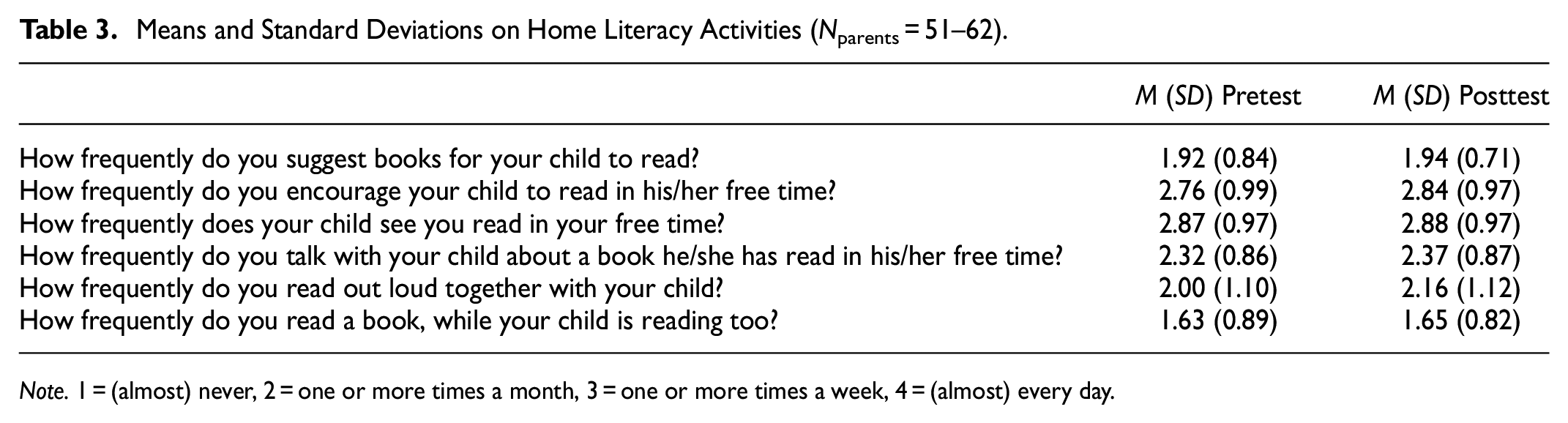
Note. 1 = (almost) never, 2 = one or more times a month, 3 = one or more times a week, 4 = (almost) every day.
Parents’ Knowledge of Children’s Books
At pretest, parents in the three conditions did not significantly differ in their knowledge of children’s books, F(2,57) = 1.42, p, =.25. Three variables had a significant effect on posttest knowledge of children’s books (see Table 2). First of all, there was a positive effect of pretest scores. Second, the positive interaction between pretest scores and the contrast “nudge versus rest” indicates that parents familiar with children’s books benefited from nudging. Third, the positive interaction between pretest scores and the contrast “information versus control” indicates a slight positive effect for the provision of information for parents familiar with children’s book (see Figure 1).

Interaction effect of pretest scores and experimental condition on parents’ knowledge of children’s books.
Effects on Students
Print Exposure
At pretest, students in the three conditions did not significantly differ in print exposure, F(2,95) = 1.76, p = .18). There were significant main effects of pretest scores and grade on print exposure at posttest (see Table 4). The negative effect of grade indicates that students in the higher grades were reading less than students in the lower grades. The nudges did not improve students’ print exposure. The effect of information and the interactions between the covariates and contrasts were not significant either.
Results of Regressing Print Exposure, Reading Attitude, and Reading Comprehension on Pretest Scores, Background Variables, and Experimental Condition in Grades 4 to 6.

Note. Standard errors are presented in parentheses.
p < .05. ***p < .001.
Reading Attitude
At pretest, children in the three conditions did not significantly differ in reading attitude, F(2,95) = 0.57, p =.57. The reading attitude pretest score was a significant predictor of reading attitude posttest score (see Table 4). The positive interaction between pretest scores and the contrast “nudge versus rest” suggests that nudges were stimulating if students had a relatively positive reading attitude during pretest. As Figure 2 indicates, a positive effect was only present in a small group with a very high reading attitude. The majority of the children did not show differences favoring nudges.

Interaction effect of pretest scores and experimental condition on children’s reading attitude.
Reading Comprehension
At pretest, students in the three conditions did not significantly differ in reading comprehension, F(2,98) = 0.23, p = .80. In addition to pretest scores, only gender affected the posttest score on reading comprehension (see Table 4): girls outperformed boys. There was no effect of condition, and none of the interactions between the covariates and contrasts were significant.
Discussion
Reminders of reading affected parents’ knowledge of children’s books, but only if parents were already quite familiar with children’s books at pretest. If parents only received information about the importance of reading once, we found a similar, albeit smaller effect. So, both the nudges and the information flyers incentivized parents to search for attractive books for their children. There is no evidence of impact on parents’ home literacy activities, such as reminding their children to read. This lack of effects may be so because parents’ pretest scores on this questionnaire were already relatively high, or answers were only a pale shadow of actual events, as the absence of significant positive correlations between home literacy activities and knowledge of children’s books suggests.
Sending reminders to parents positively affected children’s reading attitude, but only for a small number of students whose reading attitude was high at the pretest. This effect was likely made possible by parents’ active attempts to find appropriate books for their children, which aroused their interest. However, for the majority of the children, the reminders their parents received did not positively affect their reading attitude. Further, we did not find any effects on children’s print exposure or reading comprehension.
Study 2: Effects of Nudging in Secondary Education
Study 2 targeted students in Grade 7 and 8 of prevocational secondary education, the least demanding level of Dutch secondary education. Many of these students are reluctant to read during leisure time (DUO Onderwijsonderzoek, 2017), and we assumed these students could particularly benefit from nudging. As students in this age range typically control their leisure time activities, we sent nudges directly to students. As we expected that some interest in reading may be necessary for nudges to be effective (Thaler & Sunstein, 2008), we tested whether the intervention was particularly effective for students who were more prone to read. We aimed to answer the following two research questions:
Do reminders of reading influence children’s print exposure and, through that, their reading attitude and reading comprehension?
Are reminders of reading more effective if students are more prone to engage in reading?
Methodology
Study Design
Students were randomly assigned to one of three conditions: a nudge condition, an information condition, and a control condition. Students completed a title recognition list, a reading attitude questionnaire, and a reading comprehension test at pre- and post-test.
Participants
We recruited the participants from 21 classes in eight schools in different regions in the Netherlands. Parents were informed about the study and received a form that enabled them to refuse consent for participation. Students were encouraged to sign up for the study by raffling a cinema ticket among every school’s participants. One hundred forty-six students participated (nudge condition: n = 50, information condition: n = 50, control condition: n = 46). The 66 boys (45%) and 80 girls (55%) were on average 13.34 years old (SD = 0.82, range: 11.86–16.11) and were in Grade 7 (n = 79) or 8 (n = 67).
Intervention
Information Message
Students received one WhatsApp message, explaining that reading is important for learning new vocabulary, expanding general knowledge, and understanding other people’s emotions, and, therefore, reading daily is vital.
Nudges
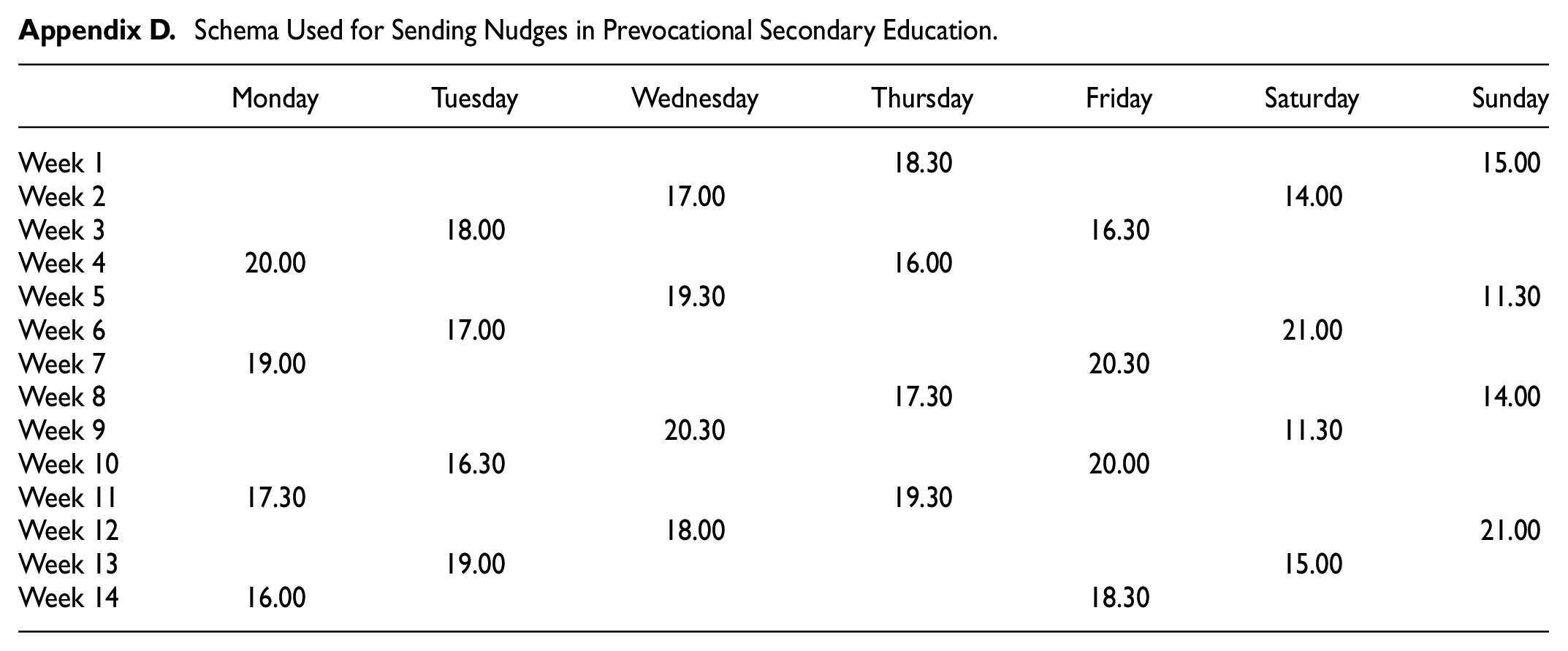
Students received pictures related to reading as reminders of reading, for example a stack of books or someone who is reading. The messages did not include any additional information about reading or tips. The nudges were sent via WhatsApp twice a week during leisure time for a period of 14 weeks (see Appendix D). We varied days and times to guarantee that at least part of the messages came in at suitable moments.
Measures
Print Exposure
A title recognition list was used as an indicator of print exposure (Stanovich & West, 1989; see Study 1). We included books appropriate for students in the upper grades of primary education (9–12 years) and books for adolescents, accounting for variation in students’ reading level. Two versions were developed to prevent a testing effect, both containing 34 existing titles and 16 fake titles (Cronbach’s α version A: pretest = .75, posttest = .88; version B: pretest = .85, posttest = .84). At pretest, there was no significant difference in average scores between versions, t(144) = −1.31, p = .19, indicating that both included an equal number of well-known books.
Reading Attitude
We assessed reading attitude with a questionnaire (Aarnoutse, 1990) containing 27 yes/no questions, for example: “Do you like reading a lot?” and “Do you find reading in class boring?.” After recoding negatively formulated items, a sum score was calculated (Cronbach’s α pretest and posttest = .93). Previous studies indicated that scores on the Reading Attitude Scale significantly correlated with scores on a title recognition list and a reading comprehension test (Nielen & Bus, 2015; Nielen et al., 2016). Further, it was found that reluctant readers, who were not familiar with age-appropriate books, scored significantly lower on this questionnaire than more enthusiastic readers (Nielen et al., 2016).
Reading Comprehension
We used the SALT-reading test to assess reading comprehension (van Steensel et al., 2013), which includes texts varying in genre (narrative, expository, argumentative, instructive) with factual and inferential questions. The test was divided in two parts to prevent testing effects, each containing 37 mostly multiple-choice questions and a few open-ended questions (seven in version A and four in version B). Open-ended questions were coded by two independent coders. Two items had low inter-rater reliability and were, therefore, not included in the total score. Total scores were the number of questions answered correctly (Cronbach’s α version A: pretest = .81, posttest = .80, version B: pretest and posttest = .80). At pretest, the average score on version A was lower than the average score on version B (t[116] =−4.75, p < .001), indicating that version A was more difficult. To correct for this difference, pretest and posttest of version A were increased with 5.19 (the difference between the A and B version at pretest), so that both versions had the same mean at pretest.
Procedure
At pre- and post-test, students completed the title recognition list, reading attitude questionnaire, and reading comprehension test during entire classroom sessions. The sessions were introduced by the second author or a trained research assistant, while teachers were present to maintain order. The administration of the questionnaire and the administration of the reading comprehension test both took approximately 50 min. The procedure was approved by the university’s Institutional Review Board.
Analyses
We tested whether multi-level analyses were necessary. For print exposure (Δ-2 Log Likelihood = 7.879, df = 1, p = .01) and reading comprehension (Δ-2 Log Likelihood = 22.814, df = 1, p < .001) a two-level model (students in classes) fitted the data significantly better than a one-level model. We, therefore, performed multi-level analyses with two levels for all dependent variables.
Pretest scores, gender and condition were entered as predictors. Since there was less variation in grades than in our study in primary education, and to prevent loss of statistical power, we did not include grade in the analyses. The intervention effect was tested with two contrasts: “nudge versus rest” and “information versus control.” Lastly, the interactions between the pretest score and contrasts were added.
The EM procedure in SPSS was used to impute estimated values of missing items on the reading attitude questionnaire and title recognition list. We considered missing items on the reading comprehension test incorrect. If more than three consecutive items were missing on a reading comprehension task, the total test was coded as missing (van Steensel et al., 2013). This was the case for 21 students at pretest and 19 students at posttest. Eight of them had incomplete reading comprehension tests at both measurements. Students with missing scores on an entire questionnaire or test were excluded, so analyses were conducted with 134 (print exposure), 132 (reading attitude), and 98 participants (reading comprehension).
Implementation
Two students in the nudge condition withdrew their participation in the intervention without giving a reason. By registering double ticks in WhatsApp, we checked whether students received our messages (i.e., the information message and the nudges). One student in the information condition did not receive the information message, probably due to an incorrect phone number. Sixteen students in the nudge condition did not receive all nudges. On average, these students received 9.44 nudges (SD = 8.95) out of 28. They probably blocked the messages on WhatsApp. The remaining 32 students (64%) received all nudges. Inspecting scores of students who did not receive all nudges, we found that, in general, their scores were comparable to the total sample.
Results
Effects of the Intervention
Print Exposure
At pretest, students in the nudge condition, information condition, and control condition did not significantly differ in print exposure, F(2,143) = 0.53, p = .59 (see Table 5). Students’ pretest print exposure scores predicted their posttest scores (see Table 6). Additionally, there was a significant effect of gender: girls outperformed boys. Although there was no significant main effect of the nudges, there was a significant interaction effect. The positive interaction of pretest scores and “nudge versus rest” suggests that students with higher print exposure at pretest benefited from the nudges, while students with lower pretest scores did not. As can be seen in Figure 3, this effect was marginal and restricted to students with very high pretest scores. For most students, the effects of nudges were negative.
Means, Standard Deviations, and Correlations on Print Exposure, Reading Attitude, and Reading Comprehension in Grades 7 and 8 (N = 113–146).
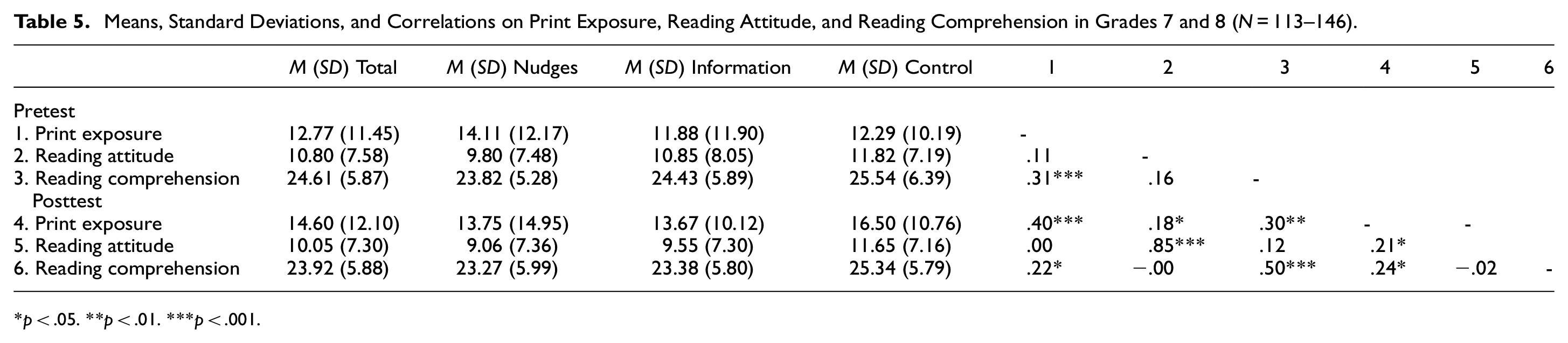
p < .05. **p < .01. ***p < .001.
Results of Regressing Print Exposure, Reading Attitude, and Reading Comprehension on Pretest Scores, Background Variables, and Experimental Condition in Grades 7 and 8.

Note. Standard errors are presented in parentheses.
p < .05. ***p < .001.

Interaction effect of pretest scores and the nudge condition on students’ print exposure.
Reading Attitude
At pretest, students in the three conditions did not significantly differ in reading attitude F(2, 141) = 0.85, p = .43. Apart from a significant effect of pretest scores on reading attitude at posttest, none of the predictors had a significant effect (see Table 6). The interactions between the covariates and contrasts were not significant either.
Reading Comprehension
At pretest, students in the three conditions did not significantly differ in reading comprehension F(2,115) = 0.87, p = .42. Reading comprehension posttest scores were significantly predicted by reading comprehension scores at pretest (see Table 6). There was no significant main effect of the nudges or information on reading comprehension and none of the interactions between the covariates and contrasts were significant.
Discussion
In prevocational secondary education, the nudges had limited effects on students’ reading. The nudges only positively affected print exposure for students who showed substantial interest in reading at pretest, as indicated by relatively high title recognition scores. For most students, reminders did not increase print exposure, indicating that the nudges did not affect their reading activities. Furthermore, we found no effects on reading attitude and reading comprehension.
Discussion About the Two Studies
Many students are willing to read but may not do so because of numerous competing activities (Willingham, 2017). In this study, we tested whether reminders to parents (Study 1) or students (Study 2) can increase reading. We found limited evidence showing that this approach is helpful. In Study 1, the nudges had a positive effect on parents’ knowledge of children’s books. However, we found this effect only if parents were more familiar with children’s books at pretest. In addition, the nudges positively affected students’ reading attitude but only for those students with an initial positive attitude. In Study 2, the nudges positively affected book knowledge but only if students had high scores at pretest. In addition, for students less interested in reading, nudging even seems to work counterproductively. The reminders appeared to annoy them, causing adverse effects on students’ reading (Damgaard & Gravert, 2018).
We additionally hypothesized that influencing students’ reading behavior would incite a positive cycle: we assumed that more frequent reading as a result of nudging would result in more positive attitudes toward reading and better reading comprehension. We found no support for this hypothesis. Study 1 suggests that part of the parents became more active in supporting their children’s reading by searching for titles that would interest their children, making them enthusiastic about reading. However, we did not observe a rise in children’s book knowledge or reading skills in line with their increased interest. Likewise, in Study 2, we observed students became more actively engaged with books (i.e., they knew more book titles), but this did not result in more positive attitudes toward reading or higher reading proficiency.
Theoretical Implications
We argued that the choice to read is often the outcome of so-called fast decisions (Dolan et al., 2012; Kahneman, 2011; Thaler & Sunstein, 2008). As a result, other appealing activities may dominate, and students neglect reading as an option during leisure time if they are not regularly reminded of the possibility to read (Willingham, 2017). By sending reminders, we indeed made reading more salient for parents and students most prone to read. This effect is in line with nudging theory, which assumes that nudges address existing intentions and thereby facilitate behavioral choices (Thaler & Sunstein, 2008). In this vein, the reminders made it easier for parents and students who already had positive intentions to more frequently engage with books.
This argument may also explain why the nudges did not affect participants’ behavior when they were less prone to read. The use of reminders is to help people not to miss activities they plan to undertake (Damgaard & Nielsen, 2018). However, it might be that many parents and students may not consider reading as an essential part of their activity repertoire, in which case the messages do not function as reminders (e.g., Evans et al., 2004). It seems necessary for these parents and students first to convince them of the importance of leisure time reading and set goals to achieve more reading. Another possibility is that some students have developed a resistance to reading due to negative reading experiences (Nielen et al., 2016). Messages about reading will not help them start reading but remind them of an activity they want to avoid. For these students, reminders may elicit negative rather than positive responses.
Limitations and Future Directions
In line with the conclusions above, it seems crucial to guarantee fertile breeding ground for nudges. When parents and students agree that reading is essential and needs to be a regularly returning spare time activity, they appear to make sense. However, there are also other potential limitations. For instance, the arrival of the reminders might not have been well-timed, coming in at times when participants did not have the opportunity to read. A more personalized timing might have more impact on the decision to read (Essl et al., 2021).
Furthermore, we have no information about participants’ responses to receiving the reminders and do not know if the reminders caused an immediate reaction in the form of a reading-related activity. Qualitative information on how participants responded to our nudges might provide more insight into the nudges’ impact.
The assumption is that nudges incite a pattern of change that may affect reading habits in the long term: students who have been repeatedly nudged automatically start reading at spare moments without considering alternatives (Owusu-Acheaw, 2014; Schmidt & Retelsdorf, 2016). However, as it likely takes some time for new routines to grind in, the current study was not long enough to demonstrate such effects. Future studies should pay attention to the impact in the long term and investigate whether nudges could lead to new reading habits.
Conclusion
Infrequent out-of-school reading has negative consequences for students’ reading interests and ability. The current study tested whether regularly sending reminders of reading might be helpful and prevent the dominance of other leisure time activities than reading. Sending reminders indeed made some students more positive about reading and more inclined to opt for reading as a pastime. However, for most students, sending reminders to parents or the students themselves was insufficient to move them toward more leisure time reading. Further research is warranted to test whether more students would benefit from a revised intervention. We expect that, in particular, when students set personal reading goals, they would benefit from the reminders. However, we also expect some students not to profit even if we personalize the messages because they do not perceive reading as an essential activity. Therefore, reminders can be crucial in stimulating reading, but only if the participants meet particular conditions. For students less prone to reading, other interventions are needed.
Footnotes
Appendix A: Information Flyer for Parents in the Information Condition (English Translation)
Appendix B: Information Flyer for Parents in the Nudge Condition (English Translation)
Schema Used for Sending Nudges in Prevocational Secondary Education.
| Monday | Tuesday | Wednesday | Thursday | Friday | Saturday | Sunday | |
|---|---|---|---|---|---|---|---|
| Week 1 | 18.30 | 15.00 | |||||
| Week 2 | 17.00 | 14.00 | |||||
| Week 3 | 18.00 | 16.30 | |||||
| Week 4 | 20.00 | 16.00 | |||||
| Week 5 | 19.30 | 11.30 | |||||
| Week 6 | 17.00 | 21.00 | |||||
| Week 7 | 19.00 | 20.30 | |||||
| Week 8 | 17.30 | 14.00 | |||||
| Week 9 | 20.30 | 11.30 | |||||
| Week 10 | 16.30 | 20.00 | |||||
| Week 11 | 17.30 | 19.30 | |||||
| Week 12 | 18.00 | 21.00 | |||||
| Week 13 | 19.00 | 15.00 | |||||
| Week 14 | 16.00 | 18.30 |
Declaration of Conflicting Interests
The author(s) declared no potential conflicts of interest with respect to the research, authorship, and/or publication of this article.
Funding
The author(s) disclosed receipt of the following financial support for the research, authorship, and/or publication of this article: This research was supported by a grant by “Kunst van Lezen” (Art of Reading).
Ethics Statement
The study was approved by the Ethical Review Board of the Faculty of Humanities of the Vrije Universiteit Amsterdam (EC17.05)

Data Availability Statement
The data that support the findings of this study are available from the corresponding author upon reasonable request.