




Abstract
Current approaches to socially distributed remembering maintain that remembering is a fluid action coordinating minds, bodies, and the physical and the social world to accomplish particular goals. That is, the act of remembering is always an active reconstruction of the past in the present. How this act of remembering unfolds is highly dynamic and malleable and is contingent on the means by which the recollection is communicated and the social and material environments in which these processes unfold. These communicative acts of remembering are always embodied, multimodal, and interactive. However, so far, little attention has been paid to the influence that the interplay of multiple behavioral channels have in collaborative remembering in small groups. The aim of this exploratory study is to demonstrate the central role that questions have as embodied and interactive tools for collaborative remembering in two small group multimodal interactions in natural settings. This study suggests that questions acting as a reminder in multimodal activities of collaborative remembering foster the formation of specific types of interactional sequences with their own temporal dynamics.
Introduction
Often collaborative remembering in everyday environments (e.g., around the dinner table) is supported by the social and material environment in which the specific activity unfolds (Sutton, Harris, Keil, & Barnier, 2010). Conversations are one way in which social groups develop shared memories of the past (Harris, Keil, Sutton, Barnier, & McIlwain, 2011). From a multimodal and ecological perspective, analyzing activities of conversational remembering in real-world contexts involves paying particular attention to the central role that linguistic, embodied, and material resources have in shaping those activities (Bietti, 2012b; Bietti & Galiana Castelló, 2013). However, so far, little attention has been paid to the influence that the interplay of multiple behavioral channels have in collaborative remembering in small groups.
Several studies in cognitive psychology (e.g., Harris et al., 2011) and discourse analysis (e.g., Bietti 2010, 2012a) have examined the central role that certain types of linguistic expressions (e.g., disagreements and corrections) have in facilitating the construction of shared memories in small groups in experimental and natural settings. Nevertheless, little attention has been paid to ways in which questions structure the joint activities of collaborative remembering. In conversations about past experiences, often questions are linguistic expressions used to make requests for information about the events being jointly recalled. Levinson (2012) argues that “one of the most prominent differences between questions and assertions is the obligation to respond” (p. 16). Hence, in activities of collaborative remembering, questions tend to act as reminders that provide dynamicity and structure to the group interaction.
The aim of this exploratory study is to show the central role that questions have as embodied and interactive tools for collaborative remembering in two small group multimodal interactions in natural settings.
Socially Situated and Distributed Remembering
In collaborative activities in everyday life settings (e.g. dinner table, classrooms and workplace), the material environments for reasoning, problem solving, and creativity are highly organized, and thus, they also enhance remembering and more general cognitive performances. These material environments have a high level of physical cues and this fosters the successful resolution of cognitive tasks. In those activities in which collaboration in social and material environments facilitates the successful realization of cognitive tasks, cognitive processes should no longer be simply characterized purely at an abstract, brain-bound, information-processing level, but as interacting networks, which integrate and synchronize the brain, the body, and the world in a functional and goal-oriented manner (e.g., Hutchins, 1995, 2010; Malafouris, 2008). Cognitive processes such as remembering in these environments do just occur in the brains of individual, rather in distributed cognitive systems formed by multiple processing units (Hutchins, 1995; Sutton et al., 2010).
Donald (2010) uses the distinction between “engrams” (Ogden & Richards, 1956) and “exograms” (Donald, 1991) to explain how the storage capacity of biological memory systems became enhanced throughout human cultural evolution. “Engrams” are mental impressions caused by memory traces in the human mind, which are the residual trace of an adaptation made by the organism in response to a stimulus (Ogden & Richards, 1956, p. 53). “Exograms” are defined as external symbolic devices linked to the present context of remembering that allow us to extend and enhance our bio-memory systems. Donald argues that “exograms” enable human beings to manipulate complex representations by significantly augmenting the capacity of working memory. In this way, non-biological memory storage (e.g., photographs) together with the bio-memory systems create the conditions for the emergence of distributed hybrid networks formed by the interwoven neural capacities and external memory devices (Sutton et al., 2010).
Experimental studies in cognitive psychology (Hirst & Echterhoff, 2012) sustain the view that examining conversations about past experiences is one of the most useful mechanisms for exploring how memory spreads across different groups. Hirst & Echterhoff (2008) argued the unreliability and malleability of human memory (unlike computer memory) “creates the opportunity for speakers to reshape both listeners’ memories and their own” (Hirst & Echterhoff, 2008, p. 209). As collective memories are commonly formed, shared, consolidated, and transformed in conversations, several studies (Echterhoff, 2010; Echterhoff, Higgins, Kopietz, & Groll, 2008) have investigated how different cognitive, linguistic, and interactive phenomena influence processes of collective memory making.
Experimental research in socially distributed remembering in cognitive psychology (Harris et al., 2011) supports the view that collaboration between members of dyads may facilitate recall. These studies have been largely based on an important research program in transactive memory in cognitive psychology (Wegner, Erber, & Raymond, 1991), philosophical psychology (Theiner, 2013), organizational and communication sciences (e.g., Hollingshead, 1998) as well as the learning sciences (Jackson & Moreland, 2009). These studies suggest that the constitution of transactive memory systems relies on the fact that some groups have the ability to develop an implicit distribution of cognitive labor whereby each member assumes responsibility for learning information within his or her own domain of expertise. Each group member also expects others to learn information about other relevant domains and assume accountability for that.
However, understanding the communication and dynamics is only part of the story in understanding how and when individuals and groups remember the past. For example, naturalistic studies from cognitive and ethnographic perspectives in cognitive science (Bietti & Galiana Castelló, 2013; Bietti, Kok, & Cienki, 2013; Dahlbäck, Kristiansson, & Stjernberg, 2013) and computer science (Wu, Birnholtz, Richards, Baecker, & Massimi, 2008) have demonstrated how the actual context in which the remembering occurs is crucial in understanding the ways in which people construct and communicate their memories.
Questions as Reminders
Reminders are extremely important in sharing memories within social groups when their knowledge of the past is distributed among group members. In conversations, reminders are often realized by questions aimed at seeking information from someone who is assumed to know about events that occurred in the past. The use of questions as reminders, such as “Do you remember when. . .?” to bring a shared past into the present for the sake of a specific goal (e.g., to create a feeling of connection between parents and children) makes evident that we are dealing with joint past experience.
Moreover, reminders function to facilitate the reconstruction of shared past experiences among members of groups by means of collaborative facilitation mechanisms (Harris et al., 2011). They may also act as interactive communicative devices that trigger the generation of “new” memories. These new memories can be strategically constructed in accordance with interactional goals, such as to reach consensus among group members (Bietti, 2012a). Thus, using questions as reminders has been shown to act as an important scaffold in joint and collaborative remembering activities. The results of several studies on collaborative storytelling among couples in which one spouse had been diagnosed with Alzheimer Disease (AD; Hydén, 2011; Hydén & Örulv, 2009) have shown that reminders allow the person with AD “to continue as an active participant and storyteller by making further contributions to the ongoing storytelling” (Hydén, 2011, p. 342).
The Current Study
In this study, the role that questions had in activities of socially distributed and situated remembering were examined in two small groups where collaborative recall was also supported by external resources (e.g., pictures) the participants had brought along to the group interactions. One group consisted of family members and the other of close friends. The particular pragmatic function (Heritage, 2002; Stivers, 2010) of each question acting as a reminder in the collaborative recalling activity among friends and family members will be explored. Participants were all native speakers of Spanish.
The selection of questions acting as reminders will be based on the coding scheme for question-response sequences in conversation that was developed by Stivers and Enfield (2010). Their coding scheme is empirically grounded in a comparative project on question-response sequences in ordinary conversation in 10 languages (Stivers, Enfield, & Levinson, 2010). Despite the fact that data of this study are in Spanish, which was not 1 of 10 languages covered by this project on questions-response in ordinary conversation, their basic differentiation between Polar Questions, Content (Q-) Questions, and Alternative Questions is in line with what has been proposed for Spanish from semantic and pragmatic perspectives (e.g., Escandell-Vidal, 1999).
From this coding scheme (Stivers & Enfield, 2010), the basic differentiation was taken between Content (Q-word) Questions (e.g., What did you eat for breakfast?), Polar Questions (e.g., Did you go to the movies yesterday?), and Alternative Questions (e.g., Are we going for a walk or do you prefer to stay at home?).
Particular attention will be paid to the central role that reminders play in the formation of adjacency pairs (e.g., Sacks, Schegloff, & Jefferson, 1974; Schegloff, 2007) that are triggered by the obligation to response put forward by questions. An adjacency pair is composed of two turns, and each turn has to come from a different speaker and be of a different type of utterance. Adjacency pairs lead to the construction of interactional spaces (Mondada, 2009). According to Mondada (2009), interactional spaces are actively and constantly shaped and sustained by the participants’ bodies, glances, and gestures during the interaction. Hence, these co-constructed interactional spaces play a central role in guiding mutual attention and reciprocity.
The jointly and dynamic construction of interactional spaces creates the conditions for the emergence of alignment mechanisms (Pickering & Garrod, 2004) among group members. Alignment mechanisms are guided by cases of dialogic syntax given by structural similarities between immediately co-present linguistic segments in a broader conversational context (Du Bois, 2010).
In relation to cases of dialogic syntax, several studies on naturally occurring interaction in conversation analysis (Ford, Fox, & Thompson, 2002; Lerner, 1991, 2004; Sacks et al., 1974) as well as in experimental settings in psycholinguistics and cognitive psychology (Allen, Haywood, Rajendran, & Branigan, 2011; Fusaroli et al., 2012) have shown the ways in which interlocutors collaboratively and cooperatively co-construct utterances in conversations. This phenomenon may occur by simply repeating and reusing each others’ lexical items and syntactic structures and/or latching onto the other person’s turn and completing it without pausing. The collaborative turn sequences are cases in which “not only a collaboration of two speakers produces a single syntactic unit [. . .] but also in which the first speaker ratifies its completion after its occurrence” (Lerner, 2004, pp. 229-230).
In addition, the analysis will determine to what extent these reminders interplay with co-verbal resources such as manual gestures (e.g., pointing and metaphorical gesture), laughter, and changes in gaze direction. As the participants of this study were not only interacting with each other but also with pictures related to the events that they were collaboratively remembering, significant occurrences of pointing gestures were considered as directing-to actions (Clark, 2003) toward the pictures being discussed. By directing-to, we refer to an action in which “speakers try to move the addressees’ attention to the object” (Clark, 2003, p. 248). Metaphorical gestures refer to the type of manual gesture that has the potential to engage an active cross-domain mapping—that is, the cognitive process of understanding something in terms of something else (Cienki & Müller, 2008).
Changes in the direction of gaze toward the recipients of questions acting as reminders will also played an important role in the analyses. This type of behavior is considered as embodied resource for mobilizing response reinforcing the accountability of recipient to respond to the reminders (Rossano, Brown, & Levinson, 2009; Stivers et al., 2010; Stivers & Rossano, 2012). Several scholars (Goodwin, 1987, 1994; Kendon, 1990) have documented the regulatory function of the speakers’ gazes in social interactions. Moreover, in experimental settings, it has been shown that “the listener tended to respond when the speakers looked at him or her” (Bavelas, Coates, & Johnson, 2002, p. 576) providing compelling evidence that collaborative activities in face-to-face interaction are not only driven by verbal resources.
These are succinct definitions of the type of questions used in this study.
Content (Q-word) Questions
Content (Q-word) questions include interrogative pronouns such as: qué/what; cuál/which; quién/who; dónde/where; cómo/how; cuánto/how much. They can be followed by noun phrases, which form a syntactic constituent. These types of questions are used to request information that has not been previously mentioned in a communicative interaction.
Polar Questions
Polar questions imply an affirmative or negative reply and therefore they are also called absolute yes/no questions. They can be accompanied by a finite verb, a negative adverb, adverb of frequency, a clitic, or a subject.
Alternative Questions
Alternative questions offer a choice between at least two alternative answers. Each of the alternatives in the question is stressed. In Spanish, any positive polar question can be turned into an alternative question by adding “o”/or and the negative tag “no”/not.
As the analysis will be focused on the key role that direct questions play in triggering processes of conversational and collaborative remembering in Spanish, it is important to point out the distinction that Spanish grammar makes between direct and indirect interrogatives. Spanish grammar (among many others) makes a distinction between direct and indirect speech. On one hand, by direct speech we refer to instances in which “the writer or the speaker textually reproduces what the speaker has directly expressed in their own words” (RAE, 1973, p. 516). On the other hand, instances of indirect speech are cases in which “the narrator refers to what the speaker, or the other person, has said” (RAE, 1973, p. 516). This distinction also applies to the interrogatives, and therefore we speak about direct and indirect questions. In other words, in direct speech the verbal communication is reproduced exactly. Verbs have the same subject, “I” and “you,” as when spoken by the speaker (Milner, 1973, p. 38). In contrast, indirect questions are cases in which verbs of saying and understanding (to say, ask, warn, tell, etc.) play a central role (e.g., el me preguntó si sabía quién había sido el responsable/he asked me if I knew who was responsible). Moreover, in indirect questions the interrogative tone disappears, as does the question mark in writing (Gili Gaya, 1961).
Method
Participants
Two groups of four participants were recruited for this study via the researcher’s social networks in Argentina. One consisted of close friends (aged 21-23), the other of family members (parents aged 57 and 63, and children aged 30 and 32). Both groups had gone through a shared event together (e.g., a vacation) and had carried along a set of pictures related to that event. All were native Spanish speakers.
Procedure and Data Collection
The data were collected between August and October 2011 in Buenos Aires. Two group conversations were recorded in the homes of one of the participants of each group. Participants were asked to recollect memories based on the pictures they had brought along. The conversation among family members was about a trip to Maui, Hawaii, that they had made together to attend the wedding of the parents’ daughter. The conversation among the friends was about a 2-week summer vacation that they had spent together in a summer resort by the seaside. The interventions of the research assistant were minimal, merely functioning to invoke continuation of the conversation. The conversations were recorded with two digital video cameras placed in different corners of the room (Canon LEGRIA HF M46 and Sony Mobile HD Snap Camera MHS-TS20).
Coding
The audio and video recordings were transcribed in detail using two specialized software programs (Inqscribe and ChronoviZ). The overall length of the recordings was 14.54 min for the family, and 22.08 min for the friends. Video and audio recordings of both focus groups were coded for a wide range of co-verbal behaviors, divided into three categories: (a) manual gestures, (b) non-manual gestures, and (c) postural behaviors. The minimum unit of time used for coding of the video and audio recording was 500 ms. For all time points, a binary value was assigned to each behavior for each participant, indicating whether he or she performed that behavior at that particular moment in time. Audio recordings were transcribed following the Jefferson Transcription System (Jefferson, 2004).
Analysis
A total number of 104 direct questions were found in the data, 57 questions in the group consisting of close friends and 47 in the group formed by family members. The larger number of questions found in the friends data may be related to the fact that that group session was 7.14 min longer than the family one. For both groups, the following charts show: (a) the percentage of questions acting as reminders, (b) the distribution of questions acting as reminders among the four participants of the group and the interviewer, and (c) how these reminders are distributed across the different types of questions described above (Content (Q-) Questions; Polar Questions and Alternative Questions).
As Figure 1, 84% (friends) and 74% (family) of the questions were cases of questions acting as reminders. Within 16% (friends) and 26% (family) under the category “other,” we included uses of questions related to the organization of the specific task (e.g., clarification questions to the interviewer) but not to the activity of collaborative remembering. This finding demonstrates the importance of reminders in this group interaction and provides analytical validity to the focus of inquiry. Figure 2 illustrates the distribution of questions acting as reminders among friends and family members. It also shows to what extent the interviewer was involved in the dynamics of the group interactions.

Questions acting as reminders.

Distribution of reminders across participants.
Figure 3 provides information regarding the type of questions found in the two groups interactions, based on Stivers and Enfield’s coding scheme (Stivers & Enfield, 2010). The questions acting as reminders made by the interviewer were excluded from this chart.
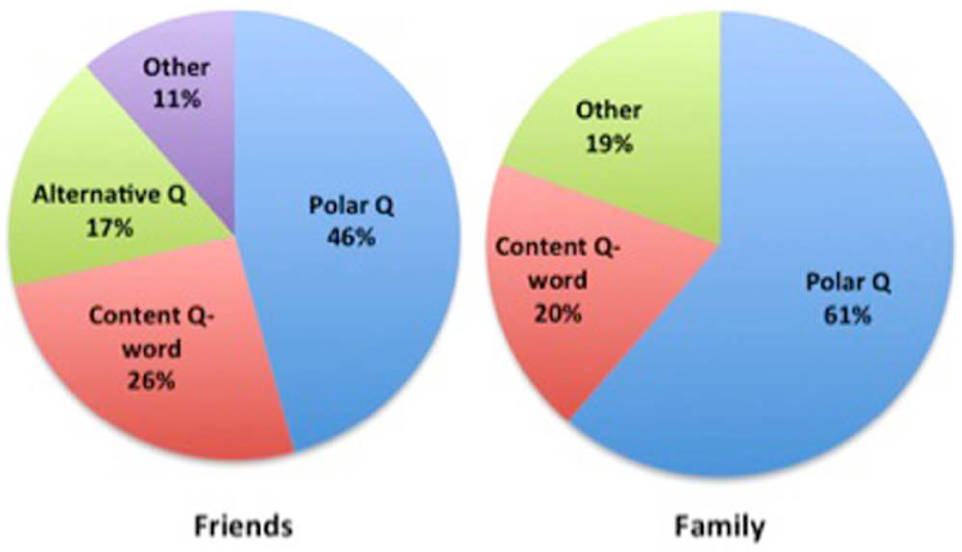
Type of questions acting as reminders.
For the qualitative and multimodal analysis we selected an interactional sequence initiated by each of the question types acting as a reminder listed in Figure 3. There were not instances of alternative questions in the family data. Hence, the section focused on the qualitative and multimodal analysis of the family interaction only includes two examples instead of three. Within 11 percent (friends) and 19 percent (family) under the category “other” we included cases of Elliptical Content Q-word and Elliptical Polar Questions (e.g., ¿y ésta?/and this?, and ¿no?/right?) that were related to the activity of collaborative remembering. However, as the identification of these cases of elliptical questions can be quite arbitrary without a proper phonological analysis, which is beyond the scope of this study, it was decided not to select them for the qualitative and multimodal analysis.
The order for presenting the examples was determined by the time of the interaction itself. Multimodal annotations on the transcripts and still images were made using the following coding scheme: (a) yellow circles in the transcripts and on the still images to indicate pointing, metaphorical gestures, facial expressions and touching the pictures; (b) red circles in the transcript to indicate when a change in the direction of eye-gaze occurs; (c) red arrows on the still images to approximately show where the participants are gazing; and (d) blue circles in the transcript to indicate instances of phrasal repetition across speakers.
A chart for each of the interactional sequences analyzed was included next to the still images to show the temporal dynamics of relevant co-verbal behaviors.
Case 1: Friends
Content (Q-word) questions
In this interactional sequence (Figure 4), the group of friends is trying to jointly identify who was missing. Augusto asked the question and he asks who took the picture that they are talking about.

Content (Q-word) Question (Friends).
From Line 1 we note how Augusto’s Content (Q-word) Question operates as a reminder within the interaction and establishes a shared goal, that is, to remember who was missing in the picture being used to remember what they were doing in that specific situation. However, to find out which of the friends were missing in the photograph also entails jogging their memories as to who the author of the picture was. It is important to point out that Augusto reformulates the reminder in Line 1, a few lines below (L. 5), and thus, he makes clear that his goal is not only to remember who was missing, but rather to recall who had taken the picture. Augusto’s question in Line 1 makes the four participants lean forward. While leaning forward, Tommy also takes the picture in question to take a closer look (pic. a). Interestingly, Augusto’s questions acting as reminders (L. 1 and 5) do not only provoke the participants to lean forward and focus their visual attention on the picture but also seem to trigger the formation of similar postural behaviors as they all try to answer the question (chin-rest, b, and Figure 5 [3,500-10,500ms]).
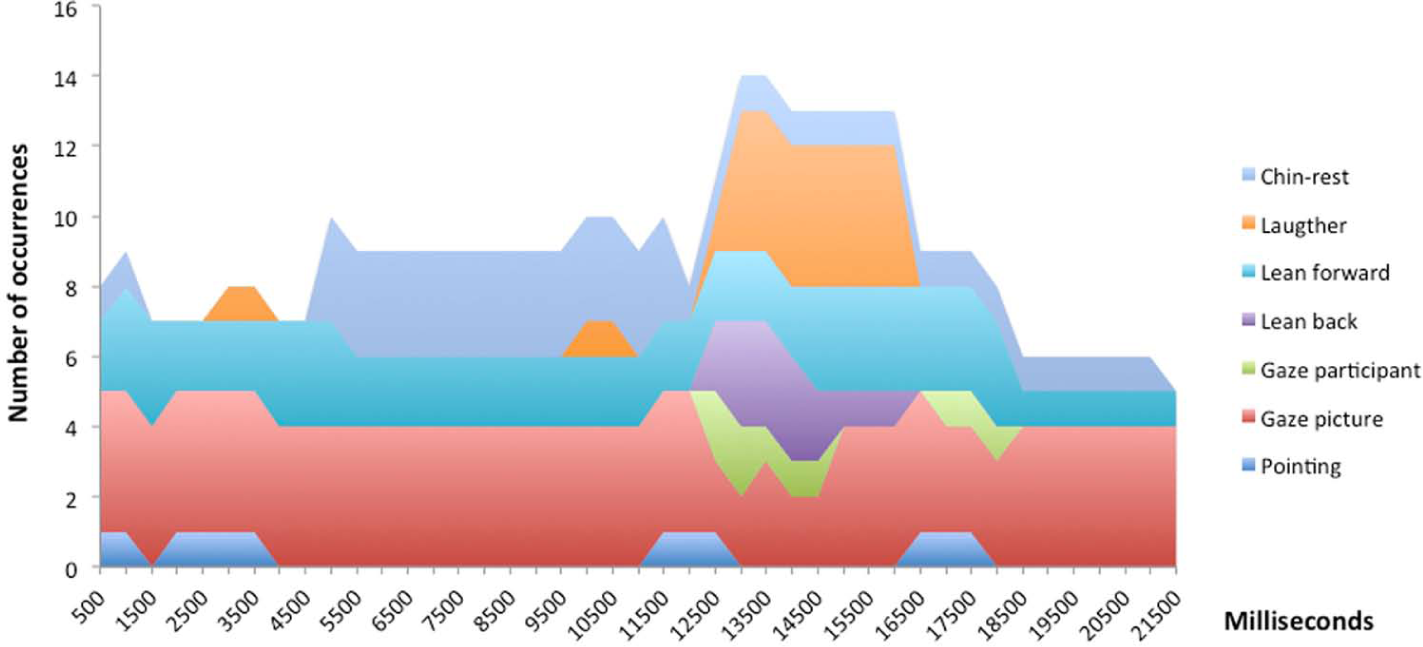
Temporal dynamics: Content (Q-word) Question (Friends).
Subsequently, in Line 8 when Santi answers the question regarding who took the picture, Augusto changes the direction he is looking toward him (L. 8, red circle, pic. b). At that point, it is when Augusto, Tommy, and Santi lean back and they all laugh simultaneously (pic. c, L. 9, Figure 5 [11,500-18,500 ms]). What is so funny about the situation is that it was Augusto who had actually taken that picture.
Throughout the entire interactional sequence initiated by Augusto’s reminders (L.1 and 5), it is possible to observe the ways in which instances of dialogic syntax based on the repetition of syntactic structures and lexical items constitute the basis for the emergence of spiral effects that linguistically shape processes of socially situated and distributed remembering (e.g., “era de día”/it was daylight, L. 2-3; and ¿quién sacó la foto?/who took the picture, L. 5-6).
Polar questions
The theme of the next interactional sequence (Figure 6) is related to the identities and descriptions of the people who attended one of the parties that they had organized at the house where they were staying during the summer vacations.

Polar Question (Friends).
In the first Line 1, Tommy uses a Polar Question to ask whether the events depicted in the picture they are looking at, and jointly remembering through it, took place at the house where they were staying during the summer vacations. While Tommy formulates the question pragmatically acting as a reminder, he also leans forward to take hold of the specific picture (pic. d). Tommy’s leaning forward and attempt to the take the picture are temporally coordinated with Augusto’s pointing at the photograph (pic. d, pic. e, and pic. f). This temporal synchronization is reflected in the temporal dynamics of co-verbal behaviors that is shown in Figure 7 (1,000 ms onward).
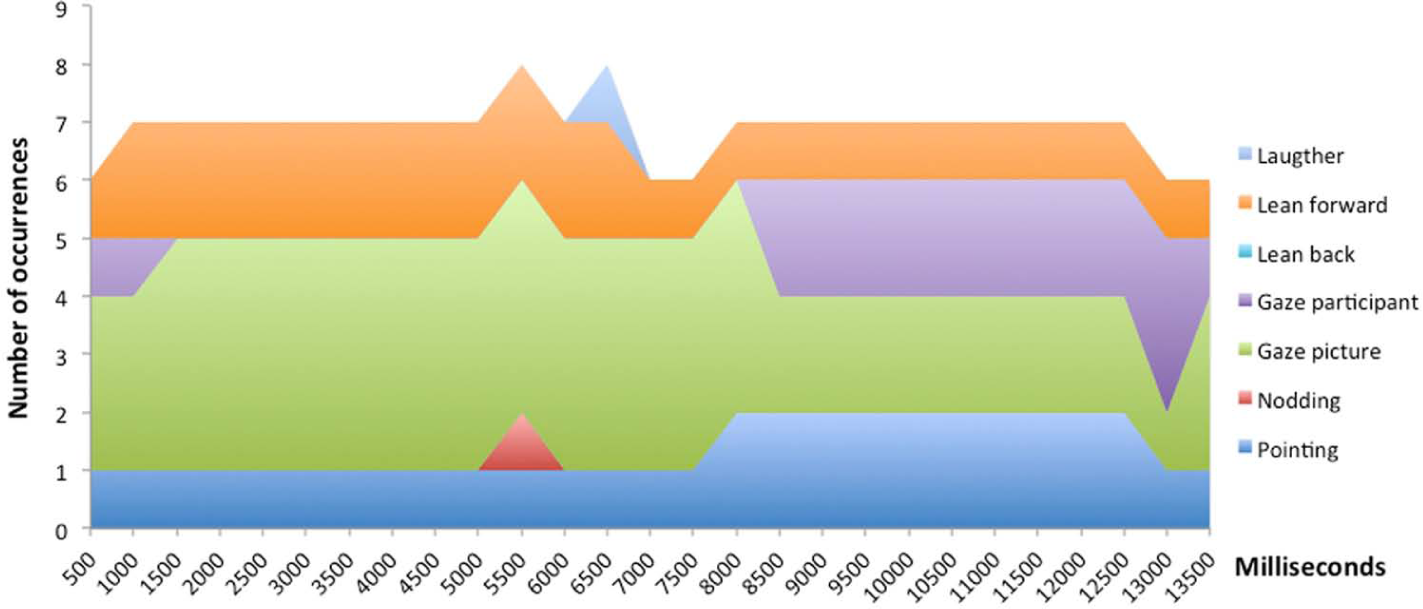
Temporal dynamics: Polar Question (Friends).
Although Tommy’s question does not seem to trigger the formation of an adjacency pair, it does lead to the initiation of interactional sequence in which the four participants are engaged in remembering who attended the party that they are describing. In Lines 3 and 5, Augusto introduces a new character in the reconstruction of the events. After Nacho’s agreement in the next line, we observe how a process of lexical alignment between Augusto and Santi (“Mitch,” blue circles, L. 4, 6-7) operates to interactionally and linguistically ground the shared activity of remembering together who else was there with them. Interestingly, the process of lexical alignment between Augusto and Santi is also embodily manifested in a change in the direction of Santi’s gaze (pic. e, Figure 7 [8,500 ms]).
In Line 8, Santi continues with the description of “Mitch” and introduces a new character in the events while he still looks at Augusto. It is at this point when Tommy changes his gaze toward Santi (red circle, L. 9). While they are looking at each other (pic. e), we can notice the formation of a collaborative turn sequence. Santi’s ratification of Tommy’s collaborative completion appears in Line 12 “Flor/Flor.” Moreover during the time they are looking at each other (pic. f), collaborative remembering between Santi and Tommy is behaviorally grounded in instances of lexical alignment (e.g., “Flor”/Flor, and “la gorda”/the fatty).
Alternative questions
In the following interactional sequence (Figure 8), one of the participants tries to find out if other members of the group had made an attempt to get off with a girl that was with them at a party.

Alternative Question (Friends).
Tommy’s Alternative Question in Line 1 initiates the interactional sequence and triggers the formation of an adjacency pair between Santi and himself (L. 1-2). Tommy’s change in gaze direction toward Santi operates as an embodied resource aimed at mobilizing response from the person who is asked the question. At the time when Santi responds to Tommy’s question, Augusto and Nacho change the focus of their visual attention from the picture that it is being discussed to him (red circle, L.2, Figure 9 [1,500 ms]). However, Augusto and Nacho are not the only participants who reorient their behavior while Santi respond to Tommy’s Alternative Q. As we can notice, almost at the time when Santi is finalizing his utterance “no estaba”/she wasn’t there (red circle, L. 2), Tommy changes his focus of visual attention again to the picture in which the girl who they are talking about is depicted, as in an attempt to check if the girl was as pretty as Santi describes her. Such multiple reorientations of behaviors are also reflected in (h), and in the temporal dynamics of co-verbal behaviors that it is described in Figure 9 (2,000-4,000 ms).

Temporal dynamics: Alternative Question (Friends).
In Line 5, Augusto also changes his gaze direction toward Tommy when he explains to him that he did not make an attempt to get off with that girl either (red circle, pic. i). Augusto’s intervention makes Tommy and himself laugh about the situation (Figure 9 [4,500-5,500 ms]).
The interactional sequence triggered by Tommy’s reminder in Line 1 is linguistically structured by the repetition and reuse of lexical items (“estaba”/was there; and “agarraste”–“no agarré”/you had her—I didn’t have her) that serve to linguistically ground the shared activity of collaborative remembering.
Case 2: Family
Content (Q-word) questions
In this interactional sequence (Figure 10), Dolores and Diego are collaboratively remembering how they were feeling on their arrival in Maui from Buenos Aires. A picture of their arrival externally supports this joint activity.
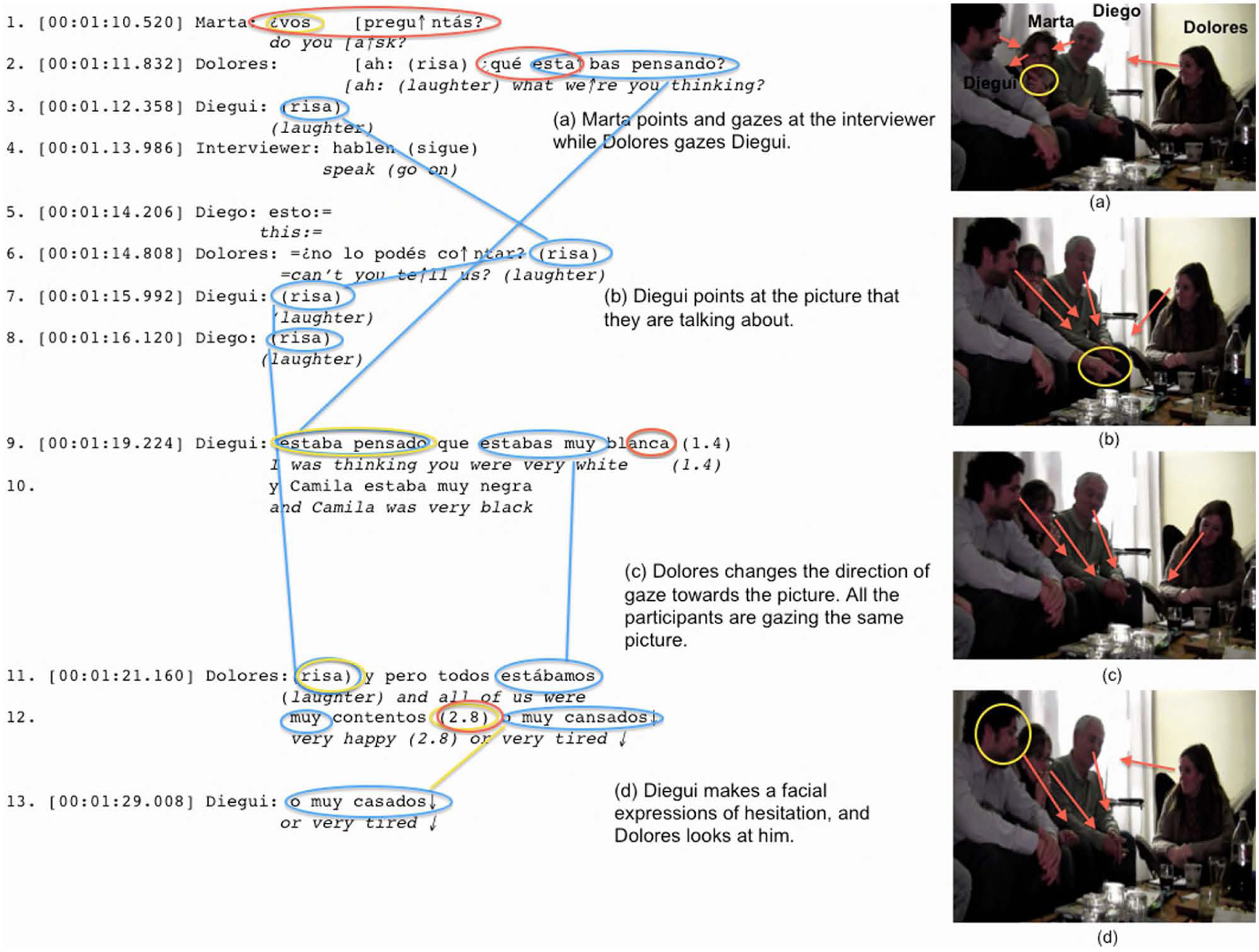
Content (Q-word) Question (Family).
In the first line, Marta asks a question (pic. a) to the interviewer regarding whether they (family members) should expect to answer questions made by the interviewer or simply engaged in conversation among themselves. The answer to this clarification question comes in Line 4. Nonetheless, Marta’s embodied request for clarification (yellow circle, L. 1), which integrates multimodal resources (speech, pointing, and gaze), concerning the nature of the activity does not interfere with the interaction between Dolores and Diegui. The adjacency pair opened by Dolores by means of the Content (Q-word) Question (L.2), acting as a reminder, initiates a sequence of laughter between her and Diegui, her husband. In this case, laugher is an embodied action (Vöge & Wagner, 2010; Zayts & Schnurr, 2011) locally produced by Dolores (L.2) to foster an affiliation and alliance with Diegui who returns the laughter, and in doing so, behaviorally aligns with his wife (blue circles, L 2-10, Figure 11 [500-13,500 ms]).
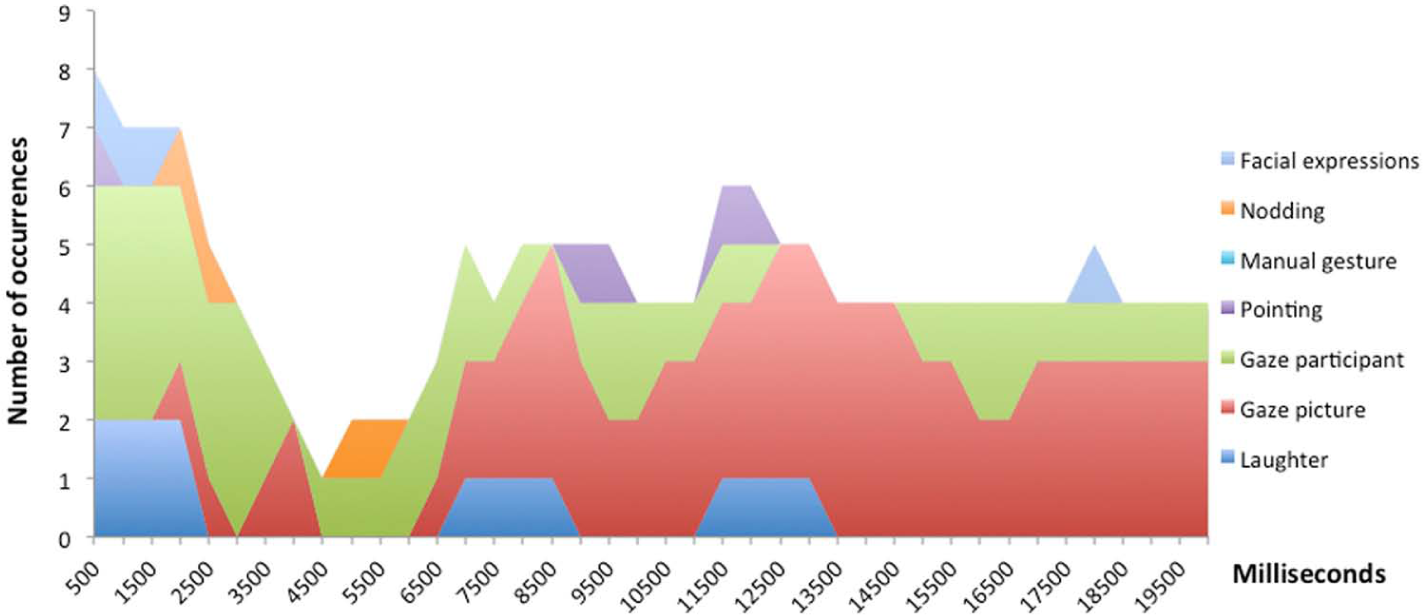
Temporal dynamics: Content (Q-word) Question (Family).
Dolores’ and Diegui’s alignment generated and mediated by simultaneous and sequential laughing is further supported by instances of linguistic alignment that are illustrated in the repetition and reuse of lexical items and syntactic structures (blue circles, L. 2, 9, 11-13). Moreover, Dolores’ gaze toward Diegui while formulating both questions (L.2 pic. a) operates as a resource for mobilizing response. Thus, Dolores makes more pressure to Diego to respond to her question acting as a reminder regarding how he was feeling on arrival in Maui.
In the second element of the adjacency pair initiated by Dolores (L.2), Diegui uses a pointing gesture (pic. b) to refer to the picture that they are talking about (yellow circle, L.9, Figure 11 [8,500-9,500 ms]). In doing so, he creates a common ground (Clark, 1996) between him and Dolores, as well as, among the four participants who change the direction of eye-gaze toward the specific picture. Diegui’s pointing gesture is a directing-to action by moving not only Dolores but also Marta and Diego’s visual attention to the particular photograph (pic. b). This photograph works as an external resource for grounding collaborative remembering between Dolores and Diegui until the long pause (2.8) in the penultimate turn of the interactional sequence (L. 12). During that long pause, Diegui makes a facial expression (eyebrow-flash) showing hesitation regarding Dolores’ account of how they were feeling on arrival (yellow circle, L.12, pic. d, Figure 11 [17,500 ms]). That is precisely when Dolores gazes Diegui (red circle, L. 12, pic. d), and thereby, the picture no longer acts as an external resource for grounding the remembering activity. Interestingly, after Diegui’s facial expression, Dolores reformulates her account. Finally, Diegui agrees with such reformulation (L.13).
Polar questions
In the following interactional sequence (Figure 12), Diegui and Marta are trying to locate in chronological time one of the pictures that they brought in for the focus group session.

Polar Question (Family).
The interactional sequence begins with Diegui’s Polar Question in Line 1. In the element of the following question-response adjacency pair (L.5-6), Marta uses a circular metaphorical gesture (yellow circle, L. 6, pic. h, Figure 13 [6,000-6,500 ms]) by moving her right hand wrist to represent the passage of time while suggesting the possibility that the events that the particular photograph are depicting occurred the third day after arrival, not the second as she previously claimed (yellow circle, L. 4, pic. f, Figure 13 [4,500 ms]). The last question-response adjacency pair is completed by another manual gesture made by Marta (yellow circle, L. 8, pic. I, Figure 13 [7,000-7,500 ms]). Marta uses a pointing gesture to refer to another picture in the photo album that seems to be thematically related to the one that they were using for grounding the collaborative activity of shared remembering. Thus, she makes an attempt to externally ground her arguments concerning the order of the pictures (and events) in time.

Temporal dynamics: Polar Question (Family).
Diegui’s and Marta’s collaborative behavior is also supported by instances of lexical alignment: “foto”/picture, “esa foto”/that picture (blue circles, L.1-2, 8), and “otro día”/another day (blue circles, L.4-6). As the interactional sequence shows, there is a clear coordination between these cases of lexical alignment and the manual gestures described above (pointing and metaphorical gesture).
Discussion
The quantitative analysis has indicated that a significant percentage of the total number of questions formulated in both sessions made a pragmatic contribution: They played the role of reminders in the multimodal interactions between friends and family members. This finding shows the central role that questions acting as reminders had for socially situated and distributed remembering in the two groups’ naturalistic interactions by providing the interactional and linguistic architecture for the entire activity.
The aim of selecting only three types of questions (Content (Q-Word) Questions, Polar Questions, and Alternative Questions) from the data for the subsequent qualitative analyses was to provide an in-depth view of the ways in which these reminders actually work in multimodal and interactional settings. At a linguistic and conversational level, reminders tend to open question-response adjacency pairs (Stivers et al., 2010). These question-response pairs along with the multiple cases syntactic and lexical alignment operated as mechanisms providing structure for the activity of shared remembering, as well as key elements in the jointly and dynamically creation of common ground among group members. However, the collaborative creation of a common ground, on which the shared activity of conversational remembering was built, could not be fully understood if we only considered the behavioral level. Several examples have demonstrated how participants do not only mechanically mirror each others’ behaviors. It goes further: There are cases in which the collaborative co-construction of utterances (Ford et al., 2002; Lerner, 1991, 2004) reflects situations in which they seemed to be actually sharing individual memories of the events experienced together as groups. This finding seems to be in accordance with the fact that instances of lexical and syntactic alignment in conversations seem to facilitate the construction of shared situation models about the events that participants in conversation are talking about (Pickering & Garrod, 2004). On the other hand, with the kind of qualitative methodology presented in this exploratory study, it is quite unlikely to demonstrate whether there are causal relations between the formation of adjacency pairs together with cases of syntactic and lexical alignment and the sharing of representations about the events experienced together. This is a methodological limitation that future studies from experimental perspectives should strive to overcome.
At the co-linguistic and multimodal level, reminders served to reorient group behavior and establish shared focus of visual attention. Such reorientations of behaviors and new focuses of visual attention indicate the joint and dynamic configurations of shared goals (e.g., Tomasello, Carpenter, Call, Behne, & Moll, 2005). Those shared goals included cases where participants were trying to remember who the author of the picture that they were talking about was (friends, Content (Q-word) Question) to collaborative recall as to how they were feeling on their arrival in Maui from Buenos Aires (family, Content (Q-word) Question). At this point, it is important to highlight the fact that in both groups, friends and family members were not only interacting with each other, but also with the pictures they themselves had taken of the events they were remembering together.
Regarding the interanimations of individual memories and the external representations supported by material environments (e.g., to use tools to solve a specific task), several studies (Zhang, 1997; Zhang & Wang, 2009) have demonstrated that the successful coordination of information from internal representations (e.g., in working memory) and external representations plays a critical role by improving problem-solving performance in activities in which interaction with external resources called for. The qualitative analyses have reliably shown that the pictures did operate as artifacts externally grounding the entire group dynamics. However, because of the methodological limitations of the study design, it would not be possible to claim whether the participants would have remembered less if the pictures were not there.
The temporal dynamics of the sequential alignment of co-verbal behaviors among participants (Figures 5, 7, 9, 11, and 13) in each of the interactional sequences initiated by the reminders suggest that behavioral and cognitive processes in the group activities were not only distributed across the room or space but also across a time (Hutchins, 2010, 2011).
When combined and integrated, the examination of the interplay of conversational with co-verbal resources in the interactional sequences triggered by the reminders shows how socially situated and distributed remembering in the two groups, that unfolded in a macro-time scale, influence interactional behavior over much shorter time-scales (the time needed to formulate a question). This was reflected in the significant percentage of total questions that acted as reminders. However, this is not a top-down relationship as the events occurring in micro-time scales (e.g., formulating questions) are precisely those kinds of actions that give shape to the overall high-level cognitive activity of collaborative remembering within the groups. Thus, and based on the qualitative evidence provided, this exploratory study has demonstrated that socially situated and distributed remembering in natural environments has to be considered as a bi-directional collaborative activity, jointly determined by high-level cognitive processes (e.g., collaboratively remembering specific shared experiences) as well as by more procedural and automatic behaviors (e.g., formation of question–answer adjacency pairs, simultaneous and sequential alignment of co-verbal behaviors).
It is hoped that future studies on collaborative remembering in experimental settings could empirically test the central role that questions acting as reminders may have on benefiting shared and distributed remembering in small groups. Thus, it would be possible to unravel the web of multiple interanimations among a wide range of multimodal behaviors unfolding on interdependent time-scales in this kind of everyday but complex social activities.
Footnotes
Acknowledgements
I would like to thank Alan Cienki, Kasper Kok, the article editor, Kevin S. Reimer, and two anonymous reviewers for comments on earlier versions of this article.
Declaration of Conflicting Interests
The author(s) declared no potential conflicts of interest with respect to the research, authorship, and/or publication of this article.
Funding
The author(s) disclosed receipt of the following financial support for the research and/or authorship of this article: The study was conducted with financial support from the Alexander von Humboldt Foundation, Germany.
