




Abstract
This study employs a novel approach to investigate the effects of reading anxiety on middle school students’ reading motivation and attitudes, along with the mediating impact of reading anxiety on these two variables. Utilizing a structural equation modeling framework, we aimed to understand the relationships among these variables and developed hypotheses. The study was conducted with 401 middle school students aged between 11 and 14 in Turkey. Data were collected using reliable and valid scales to measure anxiety, motivation, and attitudes toward reading. After confirming the reliability and validity of these scales, we revealed the direct and indirect relationships between the variables. In the SEM model, reading motivation and anxiety explained 71% of the variance in reading attitude, indicating that the model has strong explanatory power. The results indicate a negative correlation between students’ reading motivation and their reading anxiety, meaning that as reading anxiety decreases, reading motivation increases. Additionally, it was discovered that students’ reading anxiety negatively impacts their reading attitudes. Another finding shows that as students’ reading motivation increases, their reading attitudes also improve. Finally, reading anxiety was found to play a critical mediating role in the relationship between reading motivation and attitudes. This unique approach and the resulting findings enhance our understanding of the complex dynamics surrounding reading anxiety, motivation, and attitudes in middle school students.
Introduction
Broadly defined, reading is the process of understanding and comprehending the universe’s situations, events, and mechanisms to grasp the relationships between them. Narrowly defined, reading begins with an individual’s school life and is a complex activity that involves numerous physical and mental processes. Furthermore, it is a systematic approach within a specific discipline. Reading, a challenging skill even in one’s native language, entails the physical, and mental act of perceiving and interpreting printed symbols (Saito et al., 1999). Katzir et al. (2018) highlight that developing reading skills involves intricate, interactive, and dynamic processes among language, cognition, and affect. Deficiencies in reading skills, which are prerequisites for learning and acquiring knowledge, can significantly hinder the ability to acquire other skills (Kirsch et al., 2003). Therefore, reading is essential for understanding written symbols and structuring them during mental activities to draw new inferences. Otherwise, reading skills may devolve into a mere process of vocalization. According to Mahardika and Kuswandono (2022), lifelong reading necessitates the ability to read, understand, and comprehend text. Comprehension serves as the foundation for interpreting and critically engaging with the text. The reader should not be viewed as a passive participant in the reading process but as an active one who decodes, questions, analyzes, and critiques the message. Numerous studies have indicated that reading and comprehending texts are critical for academic success (Schiefele et al., 2012; Snow et al., 2007).
Reading skills, which involve extracting information from written symbols, furnish insights from the text, and enable the integration of previous experiences with subconscious knowledge to attain nuanced understandings (Astuti, 2013). Reading requires the reader to synthesize the information from the text with their background knowledge for comprehension (Zahroh et al., 2022). Ullah and Fatema (2013) argue that reading fosters interaction between the author and the reader enriches students’ knowledge, broadens their imagination, and enhances their analytical thinking skills.
Motivation in Reading
Motivation, which plays a pivotal role in cultivating desire and determination (Hadriana et al., 2013), is a key factor that drives individuals to act according to their desires. Generally, motivation is defined as the impetus or rationale that prompts individuals to pursue their goals through their desires, wishes, or passions (Elizabeth & Ena, 2019). Motivation is critically significant (Mahardika & Kuswandono, 2022). According to Ullah and Fatema (2013), motivation is vital for educators as it enables them to predict students’ academic performance and success in learning. Moreover, motivation reflects an individual’s energy direction, intensity, and quality (Maehr & Meyer, 1997).
Initially, students view most school activities as interesting and exciting, approaching them with optimism. However, this initial enthusiasm tends to fade over time, and these emotional states diminish throughout their education (Wigfield et al., 2016). Motivation is essential for overcoming this decline and sustaining the desire to read. It plays a significant role in students’ reading and overall academic success (Guthrie et al., 2006). Reading motivation fuels and guides reading behavior (Aarnoutse & Schellings, 2003). Guthrie and Wigfield (2000) assert that motivational processes are foundational for aligning cognitive goals and strategies in reading. Reading motivation is crucial for students to engage in activities and develop language skills (Ismail et al., 2012). Stimulating reading motivation and developing strategic approaches significantly enhance problem-oriented learning environments (Aarnoutse & Schellings, 2003). Many studies have identified a direct relationship between the acquisition of reading strategies and motivation, which is vital for effectively applying these strategies. Motivation affects reading strategies, and the application of these strategies influences reading motivation (Aarnoutse & Schellings, 2003; Pressley et al., 2023). Several studies have established a connection between reading motivation and reading success (Andreassen & Bråten, 2009; Becker et al., 2010; J. H. Wang & Guthrie, 2004). According to Elizabeth and Ena (2019), motivation enables students to comprehend learning, enhances the reading process, and influences their perspectives on learning experiences. Reading motivation can be categorized into two types: intrinsic and extrinsic (Reiss, 2012; Schiefele et al., 2012; Unrau & Schlackman, 2006). Intrinsic motivation reflects a positive attitude toward reading as it is seen as rewarding (Schaffner et al., 2013; Schiefele et al., 2012). This motivation is driven by an individual’s interest in a topic and enjoyment from engaging in the activity (Unrau & Schlackman, 2006). Intrinsic motivation is tied to individual desires and needs (Ismail et al., 2012). It allows students to enjoy their learning efforts and transforms them into a consistent behavioral pattern.
Extrinsic motivation, on the other hand, involves rewards and actions resulting from instrumental applications (Benabou & Tirole, 2003). According to Hadriana et al. (2013), extrinsic motivation comes from external sources such as the support of parents, teachers, and friends. Factors from the external environment that motivate an individual, such as peer support and encouragement from others, are classified as extrinsic motivation. Both intrinsic and extrinsic motivation significantly impact students’ motivation and its enhancement. These motivational elements can encourage students to read academic texts in prominent journals (Mahardika & Kuswandono, 2022).
Numerous studies have found that intrinsic reading motivation is more strongly related to reading comprehension than extrinsic reading motivation (Guthrie et al., 2005; J. H. Wang & Guthrie, 2004). Therefore, intrinsic motivation is considered more effective and enduring than extrinsic motivation. It is influential in transforming the act of reading into a habit.
Reading Anxiety and Attitude
Most studies in the field of reading have focused on linguistic and cognitive factors, leading to a limited understanding of the affective aspects of reading, such as the perceptions of young readers (Kasperski et al., 2016). Zembylas (2005) also emphasizes that emotions are among the least researched yet most frequently mentioned and critical elements in teaching-related research. Emotions play a vital role in learning to read, comparable to the significance of physical and cognitive processes, and should not be overlooked. Yamashita (2015) observes that reading involves learners’ emotional states and cognitive processes.
Anxiety and attitude are two of the most significant emotional states that play a crucial role in the development and progress of reading skills. Anxiety is defined as a feeling of unease or fear associated with the arousal of the autonomic nervous system, characterized by tension, worry, nervousness, and apprehension (Venes, 2017). Influenced by biological, psychological, and genetic factors, anxiety encompasses a variety of thoughts, feelings, and behaviors (Foa & Andrews, 2006). Anxiety, fear, uncertainty, discomfort, and tension are integral elements of human emotions (Brown, 2000). Reading anxiety can be described as an intense fear or worry related to situations that require the processing of textual information (Ramirez et al., 2019) or as a situational phobia toward the act of reading, involving both physical and cognitive responses (Zbornik, 2001).
Related Literature and Study Purpose
Many studies have found that students’ emotions are linked to academic achievement (Mega et al., 2014; Pekrun et al., 2002; Ramirez et al., 2019), with a negative correlation between anxiety and achievement (Blankstein et al., 1989; Cassady & Johnson, 2002). A negative relationship exists between students’ reading skills and anxiety (Grills et al., 2014; Plakopiti & Bellou, 2014; Tsovili, 2004). Anxiety can positively or negatively impact language learning success (Fadhilah & Marlina, 2022; Skehan, 1989). While moderate anxiety is said to have a motivating effect on the learning process (Jafarigohar & Behrooznia, 2012), high levels of anxiety may lead students to lose interest and shy away from learning (Eysenck, 1979; Scovel, 1991). Consequently, maintaining an appropriate level of anxiety is crucial for achieving progress in reading success and comprehension skills. Research indicates that students’ attitudes toward reading significantly influence their anxiety levels. Numerous studies have identified a direct correlation between children’s reading attitudes and their reading success (Clark, 2014; McKenna et al., 2012; Petscher, 2010), with other research highlighting that reading attitude plays a significant role in reading proficiency (Conlon et al., 2006; Katzir et al., 2009). Petscher (2010) found that the relationship between reading attitude and reading success holds moderate strength, particularly among elementary school students. Nonetheless, students with positive attitudes toward reading frequently exhibit a decline in these attitudes as their grade levels rise (McKenna et al., 2012; Sainsbury & Schagen, 2004).
The relationship between motivation and anxiety, the influence of middle school students’ reading habits on their reading attitudes and anxiety via structural equation modeling (Baki, 2017), the connection between reading anxiety, digital reading motivation, attitudes toward Turkish lessons, and reading comprehension levels of fourth-grade students (Bakkaloglu, 2023), and the association between online reading motivation and reading anxiety among first-year high school students (Xie & Huang, 2024), along with the relationship between learning motivation and anxiety levels among 11th-grade students (Marzuki et al., 2021), have been explored. Moreover, numerous studies have investigated the relationship between reading anxiety, motivation, and attitude in second language instruction and their various factors (Ahmed Abdel-Al Ibrahim et al., 2023; Ahmetovic et al., 2020; P. H. Chen, 2019; S. Chen et al., 2022; Yousefabadi et al., 2022).
In conclusion, affective processes such as reading motivation, anxiety, and attitude affect reading success. While determining the problem situation of this research, it was found that previous studies were related to reading success, and there were limited resources on the influence and predictive power of these affective processes on each other. It is thought that reading anxiety has negative effects on students’ reading motivation and reading attitude. However, there is no research or information in the literature on how reading anxiety exactly affects reading motivation and reading attitude and to what extent these effects occur. Therefore, this study aims to reveal the relationships between affective processes that impact reading, which is a skill most encountered by students receiving education in their native language, and to establish a multi-faceted network of relationships. Although there are many studies examining the effects of reading anxiety, reading motivation, and reading attitudes among secondary school students, no study has been found that investigates the mediating effect of reading anxiety on reading motivation and reading attitudes. This research primarily aims to examine the impact of middle school students’ reading anxiety on their reading motivation and reading attitudes and to investigate the mediating role of reading anxiety on these two variables. The findings of this study may provide teachers with insights into how to support reading anxiety, motivation, and attitudes in a consistent manner among secondary school students. This, in turn, could contribute to the effectiveness of reading instruction and promote positive development in students’ reading skills. Indeed, Türkben (2020) found a significant negative relationship between reading anxiety scores and reading motivation scores. Similarly, Jalongo and Hirsh (2010) identified that students with high levels of reading anxiety may exhibit physical, emotional, and cognitive responses during reading, such as sweating, trembling hands, and rapid breathing.
The model for the hypotheses of the research is presented in Figure 1.

Research model design.
Research Hypotheses:
H1: Reading motivation decreases reading anxiety among middle school students.
H2: Reading anxiety decreases reading attitudes among middle school students.
H3: Reading motivation increases reading attitude among middle school students.
H4: Reading anxiety mediates the relationship between reading motivation and reading attitude. Specifically, when students’ reading anxiety is low, the effect of reading motivation on reading attitude is more substantial.
Method
Research Design
This study employs a correlational research design to assess the relationship or impact between two or more variables within a group (Cohen et al., 2000; Karasar, 2000). Structural Equation Modeling (SEM) is utilized to test the hypotheses and explore the connections among variables. It’s important to understand that SEM refers to a collection of related procedures, not a single statistical method (Kline, 2019). Its ability to model measurement errors and handle latent variables makes SEM more appropriate than other statistical techniques. These capabilities enable a thorough analysis of both direct and indirect relationships between variables. Consequently, SEM was chosen to align with the study’s objectives.
Participants
A total of 401 students participated in the study. This group included students aged 11 to 14 attending middle schools in various regions of Türkiye. Participation in the survey was voluntary. Table 1 presents descriptive information about the students’ characteristics.
Descriptive Characteristics of the Participating Students.

According to Table 1, most of the students participating in the study are 12 years old (48.13%), with the largest group consisting of fifth graders (30.17%). The gender distribution is nearly equal. The average age of the students is 12 years (SD = 1.09).
Data Collection
Ethical approval was obtained from a state university in Turkey before data collection. Surveys were then administered to students in five different schools across five cities in Turkey (Ankara, Aksaray, Istanbul, Van, and Gaziantep) under the supervision of teachers. Students had one class period to complete the surveys. The collected survey results were entered into Excel and then transferred to SPSS for analysis.
Data Collection Tools
Three different scales were used to examine the psychological processes of reading in the study.
Reading Motivation Scale
Developed by Wigfield and Guthrie (1997), this multidimensional scale consists of 11 factors and 54 items. It was later revised by J. H. Wang and Guthrie (2004) into a two-factor model focusing on intrinsic and extrinsic motivation. The scale was adapted into Turkish for students aged 9 to 12 (Yıldız, 2010). Confirmatory Factor Analysis (CFA) tested its construct validity, resulting in a 21-item scale with good construct validity. The reliability analysis revealed Cronbach’s Alpha values of .68 for intrinsic motivation, .82 for extrinsic motivation, and .86 overall. Some items from the scale include: “I tell my friends about what I read. I try to answer more questions correctly about what we read than my friends. I like reading about new things.”
Reading Anxiety Scale
Melanlıoğlu (2014) developed a 14-item, three-factor scale to assess the reading anxiety levels of middle school students. This scale was designed through a comprehensive literature review and expert consultations to ensure content validity, followed by a pilot application. Both exploratory and confirmatory factor analyses were performed to establish its validity. The scale’s factors include “planning the reading process (0.682–0.544),”“supportive elements of reading (0.821–0.774),” and “understanding and analyzing the text (0.763–0.471).” The reliability analysis indicated a Cronbach’s Alpha internal consistency coefficient of .87. Some items from the scale are: “If nothing from the text stays in my mind after reading, I do not feel comfortable. I feel anxious if I do not decide what to do while reading. I worry if I cannot make inferences from the text.”
Reading Attitude Scale
To evaluate the reading attitudes of fifth, seventh, and eighth-grade students in Turkey, a 25-item scale of four sub-dimensions was created by Özbay and Uyar (2009). The factors include attitudes toward free reading, books, general reading, and academic reading. The reliability analysis yielded Cronbach’s Alpha values of .883 for the first sub-dimension, .872 for the second, .804 for the third, .705 for the fourth, and .930 for the overall scale. Validity was confirmed through item discrimination and exploratory and confirmatory factor analyses. Some items from the scale are: “Reading holds an important place in my life. I believe reading is necessary for people of nearly all ages. I think reading can positively change people.”
Data Analysis
Structural equation modeling is used to test the validity of a measurement tool and to investigate causal links between variables. In the analyses conducted using this method, a structural model was developed and the relationships between latent or observed variables were tested in terms of direct, indirect and mediating effects (Gürbüz, 2021). Reading motivation (independent variable), reading anxiety (mediating variable) and reading attitude (dependent variable) were used as the basis of the study. In data analysis, path analysis was performed based on the hypotheses, and predictions and relationships between variables were revealed. In this process, the covariance matrix was created using the Maximum Likelihood calculation method for predictions. Fit indices such as χ2/df, CFI, NFI, RMSEA and SRMR were utilized to evaluate the fit of the model (Gürbüz, 2021; Kline, 2019). The mediation effect was revealed by looking at the direct and indirect effects of mediator variable analyses. AMOS 21 program was used for these analyses.
Result
Reliability, Validity, and Correlation Result of Factors
Cronbach’s alpha values and Fornell-Larcker criteria were used to determine the reliability and validity of the data obtained from reading motivation, reading anxiety, and reading attitude.
According to Table 2, the factors within the measurement model demonstrate good internal consistency, with most Cronbach’s alpha values exceeding the acceptable threshold of .70. However, the Cronbach’s alpha values for certain structures—including the RCA and ATAR dimensions and the intrinsic motivation subscale of the reading motivation scale derived through DFA—were found to be below .70. Although a reliability coefficient of 0.70 or higher is preferred, values between 0.60 and 0.70 are considered acceptable, especially in the early stages of research or when measuring psychological constructs (Kline, 2019).
Reliability, Validity, Descriptive, and Correlation Values of the Factors of the Measurement Model.
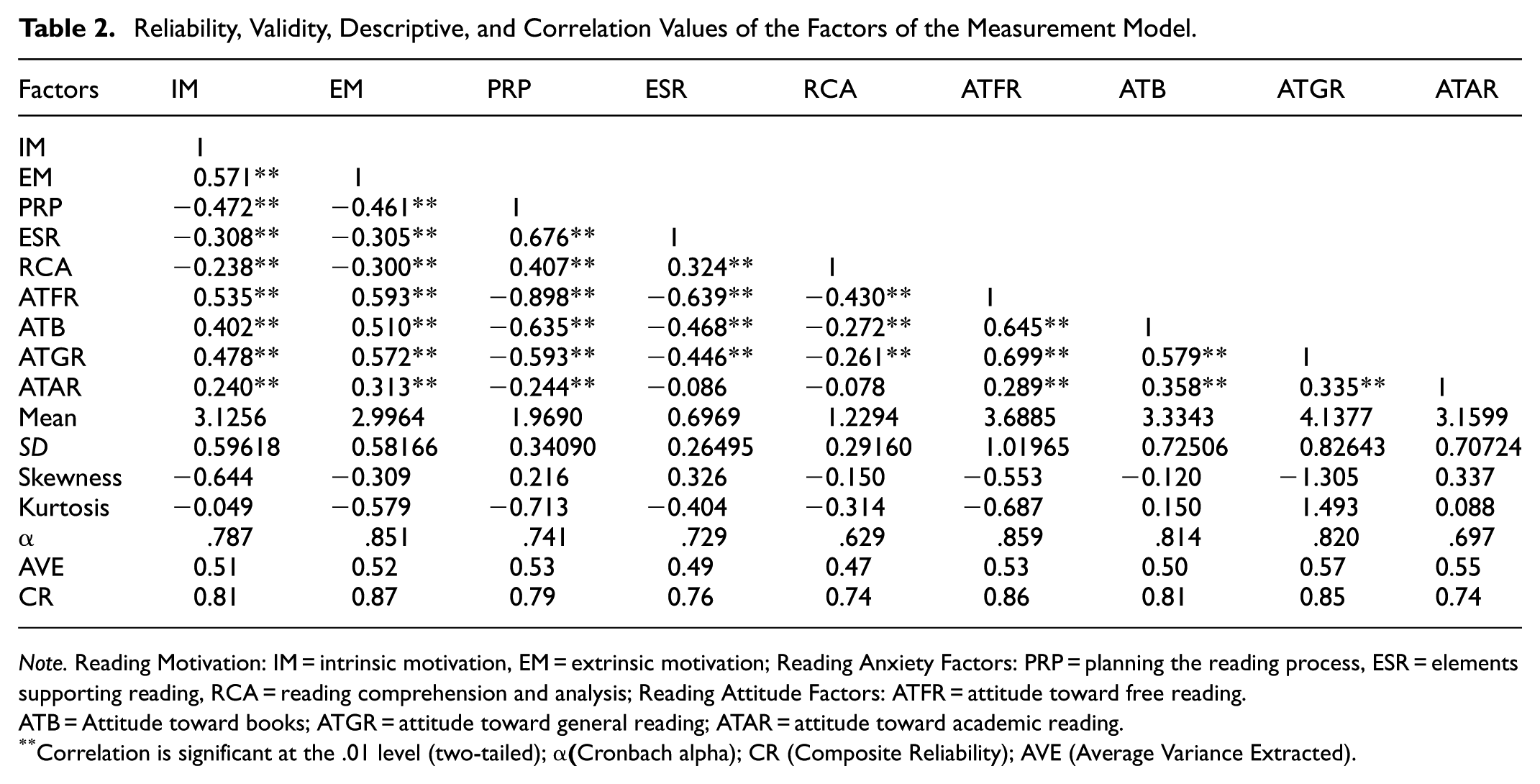
Note. Reading Motivation: IM = intrinsic motivation, EM = extrinsic motivation; Reading Anxiety Factors: PRP = planning the reading process, ESR = elements supporting reading, RCA = reading comprehension and analysis; Reading Attitude Factors: ATFR = attitude toward free reading.
ATB = Attitude toward books; ATGR = attitude toward general reading; ATAR = attitude toward academic reading.
Correlation is significant at the .01 level (two-tailed); α
The validity analysis results indicate that the Fornell-Larcker criterion confirms adequate convergent and discriminant validity. Most constructs exhibit Average Variance Extracted (AVE) values above 0.50 and Composite Reliability (CR) values exceeding 0.70. The correlation values among constructs remain within acceptable ranges, further supporting discriminant validity (Fornell & Larcker, 1981).
In terms of normality, the absolute skewness values range from −1.305 to 0.337, and kurtosis values from −0.713 to 1.493. Since both skewness and kurtosis fall within the ±2 range, the assumption of multivariate normality is satisfied (Kline, 2019).
Correlation analysis reveals that most variables are significantly correlated at the .01 level. Positive correlations indicate direct relationships, while negative correlations denote inverse associations. Constructs related to reading motivation (IM, EM) show significant correlations with both reading anxiety (PRP, ESR, RCA) and reading attitude dimensions (ATFR, ATB, ATGR, ATAR). For instance, ATFR is strongly negatively correlated with PRP (−0.898**) and ESR (−0.639**), suggesting that more positive attitudes toward free reading are associated with lower levels of anxiety related to planning and support.
Reading motivation factors (IM and EM) are positively correlated with each other, as are most reading attitude factors, indicating that higher reading motivation corresponds to more positive attitudes. Conversely, reading anxiety components (PRP, ESR, RCA) show strong negative correlations with reading attitudes, implying that greater anxiety is linked to more negative attitudes. Positive intercorrelations among reading attitude dimensions suggest that favorable perceptions in one area of reading often align with similar attitudes in other domains.
In summary, the data presented in Table 2 demonstrate that the measurement model exhibits acceptable reliability and validity. Moreover, the findings reveal meaningful positive and negative interrelationships among students’ reading motivation, anxiety, and attitudes.
Structural Model Results
The primary criteria to be interpreted in the structural model include model fit indices, path coefficients (β), R-squared values (R2), and the significance of these coefficients. The analysis results show that the model fit indices confirm the validity of the measurement model (χ2 [21, N = 401] = 89.382, p < .01, χ2/df = 4.256; NFI = 0.956; CFI = 0.966; RMSEA = 0.090; SRMR = 0.044). These values indicate that the model fits the data well, with CFI and NFI values above 0.95 and RMSEA below 0.1, indicating an acceptable fit.
Table 3 presents the interpretations of the hypotheses analysis results. The research model selects reading motivation as the independent variable, reading anxiety as the mediator variable, and reading attitude as the dependent variable. Initially, the effect of reading motivation on reading attitude was examined, followed by the mediating role of reading anxiety. The results of the structural model are shown in Figure 2.
Results of Factor Loadings and Path Coefficients.

Note. Reading Motivation: IM = intrinsic motivation, EM = extrinsic motivation; Reading Anxiety Factors: PRP = planning the reading process, ESR = elements supporting reading, RCA = reading comprehension and analysis; Reading Attitude Factors: ATFR = attitude toward free reading. ***p < 0.001.

Model structure and factor loadings of observed variables.
Table 3 shows that reading motivation negatively affects reading anxiety (β = −.620, p < .001). This result supports the hypothesis that reading motivation reduces reading anxiety. Another finding indicates that reading motivation positively affects reading attitude (β = .301, p < .001), supporting the hypothesis that reading motivation enhances reading attitude. Finally, reading anxiety negatively affects reading attitude (β = −.770, p < .001), confirming the hypothesis that increased reading anxiety leads to a more negative reading attitude.
Measurement Model Results
Table 4 presents the results related to the direct and indirect effects of reading motivation, reading anxiety, and reading attitude.
Results of Direct and Indirect Effects Between Variables.

Table 4 shows that reading motivation significantly reduces reading anxiety. Specifically, an increase of one standard deviation in reading motivation leads to a decrease of 0.620 standard deviations in reading anxiety. The R2 value of .384 indicates that reading motivation explains 38.4% of the variance in reading anxiety. This finding reflects a strong negative relationship: higher motivation is associated with lower levels of anxiety.
Reading motivation also has a moderate, positive direct effect on reading attitude. A one standard deviation increase in reading motivation results in a 0.301 standard deviation increase in reading attitude (Direct β = .301, Indirect β = .479, Total β = .780, R2 = .711). This indicates that reading motivation positively affects reading attitude both directly and indirectly, through its impact on reading anxiety. In other words, higher levels of motivation are associated with more positive attitudes toward reading.
Furthermore, reading motivation exerts a significant indirect effect on reading attitude by reducing reading anxiety, with an indirect effect size of 0.479. When both direct and indirect effects are considered together, the total effect of reading motivation on reading attitude is strong and positive (Total β = .780). The R2 value of .711 shows that reading motivation and reading anxiety together explain 71.1% of the variance in reading attitude.
Finally, reading anxiety has a strong negative effect on reading attitude (β = −.774). An increase of one standard deviation in reading anxiety leads to a decrease of 0.774 standard deviations in reading attitude. This reflects a strong negative relationship: higher levels of anxiety are associated with more negative attitudes toward reading.
Discussion
The results of this study show that reading motivation significantly influences both reading anxiety and reading attitude among secondary school students. Specifically, higher levels of reading motivation greatly decrease reading anxiety and promote positive attitudes toward reading, both directly and indirectly. Additionally, the strong negative impact of reading anxiety on reading attitude emphasizes its mediating role in the relationship between motivation and attitude. These findings provide valuable insights into how students’ emotional and motivational experiences are interconnected in reading.
A review of the relevant literature shows that Türkben (2020) found a significant negative correlation between secondary school students’ reading anxiety scores and their reading motivation scores. He noted that as students’ reading anxiety scores increased, their reading motivation scores significantly decreased. Guthrie and Wigfield (1997) stated that students with high levels of motivation read up to three times more than those with lower motivation. Similarly, research has indicated that children with high reading motivation tend to be better readers than those with low motivation (Anderson et al., 1988; Morrow, 1992). The findings of the present study also revealed a positive relationship between reading motivation and reading attitude. Several studies suggest that individuals with a positive attitude toward reading are more likely to be proficient readers, while those with a negative attitude tend to have lower reading efficiency (Açıkgöz & Güngör, 2006; Çakıcı, 2007). Based on these findings, it is reasonable to suggest that reading anxiety might mediate the relationship between reading motivation and reading attitude. Indeed, the results of previous studies support the findings of this current research.
When examining the relevant literature, Katrancı and Kuşdemir (2016) identified a weak, negative, and significant relationship between fourth-grade students’ reading anxiety and their reading comprehension and main idea identification skills. Baki (2017), in his study on the effects of reading habits on reading attitudes and anxiety among middle school students, found that reading anxiety and reading attitude significantly and directly influence reading habits. Furthermore, he reported that reading habits are affected both directly and indirectly by reading anxiety, while reading attitude has a direct effect on reading habits. P. H. Chen (2019) concluded that reading anxiety is the strongest predictor of reading comprehension, followed by extrinsic reading motivation, whereas intrinsic motivation does not directly predict reading comprehension. He also discovered that English language learners with high motivation (both intrinsic and extrinsic) and low anxiety achieved the best reading outcomes. Conversely, those with low motivation and high anxiety tended to perform poorly. These results support the findings of the current study, suggesting that high reading motivation correlates with lower reading anxiety. Marzuki et al. (2021) explored the impact of anxiety on learning motivation among 11th-grade students at SMAN 4 Palu, Indonesia, and found that anxiety did not significantly influence students’ learning motivation. This finding does not align with our study’s results; however, since it focuses on general learning motivation rather than reading-specific processes, differences are to be expected. Basco and Han (2016) investigated university students learning English, examining the effects of self-esteem, motivation, and anxiety levels, as well as their interrelationships. Their results revealed a positive relationship between self-esteem and motivation: students with high self-esteem also exhibited high motivation. Additionally, a strong negative correlation was found between self-esteem and anxiety, indicating that higher self-esteem is associated with lower anxiety levels. Z. Chen et al. (2021) found that university students’ reading strategies significantly predicted their reading motivation. In a study by Alpayar and Gürsoy (2021), a model was proposed to examine the mediating role of test anxiety and cooperation in the relationship between motivation and reading comprehension. The findings showed that test anxiety and cooperation partially mediated this relationship. Furthermore, direct relationships indicated a positive and significant correlation between motivation and comprehension, as well as between cooperative learning and reading comprehension. Bakkaloglu (2023) investigated the relationships among fourth-grade students’ reading anxiety, digital reading motivation, attitudes toward the Turkish course, and reading comprehension. The results demonstrated a significant negative correlation between reading anxiety and comprehension, and a significant positive relationship between attitudes toward the Turkish course and digital reading motivation. These findings support the current research, reaffirming that anxiety negatively correlates with comprehension, while attitudes positively relate to motivation. Xie and Huang (2024) aimed to explore the mediating role of online reading motivation in the relationship between reading anxiety and online reading comprehension among first-year high school students. The study revealed a significant negative correlation between reading anxiety and both online reading motivation and comprehension, as well as a significant positive association between online reading motivation and comprehension. These findings are consistent with the current study. Moneba and Lovitos (2024) examined the relationships among reading attitude, motivation, and reading comprehension among primary school students. They observed that, although reading attitude and motivation levels were high, students’ comprehension scores were low. Additionally, there was no significant relationship between reading attitude and comprehension, and only learning motivation predicted reading comprehension.
Furthermore, the literature contains numerous studies investigating the link between anxiety and various language skills. Wu (2011), for instance, found a connection between reading anxiety and language anxiety and reported that students with lower anxiety levels performed better on reading comprehension assessments. Likewise, Jafarigohar and Behrooznia (2012) documented a negative relationship between reading anxiety and reading comprehension. Adnan et al. (2020) identified a negative correlation between anxiety and listening comprehension, noting that increased anxiety impairs students’ ability to understand spoken texts. Mardianti et al. (2021) also observed a negative relationship between reading anxiety and reading comprehension. In his study, Oflaz (2019) examined the link between language learning anxiety and academic success. He found that students with low anxiety levels achieved higher end-of-year grades compared to those with moderate and high anxiety. Based on her 2021 research, Esen-Aygün determined that reading anxiety significantly influences reading comprehension skills. According to Carpenter et al. (1995), high anxiety levels negatively affect the brain’s comprehension process, harming reading ability. These studies suggest that organizing different group activities can help reduce language learning anxiety among students. Allowing students to communicate with various partners and providing practice in language skills within the classroom can create a comfortable learning environment and lower anxiety levels. This can, in turn, support improvements in students’ motivation and attitudes toward reading. Çevik et al. (2019) found that as parents’ education levels increase, students’ reading anxiety decreases. Therefore, parents responsible for their children’s education should aim to improve their own educational levels, stay actively involved in their children’s learning process, and offer proper guidance related to reading. This approach not only helps decrease students’ reading anxiety but also positively impacts their motivation and attitudes toward reading.
When examining studies related to reading anxiety and educational level, it is observed that as parents’ educational level increases, reading anxiety decreases (Alisinanoglu & Ulutas, 2003; Durkan & Ozen, 2018; Katrancı & Kuşdemir, 2016; Kuşdemir, 2019; Ozen & Durkan, 2016; Yenilmez & Özbey, 2006). The higher educational levels of parents, who are primarily responsible for students’ education, can have a positive effect on their active involvement in their children’s education, and on guiding them correctly in reading.
As a result, previous studies have mainly explored the relationships between reading motivation and reading comprehension, reading anxiety and reading comprehension, and motivation and anxiety, reporting findings similar to those in this study. However, no earlier research was identified that examined whether reading anxiety acts as a mediating variable between reading motivation and reading attitude. This study found that reading anxiety indeed functions as a mediating factor in the relationship between reading motivation and reading attitude. Based on these results, it is suggested that, in educational settings—particularly in language teaching—teachers can leverage the mediating role of reading anxiety between reading motivation and reading attitude when designing reading-related activities. Reducing students’ reading anxiety could lead to increased reading motivation. As motivation rises, students are more likely to develop positive reading habits, which may, in turn, foster more favorable attitudes toward reading. This process can support the development of effective reading skills and habits in students. Consequently, the findings from this study are believed to contribute not only to academic literature but also to the improvement of educational practices.
Conclusion
This study examined the interrelationships among affective factors closely related to reading skills. The results indicate that reading anxiety negatively predicts reading motivation and reading attitude. Additionally, a positive relationship was found between reading motivation and reading attitude. It was also established that reading anxiety mediates the relationship between reading motivation and reading attitude, meaning that when reading anxiety is low, the effect of reading motivation on reading attitude is more substantial. The structural model obtained in the study explained 71% of the variance in reading motivation, demonstrating a considerably high level of explanatory power compared to similar studies in the literature. This indicates that the variables included in the model provide a strong theoretical and empirical basis for understanding reading motivation.
Consequently, it has been demonstrated that the reading-related anxieties experienced by middle school students learning their native language can influence their motivation and attitudes, both positively and negatively. Therefore, reducing students’ reading anxiety may help them manage other affective processes and directly and indirectly impact reading success. Increasing students’ reading motivation could be a significant strategy for reducing anxiety and improving attitudes toward reading. Furthermore, managing reading anxiety may be a key way to enhance students’ reading success, as it directly and indirectly affects reading attitudes. This study makes a unique contribution to the literature by specifically focusing on the mediating role of reading anxiety and explaining the holistic relationships among the variables affecting reading motivation through a structural model.
Recommendations
This research established a model exploring the psychological processes related to reading (motivation, anxiety, attitude) among middle school students, revealing the patterns among these processes. Studies in this area can demonstrate the impact of psychological factors on basic skill education, aiding in the development of educational processes and curricula. Future research should incorporate more variables and conduct multi-level analyses to contribute to the field further. Identifying the causes of students’ reading anxiety and developing strategies to alleviate this anxiety is essential. Based on the results of this research, educational policies that focus on students, encourage active participation in class, and promote communication among students should be adopted. Teachers should align their lessons with these policies to help reduce students’ anxiety levels. Additionally, various seminars can be organized to raise parents’ awareness of reading skills. Additionally, incorporating self-efficacy as a mediating variable alongside anxiety could enhance the model. Experimental studies should support methods and techniques to reduce reading anxiety and increase reading motivation and attitude. Finally, systematic reviews and meta-analyses of the relationships between reading anxiety and other psychological variables could elucidate their effect sizes.
Limitations
This study has certain limitations. The data from the scales rely on participants’ self-reports, which can be affected by social desirability and recall biases. Also, because the sample only includes students from middle schools in five Turkish provinces, the findings are not widely generalizable. Moreover, the cross-sectional design limits the ability to draw causal conclusions about the relationships among the studied variables.
Footnotes

Ethical Considerations
Ethical approval for this research was obtained from the Publication Ethics Committee of Van Yuzuncu Yıl University with decision number 2022/24-03 dated November 23, 2022.
Current Themes of Research
Reading Anxiety, Reading Motivation, and Reading Attitude.
Consent to Participate
Informed consent was obtained from all student participants and their legal guardians prior to participation. Participation was voluntary, anonymity and confidentiality were ensured, and the study was conducted in accordance with the ethical standards outlined by the Declaration of Helsinki.
Author Contributions
All authors contributed to the study equally.
Funding
The authors received no financial support for the research, authorship, and/or publication of this article.
Declaration of Conflicting Interests
The authors declared no potential conflicts of interest with respect to the research, authorship, and/or publication of this article.
Data Availability Statement
On reasonable requests, the datasets of the current study are available from the first author.