




Abstract
L2 reading attitude has been the subject of more recent studies in English as a Foreign Language (EFL), and many have attempted to define this construct and find its correlates such as gender and L1 and L2 proficiency level. This study builds on the previous studies and aims at highlighting the connection between L2 and L1 reading attitudes and the degree L2 reading attitude contributes to L2 reading achievement in Iranian EFL context. Participants of the study included 230 male and female Iranian language learners roughly at intermediate level of English reading proficiency. L2 and L1 reading attitudes were measured using reading attitude questionnaires, and data were analyzed by employing descriptive statistics, correlation coefficient, and regression analysis. Results showed that L1 and L2 reading attitudes were highly correlated (r = .71); L1 reading attitude significantly explained 51% of the variance in L2 reading attitude, but between the L1 and L2 reading attitudes, only L2 reading attitude made unique significant contribution to L2 reading achievement. Findings suggest the importance of developing positive attitude among L2 learners generally and L2 readers particularly.
Keywords
Introduction
For all students—foreign language learners in particular—reading has been the main channel for acquiring academic knowledge. This shows that we should attach great importance to how reading is viewed as a skill by learners. Alexander and Filler (1976) define reading attitudes as “a system of feelings related to reading which causes the learner to approach or avoid a reading situation” (p. l). Understanding the role of readers’ attitudes is important in that attitude may affect the level of ability ultimately attained by a given student through influencing factors such as engagement and practice. Attitudes toward reading are formed through past experiences related to reading, educational background, cultural belief, and success and failure in reading (Day & Bamford, 1998). McKenna, Kear, and Ellsworth (1995) found that positive attitudes turn negative as children get older. This is more evident in children who experience difficulty in reading. Therefore, success or failure in reading is affected by reading attitudes.
In addition, cultural norms, values, and expectations are among other factors affecting reading attitudes. For example, girls have been found to be better readers than boys (McKenna et al., 1995). This can be associated with cultural expectations individuals have formed in society regarding their gender. There are many studies reporting more positive attitudes in females than males (Logan & Johnston, 2009; McKenna et al., 1995; Worrell, Roth, & Gabelko, 2007). In another study, McKenna, Conradi, Lawrence, Jang, and Meyer (2012) found that females reported more positive attitudes for academic reading while males reported more positive attitudes toward recreational readings. This shows that text type and genre also influence reading attitude. Different reading attitudes may be observed in different sociocultural contexts.
However, the literature reveals inconsistent results regarding the relationship between reading attitude and reading achievement. Martinez, Aricak, and Jewell (2008) investigated the relationship between reading attitude, reading ability, and reading achievement among 76 American elementary children. The findings showed that both reading ability and reading attitudes significantly predicted reading achievement. Lazarus and Callahan (2000) measured reading attitudes among children with learning disabilities and found that they had favorable reading attitudes. They concluded that attitude may not be associated with reading ability. In another study, it was reported that more able readers had more positive attitudes toward reading (Wigfield & Asher, 1984). Kush, Watkins, and Brookhart (2005) found that poor readers with positive attitudes kept their positive attitudes despite experiencing challenges with reading. Interestingly, reading attitudes generally decline as individuals advance in school.
Most of the studies mentioned above deal with L1 reading attitudes while research on L2 reading attitudes has been the concern of several researchers (e.g., Camiciottoli, 2001; Day & Bamford, 1998; Yamashita, 2004). Kamhi-Stein (2003) investigated the relationship between the L1 and L2 reading strategy used and how beliefs about L1 reading affect L2 reading behavior among four L2 college readers of Spanish and English. She concluded that students’ beliefs about home language and reading affect their behavior. For instance, those who viewed their L1 as an asset translated L2 reading into their native language purposefully. She believes that more research is needed to examine the relationships between beliefs about reading and reading processes. In a study by Yamashita (2004) on 59 Japanese university students, the findings showed that reading attitudes are generally transferable between first and second languages but with different transferability degree. She identified four variables for reading attitude (comfort, anxiety, value, and self-perception), with the value (what person thinks) as a variable more transferable than comfort, anxiety, or self-perception (what person feels). She concluded that merely thinking that reading is beneficial does not bring enough motivation to read. Her study demonstrated the importance of reading attitude (particularly how one feels about reading attitude both in L1 and L2) in improving L2 reader’s involvement. In a later study, Yamashita (2007) investigated the transfer of reading attitudes from L1 to L2 in Japanese students and found that Japanese students had different L1 and L2 reading attitudes. Regression analysis indicated that a significant proportion of L2 attitudes could be explained by L1 reading attitude. Yamashita (2007) warned against the generalizability of the findings due to English as a Foreign Language (EFL) context of Japan and also several methodological limitations of the study.
Although no accurate report has been released regarding the amount of reading done by Iranians, a few reports point to the inadequate amount of reading done by young Iranians. Some have reported an amount of reading between 6 and 7 min per day while another reports 7 min of reading per day. A variety of factors can be associated to this little amount of reading among which can be attitude toward reading. The present study is another attempt to shed more light on the role of L1 and L2 reading attitudes as represented in the following research questions:
To find answers to the above research questions, the following methodological issues were taken into account.
Method
Participants
The participants of the study included 230 male and female English language learners studying at various language institutes in the North Khorasan province of Iran. Most were aged between 18 and 28 years and had a variety of education levels. Based on the results of a Cambridge Preliminary English Test (PET) as well as the proficiency level reported by the learners, their level of English reading proficiency was at the intermediate level. The results of the PET are shown in Table 1.
Statistics of Reading Scores on the 230 Language Learners.

Note. PET = Preliminary English Test.
Instruments
To achieve the aims of the study, three instruments were used: (a) a reading proficiency test, (b) L1 and L2 reading attitude questionnaires, and (c) a reading achievement test. What follows is the description of these three measures.
PET
A PET was administered to make sure that learners were homogeneous with respect to their reading proficiency. PET is a qualification in EFL developed by Cambridge ESOL. The test measures the overall language proficiency of test takers up to B1 level of Common European Framework of Reference for Languages (CEFR) corresponding to the traditional level of intermediate language proficiency. As the participants of the study had just started studying English at intermediate level, this test could well serve the purpose of the study. It is worth noting that because the variables under study were related to foreign language reading and that reading performance was one of the variables, only the reading section was used in the study.
L1 and L2 reading attitude questionnaires
The present study is aimed at investigating the connection between L1 and L2 reading attitudes. The needed data were collected through L1 and L2 reading attitude questionnaires, adapted from Lee and Schallert (2014) and targeted attitude components proposed by Mathewson (1994), that is, feeling (affective), evaluative beliefs (cognitive), and action readiness (conative). Based on the factorial report by Lee and Schallert (2014), the scales consisted of five factors, namely, cognitive attitudes, conative attitudes, negative affect, anxiety, and self-assessment. According to Lee and Schallert (2014), cognitive factor is related to the intellectual, practical, and linguistic values of reading; conative factor to the actual behavior of readers; and negative affect and anxiety to negative feeling about reading and self-assessment to students’ perceptions of their reading competence (see Tables 4 and 5 to find each item of the questionnaires and the respected factors). Both of these measures were in Persian to prevent any misleading information due to possible English linguistic deficiency by participants. For each item, the students rated the extent to which they agree with the statement on a 5-point scale with 1 = not at all true of me and 5 = completely true of me. The original questionnaire contained 30 items which were reduced to 27 in L1 reading attitude questionnaire after revision, but it remained the same in L2 reading attitude questionnaire. To remove any concerns regarding the reliability of the two scales, they were both piloted on a sample of 30 EFL learners. Table 2 displays the statistics obtained after administering the two scales to the pilot sample.
Descriptive Statistics of the L2 and L1 Reading Attitude Scale.

As seen in Table 2, mean score of L1 reading attitude is less than L2 reading mean score, which may be construed as the more positive attitudes of the participants toward L2 reading rather than L1 reading. However, this should also be remembered that they were voluntary EFL learners. This means that they held positive attitudes toward L2 learning as they were willing to learn English voluntarily. Cronbach’s alpha indicated an index of .86 and .74 for internal consistency of L2 and L1 reading attitudes, respectively.
Reading achievement test
The reading achievement test used in the present study was the standard reading test used by language institutes. The reading comprises three passages, which were similar to the reading passages covered during the instruction period. Totally, the test contained 15 multiple-choice questions assessing students’ inferencing ability, main idea extraction, lexical inferencing, and sentence and general comprehension. To have a better psychological effect on students and have a better comparability impression with PET scores, the obtained scores were multiplied by 3. Therefore, the minimum score could be 0 and maximum score could be 45. The result of this test was used to calculate the predictability power of L1 and L2 reading attitudes in explaining the L2 reading achievement.
Procedure
After consulting various private institutes and getting their consent for using their students as participants of the study, selection of the participants started. Based on the agreement between the researcher and the language institutes, the researcher promised to keep the name of institutes and students confidential. The institutes were asked to provide the researcher with a list of their intermediate students. Through consulting the list of intermediate students, 304 students were selected as the initial pool of participants of the study. Students sat for the PET, and after scoring students’ paper, students whose scores fell between +1 and −1 standard deviation were selected as the legitimate subjects of the study. This was to make sure they are roughly homogenized in terms of L2 reading ability. In total, 230 students out of 304 students were chosen to participate in the study. Next, students completed the L2 and L1 reading attitude measures after receiving proper guidance and instructions on how to complete the measures. To score the measures, students’ responses to each item were assigned a value, ranging from 1 to 5. The value 1 was an indication of total absence of the truthfulness of the item, and a value of 5 indicated the complete truthfulness of the item for individuals. All the scores of the items were added up to reach the total score of each person regarding their reading attitudes. A high score was an indication of positive attitude and a low score was an indication of less positive attitude toward either L2 or L1 reading attitudes. The collected data were fed into the SPSS 16 data editor sheet and analyzed through descriptive statistics, correlation, and multiple regression function of the software.
Results
The first question of the study was about any relationship between the L1 and L2 reading attitudes of Iranian students. To start investigating such relationship, initially, L1 and L2 reading attitude scores of the participants of the study were dealt with in details. The results of descriptive analysis indicated that, as in the pilot study, students had higher mean score in L2 reading attitude than in L1 reading attitude.
As is evident in Table 3, students had a mean score of 79.69 (SD = 21.20) for L2 reading attitude, while they had a mean score of 72.86 (SD = 19.42) for L1 reading attitude, with students’ scores being more dispersed in L2 reading attitude than in L1 reading attitude. Detailed statistics of the L2 and L1 reading attitude items are displayed in Tables 4 and 5, respectively. The mean scores in Tables 4 and 5 have been ordered in a descending manner, which means that the cognitive factor (items in cognitive factor) received the highest scores and the conative factor (items in conative factor) received the lowest scores in L2 reading attitude scale. In other words, students were more positive toward the intellectual, practical, and linguistic values of L2 reading (cognitive factor) and were less positive toward actual behavior of L2 reading (conative factor).
Descriptive Statistics of L1 and L2 Reading Attitudes.

Item Statistics of the L2 Reading Attitude.

However, the highest scores in L1 reading attitude were related to items from cognitive and conative components of L1 reading attitude and again the lowest number was related to items from cognitive factor as well as negative feelings. In other words, the intellectual, practical, and linguistic values of L1 reading were among both the most positively and least positively viewed components of L1 reading (see Table 5 for more detailed statistics of L1 reading attitude items). A simple comparison between L1 and L2 reading attitude items reveals that although the least positively viewed items of L2 reading attitude were conative items, conative items in L1 reading attitude in most of the cases were viewed highly positive. This contradiction can be attributed to EFL context of Iran which makes L2 reading behavior and access to the appropriate materials and texts less convenient compared with the situation for L1 reading.
Item Statistics of the L1 Reading Attitude.
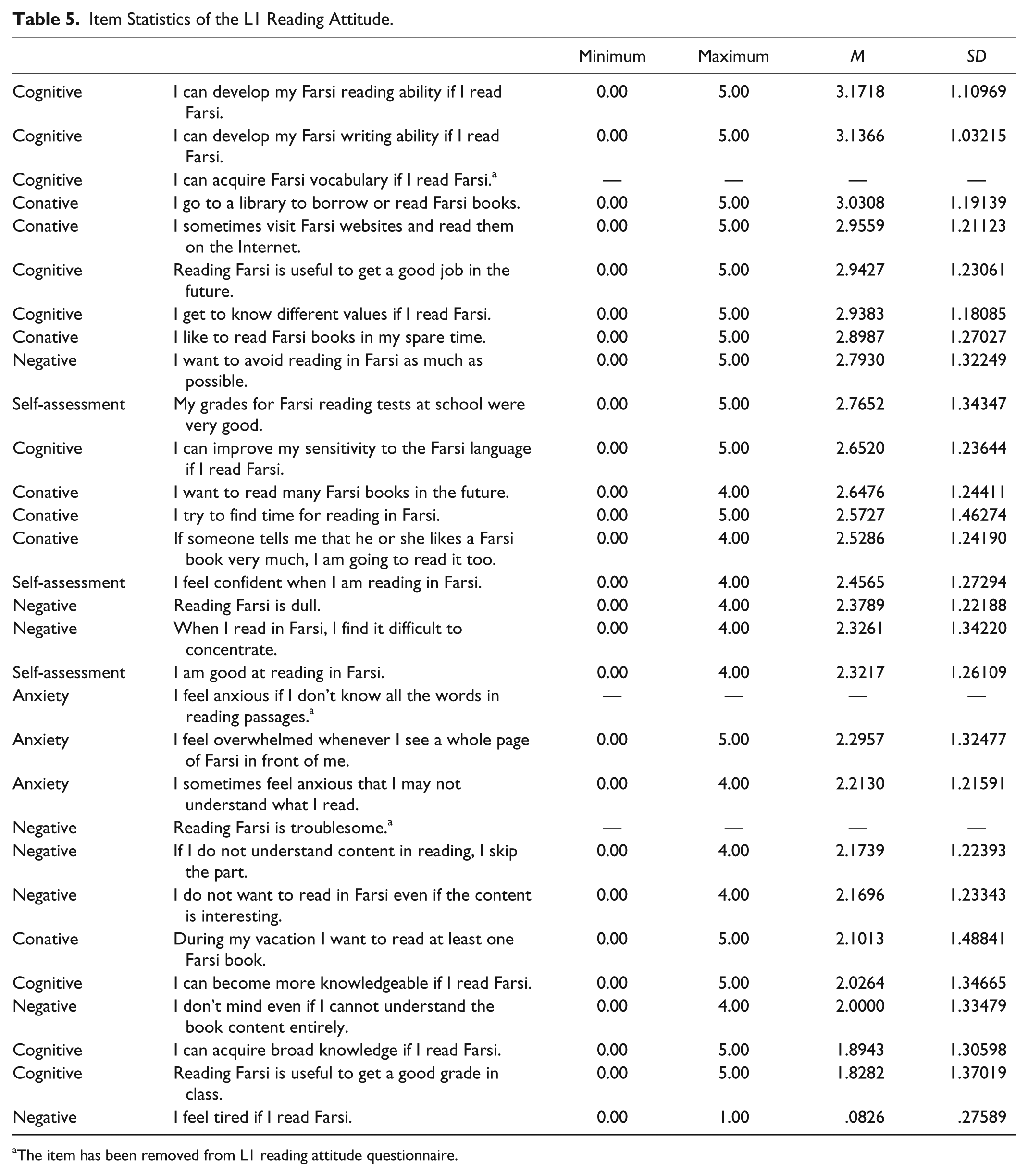
The item has been removed from L1 reading attitude questionnaire.
The differences mentioned above were the most observable ones based on mean scores of the items. However, it was intended to explore the possible relationship between L1 and L2 reading attitudes as well, which needed to be documented through appropriate statistical tests. Accordingly, a Pearson correlation formula was used to investigate the relationship between L2 and L1 reading attitudes. Table 6 shows the results of the Pearson correlation coefficient between L1 and L2 reading attitudes.
Results of Pearson Correlation Coefficient Between L1 and L2 Reading Attitudes.

Correlation is significant at the .01 level (2-tailed).
According to the Pearson correlation coefficient output, L1 and L2 reading attitudes were significantly related, r(230) = .71, p ≤ .05. This relationship was found to be positive; therefore, any increase in L1 reading attitude corresponds to an increase in L2 reading attitude.
Another aim of the study was to understand how well L1 reading attitude predicts L2 reading attitude, which was explored through regression analysis. Due to the fact that regression analysis enquires certain assumptions to be met, first, prerequisite assumptions of regression analysis were dealt with. According to Pallant (2010), multicollinearity, normality, linearity, homoscedasticity, and independence of residuals are prerequisite assumptions for carrying out regression analysis. The above assumptions were checked by consulting variance inflation factor (VIFs) for multicollinearity, and normal probability plot (P-P) of the regression standardized residual and the scatterplot for normality, linearity, homoscedasticity, and independence of residuals assumptions.
After establishing the prerequisite assumptions for regression analysis, the output of regression model was consulted. As Table 7 shows, L1 reading attitude significantly predicted L2 reading attitude, β = .74, t(228) = 15.41, p < .001. L1 reading attitude also explained a significant proportion of variance in L2 reading attitude, R2 = .51, F(1, 228) = 237.58, p < .001 (see Table 8). Accordingly, it can be concluded that L1 reading attitude can significantly predict L2 reading attitude.
The Contribution of L1 Reading Attitude to the L2 Reading Attitude.

Note. VIF = variance inflation factors.
Proportion of Variance in L2 Reading Attitude Explained by L1 Reading Attitude.

Predictor (constant), L1 reading attitude.
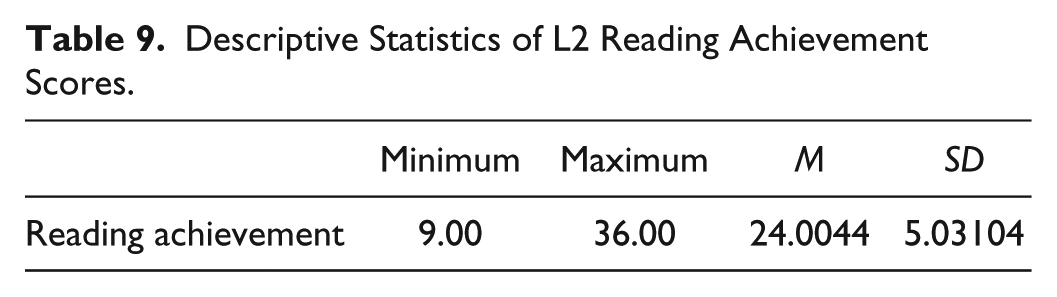
The third research question asked how well L1 and L2 reading attitudes predict L2 reading achievement. According to the obtained results from L2 reading achievement test, participants of the study scored a mean of 24.00 (SD = 5.03) with the maximum score of 6.00 and minimum score of 36 (see Table 9).
Descriptive Statistics of L2 Reading Achievement Scores.
To find the answer to the third research question, again regression analysis was sought after examining the prerequisite assumptions of multiple regression analysis by checking VIF normal probability plot (P-P) of the regression standardized residual and the scatterplot. After establishing the prerequisite assumptions for regression analysis, the output of regression model was consulted. As Table 11 shows, L1 reading attitude did not make a unique and significant contribution to L2 reading performance, β = .04, t(228) = 0.31, p > 0.05. However, L2 reading attitude made a unique and significant contribution to L2 reading performance, β = .29, t(228) = 1.99, p > .04 (see Table 10). Totally, L1 and L2 reading attitudes explained a significant proportion of variance in L2 reading performance, R2 = .11, F(2, 221) = 13.63, p ≤ .01 (see Table 11). Therefore, it was concluded that L1 and L2 reading attitudes significantly predict L2 reading performance.
The Contribution of L1 Reading Attitude and L2 Reading Attitude to the Prediction of Reading Ability.

Note. VIF = variance inflation factors.
Proportion of Variance in L2 Reading Performance Explained by L1 and L2 Reading Attitudes.

Discussion
The purpose of the study was to understand how L1 and L2 reading attitudes are connected and how these two explained L2 reading achievement. Based on the results of the analysis, it was found that L1 and L2 reading attitudes are highly correlated (r = .71) and L1 reading attitude significantly explained 51% of the variance in L2 reading attitude. Both L1 and L2 reading attitudes accounted for 11% of the variance in L2 reading achievement, but, among the two, only L2 reading attitude made unique significant contribution to L2 reading achievement. This may point to the differences in the kind of attitudes (cognitive, conative, etc.) Iranian EFL learners hold toward L1 and L2 reading. With respect to the strong relationship between L1 and L2 reading attitudes, various explanations can be put forward. Such a strong relationship can be attributed to values Iranian society put on reading and literacy. Mastashari and Khodamhosseini (2004) reported that Iranians in the United States are the most educated and one quarter of Iranians aged above 25 and living in the United States have at least a graduate degree.
It can also be hypothesized that L1 and L2 are related and this relationship affects the reading attitudes as well. In this regard, previous research also supports the relationship between L1 reading and L2 reading and also between L1 reading attitude and L2 reading attitude. This interrelationship between L1 and L2 has been considered both theoretically and empirically. For instance, in the theory of Interdependence Hypothesis developed by, for example, Cummins (1979, 1991), one of the underlying constructs that join L1 and L2 reading has been considered common underlying proficiency which posits that the cognitive skills developed in L1 have the capacity to be transferred into L2. It can be argued that such transference can happen to reading attitude and beliefs. Alexander and Filler (1976) defines reading attitude as “a system of feelings related to reading which causes the learner to approach or avoid a reading situation” (p. 1), and Smith (1990) defines it as “a state of mind, accompanied by feelings and emotions, that make reading more or less probable” (p. 215). Accordingly, there is high possibility that if a person who has positive attitudes toward reading in L1, he or she has similar attitudes toward reading though the desire of the person to read L2 texts may diminish due to L2 language deficiency and the related challenges.
In addition, the Threshold Hypothesis (Alderson, 1984; Cummins, 1979) stated that to develop a second language, a certain level of L1 knowledge is needed. Both Threshold Hypothesis and Interdependence Hypothesis provided the ground for justifying the relationship between the L1 and L2, which consequently paves the way for a second justification, and that is the transference of attitude from L1 to L2.
As shown in the “Results” section of the present article, a strong relationship was found between L1 and L2 reading attitudes. In other words, those who generally believe that L1 reading is beneficial to them (cognitive attitude), have positive feeling toward it (affective attitude), or are involved with actual reading behaviors may transfer the same attitudes to the L2 reading. The strong relationship between L1 and L2 reading has also been documented by various researchers (e.g., Lee & Schallert, 1997; Pichette, Segalowitz, & Connors, 2003; Schoonen et al., 1998), and interestingly, most of these relationships existed among the L2 readers with higher language proficiency, which supports the Threshold Hypothesis. In a meta-analysis done by Jeon and Yamashita (2014), they found 10 predictors of L2 reading among which L1 reading was one of them. With respect to empirical studies directly related to L1 and L2 reading attitudes, two pioneer works (Yamashita, 2004, 2007) on the relationship between L1 and L2 reading attitudes also indicated that L1 reading attitudes are transferrable to L2 reading.
Apart from the relationship between L1 and L2 reading attitude, the first difference observed was related to the highest mean scores of items between the L1 and L2 reading attitudes. With regard to L2 reading attitudes, students viewed most positively the cognitive merits of L2 reading or the intellectual and linguistic benefits of L2 reading. However, it was the combination of cognitive and conative perspectives that viewed positively in L1 reading motivation. Such differences between L1 and L2 reading attitudes have also been reported by Yamashita (2007). Among the reported differences, Yamashita also pointed to the fact that students believed that more practical benefits could be obtained from L2 reading rather than L1 reading. Considering the nature of cognitive benefits of reading attitudes, one can infer that this element of attitude corresponds to the instrumental kind of motivation (Gardner, 1985) and extrinsic motivation (Noels, Pelletier, Cl_ement, and Vallerand, 2000). Gardner (1985) relates instrumental motivation to the potential pragmatic benefits of L2 proficiency like job promotion or achieving higher grades, and Noels et al. (2000) talk about sources of motivation external to learner (tangible benefits) as one of the sources of motivation. As “motivation is the one of the main determinants of second/foreign language achievement” (Dornyei, 1994, p. 273), it is not unexpected that L2 reading attitude with highest mean score of cognitive attitude best predicted L2 reading achievement. This analysis suggests the close association between motivation and attitude in L2 reading similarly taken into account by Tremblay and Gardner (1995) in their second language motivation model.
In the L1 reading attitude of Iranians, conative attitude received more attention. Now the question is whether higher scores of conative attitude could contribute to prediction of L2 reading due to high correlation coefficient between L1 and L2 reading attitudes. The answer can be both yes and no regarding the fact that, first of all, the relationship between L1 and L2 reading attitudes has not always been straightforward and, second, mere conative attitude or the actual reading behavior particularly of L1 could not be interpreted as the positive internal desire toward reading. Simply mentioning that I go to library for reading L1 texts does not mean that the person is interested in reading. Instead, it may come from certain responsibilities expected of students like academic assignments. This points directly to one of the limitations of quantitative analysis too as it does not provide enough space for more dynamic and interpretative investigation. Moreover, the presence of positive attitude may not necessarily lead to more L2 reading, and there are demotivating factors as well causing adverse effects on L2 reading behaviors (Falout, Elwood, & Hood, 2009). For instance, one may hold a positive attitude for the practical and intellectual benefits of L2 reading, but certain obstacles like undesirable reading environment may prevent him or her from focused and continuous reading.
Conclusion
Based on the results of the present study, L1 and L2 reading attitudes are strongly related and L1 reading can contribute to L2 reading, which suggests invaluable implications for education system. The implications could be more emphasis on L1 reading and literacy as well as increased awareness for valuing reading and the related components. Based on research findings, phonological awareness in L1 contributes to literacy development in L1 and L2 (Durgunoglu, Nagy, & Hancin-Bhatt, 1993; Quiroga, Lemos-Britton, Mostafapour, Abbott, & Berninger, 2001). In this regard, it is suggested that more research is needed to identify the areas most common between L1 and L1 reading. Studies on the nature of reading seem very enlightening in that various components in L1 and L2 reading could be associated and explored. For instance, topical knowledge may have positive role in linking the L1 and L2 reading as topical knowledge has been reported an important component of reading comprehension in L1 (Johnston, 1984; Recht & Leslie, 1988) and L2 (Brantmeier, 2005; Johnson, 1982; Krekeler, 2006).
Moreover, positive L2 attitude contributed to L2 reading in the current study which points to the importance of developing positive attitude among L2 learners generally and L2 readers in particular. The results of the study also suggest that the use of more qualitative approaches to attitude research is necessary to obtain richer data with more explanatory power.
Footnotes
Acknowledgements
Here I feel committed to thank Jenna Oelschlegel Alpagot for her help with language editing of the article. Her comments and revisions made the reading of the article easier and smoother.
Declaration of Conflicting Interests
The author(s) declared no potential conflicts of interest with respect to the research, authorship, and/or publication of this article.
Funding
The author(s) received no financial support for the research, authorship, and/or publication of this article.