




Abstract
The role of inventory management is pivotal to improving the overall firm performance, but when it comes to the healthcare sector, then it becomes more crucial. This sector often countenances stocks-outs for life-saving drugs and equipment and competent staff that ascent the mortality rate. Thus, the current research aimed to analyze the effect of knowledge on firm performance through inventory management. For this research, a survey questionnaire with a deductive approach was utilized by collecting data from 200 respondents through multistage cluster sampling. IBM SPSS AMOS version 22.0 as a statistical tool was utilized to analyze the measurement model. Results of this research revealed a significant and positive mediation effect on the relationship between knowledge and firm performance. Finally, the results showed that the professionally well-equipped staff, accurate inventories, and stock availability improves the service quality and reduce the cost. Academicians, researchers, provincial healthcare ministries, state-funded organizations, and hospitals will all benefit from this research, which will also add to the current body of knowledge.
Keywords
Introduction
A firm performance, especially in healthcare organizations, involves many stakeholders; like government, clinicians, patients, and public sector organizations (Hashmi, Amirah, Yusof, & Zaliha, 2020), which creates the evident distinction of healthcare from other services in terms of performance (Shabbir et al., 2016). Public healthcare facilities have little managerial autonomy to act as absolute conformity on public health issues (Hashmi, Amirah, Yusof, & Zaliha, 2020). Furthermore, unaccountability, maladministration, and resource mismanagement are associated with public sector healthcare facilities (Silva & Ferreira, 2010).
Subsequently, the importance of healthcare services, in Pakistan RS168 billion are allocated to primary healthcare in the 2015 to 2016 budgets (Rashid et al., 2019). Despite that, the Punjab Institute of Cardiology was exposed to 46,000 high risks and 112 deaths because of the expired and out-of-stocked batches of restorative medicines in December 2015. Consequently, the department has to make a hasty purchase of RS. 5.6 billion, all along with RS 56 million to provide compensation to the expired victims’ families. Furthermore, the country’s 149th position in the world’s healthcare reflects the severity of the situation (Rashid & Amirah, 2017). A vital attribute of any healthcare sector is to deliver high-quality performance in a sustainable way not only to capacitate but also to increase the value of healthcare services. Therefore, there is a need to conduct research in Punjab’s public healthcare to facilitate and support the healthcare system. The current study aimed to uncover the strategic importance of certain elements through the identification of the direct and indirect impact of knowledge through inventory management on firm performance.
Research Questions
This study will uncover the strategic importance of certain elements and the following questions will address the problem statement in further detail:
Defining the effect of inventory management on firm performance.
Defining the mediating role of inventory management between the relationship of knowledge and firm performance.
Literature Review
Knowledge and Inventory Management
Several authors like Rehman et al. (2019) postulated that knowledge is constructive if a firm is practicing alteration in the workforce, inventory control planning, and inventory policy. Therefore, detailed knowledge of resource handling is a necessity to avoid waste and unnatural causes (Aroge & Hassan, 2011; Klein et al., 2022; Kovač-šebart et al., 2022). Yaghi et al. (2008) and Huque and Vyas (2008) supported the argument that staff should implement what they learned. Singh and Kumar (2010) urged that stressing hiring skilled staff results in good control over inventories. Moreover, understanding the law is crucial, and training is a source of enlightenment. While Achua (2011) found that public sector organizations are unwilling to adopt online systems due to a lack of competencies and knowledge that impedes organizational performance. Conversely, knowledge enhances the performance of a novice for a particular role or job (Guo & Zhang, 2022; Lamjahdi et al., 2020; Lueck & Peek, 2012; Steensma & Groeneveld, 2010).
Naidoo and Wu (2011) researched 570 inventory control experts from New Zealand, Australia, the United States, and the United Kingdom and established that the designated staff could professionally plan and control the inventory effectively if knowledge had been imparted to them. Though the knowledgeable labor force is a preference of every business, and implausible unskilled and non-professional staff negatively influences the business from planning to execution (Dragoni et al., 2011). Moreover, Cook et al. (2011), and Ruankaew and Williams (2013) described that sometimes staff with (knowledge even show reluctance to have active participation and cause inventory inaccuracy. Therefore, researchers urge the learning environment at the workplace. Moreover, a complex inventory control system requires a clear understanding and professional qualification (Castejón-Limas et al., 2011), and may also require assistance from other staff members to understand processes, design complexity, and business policies (Birkinshaw & Heywood, 2010). Therefore, to understand the complex inventory control models, certain principles or theories adoption is imperative for professional knowledge acquisition. However, relevant knowledge may be critically required in some business problems (Dragoni et al., 2011).
Knowledge and Firm Performance
To operate effectively and to understand organizations better, learning skills is an essential job. The growing demand for learning skills, specifically or at the organizational level, is getting more attention. Learning skills come from schools, universities, business advisers to governments, bodies representing the business community, and senior business leaders. Knowledge development benefits teams, performance, and productivity of individuals. Further, knowledge enhancement also proved job satisfaction, enhance career opportunities, build coalitions, reduce employee turnover, and improved organizational commitment (Bing et al., 2011; Gallagher & Laird, 2008; Jam et al., 2011; Valle & Perrewé, 2000). Researchers recommended that knowledgeable employees are strategic assets, and they should mentor their subordinates. Subsequently, performance does not happen randomly but is a combination of motivation, relevant knowledge, skills, and individual domains. Despite differing paradigms, the importance of a knowledgeable workforce is common (Huselid & Becker, 1996). Ferris et al. (2007) and later cited by Sheehan et al. (2016) argued that knowledge influences self and firms’ performance.
Inventory Management and Firm Performance
Sustainable firm performance is imperative and is closely linked with organizational goals and mission (Mohrman & Edward, 2014). Moreover, inventory management is indispensable for small businesses as well as for large-scale businesses. Effective inventory management can enhance the strategic competitiveness of any organization (Chopra & Meindl, 2013; Fattah et al., 2016; Hartley et al., 2002). Various companies control inventory by adopting various techniques by confirming the lowest cost and product availability (Bin-Syed et al., 2016). For better performance and due to the expensive and largeness of inventories, it is necessary to dodge superfluous costs by understanding and supporting inventory management.
Theories suggest that for enhanced performance, effectiveness of inventory management avoids stock pile up, inventory inaccuracy, obsolete inventory, and profligate. Also, evade funds tied down, stock-out, theft, holding cost, reduced utilization of equipment or machines, and obsolescence or spoilage (Beier, 1995; Buffa, 1983; Ondari & Muturi, 2016). Therefore, effective inventory management is among the key features for success, whereas, ineffective inventory virtually disrupts profitability, productivity (Hatefi et al., 2014), and loss of shareholders’ wealth (Hendricks & Singhal, 2003, 2005). Organizations must neither maintain excessive inventory to avoid tying down funds and carrying costs nor maintain too low inventories as these two conditions always affect firm performance. That’s why giant firms need rigor efforts for enhanced performance as inventory may alone involve a cumbersome amount of invested capital to keep the firm’s wheel moving (Araujo et al., 2016; Hatefi et al., 2014). Many researchers instigated that ineffective inventory management can prompt incomplete supplies (Ku et al., 2014), which upshot hasty buying and stimulates poor performance (Silver et al., 1998).
Knowledge, Inventory Management, and Firm Performance
Knowledge creation and knowledge transfer are imperative to improve staff skills. More explicitly, skills development involves transferring, retaining, interpreting, acquiring, and creating knowledge (Garvin et al., 2008), and these attributes got empirical attention (Alipour et al., 2011). Generically, firms mimic those companies that are successful in implementing a knowledge base. It helps them to legitimate for better performance (Tsai & Lasminar, 2021). Conversely, if knowledge flow is blocked, then it will confine to a single division and will not support enhancing other parts of the organization (Dee & Leisyte, 2017). The knowledgeable and professionally qualified staff helps to improve inventory management and should be considered in conjunction with influencing factors affecting organizational outcomes (Boxall, 2012; Sheehan et al., 2016).
Townsend et al. (2012) expressed that knowledgeable staff substantially contributes to performance outcomes and allows inventory functions to augment organizational performance. However, empirically this attribute has not been examined thoroughly (Galang & Ferris, 1997; Sheehan et al., 2016). Ogbo and Ukpere (2014) stated that a firm must educate its staff to reach optimal inventory levels. Consequently, the role of inventory management is increasing, and understanding the right vendor, the right time, the right price, the right quantity, and the right purchasing could only be possible with knowledgeable professionals.
H1: Knowledge has a significant effect on firm performance.
H2: The effect of knowledge on firm performance is significantly mediated by inventory management.
Relevant Theory
As the theories are imperatively being applied in the realm of supply chain management (Alrazehi et al., 2021; Hsu et al., 2009; Rashid et al., 2020). This research employed RBV Theory to build the framework for the present study, which includes one predictive variable, one dependent variable, and one mediator. There are two hypotheses in the created model, one of which is the direct hypothesis (H1), and the second is related to mediation (H2).
In quantitative research, theories are critical for answering research questions (Creswell, 2014; Hashmi, Amirah, Yusof, & Zaliha, 2020; Hashmi & Tawfiq, 2020). As a result, the effect of variables was determined using the Resource-Based View (RBV) Theory. Further, theories are imperative for answering the research questions (Creswell, 2014). Thus, in the present research, the effect of variables was determined by using the RBV Theory. The work of Barney’s (1991) “Firm Resources and Sustained Competitive Advantage” gave birth to RBV Theory. This theory was developed on the basis of Wernerfelt’s (1984) “Resource Position Barriers.” RBV Theory has two main assumptions; (i) organizational resources within an industry may differ, and (ii) those resources may not be totally movable across firms. RBV Theory focuses on resources and capabilities, which include the well-organized procedures/processes, conventions, investment, equipment, tools, expertise, abilities, and staff data (Wernerfelt, 1984). RBV Theory overwhelms the inventory control intricacy over recognizing the considerable resources that enhance the firm performance. Further, RBV Theory helps firms in amplifying agility, compliance, and ally with the supply chain management requirements. Firms’ unique resources, allocation strategy, and limited ability not only create a competitive edge for the firm but also enhance its performance (Walker & Brewer, 2008).
Data Analysis
Positivist research philosophy is applied in the current quantitative research (Creswell, 2014). In addition, an interval scale as a survey method was used to test the proposed hypothesis in this research (Hashmi, Amirah, Yusof, & Zaliha, 2021; Rashid, 2016). IBM SPSS 22.0 version is used to measure the Exploratory Factor Analysis (EFA) whereas, researchers used AMOS version 22.0 to measure the Confirmatory Factor Analysis (CFA) and Structural Equation Modeling (SEM). Furthermore, different sample sizes were used to conduct the CFA and EFA analysis (S. K. Khan et al., 2021; Rashid et al., 2021; Worthington & Whittaker, 2006). For EFA, data of 100 respondents, and for CFA data of 200 respondents using a multistage cluster sampling procedure was used. The total number of healthcare units in Punjab was clustered into nine divisions, and a sampling frame of 343 facilities was drawn from one district of each division. Later, 200 respondents were chosen at random from the selected populations (J. F. J. Hair et al., 2010; Hashmi, Amirah, & Yusof, 2020, 2021; Hashmi & Tawfiq, 2020). Additionally, the demographic characteristics of respondents were also tested to check the pragmatic impacts before being tested to EFA, CFA, and SEM analysis (Agha et al., 2021; Das et al., 2021; Hamed et al., 2021; Haque et al., 2021; Hashmi, Amirah, Yusof, & Zaliha, 2021).
Exploratory Factor Analysis (EFA)
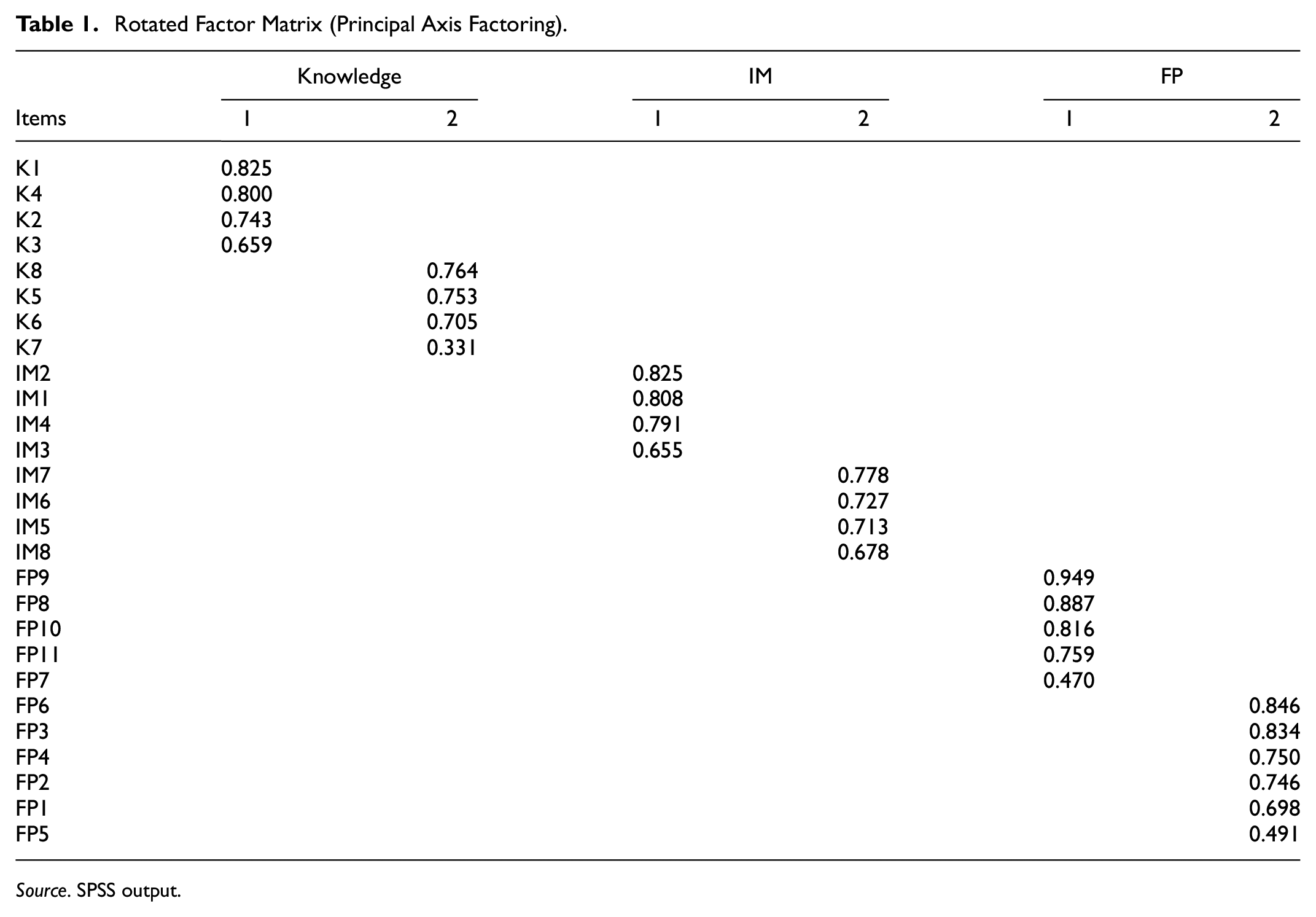
Table 1 shows 27 items in the rotated factor matrix for each variable on Varimax rotation using principal axis factoring (Tabachnick & Fidell, 2013); where three items (K7, FP7, FP5) with factor loadings <0.60 were deleted. Lastly, eigenvalues of one a total of 23 items were retained with (cross-loadings more than 75% on any other item (Field, 2013; J. F. J. Hair et al., 2010). The Kaiser-Meyer-Olkin (KMO) for knowledge, inventory management, and firm performance was waster than 0.60 (acceptable) (Rashid & Amirah, 2019); and Bartlett’s test of sphericity was found significant (Field, 2013). The communalities scores were greater than 0.2, with the exception of one item in knowledge (0.147), which was deleted (Child, 2006). The 60% of the total variation was explained by the first two factors of each construct (Hashmi, Amirah, Yusof, & Zaliha, 2020).
Rotated Factor Matrix (Principal Axis Factoring).
Source. SPSS output.
Respondents Demographics
The results of the demographic distribution of a sample were with male contributions accounted for 91.5% (n = 183) and female contributions accounted for 8.5% (n = 17). The involvement of respondents with respect to various age groups for the current study was 70.5% (n = 141) for 20 to 30 years, 25.5% (n = 51) for 31 to 40 years, and 0% (n = 8) for 41 to 50 years. Moreover, 154 (77%) respondents were single, while 23% (n = 46) were married. A total of 17 respondents (8.5%)were holding master’s degrees, 94 (47%) with bachelor’s degrees, 26% (n = 52) diplomas, 11.5% (n = 23) high school diplomas, and 14 (7%) were holding other degrees. At the last, 6% (n = 12) of respondents had less than 2 years of experience, 43.5% (n = 87) had 2 to 5 years of experience, 26.5% (n = 53) had 6 to 10 years of experience, 16.5% (n = 33) had 11 to 15 years of service, and 15 respondents (7.5%) had 15 years or more of service.
Descriptive Statistics
On a five-point Likert scale, the mean and standard deviation for each item was examined. The items and constructs produced acceptable results (SD = 0.760, M = 4.02; SD = 0.797; M = 3.95; and SD = 0.849, M = 4.01 for IM, knowledge, and FP, respectively). The rating scale indicated that the majority of respondents feel that knowledge and inventory management are critical to firm performance (Hashmi, Amirah, Yusof, & Zaliha, 2021; Rashid, 2016).
Confirmatory Factor Analysis (CFA)
Three latent constructs and six sub-constructs were validated using a second-order measurement model with pooled CFA. According to Hashmi, Amirah, Yusof, and Zaliha (2020), if any construct has less than four items then a pooled CFA is best in use. After that, unidimensionality, validity, and reliability were examined as part of the validation process.
Unidimensionality
Unidimensionality is a concept that can be used to explain a set of indicators (J. F. J. Hair et al., 2010). The results of the Maximum Likelihood Estimator are shown in Figure 1 (MLE), where the items T7 and SQ5 (factor loading <0.60) were removed from the lowest loading to the highest one by reconducting the test to attain unidimensionality (Hashmi, Amirah, Yusof, & Zaliha, 2020). Subsequently, by removing two items, the loadings ranged from 0.771 to 0.951, with redundant items in AMOS output (Hashmi, Amirah, Yusof, & Zaliha, 2021; S. Khan et al., 2022).
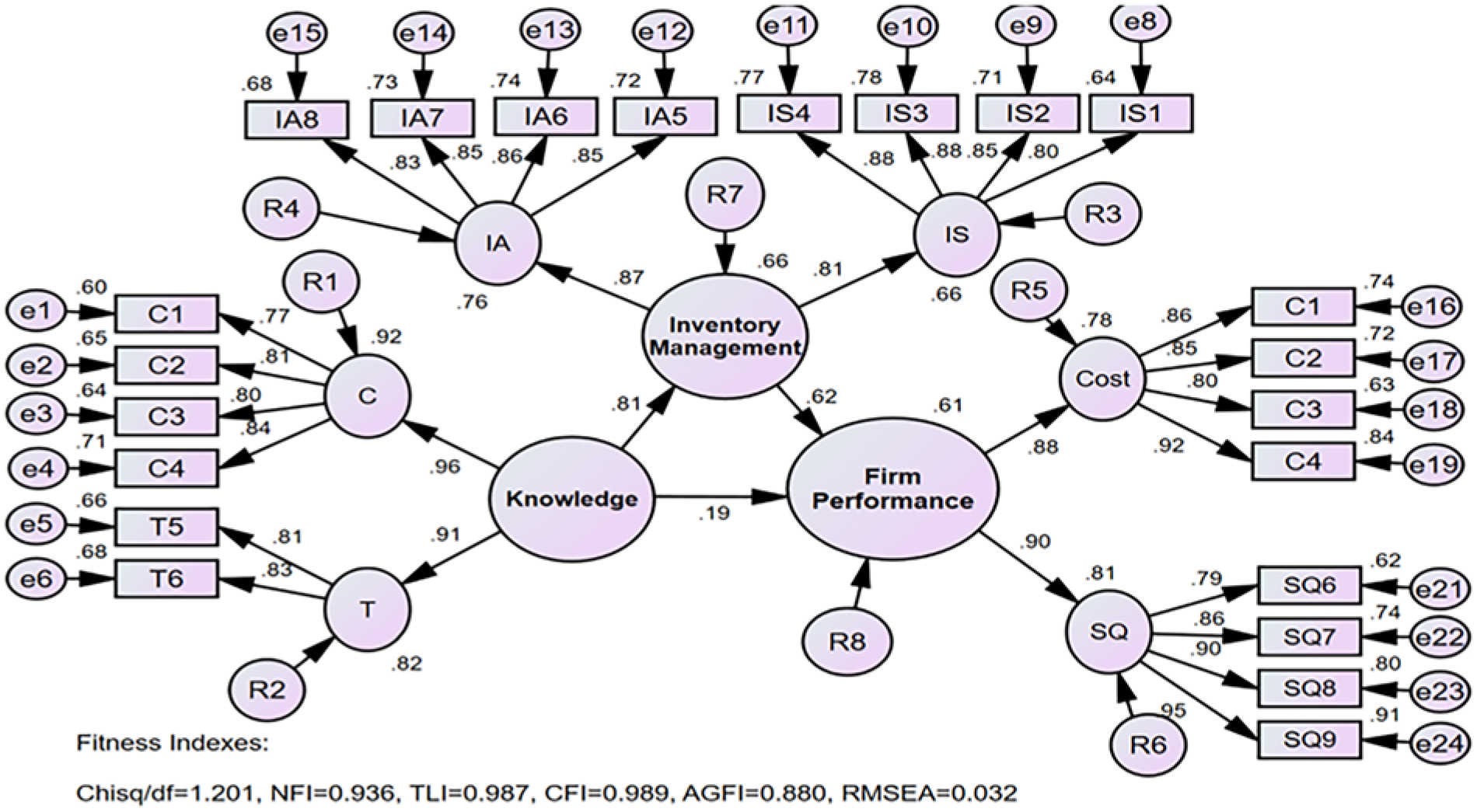
Structural equation modeling.
Constructs Validity
Convergent and discriminant validity of the construct is essential in order to measure the models’ validity (Henseler, 2012). To determine the extent of accuracy of the latent construct represented by the observed items construct validity test was used (Hashmi, Amirah, Yusof, & Zaliha, 2020). Fitness indices tested the construct validity and from each index, at least one category was chosen (J. F. J. Hair et al., 2010). The results of fitness indices are 1.201 for Chi2/df value for Parsimonious fit, NFI = .936, TLI = .987, CFI = .989, and AGFI = .880 for incremental fit, and RMSEA = .032 for absolute fit. The results show that for each category, all of the fitness indices have been met (Bagozzi & Yi, 1988; Bentler & Bonett, 1980; J. F. J. Hair et al., 2010; Jöreskog & Sörbom, 1993; Kline, 1998; Steiger, 1990)
Cronbach alpha (α) was measured by using the reliability test and the obtained values are shown in Table 2 ranging from .903 to .941. The researchers also calculated the Composite Reliability and the values obtained ranged from .831 to .929 which means greater than .70, results also revealed the factor loading values greater than 0.070 (J. F. J. Hair et al., 2010). Further, the AVE that varied from .711 to .867 (>.50) for convergent validity, has also adequately met the test assumptions (J. F. Hair et al., 2013; Hashmi, Amirah, Yusof, & Zaliha, 2020).
Validity Results.

Source. SPSS and AMOS output.
Note. C = competency; T = training; IS = inventory stocks; IA = inventory accuracy; SQ = service quality
Discriminant Validity
Table 3 summarizes the findings, with the square root of each construct’s AVE, where the diagonal scores are higher than the scores in the columns and rows. As a result, multicollinearity is not an issue, and the model attained discriminant validity (Hashmi, Amirah, Yusof, & Zaliha, 2021). After meeting the test assumption of unidimensionality, convergent validity and reliability, and discriminant validity; the normality test was performed and found skewness and kurtosis between −1.0 and +1.0 (Hashmi, Amirah, Yusof, & Zaliha, 2021).
Discriminant Validity.

Structural Equation Modeling (SEM)
Table 4 shows the SEM results for hypotheses H1indicating that knowledge significantly predicts FP (Std β = .682). In addition, IM is a strong predictor of FP (Std β = .779) than knowledge (Std β = .682). In addition, Critical Ratios (C.R) are >1.96 explaining the significance of relationships (J. F. J. Hair et al., 2010). These results have also fulfilled the required assumptions to test the mediation (Hashmi, Amirah, Yusof, & Zaliha, 2020).
A Path Analysis.

Source. AMOS output.
p < .001.
Hypotheses Testing
Primarily, the direct effect of knowledge on firm performance (path a to c), then the indirect effect of knowledge on firm performance via inventory management (a to b and b to c) was measured (Hashmi, Amirah, Yusof, & Zaliha, 2020). It is shown in Table 5 the std β significantly predicts the direct and indirect path. This level of significance is required in order to continue investigating the mediation effect. Meanwhile, after including the mediator (IM) in the structural model, the path c′ reduced from 0.682 to 0.191. The results show that the mediation is occurring and the path coefficient of the indirect path is more significant, showing full mediation type (Field, 2013; Hashmi, Amirah, Yusof, & Zaliha, 2020). Thus, results proved the mediation effect of inventory management between knowledge and firm performance.
Mediation Results.

p < .05. ***p < .001.
Further, bootstrapping method as proposed by Preacher and Hayes (2008), is another method to assess mediation (Hashmi, Amirah, Yusof, & Zaliha, 2021). Table 5 shows that the hypotheses H2 (indirect effect Std = 0.504) is statistically significant and do not straddle a 0 in between (95% boot CI [0.711, 0.903]), as a result, mediation of “IM” occurs. Besides, the insignificant direct effect suggests the type of mediation is “full mediation.”
R2 and f 2
Figure 1 demonstrates a significant R2 (.61 > .26) (Cohen, 2013); and the model is predicting 61% of organizational performance using knowledge and inventory management. Similarly, knowledge is significantly predicting66 (>.65) percent inventory management (Chin, 1998).
The f2, investigates the effect of latent predictor (independent variable) on the dependent variable (Gefen et al., 2011). The effect size was calculated through
Discussion and Implications
To answer the study hypotheses, an integrated second-order model was tested. The data fit nicely with the proposed model and the following study objectives are expressly stated in the discussion. For hypothesis H1, the SEM analysis revealed a statistically significant and positive effect of knowledge on firm performance. These results are explaining that increased knowledge will increase the firm performance and these two are proportionate. The results are supported by the findings of Hashmi, Amirah, Yusof, and Zaliha (2020). For hypothesis H2, the findings found that inventory management dominantly mediates the knowledge and firm performance. Furthermore, the form of mediation was full mediation. The conclusions of this investigation were consolidated by the findings of Rehman et al. (2019). Additionally, inventory management was having a significant positive effect on firm performance, which means that a higher level of inventory management will result in a higher level of firm performance.
Public firms, especially hospitals play an important role and are the most affected and vulnerable as a result of inventory mismanagement in pharmacy and laboratory services. Therefore, there is a call for significant and relevant research in the healthcare sector. As today’s healthcare needs and expectations are multifaceted, this research tried to cater to the needed investigation which comprehends the given theoretical and practical contribution. Through SEM, a second-order model using three constructs (knowledge, inventory management, and firm performance) was examined and validated added literature to the body of RBV theory. In addition, the mediating effect of inventory management between the relationship of knowledge and firm performance has been verified. This research also added to the current body of knowledge in a way as in studies conducted earlier in the fields of warehousing, logistics, just in time, vendor controlled inventory, and supply chain practices. The topic of inventory management and its significance is still under discussion. As a result, the findings are useful to government agencies, departments in charge of mega-structured organizations, the medicinal sector, and, in particular, private and public healthcare facilities. Furthermore, this kind of a research must be addressed because it is closely linked to two key areas of business studies: inventory management and firm performance. Furthermore, when it comes to the public sector, the characteristics of this study, such as specialized knowledge, inventory stocks, cost and accuracy, staff training, and service quality are all related. As a result, this study can serve to organizations to work on their gray areas.
Conclusion, Limitations, and Recommendations
Current research only looked at three factors, although they may all be discussed using a variety of different variables. Perceptions were used instead of absolute values in this investigation. The study also had limitations, such as a geographically limited study area, time, cost, limited and refused access to restricted evidence, and erroneous and poor record-keeping. Furthermore, contradicting or overlapping system behavior should be eliminated through staff training and enhancing their competency level. Finally, professional qualifications should be prioritized, and skill enhancement programs should be planned in the future to maintain skill levels. Other population designs with different predictors could be used in future studies. The effect of inventory management on fiscal reporting, prominent factors, and how these are related to inventory management can also be empirically tested in the research.
Footnotes
Declaration of Conflicting Interests
The author(s) declared no potential conflicts of interest with respect to the research, authorship, and/or publication of this article.
Funding
The author(s) received no financial support for the research, authorship, and/or publication of this article.
