




Abstract
The present study aims to evaluate a conceptual framework that explains patients’ attachment to a healthcare establishment by considering the effect of a natural/green environment as nature-based solutions (NBS), mental health value, emotional wellbeing, and satisfaction. An online survey method was utilized to reach Romanian patients. Using this procedure, a total of 386 cases were used for the data analysis. Structural equation modeling was utilized as the data analysis method. Our findings reveal that natural/green environment as NBS significantly influences patients’ mental health value, emotional wellbeing, and satisfaction, which contributes to an increase in their attachment to the healthcare facility. In addition, the mediating role of mental health value, emotional wellbeing, and satisfaction is uncovered. Our results can help healthcare managers and researchers develop strategies to effectively integrate natural/green features as NBS in the interior spaces of healthcare settings.
Keywords
Introduction
Healthcare establishments, such as hospitals and medical clinics, have often been associated with fear, anxiety, stress, and uncertainty that may affect the healing process of patients (Dijkstra et al., 2008). In this context, many healthcare facilities sought to incorporate natural/green features into interior spaces to reduce stress and foster patients’ wellbeing and satisfaction (Cervinka et al., 2014; Ulrich et al., 2008). Nature-based solutions (NBS), which is a concept referring to nature as a means for offering solutions to diverse societal and environmental challenges (Han & Hyun, 2019), has therefore received growing attention to date. NBS are increasingly becoming an important phenomenon worldwide, and they have been applied to designing spaces, such as residential areas, commercial and tourist establishments, airports, or urban spaces, to improve human responses and behaviors and enhance the overall quality of human life (Han, Olya et al., 2020).
In the context of healthcare services, greening the physical environment can be a critical instance of NBS application that influences patients’ experience in a healthcare setting. For example, Ryan et al. (2014) claimed that exposure to natural/green features as NBS in a healthcare facility has a positive influence on patient outcomes (e.g., faster recovery time, shortened hospital stays, reduced mental stress/anxiety, and increased pain tolerance) and experience. This influence has additionally been recognized as a contributing factor to increased levels of patients’ mental health and emotional wellbeing during medical visits or treatments in a healthcare setting (Beyer et al., 2014; Han & Hyun, 2019; Soga & Gaston, 2016) as well as reduced risk factors of some types of mental illness (Bratman et al., 2019).
Furthermore, research on access to green spaces in healthcare establishments has suggested that patients should have the most positive and satisfying healthcare experience (Jin et al., 2008). The reason for this suggestion is that patients who are satisfied with care tend to follow medical treatment and, accordingly, are more likely to return to that medical setting in the future. In addition, the qualities of natural/green attributes as NBS in a healthcare establishment have been found to create an environmental atmosphere and certain experiences that foster patients’ attachment to the healthcare setting (Kaplan & Kaplan, 1989). Attachment was investigated in the healthcare literature as a critical construct as it has been associated with better treatment outcomes among patients with chronic illnesses like diabetes, heart disease and cancer, and fewer negative affective symptoms such as depression and anxiety (Porter et al., 2012; Yilmaz Ozpolat et al., 2014). Attachment to a place/building was also found to positively influence individuals’ health and wellbeing (Sampson & Gifford, 2010; Scannell & Gifford, 2017), and life satisfaction (Billig et al., 2006), while other studies (Brown et al., 2003) showed that attachment is a result of a general sense of wellbeing of an individual. In addition, Korpela et al. (2010) emphasized that green environments tend to be common and stable types of favorite places due to their ability to promote mental restoration. Despite the importance of natural/green features as NBS and their significant effects on patients’ experience and satisfaction with healthcare facilities, the possible effects of NBS on patients’ attachment to a healthcare setting are undervalued. Research has also paid extremely little attention to the psychological mediating effects involved in the relationship between the presence of natural/green features as NBS and patients’ attachment to a healthcare establishment. Accordingly, the current study attempts to answer the following question: How might natural/green attributes as NBS and patients’ mental health, emotional wellbeing, and satisfaction relate to their attachment to a healthcare establishment? The objectives that derive from this research question are (1) to examine a conceptual framework explicating patients’ attachment to a healthcare setting by considering the effects of NBS, mental health value, emotional wellbeing, and satisfaction with the healthcare service providers; (2) to investigate the role of natural/green attributes as NBS in boosting patients’ mental health value and emotional wellbeing in healthcare facilities; (3) examine the mediating influence of mental health value, emotional wellbeing, and satisfaction; and (4) identify the salient dimension in fostering patients’ attachment to a healthcare setting. In order to achieve these objectives, the literature review and hypotheses development are presented in the following section. Subsequently, descriptions of the research method and result sections are reported. Theoretical and managerial implications, limitations and directions for future research are provided in the last section of this study. The findings of the present research provide important insights which healthcare facilities managers may use in order to develop efficient marketing strategies designed to increase patients’ attachment to such establishments.
Literature Review
Natural/Green Features as Nature-Based Solutions in the Context of Healthcare Services
Empirical research (Health Building Note (HBN) 00-01, 2014) has indicated that healthcare settings should provide a green/natural environment that facilitates the process of healing, rather than simply being an institution where medical treatment takes place. This change of paradigm signifies that healthcare services and physical environment design processes should integrate not only medical interventions but also the promotion of health and prevention of disease by developing a safe and therapeutic care environment. According to the World Health Organization (WHO, 2018), “environments are considered therapeutic (with healing qualities) when there is direct evidence that a design intervention contributes to improved patient outcomes.” A growing body of research (Annerstedt & Währborg, 2011; Ulrich et al., 2008) has indicated that natural/green healthcare environments can be a positive solution for promoting greater care and wellbeing for patients.
Recently, the concept of NBS has received attention among practitioners and researchers who applied these solutions in designing built environments that enhance the quality of human life (Han, Yu, & Hyun, 2020; Han & Hyun, 2019; Marcel et al., 2019). The concept of NBS has been defined by the European Commission (2015) as solutions that are “inspired and supported by nature, which are cost-effective, simultaneously provide environmental, social and economic benefits and help build resilience.” NBS fulfill the human need for exposure to nature, and several studies have identified the benefits of natural/green attributes as NBS into the built environment on individuals. Greening indoor physical environments in healthcare establishments can be an important example of NBS interventions that influence patients’ experience with such setting and can encourage positive patient responses/behaviors. The green indoor environment in a healthcare facility includes various (a) green features/attributes (e.g., living/potted plants, flowers, trees), (b) green interior decorations (i.e., images of nature, such as pictures/paintings/prints), and (c) natural light through glass windows/walls (Han & Hyun, 2019). These green features will be detailed in the following sections of this study.
Green Features
Vegetation, especially potted/flowering plants, is one of the most applied strategies for bringing nature into a building. Many previous studies have constantly demonstrated the multiple benefits of utilizing green features in a built environment. For example, Qin et al. (2014) emphasized the health and wellbeing benefits of placing plants into the interior areas of buildings. Likewise, Brogan (2015) and Wise (2018) showed that physical benefits resulting from exposure to green spaces include an activated parasympathetic nervous activity, lowered heart rate, lowered blood pressure, increased serotonin levels, restored digestive microbiome, and reduced digestive tract inflammation.
In the context of healthcare services, studies on the effects of indoor plants (Bringslimark et al., 2009; Ferguson, 2010; Spring, 2016) have reported multiple benefits for patients, such as increased pain tolerance, increased reaction time, attentiveness and confidence, decreased fatigue and overall discomfort, and improved physical health. The presence of plants in a healthcare setting has also been found to promote cardiovascular health by reducing stress, anxiety, and depression (van Den Bosch & Meyer-Lindenberg, 2019). Similarly, Ulrich (1984) demonstrated that access to green spaces has a positive effect on patients’ recovery, resulting in a shorter length of stay in hospital and reduced levels of anxiety. Moreover, Ferguson (2010) found that the placement of vegetation/plants in a hospital reception area positively changes occupants’ perception of the space. In particular, a study investigated the effects of plants placed inside a hospital room on patients recovering from surgery and found that these patients took less analgesic medication, reported significantly lower pain intensities and pain distress, and discharged sooner than the patients who stayed in rooms without ornamental indoor plants (Park & Mattson, 2009). Overall, the literature supports the inclusion of plants/vegetation in interior areas of a healthcare establishment to increase in/outpatients’ outcomes and experiences.
Images of Nature
In environments where direct exposure to nature through plants/vegetation may not be possible, such as sterile medical environment, images of nature can provide a connection to the natural world for patients, which have proved to offer the same beneficial outcomes as actual views of nature (Ulrich & Gilpin, 2003). Images of plants, animals, water, ocean, open views of landscapes, mountains, and geological features are common forms of contact between individuals and nature in a built environment (Kellert, 2018). Such images of nature are also a frequently used strategy for enhancing contact with nature by using different media, such as painting, video, photography, computer, and many others (Kellert, 2018).
In healthcare environments, some studies suggested that hospital patients recover more quickly and feel less stressed when they are exposed to various images of nature during the healing process (Parsons, 2007; Velarde et al., 2007). Ulrich et al. (2003) also investigated the benefits of nature images and observed that the stress levels of patients who waited in a room to donate blood were lower when television displayed images of natural/green environments. In addition, Ulrich (2002) demonstrated that pictures of art portraying nature (i.e., flowers, trees, greenery) were perceived as beneficial by inpatients, while pictures of abstract art increased anxiety among those patients. Likewise, Malenbaum et al. (2008) showed that patients who were exposed to artwork depicting realistic nature scenes required less medication and reported significantly less anxiety than other patients.
Natural Light
Light is one of the most basic resources of life and human existence. Exposure to natural light has a significant effect on how individuals react spatially and temporally, orient themselves to their surroundings, and relate to daylight patterns and shifts in the season (Kellert, 2018). Daylight is perceived by individuals as the best source of light with excellent color rendering that offers the best light for human visual comfort (Al Horr et al., 2016). Natural light can be brought into interior spaces by various design strategies, such as glass walls, clerestories, skylights, atria, and mirrors (Kellert, 2018). Exposure to natural light has a positive effect on vitamin D production in the human body, which is necessary to control the body’s circadian rhythms (Joseph, 2006) and has a positive effect on individuals’ health, comfort, and productivity (Al Horr et al., 2016).
Previous studies have investigated the influence of natural light on patients’ recovery/rehabilitation in healthcare establishments (Beauchemin & Hays, 1996; Devlin & Arneill, 2003; Walch et al., 2005). Devlin and Arneill (2003) found that hospital rooms with poor lighting may alter patients’ circadian rhythms, which results in eye fatigue and headaches. Beauchemin and Hays (1996) showed that inpatients diagnosed with severe depression who were placed in sunny hospital rooms recovered more quickly than those who were assigned to dull or shadowed hospital rooms. Walch et al. (2005) observed that patients undergoing spinal surgery who were exposed to increased amounts of natural light experienced less perceived stress and less pain and required less analgesic medication. In fact, Walch et al. (2005) found that the exposure to daylight had positive results on patients undergoing chemotherapy, specifically, it leads to a 22% decrease in the use of analgesics and a 21% reduction in healthcare costs.
Relationships Among Natural/Green Features as Nature-Based Solutions, Mental Health Value, and Emotional Wellbeing
Mental health value and emotional wellbeing have often been investigated in the healthcare literature due to their critical influence on patients’ responses/behaviors. WHO (2009) defines mental health as “a state of wellbeing in which every individual realizes his or her own abilities, can cope with the normal stresses of life, can work productively, and is able to make a contribution to his or her community.” Mental health value represents people cognitive assessment if such mental health conditions improve when engaging a specific behavior (Pietilä et al., 2015). It also reflects a range of positive means in which individuals think and feel about their lives (Seligman, 2002). Individuals with good mental health conditions often have low mental anxiety/worry/stress, strong self-confidence, and a belief that they are valuable people (Kim et al., 2016).
Emotional wellbeing reflects people’s contentment, satisfaction, happiness, and favorable thoughts and feelings derived from their optimal functioning (Sahlin et al., 2012). In the context of healthcare services, emotional wellbeing can be defined as a state determined by the presence of positive emotions and by satisfaction with healthcare settings. For example, Caspari et al. (2011) found that the design of a hospital significantly influences patients’ wellbeing and can generate positive or negative psychological responses of users. Individuals often feel relaxed, peaceful, happy, or refreshed when they experience a service that induces a high level of emotional wellbeing (Han & Hyun, 2019).
A growing recognition exists that a natural/green environment (i.e., indoor green features, images of nature, and natural light) provides a range of benefits for human health and wellbeing (Kabisch & Haase, 2018; Pietilä et al., 2015; Soga & Gaston, 2016; van Den Berg et al., 2015), restores cognitive functions (Berman et al., 2012), improves self-reported health, and facilitates recovery from stress (Tyrväinen et al., 2014). Previous research has also indicated that the green design of a healthcare facility can influence the relationship between the physical attributes of such facility and patients, thereby producing a positive effect on mental health and emotional wellbeing (Jencks & Heathcote, 2010). Smith (2007) found that access to a natural/green environment in a healthcare setting can reduce stress, improve health outcomes, and stimulate a general sense of emotional wellbeing and mental health among patients. A review of health outcomes of natural environment, such as indoor plants and natural light (Beute & de Kort, 2014; Chang & Chen, 2005), revealed that such attributes may help in reducing stress, anxiety, and tension of occupants and in increasing their emotional wellbeing. Likewise, McMahan and Estes (2015) and Berto (2005) found that simply viewing photographs of a natural environment can generate a greater emotional wellbeing and cognitive health restoration among patients when mentally fatigued. Recently, Tanja-Dijkstra et al. (2017) and Sarkar et al. (2018) observed that healthcare professionals encourage contact with natural environment as a solution to improve patients’ mental health and emotional wellbeing, as well as to reduce stress, anxiety, and psychological distress during clinical interventions. Based on the above evidence, the following hypotheses were developed:
Relationships Among Mental Health Value, Emotional Wellbeing, Satisfaction, and Attachment to Healthcare Establishments
Patient satisfaction is defined as “the perception and overall evaluation of the medical service quality, as well as patients’ judgments regarding the process of medical treatment” (Lu et al., 2021). Previous research has found that physical attributes of healthcare setting are significant predictors of patient satisfaction (e.g., Wichrowski et al., 2021). Specifically, healthcare environments that are perceived as comfortable, safe, and pleasing are likely to be rated more highly by patients, which increases their satisfaction (Sadler et al., 2011). Harris et al. (2002) conducted a qualitative study among 380 discharged patients to identify environmental sources of satisfaction with the hospital. They found that physical attributes, such as interior design, ambient environment, presence of artwork, window views of nature, and adequate lighting are classified as a source of overall satisfaction. Other studies indicated that patients who stay in hospital rooms with natural/green features are more satisfied with their rooms than those who stay in rooms without such features (Park & Mattson, 2009; Wichrowski et al., 2021). As patients are becoming increasingly concerned with and are more critical of the healthcare provided, satisfying them and complying with their needs should become an important target for every healthcare establishment.
Attachment to a place is defined as individuals’ emotional attachment to a setting, being linked to feelings of belonging and rootedness (Cleary et al., 2017). In the healthcare service literature, a few studies have indicated that attachment to a place is often affected by the physical environment of the healthcare facility (Knapp, 2020; Maller et al., 2006; Ulrich, 1984). For example, Knapp (2020) suggested that a successful therapy should include provision of a space where patients feel safe and may experience a sense of belonging. This suggestion implies that those patients who return to therapy on a regular basis will develop an attachment to the healthcare facility. Other studies (Maller et al., 2006; Ulrich, 1984) have indicated that individuals’ connection to the natural/green environment is a biologically based condition that can facilitate fast and complete physical and psychological healing. Kellert (2018) observed that an effective natural/green physical environment of a healthcare establishment can generate strong feelings of emotional affection and place attachment among patients. Similarly, Curtis et al. (2007) investigated the effect of a hospital redesign on patients’ wellbeing and found that patients feel more attached to the homely environment of the hospital, referencing features such as the presence of potted plants, large amounts of natural light, and a warm and relaxed atmosphere within the hospital.
People develop emotional attachments to the spaces they occupy when these places consistently contribute to their comfort, physical and psychological/mental health, emotional wellbeing, and satisfaction (Kellert, 2018). Previous research has also indicated that an effective green/natural design of a setting is a significant determinant of occupants’ emotional wellbeing, satisfaction, and connection with that place (Kellert, 2018). In the healthcare service literature, the increased focus on incorporating green features/attributes in designing a physical environment has been demonstrated to have multiple health and wellbeing benefits to patients (Cervinka et al., 2014; Curtis et al., 2007; Zhao & Mourshed, 2012), which significantly enhance their satisfaction with healthcare providers (Ulrich, 2002). Totaforti (2018) also found that hospital rooms with plants and natural light are likely to increase the activity of the parasympathetic nervous system of occupants, thereby encouraging a general sense of emotional wellbeing, which, in turn, contributes to an increase in satisfaction. In addition, previous studies have demonstrated a significant relationship among human health, wellbeing, and attachment to a place (Sampson & Gifford, 2010). Similarly, Russell et al. (2013) indicated that attachment to a place is influenced by a general sense of emotional wellbeing. Xu and Zhang (2016) empirically demonstrated satisfaction with a place is a significant causal antecedent of attachment to that place. Based on this theoretical reasoning, the following hypotheses were formulated:
Methods
Proposed Conceptual Framework
Figure 1 presents the conceptual framework for this study. It encompasses a total of six research dimensions (i.e., green features, natural light, images of nature, mental health value, emotional wellbeing, and satisfaction) as triggers/antecedents of attachment to healthcare setting. In addition, the framework comprises a total of 11 research hypotheses (H1–H11) directly linking the study constructs.

The research conceptual framework.
Measures and Survey Questionnaire
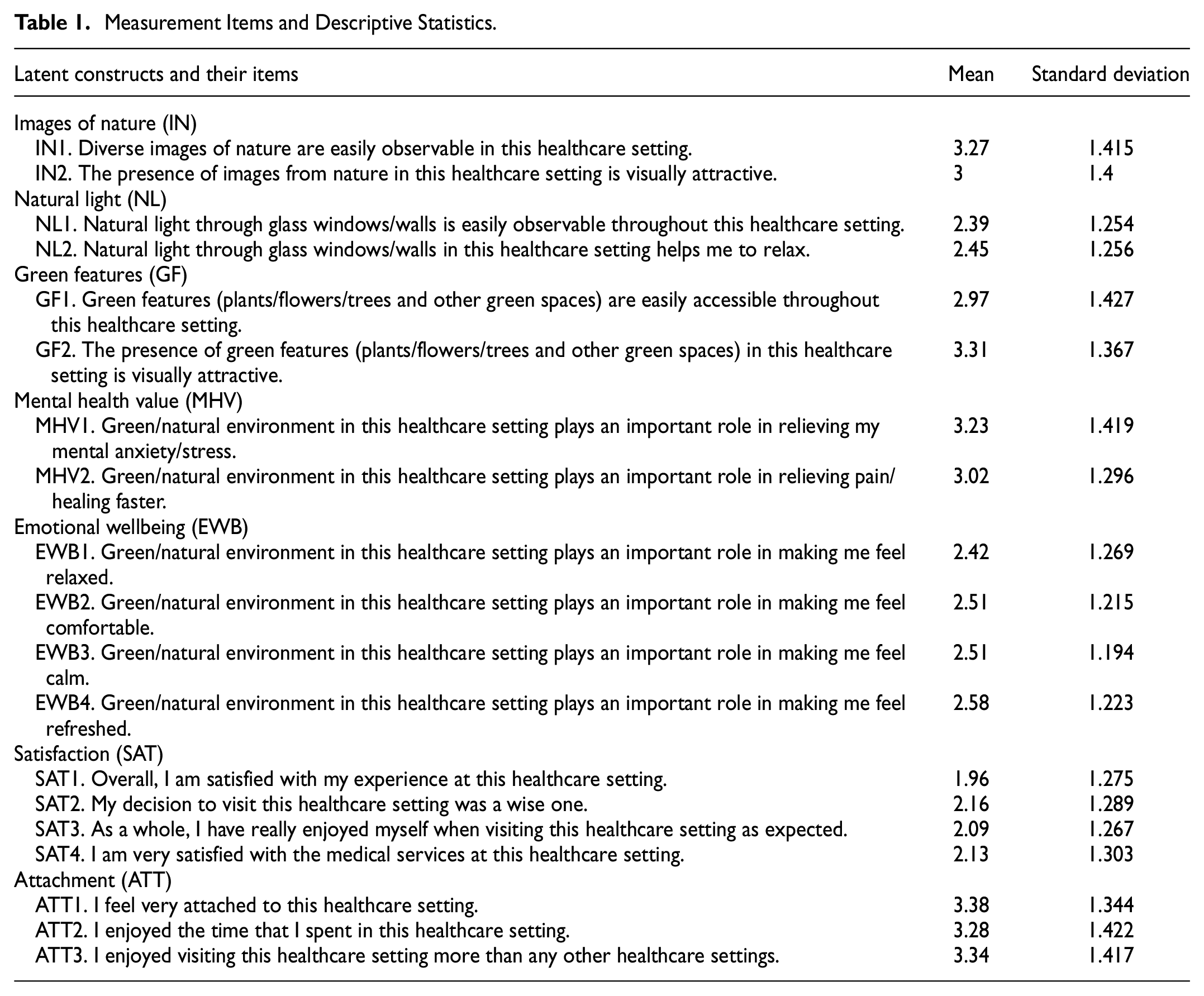
As shown in Table 1, the study variables were measured with multiple items using a 5-point Likert scale, from strongly agree (1) to strongly disagree (5). Six items by Han and Hyun (2019) were utilized to measure natural/green features in the healthcare facility. More specifically, two items were utilized to evaluate the images of nature, two items were used to assess natural light, and two items were utilized to evaluate green features. Mental health value was measured with two items, which were borrowed from Han and Hyun (2019) and slightly modified for the present research. Emotional wellbeing was assessed with four items, which were adapted from Han and Hyun (2019). Satisfaction was measured with four items, which were borrowed from Han and Hyun (2019) and slightly modified for the present study. Three items by Yuksel et al. (2010) were used to measure attachment to healthcare setting. The initial version of the questionnaire was pretested with academic experts and medical practitioners in order to verify that the item wording was explicit and comprehensive. Based on the comments received through their feedback, some items were reformulated in order to clarify the meaning of the sentence. The measurement items for each dimension used in this research are presented in Table 1.
Measurement Items and Descriptive Statistics.
Data Collection Process and Sample Characteristics
The final data was collected through an online survey method to efficiently reach Romanian patients. The survey was conducted for approximately 4 weeks, which was from June 1 to June 30, 2020. Given the difficulty of reaching the target population and due to the quarantine required by the Romanian authorities to prevent the spread of Covid-19 virus, a snowballing sampling technique was employed. The initial sample that was chosen and has consented to participate in the research study consisted of approximately 200 participants. These respondents were invited to fill out the questionnaire through the link provided by e-mail. Subsequently, these participants were requested to provide details of other individuals who are patients of the same or similar healthcare establishments. Through this sampling method, the survey questionnaire was sent to approximately 2,000 subjects. Due to the nature of the snowballing sampling method, the findings of this research, however, cannot be extrapolated to the overall population of Romania. In order to increase the response rate, reminder emails were sent to participants who did not fill out the questionnaire. Before the respondents start to complete questionnaire, a short introduction describing the green features in a healthcare facility was given. As a screening question, only those individuals who had visited a Romanian healthcare setting (i.e., hospitals and/or health clinics) with green/natural features at least once within the last 6 months were requested to participate in the survey. An e-mail survey invitation with a research description was sent to potential respondents; they were requested to click the link leading to the survey questionnaire. Through this procedure, a total of 410 respondents completed the survey. After excluding unusable responses (i.e., due to the incomplete data), a total of 386 cases were utilized for the data analysis, yielding a 19.3% response rate.
Among the 386 respondents in the survey, 41.2% were male and 58.8% were female. The respondents’ age ranged from 18 years old to 66 years old, and the mean age was 31 years. Moreover, 83.4% of the participants indicated that they were college graduates, and 16.6% of the participants were high school graduates. In addition, 26.9% of the survey respondents indicated that their monthly income per family member was 500 Euro or less, and 73.1% of them reported that their income per family member was more than 500 Euro (see Table 2).
Demographic Characteristics of the Sample.

Indicates monthly income per family member.
Data Analysis Procedure
In the present study, the collected data were analyzed using SPSS and AMOS 20. Based on the recommendations of Anderson and Gerbing’s (1988), the conceptual framework was tested using a two-step approach, that is, a measurement model and a structural model. First, a measurement model was estimated using confirmatory factor analysis (CFA) with a maximum likelihood estimation method to ensure the reliability, convergent validity, and discriminant validity of the latent constructs. The measurement model indicates how the observed variables represent constructs (Malhotra et al., 2010). In addition, CFA seeks to confirm whether the number of constructs and the loadings of observed variables on them conform to what is expected on the basis of theory (Malhotra et al., 2010). CFA can be utilized to refine an existing theory, support an existing structure and evaluate a known dimensional structure in an additional population (DiStefano & Hess, 2005). The confirmatory factor analysis is also an effective tool for data quality testing including composite reliability and construct-validity measurements (Hair et al., 2010).
Second, Structural Equation Modeling (SEM) is a standard tool to evaluate how well a proposed conceptual framework explains the collected data (Kline, 2011). It shows how the constructs are related to each other (Malhotra et al., 2010). SEM also combines aspects of multiple regression and factor analysis to evaluate a series of dependent relationships simultaneously, which is not possible using other multivariate techniques (Hair et al., 1998). This multivariate technique is particularly useful for modeling tests including several independent/ dependent factors and mediators/ moderators (Hair et al., 1998). In the present study, SEM was employed to evaluate the hypothesized associations among the research constructs and the mediating effect of mental health value, emotional wellbeing, and satisfaction.
Results
Reliability and Validity Testing
A measurement model assessment was performed. The results of the CFA indicated a satisfactory fit of the model to the data (Goodness-of-Fit Statistics: χ2 = 308.457, df = 129, χ2/df = 2.391, p < .001, RMSEA = 0.060, CFI = 0.976, IFI = 0.977, TLI = 0.969; Table 3). All items (standardized) were significantly loaded to their associated latent construct (p < .01). An estimation of composite reliability revealed that the values ranged from 0.752 to 0.968, which exceeded the criterion of 0.700, as suggested by Hair et al. (2010), demonstrating a strong internal consistency among the items for each construct. For the evaluation of construct validity, average variance extracted (AVE) values were estimated. The results revealed that all AVE values ranged between 0.603 and 0.885, which were greater than Fornell and Larcker (1981) recommended value of 0.50. In addition, all AVEs were greater than the squared correlations between constructs (Table 3). Thus, these results supported the convergent and discriminant validity of our research variables. In addition, Harman’s single-factor test was used in order to estimate common method variance (Harman, 1960). All items were loaded into a factor analysis in SPSS using the unrotated factor solution. The result revealed that a single factor explained 48.537% of the total variance, which is below the threshold of 50%, indicating that common method biases did not significantly influence our findings.
Measurement Model Assessment.

Note. (Goodness-of-Fit Statistics: χ2 = 308.457, df = 129, χ2/df = 2.391, p < .001, RMSEA = 0.060, CFI = 0.976, IFI = 0.977, TLI = 0.969).
Correlations.
Squared correlations.
Standard deviation.
Structural Model Assessment
The proposed conceptual framework was evaluated by using an SEM with a maximum likelihood estimation methodology. As displayed in Figure 2, our results revealed that the model had a good fit to the data (Goodness-of-Fit Statistics: χ2 = 352.024, df = 136, χ2/df = 2.588, p < .001, RMSEA = 0.064, CFI = 0.972, IFI = 0.972, TLI = 0.964). Our conceptual model included an acceptable level of the prediction power for attachment (R2 = .547), mental health value (R2 = .555), emotional wellbeing (R2 = .557), and satisfaction (R2 = .590).

The results of the structural model.
The proposed associations among study constructs were evaluated. The hypothesized impacts of green features on mental health value and emotional wellbeing were assessed (Table 4). As anticipated, green features had a significant and positive effect on patients’ mental health value (β = .376, p < .01) and emotional wellbeing (β = .191, p < .01). Accordingly, H1 and H4 were supported. In addition, the linkages from natural light to mental health value (β = .151, p < .05) and emotional wellbeing (β = .342, p < .01) were positive and significant, thereby supporting H2 and H5, respectively. The effects of images of nature on mental health value (β = .324, p < .01) and emotional wellbeing (β = .344, p < .01) were significant and positive. Consequently, H3 and H6 were supported. Mental health value had a positive and significant influence on attachment (β = .166, p < .01), which supported H9. However, the linkage from mental health value to satisfaction was insignificant (β = .086, p > .05). Therefore, H7 was not supported. The influence of emotional wellbeing on satisfaction (β = .718, p < .01) and attachment (β = .559, p < .01) was positive and significant, thereby supporting H8 and H10. However, the relationship between satisfaction and attachment (β = .096, p > .01) was insignificant. Therefore, H11 was not supported.
The Results of the Structural Equation Modeling, the Hypotheses Testing, and the Mediating Effects.
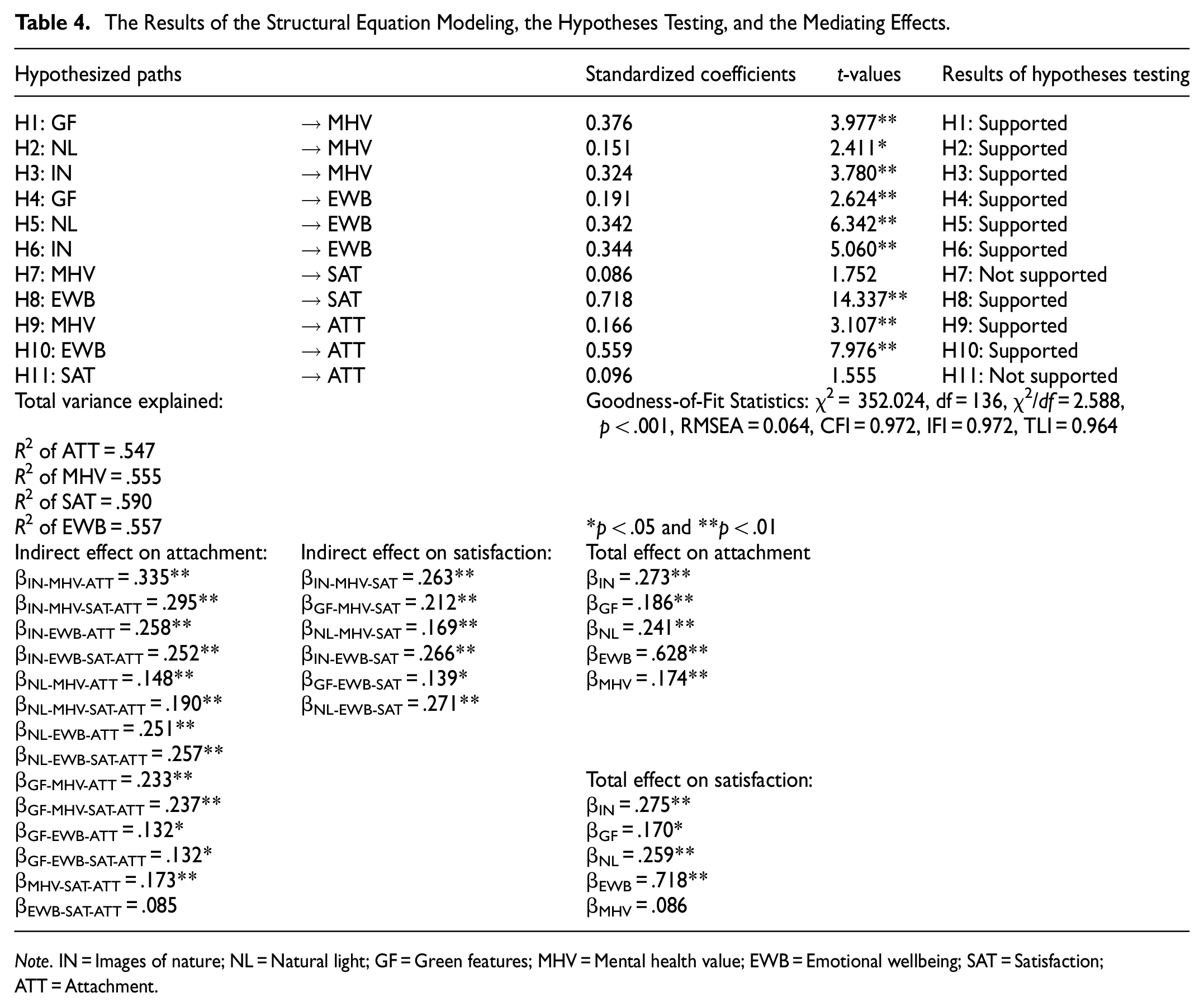
Note. IN = Images of nature; NL = Natural light; GF = Green features; MHV = Mental health value; EWB = Emotional wellbeing; SAT = Satisfaction; ATT = Attachment.
Subsequently, the indirect effects of the study constructs were examined. As shown in Table 4, images of nature (β = .295, p < .01), natural light (β = .190, p < .01), and green features (β = .237, p < .01) had significant influences on attachment indirectly through mental health value and satisfaction. Our findings also revealed that images of nature (β = .252, p < .01), natural light (β = .257, p < .01), and green features (β = .132, p < .05) had positive and significant on attachment indirectly through emotional wellbeing and satisfaction. These results indicated that mental health value, emotional wellbeing, and satisfaction acted as mediators in the present conceptual framework. Similarly, mental health value and emotional wellbeing acted as significant mediators between images of nature and satisfaction (βIN-MHV-SAT = .263, p < .01, βIN-EWB-SAT = .266, p < .01), green features and satisfaction (βGF-MHV-SAT = .212, p < .01, βGF-EWB-SAT = .139, p < .05), and natural light and satisfaction (βNL-MHV-SAT = .169, p < .01, βNL-EWB-SAT = .271, p < .01). Next, the total effect of the study constructs was calculated. Our results indicated that emotional wellbeing had the greatest effect on patients’ satisfaction and attachment (βEWB-SAT = .718, p < .01, βEWB-ATT = .628, p < .01), followed by images of nature (βIN-SAT = .275, p < .01, βIN-ATT = .273, p < .01), natural light (βNL-SAT = .259, p < .01, βNL-ATT = .241, p < .01), green features (βGF-SAT = .170, p < .05, βGF-ATT = .186, p < .01), and mental health value (βMHV-SAT = .086, p > .01, βMHV-ATT = .174, p < .01).
Theoretical Implications
In the context of healthcare services, physical environment plays an important role in shaping patients’ experience and enhancing their satisfaction, as well as behavioral responses (Wirtz & Lovelock, 2018). Some researchers (Han et al., 2018) have also recognized that green/natural environments as NBS generally affect customers’ cognitive/emotional/physiological responses and approach/avoidance behaviors. According to European Commission (2015), natural/green features as NBS provide economic, social, and environmental benefits with respect to improving human welfare, emotional wellbeing, and new business opportunities. The present study sought to address the role of NBS on patient outcomes and whether significant benefits are associated with natural/green features as NBS in the context of a healthcare setting. Our results indicated that the natural/green attributes in the interior spaces of healthcare establishments had significantly positive effects on patients’ mental health value and emotional wellbeing, which, in turn, contribute to the increase in satisfaction and attachment to the healthcare setting. Moreover, the dimensions investigated in the present study (i.e., green features, natural light, images of nature, mental health value, emotional wellbeing, and satisfaction) and their significant and positive relationships were found to be important drivers of patients’ attachment to the healthcare setting, which has not been previously examined. Thus, our results emphasized the critical role of natural/green attributes as NBS on patients’ satisfaction and attachment to the healthcare setting, which fills a gap in the extant body of healthcare service literature. However, academic literature investigating the influence of natural/green features as NBS on patients’ satisfaction and attachment to the healthcare establishment is still relatively rare.
Our results also demonstrated the critical importance of natural/green features as NBS in the interior areas of a healthcare setting to enhance patients’ mental health value and emotional wellbeing. This result is theoretically meaningful because it highlights the important effects of mental health value and emotional wellbeing in fostering patients’ attachment to healthcare providers. In addition, emotional wellbeing was the most salient dimension in generating patient satisfaction and attachment to the healthcare setting. These findings enrich the healthcare service literature because this study, to the best of our knowledge, was the first to be conducted in the healthcare context that measured the effects of natural/green items as NBS on patients’ mental health value and emotional wellbeing. Our findings also showed that the links from green features, natural light, and images of nature to attachment are statistically significant through the mediating influence of emotional wellbeing and mental health value. Theoretically, this finding fills a gap in the healthcare service literature because it addresses the vital importance of patients’ mental health value and emotional wellbeing during medical visits/treatments.
Managerial Implications
From a managerial point of view, our findings can be utilized by healthcare managers to develop efficient marketing strategies that aim to enhance patients’ mental health value and emotional wellbeing during their medical visits/treatments in the healthcare setting, which may increase their satisfaction and attachment to healthcare providers. More specifically, in order to improve patients’ emotional wellbeing and mental health value during medical visits/interventions, healthcare operators should pay more attention to creating physical environments where patients would feel a stronger connection to nature. For example, providing large glass windows/walls for natural light, placing a variety of green plants and flowers, and increasing the number of nature images in diverse areas of the healthcare setting can contribute to the increase of patients’ emotional wellbeing and mental health value. Previous studies have highlighted that green/natural environments are one of the most successful strategies for bringing the experience of nature into a building, which contribute to stress reduction, physical health improvement, and occupants’ comfort (Dijkstra et al., 2008; Hartig et al., 2014; Pietilä et al., 2015). In addition, in order to make patients satisfied and attached to a healthcare establishment, managers should incorporate natural/green features in the interior areas of the healthcare setting (e.g., reception area and hospital rooms) in various ways to increase their positive influence on patients. Previous studies (Beukeboom et al., 2012) have shown that patients recovering from surgery who were exposed to plants or various posters of plants placed inside the hospital room exhibited positive physiological, psychological, and perceptual outcomes. In addition, Walch et al. (2005) indicated that patients who were exposed to increased amount of natural light reported reduced perceived stress and decreased pain during medical treatments. Thus, patients who experience positive stimuli in the natural/green environment of the healthcare setting are more likely to have positive emotions and mental health value, which positively influence satisfaction and attachment to the healthcare establishment.
Conclusion
Despite its importance in addressing various environmental challenges, very little is understood about the effect of natural/green environment as nature-based solutions, mental health value, emotional wellbeing, and satisfaction in developing patients’ attachment behaviors in the context of healthcare settings. The present study was an important step toward a clear understanding of the influence of nature-based solutions on patients’ attachment to a healthcare facility. The objectives of the present study were wholly achieved. First, the present research successfully developed a conceptual framework that satisfactorily predicts patients’ attachment to a healthcare unit. Second, our empirical results indicated that natural/green features as nature-based solutions, mental health value and emotional wellbeing had significant effects on satisfaction and attachment to a healthcare setting. Third, mental health value, emotional wellbeing and satisfaction played an important mediating role in the relationship between green/natural features and attachment. Fourth, emotional wellbeing had the greatest effect in generating patient satisfaction and attachment to the healthcare setting. Based on the above, the present paper has offered a clear basis to understand the important factors that enhance patients’ attachment to a healthcare facility.
Research Limitation
This study has some limitations that warrant further investigations. First, this study focused on three green attributes as NBS (i.e., green plants, natural light, and images of nature), which were chosen based on the NBS literature, and included three constructs (i.e., mental health value, emotional wellbeing, and satisfaction) as significant drivers of attachment to the healthcare setting. In addition, this work included only two types of healthcare settings (i.e., hospitals and medical clinics) to examine patients’ reactions to indoor green physical environment. Second, the survey questionnaire was completed only by those respondents who had visited a healthcare setting (i.e., a hospital and/or a health clinic) at least once within the last 6 months. The time frame (i.e., within the last 6 months) taken into consideration for the selection of respondents was relatively high and may have affected the results. Consequently, the generalization of the study results is somewhat limited, and any conclusions drawn must be considered with caution. Third, the sample utilized in the present research was unbalanced, with a relatively high college graduate ratio (83.4%), which is not unusual in studies applying an online survey (Han et al., 2016).
Directions for Future Research
Based on the above limitations, future studies could expand the proposed conceptual model by including other possible triggers of attachment (e.g., attitude toward the green environment in a healthcare setting, perceived value of experience, frequency of visits, duration of hospital stays), which would create a more in-depth understanding of how natural/green environment in a healthcare setting affects patients’ attachment to such establishment. In addition, other natural/green features as NBS (e.g., natural material furnishings, water features, healing gardens, fish tanks, vertical green walls in the reception area) could be investigated to better understand patients’ responses/behaviors toward the healthcare setting. Future research may also consider investigating other categories of medical establishments, which may result in different responses to green attributes utilized by these medical units. Moreover, in the context of healthcare services, patients and employees interact constantly. Accordingly, future studies investigating the influences of natural/green features as NBS on employee responses/behaviors are suggested. Given the varying length of time of a visit to the healthcare facility (i.e., from a few minutes to a few days/weeks), further studies could also investigate the extent to which the duration of the visit significantly influence patients’ attachment to the healthcare establishment. Finally, in order to increase the generalization of the results, future studies that utilize greater high school graduate participation are necessary.
Footnotes
Declaration of Conflicting Interests
The author(s) declared no potential conflicts of interest with respect to the research, authorship, and/or publication of this article.
Funding
The author(s) received no financial support for the research, authorship, and/or publication of this article.
