




Abstract
This study investigates how physical environmental factors impact customer satisfaction and loyalty in upscale restaurants, employing partial least squares structural equation modeling (PLS-SEM) to overcome typical constraints of small and medium samples. PLS-SEM’s capacity to handle complex mediation and multiple latent variables strengthens the robustness of the findings. Data collected from fine-dining venues in culturally rich regions of southeastern Turkey indicate that elements such as aesthetics, ambiance, and service staff quality play significant roles in shaping customer satisfaction, which in turn strongly influences loyalty. Some environmental factors, including table setting and lighting, showed limited direct effects but still contributed indirectly through satisfaction. The interplay between physical environment and human interaction highlights a comprehensive approach to enhancing customer experience. While providing meaningful insights, the study’s focus on specific regional and cultural context limits generalizability, highlighting the need for broader research across different hospitality sectors and geographic areas. Nonetheless, the findings enhance the theoretical framework by confirming the mediating role of satisfaction within the DINESCAPE model and offer practical implications for hospitality managers aiming to foster customer retention through strategic environmental design.
Plain language summary
This study explores how the physical environment and service quality in upscale restaurants impact customer satisfaction and loyalty. By analyzing data from 305 restaurant visitors, we found that elements like aesthetics, table settings, and service staff play a crucial role in enhancing satisfaction and loyalty. These findings suggest the importance of integrating environmental elements into restaurant strategies to improve overall customer experience and retention.
Introduction
Hospitality is an important industry that plays an important role in tourism. It is rooted in social engagement and has historically had a profound impact on society’s behavior towards travelers and strangers (Lashley, 2008). As a result, companies in this industry are increasingly interested in improving and organizing their infrastructure and delivering the best experiences to attract and retain customers, expand product portfolios, and enhance their competitive position (Zemke & Pullman, 2008). Companies always want to attract customers. To achieve this, they try to systematically understand their customers’ needs, wishes, and preferences. Therefore, as knowledge increases, customers will play an increasingly important role in co-creating value (Prahalad & Ramaswamy, 2004a). Therefore, the companies can add added value and differentiate themselves from their competitors in the market, including reasonable prices, use of high-quality materials, excellent service, and numerous elements that help ensure customer satisfaction (Saad Andaleeb & Conway, 2006). Furthermore, to meet customer expectations and increase their satisfaction, effective product promotion and selection of appropriate communication channels are necessary to increase customer awareness (Prahalad & Ramaswamy, 2004b). A successful advertising campaign communicates a product’s special qualities to potential customers. However, it is not enough for customers to simply understand the product concept, they also need to understand the connotation of the product. It is also important that they are satisfied with the services and products provided (De Chernatony & Segal-Horn, 2001). Furthermore, in a study conducted by Liu and Jang (2009), it was observed that the physical atmosphere of service establishments has a considerable influence on how customers perceive their experience. It has indicated that the layout of a service environment holds a noteworthy effect on both customer contentment and their assessment of the quality of services rendered.
Variables such as seating comfort, interior design, lighting, and ambiance all play a vital role in shaping the customers’ perception of the establishment. Therefore, it is imperative to create a positive atmosphere that enhances the overall customer experience and increases satisfaction (Eroglu & Machleit, 1990; Sulek & Hensley, 2004). However, Baker and Cameron (1996) stated that various factors such as long waiting times, crowded spaces, uncomfortable seating, and inadequate facilities may negatively affect customers’ perceptions of service advantages and lead to dissatisfaction and a less pleasant experience. Therefore, designing a comfortable and spacious waiting area can increase customers’ willingness to wait, even during peak hours (Houston et al., 1998). According to Bitner’s (1992) perspective, the abstract nature of services makes it difficult for consumers to appraise the quality of services. To address this issue, he proposed a model that incorporates external stimuli in the service environment to assess service quality. This model combines service marketing and consumer satisfaction to understand how individuals evaluate negative service experiences. Bitner also emphasized the importance of environmental cues such as noise level, musical accompaniment, odors, lighting, and temperature in shaping the customer experience. The positioning and arrangement of furniture and appliances are also crucial to the ambiance and customer satisfaction. The aesthetic appeal of the service environment is further enhanced by decorations and signs. Ryu and Han (2011) explain that creating and maintaining a unique atmosphere is crucial to success in the hospitality industry. The reasons for consuming different types of services can vary greatly. Utilitarian and practical purposes are the main drivers behind the consumption of services such as ready-to-eat food. However, hedonistic, and emotional motivations play a significant role in the consumption of leisure services, such as gastronomic experiences. This research delves into the factors that influence customer satisfaction and loyalty in fine dining establishments.
Although various studies have highlighted the critical role of environmental factors in predicting customer satisfaction, there remains a large knowledge gap regarding the complex correlation between these factors and customer loyalty. This study aims to provide a comprehensive analysis of these relationships to better understand how the physical environment affects customer loyalty. Therefore, this study attempts to answer the question: Does the physical environment of an upscale restaurant influence customers’ loyalty through their satisfaction? Moreover, the results of this study can also make a valuable contribution to the existing services marketing literature and provide valuable guidance to restaurant managers when planning renovation projects.
The following section provides a comprehensive review of the literature, presents the research methods and findings, and concludes with a discussion of the implications of the study’s results.
Literature Review
Many studies have been conducted to explore the impact of the physical environment on human behavior. The stimulus-organism-response (SOR) model developed by Mehrabian and Russell (1974) is widely used by researchers to study how store environments affect shopping behavior (Alam & Noor, 2020). As per the model, an individual responds to a situation in their surroundings by approaching or avoiding it, whereas avoidance is a negative reaction when the individual intends to withdraw and evade the interaction. This framework offers a way to describe how retail shopping environments elicit emotional shopping behavior. However, subsequent research suggests that pleasure and arousal account for the majority of the variation in affective responses related to the environment (Kaltcheva & Weitz, 2006; Russell & Pratt, 1980). None of these studies, however, have empirically investigated the role of physical, functional, social, and hospitality responses of restaurant patrons. In contrast, The SOR model is useful for understanding the influence of stimuli, organism, and response on behavior, but it falls short in explaining the complex interactions in modern service environments, particularly in fine dining. To address this, more comprehensive models are needed that incorporate sensory, social, and cultural factors. The Experienscape model effectively encompasses these three aspects, providing a more holistic understanding of customer experiences. Pizam and Tasci (2019) proposed an experienscape model to extend the servicescape with a more dynamic conceptualization and measurement based on the S–O–R model. The model describes the impact of product or service environment stimuli (sensory, functional, social, natural, cultural, and hospitality culture) on cognitive, affective, and behavioral reactions. Experienscape evolves the concept of servicescape, which investigates the physical surroundings – including atmospherics, design and decor of the service environment, incorporating natural, social, cultural, and hospitality culture components with the functional and sensory components of the servicescape. This model accounts for the hospitality industry’s entire experience. According to this explanation, people go to restaurants not just to eat outdoors. They are looking for a unique and unforgettable experience, and the ambience of the restaurant plays a vital role in delivering that experience (Ryu & Jang, 2007). Several studies have explored the impact of atmosphere, safety, timing, value for money, and accessibility. These factors are considered important factors influencing the intention to visit a restaurant. Studies have found that when the image of a restaurant is perceived to be more positive, more guests will come (Ali & Nath, 2013; Cankül et al., 2024). The physical environment greatly influences human interaction and includes all phases from output to the delivery of services to the customer (Ali et al., 2016; Avan et al., 2019). According to Han and Ryu (2009), it refers to the human-made conditions that restaurant owners can control, distinguishing it from natural environments. When patrons eat at a restaurant, they take note of the surrounding environment prior to, during, and follow their meal, whether consciously or unconsciously. The pleasant physical environment, which includes furnishings, artwork, designs, and music, can have a big impact on overall customer satisfaction and their behavior after meal quality and service (Jeong et al., 2022). When evaluating their experience and forming opinions about a service provider, customers consider a variety of factors, not just the quality of food and service. When shopping, the ambiance of a place is sometimes as important as the goods or services on offer. Therefore, integrating innovative physical design into restaurant operations is critical to achieving marketing goals such as Promoting a positive attitude, receiving positive experience feedback, and creating positive customer perceptions. Research on the physical environment has resulted in different ways of understanding and implementing it., such as atmosphere (Baker et al., 2002) and DINESCAPE (Ryu & Jang, 2008a). DINESCAPE involves evaluating the human-made physical and human environment of the restaurant’s dining area. The scale comprises six dimensions: facility aesthetics, lighting, ambience, layout, table settings, and service staff. In today’s competitive market, customer recognition and loyalty have become key factors in determining the success or failure of a business (Scott, 2001), and service has been repeatedly proven to be crucial to customer satisfaction and loyalty (Grönroos, 2000). This study adopts the DINESCAPE model because it offers a focused framework tailored specifically to restaurant interior environments, unlike broader models such as SERVICESCAPE or SOR. DINESCAPE captures the essential physical and human elements that directly influence customer perceptions in upscale dining settings. Its emphasis on in-dining features such as aesthetics, lighting, and service staff aligns with the study’s aim to assess environmental impact on satisfaction and loyalty. Given the model’s contextual relevance and precision, it provides a more accurate basis for hypothesis development. Thus, DINESCAPE ensures both theoretical alignment and practical applicability within the restaurant industry.
Facility Aesthetics
The aesthetic quality of service environments has long been recognized as a powerful determinant of customer satisfaction. Bitner (1992) emphasized that sensory cues shaped by spatial layout, functionality, signage, symbols, and physical objects play a vital role in influencing how customers perceive and evaluate their experience. In service contexts such as restaurants, the environment often holds as much importance as the core offering itself (Kotler, 1973). In this regard, the physical layout and visual appeal of a dining space including design elements like colors, furnishings, artwork, and natural accents such as plants collectively contribute to what is termed facility aesthetics. These components serve not only to create a welcoming ambiance but also to differentiate the establishment’s identity, helping forge memorable impressions that enhance customer loyalty (Cobe, 2007; Gorn et al., 1997; Tripp et al., 1995). Guests are typically attentive to interior details, associating them with quality and care, which directly affects their overall evaluation of the dining experience. Prior research has confirmed that these visual and environmental elements significantly influence affective responses and satisfaction levels (Horng & Hsu, 2020; Tuzunkan & Albayrak, 2016; Wakefield & Blodgett, 1994; Yang & Luo, 2021). Specifically, coherent design themes characterized by harmony in lighting, layout, and décor can foster emotional engagement and strengthen guests’ attachment to the brand (Ryu & Jang, 2008a; Simpong et al., 2021). Such aesthetic consistency not only enhances perceived value but also increases the likelihood of repeat patronage (Githiri, 2017; Hanaysha, 2016). Based on these insights, this study proposes the following hypothesis:
Lighting
Lighting represents a pivotal component of atmospheric design in restaurant environments, exerting considerable influence on customers’ psychological states and behavioral responses. As emphasized by Ryu and Jang (2008a), lighting is among the most powerful ambient stimuli. This assertion is echoed by Lin (2004) and Ryu and Han (2011), who highlights its essential role in establishing an emotional climate conducive to positive dining experiences. The characteristics of lighting particularly its intensity and quality play a central role in shaping patrons’ moods and their perceptions of comfort and satisfaction (Tuzunkan & Albayrak, 2016). Lower lighting levels are often linked to feelings of warmth and intimacy, enhancing emotional comfort, whereas brighter lighting tends to stimulate arousal and alertness. As Baron (1990) observed, lighting not only informs us of our sensory perception of space quality but also subtly directs our emotional states and corresponding behaviors. Supporting this view, Chebat et al. (2009) noted that different lighting configurations can significantly affect emotional valence, with softer, warmer hues such as candlelight promoting prolonged stays and increased consumption. In contrast, harsh or overly bright lighting has been associated with shorter visits and reduced satisfaction. These effects are further moderated by the thematic alignment between the lighting style and the restaurant’s concept. Inappropriately matched lighting can undercut the intended ambiance, weakening the influence of other environmental cues. Empirical findings by Ryu and Han (2011) affirm that lower lighting levels are positively correlated with greater perceived comfort and overall satisfaction, reinforcing the strategic importance of calibrated illumination in enhancing customer experience. Based on this synthesis, the following hypothesis is proposed:
Ambiance
The ambient features of a service environment, though intangible, play a key role in shaping customer perceptions and emotions. According to Baker (1987), elements like temperature, scent, noise, music, and air quality form the sensory backdrop described by Bitner (1992). When these elements are harmonized, for example, soft lighting, a pleasant aroma, and a comfortable temperature, they create a setting that enhances comfort and satisfaction. Empirical studies support these effects. Milliman (1986) found that slow music encourages customers to stay longer and consume more, while fast music shortens visits. Caldwell and Hibbert (2002) noted that loud or unpleasant sounds reduce comfort, whereas soft music promotes relaxation. Similarly, uncomfortable temperatures are linked to negative emotions, and scent can influence mood, taste perception, and consumption (Tuzunkan & Albayrak, 2016). These ambient cues shape not only physical comfort but also perceptions of service quality and behavioral responses. In themed restaurants especially, ambiance is central to shaping customer satisfaction. Based on this, the following hypothesis is proposed:
Layout
Layout refers to the spatial arrangement of physical elements such as furniture, equipment, and fixtures within a service environment. Bitner’s servicescape model emphasizes spatial layout and functionality, such as seating, aisles, restrooms, and entrance, as key elements influencing customer experience. When thoughtfully designed, a layout supports emotional comfort and operational efficiency, especially in themed restaurants. As noted by Ryu and Jang (2008b), an effective layout balances functionality and comfort, enhancing the customer’s overall experience. Proper table placement not only facilitates staff movement but also improves the dining atmosphere by ensuring privacy and ease of interaction (Lin, 2004; Liu & Jang, 2009). According to Wakefield and Blodgett (1994), a cramped layout can negatively affect perceived quality, reduce excitement, and diminish return intentions. Based on these insights, this study proposes the following hypothesis:
Table Setting
Multiple studies have indicated it becomes increasingly clear that the tableware and containers used to serve food have a significant impact on how to perceive meals and revealed that the size of these items can also influence the amount of food consumed. For example, larger bowls or containers may result in greater consumption, even if the included foods may not necessarily be preferred (Garcia-Segovia et al., 2015; Wansink et al., 2006). At upscale restaurants, table settings play a major role in giving patrons an amazing experience. Using fine tableware and glassware conveys distinction and luxury. An elegant ambiance is enhanced by decorative elements like flowers and candles on the table. Additionally, table settings affect how customers feel and how well they perceive the quality of the service, which in turn influences how they behave and how likely they are to return (Kement et al., 2021; Lin, 2004; Ryu and Han, 2011). Therefore, we formulated the following hypothesis:
Service Staff
The behavior and professionalism of service staff significantly shape customers’ perceptions of service quality. Key elements include hygiene, appearance, responsiveness, and the ability to provide timely, accurate, and courteous service (Alhelalat et al., 2017; Kement et al., 2021; Ryu & Jang, 2008a; Tan et al., 2014; Voon et al., 2013). Equally important are interpersonal traits such as friendliness, attentiveness, and effective communication, all of which influence how customers evaluate their dining experience. As highlighted by Nikolich and Sparks (1995), customer satisfaction often stems from the quality of interaction with service providers. Reliable and prompt service acts as an intangible signal that enhances satisfaction and encourages positive behavioral outcomes (Brady & Robertson, 2001). Additionally, Baker (1987) emphasized that social cues such as the number and appearance of employees can shape emotional responses, further underscoring the role of staff in the overall service environment (Ha & Jang, 2010). Therefore, we formulated the following hypothesis:
Customer Satisfaction and Loyalty
Customer satisfaction is a psychological evaluation of how well a service or product meets or exceeds customer expectations (Kotler & Keller, 2009; Yi, 1990). It emerges from the perceived discrepancy between expected and actual performance and encompasses assessments of product quality, service attributes, and pre-purchase information (Spreng et al., 1996; X. Xu, 2020). Within restaurant settings, key drivers such as food quality, ambient conditions, and service equity significantly influence customer satisfaction (Sulek & Hensley, 2004), aligning closely with evolving customer needs (Gupta et al., 2007; Thienhirun & Chung, 2017). Customer loyalty, on the other hand, develops through repeated positive experiences and manifests as a combination of behavioral intentions, emotional attachment, and brand advocacy (W. Kim & Han, 2008; Oliver, 1997). Loyal patrons are not only more likely to return and recommend the establishment but are also more resilient to service failures (Griffin, 1995; Kotler et al., 2014). Particularly in gastronomy, memorable dining experiences shape revisit intentions, word-of-mouth behavior, and deeper engagement with local cuisine (Ma et al., 2017). In competitive service markets, customer satisfaction functions as a cornerstone for fostering loyalty and sustaining long-term organizational performance (Hossain et al., 2020; W. Xu et al., 2018). Accordingly, continual enhancement of service quality and customer experience management is critical to retaining loyal clientele and achieving competitive advantage (Achmadi et al, 2023; Chun & Nyam-Ochir, 2020; W. Kim & Han, 2008). Therefore, we propose the following hypothesis:
The Mediating Role of Customer Satisfaction
Customer satisfaction has consistently emerged as a pivotal construct, mediating the link between service quality and customer loyalty. Caruana (2002) and Karatepe (2011) provided compelling evidence that satisfaction serves as a bridge connecting customers’ evaluations of service quality with their loyalty behaviors. This mediating effect was further corroborated by Bloemer et al. (1998), who emphasized that perceived service quality impacts loyalty both directly and indirectly through satisfaction, an effect particularly pronounced in financial services. In broader service contexts, Cronin et al. (2000) demonstrated that satisfaction only partially mediates the relationship between service quality and behavioral intentions, highlighting its complex role across diverse sectors. In the hospitality and restaurant industries, the influence of the physical environment on customer satisfaction has received considerable attention. Research by Mahalingam et al. (2016) and Han and Ryu (2009) highlighted that design features such as aesthetic appeal, ambient conditions, and functional layout significantly shape customers’ emotional and cognitive responses, which in turn enhance satisfaction and subsequent loyalty. For example, Ryu and Jang (2007) found that emotional reactions to interior design in fine-dining contexts significantly influenced patrons’ enjoyment and satisfaction levels. Similarly, environmental characteristics such as spaciousness, comfort, and visual appeal were found to positively affect satisfaction among airline passengers, illustrating the broad applicability of these findings across service industries (Maeng & Park, 2015). Moreover, satisfied customers are more likely to engage in positive word-of-mouth and exhibit higher rates of repeat patronage both critical components of customer loyalty (Canny, 2014; Lai, 2015). This behavior is particularly vital in competitive markets such as the restaurant industry, where sustained growth depends heavily on customers’ willingness to return. W. H. Kim et al. (2020) and Perumal et al. (2021) supported this assertion, showing that satisfaction derived from previous service encounters plays a fundamental role in fostering loyalty behaviors. Given this substantial body of evidence, the present study posits that customer satisfaction functions as a key mediating mechanism linking various elements of the physical dining environment, such as aesthetics, lighting, ambiance, layout, table arrangement, and the demeanor of service staff to overall customer loyalty:
Figure 1 shows the research’s conceptual model with its dependent and independent variables.

Proposed model.
Research Methodology
The central aim of this research is to develop a robust and contextually grounded model that explores how key physical elements within upscale restaurant environments shape customers’ sense of satisfaction and emotional fulfillment. The study is rooted in the domain of experiential service marketing, focusing on how tangible attributes within a service setting contribute to behavioral outcomes. A non-probability convenience sampling method was employed, which is particularly suitable when the research population is dispersed or difficult to access. This technique involves selecting participants based on factors such as availability, geographic proximity, and willingness to take part (Ahmed, 2024). In light of the extensive geographical separation and the large target population, convenience sampling emerged as a pragmatic solution (Bornstein et al., 2013). Nevertheless, efforts were made to enhance the heterogeneity of the sample by collecting data across various customer profiles and dining times, thus mitigating potential biases. The empirical data were gathered through a self-administered survey instrument composed of two main sections. The initial part captured demographic variables, including age, gender, marital status, educational background, and income. The second section featured a structured set of items measuring the constructs under investigation. A 5-point Likert-type scale was adopted, ranging from 1 (“Strongly disagree”) to 5 (“Strongly agree”), allowing for consistent and scalable measurement across responses. The study was conducted across five fine-dining establishments three located in Şanlıurfa and two in Mardin regions that serve as cultural and gastronomic hubs in southeastern Turkey. These cities were purposefully selected for their unique contribution to the Mediterranean tourism landscape and their reputation for delivering high-quality dining experiences to both local and international visitors. These restaurants were also selected due to their alignment with the high environmental and service standards under examination (Lee et al., 2022). A total of 305 customers participated in the survey, each of whom was approached and invited to complete the questionnaire during their actual restaurant visit, ensuring data relevance and immediacy. The measurement instrument was designed to capture a multi-dimensional perspective on the dining experience. It was divided into four sections. The first collected respondents’ demographic data. The second section, comprising 31 items, assessed 6 critical dimensions of the restaurant’s physical environment: facility aesthetics (FA), lighting (LI), ambience (AM), layout (LA), table settings (TS), and service staff (SS), as drawn from validated frameworks in the literature (see Appendix A; Han & Hyun, 2017; Ryu & Han, 2011). The third section captured customer satisfaction (CS) metrics using established indicators (Gupta et al., 2007; Ryu et al., 2008; Wang, 2011). Finally, the fourth section addressed customer loyalty (CL), measured through scales previously developed and validated in service loyalty research (Boshoff & Gray, 2004; Kipkirong Tarus & Rabach, 2013). Data analysis was performed using Partial Least Squares Structural Equation Modeling (PLS-SEM), a method that is particularly effective for complex models involving latent constructs and moderating or mediating variables.
Demographics
Among 305 respondents, there were 170 males and 135 females, with the largest age group being 20 to 29 years old (47.5%). Most participants held a bachelor’s degree, while 20.7% completed high school. The income distribution showed a majority in the middle-income group (58.4%), followed by low-income respondents (34.4%), and a small representation of high-income individuals (7.2%) (Table 1).
Demographic Characteristics of Respondents.

Research Results
This study explores how key elements of the service environment facility aesthetics, lighting, ambience, spatial layout, table settings, and service staff affect customer satisfaction and loyalty in Türkiye. Partial Least Squares Structural Equation Modeling (PLS-SEM) was employed to analyze these relationships. This method was selected because of its suitability for complex models and moderate sample sizes (n = 305), and its ability to work effectively with both single- and multi-item indicators. All constructs were specified as reflective, aligning with best practices in PLS-SEM applications (Hair et al., 2017; Ringle et al., 2015).
Common Method Bias Assessment
The potential presence of common method bias (CMB) was assessed using Harman’s single-factor test and the full collinearity variance inflation factor (VIF) approach. These tests aim to ensure that the study’s results are not systematically biased due to the use of a single-source measurement method (Table 2).
Harman’s Single-Factor Test Results.
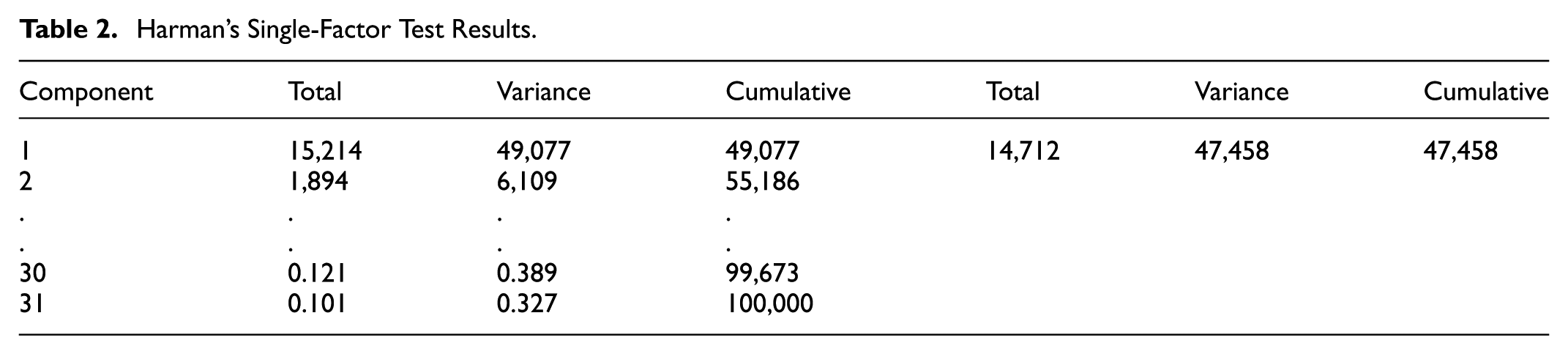
In Harman’s single-factor analysis, the first factor was found to account for only 49.077% of the total variance (and 47.458% in a second iteration), which is below the critical threshold of 50% recommended by Podsakoff et al. (2003). This indicates that no single factor dominates the variance in the data, thereby reducing the likelihood of substantial common method bias (CMB).
While the percentage of variance explained by the first factor approaches the conventional threshold of 50%, this proximity justifies the implementation of complementary diagnostic procedures, such as the full collinearity VIF test. As noted by Kock (2015), when utilizing factor-based PLS-SEM algorithms or estimation methods that account for measurement error, VIF values up to 5 may be deemed acceptable. In the present analysis, all VIF values remained below the more conservative threshold of 3.3, providing further assurance that common method bias is unlikely to compromise the integrity of the findings (Table 3).
Full Collinearity VIFs.

Measurement Model Assessment
Table 4 presents the evaluation of the reflective measurement model. All outer loadings exceeded 0.708, supporting the reliability of individual indicators (Hair et al., 2019). Internal consistency was confirmed by Cronbach’s alpha values ranging from .706 to .915. Although the alpha for “Ambience” was slightly above the minimum threshold, it remains within the acceptable range. Composite reliability (CR) values fell between .828 and .937, further verifying consistent measurement across items within each construct. Convergent validity was established through Average Variance Extracted (AVE), with all constructs exceeding the 0.50 benchmark (Bagozzi & Yi, 1988). This indicates that the constructs explain a substantial portion of variance in their indicators. Discriminant validity was evaluated using the Fornell-Larcker criterion. As detailed in Table 3, the square root of AVE for each construct (shown on the diagonal) is higher than its correlations with any other constructs (off-diagonal elements). This pattern confirms that each construct shares more variance with its own items than with others in the model, thus meeting the Fornell-Larcker requirement (Fornell & Larcker, 1981; Table 5).
Reflective Model Assessment.

Fornell Larcker Criterion.
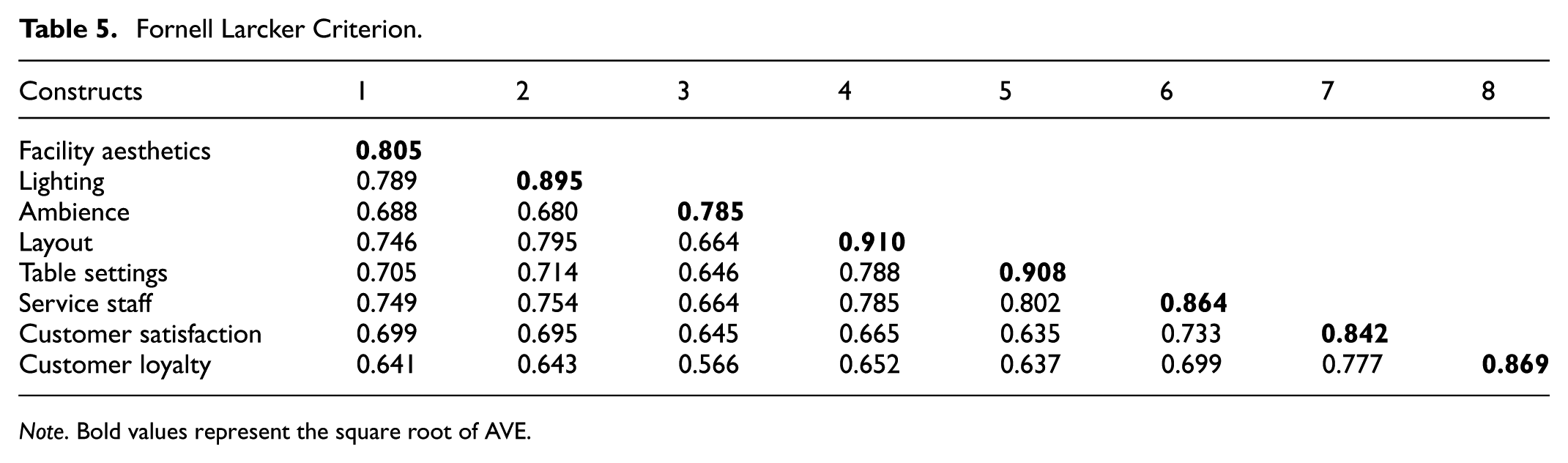
Note. Bold values represent the square root of AVE.
To complement the Fornell-Larcker assessment, discriminant validity was further examined using the Heterotrait-Monotrait Ratio (HTMT), as suggested by Henseler et al. (2015). HTMT is often considered a more sensitive approach for detecting problems with discriminant validity, especially in models involving closely related constructs.
Based on the widely accepted cutoff of 0.90, all HTMT values reported in Table 6 were within acceptable limits. One pair of constructs showed an HTMT value of exactly 0.900, which, while at the threshold, is still considered permissible particularly when corroborated by other validity tests. Overall, the results confirm that discriminant validity was adequately established across the model.
HTMT Criterion.

As a complementary step, discriminant validity was also assessed through cross-loadings. This method checks whether each indicator loads more strongly on its intended construct than on any other latent variable in the model (Hair et al., 2019). The results, shown in Table 7, confirm this condition. For example, the item AM1 loaded at 0.826 on the Ambience construct, while its loadings on unrelated constructs ranged from 0.352 to 0.456. Similar patterns were observed for all other items, where each indicator consistently showed the highest loading on its designated construct. These patterns suggest that each item aligns clearly with the construct it is meant to measure, providing further evidence of adequate discriminant validity within the measurement model.
Cross-Loading.

Note. Bold values indicate the highest loading of each item on its designated construct.
Structural Model Assessment
The predictive power of the structural model was examined through the coefficient of determination (R2). As shown in Table 8, customer satisfaction had an R2 of .616, suggesting that the physical environment dimensions explain approximately 61.6% of the variance in satisfaction. Similarly, the R2 for customer loyalty was .604, indicating that satisfaction accounts for 60.4% of its variance. According to the thresholds suggested by Hair et al. (2019), R2 values of .25, .50, and .75 are interpreted as weak, moderate, and substantial, respectively. Thus, the model demonstrates moderate to substantial explanatory strength for both endogenous constructs. Structural path significance was also tested using t-statistics and p-values. The path from the physical environment to customer satisfaction (t = 11.485, p < .001), and the path from satisfaction to loyalty (t = 13.264, p < .001), were both statistically significant. These findings offer strong empirical support for the hypothesized causal relationships in the model.
Structural Model Assessment.

To evaluate the relative importance of each predictor in the structural model, Cohen’s f2 values were calculated. This statistic measures the contribution of an individual exogenous construct to an endogenous construct by comparing the R2 values of the full model and a model excluding the specific predictor (Cohen, 1988). According to conventional benchmarks, f2 values of 0.02, 0.15, and 0.35 are considered indicative of small, medium, and large effects, respectively.
As shown in Table 9, Facility Aesthetics (f2 = 0.026), Ambience (f2 = 0.033), and Service Staff (f2 = 0.092) each demonstrated statistically significant but small effect sizes on Customer Satisfaction (p < .05). These results highlight the modest yet meaningful role of sensory and experiential aspects particularly ambiance and staff interactions in shaping satisfaction. Lighting and Table Settings showed negligible effects (f2 < 0.02), with marginal (p = .043) or non-significant (p = .669) paths. Layout Accessibility contributed no measurable effect (β = .025, p = .791; f2 = 0.000), indicating minimal relevance within this model. In contrast, Customer Satisfaction had an exceptionally large effect on Customer Loyalty (f2 = 1.528), exceeding the conventional threshold by a substantial margin. Although previous multicollinearity diagnostics (e.g., VIF) were within acceptable ranges, the magnitude of this effect calls for caution against potential overfitting or model saturation. Regarding path coefficients, Table Settings exhibited the highest influence on satisfaction (β = .370), followed by Facility Aesthetics (β = .184), Ambience (β = .170), and Lighting (β = .161). Layout Accessibility and Service Staff displayed minimal or slightly negative effects (β = −.036 and β = .025, respectively). The path from Customer Satisfaction to Customer Loyalty (β = .777) was highly significant and positive, reinforcing satisfaction’s mediating role. All indicators showed strong standardized loadings (>0.70), confirming convergent validity at the measurement level. Overall, the model offers a robust explanatory framework for understanding how various dimensions of the physical service environment influence satisfaction and loyalty.
Hypothesis Testing Results.
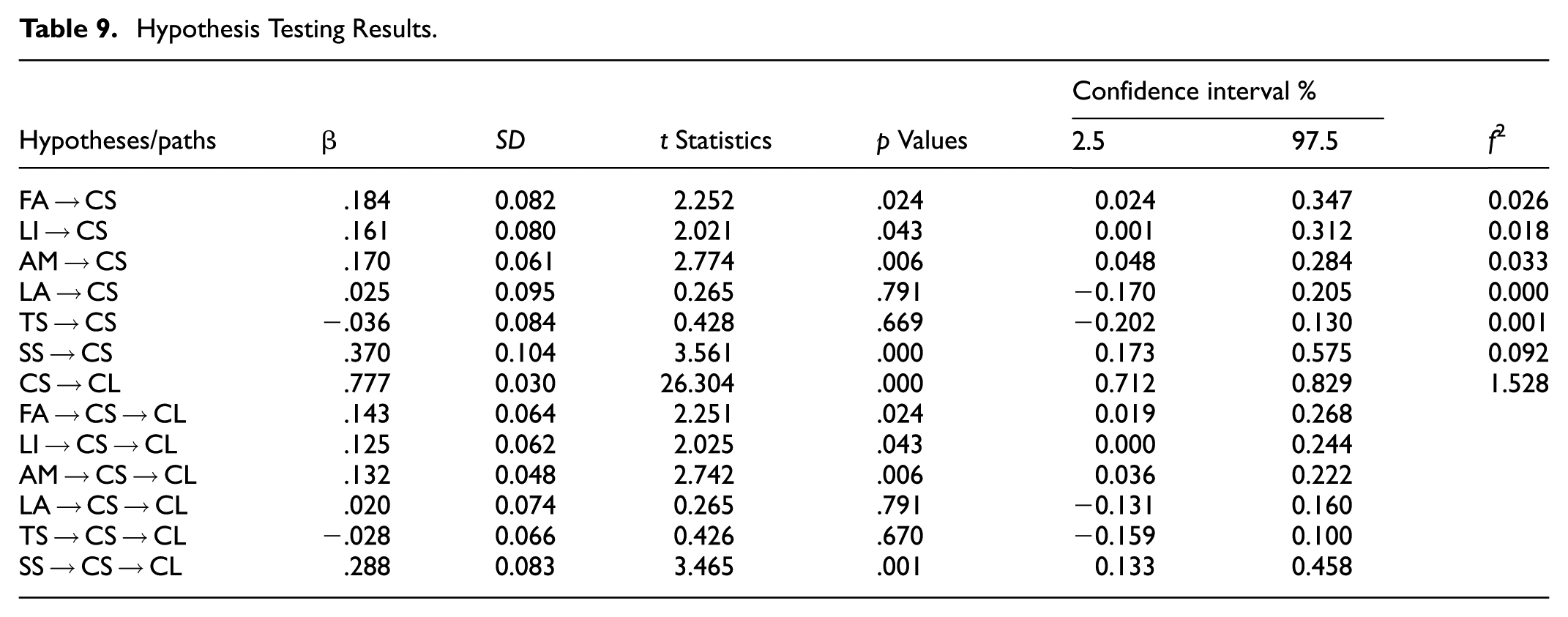
To examine the mediating mechanism of the structural model, indirect effects were assessed using a non-parametric bootstrapping procedure, following the recommendations of Hair et al. (2019). This analysis aimed to determine whether Customer Satisfaction significantly mediates the relationship between physical environmental dimensions and Customer Loyalty. The results indicated that several components of the service environment namely Facility Aesthetics (β = .143, p = .024), Lighting (β = .125, p = .043), Ambience (β = .132, p = .006), and Service Staff (β = .288, p = .001) exert significant indirect effects on Customer Loyalty through Customer Satisfaction. These findings provide empirical evidence consistent with partial mediation, suggesting that while these environmental factors do not influence loyalty directly, their impact is transmitted through satisfaction. In contrast, Layout Accessibility and Table Settings did not demonstrate significant indirect effects (β = .020, p = .791; β = .028, p = .670, respectively), indicating their limited role in shaping loyalty via satisfaction. This outcome aligns with the structural model depicted in Figure 2, where Customer Satisfaction (R2 = .616) acts as a key mediator, accounting for 60.4% of the variance in Customer Loyalty (R2 = .604). The substantial f2 value (1.528) of Customer Satisfaction on Loyalty further supports its mediating prominence. These results reinforce the theoretical view that Customer Satisfaction is not merely an outcome variable, but a pivotal conduit through which experiential aspects of the service environment translate into behavioral loyalty.

PLS results of study model.
Discussions and Conclusions
This study contributes meaningfully to the service marketing literature by providing empirical validation of the DINESCAPE framework within the context of upscale Turkish dining establishments. Utilizing PLS-SEM, we demonstrated that specific environmental dimensions, including aesthetics, ambiance, lighting, layout, table settings, and service staff, differentially influence customer satisfaction, which in turn drives loyalty. These results deepen our understanding of how the service environment functions as both a physical and psychological construct in shaping consumer behavior.
The findings affirm the critical role of facility aesthetics (H1), showing that cohesive visual elements such as interior design and architectural harmony positively influence customer perceptions. This supports earlier work by Ryu and Han (2011) and Özkul et al. (2020), underscoring aesthetics as a powerful form of non-verbal communication that enhances both emotional and cognitive evaluations.
Although lighting (H2) and table setting (H5) had limited direct effects, their indirect influences though modest underscore their atmospheric and symbolic contributions. This aligns with Wansink et al. (2006) and Garcia-Segovia et al. (2015), who recognized these features as secondary mood enhancers rather than primary drivers of satisfaction. From a theoretical perspective, these elements function within the atmospheric dimension of the DINESCAPE framework, supporting subtle affective responses that reinforce the customer’s overall perception.
Among all variables, service staff (H3) exerted the most substantial combined impact. The significant indirect effect alongside a moderate direct effect underscores the central role of human interaction in shaping customer experiences. Staff professionalism, warmth, and attentiveness serve not only as functional assets but also as emotional triggers consistent with Canny (2014) and Alhelalat et al. (2017).
Ambiance (H4) encompassing sensory cues such as music, scent, and temperature also had a moderate but significant effect on satisfaction and loyalty. Echoing findings from Marinkovic et al. (2014) and Leong et al. (2023), these results confirm that multi-sensory harmony is essential in fostering emotional engagement and repeat patronage. This is consistent with the Stimulus-Organism-Response (SOR) paradigm, where sensory inputs affect internal emotional states that influence customer behavior.
By contrast, layout (H6) did not show a statistically significant effect, suggesting that in upscale dining settings where spatial design often meets baseline expectations layout may be less influential. This nuance challenges prior models that assumed layout had a universally strong impact across all service contexts.
Most notably, customer satisfaction (H7) emerged as the strongest predictor of loyalty, demonstrating a substantial direct effect. This robust relationship reinforces foundational theories in service marketing, including those by Zeba et al. (2024) and Popova and Miteva (2022), which position satisfaction as a central determinant of behavioral loyalty.
The mediation analysis (H8) further clarifies this dynamic. Satisfaction was found to partially mediate the effects of aesthetics, lighting, ambiance, and service staff on loyalty. These mediating effects, validated via non-parametric bootstrapping, highlight satisfaction as the psychological mechanism by which environmental cues influence loyalty behavior. Conversely, table setting and layout did not exhibit significant indirect effects, indicating their limited strategic utility beyond aesthetic reinforcement. These results are consistent with previous literature (e.g., Caruana, 2002; Karatepe, 2011), which identifies satisfaction as the main pathway connecting service quality and contextual experience to customer loyalty. At the same time, our findings diverge from studies such as Cronin et al. (2000), suggesting that the strength of mediation may vary by industry and setting. This perspective strengthens the integrative role of satisfaction as a cognitive-emotional evaluation that filters environmental stimuli into loyalty outcomes.
The high explanatory power of the model supports positioning satisfaction not as a final outcome, but as an active cognitive-emotional filter that shapes behavioral responses. This reinforces the DINESCAPE model’s theoretical value in explaining the interplay between environmental elements and customer behavior.
In sum, the findings provide empirical support for the DINESCAPE model in upscale Turkish dining, highlighting the multidimensional influence of the physical environment on customer satisfaction and loyalty. Aesthetic design, ambiance, and service staff were confirmed as primary contributors to satisfaction, which in turn robustly predicts loyalty.
Among all constructs, service staff proved to be the most influential, underscoring the vital role of human interaction in experiential service settings. While aesthetic and ambient elements also yielded significant effects, the influence of layout and table settings appeared marginal suggesting that in high-end contexts, baseline expectations for space and décor may already be fulfilled, diminishing their impact.
From a theoretical standpoint, the study reinforces the role of customer satisfaction as a key mediating construct between environmental stimuli and loyalty. This is consistent with service-dominant logic, which views customer experience as co-created through both tangible and intangible resources. Moreover, it extends the framework by illustrating how satisfaction serves as a conduit that integrates environmental perception and emotional engagement into behavioral intention.
From a managerial perspective, the results encourage prioritizing investment in emotionally resonant components particularly aesthetic appeal, ambiance, and staff demeanor which exert the greatest influence on satisfaction and loyalty. Elements with limited direct impact, such as layout and table settings, may still contribute to brand identity if integrated cohesively within the overall service design. This study enhances the practical utility of the DINESCAPE model by disentangling the distinct contributions of various environmental dimensions.
Methodologically, the combination of structural modeling and mediation analysis provides a more nuanced understanding of both direct and indirect effects. Theoretically, the study refines the service environment paradigm by emphasizing the interaction between sensory stimuli, psychological satisfaction, and behavioral loyalty in high-involvement service settings.
Ultimately, this research advances the understanding of how physical and social elements of service environments work interdependently to foster loyalty in fine-dining contexts offering both theoretical insights and actionable guidance for hospitality practitioners.
Limitations and Future Research Suggestions
While this study offers valuable insights into the impact of the physical environment on customer satisfaction and loyalty within upscale restaurants in southeastern Turkey, several limitations warrant consideration. First, the geographic and cultural specificity of the sample, limited to five fine-dining establishments in Şanlıurfa and Mardin, constrains the generalizability of the findings. These cities, rich in cultural heritage and gastronomic identity, may not reflect the broader dynamics of urban, coastal, or international hospitality markets. Future research should aim to replicate this study across diverse geographic regions and restaurant formats to capture a wider spectrum of consumer behaviors and environmental interactions.
Second, although Partial Least Squares Structural Equation Modeling (PLS-SEM) proved effective in handling the sample size and model complexity, the use of non-probability convenience sampling limits the representativeness of the results. Employing stratified or probability-based sampling methods in future studies could improve external validity and ensure broader applicability of the findings.
Third, the current study relies solely on the DINESCAPE framework to operationalize the physical environment. While this model is particularly suited to upscale dining contexts, integrating it with complementary theoretical lenses such as the Experienscape model or service-dominant logic could yield a more holistic understanding of the multisensory and social dimensions of service environments. This could be especially beneficial in capturing intangible service cues and emotional resonance, which are increasingly central to customer experience research.
Additionally, future research could extend the scope beyond fine-dining establishments to include alternative hospitality settings such as boutique hotels, cafés, or fast-casual restaurants. Doing so would facilitate cross-contextual comparisons and allow for a more comprehensive evaluation of how environmental elements function across service tiers and consumer segments.
Finally, while this study emphasizes customer satisfaction as a mediating variable, future investigations might consider additional mediators or moderators such as customer engagement, emotional arousal, cultural orientation, or digital touchpoints. Incorporating these variables may deepen our understanding of the psychological mechanisms that translate environmental stimuli into loyalty behaviors.
Footnotes
Appendix A
Measurement Items Used in the Study.

| Factors | Questions |
|---|---|
| Facility aesthetics | Paintings/pictures are visually attractive. Wall decorations are visually appealing. Painting/pictures are visually attractive. Colors used create a warm atmosphere. Furniture (e.g., dining table, chair) is of high quality. The restaurant’s exterior design is visually appealing and easily captures attention. Art pieces and decorative features inside the restaurant enhance its overall visual charm. |
| Lighting | Lighting creates a warm atmosphere. Lighting makes me feel welcome. Lighting creates a comfortable atmosphere. |
| Ambience | Background music relaxes me. Temperature is comfortable. Air aroma is enticing. |
| Layout | Seating arrangement gives me enough space. Layout gives me enough tangible privacy. Layout makes it easy for me to move around. |
| Table settings | Tableware (e.g., glass, china, silverware) is of high quality. The linens (e.g., table cloths, napkin) are attractive. The table setting is visually attractive. |
| Service staff | The staff appeared well-groomed and professionally dressed. The appealing appearance of the staff positively contributed to my overall experience. Additional requests or meal modifications were handled promptly and efficiently. The staff demonstrated awareness and understanding of special dietary needs and restrictions. Having a sufficient number of staff made me feel personally attended to and cared for. |
| Customer satisfaction | Upon my arrival, I was welcomed in a polite and genuinely friendly manner. My order was delivered exactly as requested, reflecting attention to detail. I am satisfied with the overall quality of service provided during my visit. The experience I received matched the value of what I paid for the meal. |
| Customer loyalty | This restaurant will remain among my preferred choices when dining out in the future. I will confidently encourage others to try this restaurant based on my experience. It is likely that I will return to this restaurant on a regular basis. |

Funding
The authors received no financial support for the research, authorship, and/or publication of this article.
Declaration of Conflicting Interests
The authors declared no potential conflicts of interest with respect to the research, authorship, and/or publication of this article.
Data Availability Statement
The data that support the findings of this study are available from the corresponding author upon reasonable request.