




Abstract
This paper established a three-stage DEA model to measure the innovation efficiency of Chinese listed companies over the period 2008 to 2019, and then tested the impact of the Belt and Road Initiative on innovation efficiency with DID model. The results show that: (1) The innovation efficiency of enterprises along the Belt and Road are slightly lower than that of other enterprises, but the former improves faster. (2) The impact of the Belt and Road Initiative on innovation efficiency is mainly spillover and the impact tends to fluctuate upwards year by year. (3) The Belt and Road Initiative has effectively expanded the R&D capital stock, which is an important mediating factor in boosting the innovation efficiency.
Keywords
Introduction
High-quality development is an important goal of national economic growth in many countries across the globe, and innovation is an important indicator to measure high-quality development. In the process of vigorously promoting the transformation of economic development mode and structure adjustment, innovation-driven development strategy plays a decisive role in optimizing resource allocation. It can be said that adhering to innovation is tantamount to grasping the key to economic and social development. Innovation efficiency is the conversion rate of input and output of innovation activities, which can not only comprehensively reflect the level of innovation ability, but also evaluate whether this innovation ability is sustainable. It is a direct indicator to measure the innovation level. As a result, to meet the requirements of the concept of high-quality development, the current level of innovation efficiency in China needs more detailed calculations and scientific evaluation.
The Belt and Road Initiative (BRI) has opened a new channel for international economic development, established a new model of international economy and trade cooperation that is more open and inclusive, and injected new momentum into global economic growth. Taking this opportunity, China has established more closer and friendly cooperative partnerships with countries along the Belt and Road (B&R) and even countries around the world. “Made in China” has attracted more and more attention from foreign countries. Driven by new concepts such as China-Europe Railway Express, B&R e-commerce, and China International Import Expo, the development potential of countries along the B&R has been further released, and each country is moving towards the goal of common prosperity. BRI has not only led to cooperation in economy and trade fields, but also deepened the exchanges and communication between China and other countries along with it on the aspects of culture, politics, infrastructure, etc. China’s BRI has provided a valuable reference for the peaceful development of the countries and regions along with it. The construction of B&R has become the inevitable choice of peaceful development. In addition, BRI involves 65 countries and more than 450 ethnic groups, including Islam, Buddhism, and Christianity. The risk involved in economic development and international cooperation should not be ignored. Therefore, has BRI achieved the expected goal of promoting innovation and development so far? If the answer is yes, what is the specific mechanism by which the BRI has led to increased innovation efficiency? The answers to the above questions will help to evaluate the effectiveness of BRI more scientifically and will have positive practical significance for promoting high-quality innovation development.
This study, to some degree, may make marginal contribution on the following three aspects: First, it established a three-stage Data Envelopment Analysis (DEA) model to measure the innovation efficiency at the micro-level of the enterprise, which better overcomes the influence of spatial factors in macro data analysis. Second, it used the Difference-in-Differences (DID) model to assess ex-post the extent to which BRI affects China’s innovation efficiency and test the mediating mechanism, to obtain a purer policy effect. Third, it analyzed the extent of crowding-out or spillover of BRI on domestic and foreign R&D capital stock and even domestic innovation efficiency and clarified the mechanism and principle from the perspective of international operations.
Literature Review and Theoretical Analysis
Research on the Impact of BRI on China’s Innovation Development
It has been 10 years since BRI was proposed and its policy effects has begun to emerge. The debate on its role and effects has been going on since BRI was put forward, and no consensus has been reached so far.
Positive Effect
As a global cooperation program, the golden principles of BRI are extensive consultation, joint contribution, and shared benefits, which opens up new space for international cooperation along the B&R. Many scholars have confirmed that the BRI has a positive effect on innovative development of home country. According to the Chinese Ministry of Commerce, China’s total international trade with its BRI partner has amounted to US$ 11.6 trillion by 2021, accounting for about 30% of China’s total foreign trade in the same period. Sor-gog and Ma (2018) evaluated the technological innovation efficiency of enterprises located in key provinces and regions of B&R using the generalized DEA model, and found that the average technological innovation efficiency of enterprises in key provinces and regions improved significantly after the implementation of BRI. Bastos (2020) analyzed the impact of the BRI on China’s foreign trade and found that it significantly improved China’s export performance.
In addition, China’s total non-financial direct investment in countries along the route has amounted to US$ 161.31 billion, accounting for about 14% of China’s total foreign investment in the corresponding period. Du and Zhang (2018) found that the OFDI has been significantly improved by the BRI, especially mergers and acquisitions by Chinese enterprises. Li et al. (2020) found that direct investment to B&R countries can be reversed through channels of external technology divestiture, R&D cost-sharing, R&D results from feedback, etc. to promote the innovation and development of Chinese enterprises.
Negative Effect
After the BRI was proposed, concerns about it have focused on the uncertainty of the international operations and domestic innovation development created by risks and challenges along with it. G. J. Wang and Lu (2019) believed that the international operations along the B&R faces the superposition of various risks, which pose great challenges to firms and lead to uncertainty in returns. These risks include the low rates of return on investment in infrastructure construction, greater investment pressure on governments, as well as suspicion and resistance of countries along the route, etc. (Z. X. Wang & Zhou, 2019). As business operators in high-risk environments place greater emphasis on short-term returns, it would affect the R&D activities in the long-term investment, and finally the innovation level (Caselli et al., 2006).
However, some scholars have also pointed out that the risk of business activities promotes the innovation performance of firms(Chemmanur & Nandy, 2011; S. Chen et al., 2017). Therefore, the BRI can reduce the risk of international economy and trade cooperation to some extent. Cui et al. (2017) found that the relevant regional cooperation agreements under BRI are not only conducive to the improvement of investment efficiency but also the control of investment risks. Sun and Qin (2018) found that BRI effectively reduced the risk of foreign direct investment, and the associated risks tend to diminish with time.
Nonlinear Effects
In addition to the linear effects, some scholars have also found complex nonlinear relationships. Ge et al. (2018) constructed a new economic growth model of heterogeneous innovation and green total factor productivity and found that basic and applied innovation have a non-linear impact on green total factor productivity. Han et al. (2018) pointed out that the reverse spillover generated by foreign direct investment has significant spatial heterogeneity in innovative development, which shows an inverted U-shaped feature along the B&R.
To sum up, the existing studies share the following characteristics: First, most of them take BRI as the research background to investigate the changes of innovation efficiency, but it is difficult to separate the policy effect of BRI and its net impact on innovation efficiency by general methods. Second, it has become a consensus that China’s innovation efficiency keeps increasing since BRI was proposed. However, there is not yet a unified understanding of whether the effect of BRI on innovation efficiency is crowding-out or spillover.
Mechanism of BRI’s Influence on China’s Innovation Efficiency
Crowding-Out Mechanism
From the domestic perspective, the existing domestic R&D capital stock will be dispersed to different regions around the world as Chinese firms compete internationally. In terms of supply, the outward shift of R&D capital tightens its capital liquidity constraints in China and shrinking the supply of self-owned funds for innovation and development of domestic enterprises. In terms of demand, when domestic R&D capital becomes scarce, the expected return on domestic investment will become lower, resulting in the contraction of production demand. It can be found that OFDI has a significant impact on the investment decisions of the relevant enterprises on both supply and demand, reducing the scale and speed of domestic R&D capital formation, which in turn inhibits and crowds out domestic enterprises from improving their innovation efficiency.
From the international perspective, when the level of economic development and international operation in the host country is improved, it will engage international trade or foreign investment in other countries. Generally speaking, if the third country is close to the host country in terms of spatial and human factors, it is bound to compete with the home country and will show a crowding-out effect on the existing home market in the third country. China has signed multilateral or bilateral trade and investment agreements with 56 countries along the B&R. The scope for international business of Chinese enterprises has been further expanded driven by relevant agreements. Compared with countries and regions that have not signed cooperation agreements, their international cooperation and R&D capital stock with China is bound to be affected by the crowding-out effect. However, many empirical tests suggest that the theoretically expected crowding-out effect on the third country has not yet emerged (Shao & Sun, 2021; Yang, 2019).
Spillover Mechanism
In terms of the nation, the international operation can effectively contribute to the accumulation of R&D capital stock from channels of internal R&D capability and external technology divestiture. Firstly, participating in international operations makes it easier to access advanced technology and expand the foreign R&D capital stock. According to a recent research report from the World Bank in 2019, BRI has reduced global trade costs by an average of 1.1%∼2.2%, which has helped boost global economic growth and strengthened the degree of trade facilitation and the stickiness of partners. Moreover, the B&R market is vast and the international competition is forcing the countries to further expand their R&D investment and thus achieve a leap in innovation.
In terms of the industries, the international operations strengthens inter-industry and intra-industry linkages and accumulated the R&D capital stock through the global value chain system. The international operations effectively integrate the high-quality production factors from countries along the B&R, making it easier to form industrial clusters. The benefits of scale economy and learning effect of being close to the source of R&D innovation can be reaped. China’s e-commerce industry has developed rapidly in recent years, which greatly reduced the intangible communication costs in the international business. The infrastructure of countries along the B&R has been built to a high level under the principle of connectivity advocated by BRI, greatly reducing the transportation cost of tangible product trade, becoming an important support for further building a higher standard international free economy and trade cooperation network, and providing a solid foundation for the high-quality innovative development of Chinese economy.
In terms of the enterprise, international operations drive the cross-border flow of R&D capital. No matter in the form of international trade or foreign investment, the international operations of enterprises intensify the competition level in the host market, with capital competing for higher returns and lower risks, creating a competitive effect. Meanwhile, the high returns have produced an exemplary effect on other enterprises. Enterprises that engaged in the international operations in B&R, provide a favorable guarantee for promoting enterprise innovation and development by repatriating the accumulated R&D capital stock.
Therefore, whether enterprises can improve their technological innovation level under BRI lacks some a priori validity, which depends on the trade-off between the opportunities and uncertainties brought by BRI in their international operations. The hypothesis is then empirically tested with the data from Chinese listed companies.
Measurement of Innovation Efficiency
Measurement Methods
There is a wide range of methods for measuring innovation efficiency, but the DEA method is chosen for this study because it does not rely on a specific production function, which could effectively avoid model setting bias, and has no special requirements for the sample size. It can estimate the relative efficiency of multiple inputs and outputs simultaneously. It is an effective method for comparing innovation efficiency across different objects. The traditional DEA method uses the initial input-output data from the Decision Making Unit (DMU), which may lead to the biased results as the effect of slack variables is not taking into account. However, as environmental factors play an important role in influencing innovation, the three-stage DEA method becomes a more reasonable choice for this study, which divides the slack variables into environmental factors and random factors, and then measures them.
The First Stage
In terms of sample selection, generally speaking, listed companies have higher innovation efficiency and stronger incentive to participate in BRI. Therefore, A-shares listed companies in Shanghai and Shenzhen of China were selected as DMUs for innovation efficiency measurement. According to the convention, enterprises with ST shares, no patent in two consecutive years, or serious missing data on relevant variables were excluded. The data were mainly obtained from the Wind Information Database and CSMAR Database. Since BRI was proposed in 2013, to compare the changes of China’s innovation efficiency before and after the Initiative, the study period was set to 2008 to 2019, and a balanced panel data on a total of 1,698 sample enterprises were obtained.
The number of R&D personnel and funds invested in this enterprise is chosen for R&D inputs, while the number of patent applications and valid patents is chosen for R&D output. The input-output related indicators were substituted into the traditional DEA model to obtain the slack variables of each DMU, as shown in equation (1).

Where
The Second Stage
The SFA model is used to regress the slack variables and related factors affecting DMU, and the effects of environmental factors and statistical noise are removed according to the regression results. Assuming that there are n DMUs

Where
The Third Stage
This paper substitutes the input-output related indicators of each DMU that were adjusted in the second stage into the first stage of the DEA model to recalculate and obtain the innovation efficiency excluding environmental factors, random factors, and spatial factors, which could reflect the internal management level of each DMU more truly. Ultimately, the relevant results of China’s domestic innovation efficiency can be obtained.
Measurement Results
To provide a clearly picture of the changes in China’s innovation efficiency before and after the implementation of BRI, the sample enterprises were matched and categorized according to whether they were located along the routes or not, based on “Vision and Actions for Promoting the Joint Construction of the Silk Road Economic Belt and the 21st Century Maritime Silk Road” (hereinafter referred to as Vision and Actions).
Table 1 reflects the results of innovation efficiency of Chinese listed companies by province. According to the Vision and Actions, codes (1) to (18) are defined as provinces along the B&R, and codes (19) to (31) are defined as other provinces of China. For the sake of space, only the average value of each province during the research period is reported. Generally speaking, in the time period 2008 to 2019, the innovation efficiency of Chinese listed companies covers the range between 0.025 and 0.077. Although the DEA values are relative values and it is not economically meaningful to compare, it still can be found that there is an uneven development of innovation during the research period, and the innovation efficiency shows an obvious upward trend.
Innovation Efficiency Based on Traditional DEA and Three-stage DEA.

Comparing the results of the three-stage DEA model that before and after adjustment, it can be found the comprehensive innovation efficiency increased in most provinces, and the SE and PTE of all provinces have been improved by about five times, which is the key to the improvement of comprehensive innovation efficiency. However, the ranking of innovation efficiency in Hainan is always at the bottom of the ranking, indicating that there is still much room for the development of innovation activities in that province. From the aspect of the regions where the sample enterprises are located, the comprehensive innovation efficiency of listed companies in the central region has decreased after adjustment, while the innovation efficiency in the eastern and western regions has increased. The SE of enterprises in the western region is relatively the lowest, and the PTE in the central region is also relatively the lowest.
In addition, the enlightenment of the adjusted innovation efficiency to the economic reality is of more economic significance. For example, according to the measurement results of the traditional DEA method, Beijing’s innovation efficiency ranked 25th out of the 31 provinces, which is at the lower end of the scale. It is shocking that enterprises in Beijing which gathered a large number of advanced domestic R&D personnel and capital as Shanghai, ranked so far down the list with Shanghai firms at the top. Not unexpectedly, after controlling for the influence of environmental and random factors, Beijing’s ranking occupied the top two spots on the list along with Shanghai. For another example, the DEA measurement result of Ningxia shows that its innovation efficiency is in the top 1/3 in China, but according to the result of the three-stage DEA model, its innovation efficiency is in the bottom third of the country, and there is more room for innovation and development, so it should not be blindly optimistic.
The average innovation efficiency of enterprises in provinces along the routes is slightly lower than that of enterprises not along it, as most of the provinces along the B&R are located in the central and western regions, where there is still an obvious gap in the software and hardware of economic foundation and innovation development compared to the eastern region. Although the time trend reflects that the innovation efficiency of Chinese listed companies has improved obviously since the implementation of BRI, the extent to which they have benefited from it still requires a more scientific approach to judge.
Empirical Strategy and Results
Empirical Model
The premise of this study is that BRI is a qualified quasi-natural experiment, which requires satisfying the assumptions of both stochasticity and homogeneity. Firstly, for the provinces, ports, and highlands along the B&R, it is impossible to predict in advance whether the Initiative will be launched, nor is it possible to pre-select the geographical location of the Initiative. Therefore, it can be considered that the BRI meets the first hypothesis of a quasi-natural experiment—stochasticity.
Secondly, the results of innovation efficiency of Chinese listed companies were grouped according to their provinces. The enterprises in 18 provinces along the B&R are regarded as the treatment group and the enterprises in the remaining13 provinces as the control group. The trends of the two before and after the experiment can be observed in Table 1, which shows the average innovation efficiency of the two groups in the time period 2008 to 2019, and a similar trend can be observed. Before the BRI was proposed, the innovation efficiency of the treatment group and the control group maintained roughly the same growth trend. After that, the growth trend of innovation efficiency between the two groups has changed clearly. The growth rate of innovation efficiency in provinces along the B&R is faster, while the difference between the two is shrinking. Therefore, it can be assumed that BRI satisfies the second hypothesis of quasi-natural experiment—homogeneity.
The parallel trend test results are shown in Figure 1. There is no significant effect on the innovation efficiency of Chinese enterprises before the BRI was proposed in the year 2013, while there shows significant positive impact after that, and this effect continues to work for many years afterwards. So, there is no expected effect of the BRI, and the parallel trend hypothesis holds. A subsequent DID test can be conducted.

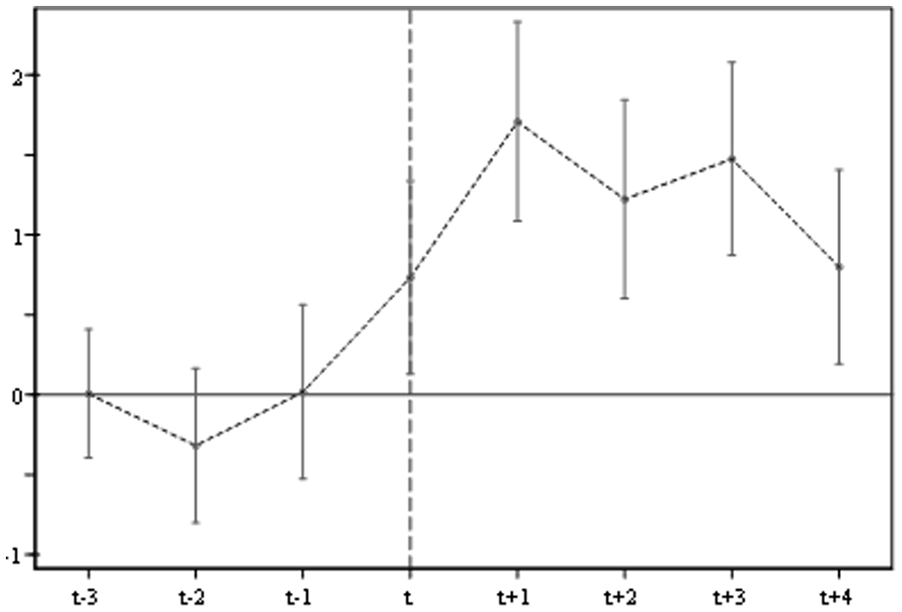
Parallel trend hypothesis.
In equation (3), time represents the time of the BRI shock. The year 2014 and after is set to 1, and the year before is set to 0. If treated = 1, it belongs to the treatment group, indicating the domestic provinces along the B&R; If treated = 0, it is the control group, indicating other provinces in China. If the variables in the two sample groups of have the same time fixed effect, the difference in the results of the two groups before and after the quasi-natural experiment is the net policy effect concerned in this study.
Empirical Test
Table 2 shows the basic test results of DID model. Model (2) added the controls of regional and time effects to model (1), while models (3) and (4) added explanatory variables. It can be clearly observed that owing to the spillover effect of BRI, the innovation efficiency of Chinese listed companies does obtain different degrees of improvement. After considering the main influencing factors and controlling for the regional and time fixed effects, the promoting effect of BRI on innovation efficiency is about 0.0157, and the result is significant at 1%. In addition, higher level of economic development, economic openness, and the importance of education are all important factors to improve innovation efficiency.
Basic Test Result.

Note. Robust t-statistics in parentheses.
p < .1. **p < .05. ***p < .01.
Endogenous Test
The above tests have proved that BRI plays an important role in promoting innovation efficiency. DID model can partially solve the endogeneity problems, but there may still be endogeneity in other aspects. For example, whether the improvement of innovation efficiency in provinces along B&R comes from national and regional incentive policies for innovation, or whether provinces along B&R have stronger innovation potential, and the self-selection effect may be a direct source of the endogeneity. Therefore, the instrumental variable (IV) method can be used to further eliminate it. Duranton et al. (2014) and Agrawal et al. (2017) studied the relationship between interstate highways and trade and innovation using the historical US Interstate Highway System Program, railway networks and exploration routes as instrumental variables, respectively. Therefore, the paper uses the provinces along the ancient “Silk Road” as the instrumental variable for grouping. Firstly, BRI was put forward based on the ancient “Silk Road,” which meets the requirements of correlation. For another reason, there is no direct link between the Silk Road, which originated in the Western Han Dynasty (202 BC–8 AD) and the innovation efficiency of Chinese firms in the 21st century, which meets the requirement of exogeneity. Therefore, the ancient “Silk Road” could be a more valid instrumental variable for treated.
If a province is located on the ancient “Silk Road,” it is set as 1, otherwise, it is 0. Use interaction term time × IV as an instrumental variable for time × treated. The 2SLS method was used for regression, and the results are shown in Table 3. The first stage regression shows that provinces located on the ancient Silk Road are more likely to be identified as provinces along the B&R. For the regression results of the second stage, innovation efficiency (inno) is the explanatory variable, the results of time × treated are significantly positive, which indicates that the basic test result is still significant, and BRI has a positive spillover effect on China’s innovation efficiency, after alleviating the possible endogeneity issues.
Empirical Results of Instrumental Variable.

Note. Robust t-statistics in parentheses.
p < .05. ***p < .01.
Robustness Check
Impact of BRI on Innovation Efficiency of the Key Provinces
The B&R encompasses both the Silk Road Economic Belt and the Maritime Silk Road. Since ancient times, there have been great differences in the economic structure and innovation development of the provinces along the Silk Road on land and sea. Therefore, it is necessary to examine heterogeneity separately. BRI focused on the construction objectives of 15 ports (Shanghai, Tianjin, Ningbo-Zhoushan, Guangzhou, Shenzhen, Zhanjiang, Shantou, Qingdao, Yantai, Dalian, Fuzhou, Xiamen, Quanzhou, Haikou, and Sanya) at the beginning of its implementation. Moreover, it was proposed in the Vision and Actions that BRI focuses on building 2 core zones (Xinjiang and Fujian), 4 portals(Shaanxi, Gansu, Guangxi, and Yunnan), and 8 open highlands(Lanzhou, Xining, Chengdu, Zhengzhou, Wuhan, Changsha, Nanchang, and Hefei), involving a total of 13 provinces along the B&R, which overlaps and differs from the 18 provinces mentioned in the earlier plan.
Next, the impact of the implementation of BRI on innovation efficiency of these key provinces is tested empirically. Models (1) and (2) in Table 4 show an unexpected result that BRI does not significantly improve the innovation efficiency of the 8 provinces where the 15 port cities are located. The BRI includes both land and sea routes, both of which are the key areas for national promotion. However, tests on representative provinces show that the BRI has not shown the expected effect on the innovation efficiency of the provinces along the 21st Century Maritime Silk Road, possibly due to a crowding-out effect. Therefore, it needs to pay more attention to the innovation and development along the Maritime Silk Road in the future construction process, and rely on the innovation system of the southeast coastal region to build a two-wheel driven development model of scientific and technological innovation from the aspects of innovative talents, innovation platforms, and innovation quality.
Influence of BRI on Innovation Efficiency of Key Provinces.

Note. Robust t-statistics in parentheses.
p < .1. **p < .05. ***p < .01.
Models (3) and (4) in Table 4 reflect the effect of BRI on the 13 key provinces represented by the 2 cores, 4 portals, and 8 highlands. Compared to the results of 18 provinces along the B&R in Table 2, the implementation of BRI has shown a more significant contribution to promoting the innovation efficiency of the representative regions. It is confirmed from the aspect that the relevant supporting policies at the national level have effectively promoted the implementation of BRI and helped to expand its positive role in domestic economic development.
Impact of BRI on Innovation Efficiency in Different Years
With the promotion of BRI, its influence on China’s domestic innovation efficiency is bound to deepen year by year, and the impact can be investigated by the year. The research period covers the first year of the initiative (2014) to the fifth year (2019).

In equation (4), i = 1, t = 1, if the sample is from the treatment group; otherwise, i = 0, t = 0. treated × time represents the interaction of dummy variable and treatment effect for each year after the implementation of BRI.
In Table 5, model (1) tests the impact of BRI on China’s innovation efficiency in the year of its introduction. Models (2) to (6) reflect the change in the impact on domestic innovation efficiency in the first to fifth years after the initiative was put forward, respectively. According to econometric theory, if BRI does help to improve the innovation efficiency, the coefficient of interaction term should not be significant before the implementation of BRI, while significant after that. In Table 5, the coefficient value of the interaction term shows an obvious upward trend, gradually changing from the initially insignificant negative impact to a relatively significant positive one, and the coefficients and significance levels of the other variables vary less from year to year. This shows that in the first few years of BRI, its impact on domestic innovation efficiency was very limited. It is not only because there is a time lag in the effect of any policy, but also because although the concept of B&R was proposed in autumn of 2013, the Vision and Actions was not issued until 2015 when BRI has entered a stage from a great idea to practical cooperation. Moreover, the effect in the first few years is not satisfactory because many countries were wait-and-see and skeptical about the BRI at the early stage of its implementation, holding an opinion that the main purpose of BRI is to access the natural resources of the countries along the route, or even called it the Chinese version of the Marshall Plan.
Empirical Results of Different Years.

Note. Robust t-statistics in parentheses.
p < .1. **p < .05. ***p < .01.
Mechanism Test
By actively participating in the international operations along the B&R, China has accumulated abundant R&D capital stock, which provides the preconditions and guarantees for the improvement of domestic innovation efficiency. Therefore, the next step is to test the mediating effect of R&D capital stock in the process of innovation development. Drawing on Y. F. Chen et al. (2020) to measure the R&D capital stock, the R&D of Chinese firms is statistically aggregated in terms of both scientific research and experimental development.
The mediating effect model is set up in three steps: First, the direct impact of BRI on China’s innovation efficiency is analyzed according to the basic test. Then, the relationship between innovation efficiency and R&D capital stock is tested. Finally, the impact of BRI on innovation efficiency is tested again after controlling the R&D capital stock. The three models in Table 6 show the mediating effects for the above steps by OLS and GMM methods in turn. To further control for possible endogeneity, the GMM test was added for comparison, with the coefficient of the GMM method slightly higher than that of the OLS method. According to model (1) in Table 6, BRI has significantly improved the level of innovation efficiency. Model (2) shows that the level of innovation efficiency is closely linked to the R&D capital stock. In the process of innovation and development, more attention should be paid to increasing the investment of R&D capital to activate the scientific research forces and boost innovation development. Model (3) shows that after controlling the R&D capital stock and other influencing factors, the positive spillover effect of BRI is obvious, which plays a positive role in enhancing domestic innovation efficiency. Compared to model (1), the coefficient is still significant, but the value is obviously smaller. According to the research of Wen and Ye (2014), this reflects that under BRI, domestic and foreign R&D capital stock is an important mediating factor of innovation efficiency.
Test of Mediating Effect of R&D Capital Stock.

Note. Robust t-statistics in parentheses.
p < .1. **p < .05. ***p < .01.
Conclusion and Future Research
Concluding Remarks
BRI has made remarkable achievements since its implementation in 2013. It is of positive practical significance to analyze the role of BRI implementation on innovation efficiency in the stage of high-quality development. Based on the scientific calculation of China’s innovation efficiency using the three-stage DEA model and DID method, we can come to the following research conclusions:
First, the innovation efficiency of China’s major listed companies improved steadily over the course of 12 years (2008–2019). The difference in innovation efficiency between the eastern, central, and western regions is gradually narrowing. Since most of the provinces along the B&R are located in the central and western regions of China, their average innovation efficiency have increased faster than those of the provinces not along the routes, and this trend is more obvious after the implementation of BRI.
Second, the spillover effect of BRI on China’s innovation efficiency is greater than the crowding-out effect, promoting the innovation efficiency of provinces along the B&R. With the continuous promotion of the BRI, its positive spillover effect makes a fluctuating upward trend of domestic innovation efficiency. The spillover effect on the innovation efficiency of the representative key regions such as 2 cores, 4 portals, and 8 highlands is the most significant, while the degree of spillover and enhancement of the innovation efficiency of provinces along the Maritime Silk Road need to be strengthened.
Third, the R&D capital stock is an important mediating factor to promote China’s innovation efficiency. The BRI has driven the development of international operations such as international trade and foreign investment between China and countries along the route. By participating in the international operations, the domestic and foreign R&D capital stock from the national, industrial, and enterprise aspects has been accumulated and expanded, providing a guarantee for improvement of innovation efficiency.
Future Research
First, although this paper has conducted a variety of empirical tests according to the geographical criteria of the provinces to which the sample enterprises belong, considering the huge economic volume of China, the innovation and development level of enterprises and the characteristics of international operations are quite different. So, the future research can be deepened from the aspects of industry category, headquarters location, market share, ownership, and so on.
Second, although the mechanism analysis of this paper makes a marginal contribution to the research of BRI and innovation efficiency issues, the main contributions are concentrated in the theoretical analysis. In the process of empirical test, it is not able to clearly distinguish the two mechanisms of international trade and foreign investment. Future research may seek to explore the specific direction and strength of the two mechanisms in the transmission of innovation efficiency.
Footnotes
Declaration of Conflicting Interests
The author declared no potential conflicts of interest with respect to the research, authorship, and/or publication of this article.
Funding
The author disclosed receipt of the following financial support for the research, authorship, and/or publication of this article: Social Science Fund of Shandong Province, “Research on Potential Transition Path and Dynamic Cultivation Strategy of Hidden Champion in Shandong Manufacturing Industry” (21CJJJ07).
