




Abstract
The concept of Corporate Social Responsibility (CSR) has been the object of study by the academic world in recent years, however, despite the large number of published works, there are still many gaps in its conceptualization and the implications it has on business management. In this sense, despite the great interdisciplinarity of the concept, a large part of academic production is focused on the field of business, something that has limited the construction of new research perspectives which will allow to continue expanding in knowledge. The objective of this work is to provide evidence of the scientific production developed in the field of CSR that serves as a basis for researchers in making strategic decisions about the orientation of their work, taking into account new perspectives based on the impact generated by the publications in the different research areas. For this, a search of existing publications on the Web of Science (WoS) was carried out. The analysis of the results was developed through the use of the InCites citation analysis tool, which made it possible to evaluate the productivity and performance of the research developed. The results show the existence of research areas with low productivity in the topic under study, but with a high impact of their publications. It is concluded that publication in these research areas should be a priority for researchers, who, by directing their work toward them, might open up new research perspectives and continue to delve into the concept.
Introduction
The concept of Corporate Social Responsibility (CSR) has evolved over the years since it was defined by Bowen (1953) as the obligation to implement policies, make decisions, and follow desirable strategies in terms of objectives and values for the society, to be conceived as an integration of social, labor, environmental, and human concerns in the procedures and policies of the company on a voluntary basis (Ros-Diego & Castelló-Martínez, 2012). A socially responsible company must not only comply with the legal requirements that apply to it, but also go one step further and invest in human capital, the environment, and the promotion of a proactive relationship with its stakeholders (Czinkota et al., 2018).
The transcendence and importance of CSR has been growing and receiving increasing attention from the academic world, the media, society, and politics (Gatti et al., 2019), since The United Nations adopted the Sustainable Development Goals (SDGs) in 2015 (ElAlfy et al., 2020). CSR has gone from being a trend or marketing tool (Lin et al., 2020), to becoming an intangible asset for organizations of any size and country (García-Hernández et al., 2017), making many of them adopt CSR as an essential element of their business plan (Ikram et al., 2020). In this sense, despite the great interdisciplinarity of the concept, much of the academic production is focused on the field of business (Ji et al., 2020), something that limits the construction of new research perspectives that allow delving into the topic.
Strugatch (2011) defines CSR as a global movement based on values such as sustainability, transparency, and ethics, among others. In an increasingly competitive market, companies face a growing demand from their stakeholders for transparency and social responsibility (Javed et al., 2020), which has made CSR a key tool when talking about the sustainability of companies (Lu et al., 2020). A sustainable organization cannot focus solely on its development at an economic level, but must manage both the social and environmental impacts of its actions, focusing its efforts on a unique business strategy (Porter & Kramer, 2006), which takes into account the social and environmental values and expectations of its stakeholders (Šontaitė-Petkevičienė, 2015). In this sense, some authors speak of CSR as the management of stakeholder expectations (Lock & Schulz-Knappe, 2019).
Throughout the literature, there are works that analyze the concept of CSR from different perspectives that coincide with its three pillars: economic, environmental, and social. First, from the economic perspective, although it is true that many studies speak of CSR as a source of economic benefits for companies, the debate on the relationship of CSR practices with financial performance has been alive for many years (Bahta et al., 2020). In this sense, as pointed out by Abad-Segura et al. (2019) much of the research in CSR has been focused on the areas associated with business, management, and accounting, in search of reaching a clear conclusion that has not been achieved so far, being able to find research that conclude that a company that dedicates resources to fulfilling what is perceived as its social responsibilities can obtain a better, worse, or equal financial performance than if it had done it in another way (Kurucz et al., 2008). From the business management point of view, it is essential to know the impact of CSR on financial performance in order to know how and when to invest in the development of ethical and socially responsible practices (Bhardwaj et al., 2018).
Continuing with the environmental perspective, society increasingly requires all organizations to be respectful of the environment (Pipatprapa et al., 2017). Consumers and investors value companies that are concerned about their environmental impacts (Pizzetti et al., 2021). CSR has become a business strategy that allows solving the environmental problems of organizations; allowing them to achieve a sustainable growth (Lu et al., 2020). That is why the concept of CSR is usually related to sustainability, defined for the first time in the Brundtland report in 1987 as the development that allows meeting the needs of current generations, without compromising the needs of future generations (Abad-Segura et al., 2019). At the business level, companies must take into account the environmental impacts that their activities generate in order to manage and control them, integrating these impacts into their business strategy. In recent years, environmental management and environmental management systems (EMAS, ISO 14001) have also become a key factor in ensuring the competitiveness of companies (Para-González & Mascaraque-Ramírez, 2019), having been associated with their financial performance. The academic world has not remained aloof from this reality and the number of publications on CSR related to research areas with a focus on the environment and sustainability has been increasing in recent years (Abad-Segura et al., 2019; Feng et al., 2017).
Third, the social perspective of CSR appears. Society demands that companies participate and contribute to its well-being in order to grow as a business (Barauskaite & Streimikiene, 2020). It has become essential for companies to know how stakeholders perceive and subsequently react to CSR initiatives (El Akremi et al., 2018). A concept that is commonly associated with CSR is business ethics and good corporate governance (Fassin et al., 2011). According to Schwartz and Carroll (2008), business ethics would encompass the ethics, integrity, and values of the organization, focusing on compliance with the law and corporate standards, adopting an internal perspective to the organization, while CSR would seek to reduce negative impacts on society, enhancing positive ones, focusing on the external perspective. Business ethics is one of the research trends found in international business journals by Zhao et al. (2018) and therefore a research area to consider.
The interdisciplinarity of CSR has made scientific production in recent years very prolific and has led to the development of several bibliometric studies on the topic CSR, published in different WoS journals belonging to different research areas, with various objectives, which seek to clarify the different dimensions of the concept. For example: analysis of CSR in the context of a specific country (Amos, 2018; Jaén et al., 2018); analysis of CSR in different sectors of activity or within the supply chain (Feng et al., 2017; Lizcano-Prada & Lombana, 2018; Rodrígues & Mendes, 2018; Zanfardini et al., 2016); business sustainability through CSR (Abad-Segura et al., 2019; Bartolacci et al., 2020; Jia et al., 2019; Zemigala, 2019); and communication and reporting of CSR (Ali et al., 2017; Sánchez-Arrieta et al., 2019). A co-citation study on CSR in international business journals has also been developed (Zhao et al., 2018) whose objective was to analyze the research on CSR in international business journals.
Bibliometry allows the study and analysis of scientific activity applying mathematical and statistical methods (Abad-Segura et al., 2019), generating a positive impact when it comes to expanding knowledge and evaluating scientific production (Ellegaard & Wallin, 2015), as well as being a technique of approximation that allows for the analysis large amounts of information (Zhao et al., 2018). Bibliometrics is a technique frequently used to describe subject areas but also for evaluative purposes. It is a frequent approach to the analysis of areas as it combines elements such as production and scientific impact measured in citations, which can be contextualized by areas and years. The main contribution of this work is that it goes one step beyond the bibliometric studies developed so far, through an analysis of the productivity and impact of publications in the different research areas, with the aim of providing evidence of scientific production in a general way, without focusing on any of the three dimensions of CSR (economic, social, and environmental), so that the results serve as a basis for researchers in making strategic decisions about the construction of new perspectives of research and the publication of the results of their research in CSR.
Methodology
The Web of Science Core Collection (WoS) database was used to carry out the study as it is one of the most important repositories of scientific publication in the areas of science, social sciences, and arts and humanities with more than 18,000 journals of high impact (Baier-Fuentes et al., 2018), providing reliable, influential, relevant, and credible information (Modak et al., 2019).
A search by topic was conducted in October of 2020 in the main WoS collection using the words “Corporate Social Responsibility.” The search was carried out from 2015, when SDGs were adopted, to 2019, before the covid pandemic. No other search terms frequently related to the concept were used, such as sustainability, ethics, philanthropy, or social behavior, because the objective is to have a global vision, without orienting the study toward any of the perspectives encompassed in corporate social responsibility. A selection was made by type of publication including articles, proceeding papers, and reviews. The analysis of the results was carried out using the InCites citation analysis tool, which allows evaluating productivity and performance in research (Greco et al., 2012).
In the first place, the research areas that have been published on CSR were analyzed to identify those in which there is a greater scientific production and therefore pay more attention to the topic analyzed. For this, two of the production indicators provided by InCites, Web of Science Documents and Times Cited, were used. Next, the impact of the publications made in the different areas was investigated. For this, the impact indicator Documents in Top 10% and % Documents Cited, the Essential Science Indicator, Highly Cited Papers were studied. Finally, the standard indicator, Category Normalized Citation Impact (CNCI) was considered. On the other hand, the indicators included in Journal Citation Reports (JCR) were analyzed to identify the works published in the best journals in each of the research areas, through the indicator Documents in Q1 to Q4 Journals. Finally, collaborations were analyzed both at international level and with the industry, through the indicators: Industry Collaboration and International Collaboration. Table 1 contains a summary of the bibliometric indicators analyzed.
Analysis of the Bibliometric Indicators.
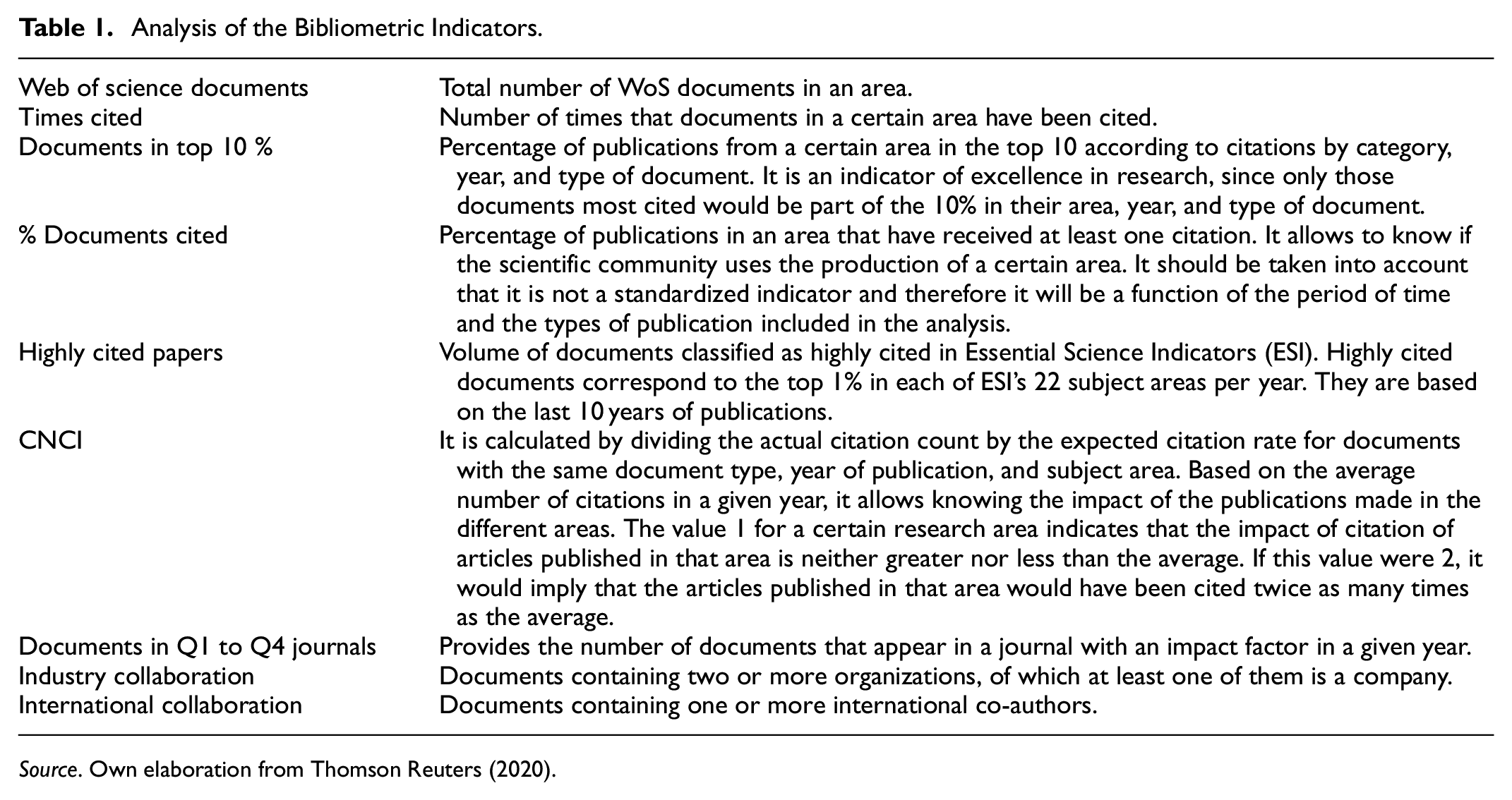
Source. Own elaboration from Thomson Reuters (2020).
The research areas were classified according to their perspective. For this, the description provided by InCites for each of the categories was used, encompassing them as shown in Table 2.
Description of Perspectives.

In addition, to know the main research topics developed so far, the Vosviewer software was used (Van Eck & Waltman, 2010). Vosviewer provides a graphical visualization through network structures, where it must be considered that the larger the size of the circle, the greater the relevance of a certain element, also allowing the grouping by colors of the different clustered elements. A co-occurrence analysis was developed that allows knowing the frequency with which a keyword appears next to another in two publications (Gaviria-Marín et al., 2018).
Results
The search carried out identified a total of 10,988 results, of which, considering the inclusion criteria selecting the articles, the proceeding papers, and the reviews, 10,593 were analyzed.
Figure 1 shows the evolution of academic production in the last 5 years. A slight increase in the number of publications is observed throughout the period under study, going from 15.57% in 2015 to 25.15% in 2019.

Number of publications per year.
Figure 2 shows the total number of publications by research area. Of a total of 121 identified areas that have published on the subject under study, those of Business and Management stand out, with 33.5% of the total publications on corporate social responsibility. The 20 areas in which there is a greater number of publications representing 89.9% of the total publications identified, are presented. Regarding the number of citations, several areas appear above the two most productive: Manufacturing Engineering (1,440 citations, 72 publications), Operations Research & Management Science (2,830 citations, 149 publications), Applied Psychology (1,737 citations, 93 publications), Environmental Engineering (5,593 citations, 319 publications), Industrial Engineering (1,544 citations, 91 publications), and Ethics (8,642 citations, 626 publications).
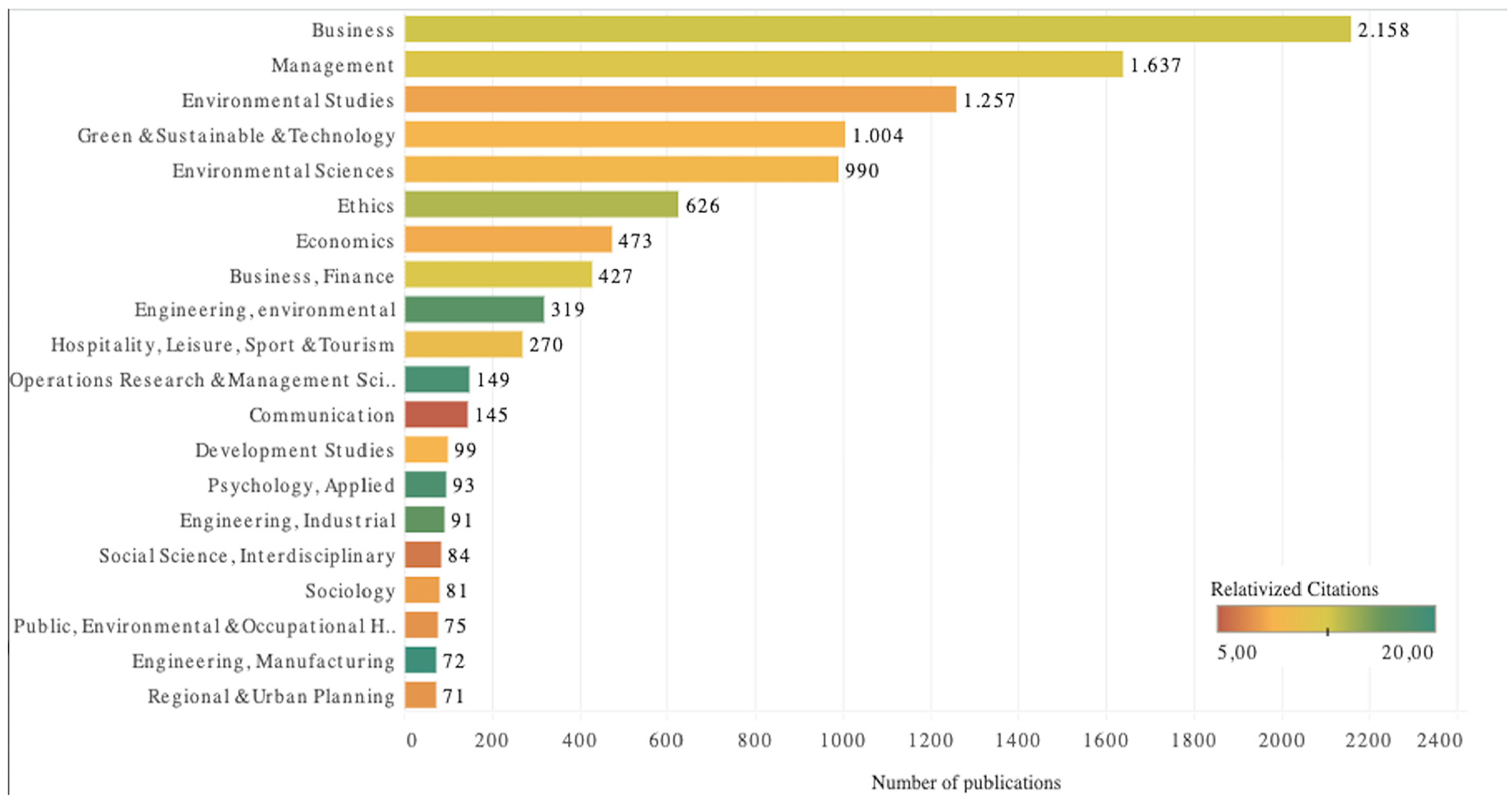
Publications in WoS by research area.
Table 3 collects the bibliometric indicators that allow analyzing the impact of publications on CSR by research area, for the 20 areas that present the highest number of publications, classified in different perspectives: management, economic, environmental, social, transverse. It is observed how the CNCI in the areas that occupy the first five positions by number of publications is lower than in other areas with fewer publications. The Ethics area stands out with the highest CNCI (3.99), followed by Business Finance (3.06), and Applied Psychology (2.88). The Documents in Top 10% indicator follows the same line, with the highest values for the Ethics area (47.60), followed by Business Finance (37.47) and Operations Research & Management Science (33.56). Regarding the Highly Cited Papers, it is worth highlighting that the Applied Psychology area with 93 publications in WoS has 11 of them classified as highly cited in ESI, which corresponds to 11.80%, well above the Business and Management areas, which place only 3.75% and 4.46% of their total publications as highly cited.
Bibliometric Indicators of Impact on CSR by Research Area.

Note. The research areas are ordered by the number of publications. CNCI = HCP = highly cited papers.
Figure 3 shows the number of publications in Q1 to Q4 journals for the 20 areas with the highest number of publications in WoS. Some areas with a high percentage of their publications in the first quartile are noteworthy: Environmental Engineering (96.86%), Ethics (95.53%), Operations Research & Management Science (71.81%), Hospitality, Leisure, Sport & Tourism (70.48%), Regional & Urban Planning (61.43%) or Public, Environmental & Occupational Health (60.81%), all of these are higher than that of the Business and Management areas, with 41.90% and 49.61% respectively, of publications in Q1. It is also observed that all areas have more than half of their publications in indexed journals Q1 and Q2.

Number of publications of impact on WoS by research area.
Finally, Table 4 collects the indicators that show the existing collaborations by research area for the 20 most productive areas. At an international level, the Operations Research & Management Science area stands out with a collaboration percentage of 79.19%, much higher than that of the most productive areas, Business and Management, with percentages of 36.56% and 35.13% respectively. The second and third place by percentage of international collaboration is occupied by two areas related to engineering: Environmental Engineering (52.66%) and Industrial Engineering (40.66%). The rest of the areas have collaboration percentages between 20% and 30%, with the exception of Regional & Urban Planning, which only has 16.90%. On the other hand, collaboration with industry is very scarce, almost non-existent in all areas of research, with a maximum value of five collaborations for the Management area, followed by Business with four collaborations and Environmental Sciences, Green & Sustainable Science, and Technology and Environmental Studies, with 3.
Number of Collaborations at the International Level and Between Industries.

Note. +. Int. Col = international collaboration; Ind. Col. = industrial collaboration; CNCI = category normalized citation impact; %HCP = % high citation publication-.
Table 4 also allows us to observe the relationship between international collaborations, citations, and the CNCI bibliometric impact indicators, % Documents in Top 10% and% Highly Cited Papers Focusing first on the CNCI, a direct relationship between international collaboration and this indicator is not appreciated, since the areas with the highest percentage of international collaboration are not those with the highest CNCI. The highest CNCI is for the Ethics area (3.99) which is in fifth position in terms of international collaboration with 38.66%, followed by Business Finance (3.06) which appears in sixth position with a 37% international collaboration percentage. The same occurs with the % Documents in Top 10%, the highest value for this indicator is for the Ethics area (47.60%) followed by Business Finance (37.47%). Finally, in the case of % Highly Cited Papers, the highest value appears for Applied Psychology (11.83%), which is in the eleventh position in terms of the percentage of international collaboration. Nor is there a relationship between international collaboration and this indicator.
Discussion
The results obtained show that CSR is a widely relevant topic in the academic world in recent years (2015–2019), with a total of 10,593 publications in WoS, which have been increasing. Therefore, it can be stated that it is a topic of interest today. In this sense, although it is true that throughout the last 6 years the scientific production that analyzes this concept has been very fruitful and has been increasing, there are still things to be said, and it can be expected that it will be a research topic in the future since there are many gaps in its conceptualization and the impact that CSR practices have for companies and society (Gatti et al., 2019; Lin et al., 2020).
The great interdisciplinary nature of the concept also stands out, associated with its nature, an aspect that is evident in the analysis of the publications, where 121 areas with some CSR publication are identified. In the analysis of the 20 most productive areas, which account for 89.9% of the total publications identified, it is evident that the publications are grouped around the three previously commented dimensions of CSR: economic, social, and environmental (Xie et al., 2017). Companies have come to be seen by their stakeholders in terms of the so-called “triple bottom line,” not only good financial performance is expected, but good environmental performance and positive performance toward society are required (Santos, 2020).
As expected, the areas with the highest number of publications are associated with business management, which includes 40.58% of the publications from the 20 most productive areas, with Business (2,158 publications) and Management (1,637 publications) standing out above from Operations, Research & Management Science (149 publications), Industrial Engineering (91 publications), and Manufacturing Engineering (72 publications). The areas included in the environmental perspective would be placed next, which comprise 35.97% of the publications (Environmental Studies, 1 257; Green & Sustainable and Technology, 1,004; Environmental Sciences, 990; Environmental Engineering, 319; and Regional & Urban Planning, 71). Within the areas included in the economic perspective there are 9.87% of the publications, comprised in three areas (Economics, 473 publications; Business Finance, 427 publications; Developmental Studies, 99 publications). Finally, from the social perspective, five areas appear that account for 9.47% of the publications (Ethics, 626; Applied Psychology, 93; Sociology, 81; Interdisciplinary Social Science, 84; Public, Environmental & Occupational Health, 75). These results are in line with those obtained by Abad-Segura et al. (2019) that indicate the category of Scopus, Business, Management, and Accounting, as the most prolific; although they rank Social Science in second position and Environmental Science in third. Two transversal areas also appear: Communication and Hospitality, Leisure, Sport & Tourism. Communication is one of the main characteristics of CSR, playing a key role in its management (Tata & Prasad, 2015), so it is not surprising that this area appears among the 20 most productive. Companies must explain to their stakeholders what they do and why they do it (Villagra et al., 2015) if they want their CSR practices to be perceived by their stakeholders in a positive way and aligned with the principles and values of the organization (Rehman et al., 2020). The disclosure of this information will influence in assets as important as the legitimacy or reputation of the companies, significantly affecting the profitability of the business (Escamilla-Solano et al., 2019).
The fact that Hospitality, Leisure, Sport & Tourism appears in 10th position, shows that the academic world has paid strong attention to the tourism sector when studying CSR practices, motivated by the economic and social impact this sector has in society (Cowper-Smith & de Grosbois, 2011) and therefore the different sectors of activity must be considered (Partalidou et al., 2020).
It is considered that this greater number of publications in the business and management areas is not associated with the topic being of more interest in those areas, but would be related, on the one hand, to the fact that these areas receive a greater number of jobs, since research In CSR began in the field of management (Ji et al., 2020) which leads the authors to focus on these areas when submitting their research, and on the other hand, that business management encompasses the three perspectives Therefore, in these areas there will be accumulated works focused on the economic, environmental, and social dimension of CSR. Most of the bibliographic reviews found focus precisely on the publications of the business and management areas (Bartolacci et al., 2020; Jaén et al., 2018; Lizcano-Prada & Lombana, 2018; Rodrígues & Mendes, 2018; Zhao et al., 2018), which highlights this tendency to associate CSR with these areas.
In relation to the analysis of citations relativized by number of documents published for each of the 20 most productive research areas, it is observed that the areas with a greater number of publications, Business and Management are not those that in proportion receive a greater number of citations, being surpassed by areas such as Manufacturing Engineering, Operations Research & Management Science, Applied Psychology, Environmental Engineering, and Industrial Engineering and Ethics. Furthermore, the results of the analysis of the bibliometric indicators CNCI and Documents in Top 10% follow the same line. The highest value of the CNCI appears for the Ethics area (3.99), located in sixth position by number of publications, followed by Business Finance (3.06) that appears in eighth position by productivity, and Applied Psychology (2.88), in fourteenth position of the top 20 of the most productive areas. These results imply that the articles published in the Ethics area have been cited almost four times above the average value of citations, while those published in the Business Finance area three times above the average value and in the Applied Psychology area almost triple the times. However, the CNCI for the Business and Management areas that are the most productive would be 2.08 and 1.85, respectively. If we pay attention to the indicator Documents in Top 10%, it is observed that it follows the same line and the highest value appears again for the Ethics area (47.60) and as for the Highly Cited Papers, the Applied Psychology area presents 11 of its 93 WoS publications classified as highly cited in ESI, which indicates that 11.80% of their total publications are highly cited, well above the Business and Management areas, which only place 3.75% and 4.46% of their total publications as highly cited. These results show that the articles published in the most productive areas are not the ones generating the greatest impact.
If an analysis of the results is made taking into account the perspectives to identify those research areas that are most interesting for researchers when submitting their research for publication, it could be said that the Business Finance area can be a good option for job posting from an economic perspective. This area appears in eighth position in terms of productivity, with which so far it has not published much on the subject, however presenting a greater impact of its publications than Business and Management, with a CNCI and a % of Documents in the top 10% higher. From the environmental perspective, it is suggested that the authors look for areas less exploited than Environmental Studies, Green & Sustainable Science & Technology, or Environmental Sciences that appear in third, fourth, and fifth position for productivity, such as Regional & Urban Planning for those studies focused on sustainability, in which there are only 71 publications, but whose impact, if the CNCI and the % of documents in the Top 10% are analyzed, is higher than in the three mentioned areas. Another option could be Environmental Engineering, in ninth position for publications, but with a higher impact than Green & Sustainable Science & Technology and Environmental Sciences. Regarding the social perspective, the Ethics area is presented as a good option, due by both, its productivity, and the impact of publications, with the highest CNCI (3.99) and the highest % of documents in the Top 10% (47.60%). Finally, a good option to send those works that are not focused on a specific perspective but on business management, can be Operations Research & Management Science whose CNCI and % of documents in the Top 10%, is higher than of Business and Management, with a much lower productivity.
On the other hand, if a co-occurrence analysis is carried out using the Vosviewer software to know the main research topics developed so far in the five proposed areas, it is observed how the focus of attention of each of them is focused on the perspectives mentioned before. Figures 4 to 8 represent the co-occurrence map by labels, taking into account that the larger the size of the circles, the greater the number of citations a term has, and grouping the different thematic groups by color. Thus, in Figure 4 you can see the map of labels for the Business Finance area where seven main lines of research are distinguished that are grouped under the following terms “Corporate Social Responsibility,” “Governance,” “Financial Performance,” “Management,” “Impact,” “Risk,” and “Stakeholder Theory,” mostly oriented to the financial part of business management, which confirms the proposal to guide the work from the economic perspective to this research area.

Co-occurrence analysis business finance label map.

Co-occurrence analysis Regional Urban Planning label map.

Co-occurrence analysis of Environmental Engineering label map.
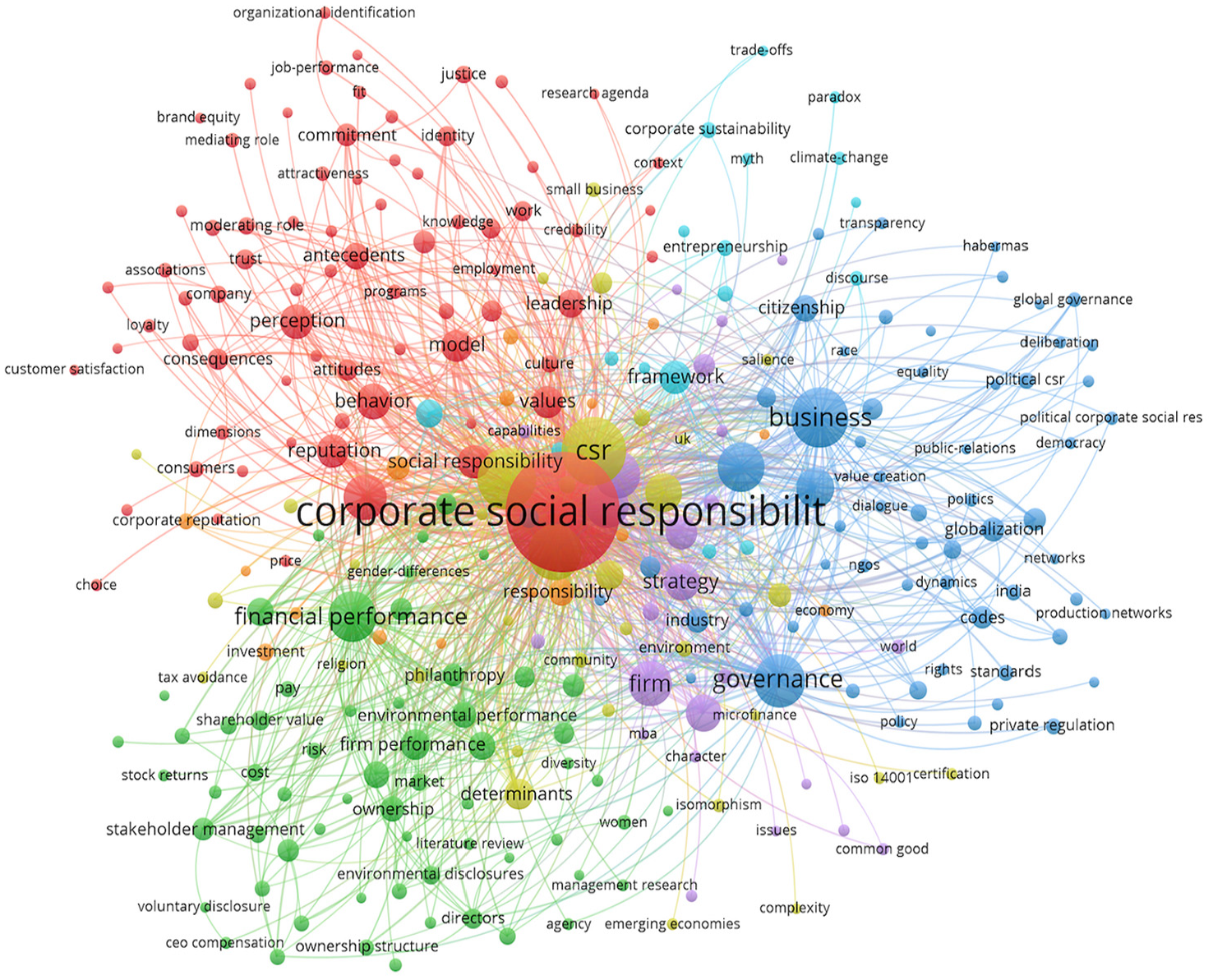
Co-occurrence analysis of ethics label map.

Co-occurrence analysis of ethics label map.
Continuing with Figure 5, it shows the co-occurrence analysis for the Regional Urban Planning area that shows five main lines of research grouped under the terms “Corporate Social Responsibility,” “Sustainable development,” “Management,” “Governance,” and “Financial Performance.”
Figure 6 shows the results for the Environmental Engineering area, appreciating in this case seven lines of research “Corporate Social Responsibility,” “Sustainability,” “Management,” “Financial Performance,” “Green,” “Supply Chain Management,” and “Companies.” In both areas, the second cluster behind “Corporate Social Responsibility” is associated with sustainable development, for which it is once again confirmed that these two research areas are appropriate to send those works developed from an environmental perspective.
As for Figure 7, it belongs to the analysis of the “Ethics” research area. In this case, five main lines of research appear “Corporate Social Responsibility” or “CSR,” “Business,” “Ethics,” “Financial Performance,” and “Framework,” showing themselves as a good option for jobs from a social perspective.
Finally, in the case of the Operations Research & Management Science area, Figure 8 distinguishes seven main lines of research: “Corporate Social Responsibility,” “Sustainability,” “Financial Performance,” “Strategy,” “Framework,” “Green,” and “Firm.” This area is presented as a multidisciplinary option oriented to business management as previously indicated.
Table 5 contains a summary of the research areas proposed for the submission of papers, taking into account their perspectives and the research lines of each of the areas.
Proposed Research Area.

On the other hand, one should not lose sight of transverse research areas such as Communication for those works that focus on the communication processes of CSR or Hospitality, Leisure, Sport & Tourism, for those that focus on the tourism sector.
Regarding the analysis of publications Q1 to Q4, the results show a high percentage of publications in indexed journals in the first two quartiles. Following the line of previous results, the most productive areas, Business and Management, are not the ones with the most publications in Q1 (41.90% and 49.61% respectively). From the business management perspective, the Operations Research & Management Science area with 71.81% in Q1 appears again as a good option for CSR publications, from a global perspective. Continuing with the economic perspective, Business Finance with 73.09% of its publications in Q1 and Q2, is postulated again as a good option taking into account this indicator. Regarding the environmental perspective, as it had already been observed in the study of the rest of bibliometric indicators, Environmental Engineering and Regional & Urban Planning, are considered a good alternative with 96.86% and 61.43% of publications in Q1 respectively. Finally, from the social perspective, although it is true that the Ethics area stands out with 95.53% of publications in Q1, the rest of the areas included in this perspective: Applied Psychology, Interdisciplinary Social Sciences .and Sociology are not far behind, with percentages of publications in Q1 and Q2 of 74.73%, 64.56%, and 71.05% respectively.
Continuing with the collaboration analysis, the results show an uneven international collaboration in the different research areas and practically no collaboration with the industry in all areas. From the management perspective, the Operations Research & Management Science area stands out above the rest with a high percentage of collaboration (79.19%), followed by Industrial Engineering (40.66%) which occupies the third position; however, Business and Management, with international collaboration percentages of 36.56% and 35.13%, are in seventh and eighth position. It is also striking that there is little or no collaboration with the industry. In the case of the Operations Research & Management Science area there is no collaboration, Industrial Engineering presents one collaboration and for Business and Management, there are four and five collaborations respectively, but taking into account the total number of publications in both areas, these values are insignificant. On the other hand, the areas associated with the economic perspective, show dissimilar percentages of international collaboration, with Developmental Studies (39.39%) in fourth position, Business Finance in sixth place (37.00%), while Economics only has 24.95% of publications with international collaboration and appears in the eighteenth position. Regarding international collaboration, no collaboration is observed in the case of Developmental Studies and in the other two areas there is only one collaboration with industry. From the environmental perspective, Environmental Engineering stands out with 52.66% of international collaboration and two collaborations with the industry. The rest of the areas included in this perspective have percentages of international collaboration between 20% and 30% and a very low collaboration with industry in which with three collaborations: Environmental Sciences, Green & Sustainable Science, and Technology & Environmental Studies, rank behind Business and Management. Finally, from the social perspective, Ethics, with 38.66% of international collaboration and two collaborations with the industry, ranks as the area with the highest collaboration among those included in this perspective. On the other hand, it is not appreciated that international collaboration generates a greater impact of publications, since there is no relationship between the% of international collaborations and the level of citation or the CNCI bibliometric indicators, % of documents in the Top 10% and % Highly Cited Papers. Abad-Segura et al. (2019), although they observed that international co-authorship generated a greater number of citations, this did not occur in all the countries under study.
Finally, there is practically no collaboration with the business world, something already revealed by Ribeiro et al. (2020). It is considered that the business world should not stay at margin and it is essential that it be involved and collaborate with the academic world so that the results of the research can be transferred to the business reality, and close the gap between academic research and business practice (Jia et al., 2019).
Conclusions
A total of 10,928 publications in the last 6-year period (2015–2019) show that CSR is a topic of interest in the academic world today.
The objective of this work was to provide evidence of the scientific production associated with the different research areas, which serves as a basis for researchers in making strategic decisions about the construction of new research perspectives and the publication of the results of their research in CSR.
The first conclusion of this work indicates that an important aspect when guiding CSR research and looking for where to publish the results, is to have a clear perspective of the study developed, taking into account the three dimensions of CSR: economic, social, and environmental. It is expected that the publication of the works in those journals that are part of less productive research areas in the matter may be easier for researchers, since these areas will not receive as many works and they will be more innovative.
The second conclusion points out that productivity and impact do not go hand in hand. There are areas of research that, despite being much less productive, generate a greater impact. Therefore, the publications of works tin these areas should be sought. Journals from the following areas are proposed depending on the perspective of the study, taking into account the main lines of research developed in each of them: Business Management: Operations Research & Management Science; Economic Perspective: Business Finance; Environmental Perspective: Regional & Urban Planning and Environmental Engineering; Social Perspective: Ethics. In addition, we should not lose sight of those cross-sectional studies focused, for example, on one of the pillars of CSR such as communication and therefore the Communication research area.
In summary, researchers are suggested to guide their publications based on the perspective of their work, not focusing solely on management journals. Giving different perspectives to the works will allow opening new lines of research and continuing to delve into the matter. The fact that research areas focused on business management such as Business and Management are the most productive implies that the publication of a work on CSR in them will be more difficult due to the large number of works that have already been published and the amount of studies that journals in these areas receive. The originality that a focused article can present from a perspective that allows its inclusion in less productive research areas will facilitate its publication for researchers. Additionally, the impact of publications in these other less productive areas has been shown to be greater.
The main limitation of this work would be associated with the use of a single database, WoS, to carry out the bibliometric study. Although it is one of the most important repositories for scientific publication, there are other databases such as Scopus, which offers an overview of production in the field of social sciences. Expanding the scope of the sample in future research would allow a more detailed view. However, it is considered that this study contributes significantly to the CSR literature by providing important information to researchers when proposing their research strategies and subsequent publication of the results obtained, taking into account the impact that CSR publications generate in the different areas of research, which will allow to open new lines of research and continue delving into the topic.
Footnotes
Declaration of Conflicting Interests
The author(s) declared no potential conflicts of interest with respect to the research, authorship, and/or publication of this article.
Funding
The author(s) received no financial support for the research, authorship, and/or publication of this article.
