




Abstract
As the world’s aging population continues to grow, leveraging technology to support healthy aging presents significant advantageous. Numerous studies have investigated the impact of ICT-related factors on the life satisfaction of older adults. However, existing research often approached these factors from a single perspective, overlooking potential threshold effects. This study addresses this gap by exploring the multifaceted determinants of ICT-related life satisfaction among older adults, incorporating the notion of threshold effects. A structured questionnaire was administered to 418 older adults residing in Wuhan, China, capturing their experiences and perceptions. Linear regression and piecewise regression model were utilized to explore both the linear and threshold effects of ICT-related factors on older adults’ life satisfaction. The findings reveal that (1) a positive attitude toward ICT, ICT use for social communication, and receiving feedback on digital skills and safety and security significantly and positively impact life satisfaction; (2) the use of ICT for learning and training was found to negatively affect older adults’ life satisfaction; and (3) attitudes toward ICT, ICT use for learning or training, digital skills feedback, and digital safety and security feedback exhibited threshold effects, suggesting that these factors significantly impact life satisfaction only up to a specific threshold. Beyond these thresholds, the effects tend to diminish or even reverse. This study offers a more comprehensive and precise understanding of the key ICT-related factors influencing older adults’ life satisfaction, along with their underlying mechanisms. Based on these findings, this study concludes by providing practical recommendations to enhance the well-being of older adults in the digital era.
Introduction
The contemporary digital era, characterized by the widespread use of information and communication technology (ICT) and the Internet, coincides with the global trend of an aging society. This demographic shift has heightened the importance of addressing older adults’ life satisfaction in the information age. Life satisfaction, defined as the evaluation of one’s life situation (Celik et al., 2018), serves as a vital metric for assessing successful aging (Heart & Kalderon, 2013). Diener (1998) describes life satisfaction as “the degree to which an individual assesses the overall quality of their life,” based on personal judgments and criteria. It encompasses an individual’s subjective assessment of their entire life, akin to the concepts of happiness and quality of life (Neto & Fonseca, 2016; Shan et al., 2022). Prior studies have utilized life satisfaction as an indicator of health risk and successful aging (Kavanaugh & Patterson, 2001). Individuals with high levels of life satisfaction experience optimistic feelings and maintain a positive outlook on themselves, others, their past, future, and immediate environment. Conversely, those with lower life satisfaction encounter more negative emotions, such as depression and anxiety (Khvorostianov et al., 2012). This evaluation measures the extent to which individuals perceive their lives as meaningful, effectively adapt to their surroundings, and fulfill personal requirements without facing emotional and social challenges (Kong & Liu, 2023).
The recent rapid development of ICT has facilitated its utilization to enhance the health and life satisfaction of older adults. According to Nevado-Peña et al. (2019), ICT can assist older adults in reducing psychological or cognitive deficiencies and social distress. Specifically, the use of ICT, including the internet, personal computers, and other computerized devices, can improve the quality of life for older adults (Heart & Kalderon, 2013; Marschollek et al., 2007). For example, Cohen-Mansfield and Biddison (2007) reported that ICT enabled significant connections and stimulated social interactions among older adults residing in retirement facilities. Consequently, ICT has a substantial impact on the life satisfaction of older adults in the digital era. Considering the varying degrees of digital literacy among older adults, it is imperative to consider their needs when designing digital solutions (Martin et al., 2023). Worldwide, nations are grappling with the consequences of an aging society, addressing it through research and policy interventions (The National Institute on Aging, 2018).
Given the promise of ICT, an increasing number of research studies have focused on its impact on older adults’ life satisfaction (Bobillier Chaumon et al., 2014; Nevado-Peña et al., 2019; Y. Zhang, 2023). While recent studies have made valuable contributions to understanding the impact of ICT-related factors on older adults’ life satisfaction, their focus has primarily centered on isolated factors, such as ICT attitude, self-efficacy, or social support, on older adults’ life satisfaction (Kong & Liu, 2023; Stepanikova et al., 2010; J. Zhou, 2018). Few studies have considered potential influences from a more holistic perspective, including individual, behavioral, and environmental factors, as suggested by social cognitive theory (Bandura, 1999). Additionally, prior research has predominantly examined a linear relationship between ICT-related factors and older adults’ life satisfaction (Celik et al., 2018; Y. Zhang, 2023). However, these studies often present varying results, potentially attributed to the lack of consideration for threshold effects.
The threshold effect, which refers to a nonlinear relationship between ICT-related factor and older adults’ life satisfaction, has received limited attention (Correia et al., 2024). A critical point or threshold must often be exceeded for a significant improvement in life satisfaction to occur. Below this threshold, the factor may exert minimal or no influence, indicating that the relationship is not linear but characterized by a distinct tipping point. For instance, Kong and Liu (2023) observed that ICT’s effects on life satisfaction becomes significant only after older adults attain a certain level of proficiency or frequency in ICT use. Research has shown that ICT significantly improves life satisfaction by enhancing social connections, increasing autonomy, and reducing loneliness, with digital skills training and technical support further enhancing well-being (Alhassan & Adam, 2021; Chen & Schulz, 2016). However, despite these promising findings, research also highlights that excessive reliance on ICT may have detrimental effects. Ihm and Hsieh (2015) argue that such reliance may exacerbate social isolation, lead to technological exclusion, and contribute to mental health issues. This discrepancy underscores the importance of examining threshold effects, as identifying the specific levels of ICT usage that either positively or negatively impact life satisfaction is crucial. Investigating threshold effects allows for a more nuanced understanding of how ICT influences the well-being of older adults. Such exploration could clarify inconsistencies in the literature, providing more precise guidance for researchers, practitioners, and policymakers.
As one of largest populated countries, China is facing the challenges of an aging population. The role of ICT in enhancing the quality of life for older adults has gained significance (Jun et al., 2021; Sala et al., 2022; Y. Zhang, 2023). Acknowledging this, China has initiated plans to integrate various ICT products into older adults’ care services (Ministry of Industry and Information Technology, 2017). Nevertheless, a comprehensive understanding of how ICT-related factors influence older adults’ life satisfaction remains elusive. This gap in knowledge limits the ability of researchers, practitioners, and policymakers to devise effective strategies to improve older adults’ well-being.
Therefore, to addresses this research gap, the present study aims to investigate the influence of ICT-related factors on Chinese older adults’ life satisfaction and threshold effects from the perspective of social cognitive theory. The results of this study could provide new insights into the influence of ICT-related factors on older adults’ life satisfaction and benefit decision-makers concerning educational policies, training programs, and ICT application development targeted at improving older adults’ life satisfaction. The results can also help older adults better adapt to life and embrace the conveniences afforded by ICT in the digital era. More specifically, this study was guided by the following research questions: (1) What ICT-related factors (personal, behavioral, and environmental factors) predict older adults’ life satisfaction? (2) Are there threshold effects in the influence of ICT-related factors on older adults’ life satisfaction?
Theoretical Framework
Social Cognitive Theory
Social cognitive theory (SCT), developed by Bandura (1999), explains psychosocial functioning in terms of triadic reciprocal causation. In this causal model, behavior, cognitive and other personal factors, and environmental events operate as interacting determinants that mutually influence each other bidirectionally (Bandura, 1999). Personal determinants encompass an individual’s expectations, beliefs, and emotional state including their physical characteristics such as age, race, gender, occupation, and physical attractiveness. Behavioral determinants refer to individuals’ behaviors reflecting their abilities and skills, while environmental determinants refer to the influence of environmental conditions on an individual’s abilities, knowledge, and beliefs. Within the context of social cognitive theory, life satisfaction is a comprehensive psychological index that measures a person’s life quality. It includes satisfaction with family relationships, education, one’s financial situation, and social life. Thus, life satisfaction is influenced by personal, behavioral, and environmental determinants.
Social cognitive theory has become a fundamental theory in clinical, educational, social, developmental, health, and personality psychology, and has been widely used in empirical research to analyze an individual’s abilities or skills. For example, Savolainen (2002) proposed a network competency model and applied social cognitive theory to analyze the main factors affecting network competency, while Zhu et al. (2019) utilized the theory to explore the factors that influence students’ information literacy. Similarly, Boutaky and Sahib Eddine (2023) analyzed the determinants of entrepreneurial intentions among science students based on social cognitive theory. Lent and Brown (2006) employed the social cognitive model to predict Italian teachers’ work and life satisfaction. Despite the wide-ranging application of social cognitive theory, its use in research on older adults’ life satisfaction in the digital era remains limited.
ICT-Related Factors and Older Adults’ Life Satisfaction
Personal Determinants
Personal factors, such as gender, age, income, education, employment status, family relationships, and physical health, have been shown to influence older adults’ life satisfaction (Celik et al., 2018; Cotten et al., 2013). For instance, Berg et al. (2006) found that age negatively affects perceived life satisfaction among older adults, with younger individuals reporting higher life satisfaction. As age increases, reduced mobility and increased care needs may contribute to declining life satisfaction. Additionally, older adults with higher levels of education and incomes are more likely to own and use digital devices such as personal computers and mobile devices. This increased usage allows them to enjoy the benefits of technology, enhancing their perceived life satisfaction (H. Li et al., 2013).
Previous research consistently highlights that ICT-related factors, particularly attitudes toward ICT, play a crucial role in shaping older adults’ life satisfaction. Attitude defined as an individual’s personal evaluation of technology use—including interest and enjoyment—has been found to positively influence older adults’ overall life satisfaction (Y. Zhang, 2023). Specifically, older adults with positive attitudes toward ICT tend to view themselves as open to new experiences and are more inclined to use these technologies, enhancing communication with their families and friends. This increased connectivity strengthens relationships and facilitates the provision of support and care from loved ones. These findings underscore the need for further research and interventions that promote positive ICT attitudes among older adults, ultimately contributing to their enhanced quality of life.
Behavioral Determinants
Older adults’ specific Internet or ICT usage is considered the primary behavioral factor influencing their life satisfaction. Prior studies have demonstrated that ICT use among older adults positively impacts their life satisfaction by increasing their social connections (Sala et al., 2022). For instance, Q. Zhang et al. (2022) found that ICT use strengthens intergenerational relationships between older adults and their families while keeping them informed about local community events. Thus, ICT use supports older adults’ psychological well-being by offering opportunities to socialize and interact with others (Shapira et al., 2007; Stepanikova et al., 2010).
Although most previous research suggests that ICT has a positive impact on older adults’ life satisfaction, some studies have identified potential negative effects. Theories of psychological aging suggest that older adults may face cognitive limitations, making them more susceptible to distractions or misinformation, which could negatively affect their health, and life satisfaction (Balota et al., 2000; Kooij et al., 2008). However, other research suggests that the relationship between Internet use and psychological well-being can be either positive or negative, depending on how ICT use influences the social processes affecting mental health (Stepanikova et al., 2010; Y. Zhang, 2023). The impact of time spent using ICT on life satisfaction remains inconsistent across studies. Stepanikova et al. (2010) found that the time spent perusing the web by U.S. adults was negatively related to life satisfaction. In contrast, Milosevic et al. (2024) reported a positive correlation between children’s life satisfaction and time spent online in Norway, while Kardefelt-Winther et al. (2020) found that time browsing the Internet did not appear to be related to children’s life satisfaction.
Despite contributing to a better understanding of ICT’s impact on older adults’ life satisfaction, most studies have examined the issue from a single perspective, without distinguishing between different types of ICT use. Older adults primarily use ICT for searching for information and news, maintaining and extending social communication, online learning, and managing their health by accessing relevant information to make informed decisions (Q. Zhang et al., 2022). However, ICT’s impact may vary depending on the purpose of its use, such as information search, communication, online learning and training, or health management. Hence, it is important to explore how different purposes of ICT use affects older adults’ life satisfaction.
Environmental Determinants
The environmental determinants of older adults’ life satisfaction mainly refer to ICT support or assistance provided by family members. Digital feedback refers to the technological support and assistance provided by family members to the older individual (Hong et al., 2016). The concept of digital feedback originally stems from cultural feedback which refers to the younger generation teaching older individuals about the cultural knowledge of the new era and facilitating reverse cultural inheritance in an era of rapid cultural change (X. H. Zhou, 2000). This means that younger people should assist older adults in adapting to the changes in the digital era by providing the access of digital resources, teaching them how to use digital technology, and improving their digital literacy and media literacy (Livingstone, 2003; Xenos & Foot, 2009). The major components of digital feedback include digital access feedback, digital skills feedback, and digital safety and security feedback. Digital access feedback refers to a younger person granting or providing an older person access to the Internet and digital devices such as a smartphone or tablet computer, digital skills feedback refers to technical support regarding the functional operation of digital devices, while digital safety, and security feedback mainly refers to assistance provided to an older adult to improve their cyber awareness, such as teaching someone to identify false digital information (Eynon & Helsper, 2015).
Prior studies have explored the influence of digital feedback on older adults’ digital literacy and digital product usage and Kiesler et al. (2000) found that young people are crucial in providing older adults with digital feedback. In addition, B. Li (2020) found that digital feedback had a significant impact on older adults’ use of instant messaging software such as WeChat, and the results of Jun et al. (2021) revealed that a high level of ICT support from family members or friends was significantly associated with bridging the digital divide faced by older adults. During in-depth interviews with six families, Zhou and Feng (2018) found that the provision of digital feedback can not only assist older adults in using digital technology more efficiently but also facilitate two-way communication between younger and older family members. However, limited additional research has attempted to explore the relationship between digital feedback and the life satisfaction of older adults.
Research Model and Hypotheses
Based on the social cognitive theory and literature review on ICT-related factors and older adults’ life satisfactory, we propose that personal determinants (a positive attitude to ICT), behavioral determinants (smartphone use (amount of time), ICT use for seeking and reading news, ICT use for social communication, ICT use for online learning and training, and ICT use for health management), and environmental determinants (digital feedback including feedback regarding digital access, digital skills, and digital safety and security) influence older adults’ life satisfaction. Therefore, as shown in Figure 1, we proposed the following research hypotheses:

The research model.
Methodology
Participants and Data Collection
Many cities in China have established communities for older adults, offering opportunities for social engagement through activities like fitness exercises and card games. To ensure geographic representativeness in our study, participants were recruited using a snowball sampling method, randomly selected from an older community in Wuhan City. Wuhan, situated in Central China, is not only the most populous city in Hubei Province but also one of China’s nine National Central Cities. The snowball sampling method (Kirchherr & Charles, 2018) followed this approach: Initially, the characteristics of the sample were defined, specifically targeting individuals aged 60 and older. Variations across distinct age brackets (60–65, 66–70, and 71–75) were considered in terms of their experience with ICT usage. Additionally, factors such as educational backgrounds, professional fields, and socioeconomic status, including income levels and occupational backgrounds, were taken into account. Secondly, to establish the initial sample, participants were recruited from various channels, including community centers, universities for the elderly, retirement associations, and parks. These initial participants, or “seeds,” were selected to ensure diversity in terms of age, gender, education level, and proficiency in ICT usage. Each seed participant was contacted and provided with detailed explanations regarding the research objectives, methodologies, confidentiality principles, and data utilization methods. This step ensured that participants had a comprehensive understanding of the voluntary and anonymous nature of the study. Thirdly, the snowball sampling technique was implemented. The initial sample was invited to recommend older adults individuals from their social circles who met the study’s criteria, particularly those with varied experiences in ICT usage. To maintain sample diversity, recommendation criteria were established, such as suggesting older adults from different age brackets and educational backgrounds, or those with notable differences in ICT usage. Simultaneously, the source of each recommendation was documented, and the diversity of the collected samples was periodically assessed, including their distribution across age, gender, education level, and ICT usage proficiency. If a particular type of sample became overrepresented, recruitment from that category was reduced while increasing recruitment of other types. Finally, the sampling process was terminated, and sample verification was conducted. Based on the research requirements, a target sample size was set, and the collected samples were reviewed to ensure they met the study’s criteria. Samples that did not meet the requirements or were incomplete were excluded. Throughout the sampling process, confidentiality of the participants’ personal information was strictly maintained, and relevant laws, regulations, and ethical guidelines were adhered to.
Notably, between 2010 and 2020, Wuhan experienced unprecedented population growth, averaging an annual increase of 2.34%, surpassing 10 million residents for the first time in its history (Wuhan Municipal Bureau of Statistics, 2021). Considering retirement age in China, where women typically retire at 55 (in administrative and public institutions) or 50 (in enterprises) and men at 60 (in administrative and public institutions) or 55 (in enterprises), individuals aged 60 and above were selected as the older adult participants in this study. This choice was made with consideration of both Wuhan’s population growth characteristics during this period and its uniqueness as a major city.
To assess the representativeness of our sample, we compared the education and income levels of our sample with those of the national elderly population data released by the National Bureau of Statistics of China. Reports indicate that, among the elderly population in urban areas of China, 28% receive a pension of less than 3,000 yuan, 33% receive a monthly pension ranging from 3,000 to 5,000 yuan, and 21% have a monthly income exceeding 8,000 yuan (Duan et al., 2018; Health Commission, 2021; Institute of Gerontology, Renmin University of China, 2016). Regarding educational attainment, approximately 29.6% of the elderly in China have never attended school, 41.5% have only a primary school education, 15% have only a junior high school education, and only 36.69 million have a high school education or above, which represents 13.90% of the total population (Duan et al., 2019; Institute of Gerontology, Renmin University of China, 2016). It is evident that the overall educational level of the elderly in China is relatively low. The results indicated that, despite some regional differences in specific details, our sample closely aligned with the overall characteristics of the national elderly population in terms of education level distribution and income. This enhances the general applicability of our research findings to the elderly population in China.
The study questionnaire was completed by residents of Wuhan City, specifically older adults. Recognizing that some older adults might encounter difficulties or inconveniences while completing an online survey, we provided paper-based questionnaires. Each survey took approximately 20 to 30 min, and participants were given a 10-yuan (RMB) gift card as a token of appreciation for their participation. The survey was conducted over 8 weeks spanning March to April 2023, with participation being entirely voluntary. To facilitate the process, we enlisted the assistance of seven college students who could aid participants in completing the questionnaire or address any questions they had. Additionally, we ensured accessibility by providing reading glasses and pens to those in need.
Due to physical limitations experienced by some respondents, including difficulties with focus or vision, coupled with limited ICT experience, a total of 71 samples were excluded from the initial pool of 489 participants. These exclusion criteria were meticulously applied to maintain the relevance and representativeness of our study sample. Specifically, individuals were excluded if they: (a) Experienced vision disorders, hearing disorders, or a combination of both, which could hinder their ability to fully engage with the study materials and instruments. (b) Encountered significant difficulties in comprehending the study’s scales and measures, potentially due to conditions such as dementia or other cognitive impairments that could affect their understanding or accurate responses. Ultimately, we retained 418 valid samples, achieving an approximate effective response rate of 85%. All participants in this study were informed of the study’s purpose, and we obtained verbal consent from each individual involved in this study. Table 1 provides a breakdown of the 418 participants, with 51% being male and 49% female. A significant portion of participants (48%) had an education background limited to junior high school or lower.
Sociodemographic Characteristics of Participants.

Note. Total valid samples: 418. US$1.00 is worth about 7.18 yuan.
Instrumentation
This survey consisted of two parts. The first part related to participants’ general demographic information, such as age, gender, education level, profession, monthly income, and whether they lived alone or not. This survey also asked about their Internet experience (years of use), the time spent using a smartphone per day, and the type of smartphone used. The second part of the survey assessed participants’ life satisfaction, attitudes toward ICT, specific use of ICT, and digital feedback levels.
The participants completed the Satisfaction of Life Scales to assess their life satisfaction. The scale was adapted from Cheng et al. (2024), and consisted of four self-report questions. Items included: “I am satisfied with my present work\health condition\relationship with family, relatives, friends, neighbors, and colleagues.” Each item was answered using a 5-point Likert scale (1 = totally disagree, 5 = totally agree) and the scale demonstrated good internal consistency (α = .82).
ICT attitude mainly refers to the older person’s subjective perception or feelings toward ICT or Internet use. The ICT attitude scale used was adopted from Klimova et al. (2016) and consisted of three items (e.g., “I think using smartphones or other electronic devices is interesting,”“I think computers make my life easier,” and “I think computers bring people together”). Each item was answered using a 5-point Likert scale (1 = totally disagree, 5 = totally agree) and the scale showed good internal consistency with a Cronbach’s alpha of .88. To assess older adults’ ICT use, several items were adapted from Y. Zhang (2023), including ICT use for seeking and reading news, which focuses on passive information consumption on the internet (e.g., browsing daily news, watching online videos, etc.); ICT use for learning and training, which emphasizes active skill acquisition (e.g., watching tutorials on smartphone usage, taking online courses on investment and finance, as well as healthcare, etc.); ICT use for social communication, which includes activities like using WeChat, QQ, Email, and online telephony to maintain contact with others; and ICT use for healthy management, which primarily involves using ICT for monitoring and managing one’s health (e.g., using telemedicine services, fitness apps, and monitoring devices).
The digital feedback scale developed by Y. Q. Zhou and Ding (2020) was used to assess the degree to which children assist their parents in using information technology by providing feedback. The scale comprises three items (e.g., “My children and grandchildren often teach me how to use a smartphone,”“My children and grandchildren often teach me how to shop online\share new information with me at home,”“My children or grandchildren often teach me how to avoid online fraud,” and responses are rated on a 5-point scale ranging from 1 (never) to 5 (always). The scale showed a good inner consistency (α = .82).
Data Analysis
Data analysis proceeded in three steps. First, the data were screened and imported into SPSS 25.0 for statistical analysis. Following screening, descriptive statistics were computed to examine the means and standard deviations of older adults’ life satisfaction and their ICT-related factors. Second, we conducted Spearman’s correlation tests and regression analyses to investigate the ICT-related personal, behavioral, and environmental factors that influence older adults’ life satisfaction. Third, to explore the threshold effect of ICT-related factors on older adults’ life satisfaction, piecewise regression modeling (PRM) was employed using the segmented package of R (Muggeo, 2008). Piecewise regression modeling, also known as “broken-stick” models, is a statistical technique that represents complex relationships in data by using two or more linear segments joined at unknown points, called “breakpoints” (Muggeo, 2017). These breakpoints act as thresholds that divide the data into distinct regions, each characterized by a different linear relationship. By identifying and modeling these segments, researchers can uncover deeper insights into the underlying processes, leading to more robust, and meaningful findings (Malash & El-Khaiary, 2010).
In our study, piecewise regression modeling (PRM) was employed to capture the non-linear relationship between the independent variable (life satisfaction) and the dependent variables. The PRM model allows for different slopes and intercepts for different segments of the data, thereby capturing the non-linearity in the relationship. Furthermore, sub-group analysis was conducted with the same PRM to determine if there were different patterns of ICT-related factors’“threshold effect” on older adults’ life satisfaction.
Results
Descriptive Analyses
Participants’ (N = 418) results on the Life Satisfaction Scale are summarized in Table 2 which shows that the average (mean) score was 3.77. Table 2 also shows that the older adults were most satisfied with their family relationship (4.25), moderately satisfied with their social life, entertainment activities, and financial situation with scores of 3.74, 3.67, and 3.66, respectively, and were least satisfied with their education (3.55).
Older Adults’ Life Satisfaction Scale Scores.

Note. M = mean; SD = standard deviation.
The descriptive statistics pertaining to older adults’ ICT-related variables are shown in Table 3. Their average ICT attitude score was 3.60, indicating that they generally hold positive attitudes toward ICT. Similarly, they achieved relatively high scores for ICT-related behavioral factors (ICT use for social communication was 3.32, and ICT use for seeking and reading news was 3.20), while their score for ICT use for health management was lower (1.86). In terms of environmental factors, the highest score was for digital safety and security feedback from family members (3.43), while the lowest score was for digital access feedback (3.03).
Older Adults’ Scores on ICT-related Variables.

Note. M = mean; SD = standard deviation.
The Linear Regression: The Effects of ICT-Related Factors on Older Adults’ Life Satisfaction
To answer R1, correlation analyses were conducted to investigate the relationship between older adults’ ICT-related factors and their life satisfaction. As shown in Table 4, the majority of older adults’ ICT-related factors significantly correlated with their life satisfaction scores. Meanwhile, their ICT positive attitudes, smartphone use (time per day), and ICT use for seeking and reading news were significantly correlated with other variables except for ICT environmental factors (i.e., digital access feedback, digital skills feedback, and digital safety and security feedback). Based on these results, most correlated variables were included in the linear and piecewise regressions.
Correlations Among All Variables Under Investigation.

Note. 1 = Life satisfaction; 2 = ICT positive attitude; 3 = Smartphone use time (per day); 4 = ICT use for seeking and reading news; 5 = ICT use for social communication; 6 = ICT use for online learning and training; 7 = ICT use for health management; 8 = Digital access feedback from family members; 9 = Digital skill feedback from family members; 10 = Digital safety and security feedback from family members.
Indicates Significant: *p < .05. **p < .01.
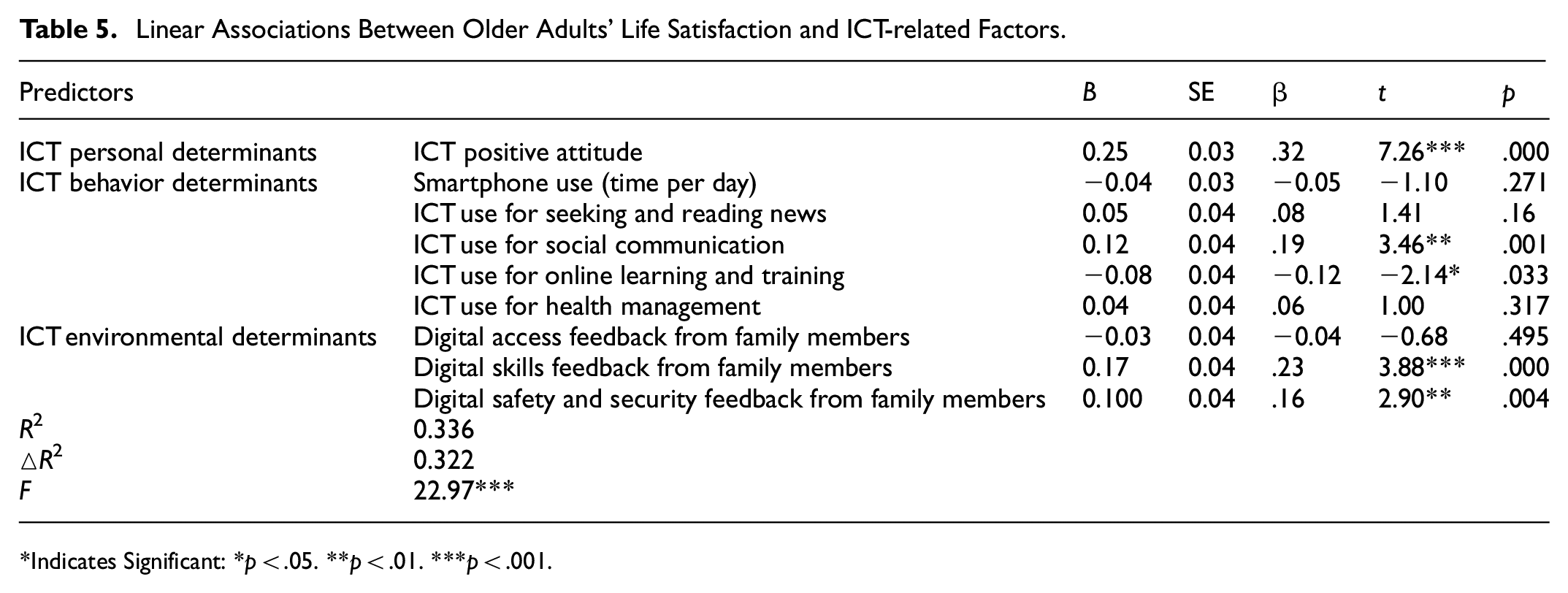
Linear regressions were conducted to examine whether ICT-related factors (personal, behavioral, and environmental) were linearly associated with older adults’ life satisfaction, with the results summarized in Table 5.
Linear Associations Between Older Adults’ Life Satisfaction and ICT-related Factors.
Indicates Significant: *p < .05. **p < .01. ***p < .001.
From a personal perspective, older adults’ positive attitudes toward ICT significant and positively predicted life satisfaction (t = 7.26, p < .001), confirming H1.
From a behavioral perspective, smartphone use (time per day), ICT use for seeking and reading news, and ICT use for health management were not significantly related to life satisfaction. In contrast, ICT use for social communication positively and significantly predicted life satisfaction (t = 3.46, p < .001). Interestingly, ICT use for online learning and training was found to be negatively associated with life satisfaction (t = −2.14, p = .033), confirming H4, while H2, H3, H5, H6 were rejected.
Regarding ICT environmental factors, which included digital access feedback, digital skills feedback, and digital safety and security feedback provided by their children or grandchildren, the results showed that digital skills feedback (t = 3.88, p < .001) and digital safety and security feedback (t = 2.90, p < .001) significantly and positively predicted older adults’ life satisfaction, while digital access feedback had no significant effect. Consequently, H8 and H9 were confirmed, while H7 was rejected. The findings suggest that the more feedback older adults received, particularly in digital skills and safety, from their children or grandchildren, the higher their life satisfaction. Overall, the model explained 32.2% of the variance.
The Piecewise Regression: The Threshold Effect of ICT-Related Factors on Older Adults’ Life Satisfaction
R2 aimed to examine the threshold effects of ICT-related factors (i.e., personal factors, behavioral factors, and environmental factors) on older adults’ life satisfaction with piecewise regression models (PRM), while accounting for covariates such as age, education, and gender. As shown in Table 6 and depicted in Figure 2, the results indicated the presence of threshold effects for ICT positive attitudes, ICT use for online learning and training, digital skills feedback, and digital safety and security feedback on older adults’ life. satisfaction.
Piecewise Regression: Testing Thresholds of ICT-related Factors on Older Adults’ Life Satisfaction.

Note. Est. = cut-off point estimate; B = regression coefficient estimate; SE = standard error.
Indicates Significant: *p < .05.

Threshold effects of ICT-related factors on older adults’ life satisfaction.
Results of the PRM analyses of ICT positive attitudes showed that the cut-point for older adults’ life satisfaction was 3.27 (SE = 0.19), and slopes below and above the cut-point were −0.05 (SE = 0.09) and 0.70 (SE = 0.13), respectively. Post-hoc comparisons indicated significant differences between older adults’ ICT positive attitudes and their life satisfaction both above and below the cut-off (p < .001). Older adults’ ICT positive attitudes were not associated with their life satisfaction below the cut-point (representing lower ICT positive attitudes) but were significantly associated with higher ICT positive attitudes (above the cut-point). Results also indicated that 146 (35%) of the cohort had ICT positive attitudes below the threshold, and 272 (65%) had ICT positive attitudes above it.
Likewise, PRM analyses of ICT use for online learning and training showed the cut-point for older adults’ life satisfaction was 2.83 (SE = 0.40), while slopes below and above the cut-point were 0.18 (SE = 0.09) and −0.39 (SE = 0.15), respectively. Post-hoc comparisons indicated there were significant differences between ICT use for online learning and training and life satisfaction at both ends of the cut-off (p < .05). Results showed that the impact of ICT application on life satisfaction was significant and positive when older adults’ use of ICT for learning or training was lower than the cut-off. However, the impact was significant and negative when scores were above the cut-off. Within this cohort, 251 (60.0%) had scores below the threshold, and 167 (40.0%) had scores above it.
Third, PRM analyses of digital skills feedback yielded a cut-point for older adults’ life satisfaction of 3.00 (SE = 0.80) with slopes below and above the cut-point being 0.14 (SE = 0.07) and 0.23 (SE = 0.16), respectively. Post-hoc comparisons indicated that older adults’ life satisfaction was more strongly related to higher levels of digital skills feedback (above the cut-point) than to lower levels of feedback (below the cut-point) (p < .01). The results also showed that among the participants, 239 (57.2%) had scores below the digital skill feedback threshold (3.00), while 179 (42.8%) had scores higher than it. An independent samples t-test revealed a significant difference in the life satisfaction scores of older adults with scores higher and lower than the threshold (p < .01).
Finally, PRM analyses of digital safety and security feedback yielded a cut-point of 3.54 (SE = 0.25) for older adults’ life satisfaction, with slopes below and above the cut-point being 0.02 (SE = 0.07) and 0.51 (SE = 0.12), respectively. Post-hoc comparisons of the slopes indicated that the relationship between digital safety and security feedback and life satisfaction was significantly different for people with scores higher and lower than the cut-off (p < .05). Digital safety and security feedback significantly predicted older adults’ life satisfaction above the cut-off, but not below it. Within this sample, 189 (45.2%) had scores below the threshold for digital safety and security feedback and 229 (54.8%) had scores higher than the threshold.
Discussion and Implications
Discussion
Life satisfaction has emerged as a pivotal indicator of well-being and successful aging, a concept thoroughly substantiated by J. Zhou (2018). As societies transition into the digital age, understanding the complex interplay between Information and Communication Technology (ICT)-related factors and life satisfaction among older adults becomes increasingly crucial (Kong & Liu, 2023). Compared to previous research, the main contributions of this study are as follows: Firstly, this study provides a comprehensive analysis by utilizing Social Cognitive Theory. Unlike previous studies that often examine the influence of a single aspect, this study integrates multiple factors using Social Cognitive Theory, offering a more holistic perspective on life satisfaction among older adults. Secondly, this study explores the nonlinear relationships between older adults’ ICT-related factors and their life satisfaction. By investigating threshold effects and identifying critical points where ICT-related factors significantly impact life satisfaction, this study transcends linear relationships. This approach provides theoretical support for more targeted policies and interventions. Thirdly, this study reveals a novel application of Social Cognitive Theory. By applying the theory to the older adult population, this study expands its application and offers a new framework for enhancing life satisfaction among this demographic.
Based on the Social Cognitive Theory, this study examines the impact of ICT-related factors on older adults’ life satisfaction considering personal, behavioral, and environmental aspects. In terms of personal factors related to ICT among older adults, our findings affirm a positive correlation between older adults’ positive attitudes toward ICT and higher life satisfaction scores. These findings support previous findings demonstrating that older adults with more positive attitudes toward ICT are more willing to utilize ICT, have better access to various ICT devices, and have higher life satisfaction (Y. Zhang, 2023). Similarity, the results of Chopik (2016) indicated that older adults with positive attitudes toward ICT experience reduced feelings of loneliness, which is directly associated with higher life satisfaction. Furthermore, a positive perspective on ICT may augment older adults’ usage and life satisfaction by fostering better social interactions (Vroman et al., 2015). This underscores the importance of nurturing positive perceptions of ICT among older adults.
Regarding the behavioral factors related to Information and Communication Technology (ICT) use among older adults, this study delves into the nuanced impacts of ICT use on life satisfaction. Specifically, it highlights the distinct effects of using ICT for social communication versus using it for learning and training. Notably, the utilization of ICT for social communication emerges as a positive influence on life satisfaction. These findings align with the burgeoning trend of older adults engaging with social communication platforms, such as Messenger and social networking sites (SNS), which contributes to reduced feelings of loneliness and heightened life satisfaction (Nimrod, 2020). This underscores the potential of technology, particularly social communication tools, to alleviate feelings of isolation among older adults. Indeed, active engagement in social communication through ICT can diminish feelings of loneliness and augment life satisfaction, particularly when communicating with close friends and family (Chen & Schulz, 2016). Similarly, Seifert et al. (2021) found that older adults who are active Internet users and frequently participate in blog discussions tend to perceive a higher sense of community compared to those who do not engage in such activities. van Boekel et al. (2017) also reported higher life satisfaction among older adults who engage in social communication through ICT. As older adults increasingly embrace messaging applications like Messenger and engage in social networking (Q. Zhang et al., 2022), the potential benefits for mitigating loneliness and enhancing life satisfaction become increasingly apparent.
In contrast to the positive effects of using Information and Communication Technology (ICT) for social communication, the utilization of ICT for learning and training exhibits a significant negative impact on life satisfaction among older adults. One possible explanation for this finding may be that engaging in ICT for learning and training can reduce connections with family, friends, and communities, leading to social isolation and a subsequent decline in emotional and social support, which in turn may negatively affect life satisfaction (Chen & Schulz, 2016; Seifert et al., 2021). Furthermore, the use of ICT for learning and training can produce a substantial cognitive load, and the continuous process of learning and adapting to new technologies may induce psychological pressure and frustration, thereby reducing life satisfaction (Kim et al., 2023; van Boekel et al., 2017; Xie et al., 2012). According to theories of psychological aging, older adults may face limitations in their mental capacity (Kooij et al., 2008), making them more susceptible to distractions or misinformation, which could adversely impact their health, or life satisfaction (Balota et al., 2000). However, other research has indicated that the relationship between Internet use and psychological well-being can be either positive or negative, depending on how ICT use influences the social processes that affect mental health (Stepanikova et al., 2010; Y. Zhang, 2023). From this perspective, the results of this study provide additional evidence for the design of ICT courses and training for older adults. Specifically, it suggests that ICT training and learning for older adults should be limited to shorter durations to avoid overwhelming them. Additionally, the equipment and training courses should be user-friendly and tailored to meet the specific needs of older adults.
With regard to the ICT environmental determinants for older adults, the study underscores the crucial role of family members and the importance of their feedback in augmenting digital skills and cyber awareness. Family members, who are often more proficient in navigating the digital landscape, can substantially contribute to improving older adults’ digital skills, safety, and security. By establishing a support system where family members guide older adults through the complexities of using digital devices, recognizing false information, and fostering a secure digital environment, life satisfaction can be significantly enhanced (Bae, 2022). Furthermore, Xie et al.’s (2012) study indicates that family feedback and support in learning digital skills play a crucial role in the adoption of social media among older adults, fostering a sense of connection and enhancing their personal capabilities. Similarly, Nguyen et al. (2020) found that feedback from family members is a key factor in shaping older adults’ confidence in using technology, which directly contributes to increased life satisfaction.
Feedback, particularly concerning digital skills and digital safety and security, plays a crucial role in shaping the life satisfaction of older adults. This aligns with the notion that younger individuals, who often possess inherent digital proficiency, play a pivotal role in providing feedback that fosters older adults’ acceptance of digital life (Kiesler et al., 2000). This intergenerational learning approach can be highly effective in enhancing digital skills and improving life satisfaction among older adults (Miller et al., 2024; Pihlainen et al., 2023). Kamin et al. (2017) found that feedback from family members on digital skills significantly impacts older adults’ self-efficacy and confidence in using technology. Similarly, Choi et al.’s (2012) study indicated that positive feedback cultivates a sense of achievement, leading to increased life satisfaction. Additionally, it is also critical that family members provide feedback on digital safety and security to older adults. By providing guidance on topics such as recognizing online scams, protecting personal information, and using secure passwords, they help older adults feel more secure in their digital interactions, reducing anxiety and increasing overall satisfaction with technology (Bhattacharjee et al., 2020).
In addition to exploring the impact of ICT-related factors on older adults’ life satisfaction, this study introduces the concept of a threshold effect concerning ICT-related factors, exploring the threshold effect of personal factors, behavioral factors, and environmental factors on older adults’ life satisfaction. The identification of threshold effects sheds light on the nuanced dynamics at play. Attitudes toward ICT, ICT use for learning and training, digital skills feedback, and digital safety and security feedback exhibit threshold effects, indicating that these factors have a significant impact only up to a certain level. Beyond these thresholds, the effects tend to diminish or even reverse. A phenomenon also noted by Kong and Liu (2023) who posits that the positive impact of ICT on life satisfaction among the older adults becomes pronounced only after a certain proficiency or frequency of use is achieved.
The findings of the second research question reveal that ICT positive attitude of older adults and the feedback regrading digital skills and digital safety and security from family members surpass their respective thresholds, can the significant positive impact on their life satisfaction become apparent. The specific trends observed were as follows: When the ICT attitude score is below 3.27, there is no significant correlation with life satisfaction. However, as the score surpasses this threshold, life satisfaction increases significantly with improvements in the ICT attitude. Regarding digital skill feedback, when the score surpasses the cutoff point of 3.00, the correlation between older adults’ life satisfaction and digital skill feedback becomes stronger. The analysis of digital safety and security feedback also reveals a similar piecewise linear threshold effect. Specifically, when older adults’ digital safety and security feedback scores exceed 3.54, digital safety and security feedback can significantly predict their life satisfaction above this threshold, but not for those below it. In this study, 35% of older adults exhibited ICT positive attitudes below the threshold, while nearly 57% and 45% did not reach the threshold level in terms of receiving digital skill feedback and digital safety and security feedback from their family members, respectively. These results also suggest that researchers, practitioners and policy makers should consider the diversity of the older adults in the implementation of education related programs, For instance, cultivating positive attitudes toward ICT should be a primary focus, with targeted interventions for those with negative attitudes. Family members can play a crucial role in teaching the basic functions of digital products to alleviate fear and enhance confidence. Geerts et al. (2023) also found young family members, known as “warm experts,” assist older adults in mastering technology with patient, and empathetic teaching, addressing challenges like cognitive decline and tech anxiety.
Furthermore, the findings related to the second research question also reveal a significant negative impact on life satisfaction when the use of Information and Communication Technology (ICT) for learning and training exceeds a certain threshold. Specifically, when the level of ICT learning and training is below the threshold of 2.83, it has a positive effect on life satisfaction. Blazun et al. (2012) found that such training reduces loneliness and enhances life satisfaction, whereas Gonzalez et al. (2015) suggested that it boosts confidence and competence in using computers, further improving well-being. Additionally, a study by Finkelstein and Brennan-Ing (2023) emphasized that appropriate ICT training and support not only facilitate technology adoption but also enhance social connectivity. However, when the training exceeds the threshold of 2.83, life satisfaction decreases as the amount of training increases. Possible explanations for this decrease include reduced social connections, increased cognitive load, and potential psychological pressures and frustrations associated with continuous learning (Khvorostianov et al., 2012; Stepanikova et al., 2010). Tyler et al. (2020) argued in their study that when designing technical training for older adults, it is crucial to consider their learning styles, ensure that the training meets their actual needs, involve them in course decisions, and tailor the experience to individual requirements. These findings underscore the importance of striking a delicate balance when designing ICT courses for older adults, advocating for shorter durations and user-friendly, tailored content.
Implications
The study’s extensive findings pave the way for specific recommendations to improve the well-being of older adults in the digital era.
Firstly, government agencies and educational institutions should play a crucial role in cultivating positive attitudes toward Information and Communication Technology (ICT) among older adults, particularly those who hold negative attitudes. To achieve this, these entities should develop educational initiatives specifically tailored for this demographic. These programs, designed to be engaging and informative, should concentrate on imparting basic digital skills, and underscoring the practical benefits of ICT in daily life. Furthermore, family involvement is indispensable in addressing negative attitudes toward ICT among older adults. Family members, as close relatives and caregivers, should be encouraged to actively support and guide older adults in their digital endeavors. Family-led interventions, organized and facilitated by family members, can take various forms, such as tutorials, interactive sessions, and collaborative learning experiences. By collaborating and working together, family members can assist older adults in overcoming their fears and hesitations toward adopting and utilizing ICT, thereby fostering a more positive and open attitude toward technology.
Secondly, manufacturers of Information and Communication Technology (ICT) products should optimize social interaction applications for older adults by prioritizing user-centric design when developing software. These manufacturers, recognizing the importance of catering to this demographic, should adapt existing social networking software to better meet the specific needs of older adults. Features such as larger fonts, user-friendly interfaces, and pre-set communication functions should be incorporated into these applications to ensure accessibility and ease of use for older adults. Furthermore, government agencies, non-profit organizations, and other stakeholders should collaborate to create and promote age-friendly online communities that cater to the interests and needs of older adults. These organizations, recognizing the value of such communities, can serve as valuable platforms for older adults to share experiences, exchange insights about ICT, and establish a supportive network of peers. By fostering a sense of community and belonging, these online spaces can help older adults overcome feelings of isolation and loneliness, while also providing opportunities for social interaction, and learning among them.
Thirdly, educational institutions and program developers must ensure that they balance the use of Information and Communication Technology (ICT) for learning and training among older adults. Courses specifically designed for this demographic should break content into smaller, manageable components to reduce learning difficulty and maintain cognitive engagement without causing fatigue. Furthermore, it is crucial for educators and trainers to emphasize the importance of moderation in ICT use for learning and training. They should guide older adults to maintain a healthy balance, avoiding excessive reliance on technology that may potentially diminish their overall life satisfaction.
Lastly, it is imperative to enhance digital skills and ensure digital safety and security among older adults. Family members, as key stakeholders, should actively engage in teaching digital skills, providing constructive feedback, and supporting older adults as they navigate digital platforms. These initiatives, led by relevant organizations, should prioritize the creation of a positive digital environment that fosters both digital skills, and safety. Furthermore, educational institutions and technology companies should make accessible online resources, tutorials, and applications available to empower older adults to independently enhance their digital competencies and protect themselves online. Family members, in collaboration with these organizations, can play a pivotal role in guiding older adults in effectively utilizing these resources to further enhance their digital skills and safety.
Conclusions and Limitations of the Study
In conclusion, this study conducts a comprehensive examination of the intricate relationships between ICT-related factors and life satisfaction among older adults in the digital age. The multifaceted insights acquired contribute to both theoretical understanding and practical strategies for improving the well-being of older adults. By emphasizing the importance of cultivating positive attitudes toward ICT, optimizing ICT use for social interaction, balancing ICT use for learning and training, and enhancing feedback on digital skills and digital safety and security, this study lays the groundwork for future research and interventions aimed at ensuring a positive and fulfilling digital experience for older adults. As society continues to evolve in the digital era, these insights become increasingly invaluable in fostering a digitally inclusive and satisfying environment for older individuals.
Nevertheless, this study has several limitations. First, our data were collected from self-reported surveys, which may not fully capture the objective measures of life satisfaction, ICT attitudes, ICT use, and digital feedback. Second, the study is confined to mainland China, and cultural differences may require different models in other countries. Third, this study considered only digital feedback from family members under environmental factors. Future research should include a broader range of environmental factors, such as community policies and activities aimed at improving digital skills. Additionally, this study primarily explored the linear and nonlinear relationship between ICT-related factors and life satisfaction within the framework of Social Cognition Theory, it did not fully explore the interaction between these factors. For instance, personal and behavioral factors are closely interrelated and may not always be considered as variables independently. A positive attitude toward ICT could lead to increased ICT usage, and vice versa, suggesting that mediation modeling may be useful for examining how personal factors influence behavioral factors, and ultimately impact life satisfaction. Furthermore, while personal and behavioral factors are individual determinants, environmental factors serve as external influences that may moderate their effects on life satisfaction. For instance, digital feedback can influence how effectively older adults engage with ICT and derive life satisfaction from its use. Recognizing these moderating effects provide a more nuanced understanding of how personal and behavioral determinants operate within different contexts. Future research will focus on further explore the interaction and complex mechanism between older adults’ ICT-related variables and their life satisfaction.
Footnotes

Ethical Considerations
The procedures for human participants involved in this study were consistent with the research ethics and security committee of science and technology of Hubei University of Technology and the ethical standards of 1975 Helsinki Declaration. The approval number is HBUT20230084.
Consent for Publication
All participants in this study were informed about the purpose of the survey, and we obtained verbal consent from each individual involved in this study. This process was carried out in accordance with the guidelines set forth by the Institutional Review Board and with full respect for the principles of voluntary participation, anonymity, and confidentiality.
Author Contributions
Liqin Yu: Conceptualization, Methodology, Software, Investigation, Funding Acquisition, Formal Analysis, Writing - Original Draft. Harrison Hao Yang (Corresponding Author): Conceptualization, Resources, Supervision, Writing - Review & Editing. Dan Ma: Methodology, Visualization, Investigation. Fulin Liu: Data Curation, Writing - Original Draft. Manyu sun: Methodology, Investigation.
Funding
The author(s) disclosed receipt of the following financial support for the research, authorship, and/or publication of this article: The study was supported by Research on Practical Model and Effect Evaluation of “University-Community” ICT Intergenerational Learning to Promote Digital Literacy of the older adults, funded by General Project of Humanities and Social Sciences Research of the Ministry of Education (grant number 24YJC880167), and Research on Dimensions, Measurement and Influencing Factors of Vocational College Students’ Information Literacy in the Intelligent Era funded by Ph.D. Foundation of Hubei University of Technology (grant number XJ2021004301).
Declaration of Conflicting Interests
The author(s) declared no potential conflicts of interest with respect to the research, authorship, and/or publication of this article.
Data Availability Statement
The datasets generated during and/or analyzed during the current study are available from the corresponding author upon reasonable request.