



Abstract
Third Front construction was a massive defensive industrialization and economic campaign in response to the threat of war from both the Soviet Union and the United States in the 1960s in the remote and isolated hinterlands of China, which remained a top secret for many years before 1980s. Academic community has been making growing efforts in exploring its origin, history, development and influence ever since. As the largest industrial relocation in modern Chinese history, it is crucial for understanding the complexity of China today. Based on the bibliometric analysis of the retrieved and pruned 370 bibliographic references from Google Scholar, this article identified the major references, leading authors, contributing journals, productive countries or territories and cooperating institutions, as well as hot topics and emerging trends of the research on Third Front construction. By adopting VOSviewer as the visualizing tool, the paper found that Third Front construction continues to be a hot research topic with growing trend from the perspectives of historical background, macro-policy, industrial development, third-front cities and modern development of the Third Front construction in China. It also revealed the potential research trends in urbanization, industrial heritage and Cold War related to Third Front construction. Meanwhile, the paper made a brief comparison between the research on China’s third front construction in English and Chinese languages. The findings could be of theoretical values to the academic community for the revelation of the knowledge landscape of Third Front construction and the entry point to the modern history of China.
Keywords
Introduction
In the mid-1960s, the international environment surrounding China was worsening with each passing day. In the south, the United States escalated the Vietnam War in 1964 and 1965, posing a major threat to China’s national security (Lüthi, 2008). In the north, tensions on the Sino-Soviet border have also increased due to the overall deterioration of Sino-Soviet relations (J. Li, 2015a). In the southwest, the situation on the Sino-Indian border had not been eased after the Chinese army repelled the invasion of the Indian army in 1962 (Gupta & Lüthi, 2016). In the northeast, US troops stationed in South Korea and Japan. In view of the increasingly tense international situation at that time, the Central Committee of the Communist Party of China and Chairman Mao decided to implement a massive project to relocate the industrial and military assets from the border and coastal provinces to the hinterland called the “Third Front.” The aim of the Third Front construction was to establish a complete industrial system in the naturally remote and strategically secure regions, originally called “big third front,” that include Sichuan, Yunnan, Guizhou, Gansu, Qinghai, and Ningxia, part of Shaanxi, and the western mountainous areas of Henan, Hubei and Hunan (see Figure 1) (Naughton, 1988) so as to respond to military threats from Soviet Union and the United States.

The third front regions (big third front).
Initiated under the above-mentioned complex international background and mainly carried out during the period of “Cultural Revolution,” the Third Front construction was intertwined with national defense (Bitzinger, 2016; Lüthi, 2008), economic construction (Bramall, 2003; H. X. Wu et al., 2015), personnel relocation (He & Pooler, 2003; H. Yang, 2000) and political movements (Shen, 2016), which have great impact on the development of China in the past, at present and in the future. The complex international and domestic environments, the limited research sources, and the problems left from the campaign have invited much attention from English academic community. Naughton (1988) and Xu (2020) explored the origin, development and influence of the Third Front construction from the perspective of history, politics, and economy. Based on the case studies on Germany and China, L. Li and Soyez (2017) explored industrial heritage valorizations from the perspective of transnationalization and discussed socialist industrialization of the Third Line construction. Friedmann (2005) traced the influence of the Third Front construction on regional economic development. Other research has also been done in the urbanization (Chan, 1992; B. Chen & Lin, 2014; Deng, 2018), economic restructuring (Hu & Hassink, 2017), industrial modernity (C. F. Meyskens, 2015), Third Front enterprise (C. Chen, 2016; Dong, 2013), Third Front provinces like Sichuan (K. Zhang & Rui, 2018; McNally, 2004) or Guizhou (Tian et al., 2010) and cities like Chongqing (Bao et al., 2019; X. Wu & Cui, 2016), Chengdu (Y. Wang, 2012), Mianyang (M. Chen, 2011), Panzhihua (B. Qin & Yang, 2019) and Lanzhou (Guo, 2018). Some scholars argued the construction of Third Front was an economic failure (D. Yang, 1990; Ishikawa, 1983; Naughton, 1988; Shapiro, 2001), while others believed that the project brought about a higher standard of living for the people in Sichuan (Bramall, 1993), boosted the regional transportation in large parts of western China (C. Meyskens, 2015) and stimulated local structural transformation (Fan & Zou, 2015). There is a growing trend in studying the Third Front construction from various disciplines.
However, a bibliometric and comprehensive analysis of the academic literature on Third Front construction, particularly in English Language has not been done yet. The present study aims to answer two research questions: (1) What is the current situation of the academic research on Third Front construction in English language? (2) What are the emerging trends of the research on Third Front construction in English language for potential future research? This research adopts bibliometric methods such as co-authorship, co-citation and co-occurrence of the bibliographic literature to identify the influential articles, major researchers, productive countries or territories, contributing journals, collaborating institutions, hot topics and research trends so as to reveal the knowledge landscape in this research field from the very beginning to the year of 2021. Based on the knowledge mapping, the research presents a brief comparison of the studies on Third Front construction between Chinese and English academic literature, attempting to make further exploration into Third Front construction.
Data Collection and Data Analysis
Data Collection
Google Scholar, an academic literature search engine and bibliographic tool launched by Google in November 2004, has been widely used for bibliometric analysis and academic evaluation, especially in social sciences and humanities (Orduna-Malea et al., 2017). Though it has a large degree of overlap with the academic literature yielded by Web of Science, FRANCIS, and GeoRef, Google Scholar is able to present numerous unique bibliographic references (Ştirbu et al., 2015). The bibliographic data in this research was obtained from Google Scholar with the following search strategies: (1) “third line construction” and China; (2) “third front construction” and China; (3) “third front movement” and China; (4) “third line movement” and China; (5) “third front defence” and China; (6) “third line defence” and China. The timespan was from the establishment of the database to January 6, 2021. Four hundred twenty academic references were retrieved and 370 were kept for further analysis after data cleaning. The other 50 academic literature were pruned because they were either not written in English or irrelevant to the research content. The document types are shown in Table 1:
Document Types of the Retrieved Literature.

Data Analysis
Bibliometric studies are becoming more and more popular in evaluating scientific literature, and bibliometric indicators are gaining increasing application in assessing research performance (Wallin, 2005). Bibliometric methods adopt objective measurement standards in evaluating academic literature, which makes it possible to improve the preciseness of literature review and reduce the bias of researchers by gathering the views of different scholars in the research field (Zupic & Čater, 2015). Bibliometric approaches have been employed for reviewing literature and drawing science mapping in various research fields such as tourism (Koseoglu et al., 2016), transfer pricing (Kumar et al., 2021), incidental gallbladder cancer (Fu et al., 2021), business and economics research (Rousseau & Rousseau, 2021), etc. Bibliometrics enables researchers to conduct subjective evaluation of academic references through quantitative method and make theoretical contributions to the existing literature derived from the bibliographical evidence.
This article adopted Co-Occurrence 6.7 (COOC 6.7) for frequency count and weighted Time-zone map of keywords (Xueshudiandi, 2020) and VOSviewer 1.6.13 to draw bibliometric maps of the co-citation of journals, co-authorship of institutions and countries or territories, and co-occurrence of keywords to reveal the past, present and future of research on Third Front construction. COOC 6.7 is a bibliometric tool developed and constantly updated by a group of Chinese scholars, whose validity and reliability has been confirmed in a large number of studies such as sustainable development and sharing economy (Pu et al., 2021), and Montessori intervention in patients with dementia (T. Zhou et al., 2021). Developed by Van Eck & Waltman at Leiden University in Netherland in 2009, VOSviewer is a free software for creating and visualizing bibliometric networks. Based on the algorithm of citation, bibliographic coupling, co-citation, co-authorship, and co-occurrence of academic references, VOSviewer can draw various maps to visualize networks for different disciplines (van Eck & Waltman, 2010), which has been widely used to identify the collaboration (Huang et al., 2020) and research trends (Jeong & Koo, 2016).
Results
Publishing Years
Since most of the Third Front projects were highly confidential for the reason that they were launched to prepare for military aggression, people did not know much about their content and significance until the 1980s (Xu, 2020). As shown in Figure 2, among the 370 documents retrieved, the earliest one was published in 1981.There were less than 10 publications each year before 2012, while the number was increased to 17 in this very year. Thereafter, the number of articles published every year remained at double digits with only one exception in 2013 (nine publications). The average annual publication in the past 3 years was 38. It is noteworthy that the publications reached 43 in 2020, the most productive years throughout the studied period. With more archival data open to the public, Third Front construction becomes a hot research field in the English world and has received extensive attention from the academic community (C. Meyskens, 2021).

Publishing years of the documents related to Third Front construction.
Most Cited Reference
Table 2 lists 13 most highly cited documents with no less than 100 cited times respectively in the research of Third Front construction. With 532 cited times, the paper by Naughton ranks the first on the list, which discussed the origin, development and legacy of the Third Front. Although the strategy enhanced China’s ability to respond to major military attacks without a doubt, its construction could not be accomplished in view of China’s development level at that time and its achievements were not able to make up for the huge resources invested in the program (Naughton, 1988). By studying the changes in China’s regional inequality from 1952 to 1985, the second most-cited paper found that the inter-provincial income gaps did not narrow during this period, and fiscal decentralization was positively correlated with regional inequality. It mentioned that the Third Front construction did not lead to a reduction in regional inequality because this surge in investment did not last for a long time in some inland provinces, and the capital investments failed in increasing productivity of those enterprises (Yuen Tsui, 1991). The third most cited paper investigated the experience of China’s suburban development since it was found in 1949 and pointed out that Third Front construction led to deurbanization during 1961 and 1965 because the campaign dispersed urban industries and human resources from coastal provinces to the vast and isolated regions in the middle and west parts of China (Y. Zhou & Ma, 2000).
Top 13 Highly Cited References Related to Third Front Construction.

Major Authors
Figure 3 shows the top 12 researchers who have contributed more than three articles in this research field. These researchers came from seven different countries, including China, USA, German, UK, Australia, Hungary, and Singapore. Foreign researchers showed as much concern to Third Front construction as Chinese scholars did. As the most productive author, Chen, C. from Xiamen University, examined the group governance (C. Chen, 2014), the social structure of Third Line enterprises (C. Chen, 2016) and the history and development of Third Line Construction (C. Chen, 2018) with case studies on Jinjiang Oil Pump and Nozzle Factory in Chengdu, Sichuan. Li, J., from Central European University of Hungary, as the second most prolific author, studied the everyday resistance (J. Li, 2012) and cultural identity (J. Li, 2015b) of state-owned enterprise workers in Nanfang Steel, a surviving third-front steel production base, who also explored a particular aspect of China’s discontinued socialist history of the Third Front construction and its connection to the present (J. Li, 2015a) and the influence of changing political opportunity structure on the processes, strategies, and outcomes of workers’ contentious collective action with a case study on Changcheng Special Steel, a state-owned steel factory located in Sichuan since the third-front period (J. Li, 2016).
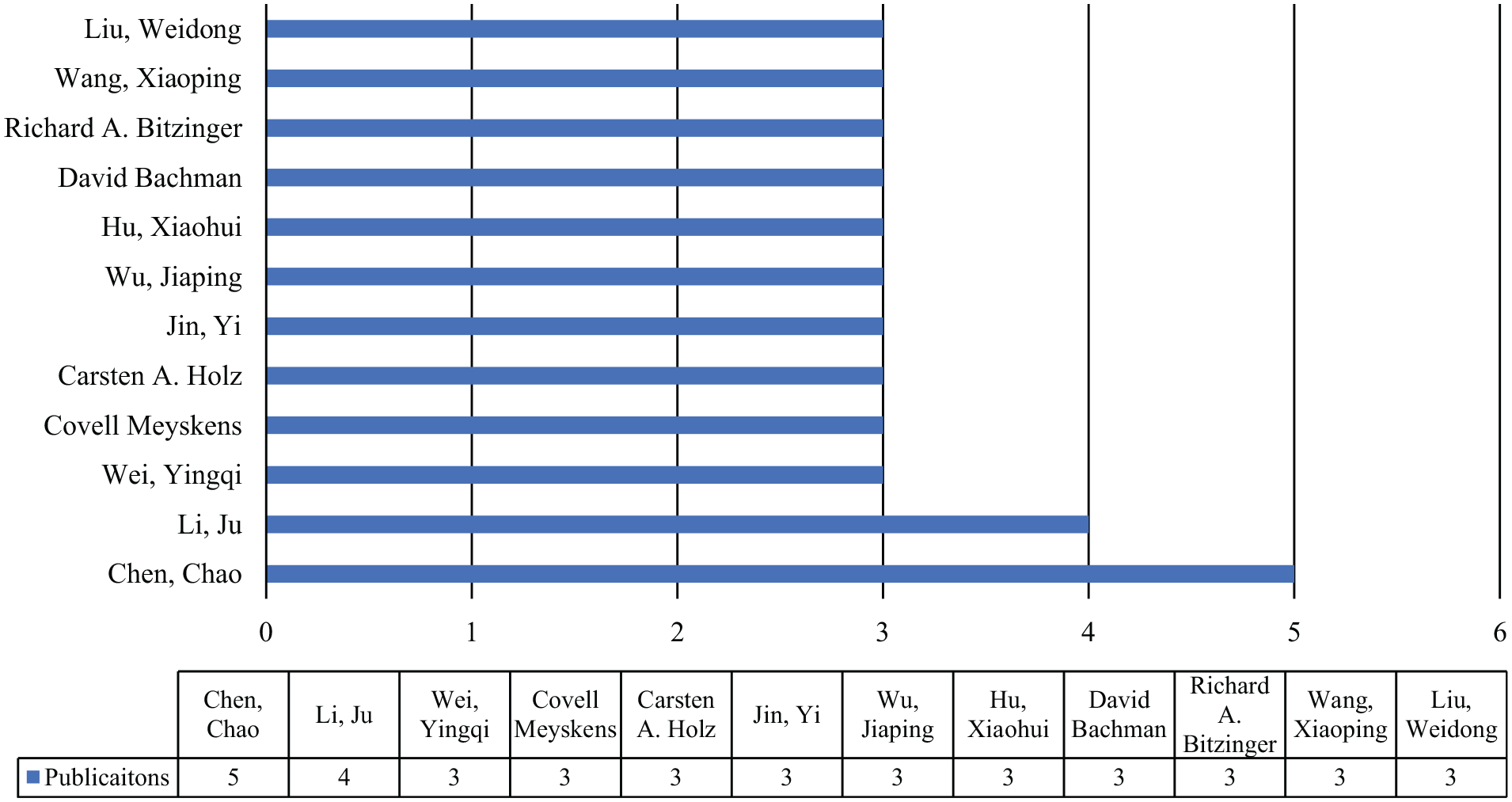
Major authors in the research on Third Front construction.
The cooperation network of the authors is shown in Figure 4, which can be grouped into four clusters according to their co-authorship. Cluster #1 included Fan, P., Huang, J., Li, D., Liu, Y., Tian, Z., Yue, W., and Zhang, Z. with Liu, Y. as the major contributor. The major research interest of this group was urban redevelopment, history of Third Front construction and case studies in Chongqing. Cluster #2 included Cheng, W., Gao, L.; He, T., Tian, Y., Zhang, Q., and Zhang, S. whose main research focuses were coal resources, assessment and conservation of architectural heritage. They all had the same total link strength in this group. Cluster #3 included Huang, J., Jiang, J., Li, X., and Liu, Y. with Li, X. as the major contributor. This research group mainly focused on China’s modern iron and steel industry, urban development, regional inequality, case studies of Chongqing and Guizhou. Cluster #4 includes Geertman, S., Lin, Y., and van Oort, F. who examined brownfield formation and institutional settings of urban areas and urban villages.

Collaboration network of the authors of Third Front construction literature.
Countries or Territories
The 370 bibliographic references retrieved in this research were composed by 24 countries or territories. The top 14 most prolific countries or territories with more than three publications are listed in Table 3. With 152 academic references, China contributed nearly 41% of the total publications, followed by USA (84 publications) and UK (38 publications). These contributing countries or territories were grouped into four collaborating clusters by VOSviewer with minimum cluster size ≥2 (see Figure 5) based on their co-authorship. The size of each nod in the cluster map is determined by its total link strength in the literature. Cluster #1 included China, Austria, Japan, Korea, Portugal and Slovak Republic. Cluster #2 included Canada, USA, Australia and Thailand. Cluster #3 included Germany, South Korea and Singapore. Cluster #4 included UK, Hongkong and Denmark. Centered on China, Canada, Germany and UK, the research of those four clusters was relatively focused and inner-related. China’s publications focused on five major themes: development, industry, Chongqing, Panzhihua and governance. (See Figure 6).
Top 14 Most Productive Countries or Territories.


Cluster map of countries or territories.

Major research themes of Third Front construction in China.
Productive Institutions
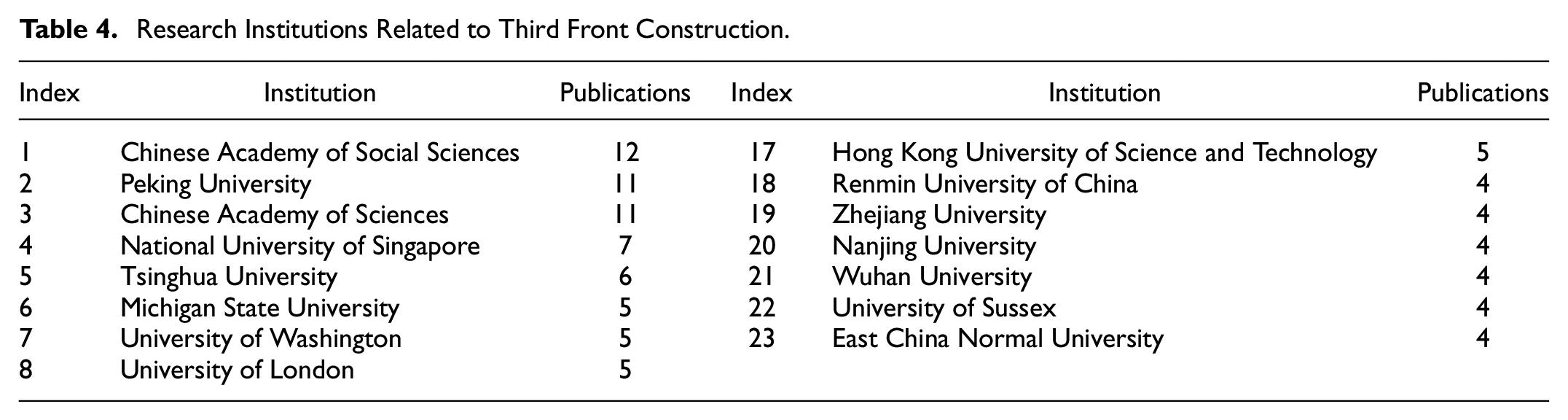
Table 4 lists the top 23 research institutions that published more than four articles respectively. The top five prolific universities were Chinese Academy of Social Sciences, Peking University, Chinese Academy of Sciences, National University of Singapore and Tsinghua University, of which four were from China, one was from Singapore. Other major research institutions also included Michigan State University, University of Washington, University of London and Hong Kong University of Science and Technology. Figure 7 shows the collaborating networks between the institutions, which can be clustered into five groups according to their cooperation. Chinese Academy of Sciences, Peking University, Fudan University, Tsinghua University and City University of Hong Kong were the main contributors within each cluster.
Research Institutions Related to Third Front Construction.

Co-authorship of institutions in the research on Third Front construction.
Publishing Journals
The top 13 journals that published more than three articles on the Third Front construction is shown in Table 5, among which The China Quarterly ranked the first with 17 papers, more than four times that of the journal at the second place. Inner Asia and Chinese Geographical Science published four papers respectively. The China Quarterly, published by University of London, is an important scholarly journal in the field of contemporary China. Inner Asia, published by University of Cambridge, focuses on the field of Mongolia and Inner Asia study. Chinese Geographical Science is from China that prioritizes social sciences.
Major Journals That Published References on the Third Front Construction.

Keywords
Major Research Focuses and Themes
As is shown in Table 6, the most frequent keywords in the research on Third Front construction were urbanization, Chongqing, urban planning, Cultural Revolution, development, Mao Zedong, industrial heritage, path dependency and sustainable development besides the topic word “China,” which indicated that the researchers mainly focused on the urbanization during the period of constructing Third Front, the geographic locations of the campaign, the historical background and the industrial development.
Most Frequent Keywords in the Research on Third Front Construction.

Co-occurrence analysis on the keywords resulted in five major research themes (see Figure 8). Research theme #1 (in red color) can be viewed as the historical background of China’s Third Front construction, including the major keywords such as Cold War, Maoism, planning, government engineered industrialization. Research theme #2 (in yellow color) can be summarized as China’s macro-policy of Third Front construction with the following keywords: China, economic restructuring, political economy, industrial heritage, industrial policy, local government, old industrial areas, path dependency and planning history. Research theme #3 ((in green color) can be concluded as the industrial development of Third Front construction, with keywords including industrial transformation, land use control, reform and opening-up, industrial policy and the industrial cluster. Research theme #4 (in blue color) can be drawn as China’ s Third-front cities, which includes keywords as Chongqing, industrial location, local protectionism, Panzhihua, regional development, industrial relocation, sustainable development, and urban planning. Research theme #5 (in purple color) can be summarized as the modern development of the Third Front construction in China, including the development of Modern China, modernity, new town, rural-urban relations and urbanization.

Co-occurrence of main keywords in Third Front construction research.
Co-occurrence of key words showed that historical background, macro-policy, industrial development, third-front cities and modern development of Third Front construction are directly or indirectly linked by lines, implying the five research themes are closely and effectively related. From the 1980s, Barry Naughton’s two articles occupied the most important position in the research themes, and most European and American views about Third Front construction were inherited from Naughton’s ideas (Fairbank & Goldman, 2006). Collecting data on the overall size of the Third Front construction, the two articles, The Third Front: Defence Industrialization in the Chinese Interior (Naughton, 1988) and Industrial Policy During the Cultural Revolution: Military Preparation, Decentralization, and Leaps Forward (Naughton, 1991), described its origin, development and legacy, discussed its strategic rational and impact, and assessed its economic values.
Research Trends
Figure 9 is a weighted Time-zone map generated by COOC 6.7 to identify emerging trends and research frontiers of Third Front construction by exploring the evolution of the keywords from the retrieved academic references. The size of the nodes shown on the time-zone map are in line with the emergence and frequency of the corresponding keywords. The position of the nodes on the map is determined by the average weighted year of the keywords based on the calculation of obtained bibliographic set with the following formula:
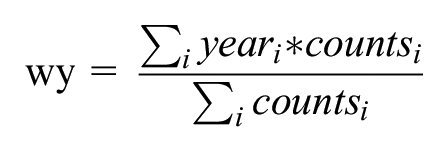
(yeari: the year when the keyword appears, countsi: the frequency of the year as the keyword appears)

Weighted Time-zone map of keywords in Third Front construction research.
The weighted Time-zone map of keywords (see Figure 9) shows that urbanization, industrial heritage and Cold War are the trends and emerging hotspots of the research on Third Front construction research in recent years.
Specifically, urbanization refers to urban planning, urban political economy, driving forces, public policies, resource-based cities and human settlements. The research on urbanization is tightly connected with industrialization in the campaign, including both cities’ and rural industrialization. Third Front construction accelerated the industrialization of the cities along with the upper and middle reaches of Yangtze River, and the industrialization focused on the fields of mineral resources excavation, textile etc. (Hurst, 2008). Meanwhile, Third Front construction pushed forward the rural industrialization as well as the cities’ (Bramall, 2006).
Industrial heritage touches on transnationalization, heritage tourism, tourism development, post-industrial era, value evaluation, conservation planning, urban revitalization and development history. From 1980s when Third Front construction first appeared in English academic literature, the relationship between the development of China’s economy and society and Third Front construction has been the focus, including various aspects of industrialization such as rural areas, transportation, personnel relocation and placement. In recent years, the foreign scholars pay more attention to the role of Third Front construction in the Chinese social history and its industrial legacies (J. Li, 2019), attempting to make further research from much more macro perspectives. Based on German and Chinese case studies involving Third Front construction industries, L. Li and Soyez (2017) proposed that industrial landscapes demonstrated the distressing and discordant legacy in the process of transboundary industrialization, which should be more adequately and persistently reflected in industrial heritage tourism. In order to preserve industrial heritage, it is crucial to incorporate conservation measures and requirements into elaborated urban planning with reference to a progressive assessment on the conservation and utilization of Chongqing’s industrial heritage (Yao et al., 2019).
And Cold War sheds light on modern China, socialism, social history, political economy and Rammed-earth Campaign. The trend of Cold War centers on the retrospection and analysis of the international background, motivation, economic development and strategic transfer of Third Front construction during the Cold War. The latest article about Cold War and Third Front, Experiencing the Cold War at Shanghai’s Secret Military Industrial Complex, explores how the geopolitical tensions of the Cold War became embedded in frameworks of meaning and practices of everyday life in Mao’s China (C. Meyskens, 2021).
Discussion
The analysis above clearly described the present research state on Third Front construction and revealed its hot spots and emerging trends. However, some of these bibliometric findings need further discussion.
Surge in Publications Since 2012
The bibliometric analysis of the publishing years of the retrieved academic literature in English language showed that less than 10 references were published before 2012, and the publications kept increasing since this very year (with only one exception in 2013). This finding echoes with the research situation about Third Front construction in Chinese language. Comparing with the bibliographic data from CNKI (China National Knowledge Infrastructure), the largest and most prestigious academic database in China, related literature in Chinese language appears the same increase after the year of 2012. This may be associated with the reason that after the 18th CPC National Congress held in 2012, more scholars, both from China and other countries in the world, are concerned about China’s modern history and development, for the systematic and intensive study on Third Front construction is significant in China’s new turn of Western Development and the flourishment of socialist culture (Xu & Zhang, 2021), and scholars hope to gain a better understanding of the institutional dynamics to China’s early march toward socialist modernity (Y. Chung, 2021).
Third Front Construction as a Research Filed
The bibliometric analysis showed that the research of Third Front construction had its own research personnel, institutions, publishing journals, research focuses and themes. Since 1980s, western academic community has paid more attention to Third Front construction, from the basic concept, the construction itself and other relevant fields, which leads to significant progress in the research (Y. Qin & LIu, 2020), thus forming an independent academic circle (Xu & Zhou, 2018). As China is undergoing dramatic changes in the contemporary world and playing an increasing important role in the international arena, scholars in the English world are probing into more aspects of the relations between China and the other two relevant major powers, Russia and the United States.
Influence of Top Reference
The citation analysis demonstrated that Naughton’s article published in 1998 toped the first with 532 cited times, implying that many views and explanations are inspired by and extracted from the article. Many previous studies by European and American scholars directly employed Chinese local chronicles, historical descriptions and viewpoints from Naughton’s article as references (C. Meyskens, 2015). This phenomenon might be partly due to the limited access to official files and scarce studies in this field. In recent years, since more government archives, Third Front enterprises’ records, relevant documents and various memoirs are open to the public (Xu & Zhang, 2020), the early research data and materials can be improved in order to have a clearer understanding of the content, progress and results of Third Front construction.
Brief Comparison With Chinese Counterpart
The bibliometric results showed that China was the major contributor to the research on Third Front construction in English language. It would be of theoretical significance to have a look at the research in Chinese language within China. According to CNKI, as of January 2022, there were 1,297 related Chinese documents with 124 doctoral dissertations and 69 monographs, which could be clustered into four major research themes: (1) the literature research, including the relevant documents and materials of countries, provinces and cities from the very beginning of Third Front construction (Duan, 2012); (2) the overall research, including Third Front construction decision-making (D. Chen, 2008), background (Duan, 2012), implementation process (Xu & Zhang, 2020) and practical value (Xu & Zhang, 2021); (3) the academic thematic research, involving politics (D. Chen, 2008), economy (Xu & Chen, 2015), urban construction and development (F. Zhang, 2007), history (Zheng et al., 2012), society and culture (J. Wang et al., 2020), etc.; (4) the study of Third Front construction spirit, including the historical productive logic (Zhu & He, 2020), theoretical connotation and important value of the spirit (X. Chen, 2020).
The co-occurrence analysis of keywords clustered the English academic literature into five major research themes. Comparing the respective themes in Chinese and English languages, we found that both communities made similar academic efforts in studying the history, policy, location, economy, and urbanization of Third Front construction. Nevertheless, the results also indicated discrepancy between their research focuses. Chinese community devoted more attention to the access of new official documentary materials and the revitalization of Third Front construction spirit in China today, while English counterpart gave greater emphasis on how Third Front construction shapes modern China and impacts its process of industrialization.
Conclusion
Based on the bibliometric analysis and visualized mapping of the bibliographic references obtained from Google Scholar, this paper found that Third Front construction continues to be a hot research topic with growing popularity. The top three most cited reference explored Third Front construction from defense industrialization, regional inequality and suburbanization. The most productive authors were Chen C. and Li J. with five and four publications respectively. The contributing authors can be grouped into four collaborative networks according to their links in the field. It is noticeable that nearly 41% of the total publications were contributed by China, followed by USA and UK. Further, the countries or territories that have published related academic references were grouped into four collaborating clusters based on their co-authorship. In terms of research institutions, four of the top five most prolific universities were from China, and the other was from Singapore. Based on the cooperation between these institutions, they can be clustered into five groups with Chinese Academy of Sciences, Peking University, Fudan University, Tsinghua University and City University of Hong Kong as main contributors within each group. From the perspective of publishing journals, The China Quarterly ranked the first with 17 papers, more than four times that of the journal at the second place. The co-occurrence analysis of keywords identified five major research hotspots: (1) historical background of China’s Third Front construction, (2) China’s macro-policy of Third Front construction, (3) industrial development, (4) China’ s third-front cities and (5) modern development of the Third Front construction in China. The research also revealed the potential research trends in urbanization, development and Cold War related to Third Front construction.
The current study also briefly investigated the research status on Third Front construction in Chinese language and detected four major research themes: (1) the literature research; (2) the overall research; (3) the academic thematic research; and (4) the study of Third Front construction spirit. The comparison analysis found that both Chinese and English communities had similar academic interest from the perspectives of history, policy, location, economy, and urbanization, but they also differed in terms of specific research focuses.
The findings of this paper provided useful information for the research status in Third Front construction and identified research hotspots and emerging trends. Since China has already become a major player on both the global and regional arena, it is of practical value to dig into the past that shapes China today and understand the complexity of China’s socialism because the Third Front construction was the largest industrialization campaign in modern Chinese history.
Limitations and Future Research Directions
Although this research concludes with meaningful findings in the research on Third Front construction, it is worth mentioning that it has some certain limitations. Firstly, the academic references analyzed in this study were not exhaustive because they were all retrieved from one academic literature search engine, Google Scholar. Secondly, linguistic bias existed in this research since the references written in other languages instead of English were excluded. Thirdly, bibliometric analysis needs to be updated to keep up with the research trend and reveal the real picture of the research status because the cited times and the collaboration between authors, institutions, journals, and countries or territories may change with the time. Further research is encouraged to keep pace with the latest development in this topic to identify how Third Front construction shapes and influences Modern China.
In addition, the findings and discussions showed that the researchers in Chinese and English languages both contributed to the studies of Third Front construction, and they provided different perspectives based on various cultural backgrounds and research focuses. C. F. Meyskens (2015) deemed that Third Front construction has not been given due attention and a large proportion of the related research was limited within China’s economic development. He proposed to widen the research fields based on China’s social, cultural and oral histories. Y. Qin and LIu (2020) suggested that Chinese scholars should excavate the potentialities of Third Front construction with the reference to foreign scholars’ research perspectives. Since the primary objective of the current research was to explore the status and trends of research on China’s third front construction in English language, future research is encouraged to conduct in-depth comparison between the research in both Chinese and English languages for a more comprehensive and systematic understanding of the similarities and differences between them.
Footnotes
Declaration of Conflicting Interests
The author(s) declared no potential conflicts of interest with respect to the research, authorship, and/or publication of this article.
Funding
The author(s) disclosed receipt of the following financial support for the research, authorship, and/or publication of this article: This research was supported by the Sichuan Federation of Social Science Associations (Grant No. SC22BS047) and Panzhihua University (Grant No. 2021PY013).
