




Abstract
Customers’ concerns regarding product quality (CPQs), as expressed in online reviews, provide future customers with information that may influence their own purchase decisions. Recent research attaches considerable importance to consumers’ emotions embedded in their language style, based on function words, but rarely touches on their CPQs, which are also embedded in their language style. Therefore, this study aims to examine the CPQs of Chinese women’s clothes buyers. We build a corpus of 32,667 words from the online reviews of women’s clothes buyers on the Chinese website Taobao. A novel language inquiry word count dictionary for topic types related to product quality is built, which is then imported into a language style matching algorithm which assesses the synchrony of the language style. Our results show that buyers’ CPQs are diverse and concentrated in scope; consumers’ different expressions in online reviews are dependent on the sequence and impact factor of CPQs embedded in their language style. This study’s findings offer companies valuable insights to identify customers’ CPQs based on their language style, which may allow them to devise more effective promotion strategies and product designs.
Keywords
Introduction
Online reviews’ language style provides helpful information for customers and may determine their product acceptance attitude (Catherine et al., 2019; A. X. Liu et al., 2018), reviews’ helpfulness (Guo et al., 2020; Mudambi & Schuff, 2010), emotion extremity (Pan & Zhang, 2011), and consumers’ purchase decisions (A. X. Liu et al., 2018; Romero et al., 2015). However, most prior studies focus on language style as a source of peripheral information (F. Wang & Katami, 2019), rather than as crucial and useful information for customers to evaluate product quality. Thus, prior studies on the role of online reviews’ language style are chiefly based on emotional words, such as first-person pronouns (Catherine et al., 2019; A. X. Liu et al., 2018; Pan & Zhang, 2011) and function words (A. X. Liu et al., 2018), while rarely addressing customers’ product-related concerns based on words related to product quality. Therefore, the current study analyzes customers’ concern regarding product quality (CPQs) embedded in their language style via content words.
Recent studies focus on online reviews’ language style from two major aspects. On the one hand, language style is mistakenly equated to emotions in terms of the content’s discourse genre (Cenni & Goethals, 2021; Yin et al., 2017). On the other hand, it is associated with the effectiveness of purchase behavior (S. Q. Liu et al., 2018). For example, Antioco and Coussement (2018) studied market managers’ cognitive response to online reviews and argued that consumers’ writing style can result in “managers’ misreadings of negative consumer feedback”. Guo et al. (2020) proved that positive/pleasant (as opposed to negative/unpleasant) emotional content in online reviews can lead to increased chances of purchase. However, these studies focus on the impact of emotional expression on customers’ behavior (purchase), while the expression of CPQs remains relatively unexplored. As we focus on the specific features of CPQs, this study’s key contribution comprises its analysis of the non-emotional characteristics of online reviews from the perspective of language style.
However, previous studies are inconclusive regarding CPQs’ language style. According to Guo et al. (2020), non-emotional information may include “review valence, gender, credibility, and the scientific processing system of mankind” (p. 12), which comprise peripheral cues rather than details of the product itself. Peng et al. (2014) clearly include the advantages and disadvantages of product quality into the category of non-emotions. Moreover, opinions, appraisals, sentiments, and evaluations are understood as the product quality-related content of online reviews (B. Liu, 2012). From this perspective, research on online reviews’ language style usually excludes any aspects related to content and simply refers to emotions (Ludwig et al., 2013; Swaab et al., 2011). We hypothesize this is caused by the following factors: (1) there is an unclear understanding of the review content and product quality, as emotions, opinions and judgment may be bonded with the product’s performance, material, etc.; (2) there is no consensus regarding how product quality information is embedded in reviews’ language style; and (3) although emotional analysis covers some aspects of product quality, there is currently no product-centered linguistic classification. To bridge this research gap, we attempt to examine the language style related to product quality, that is, consumers’ CPQs. Thus, the present study contributes to the literature by creating a CPQ-related language inquiry word count (LIWC) to address the following questions:
(1) Are consumers’ CPQs identifiable based on online reviews’ language style?
(2) What are the features of Chinese female online customers’ CPQs?
Traditionally, companies rely on information cues from online reviews to strengthen their linkage with customers, as such cues are linked to the effectiveness of their product promotion strategy and customer loyalty (Prentice et al., 2019). In this sense, the CPQs embedded in online reviews’ language style are relevant to managerial improvement in terms of companies’ targeted customers and promotion strategy.
This study is structured as follows. First, a review of the literature on language style, language style matching (LSM), and language expectancy theory (LET) is presented. In the Methodology section, we explain this study’s process and the LSM method that was adapted for this study. In the Results section, we present the LSM and Percentrank data. In the Discussion section, we explain the sample’s CPQs, embedded in online reviews’ language style. In the Conclusion section, we conclude that CPQs’ language style is important to gauge the change of consumers’ focus of interest.
Literature Review
LSM and LET
As Ireland and Pennebaker (2010) pointed out, individuals with similar expertise or interests are likely to communicate in a way that encodes the linguistic features of previous speakers into their own utterances. This probability of interlocutors’ matching language expressions is referred to as LSM. This term is also used to refer to a text analysis technique that aims to assess the degree of matching between two or more expressions (Ireland et al., 2011). The main objective of the LSM technique is to explain why people are more likely to talk alike, and measure how many of the linguistic features in their utterances are recurrent within their discourse (Gonzales et al., 2010).
Accordingly, within the context of online reviews, prior reviews influence the expressions of future consumers, thereby leading to a synchronicity in the expressions used. This synchronicity in expressions is caused by reviewers’ intention to follow the norms regarding how information is conveyed so that certain results are achieved. Such expectations regarding linguistic expression is referred to as the LET (M. Burgoon & Miller, 1985). As a result of said expectations, audiences are likely to exhibit similar communication styles to establish a commonality with the speaker, that is, audiences encode the language style of previous speakers into their own language style.
As LSM measures the level of discourse cohesiveness between speakers, it is often regarded as an effective way to account for the LET. Changes to the recipients’ expectations may influence the effectiveness of communication, thereby altering their readiness to accept a given discourse (Lee & Yu, 2020). Recipients’ expectations are influenced by positive sentence structures that indicate a certain degree of credibility while simultaneously exhibiting few negations (Averbeck & Miller, 2014).
Most scholars use LSM to assess online reviews’ degree of matching, or to interpret the impact of sentiment, evaluation, or attitudes on consumers’ purchase decisions (Guo et al., 2020; Ireland et al., 2011). Consumer reviews’ figurative language is more conversationally normative and shows a comparative advantage over general description of preference in marketing communication (Kronrod & Danziger, 2013). However, Wu et al. (2017) argue that figurative language can only be effective when used by consumers with high expertise. Further, LSM can be used to detect minor differences in online expressions as long as it is correctly and comprehensively compared. Thus, LSM is also used to demonstrate the features of mitigated perception of products (J. K. Burgoon & Poire, 2010; S. Q. Liu et al., 2018). The intention to share information on Twitter (LSM with function words) can heighten the self-awakening awareness of recipients and increase the success of natural disaster treatment (Lee & Yu, 2020). Individual customers’ chosen expression style is likely to elicit a response from other customers, thereby influencing how said product is received (Semino & Culpeper, 2011).
Another feature of LSM research is that most scholars focus on function words (e.g., first-person pronouns, the pronoun “it,” and articles) to study the matching degree of emotions (Fan & Chen, 2017; Guo et al., 2020; S. Q. Liu et al., 2018). For example, A. X. Liu et al. (2018) used nine category function words to measure the LSM of hotel booking consumers’ emotions. The same approach was used by Yin et al. (2017) and Agee (2019) to discuss the extent and nature of emotions in online consumer reviews. Beyond function words, topic themes and the focus of the online reviews began to gain research attention with the introduction of other content words. Moreover, Lin and He (2009) used function words to assess changes in the topics that interest consumers. Further, one method to discover discourse topics is latent Dirichlet allocation, a machine learning tool (Blei et al., 2003), although its reliability remains a subject of controversy. Another method to identify discourse topics is based on linguistic features such as word density and diversity. Word density refers to the frequency of a certain topic-related word within discourse, which may indicate the focus of interest (M. Burgoon et al., 2002). Word diversity indicates the complexity and range of the different words used in discourse, which, in turn, indicate topics’ complexity (Averbeck & Miller, 2014; Jensen et al., 2013). However, these two linguistic approaches cannot determine consumers’ CPQs and their importance. Therefore, the present study combines LSM with non-emotional product-related words (i.e., function words), and discusses CPQs based on content words.
LSM is calculated using the LIWC, which is a program that automatically counts and analyzes textual words. By calculating verbal cohesiveness, LSM can assess the cohesiveness of the discourse (Tausczik & Pennebaker, 2010). According to Gonzales et al. (2010), the LSM algorithm comprises the following procedure: Calculate the absolute value of the proportions of words in a given word category out of the total number of words in each sample group. Next, divide said value by the sum of each sample group, based on the difference of word usage in that category between samples 1 and 2. Finally, the similarity is obtained by subtracting the result by 1.
Since this study measures consumers’ CPQs (represented by online reviews’ language style) based on an LIWC that can describe product quality, it adapts the LSM(material) algorithm as shown below.

In the LSM(material) algorithm, S1 and S2 refer to the text words under the category of “material” spoken or written by Samples 1 and 2. A denominator of 0.00001 is used to avoid empty sets, provided that the LSM equation is valid. S1 is acquired by the calculation of the percentage under the word category of “material” against the total number of words.
Language Style of Emotion and Product Quality
As mentioned above, the current study adopts the LSM approach, using diverse information cues from online reviews. Online reviews’ language style also comprises an information cue in itself and can be used to evaluate reviewers’ emotions (Willemsen et al., 2011), as the information required to assess the product and make a purchase decision is limited (Steenkamp & Ter Hofstede, 2002). Online reviews’ language style is recurrent because customers simply add their own evaluations and understanding of the product onto the existing text model, thereby leading to a high likelihood of synchronicity (Gernsbacher & Hargreaves, 1988; Zwaan & Radvansky, 1998).
One way to monitor information cues is the discourse’s central meaning. Srivastava and Kalro (2019) point out that online reviews’ central meaning is determined by “central” and “manifest” linguistic attributes such as word frequency, sentence types, review rating, and image volume. For example, the signal and observability of language style can be treated as central linguistic factors to evaluate product quality. In addition, Maslowska et al. (2017) also include review clarity and readability as central factors related to product quality. Forman et al. (2008) propose to comprehensively consider online reviews’ length, rating valence, and affective characteristics to assess their helpfulness. Yin et al. (2017) argued that a matched language style showing positive emotions affects the evaluation of products via price valence. If manipulation runs through the emotional language style of the comments in online reviews, consumers’ perception will be affected accordingly (Ghahtarani et al., 2020). The emotional expression (i.e., feelings and motivations) represented by function words has a considerable effect on the emotions of prospective customers, who may become more positive and active in making purchase decisions (Precht, 2000, 2003).
However, these efforts based on linguistic features attempt to use the assessment of emotions to elucidate reviewers’ attitudes toward product quality; essentially, they adopt an emotion- or attitude-based approach instead of focusing on product performance. Customers use information on product quality (i.e., the non-emotional content of online reviews) to make unbiased decisions (Jiang & Benbasat, 2007; A. X. Liu et al., 2018). Product quality information can reduce decision-making risks because it minimizes the influence of emotionally biased information (Pavlou & Dimoka, 2006). In this study, we allow customers to access product assessments by browsing prior customers’ reviews (X. Wang et al., 2022), rather than social knowledge (Z. Huang & Benyoucef, 2013), emotions (Yin et al., 2017), or emotional comments regarding product quality (Guo et al., 2020; A. X. Liu et al., 2018).
Method
Overview of the Research Method
We analyze consumers’ language style (embedded with product quality markers) to monitor the CPQs of online reviews written by female Chinese women’s clothes consumers. To this end, we develop an LIWC dictionary for product quality that describes consumers’ CPQs. With reference to the LIWC dictionary for product-centered language style (Hu et al., 2019; X. Wang et al., 2022), we add CPQs in Figure 1. Three steps are essential to develop the LIWC dictionary for product quality: (1) building a new LIWC made up of content words to indicate the language expressions related to product quality; (2) importing the LIWC words into the LSM to calculate the matching degree based on the LSM algorithm; and (3) comparing the LSM results to demonstrate the information cues related to CPQs.

Research approach.
Sampling of the Online Reviews
We use Python software and collect 32,667 online reviews from Taobao, an online e-commerce platform popular among Chinese consumers, especially women. The data covers the period 2018 to 2020, concentrating on online reviews of women’s clothing. We focus on the language expressions of the online reviews, excluding the valence and feedback images. According to Mirowsky and Ross (2001), online reviews are dependent on age, income, family, community, personal hobbies, and engagement level (Catherine et al., 2019). Many scholars have included age as one of the key factors of purchase decisions. According to X. Wang et al. (2022), the segmentation of consumer age does not follow the division standards of the World Health Organization (2010). Therefore, we follow the typical Taobao age-based demographical classification, classifying reviewers into three age groups: 18 to 25, 25 to 45, and 45 to 65 years, representing Taobao’s young, middle-aged, and senior demographics, respectively (X. Wang et al., 2022). As consumer engagement in the online reviews is also closely related to brand identification (Catherine et al., 2019), and to include online reviews of influential brands, we select the online reviews by comparing the sales against the brand rank—that is, the sales weights over the brand. See Table 1 for the details of online reviews.
Data Collection Standards and Size.

LIWC for Product Quality
According to Pennebaker (2015), the LIWC program’s objective is to count and classify words; through this process, words are encoded and classified into categories that denote their functions. Categories themselves are referred to as topic types (Hu et al., 2019). For instance, “texture” is a content word related to the product’s material. The word “texture” is imported into the LIWC dictionary to see if it is used only to refer to clothing materials. The frequency of “texture” and other words that describe the material (e.g., “linen,”“silk,” etc.) are counted. The updated LIWC program (Pennebaker, 2015; X. Wang et al., 2022) contains more than 94 category dictionaries including 6,400 words, word stems, and emoticons. Further, it comprises “21 standard linguistic dimensions (e.g., percentage of words in the text that are pronouns, articles, auxiliary verbs, etc.), 41-word categories psychological constructs (e.g., affect, cognition, biological processes, drives)” (Pennebaker, 2015, p. 4).
In this study, the LIWC is expanded and updated according to research needs. An emotional, cognitive, and behavioral dictionary is built to gauge the misreading of online reviews by language style (Antiocoa & Coussementb, 2018). Kross and Ayduk (2008) expanded the category of cognition with causal words and insight words. As pointed out above, the current LSM is oriented toward emotions based on affective, cognitive, and drive words (A. X. Liu et al., 2018), as well as function words (Fan & Chen, 2017). Though few scholars focus on content words (Cheng & Ho, 2015; Willemsen et al., 2011), the category of product quality remains relatively unexplored.
As mentioned previously, information cues related to product quality are essential to the understanding and knowledge of a product’s status quo. Further, most of the information cues related to product quality originate from content words (Z. Huang & Benyoucef, 2013). Haspelmath (2001) posited, based on the results of Tausczik and Pennebaker (2010), that content words are those that convey the content of communication, including nouns, regular verbs, adjectives, and adverbs. In line with the extant classification of product quality (Guo et al., 2020; A. X. Liu et al., 2018; Zhang, 2019), this study builds a word dictionary for product quality based on content words. The LIWC comprises eight factors commonly used to describe the topic types of product quality, namely, clothes’ price, type, color, function, materials, size, and workmanship (See Table 2).
LIWC Dictionary of Product Quality.

Results
LSM
We apply the data to the LIWC and the LSM algorithm and obtain the LSM scores of each group and the LSM mean (See Table 3).
LIWC and LSM Scores.

We conduct a validity test for the LSMs (See Figure 2). First, we conduct the p-value test; the results (p = .64, .06, .12) show that the LSM is valid (see Table 4). Further, we conduct a standard deviation test of the LSM for product quality (0.11–0.5).
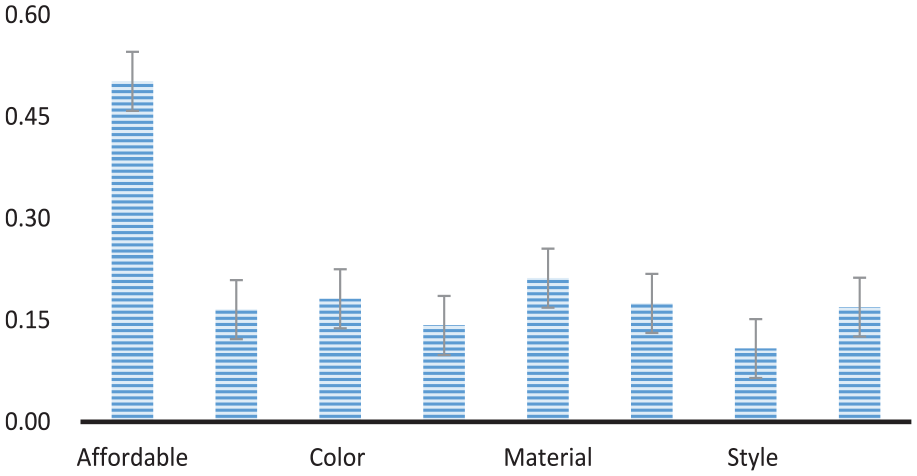
Standard deviation variance of the LSMs.
p-Value of the LSMs.

Co-efficiency of Variance of CPQ
Online consumer reviews show a trend of change because of the mitigation effect of language expression (Ren, 2018). In order to determine whether consumers’ CPQs diverge or converge, we calculate the correlation of the eight topic types (i.e., CPQ factors) and present the clustered results in Figure 3. Figure 3 shows that the eight factors are highly correlated (correlation >.6) for most of the items, whereas the factors “size” and “style” are weakly correlated. Further, the correlation is on a downward trend, indicating that the weighted sequence is in line with the sequence in Table 2.

Scattergram of the LSM correlation and linear regression.
To determine the CPQs shared by the three groups, we import the function of Percentrank (Table 5). Percentrank can create a rank list of the same percentage among different items.
CPQ Priority Rankings Between Groups.

Discussion
CPQ’s Diversity and Concentrated
One question this study aims to address is whether consumers’ CPQs can be determined through consumers’ language style related to product quality. The word categories can reveal consumers’ priorities and attention focus (Tausczik & Pennebaker, 2010). In line with prior research on product quality and language style (Salehan & Kim, 2016; F. Wang & Karimi, 2019), the LSM designed specifically for this study (Table 3) shows that the CPQs are diverse and concentrated. In Table 3, we can see at least two examples of concentration. Firstly, for S1 (young women) three important factors stand out (>1), namely, function (5.51), style (4.41), and color (2.57), whereas the other topic types are <1, and price is 0. The extremity of the topic types indicates that online reviewers in S1 were cognitively influenced by previous customers’ comments, while their CPQs are evident in the S1’s LSM; that is, S1 reviewers tend to be linguistically expressive regarding clothes’“function” and “style,” while they are indifferent to price. This phenomenon is reflected in the high score of “affordability” in terms of standard deviation. Second, the LIWC scores for “function” are 5.51, 10.03, and 9.41 for S1, S2, and S3, respectively. This concentrated scope of concerns in light of high LIWC score, indicates that the entire sample, regardless of age and other factors, consider “function” to be important.
Such a difference in CPQs is a reflection of consumers’ social identification. In a community, the confirmation of their identity augments the shared attitudes of trust and engagement level (Brodie et al., 2011). Consumers seek confirmation of their identity because it is indicative of the fulfillment of their relationships, thereby associating with other members of the online community in search of understanding, support, and admiration (Catherine et al., 2019). The language style used in online reviews is an indicator of the psychological process of confirmation of identity (Schindler & Bickart, 2012). Such identity confirmation is demonstrated by individuals’ psychological need for committed association with other online members. Individual behavior is chiefly governed by attitude (Fishbein & Ajzen, 1975). In our study, young women’s clothes buyers (S1) seem to identify themselves as a group that does not care much about price. This may be explained by younger individuals’ lower priority for money-related concerns, which is represented by the low frequency of information cues related to price, a state driven by consumer’s cognition and psychology (Porter et al., 2011).
We calculate the average mean of the three groups (S1 = 0.49; S2 = 0.42; and S3 = 0.70) and the correlation between them. The S1/S3 correlation (.04) shows that S1 and S3 exhibit the lowest degree of matching in language style, which may be explained by the age gap between both groups. The S1/S2 correlation (.78) shows relatively high synchrony in language style, which represents the smooth language style transition between young and middle-aged women. These results show the extremity of CPQs embedded in female consumers’ language style across all age groups.
This concentrated CPQ can be explained by the prevalent LSM scoring methods. According to Tausczik and Pennebaker (2010), the LSM is scored on a scale from 0 to 1.0. If the LSM score is ≤0.60, the level of matching is defined as low; if it is ≥0.85, matching is identified as high. However, the gap between these two thresholds (0.6–0.85) is not defined by Pennebaker (2010). Many scholars evaluate the degree of matching based on these high and low thresholds. The high LSM is affected on consumers when they choose fewer familiar restaurants and read complicated reviews (A. X. Liu et al., 2018). Agee (2019) argued that librarians tend to produce feedback expressions that are highly synchronized with those of book borrowers. Consumers’ intention to influence recipients is associated with the classification of high and low LSM (Giles et al., 2007). In this study, high LSM (>0.85) scores are found in the LSM S2/S3, specifically for function, color, and price (0.97, 0.92, and 0.87, respectively), while other topic types exhibit low LSM scores. The scarcity of high LSM scores shows that online reviews of Chinese clothes buyers are linguistically diverse.
Figure 3 shows the downward trend of correlation for the eight topic types. This demonstrates that, in terms of age progress, the LSM of each group is on the decrease, as shown in Table 2. One reason for this may be previous reviewers’ reduced impact despite their desire to influence other consumers. According to LET (M. Burgoon, 1995), although people usually develop norms to achieve language’s optimal effect on others, its inappropriate use does not always result in impaired message transmission. Regarding language expectancy, people with insufficient expertise usually conform to the aforementioned norms, whereas people with high expertise may freely choose the language style (Jensen et al., 2013). Mature women have higher expertise when writing reviews; therefore, they tend to express their own diagnosis of information instead of being influenced by previous writers. Chung and Pennebaker (2007) argued that leadership, integrity, economic situation, age, and other factors may cause considerable variance in language expression in online reviews. It can be inferred that high-expertise individuals may convey persuasive messages even if they violate the norms or diverge from previous writers’ language expectations (Jensen et al., 2013). This may explain this study’s low LSM scores, as some consumers may believe that their reviews will constitute unique contributions to other customers’ purchase decisions.
The Prioritization of CPQ
This study’s second research question addresses CPQ in Chinese women’s clothes reviews. Previous studies focus on the specific factors related to product quality, such as review length, rating valence, and affective content (Forman et al., 2008), the value of the review (Willemsen et al., 2011), review quality (A. H. Huang et al., 2015; S. Q. Liu et al., 2018), social knowledge (Z. Huang & Benyoucef, 2013), argument density, diversity, and peripheral cues (Willemsen et al., 2011). In summary, the factors that influence online reviews have been extensively researched. This study continues this effort by examining the impact of different factors related to CPQ. By measuring the correlation of cognitive, linguistic, and behavioral factors, A. X. Liu et al. (2018) argue that online reviews are considerably influenced by community cognition. Topic types’ importance is closely related to the cognitive evaluation of consumer concerns regarding specific topics (Tausczik & Pennebaker, 2010). Though CPQ is expressed differently according to consumers’ lexicon, rhetoric, and grammar, the importance or the weight of their opinion is actually iterated by other consumers, as evidenced by groups’ matched language style.
Importance of CPQ, represented by the LSM scores, depends on the relative weight of each topic type. Figure 4 shows the correlation of LSM variance, indicating the cognitive priority in consumers’ hearts. Consumers priority followed the order of affordability > function > material > size > workmanship > type > style > color. This means that consumers are most concerned about the performance-to-price ratio (affordability and function).
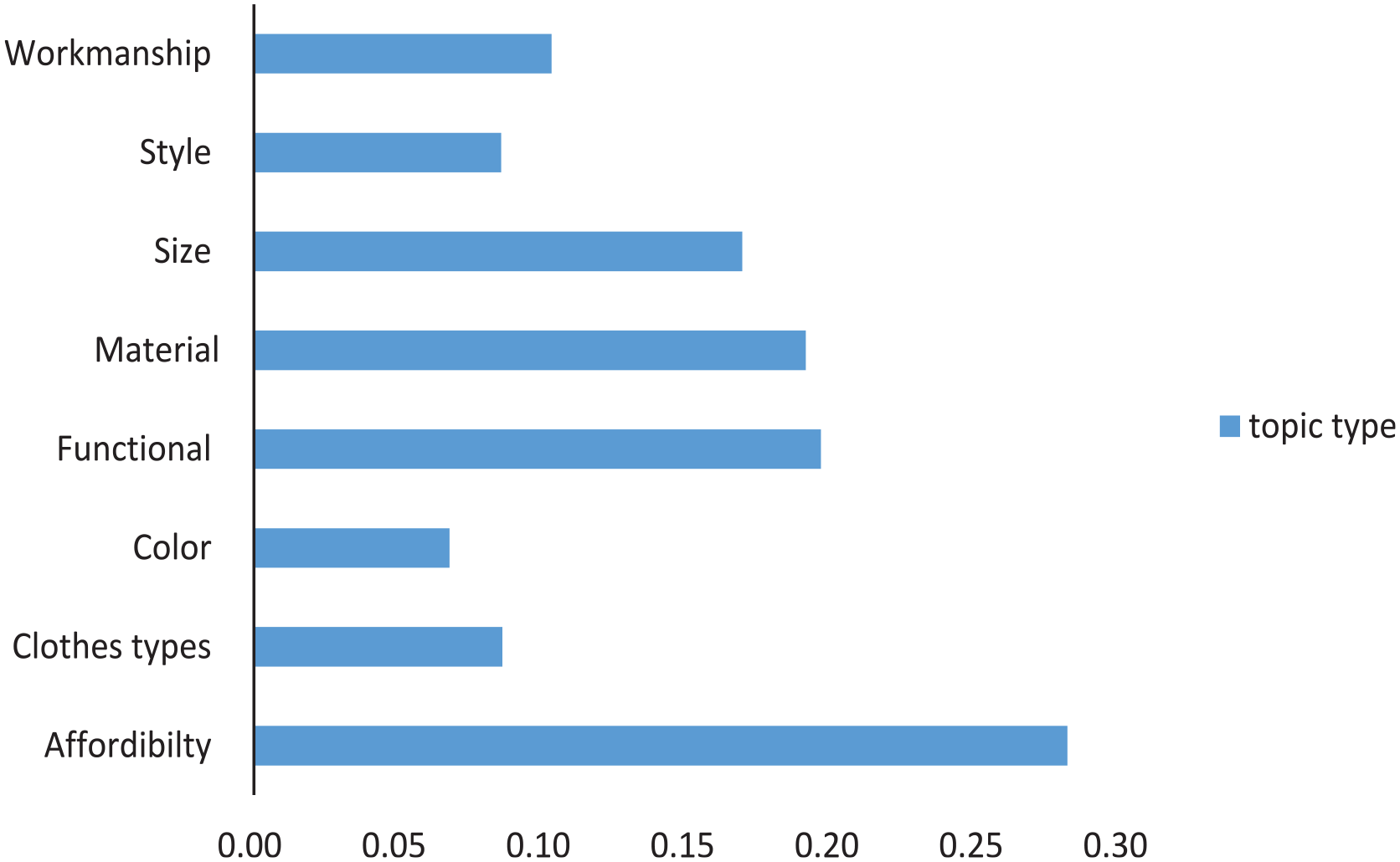
Co-efficiency of variance by topic type (i.e., CPQ factors).
Consumers’ CPQ can be examined in greater detail using Percentrank. The overall factor priority across the three age groups is determined. Table 5 shows that the only factor that shares the same importance across all three groups is “material” (14.2%). Table 5 also shows that “color” and “function” are the two factors that are evaluated highest (>50%) across all three groups. Further, we also determine which CPQ factor was highest in priority across two groups. For example, at the 100% significance level, style was highest for the S1/S2 and S1/S3 dyads, while function was highest for the S2/S3 dyad. This data can help companies identify consumers’ CPQ concerns more accurately across different age groups. Specifically, as CPQ is embedded in individuals’ language style, which is indicative of their cognition and attention focus, the data in Table 4 can help stakeholders identify the most “attractive” factors related to CPQ (Tausczik & Pennebaker, 2010). Table 5 shows that the S2/S3 dyad exhibited an 85.7% preference for the factor “color” whereas the S1/S2 dyad exhibited a 57.10% preference. We reason that the higher preference of the S2/S3 dyad is owed to individual focus. CPQ is dependent on both individual focus and situational focus (Hidi & Boscolo, 2006). Individual interest in certain specific information makes up the individual focus, and contextual or community interest will be contextualized into the individual focus (Krapp, 2002). The combination of individual and situational focus influences consumers’ CPQ, as evidenced by groups’ different factor preferences. We hypothesize that the groups S2/S3 share a high preference for the “color” factor because mature women are more expressive and want their clothing to draw viewers’ attention.
Conclusion
The language style of business online reviews has recently drawn considerable research attention (Semino & Culpeper, 2011), concentrating on various elements such as length, focus of attention, word density, valence, etc. (Forman et al., 2008). Following the efforts to determine online reviews’ information cues related to product quality, the current study analyzes consumers’ CPQ embedded in their online reviews’ language style. As CPQ is embedded in the language style, we build a novel LIWC dictionary that differentiates CPQ from emotional expressions based on the linguistic approach of content words. Using the LSM algorithm, we study CPQ’s factors and determine consumers’ preference for specific factors.
This study’s main contributions to the literature comprise the following: (1) The CPQ of Chinese women’s clothes consumers are diverse and concentrated. Consumers’ CPQs vary by group; high LSM scores only appear in the S2/S3 (middle aged women/senior women) for the “color” and “function” factors. (2) The importance of the eight CPQ factors varies, whose sequence or importance influences the structured expressions of online reviews.
This study offers valuable pragmatic implications for the clothes industry in China and worldwide. Its findings may help companies identify the factors of greatest importance to consumers; based on this information, companies may develop more effective promotion strategies and product designs.
Limitations
As academic research has pointed out, language style appears not only as a result of contextualized expressions, but also as a result of the salient differences between a text and the contextual norms (Semino & Culpeper, 2011). Further, visual cues (pictures) help considerably in online reviewers’ expression. Thus, future studies should examine the contextualized expression of visual cues. In this article, we mainly focus on female consumers. Therefore, future studies could include larger samples including men.
Footnotes
Acknowledgements
CM is acknowledged in that he provided support for the review of the original manuscript.
Author Contributions
XW contributed to the concept of the article and to the review and critical analysis of relevant scientific literature. He wrote a first version of the manuscript and produced a final version of the manuscript incorporating changes in response to the helpful suggestions of reviewers and editors. HL contributed to the conception, to the review and critical analysis of scientific literature on the subject, collecting data and building the corpus. She edited the tables, citation, and references in each version of manuscript. QW applied the mathematical method of percentrank function, p-value, and Co-efficiency of variance to interpret from the perspective of social economics, and optimized the figures in each revised manuscript. AN contributed to review the different versions of the manuscript and to polish the language. All authors contributed to the article and approved the submitted version to be published.
Declaration of Conflicting Interests
The author(s) declared no potential conflicts of interest with respect to the research, authorship, and/or publication of this article.
Funding
The author(s) disclosed receipt of the following financial support for the research, authorship, and/or publication of this article: This paper is sponsored by NSSFC (National Social Science Fund of China) [18CYY0231].
