




Abstract
With the rise of online commerce, consumers come into contact with novel products in unfamiliar categories. Our aim was to contribute to the understanding of explicit and implicit attitude formation by studying the effects of elaboration and repetition as strategies for the formation of positive explicit and implicit attitudes toward novel brands in unfamiliar categories. Across three studies, results indicated that explicit attitudes may form with both elaboration and repetition, but the presence of competing products interfered with positive explicit attitude formation. Elaboration was not an effective strategy for implicit attitude formation, but repetitive exposure of an object coupled with a positive valence was successful in the formation of positive implicit attitudes. There may be dual routes to explicit and implicit attitude formation with different consequences for managerial action. Limitations and managerial implications are discussed.
With globalization forces and the growing prominence of online shopping (Ward & Ostrom, 2003; Yip, 2000), consumers face greater exposure to novel products in categories with which they have little experience. In the absence of having past experiences or products to compare with, consumers would be more dependent on marketing materials in forming both explicit and implicit attitudes toward such products. The goal of the current series of studies was to investigate the effects of message elaboration and repetition on explicit and implicit attitudes formation toward a novel product or brand.
Consumers typically rely on prior experience with the category of product when making judgments about an instance of novel product (Sujan, 1985). But if consumers lack familiarity with the category of the product itself, the marketing material may be the consumer’s only source of information, and hence, have a strong influence in shaping the formation of attitudes. Existing literature address aspects of this process (e.g., Gregg, Seibt, & Banaji, 2006; Zajonc, 1968), but to our knowledge, studies have rarely examined the pattern of explicit and implicit attitude formation when consumers encounter a novel object in a novel category. Such understanding is necessary because the two types of attitudes appear to effect different consumer outcomes. Whereas explicit attitudes are associated with planned purchase behavior, implicit attitudes are associated with purchase behavior where cognitive resources are limited (Friese, Wänke, & Plessner, 2006). If the pattern of explicit and implicit attitude formation depends on the presentation of novel objects, this implies different managerial implications, depending on which kind of attitude formation is sought.
Our focus was on implicit attitude formation, and we attempt to outline the conditions under which implicit attitudes form, and provide reasons for why explicit attitudes may or may not form concurrently with implicit attitudes. The particular implicit attitude measurement model adopted for this study was the Implicit Association Test (IAT; Greenwald, McGhee, & Schwartz, 1998; see De Houwer, Teige-Mocigemba, Spruyt, & Moors, 2009, for a discussion of the nature of the “implicitness” of such measures). The general pattern of findings using the IAT is that implicit attitudes appear to be a function of the frequency with which concepts are paired in one’s environment, and hence, a function of the frequency with which concepts are perceived (consciously or not) by the individual (Greenwald & Banaji, 1995; Karpinski & Hilton, 2001). This finding extends to the consumer behavior domain in that the frequency of use of a product reflects implicit attitude strength (Perkins, Forehand, Greenwald, & Maison, 2008).
However, the studies along this line of research offer limited implications for understanding the pattern of explicit and implicit attitude formation toward novel products in novel categories because there has been a lack of focus on strategies, other than frequency of presentation, in inducing implicit attitudes for novel objects. Specifically, despite the definition of implicit attitudes hinging on repeated associations between concepts, Gregg et al. (2006) and Perkins et al. (2008) were able to induce implicit attitudes with exposure to a single instance of a message, by invoking salient intergroup processes (i.e., social identity processes, cf. Tajfel, 1982). A possibility based on these findings is that a single but salient marketing message about a novel object could be a sufficient condition for implicit attitude formation. Although this proposition seems plausible, the presentation of a novel object in an unfamiliar category, by definition, has no meaningful relationship to any of the consumer’s existing set of knowledge, and may not serve as a cue to trigger salient intergroup processes. More generally, without access to a consumer’s existing set of associations, a novel object in an unfamiliar category is unlikely to evoke stored associations, or be a trigger for interpersonal or intrapsychic processes likely to increase the salience of the object.
Thus, one of the few plausible ways in which a single exposure of a novel object in an unfamiliar category could influence implicit attitudes would be the salience of the marketing message itself. The literature suggests that the level of elaboration may play a role in attitude formation toward novel objects because when a piece of information does not relate to one’s existing set of knowledge, an increase in the amount of provided information facilitates the degree of influence of that information (Schwarz, 2004). If we extend the logic to consider a consumer’s response to multiple novel objects in a novel category, it is possible that greater elaboration of one object relative to another object (i.e., a brand about which the perceiver has just received information about vs. an unknown brand) may influence attitude formation, given that consumers base their purchase decisions on the relative familiarity of an object (Hoyer & Brown, 1990; Laroche, Kim, & Zhou, 1996).
We investigated the above propositions in Study 1. Red wine was selected as a category that would be relatively unfamiliar to the South Korean participants recruited because it is not traditionally consumed, and consumers have little information about specific products or the category in general. That is, the participants would be relatively naive in their conceptualization of wine, which implies participants would rely solely on the materials presented to them in attitude formation. Experiments 1a and 1b tested whether attitudes toward a brand could be formed after a single exposure to marketing material, whereas Experiment 1c sought to determine if greater familiarity toward one brand relative to another would influence implicit and explicit attitude formation.
An alternate mode of attitude formation may lie in repeated exposure to concepts. Investigations by Olson and Fazio (2001, 2002) and Karpinski and Hilton (2001) showed that repeated exposure to pairs of concepts could result in either the formation or increase in the salience of implicit attitudes. However, they do not speak directly to attitude formation, as both studies investigated objects that had existing associations with either positive or negative valences, and neither were systematic about measuring explicit and implicit attitudes at pretest and posttest. To overcome these limitations, we directly test if implicit attitudes could be formed through repeated exposure to a neutral object (novel product in an unfamiliar category), and measure both explicit and implicit attitudes at pretest and posttest to detect the pattern of explicit and implicit attitude formation.
We investigated the role of repeated exposure in attitude formation in Studies 2 and 3. In Study 2, to directly evaluate the effects of frequency, we simulated the effect of repeated exposure to marketing material through evaluative conditioning. In Study 3, we attempted to determine whether such repetition effects would be reflected in relation to existing brands, by assessing the attitudes toward a national brand versus a comparable foreign brand.
Study 1
Experiments in Study 1 address the following question: Does salience of the material influence implicit attitude formation? Three experiments were conducted. Experiment 1a tested the effect of simulated marketing materials, Experiment 1b tested the effect of visiting an authentic-looking website, and Experiment 1c tested the effect of having an unknown, competitive product in the evaluation set. The study had one desideratum—that marketing messages include no references to already valenced attitude objects, to prevent indirect valence transfer, as observed by Perkins et al. (2008).
Method
Participants
Participants were recruited from a private South Korean university. One hundred and thirty-nine students (59 females; age M = 22.71, SD = 2.36) participated in Experiment 1a, 82 students (12 females; age M = 22.28, SD = 2.32) in Experiment 1b and 67 students (42 females; age M = 20.90, SD = 1.97) in Experiment 1c. Overall, participants generally reported minimal familiarity with wine. We attempted to eliminate the effects of participants’ preconceptions of wine by measuring prior familiarity of wine, wine purchase, or supposed familiarity with the brand of the wine at pretest. The exclusion of participants who indicated any familiarity or prior purchase of wine did not affect the pattern of results, so all participants were retained in the analyses.
Overview of procedure
All studies followed a pretest/posttest design with explicit and implicit measures collected at both phases. In Experiment 1a, elaboration of marketing material about a fictional brand of wine (Cultura) was manipulated. After completing the pretest measures, participants were assigned to one of four conditions: control, low, medium, and high elaboration groups. In the low elaboration group (n = 33), participants were given a brochure (double-sided A4 size) containing information about the region in which the grapes were cultivated, a short description about the wine, and color photos of the wine bottle. In the medium elaboration group (n = 36), participants were given the same brochure accompanied by a bottle of wine with a fake, but high-quality label. In the high elaboration group (n = 34), participants were provided with an enhanced brochure, in addition to being shown the bottle of wine. Inspection time across these conditions was 5 min. The price of the wine was omitted across conditions as it could be interpreted as a signal of quality (Lecocq & Visser, 2006). Participants in the control group (n = 36) were instructed to take a 5-min break. The inclusion of this no-activity control group assured against practice effects known to occur with pretest/posttest use of an IAT-type measure.
The objective of experiment 1b was to replicate experiment 1a, while avoiding confounds present in the manipulation materials. Most importantly, the authenticity was enhanced by having participants search for the brand on google.com and then visiting the supposed corporate website (when in fact, the participants were actually directed to a website controlled by the experimenters), providing authenticity to the marketing message. Another potential confound was that different modalities of marketing material (i.e., brochures and wine bottles) could result in different consumer outcomes (Kardes, Cronley, & Kim, 2006), so no tactile materials were provided to the participants in Experiment 1b. Finally, instead of presenting different kinds of information across conditions, quantity of information was varied by having participants view a website that was complete versus those still under construction.
Participants assigned to the low (n = 26) and high (n = 28) elaboration groups were told to perform a Google search on a real, foreign brand of wine called Penfolds. The query resulted in a large number of search results for the Penfolds brand, which was visible to participants, affirming its status. Participants were directed to click on the first of those search results. Lab computers were configured such that clicking on the top search result would redirect the participants to a website controlled by experimenters. In the low elaboration condition, participants were exposed to a website that was not complete, with placeholder notices (“under construction”) in place of content. In the high elaboration condition, participants were exposed to a website that was fully furnished with content in all sections of the website. Both versions of the website were visually identical, with the difference in the level of content available to the participant. In keeping with the notion that Penfolds is a foreign brand, the website was presented in English, but the participants were provided with a Korean translation. In addition, to ensure that participants would digest the information, they were given a short worksheet of questions to complete while browsing the website. Participants were permitted 5 min to inspect the website under low elaboration and high elaboration conditions. Participants in the no-activity control group (n = 28) were told to take a 5-min break.
Thus the aim of Experiment 1c was to determine the effect of competing brands within an unfamiliar category. It is often the case that when investigating a new category, consumers are aware that there is more than one brand from which to select. Our question was whether greater elaboration of one brand relative to another would result in explicit and implicit attitude formation. We minimally altered the protocols of Experiment 1b, such that participants expected to be exposed to two competing brands—Penfolds and Yalumba. Directly after being exposed to the Penfolds brand, participants completed the posttest questionnaires. Twenty-three participants were in the control group, 21 participants were in the low elaboration group, and 23 participants were in the high elaboration group.
Explicit measures
Semantic differential
To assess the cognitive component of the participants’ attitudes toward Cultura/Penfolds/Yalumba, the participants completed a semantic differential scale (Experiment 1a, Cultura α = .85; Experiment 1b, Penfolds α = .87; Experiment 1c, Penfolds α = .90, Yalumba α = .89) consisting of the following eight pairs of words: Like/Dislike, Satisfied/Dissatisfied, Mild/Cold, Joy/Sad, Luxury/Lowbrow, Graceful/Abject, Sophisticated/Trite, Happy/Unhappy. The participants listed their answers on a 1 to 7 scale, with higher scores indicating positive cognitive evaluations. Such semantic differentials have been used in previous research, using the IAT (e.g., Brunel, Tietje, & Greenwald, 2004; Dasgupta & Greenwald, 2001), and we modified the adjective pairs to reflect evaluative dimensions relevant to consumer choice in Korea.
Thermometer scale
To assess the affective component of their attitudes toward Cultura/Penfolds/Yalumba, the participants completed a thermometer scale consisting of one item (α = n/a; single-item scale), in which they indicated a temperature between −50 to 50 degrees that reflected their affects toward the brand, with higher scores indicating more positive affective evaluations. We used this scale because it made more intuitive sense to mark cold and hot temperatures, given the use of the metric system in Korea. For ease of interpretation and compatibility with previous uses of the thermometer scale, we transformed this scale to range from 0 to 100 degrees.
For Experiment 1c, we assessed the extent to which participants favored Penfolds over Yalumba. Therefore, the difference scores between the two semantic (Penfolds α = .90; Yalumba α = .89) and thermometer (α = n/a; single-item scale) scales were used as the dependent variables. Higher scores indicated a more favorable evaluation of the Penfolds brand.
Implicit measures
IAT
The IAT methodology (Greenwald et al., 1998) was adopted to assess implicit attitudes toward Cultura (α = .79). Because there was only one object to judge, there were two target categories: a Cultura category and a blank category. Conceptually, if there is no contrasting concept, a single-category IAT is the logical operationalization of the IAT procedure (Bluemke & Friese, 2008; Brunel et al., 2004; Kim, 2004). In essence, the blank category can be regarded as a neutral baseline against which the Cultura concept can be assessed. The evaluative categories were “Good” (with warm, refined, birthday, happy, friendly, joy, and freedom as stimuli) and “Bad” (with failure, ruin, tire, pain, danger, shortage, sadness, and poverty as stimuli). The newer d-score scoring method (Greenwald, Nosek, & Banaji, 2003) was used in the final analysis. For Experiment 1b, a similar measure was used, but with the Cultura category and stimulus renamed to Penfolds (α = .89). For Experiment 1c, the blank category was replaced with a Yalumba category (α = .88). In all cases, the IAT scores were calculated such that positive scores were reflective of greater preference toward Cultura/Penfolds (i.e., the positively exposed brand).
Results
A series of ANCOVA procedures were conducted with the posttest measures as the dependent variable, pretest measures as covariate, and a condition main effect (comparing the different levels of treatment) as a between-subjects variable. The critical result was the main effect of the condition main effect. Table 1 shows the pretest and posttest means of the measures in each of the experiments in Study 1.
Pretest and Posttest Attitudes Toward Manipulated Brands in Study 1.
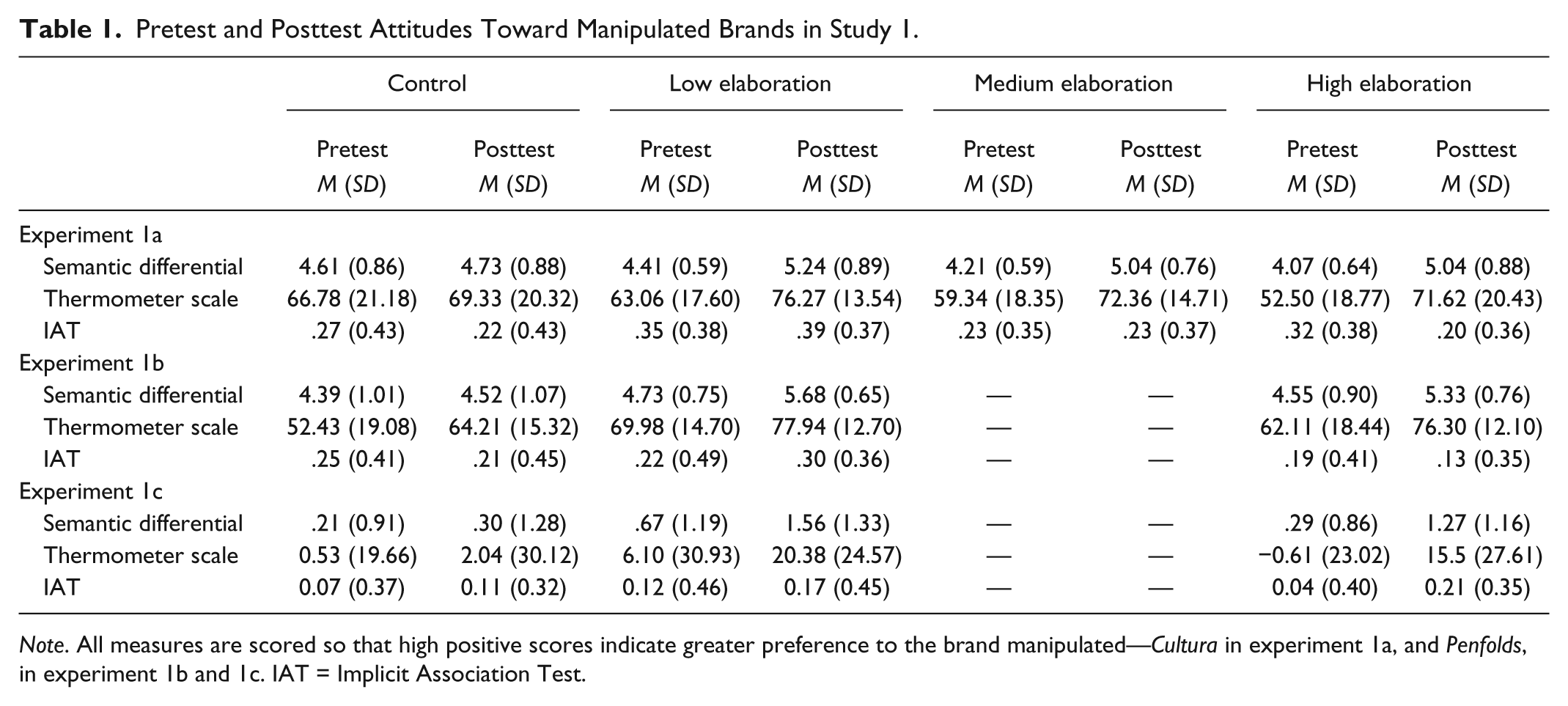
Note. All measures are scored so that high positive scores indicate greater preference to the brand manipulated—Cultura in experiment 1a, and Penfolds, in experiment 1b and 1c. IAT = Implicit Association Test.
Cognitive attitude formation
Overall, the pattern of results suggested that favorable cognitive attitudes toward a brand could form toward a novel brand with only a single exposure, but only if one novel object was presented. In Experiment 1a, the analysis revealed a significant effect of condition, F(3, 130) = 10.86, p < .001, partial η2 = .20, with the low (adj. M = 5.18, SE = .11, t(130) = 4.57, p < .001, d = .80), medium (adj. M = 5.18, SE = .11, t(130) = 4.44, p < .001, d = .79), and high conditions (adj. M = 5.26, SE = .11, t(130) = 4.94, p < .001, d = .87) being significantly higher than controls (adj. M = 4.49, SE = .11). However, there were no differences between the manipulation conditions.
In Experiment 1b, there was again a significant effect of condition, F(2, 77) = 18.82, p < .001, partial η2 = .33. Although both the low (low adj. M = 5.55, SE = .11, t(77) = 5.84, p < .001, d = 1.33) and high manipulation conditions (high adj. M = 5.34, SE = .11, t(77) = 4.55, p < .001, d = 1.04) were significantly more positive than in the controls (adj. M = 4.63, SE = .11), there was no difference between the low and high conditions.
The introduction of an unknown competing brand resulted in a different pattern of data. After the removal of an outlier, there was no significant effect of condition, F(2, 61) = 2.18, p = .12, partial η2 = .07, indicating no differences between the low (adj. M = .73, SE = .23), high (adj. M = 1.37, SE = .24), and control groups (adj. M = 1.25, SE = .23).
Affective attitude formation
Affective evaluations appeared to be sensitive to exposure to a positive presentation of a novel object when the marketing material had greater authenticity and there was no competing product. In Experiment 1a, where we used our fabricated materials, there was no significant effect of condition, F(3, 130) = 1.51, p = .22, partial η2 = .03, indicating no difference between low (adj. M = 75.60, SE = 2.90), medium (adj. M = 73.89, SE = 2.94), high (adj. M = 73.79, SE = 2.91), and control (adj. M = 67.66, SE = 2.81) groups.
In Experiment 1b, when an authentic-looking website was presented, positive affective evaluations for both low and high elaboration were apparent. After exclusion of one outlier, analyses revealed a significant effect of condition, F(2, 76) = 12.15, p < .001, partial η2 = .24. Follow-up tests revealed a favorable change in attitude toward Penfolds under the low condition (adj. M = 74.58, SE = 1.94, t(76) = 3.42, p = .001, d = .78) and under the high condition (adj. M = 77.70, SE = 1.85, t(76) = 4.75, p < .001, d = 1.09) compared with controls (adj. M = 65.44, SE = 1.81). There was no difference between the low and high conditions.
In Experiment 1c, no favorable affective attitudes formed when a competing brand was present. Analyses for Experiment 1c revealed a nonsignificant effect of condition, F(2, 62) = 2.70, p = .08, partial η2 = .08, indicating no differences between the low (adj. M = 68.21, SE = 5.39), high (adj. M = 68.82, SE = 5.25), and control conditions (adj. M = 52.76, SE = 5.13).
Implicit attitude formation
The pattern of results suggests that a single exposure to a novel object did not result in implicit attitude formation, even after increasing the elaboration of the material. Across Experiments 1a, 1b, and 1c, none of the condition main effects were significant—Experiment 1a: F(3, 132) = 1.63, p = .19, partial η2 = .04, low (adj. M = .37, SE = .06), medium (adj. M = .26, SE = .06), high (adj. M = .19, SE = .06), and control (adj. M = .23, SE = .06); Experiment 1b: F(2, 76) = 1.52, p = .23, partial η2 = .28, low (adj. M = .30, SE = .07), high (adj. M = .14, SE = .06), and control (adj. M = .19, SE = .06); Experiment 1c: F(2, 62) = .75, p = .48, partial η2 = .02, low (adj. M = .12, SE = .06), high (adj. M = .14, SE = .07), and control (adj. M = .22, SE = .06).
Discussion
With only one encounter, marketing materials may bear only limited implications for explicit and implicit attitudes toward novel consumer objects. In general, formation of explicit attitudes could be achieved by providing marketing messages about a single product, but the presence of a competing object appeared to neutralize the effectiveness of elaboration. In contrast to the partially successful formation of explicit attitudes, implicit attitudes could not be formed with a single exposure to marketing message, despite attempts at increasing elaboration. These results discount the role of salience in implicit attitude formation and point to presence of repeated associations between concepts being a more plausible way to form implicit attitudes toward novel objects.
Study 2
The aim of this study was to directly test if an evaluative priming procedure would be successful in inducing implicit attitudes about a novel object. A crucial consideration is that repeated exposure to an unknown brand may not, in and of itself, form the basis for implicit attitude formation. This is because the presentation of an unvalenced concept unaccompanied by other stimuli is a context in which associative processes should not be activated, and thus, should not lead to the formation of an implicit attitude. A strong test of this hypothesis would be that implicit attitudes would not form toward a brand that was exposed with the same frequency but without simultaneous presentation with positive valences. Unlike previous studies, we do not make comparisons between two objects conditioned with either positive or negative valences (cf. Olson & Fazio, 2001, 2002) because that operationalization is unrepresentative of the idea of novel objects in an unfamiliar category.
The frequency of exposure to an attitude object with positively valenced concepts may also result in the formation of explicit attitudes. Previous studies show repetitions of advertisements enhance explicit attitudes toward the novel object (Haugtvedt, Schumann, Schneier, & Warren, 1994; Schwarz, 2004), so compared with the presentation of a brand without valences, the presentation of a brand with positive valences should receive favorable evaluations by comparison.
Method
Participants and overview of procedure
Fifty-five students (14 females; age M = 23.55, SD = 1.93) from a private South Korean university were recruited. After completing explicit and implicit measures of their attitudes toward two brands with which they were unfamiliar, the study participants were randomly assigned to either the Penfolds or the Yalumba exposure groups. After the manipulation, the participants completed identical explicit and implicit measures at pretest. As in Study 1, participants generally reported low familiarity with wine or either of the brands. Moreover, as in Study 1, excluding participants who had familiarity with wine, had purchased wine, or expressed that they had previous knowledge of the test brand had no impact on the pattern of data, and thus were retained in the study.
Manipulation
In both conditions, participants were instructed to memorize the pairs of words shown on the screen, as a memory test would ostensibly be administered at the end of the presentation. Participants were exposed to 100 pairings of either Penfolds or Yalumba with one of five positive evaluative stimuli not presented in the IAT task (good, happy, joy, hope, success—although some of these stimuli overlap the stimuli for the IAT, they were close synonyms in Korean; no direct English equivalent translations); one drawback of a previous study of implicit attitude formation toward novel objects was that the concepts used in evaluative conditioning and implicit attitude measurement were identical, thus confounding attitude formation with practice effects (Mitchell, 2004). The word pairings were presented such that the brand name would be presented on either the left or right half of the screen, and an evaluative word would appear on the other half of the screen. The pairings were presented for 1 s each on a computer screen, after which the word pairing was obscured by an opaque white rectangle. The participant then pressed a key on the keyboard to advance to the next pairing. Presentation of the concept word and the positive evaluative word was fully counterbalanced across different sides of the screen. This procedure continued until the participant had been exposed to all 100 brand-evaluative word pairings. This procedure closely mimics the procedure used by Karpinski and Hilton (2001), with the difference being that the current study used pairs of novel objects with either positive or neutral valences, whereas Karpinski and Hilton (2001) paired known concepts with either positive or negative valences. In addition, to ensure that mere exposure to the brand did not influence the formation of the attitude, in the Penfolds exposure group, the concept Yalumba was presented paired with a white blank rectangle rather than an evaluative word for 100 exposures, and in the Yalumba exposure group, a white blank rectangle was presented with the word Penfolds for a total of 100 exposures. Thus in each condition, participants were exposed to 200 presentations of brand names. A separate nonexposure control group was not included because the question we wished to ask was if repeated positive exposure to a brand would facilitate the formation of implicit attitudes, compared with unvalenced repeated exposure.
Explicit and implicit measures
Measures were identical to those in Experiment 1c. The difference score between the Penfolds (α = .81) and Yalumba (α = .63) semantic differential and thermometer (α = n/a; single-item scale) scales and IAT (α = .89) were adopted as the dependent variables, with higher scores representing greater favorability toward the Penfolds brand.
Results
Explicit and implicit attitudes toward Penfolds versus Yalumba
ANCOVA was conducted with the posttest measures as the dependent variable and pretest measures as covariates, with a between-subjects factor of condition (Penfolds vs. Yalumba exposure). Table 2 shows the pretest and posttest means of the measures.
Pretest and Posttest Attitudes Toward Manipulated Brands in Study 2.
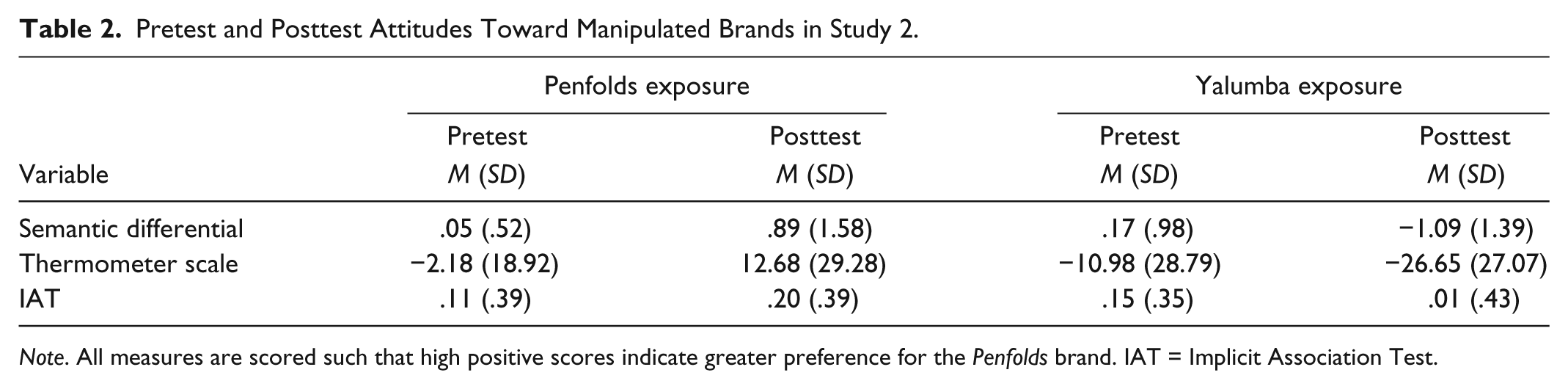
Note. All measures are scored such that high positive scores indicate greater preference for the Penfolds brand. IAT = Implicit Association Test.
Results showed that cognitive attitudes form for brands presented with positively valenced concepts. Analysis on the semantic differential showed that the effect of condition was significant, F(1, 52) = 28.18, p < .001, partial η2 = .35, thereby indicating that participants in the Penfolds (adj. M =.92, SE = .27) and Yalumba exposure groups (adj. M = −1.13, SE = .28) reported higher cognitive evaluations of the brand to which they were exposed.
Affective attitudes showed a similar pattern. The effect of condition was significant, F(1, 52) = 27.32, p < .001, partial η2 = .34, which indicates that participants in the Penfolds (adj. M = 9.79, SE = 4.44) and Yalumba exposure groups (adj. M = −23.64, SE = 4.53) liked the brand to which they had been exposed.
Implicit preference for the exposed brand was also observed. The effect of condition was shown to be significant on the IAT, F(1, 52) = 5.55, p = .02, partial η2 = .10), indicating a preference toward the positively exposed brand in the Penfolds (M = .22, SE = .07) and Yalumba exposure groups (M = −.004, SE = .07).
Discussion
Formation of explicit attitudes was facilitated by repeated exposure to positively valenced concepts, with cognitive and affective evaluations being favorable following exposure to a simulation of repeated marketing messages. But merely being seen (even repeatedly) is an insufficient condition for positive implicit attitude formation. Viewed in the context of the previous findings, the data indicate that favorable implicit attitudes are dependent on the frequency of positively valenced exposures, rather than on the salience of the material.
Study 3
Although Study 2 showed that the frequency of exposure coupled with positive valences could result in the formation of implicit attitudes, it remains to be seen if the effects of frequency on implicit attitude formation can be inferred from implicit attitudes toward existing brands. One case in which a clear difference in the frequency of exposure might be expected is between a dominant national brand and a less dominant foreign brand. Specifically, we compared explicit and implicit attitudes toward comparable brands that are well-known among Koreans—namely Samsung (a Korean brand) and Sony (a Japanese brand). Both brands represent large, multinational firms that compete in similar categories and have a significant consumer presence. The data were collected in the Korean city of Suwon, which also serves as the headquarters for their electronics division, and it also sponsors the local national-league soccer team. In addition, Samsung is the largest company in Korea, accounting for a considerable portion of the goods sold and economic activity in the country. We believed Koreans to have a higher frequency of positive exposure toward Samsung as compared with Sony, and anticipated that Koreans would have more favorable implicit attitudes toward Samsung than toward Sony.
Methods
Participants and overview of procedure
One hundred and thirty participants (41 females; age M = 31.78 SD = 10.10) were recruited from a private university in South Korea and completed explicit and implicit measures of Samsung and Sony as well as demographic questions.
Explicit and implicit measures
The explicit and implicit measures mirrored those in Study 2, except that Samsung and Sony were the target concepts in both the semantic differential (Samsung, α = .87; Sony, α = .86), thermometer scales (α = n/a; single-item scale), and IAT (α = .91). In all cases, positive scores represented greater preference toward Samsung. If greater positive exposure to Samsung does lead to positive attitudes, we would expect the means of the measures to be positive and significantly different from zero.
Results and Discussion
We analyzed Koreans’ explicit and implicit attitudes toward Samsung versus Sony by subjecting the difference scores on each of the measures to a one-sample t test. Cognitive attitudes showed a preference for Samsung, M = .33, SD = .88, t(129) = 4.31, p < .001, d = .76, as was also the case for affective attitudes, M = 9.31, SD = 18.38, t(129) = 5.77, p < .001, d = 1.01, and the IAT, M = .40, SD = .38, t(124) = 11.72, p < .001, d = 2.10.
Overall, the pattern of data is consistent with that of Study 2, indirectly suggesting that repeated exposure to paired concepts could account for the formation of implicit attitudes. The difference, however, is that the current study used familiar brands. One interesting point is that participants would have encountered the marketing materials showing each of the brands in a positive manner. If merely being associated with positive valences is responsible for implicit attitudes, then Koreans should be indifferent in their comparative implicit attitudes toward Samsung and Sony. The clear preference for one brand indicates the importance of relative exposure frequency.
One plausible alternative explanation was that ethnocentrism may have been a factor in the implicit attitudes observed (e.g., Shimp & Sharma, 1987; Verlegh & Steenkamp, 1999; Watson & Wright, 2000). However, IAT-type measures are relatively sensitive to the stimuli presented to the participant such that, even with the same target concept, different implicit attitudes may arise as a function of differently valenced stimuli used in the measure (Bluemke & Friese, 2006; Govan & Williams, 2004; Kim, 2004). Because the IAT we used did not contain references to national identities, the associative link between one’s country and brand may not have been reflected in the responses. Although we acknowledge that all sources of confounding effects cannot be ruled out, it is difficult to eliminate such effects when dealing with data on objects that exist in the wild.
General Discussion
Summary of Results
Across the experiments in Study 1, single exposures to marketing material were shown to be effective in forming explicit but not implicit attitudes toward novel attitude objects (new brands). Furthermore, we detected some differences in responses in the pattern of explicit responses. Although cognitive attitudes could be induced, the degree of elaboration did not result in differentiated attitudes (Experiments 1a and 1b), and the presence of competing brands (Experiment 1c) resulted in no preference toward a novel brand about which marketing efforts were expended. By way of contrast, we observed that authenticity appeared to induce affective evaluations (Experiment 1b), but it was also insensitive to the amount of elaboration. The presence of a competing brand appeared to erase the effects of authenticity, however. With respect to implicit measures, single exposures to novel objects did not appear to lead to the formation of implicit attitudes.
Studies 2 and 3 provided evidence that repeated presentation of a brand with positive valences could result in positive implicit attitudes. Both controlled repeated exposures in the laboratory and theorized differences in frequency of exposure to one brand appeared to yield favorable implicit attitudes. These studies also demonstrated that repeated exposure contributed to favorable cognitive and affective attitudes.
The Pattern of Explicit and Implicit Attitude Formation
In attempting to organize the current findings in the light of previous research, we offer the following analysis. In our studies, where the salience of the judgment was low, implicit attitude formation was not influenced by single exposure to stimuli, but where sufficiently salient cognitive processes, such as intergroup classification are invoked, a single exposure may result in derivation of valence (cf. Gregg et al., 2006; Perkins et al., 2008). Thus, if the novel brand is not subject to influential cognitive processes, consumers may require substantial exposure to novel brands paired with positive stimuli before implicit attitudes form.
We speculate that this picture may not be so simple because explicit and implicit attitude formation may interact. Brands with a heightened public profile may be judged as having been socially validated, thereby indicating that the brand (even if novel) offers goods that people prefer to consume (Baker, Hutchinson, & Nedungasi, 1986), heightening the salience of such information and implying an associative link between the product and an ingroup. Furthermore, a conscious decision to alter one’s engagement to include more exposure to certain associations (e.g., routinely choosing to walk past an attractive billboard) could alter the availability of the associations themselves. In short, although frequency of exposure may directly lead to implicit and explicit attitude formation, a variety of mediating and moderating effects could exist.
Theoretical and Managerial Implications
We contribute to the literature on implicit attitudes by demonstrating the pattern of explicit and implicit attitude formation. It has long been suggested that implicit attitudes are the product of repeated associations between concepts (Greenwald et al., 1998). Subsequent investigations have shown that invoking salient intergroup processes can lead to the formation of implicit attitudes (Gregg et al., 2006), but relatively little attention has been given to how implicit and explicit attitudes arise toward a relatively unfamiliar object. Using the consumer behavior context allowed us to study both explicit and implicit attitude formation, and to demonstrate divergence in the formation of explicit and implicit attitude formation. The key to understanding the formation of attitudes is that implicit attitude formation is dependent not on salience but on the relative frequency of the presentation of an object and a valenced concept, whereas explicit attitudes can arise as a function of frequency and salience. This pattern is strongly consistent with multiple routes to attitude formation, one through elaboration and another through repetition, with different consequences for explicit and implicit attitude formation.
Based on our findings, we suggest an important caveat to marketing actions. Managers who are interested in creating favorable implicit attitudes, which appears to be associated with nondeliberative purchase behavior (Perkins et al., 2008), could adopt a marketing strategy focused on repeated exposure of the product to the consumer. Focusing on elaborate presentations to form implicit associations may not be as effective without invoking salient intergroup processes.
Limitations and Directions for Future Research
A few points in these studies merit further consideration. We recruited exclusively from a private South Korean university, which is a relatively homogeneous population. We do not know how the results would be affected by recruiting more diverse populations and explicitly accounting for group differences. Furthermore, we did not exhaustively vary the salience of materials, nor did we define the boundary conditions under which explicit and implicit attitudes form. In particular, although we decided on 100 exposures of a brand coupled to a positive valence in Study 2, this number was arbitrary. Previous investigations have met with success in inducing implicit attitudes after associating concepts in a range from 20 to 200 exposures (Baccus, Baldwin, & Packer, 2004; Karpinski & Hilton, 2001; Olson & Fazio, 2001, 2002; Perkins et al., 2008). Future research should seek to determine the point at which implicit attitudes form. In addition, we note that the vast majority of participants in Study 1 and 2 preferred alcoholic beverages other than wine. Therefore, the participants in those studies may differ qualitatively from typical consumers who are consistent in their preferred brand of product and purchase behavior (Cobb & Hoyer, 1986).
Footnotes
Acknowledgements
The authors would like to thank the members of the Center for Interdisciplinary Research in Business and Psychology and Global Management for their invaluable assistance in the completion of this research.
Declaration of Conflicting Interests
The author(s) declared no potential conflicts of interest with respect to the research, authorship, and/or publication of this article.
Funding
The author(s) disclosed receipt of the following financial support for the research, authorship, and/or publication of this article: This article was completed with the support of an Ajou University research fellowship of 2012 awarded to the second author. This work was also partly supported by a grant funded by National Research Foundation of Korea (NRF-2012014598), which was awarded to the second author.