




Abstract
This research endeavors to fill the research cavity in the domain of online consumer reviews (OCRs) through investigating the relationship between review length and rating. Moderated multiple regression (MMR) analysis was used to investigate the moderation interactions of some critical factors, including the product price, brand, product type, and delivery systems. Through data curation, 10,547 sets of cross-sectional product data containing 200,169 sets of reviews refined from the original 12,009 products collected from jd.com in China were used. Research through econometric analysis reveals that review length improves rating. Through interactions, this study found that the price has negative interaction, whereas brand familiarity has a positive interaction with review length and rating. Domestic brands, search goods, and third-party delivery systems have more positive interactions on review length and rating than the overseas brand, experience goods, and platform’s self-delivery systems, respectively. This paper renders insight for managers, especially merchants, who should encourage consumers to write meaningful lengthy reviews to improve their reputation.
Keywords
Introduction
Electronic commerce (e-commerce) has become the sustainable business sector in the world with enormous opportunities. Many companies such as Amazon and Alibaba group have become revolutionary growth legends over decades through e-commerce business. Every day, many new companies are arising from niche markets. E-commerce foundation reported that, in 2016, global business turnover touched $2671 billion, which was considered as a noteworthy reaching in the domain of online marketplace (Foundation, 2016). Reports show that digital buyers are continuously rising with a good ratio. Statista reported the statistics for e-commerce of digital buyers in billions from 2014 to 2021 and retailing share from 2015 to 2021, as displayed in Figures 1 and 2, respectively. The report has shown that the digital buyers are going to catch 2.14 billion within 2021 (Statista, 2019b) as well as the e-commerce retailing sector is going to reach 17.5% within 2021, which is more than double than of 2015 (Statista, 2019a).

Worldwide digital buyers statistic in billions.
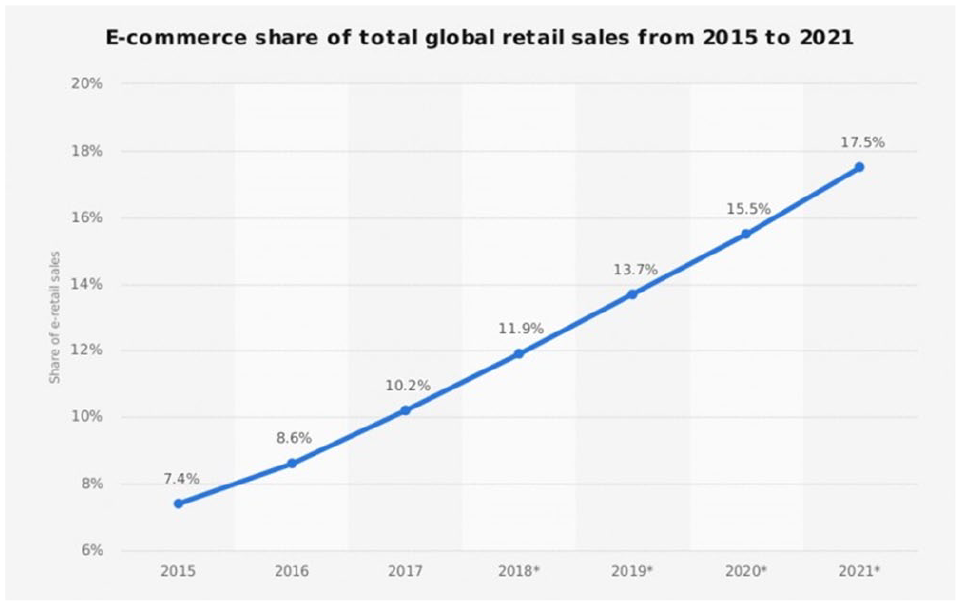
Global online retailing sales share (2015–2023).
The advantages of this sector are adequate and prolific, such as it facilitates both seller and consumer to accomplish the sell-buy dealings and transactions with saving time and money along with enormous handy features. Through online shopping, buying a product becomes a matter of several operations only. Nowadays, consumers often like to wander in online shopping platforms to find suitable products at an appropriate price. Consumers can easily compare the price, product descriptions, reviews, and ratings. They search the product until finding a suitable one for their mental satisfaction. Sometimes they buy different kinds of commodities while searching for another product due to affordable prices and choice, especially with the features of the group-buy, hot sale, time purchase, and so on. Consumers are now much more careful about some factors like price, reviews, rating, product features, brand, delivery systems, and so on. Some elements can have a direct and indirect interwoven impact on the rating, trust, and consumer behavior. On the other hand, with the flurry of information systems, e-commerce, and web 2.0 technology, the battle of sellers is at its apex with multiple strategies such as omnichannel marketing, product information enhancement, online consumer reviews (OCRs), and so on. Consumer-generated OCRs are the prime source of electronic word of mouth (eWOM) as a means of marketing to win the market, and it has gained both consumers and sellers special attention over time (J. A. Chevalier & Mayzlin, 2006; Hu et al., 2008). Text review is the primitive version of OCRs deployed in online shopping and is the key to perceive reviews (Godes et al., 2005; Moore, 2011). Over time, many features were added along with the text reviews to enhance the OCRs and consumer-generated information (CGI) readability. Text reviews are yet considered as stable and sustainable elements of OCRs, which always exists in online shopping malls and consumers prefer to read and rely on these textual reviews rather than summarized statistics (J. A. Chevalier & Mayzlin, 2006). However, consumers have different sentiments for diffusing text reviews with varying lengths, and consumers adopt this text review length with a different motivation. Some consumers love to place short reviews, whereas some of them love to write long text reviews with detailed information and rating. Hence, consumer behavior might vary for producing seller product rating based on different lengths of text reviews. Consumer purchasing attitude, seller reputation also motivated through the varying depths of text review.
Online reviews and rating reflect the consumer’s experience, product, and seller reputation, which plays as the important driver for product choice, product attitude, consumer retention and purchasing intention, and so forth. Thus, many potential researches spur in this realm, including marketing, decision-making, information science (IS), and so on to extract and depict the potentials of OCRs, such as text review analysis includes review valence, review helpfulness, consumer trust, fake reviews detection, consumer loyalty, and so on through different strategies such as structural equation modeling (SEM), econometric analysis, fsQCA, exploratory data analysis, data mining technics, machine learning, and so forth. Although, online reviews and rating were extensively researched, including the interplay of review helpfulness and review contents (Korfiatis et al., 2012; Pan & Zhang, 2011), effects of rating in review length (Korfiatis et al., 2012), positive relationship of reviewer reputation and review helpfulness (Chua & Banerjee, 2015), moderating effects of review depth in rating and review helpfulness (Chua & Banerjee, 2015), perceived review helpfulness, interestingness, and trustworthiness from review and rating (Tsang & Prendergast, 2009). However, surprisingly, no direct research focused on the relationship of review length effects on rating, which indicated a research lack in this area and can give us new and additional sense to understand consumer behavior and review helpfulness.
Although price (i.e., low and high; Brucks et al., 2000; J. Chevalier & Goolsbee, 2003; Dodds et al., 1991), brand recognition (i.e., not famous and famous; Akdeniz et al., 2013; Dodds et al., 1991; Erdem et al., 2006; Wen et al., 2020), goods type (i.e., search and experience; Klein, 1998; Weathers et al., 2007; Zhai et al., 2019), brand type (i.e., domestic and overseas; Halkias et al., 2016; Hoskins et al., 2021), and delivery type (i.e., platform’s own delivery and third-party delivery; Chan et al., 2018; Govindan & Chaudhuri, 2016; Hertz & Alfredsson, 2003; Zheng et al., 2020) were extensively researched with[out] integration of OCRs in marketing, psychology, and decision-making area. Yet these factors have been underexplored in the relation of review length and rating as the moderation effects. Therefore, through utilizing this gap, in this study, we aim to apply these moderations effects to contribute and broaden the vivid knowledge to the extant literature of OCRs.
Our research solicits to elicit the following research questions to provide a vivid and lucid understanding of our research motivation and objectives to the readers:
In the forthcoming sections, we will delve into our knowledge to investigate our research questions and delineate our research. Section 2 discusses details about literature reviews for OCRs, text review length, and the role of moderator factors. Setup hypothesis, conceptual, and theoretical framework. Through section 3, we present research methods, variables, descriptive information of our collected data. Section 4 displays our investigated results through regression analysis and the graph of different variables to show their relations. Section 5 summarizes the conclusions of our research by providing theoretical and managerial implications as well as provides limitations and future research direction from our findings.
Literature Review
Consumer Reviews (OCRs) and Behavior
Consumer reviews, a significant and reliable source for product information, notably influence rating, trust, and sales through the measurement of consumer behavior. Especially, consumer-generated textual review content length is a critical concern in this research. Therefore, we mostly focused on social evidence of OCRs and the genre of the form of OCRs. Figure 3 shows the structure of the OCR’s classification on a different scale.

Form and classification of online consumer reviews (OCRs).
From Figure 3, it is obtrusive that elements of OCRs are increasing over time, which insinuates the drastic significance of OCRs in the context of e-commerce and consumer behavior. Product information can be diffused through seller-generated information, including texts, images, and videos, as well as CGI, including OCRs, questions and answers (Q&A), forums, chatbots, and so on. All of this product information is useful for product marketing via the means of eWOM (Hu et al., 2012). However, the consumer’s generated information, especially OCRs, are more trustworthy to readers and helpful to obtain previous customer shopping experience (A. H. Huang et al., 2015), as well as OCRs are considered as the sustainable and prime role for the mutation of word of mouth (WOM) to eWOM (Hill, 2016). OCRs have become the digital marketing tool for merchants via the means of eWOM and social commerce. Besides the merchants, when buying a product, consumers also focus on CGI and gather detailed knowledge of a product through OCRs (Willemsen et al., 2011). Even it is considered as the second most trustworthy origin of information merely after the endorsement from the family and friends (Nielsen, 2011). It is treated as consumer-friendly and extracts the real information through the consecutive period for a particular product. Some consumers transmit OCRs for the second time after carefully using the product, while most of them place OCRs for the first time with all evidence they face during consumption of the product. Hence, OCRs contain plenty of information with a variety of sentiments and usability such as product application, features, suitability, service level, merchant quality, product packaging, and so on (Y. Chen & Xie, 2008). Along with other marketing strategies, nowadays, the seller encourages and provides the incentive to the consumer to produce quality and informative OCRs, which eventually aid sellers to motivate consumers to purchase their goods (Y. Chen & Xie, 2008; Godes & Mayzlin, 2004). Through the proper and discerning use of OCRs, sellers can have a sustainable reputation and sales rate.
Not only the source of eWOM, but OCRs are also helpful in understanding consumer thoughts, consumer perception, retailer reputation, retailer service level, brand allegiance, customer fidelity, and so on. It is regarded as the considerable pace for research exploration in various domains of online marketplaces, including tourism, business to consumer (B2C), consumer to consumer (C2C), online to offline (O2O) and so on. Practitioners and researchers often use OCRs to hunt the research findings in many areas such as consumer perception, review valence, review helpfulness, consumer trust, consumer loyalty, and so on (J. A. Chevalier & Mayzlin, 2006; Dellarocas, 2003; Godes & Mayzlin, 2004; X. Li & Hitt, 2008). For instance, reputation, emotions, and expression of a reviewer are most important to a consumer for OCR’s perception (Hu et al., 2008). Product type, review scale, and review depth can impact the OCRs perceived helpfulness; More clearly, the investigation found that review length positively affects the perceived usefulness. In the case of search goods, it has more favorable effects on the helpfulness of OCRs (Mudambi & Schuff, 2010). Consumer perceptions are divergent based on OCR contents. For instance, Cao et al. (2011) found that linguistic characteristics influence more in OCR helpfulness and apprehension. OCRs with acute opinions obtain higher helpfulness votes than combined and impartial views (Cao et al., 2011). In the case of reviewer avatar image research, the consumer has broader perceptions of review helpfulness if there have a happy-looking avatar image exists in review contents (M.-Y. Chen et al., 2019). E.-J. Lee and Shin (2014) found that review contents notably influence website evaluation and consumer perception in the presence of reviewer photo. Attributes of commentator and opinion contents have diverse degree of effect on review helpfulness (A. H. Huang et al., 2015). Opinion variety and concepts influence the review contents understanding (Qazi et al., 2016). In the context of OCRs helpfulness, some research investigated different nationalities’ consumer sentiments for diffusing the OCRs. Zhou et al. (2016) found that Chinese consumers concentrate on the commodity’s outer features and consumer feelings, whereas American consumers keep attention on the commodity’s interior characteristics and detailed information. When transmitting OCRs, Chinese consumers like to express their feelings passively, whereas American consumers tend to express their feelings in a straight way (Zhou et al., 2016). Consumers trust the OCRs for reviews where the critic’s identity and avatar images are integrated (Munzel, 2016). Fonts used in OCRs contents also affect reviewer quality and helpfulness. For the first time, OCR font influences reviewer quality, and when the consumer goes deep in the texts, fonts efficacy vanishes (Y. Huang et al., 2017).
OCR is a concise representation of the consumer shopping experience and is trustworthy for future customers’ perceptions. OCRs can be transmitted through both the review contents and ratings. Both review contents and rating represent the consumer shopping experience and product/seller reputation and have an influence on consumers in many ways. Review contents include text reviews, photo reviews, secondary reviews, and video reviews provide in-depth information about consumer feelings. Researchers often probe the usability of review contents elements to understand profoundly about consumer behavior, consumer loyalty, review helpfulness, seller quality, and so on (Cao et al., 2011; Hossin et al., 2019; Hu et al., 2012, 2008; Korfiatis et al., 2012; Qazi et al., 2016; Weathers et al., 2015). Even some of the research investigates air pollutions effects through OCRs (Fang et al., 2019). On the other hand, a rating is the overall consolidated measurement scale for a seller/product, which is effortless and quickly readable to the readers. Researchers found that consumers pay the price premium for high ratings (J. A. Chevalier & Mayzlin, 2006). Academicians also found that a high score is meaningful with[out] going through review contents, but a low rating is worthwhile only going through the review contents (Gavilan et al., 2018). From the perspective of review helpfulness, it was investigated that long reviews are more helpful than short reviews (Mudambi & Schuff, 2010).
Role of Review Length in OCRs
Text reviews are the rudimentary version of OCRs, which were integrated early in e-commerce platforms where user can express their experience through text. It is the elementary foundation of OCRs, which is considered as the eWOM and used as a recommendation for future users. Many overwhelming previous research publications had been done based on text reviews such as text mining (Cao et al., 2011; Chatterjee, 2019), consumer behavior (Comscore, 2007; Zhou et al., 2016), review helpfulness (Chua & Banerjee, 2015; Korfiatis et al., 2012), trustworthiness (Tsang & Prendergast, 2009), fake reviews (Hunt, 2015), security issues (Bao et al., 2000), purchasing decisions (Chatterjee, 2019), and so on. In this study, we cope with the review length to understand the usefulness to consumers as well as understand the consumer sentiment for OCRs when expressing different lengths of text reviews.
OCRs render profitable information to future consumers, where consumers use these OCRs before purchasing a product (Yin et al., 2016). One of the prominent features of OCRs is that the reader can transmit reviews as the review helpfulness to future readers (Mudambi & Schuff, 2010). Much overwhelming research demonstrated that product sales in e-commerce are influenced by the degree of opinion helpfulness. The more the helpfulness of OCRs are, the more sales are increased (Dhanasobhon et al., 2007). Many research works paid momentous focus on review helpfulness and its influence on purchasing decisions. Along with other data in e-commerce, consumer generates text reviews to express their experience and opinions in detail (Zimmermann et al., 2018). Considering the prevalent influence of text reviews and through adequate research work critiques, many researchers found the relation of text review length with review helpfulness. For example, S.-G. Lee et al. (2018) found that lengthy reviews were more helpful to consumers in their purchasing decision. Many of the researchers stated that lengthy text reviews are more productive than short text reviews (Mudambi & Schuff, 2010; Pan & Zhang, 2011; Yin et al., 2016). Review length by word count has a threshold point in its influence on opinion contributions (A. H. Huang et al., 2015). Long text reviews are also helpful by means of the information source; by the long text reviews, consumers can render more arguments about the product quality and seller details (Korfiatis et al., 2012). The future consumer also benefitted through long reviews by reading details of the product. Long text reviews may contain much useful information such as product quality, features, product outlook, customer services, seller attitude, logistics support, warranty, guaranty, and so on. By posting this valuable information, consumers are helping future consumers to have a detailed idea about the product/service before purchasing. These text reviews reflect the consumer satisfaction level while they generate the posts. Anderson found that when a customer has feelings of satisfaction or is totally dissatisfied, they tend to procreate reviews to express their feelings about this product (Anderson, 1998). With the positive influence of social media, future reviews and ratings are influenced by prior OCRs (Aral & Walker, 2012). Consumer beliefs are also influenced by the degree of reviews and ratings. Consumers persuaded high scores abreast the high number of reviews, whereas consumers trust low ratings without the utmost concern of review numbers (Gavilan et al., 2018). Many researchers focused on review types such as fake reviews (Hunt, 2015; Munzel, 2016) based on review content using data mining techniques and consumer psychology. Long text reviews have an ample advantage over fake reviews also, since consumers need to write the content with proper attention. Figure 4 displays the different lengths of text reviews along with other elements of OCRs from jd.com.
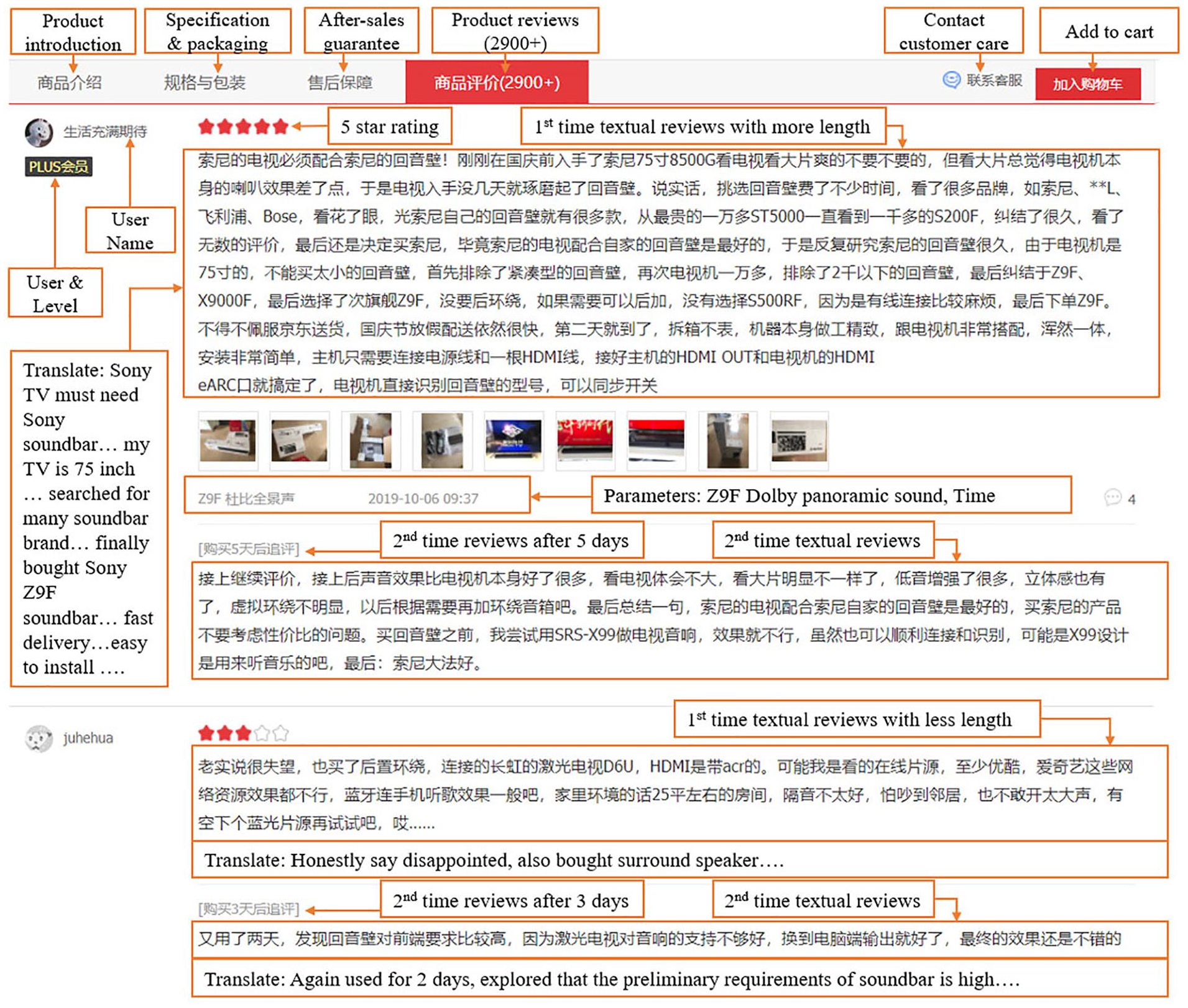
Review length for different ratings in jd.com.
E-commerce is a drastic competitive business sector where almost all the information is available. Besides the seller-generated information, CGI is a prime concern for the seller to improve their selling rates. Therefore, sellers strive best to supply the best services with the best quality to their customers. Nowadays, sellers offer 24/7/365 customer services which mean consumer can contact seller anytime whenever they want. In most cases, many problems of product and services are solved through seller online conversation, aka customer service. If consumers find any imperfections in products, they usually contact the seller before posting any bad reviews. Through the seller-consumer consultation, most of the problems are solved; consequently, bad reviews are restrained from availing in the online shopping mall.
Text reviews also have the advantage of being an information scent used in information foraging theory (Pirolli, 2007; Pirolli & Card, 1995, 1999), where consumers use this information scent to understand details of the product leading them to purchase the goods. Information foraged by a consumer usually needs eloquent information where the consumer fascinates by this information. Long text reviews have more advantages over short text reviews, which acts as an information scent to be foraged by consumers since long text reviews can give the detailed idea and information of all sides to the consumer, which increases the information fragrance. Therefore, the seller of the retailing shop has different strategies such as yielding the best quality, best price, best customer service, coupons, and so on to achieve the superior quality of long reviews from the consumer.
Theoretical Framework
Based on the review length, theoretical framework sketched below in Figure 5 to display review length and rating relation. In this framework, we have integrated Stimulus-organism-response (S-O-R) model to explain the variables mechanism concisely. The S-O-R model was initiated by Woodworth (1929) as an extended theory of the stimulus-response model proposed by Pavlov (1927). This model is integrated with three key components, such as stimulus, organism, and responses, which reflect the behavioral relations and outcomes of the events.

Theoretical framework.
Among them, the stimulus refers to the outside environmental forces that affect the individual’s psychological motivation (Jacoby, 2002; Peng & Kim, 2014; Young, 2016), and here in this study, reviews and rating reflect as the stimulus which influences consumers internal psychological state. The organism is the encountering outcome from stimulus representing individuals internal psychological and motivational process, and here organism is treated as the consumers emotional/motivational responses for reviews and rating. The last component, response, represents the individual’s final behavioral positive/negative outcome (Donovan & Rossiter, 1982; Spence, 1950), and here purchasing and rating actions are treated as the responses of consumers. Indeed, there is another satisfaction feeling stage after purchase, and hence, we designed the framework as a feedback loop to the reviews and rating.
As manifested in the theoretical framework from Figure 5, a product can have different types of reviews as information scent twisted with the rating, such as good rating with the broad length of reviews, rating with the low span of reviews, and unsatisfactory rating with reviews. For a superb rating with long text reviews, information is more authentic and reliable to consumers as the stimuli. Hence, consumers are motivated/aroused by this type of OCR and may decide/respond to purchase the goods. The probability of getting a good quality of the expected product is high in this stage, which stimulates consumers to transmit high ratings. Eventually, increase sales and scores. For the rating with short text reviews, the information is nebulous, where it may have a tapestry of good and bad reviews, and consumers have hesitation about product purchasing in this stage. Some consumers will give up purchasing the goods in this stage, whereas some will buy. If the consumers purchase goods, they may have satisfactory or faulty products. Based on the product quality and satisfaction level, they will rate the product through OCRs. Research found that reviews and rating relationships are unidirectional (i.e., positive relationship between reviews and star ratings), and reviewers post short reviews (even bad reviews or no reviews at all) upon their dissatisfaction with the products/services (S.-G. Lee et al., 2018), resulting in the diminishing of sales and score. In this vein, if they find an adequate level of product/services, they will render good ratings with long reviews, resulting in an increase in sales and rating. Finally, if the product has a bad rating with short reviews, due to information uncertainty, mostly the consumer will give up buying the goods, resulting in diminish in sales and ratings.
Therefore, focusing on the plausible explanation discussed for review length and rating through the S-O-R model and information scent, we consider stipulating the hypothesis that,
Moderating Role to Consumer Behavior and OCR
Role of product price
Price plays an imperative role in consumer behavior and OCR. Consumer motivation is to solicit the best price with the best quality (J. Chevalier & Goolsbee, 2003) by exploiting e-commerce (EC) and information technology. In most cases, consumers aim to obtain the best quality products, and often they choose price premium (Zhang et al., 2013). Savvy consumers often compare the price with different platforms. Some consumers always attempt to select the product with the lowest price. However, not all the time, their foraged best or economic price can precipitate magnificent results. Sellers’ targets are different based on price. Some sellers focus on quantity selling by giving discount prices rather than service level or quality. Some sellers concentrate on quality products and service level improvements and highly revolve around the consumer reactions throughout the OCRs. Some sellers also sell fake, copy, or refurbished products by enticing very low prices to customers (Munzel, 2016). Therefore, based on consumer demand and cost, the reviewer also has ambivalence sentiment for diffusing OCRs based on price range.
In most cases, product items with high prices are purchased by the high-end and experienced customer. Price plays as a quality signal and is often adopted by the customer as the product quality (Brucks et al., 2000). Hence, customer expectation for the high-end products and the high-value price is higher than a low-value price. If the product has any problem regarding the quality or features lacking, they can easily be motivated to place a comparatively lower score with meaningful review contents. Besides the product evaluation, the high price of the product is related to a higher level of sacrifice (Dodds et al., 1991). So, if the customer faces any service level, packaging, or logistic support, they can easily be motivated to react to the supplier through review contents and rating due to the higher expectation. Eventually, those consumers will post meaningful short/long reviews and relatively lower score. Hence, the probability of customer expectation is high for high-end products and prices, consequently prone to generate relatively bad score with meaningful OCR contents. Eventually, we can summarize that a high price can yield a lower rating with meaningful review contents.
Role of brand type
E-commerce breaks the barrier of the global business border. Plenty of abroad brand enters other countries quickly with the help of e-commerce and information obtainability (Hill, 2016; Klein, 1998). Consumers can easily view and choose a wide variety of products, including domestic and overseas brands in online shopping portals. Only with the help of e-commerce, consumers can directly buy a product from overseas and receive it through the international courier. However, consumers have disparate emotions for native and foreign brands (Barbro et al., 2020). Besides consumer behavior, different brands have different motivations for consumers to promote their products in the market. For a specific country or region, local brands have some privileges, sales performance advantages (Hoskins et al., 2021), and significant market success (Halkias et al., 2016) over abroad brands. On the one hand, local brands are supported by endemic consumers to raise the national economy (Weber et al., 2008) and can gain additional positive reviews through their friends, relatives, neighbors, and followers, and it might be from the basis of cultural responses bias (Baumgartner & Steenkamp, 2001). On the other hand, local brands are at a rising period; hence, they focus on reputations through OCRs along with other omnichannel markets. Another obtrusive advantage of a local brand, they are more familiar with local markets, customer service, and delivery systems. These bring local brands supplemental positive reviews from consumer’s sides. Conversely, foreign brands are the most renowned brand and may not concentrate on OCRs as well as consumers may feel reluctant about reviews for overseas brands. Remote brands may have difficulties to provide better services in abroad that precipitate less favorable reviews from consumers. Through all this perspective, we can aver that local brands will have more privilege over foreign brands for OCRs and speculate that,
H2b: Moderation effect of the domestic brand is more supportive in the association of review length and rating than the overseas brand.
Role of product type
Goods are increasing drastically in the market with the aid of modern manufacturing technology, information technology, and the skilfull workforce. The consumer has dilemma behavior for different categories of products. Hence, exploring product classification is indispensable in understanding consumer behavior properly. Academicians mostly categorize the product based on attributes and haptic sense. A commodity can be categorized into search, experience, and credence commodity based on haptic touch or attributes (Klein, 1998). Besides the characteristics and haptic sense, there are other ways to divide the product. Table 1 displays the product classification based on a different methodology.
Goods Type Classification.

The scope of this research of goods type is the search and experience goods, which is the ordinary and conventional classification way of product type (S.-G. Lee et al., 2018; Nelson, 1970; Zhai et al., 2019). Products are considered as search goods when the purchasing decision is entirely based on consumer intuition through the product information created by sellers or manufacturers (S.-G. Lee et al., 2018). On the other hand, products are considered as experience goods when consumers evaluate the products after consumption and are difficult to evaluate before consumption (S.-G. Lee et al., 2018). Consumer sentiment is different for OCRs based on goods type. For the search goods, consumers focus more on attributes information and transmit reviews through primary text reviews. A consumer can write more about attributes and product descriptions through text reviews. Therefore, review helpfulness for in-depth reviews is stronger for search goods than experience goods (S.-G. Lee et al., 2018; Mudambi & Schuff, 2010). On the other hand, for the multimedia content in reviews, consumers focus more on experience goods and share their experiences after carefully observing the commodities. For the seller, they focus more on multimedia content for experience goods to promote their products.
Orthodox to other overwhelming researchers, our moderation effect is based on search goods and experience goods. In the principal relation of review length and rating, product type has a prevalent influence through moderation. Text reviews are more pertinent to attribute information of a product where consumer share their experience by writing details of product features. More lengthy opinions may express more about the product details and characteristics. Hence based on the discussed critiques, we can propose the hypothesis that:
Role of brand recognition
A myriad number of brands are rising to the market with a garden-variety of products. Industries are striving to reveal new products with more features in a short time. Therefore, now the challenges of the sectors are drastic, and the product cycle is much shorter. Consumers’ expectations are much higher because of the extensive availability of products. Brands need to consider all of these situations, along with gaining consumers’ satisfaction. A renowned brand can have most of the competitive advantages naturally created in the market. Through proper management, a well-known brand can maintain a high level of quality control (Q.C.), consequently providing the superior quality of commodities to the consumers (Akdeniz et al., 2013), which eventually renders quality signals to them (Erdem et al., 2006). Their service level, such as customer service, distribution systems, inventory management, are comparatively higher (Wen et al., 2020). Accordingly, they can easily satiate consumer demand with less risk (Erdem et al., 2006). Through productive lab facilities, skilled human resources, long history of experience, advanced manufacturing technology, and monolithic investment, they can enhance the product features, shorten product manufacturing cycles, and reduce production costs. All these advantages can facilitate consumer demand and brings positive reviews in the market. The policy of a renowned brands are well organized for warranty and guarantee policy for a product. It can be easily and quickly solved through their rich support of customer service, consequently satisfying consumers and brings positive reviews. Deploying these entire phenomena for brand recognition, familiar brands have definite advantages for consumer behavior in OCRs than not a famous brand.
Role of delivery systems
The delivery system is one of the prime exigency demands of the consumer for purchasing goods from online shopping. At present, there are different types of delivery systems to satiate consumer demand (Hertz & Alfredsson, 2003), such as the e-commerce platform’s own delivery, third-party delivery, on-time delivery, and so on. Based on delivery systems and supply chain management, an overwhelming number of logistics firms are arising in the market (Hurriyati et al., 2017). Especially the third-party logistics firms, which help all e-commerce platforms to deliver their goods as supporting services. Some of the e-commerce companies maintain their own distribution systems to make the delivery faster and meet consumer demand. For instance, JingDong (JD) or jd.com, a hegemony online retailing shop in China, supports its private delivery systems to send goods to the consumers (Zheng et al., 2020). However, most of the e-commerce companies run their business through third-party logistics companies to guarantee reliable distribution to the consumers (Hertz & Alfredsson, 2003).
Not only the e-commerce companies, but third-party retailers in e-commerce also prefer third-party logistics firms to make the distribution hassle-free and improve the efficacy. By utilizing these third-party logistic services (3PLs), they can focus more on product information, consumer’s reaction, and demands (Zheng et al., 2020). Third-party retailers in e-commerce are competitive and discern more about consumers’ behavior and requirements by providing a satisfactory service level. Thus, using third-party delivery systems brings positive reviews in OCRs. Another advantage of third-party logistics is their robust distribution network where they can deliver the goods with full reachability. They are more familiar with regional logistics support, where they can optimize their distribution systems and gain consumer satisfaction, consequently having favorable control on reviews and ratings.
In China, e-commerce sectors are snowballing along with some successful companies famous to the world, such as Alibaba Group, jd.com, Meituan, and so on. Now Alibaba group has become the world’s largest e-commerce company (Tse, 2015). China’s e-commerce sector is successful with the advantages of a robust supply chain and logistic companies. This proliferation of delivery systems underpins China’s e-commerce sectors, resulting in more new companies being willing to invest in these sectors in China. Some major courier companies that run a successful delivery system in China are S.F., China postal service, Z.T., ST, Junda, and so on. A delivery system for e-commerce usually falls into two types: company own delivery distribution and third-party distribution (Hertz & Alfredsson, 2003). In this study, we will use the case of jd.com (formerly known as 360buy.com); as a consequence, the distribution system of the company will be analyzed here to identify its moderation effect. Jd.com supports both its own delivery and third-party delivery systems. Mention that jd.com grew its business by serving its own delivery systems at the initial stage. At the rudimentary level, the company only distributed all the goods via their own channel means that there was no third-party company that could directly sell their product through their platform. However, over time, JD widens its platform to third party sellers and also supports third party delivery systems. Now, jd.com is the biggest competitor in Chinas’ electronic retailing (e-tailing) online market. Third-party delivery systems are mostly used by third party vendors who are more aggressive in increasing their sales by retention of good reviews. Although JD’s self-delivery systems are faster and render on-time delivery (Xianglian & Hua, 2013), third party delivery systems, in contrast with JD’s individual delivery, are more professional. Many third-party vendors chose this third party professional courier company for their hassle-free business (Zheng et al., 2020) with risk reduction (Govindan & Chaudhuri, 2016), while the sellers are much sincere about the consumer’s reviews, giving many offers or discounts to make the customer happy, which leads them to have good reviews. Therefore, through this plausible analysis, we can establish the hypothesis that,
Hypothesis Testing Framework
Figure 6 shows the hypothesis testing framework assembling discussed relations for hypothesis assumptions by demonstrating all factors’ roles such as review length, quadratic term, photo reviews, secondary reviews, video reviews, product price, brand type, goods type, brand familiarity, and delivery type.

Proposed hypothesis testing framework.
Research Methodology
Data Collection
Data was collected through jd.com, one of the biggest B2C online retailing e-commerce platforms. By 2018, jd.com online retailing shop touched the total assets of 209.16 billion yuan as well as total net revenue calculated to 462.02 billion yuan (Statista, 2018c). Statista (2018b) reports that online retailing store jd.com ranked second position worldwide in 2018, with total revenue of 61.6 billion U.S. dollars. Another report from Statista (2017) found that jd.com shared 27.2% of the whole B2C online e-tailing market in China. A report from eMarketer (2017) showed that jd.com shared 24.7% of the total B2C online shopping platform in China. In China, there are several online shopping days, especially 618, Singles day, Valentine’s day, and so on. Jd.com always shares a big market from this online shopping day. For instance, in the “618” occasion, it had touched the sales amount to $23.7 billion from June 1, 2018 to June 18, 2018 (iResearch, 2018). This amount was calculated as a 37% year-over-year (YOY) growth rate for jd.com (iResearch, 2018). Jd.com was founded in 2004 by Richard Liu and was initially known as 360buy.com. Now Jd.com is the most popular and influential B2C online shopping mall in China with $60 billion U.S. dollar revenue (Statista, 2018a). Therefore, real data from jd.com is our exclusive focus and was considered the most reliable source.
Based on goods type (search and experience goods), data were collected from jd.com with different categories. For the search goods, we used the laptop and mobile category to collect the data, which was considered a better example of search goods (Luan et al., 2016). For the experience goods, we selected facial mask and biscuit to collect the data, which were also regarded as the best example for experience products (P. Huang et al., 2009). A total of 12,009 datasets for each product were collected to conduct the regression analysis. These datasets are the full sets of cross-sectional data, and every dataset contains the first 20 sets of reviews from JD’s existing source. These first 20 sets of reviews are the most active, fresh, complete, representative, and amalgamate of all types of reviews, which are considered as the most plausible and reliable for this study to reduce the bias in our results. A survey questionnaire was regulated by different users from different countries to find out the brand familiarity.
Sample Selection
The data refining process gives better results. Our primary cross-sectional data were collected from an existing source. Each dataset comes through a unique product link. However, from a large set of data, there may have some glitches such as missing value, wrong value, outlier value, and so on. Thus, we refined our datasets to embellish its better output through forthcoming steps:
Step1: On the front page, many products displayed are sometimes old, and sellers do not want to continue these products. As a result, some products, which consumers try to access may not find the details anymore. Those products were considered as removed items and deleted from our datasets. Although our data comes through unique product links, there may still have a chance to exist in repeated rows. We removed all duplicated items from datasets. We removed the datasets where product id, price, the rating has no values meaning missing the data in those fields. Next, we removed the datasets of price, total reviews, and rating = zero (0) value. For the rating, we removed datasets whose values were below 2.5 since there were few numbers of datasets below 2.5 rating and was considered to be an outlier in datasets. Finally, we removed the datasets whose value is -1. After these filtering steps, data remained with 10,591 sets.
Step2: We removed all datasets where review length = 0 since a review length = 0 is out of our research scope. After refining the data in this stage, total data remained 10,547 for each product with 200,169 sets of individual reviews. For the review contents, we used the python regular expressions (REGEX) method to remove all the punctuations in order to reduce the biased effect on our analysis. Table 2 displays the sampled data through various rational steps. The table also shows the data of numerous categories with their percentage.
Sample Selection Summary.

Measures
Independent and dependent variable
In this study, the leading independent variable (IV) was considered as primary text review length (M = 71.5734, SD = 42.6573), which is the average length of the first 20 text reviews measured for each product. There is much information displayed for a product, which can be created by both seller and customer, where consumers may focus before purchasing a product. In addition, due to the rapidly increasing contest in e-tailing, sellers are deploying many new technics, information, and features to fascinate the consumer. Thus, considering the text reviews, a consumer usually does not focus on many reviews; often, they focus on the first page of the reviews, which contains 10 reviews. Our research included the average length of 20 primary text reviews, which was extracted from the first and second pages of reviews. This data was considered a plausible effort to find consumer behavior and verify our relation hypothesis. For the dependent variable (DV), we define the overall retailer product rating (M = 4.86228, SD = 0.13708), which is the overall reputation level of a seller. Figure 7 shows the review length distribution.

Review length distribution.
Control variable
Besides the regressor and regressed variable, there are some variables closely related to the principal relation of review length and rating. OCRs elements such as photo reviews, video reviews, and secondary reviews are deemed as the control variables. These variables could potentially influence our relation model but were not the indispensable interest throughout this research. Without these control variables, there might have invalid outputs for the correlation and regression results, which consequently might skew our overall results. Thus, we control these variables with independent and moderator variables.
Moderating and dummy variable
This paper included the moderator variable, which has meaningful interactions through predictor and predicted variables. This study encapsulated some moderator variables (Baron & Kenny, 1986), such as product price, brand type, goods type, brand familiarity, and delivery type. Product price (M = 2.49120, SD = 1.02182) as a significant moderator variable comes through a spacious category of product, existing big price difference sometimes. For instance, the price of a brand new Dell laptop has a colossal price difference with a packet of biscuits. In order to reduce the price difference from the far-ranging category, the price was calculated by logarithm base 10. Brand type is the dichotomous dummy variable, which has been identified through an extensive review of brand history. In our research, 0 represents the local brand, whereas 1 represents the foreign brand. Similarly, both goods type and delivery type are dichotomous dummy variables. For the goods type, a numerical value of 0 means the search goods, and 1 means the experience goods. For the delivery type, 0 represents the third-party delivery systems, and 1 represents JD’s own delivery systems. Finally, the brand familiarity score (M = 2.89988, SD = 1.73900) is the continuous ranking variable from 1 to 5, where 1 represents the extremely not familiar, and 5 represents an extremely famous brand. Brand familiarity scores of data were collected through survey questionnaires for all datasets and brands.
As discussed in the preceding sections, our data comes from an expansive category; hence, there is a probability to have multicollinearity between the variables, especially continuous variables. To prevent the multicollinearity issues (Cohen et al., 2013), we centered the IV along with other continuous moderator variables. The summary of the continuous variable after centering is displayed in the below section of Table 3. Finally, the correlation matrix was calculated to find the associations between all variables, as presented in Table 4. We found that valuable interconnection among the variables is meaningful, which also helped us to exploit this correlation data for the explanation of the effect.
Descriptive Information.

Correlation Matrix.

Method and Model Development
Before running the regression analysis, our data were refined to remove spurious and outlier values. Notably, the datasets were removed where rating values were less than 2.5 scales. Below the 2.5 level, the rating value is scarce and unnecessary for us. Removing this small portion of data is supported by a winsorized method where 5% of the total below or upper data can winsorize in order to prevent potential outliers (Dixon, 1960; Wilcox, 2003). We reduced the risk of potential outliers by exploiting Cooks’ distance (Cohen et al., 2013). Each performance measure was found to be below one Cooks’ length depicting that our data and regression results are not willing to affect the regression analysis result biased by potential outliers. Finally, to avoid multicollinearity (Cohen et al., 2013) and improve the regression results, we centered the continuous IV along with other constant moderator variables.
Based on our data criteria and relation of the IV and DV along with the moderation effect, we selected Moderated Multiple Regression (MMR) analysis through using of robust regression (Andersen, 2008) technique and iteratively reweighted least squares (IRLS) method. The robust regression analysis has many advantages over ordinary least squares (OLS). Robust regression can enhance the regression output in the presence of potential outliers. Another advantage of exploiting robust regression is reducing the heteroscedasticity that comes from an extensive category of data and a wide range of variables.
We selected model 2 to analyze the moderation effect along with the IV outcome discussed in the moderation chapter written by Hayes (2017), a formative book for moderation, mediation, and conditional process. The below equation displays the regression analysis model based on our hypothesis, theoretical framework, and variables using the MMR.

Here variable declared as:
Rating = Dependent variable,
Review length = Independent variable,
Review length2 = Quadratic effect,
Pictured reviews, Video reviews, second time reviews = Control variable.
Product price, Brand familiarity = Continuous moderator variable.
Brand type, Goods type, Delivery type = Dummy moderator variable.
Results
Regression Model Analysis
Exploiting MMR and Multiple Robust Regression analysis with IRLS method, data were analyzed through R and python software. R software (Everitt & Hothorn, 2009) becomes a prominent tool for large sets of data analysis in the shortest time and accurate way. Output after running the regression analysis is displayed in Table 5, where coefficient (Coeff), standard error (SE), z statistic, and p-values are summarized clearly. Results show a significant F-statistics value of F (15, 10,531) = 123.8, p = .000, and R2 values of 15.0%, which depicts that our model has significant meaning for the greater portion of data. Finally, our results also display a shallow value of SE and p, meaning the significance and well suited the model. Mention that our sample size is greater than 30; that being so, we use a two-tailed z test for p-value measurement.
Regression Analysis Results.
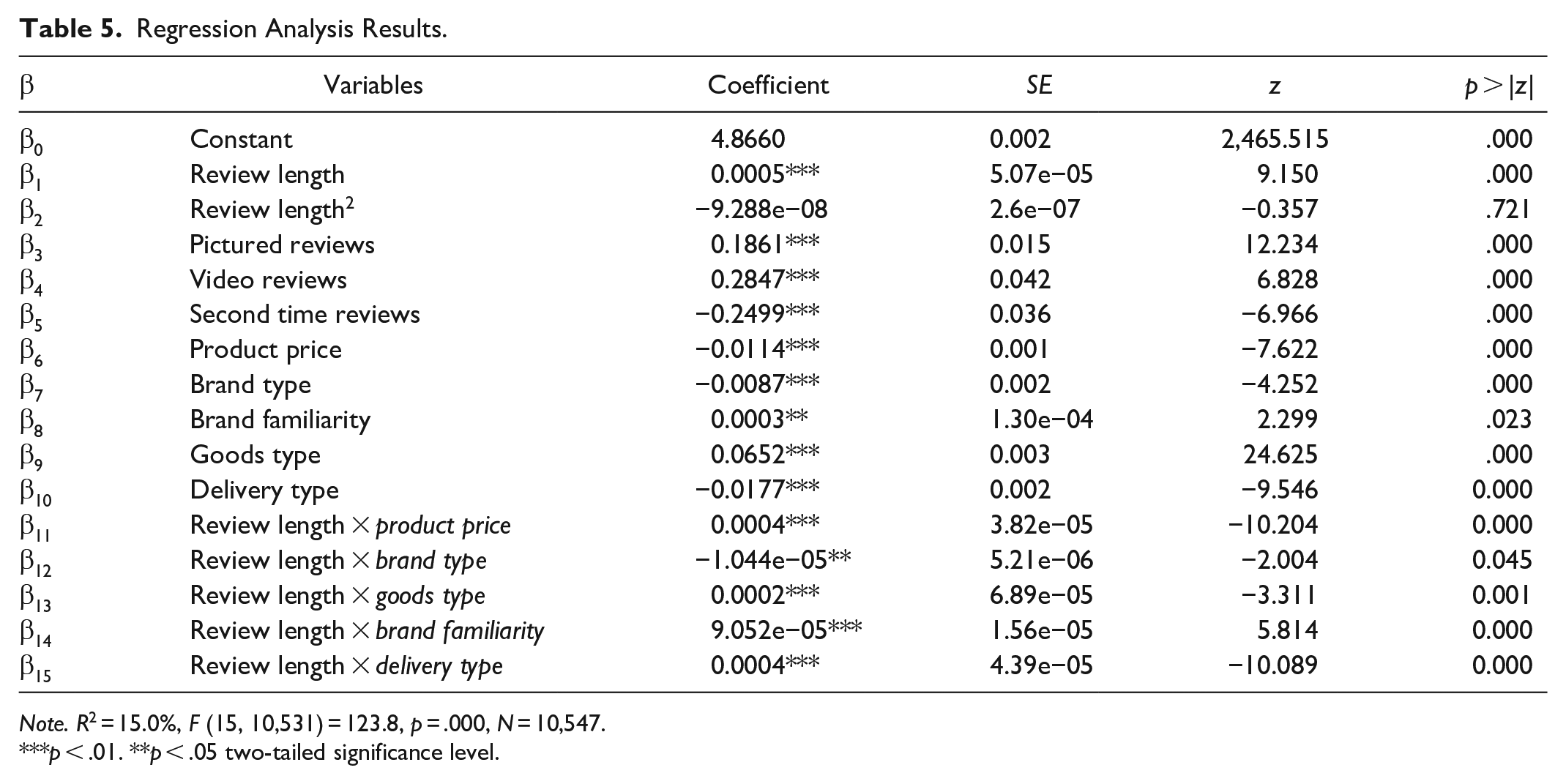
Note. R2 = 15.0%, F (15, 10,531) = 123.8, p = .000, N = 10,547.
p < .01. **p < .05 two-tailed significance level.
Review Length
Regression results show the positive associations between the review length and the seller product rating (β1 = .0005***). The review length effect is graphed through Figure 8 to explain details about the impact. From the figure, more particularly, we can say that rating increased with the increase of review length. From the original review length and rating distribution, it is also clear that short review contents are prone to have both low and high ratings, rating increases with review length, and lengthy review contents always have a comparatively higher rating. From the correlation matrix, we can also see that scores have a positive correlation (r = .02) with review length. The analogy with the findings that review depth improves the helpfulness (Mudambi & Schuff, 2010); our investigated result shows that review depth improves the rating. Long reviews contribute meaningful knowledge through describing more about product and seller details, which work as a trustworthy information scent to the future consumer that motivates them to buy the products; eventually, rating, reviews, and sell quantity are increasing recursively. Short reviews sometimes can be fake (Munzel, 2016) and generated by software tools, but for long reviews, it is not easy to generate because of grammar, meaning, punctuation, and so on. Through the long reviews, consumers generate the true information posted in reviews with sincerity, which also inspires consumer’s organism to trust them and purchase the goods with less confusion, hence rating increases recursively. Nowadays, the seller also focuses on omnichannel marketing (Harvard Business Review, 2017), especially social commerce (Amblee & Bui, 2011), to spread their product to attract more consumers. In this vein, long reviews describing the product and seller details also play a vital role as an information scent to attract consumers, which bring them to their shopping site. The more the consumer visit the shopping site, the more probability to increase the selling, which eventually generates a good rating recursively. Besides, good long reviews, bad long reviews submitted by consumers are easily visible to the seller, and the problems can be solved before approval of the long bad reviews, hence, reducing the long bad reviews in OCR sections. Therefore, the results follow the hypothesis assumption H1: Rating increase with the increase of review length.
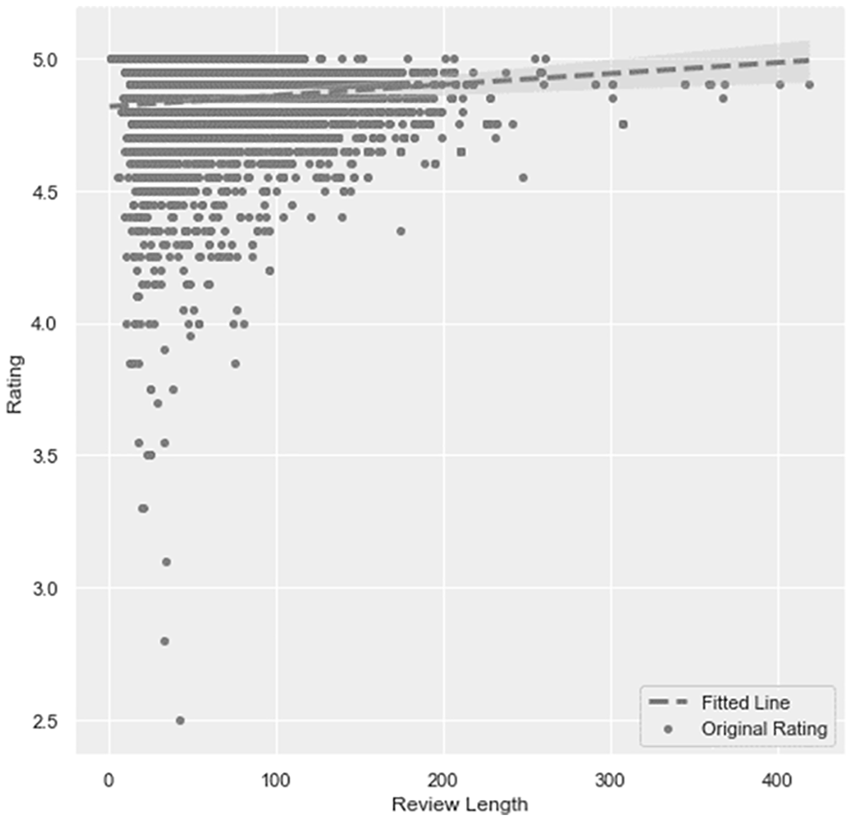
Fitted line and original rating distribution with review length.
Moderation Effect
Product price
Product price as a significant moderating variable for the association of review length and rating have indicative results in our regression output (β6 = −.0114*** and β11 = .0004***). To explain in detail the moderation effect, we graph the moderation variables with review length and rating as Figure 9a. From Figure 9a, we can find the product price different effects to review span and grade. Review length and the product price was calculated for low (1 SD below mean), med (the mean), and high (1 SD above mean; Aiken et al., 1991), which is the renowned method for moderation effect calculation. From Figure 9a, we can say that product price has a decreasing effect on review length and rating. More specifically, we can say that low product price has a more positive impact, and high product price has a less affirmative impression for review length and rating, which is supported by our expected hypothesis H2a: Price of commodity negatively moderates the bond of review length and score.

Moderation effect of the product price, brand type, product type, brand recognition, and delivery type on review length–rating.
Brand type (local brand vs foreign brand)
Brand type as a moderator variable has a less significant effect to review length and rating (β7 = −.0087*** and β12 = −1.044e−05**) yet still explainable from the moderation effect graph. From Figure 9b, we found that native brand has a more positive effect as moderation to review length and comprehensive online retailer product score. Conversely, the foreign brand has a less negative impact to review extent and score. The results and figure output approve the discussed proposition H2b: Moderation effect of a domestic brand is more supportive in the association of review length and rating than the overseas brand.
Product Type (Search Goods vs. Experience Goods)
Now exploring the moderation effects of goods type, our regression output gives a significant meaning of its moderation effect (β9 = .0652*** and β13 = .0002***) on review length and rating. Figure 9c illustrates the product type effect as a moderator variable to review depth and score more precisely. From the plotting in Figure 9c, we found that search goods positively increase in parallel with experience goods as moderating effect to the relation of review length and rating. However, search goods slightly acute favorable reaction to the associations of review length and score. Therefore, in overall cases, search product more positively affects the review length and rating as a moderating variable. Finally, we can conclude that this regression results and moderating plot partially support our explained variable H2c: In the interconnection of review depth and rating, search product reveals a more beneficial effect than experience products.
Brand recognition (not well recognized–well recognized)
Searching the regression results for the moderator variable of brand familiarity (β8 = .0003** and β14 = 9.052e−05***), we found a less significant coefficient value but very less p-value, which is a considerable effect after all. From Figure 9d, we observed that brand familiarity has a significant visual footprint on the review length and rating. From the Figure 9d, we can explain that high brand recognition has a more positive effect than low brand familiarity as a moderating effect on the association of review depth and rating given by the consumer. In summary, we can say that brand familiarity as a moderating variable positively moderates the connection between review length and rating. Plotting and regression results for moderating effect consistent with our generated hypothesis H2d: For the association of review length and rating, brand recognition display increasing moderation interaction.
Delivery type
Delivery type is the cardinal focus for a moderating effect on the reader of this research. After looking at the regression results from Table 5, we found that delivery type (β10 = −.0177*** and β15 = 0.0004***) has a meaningful effect on the relation of review length and rating. To understand the moderating effect clearly, we go through the visual plot as Figure 9e. Through Figure 9e, we found that third-party delivery type is more favorable than JD’s own delivery in the connection of review span and overall rating. Our exploring results and plot analysis are consistent with defined hypothesis H2e: third party delivery type more positively moderates the relation of review length and grade.
General Conclusions
OCRs are the most trustworthy source of information to the consumers, which always have ambivalence reactions on consumer perception and purchasing decisions. For both the seller and e-marketplace managers, it is indispensable to understand these enigmatic sentiments for diffusing the OCRs and perceived helpfulness after yielding these OCRs. Every seller may expect quality, informative, useful, and eloquent OCRs, which eventually influence the consumers buying behavior in the context of the e-commerce domain (Amitav et al., 2006). Previous numerous research has shown the perceived helpfulness of OCRs in many ways. Kumar and Benbasat (2006) showed that precise display of reviews can improve the website evaluation. Avatar images, images in reviews, review depth can improve the perceived usefulness of OCRs (M.-Y. Chen et al., 2019; Hossin et al., 2019). Furthermore, a quality and informative review can help the consumers and have great potential for merchants to increase the selling rate and seller sustainable reputation (J. A. Chevalier & Mayzlin, 2006). Therefore, merchants should solicit quality, informative, useful, and motivational OCRs through understanding the consumer ambivalence behavior when they transmit the OCRs. Rating is the overall synthesized measurement scale for a seller and product. Consumers mostly look for the rating for the first time. Sometimes they may overlook the review contents. Hence understanding the rating as means of consumer behavior is the exigency demand for seller and merchants. This prolific research contributes the knowledge insights for review depth and rating relation to understand the consumer sentiment when they diffuse OCRs, which was previously ignored by the academicians in the context of OCRs and e-commerce realm.
Our empirical investigation displays that primary text review length by character count has a positive influence on inclusive vendor product rating. In a more laconic way, we can stipulate that rating increases with the increases of review depth. When consumers place lengthy reviews, they are contributing informative reviews with ratings that disclose the positive sentiment of the customer. When consumers place short reviews, the reviews do not have enough information and are not helpful, as well as disclosing consumers’ negative sentiment and producing low ratings. This mixed sentiment for fabricating OCRs provides deep insights to merchants to understand consumer behavior. Moreover, this study also investigated the moderation effect of price, brand acquaintance, brand type, product type, and distribution systems to understand the consumer feelings in their existence. For the commodity price, the result showed that price negatively moderates the review length and rating relation. For the brand acquaintance, it positively interacts with the review length and rating. For the brand type, product type, and delivery type: local brand, search goods, and third-party delivery systems have more positive influence than the foreign brand, experience goods, and platform’s own delivery systems. These moderation interactions delineate consumers’ sentiment when they create OCRs in their presence, which render insights for merchants to know about consumer behavior.
Theoretical Implications
The investigated stimuli (review depth and moderating factors) of this research support the Stimulus-Organism-Response (S-O-R) model (Chang et al., 2011; Kim et al., 2018), which is considered a sustainable and potent psychological theory to analyze consumer behavior. These stimuli, along with other information generated by both seller and consumer, have favorable effects on rating while diffusing OCRs. On the one hand, influenced by adequate information by these stimuli and moderating factors, consumers can have more hedonic and utilitarian organisms that precipitate them to transmit positive OCRs elements along with high ratings. On the other hand, consumers are influenced by these stimuli as a plentiful source of information that generates their heuristic, influential, and cognitive ability as means of the organism; consequently, these lead them to purchase the goods and eventually increase the sales rate for a product.
Our investigated long text reviews augment the information traces generated by the consumer, which are used as an information scent preferable to consumers to adopt and fascinate it; consequently, they may decide to purchase the goods. This logic buttresses the concept of social foraging theory (Giraldeau & Caraco, 2018), where the consumers forage for information through online shopping and the internet collaboratively and have interaction with this information and finally produce some comments for this information. Information foraging theory (Pirolli, 2007; Pirolli & Card, 1999), a cogent theory in IS, also supports our study for the investigated features of OCRs. These features provide a valuable, useful source of information, increasing information scent to consumers.
While most of the IS-based e-commerce research focus on marketing or decision-making literature in the stream of OCRs, such as how to improve and promote sales (K. Li et al., 2020), setting pricing policy (Duan et al., 2022), consumer decision to purchase goods (von Helversen et al., 2018), prediction of product recommendations (Siering et al., 2018), text mining-based explanation of OCRs and recommendations (Chatterjee, 2019), which eventually conducive for promoting the goods in e-commerce based on online reviews, and so on. This study focused on the internal relationship of reviews and rating through econometric modeling as the important performance indicator and driver, core and comprehensive elements of e-commerce (Chatterjee, 2019), which discovers and replenish the existing research about the antecedent factors of ratings and sales and clearly depicts that how to improve the rating through review contents with other relevant moderating effects.
Managerial Implications
The critiques and results of this research show the previously undiscovered consumer enigmatic behavior in an extensive way through review acuteness and rating as well as through moderation interaction of some important and conventional factors. Our analysis and results are imperative for practitioners, retailers, marketplace owners, and manufacturers. Our empirical findings discover the obfuscated relation of review depth and rating along with orthodox moderation factors and give a new streamline for practitioners to apprehend the customer sentiments. Sellers can exploit our findings to understand consumer behavior in-depth and improve OCRs to retain their sustainable reputation and selling rates through improving their service level, product quality, packaging, and features. The retailer can advise and monitor review depth before they post it to online shopping platforms. The seller should provide incentives to encourage their buyers to produce quality, meaningful, helpful, and lengthy reviews, which will be the potential source to motivate future readers.
Platform owners can deploy our findings to monitor the seller and manufacturer’s quality. Marketplace managers should set the policy for the minimum length of reviews to make the OCRs more informative and eloquent. They also can reward consumers for placing depth reviews along with other OCRs elements to make the OCRs potential for future consumers. Platforms research and development (R&D) centers can develop suggestive automotive tools that can provide suggestions to consumers when writing review content to make the OCRs more eloquent and informative. A long review can prevent fake reviews by properly writing the contents. Hence, the marketplace can deploy these review contents as a tool to identify fake reviews. Ultimately, the marketplace manager can deploy these lengthy reviews in social commerce to populace their products and platforms as a means of digital marketing.
A manufacturer can utilize the meaningful lengthy review to improve its product features, applications, and quality. Often some retailers are prone to sell refurbished and copy products of some renowned brand. A manufacturer can identify this type of copy product through meaningful extensive review and prevent the duplicity of the product. Nowadays, due to advanced manufacturing and IT, the product cycle is too short, and manufacturers need to evolve product features to adapt to the market. Through the informative OCRs, manufacturers can understand consumers’ expectations and meet their requirements by quickly developing the features. More information in OCRs through long reviews can enhance the manufacturer’s reputation and path for motivation. Finally, meaningful OCRs with long reviews play a vital role for all parties and gain consumer trust and sustainable market reputation.
Limitations and Future Research
During the research, this study comes to have some limitations. We collect 20 reviews for each product from the existing source of data in the jd.com online shopping platform. Therefore, we were unable to cross-check the data for every review that are not available in EC platforms. In most of the EC platforms, only 2000 sets of data exist for a particular product. Although we deemed this is the reasonable sample quantity for our datasets, some researchers may be interested in finding the average of review lengths for the entire sets of reviews for each product. Although, it is quite impossible to retrieve all review contents; still, someone may try to get through the backend database of the online retailing shop. Our research findings provide the streamline for future research in the domain of understanding consumer behavior from review depth and rating interconnection. Future extensions of this research can include: Besides our chosen products, some researchers may be interested in checking other goods types to cross-check our findings. Extensive research can investigate these results and verify them with other datasets. Use longitudinal (panel) data to see the relation over the consecutive period of time. Deploy data mining, text mining, fsQCA, SEM, and meta-analysis to observe the relation of review depth and rating. Nowadays, social commerce is also a popular and focal point of researchers, and OCR features are now closely similar to social media posts. Someone may be interested in finding an influence gap with social media review contents with these online retailing shop review contents. Such kind of extensive research can be helpful for managerial implications and can advance the new explanation of OCRs presentation on rating relationship for omnichannel marketing
Footnotes
Acknowledgements
We would like to thank the anonymous reviewers and the associate editor (Rishabh Yadav) for their in-depth, helpful, valuable, and constructive comments, which not only improved the quality of this manuscript but also encouraged us this high-quality research.
Author Contributions
Hossin Md Altab devised the research, conducted formal analysis, wrote the original manuscript, and responsible for funding. Mu Yinping revised and validated the manuscript. Hosain Md Sajjad helped with the variable’s selection, investigation, theoretical development, and modeling. Adasa Nkrumah Kofi Frimpong contributed to the literature review and content revision. Michelle Frempomaa Frempong helped with the resources, questionnaire survey, data sampling, and data curation. Stephen Sarfo Adu-Yeboah contributed to content editing and improving the manuscript.
Declaration of Conflicting Interests
The author(s) declared the following potential conflicts of interest with respect to the research, authorship, and/or publication of this article: All the authors are well informed about the study’s objectives and provided consent. They have no objections to competing for interest in the content of this paper.
Funding
The author(s) received no financial support for the research, authorship, and/or publication of this article.
