




Abstract
This study analyses the relationship between a firms’ growth and the educational diversity of their workforce. It differentiates itself from other studies by using two measures of human capital diversity—one for education levels and one for fields—instead of one. The results show that workers with more diverse specializations than the workforce of competitors benefit the firm’s growth and extensive margin of trade. Contrastingly, above-average workforce heterogeneity in education levels does not seem to affect firms’ performance. Furthermore, it is shown that the association between human capital diversity and firms’ performance differs among sectors. Compared to previous studies, which concentrated on one particular industry or one measure of educational diversity, this more comprehensive approach allows reconciling some of the contradicting results. The study shows that the mixed results in existing papers can result from dissimilar impacts of various measures of human capital diversity on firm performance or its differences among sectors.
Introduction
The importance of human capital for firm performance has become a fact in economic literature. Already in the mid-20 century, Becker (1964) defined human capital as skills and knowledge that individuals obtain through investments in schooling, on-the-job training, and other types of experience. As such, it can be considered as an additional input (separate from labor) to the production function (e.g., Black & Lynch, 1996; Sisodia et al., 2021) and one of the factors that determine firm growth (for a review of all determinants, see Coad, 2009; Davidsson et al., 2010; Shela et al., 2021; Vaz, 2021; Zhou et al., 2018).
In a special brand of literature, two competing theories that are important for the topic addressed in this paper explain the relationship between human capital and firm performance in international trade. According to the first, there are fixed costs of exporting. Only firms with higher endowments of resources (including human capital) and hence productivity can “invest” in exporting (Bernard & Jensen, 1999; Bertarelli & Lodi, 2018; Clerides et al., 1998; Falk & de Lemos, 2019; Melitz, 2003). However, this productivity effect is not likely to persist among exporters, so the more productive firms are not likely to export more than less productive firms after becoming exporters. The competing theory with less empirical support claims that firms become more productive (and increase human capital) due to the competition and learning in international markets (e.g., Clerides et al., 1998; Sahoo et al., 2022; Sharma, 2018).
Furthermore, theory shows that the level of human capital and its diversity affect firm growth through productivity, and the relationship between the two can be either positive or negative. Using a theoretical model that follows the production function approach, Lazear (1999) argued that the gains from workforce diversity are most significant when individuals can communicate and understand each other but have entirely disjoint skills and information sets, which are all relevant for the tasks that have to be performed within the firm. The relation between human capital diversity and firm productivity will be positive if there is sufficient mutual learning and collaboration among workers with different human capital (Hamilton et al., 2012). The impact of human capital heterogeneity also depends on several firm characteristics—it is more beneficial to firms that depend on the innovations (Jehn et al., 1999; Prat, 2002) and have greater complexity of tasks (Jehn, 1995; Jehn et al., 1999; Parrotta et al., 2014b; Stewart, 2006). Nevertheless, diversity can also hamper job satisfaction, communication and the possibilities of a confrontation between competing views, which could negatively affect firm performance (Festinger, 1954; Grund & Westergaard-Nielsen, 2008; Pfeffer, 1985).
While empirical studies have generally reached a consensus on the relationship between the level of human capital and firm performance (see, e.g., Crook et al., 2011 for meta-analysis), the same does not hold for the relationship between the educational diversity of the workforce and firm performance. Research papers analysing the educational diversity—firm performance relationship reported positive effects (e.g., Backman & Kohlhase, 2020; Garnero et al., 2014; Hirsch et al., 2020; Iranzo et al., 2008; Lee & Kim, 2020; Navon, 2010; Parrotta et al., 2014a), negative effects (e.g., Ilmakunnas & Ilmakunnas, 2011; Jehn & Bezrukova, 2004) and no effects (e.g., Kurtulus, 2011; Parrotta et al., 2014b; Vandenberghe, 2016). Although firms’ educational heterogeneity of human capital can stem either from differences in levels or fields of education, the existing studies concentrated only on one of them or a combination of both. But, do the increases of the two measures of educational workforce diversity have equivalent impacts on firms’ performance? If not, the different educational heterogeneity measures might explain at least a part of the contrasting empirical results. The other part of the discrepancies in the empirical results could arise due to the different firm performance measures or differences in the industry of the firms selected in the samples. Here presented analysis tackles the question above by analysing the impact of both measures of educational heterogeneity on growth, the probability to export and export intensity across diverse industries.
Researchers have thus far measured firm performance with value added (Garnero et al., 2014; Ilmakunnas & Ilmakunnas, 2011; Iranzo et al., 2008; Navon, 2010), total factor productivity (Ilmakunnas & Ilmakunnas, 2011; Parrotta et al., 2014a), turnover rate (Hirsch et al., 2020; Jackson et al., 1991; Tsui et al., 1992), growth (Hambrick et al., 1996; Simons et al., 1999; Smith et al., 1994), worker/team performance (Jehn & Bezrukova, 2004; Kearney & Gebert, 2009; Kurtulus, 2011), firm survival (Backman & Kohlhase, 2020), profit (Lee & Kim, 2020), firm’s innovation (Parrotta et al., 2014b), efficiency (Vandenberghe, 2016), and strategic consensus (Knight et al., 1999). The majority of these studies measured education diversity only in terms of levels of education. In contrast, Parrotta et al. (2014a, 2014b), Iranzo et al. (2008), Jackson et al. (1991), and Backman and Kohlhase (2020) used one combined measure of diversity in education levels and fields, while Navon (2010), Hambrick et al. (1996), and Kearney and Gebert (2009) concentrated only on workforce diversity in fields of education. None of these studies differentiated between diversity in education levels and diversity in education fields. Out of the 19 above-listed studies, only 7 used a sample of firms from more than one sector; 12 of them found a positive effect on performance, 4 found a negative effect on performance, and 3 an insignificant one.
The empirical evidence on firm performance in international trade provided more support for the theory with fixed costs of entering export markets (e.g., Eliasson et al., 2012; Ganotakis & Love, 2011; Mulliqi et al., 2019; Munch & Skaksen, 2008). Papers measuring human capital with shares of high skilled or low skilled workers provided evidence for a positive link between exports and the workforce’s education (Brambilla, 2017; Chiappini, 2021; Ganotakis & Love, 2011; Mulliqi et al., 2019; Wagner, 2012). However, the effect might differ between sectors (Mulliqi et al., 2019), types of products, and countries’ income level (Luong & Chen, 2016). The impact of educational diversity of the workforce on exports has been underexplored thus far.
This paper fills the literature gap by investigating how the diversity of all employees with respect not only to education levels but also fields of education affects three proxies of firm performance: the growth of total sales and foreign sales per employee and the probability of being an exporter in a wide variety of industries. 1 In addition, it examines whether estimates of diversity—growth nexus differ between knowledge-intensive or high-tech firms and those that are not. This more comprehensive approach, which is not concentrated on one particular industry or one measure, is possible due to the unique register-based linked employer-employee dataset from Slovenia and allows to reconcile some of the previous contradicting results. As such, the analysis is undoubtedly relevant for the international audience.
Two separate measures of human capital diversity—one for levels of education and one for fields—reveal that increase in diversity of fields of education above the one of competing firms is positively associated with firm growth. However, the same does not hold for diversity in levels of education. The diversity in education fields also impacts the extensive margin of trade, but no significant effects were found for the intensive margin. The results, therefore, suggest that firms should strive for human capital diversity. However, the workforce should be heterogeneous in terms of fields rather than levels of education.
The paper continues with a short description of the institutional framework, which is followed by a portrayal of empirical strategy and characterization of the dataset. The following section presents results and discussion. The last section concludes the paper.
A Very Short Description of the Slovenian Economy
Slovenia is a small, open economy. Since the data available for this paper cover the 2008 to 2017 period, we present the economy’s characteristics for the year 2017. Slovenia’s GDP per capita was 20,810 EUR in 2017 (69.2% of EU28 total GDP per capita). Its real GDP growth rate in 2017 equaled 4.8, exceeding the EU28 average by 2.2 percentage points. A 20.6% of the total value added was created in manufacturing. The second-largest sector by created value added was wholesale and retail trade, which generated 10.4% of the total value added. Exports of goods and services in the year 2017 presented as much as 83.2% of GDP—highly exceeding the EU28 average (45.7%)—, while imports presented 74.3% of GDP (EU28 average was 42.2%). The main Slovenian trade partners were Germany, Italy, Austria, and Croatia. Exports to these countries presented 47% of all exports and 51% of all imports (Eurostat, 2020a; SURS, 2020).
The majority of 195,756 Slovenian firms were micro or small enterprises—there were only 2,084 medium-sized firms and 346 large firms with more than 250 employees in 2017. The majority of large firms operated in the manufacturing sector. Besides manufacturing, the most important economic activities by the number of firms were professional, scientific, and technical activities (NACE section M), wholesale and retail trade (NACE section G), construction (NACE section F), and other service activities (NACE section S) (SURS, 2020). Slovenia had roughly 845,000 active persons in 2017 and a 6.6% unemployment rate. A 56.2% of active persons had secondary education, and 31.4% per cent were tertiary educated. Females presented 41.7% of the active labor force.
Empirical Strategy
Following the empirical strategy of, for example, Garnero et al. (2014) and Siepel et al. (2021), who studied the relationship between workforce diversity and firm performance, we used the specification, which takes into account the firm’s micro and macro factors:

y presents one of the three proxies for firm performance: growth in sales per employee, growth in foreign sales per employee, or probability of exporting; X is a vector of microeconomic factors that potentially impact performance (e.g., size, age, financial constraints, and human capital); Z stands for macroeconomic factors such as industry, business environment, or tightness of the labor market; µ and τ represent firm-specific fixed effects and time effects, respectively.
The main variables of interest are human capital diversity indicators with respect to the level and field of education. The diversity indicators are calculated with a normalized Herfindahl index (NHI):

where si,k is a share of employees with specific characteristics (e.g., specific level of education) in a firm i of a specific size in industry k, and N is the number of groups defined by these characteristics (e.g., the number of levels of education). Diversity in each dimension thus ranges between 0 and 1, with lower values indicating lower diversity and vice versa. However, the levels of diversity that are the most beneficial to the firm’s performance might depend on firm size and industry. For example, it might be optimal for a small programming firm to employ only highly skilled programmers. However, a middle-sized programming firm might struggle without employees with managerial and marketing skills. In order to eliminate such size and industry-specific effects, the equations include normalized diversity indicators:

where
Since unobserved firm-specific time-invariant characteristics such as ownership of a patent, access to market, or resources can cause omitted variable bias, they must be removed by an appropriate econometric estimation technique. Due to inconsistency of within and first-difference estimator in autoregressive panel-data models, the estimation is performed with panel GMM estimation (Arellano & Bond, 1991; Arellano & Bover, 1995; Blundell & Bond, 1998) and followed by two specification tests: Sargan test of overidentifying restrictions and Arellano-Bond test for zero autocorrelation in the first differenced errors.
Data and Descriptive Statistics
The empirical analysis uses matched employer-employee dataset of private firms operating in Slovenia in economic activities coded B–N (without L) by NACE classification in the 2008 to 2017 period. As the aim is to analyze the impact of human capital diversity, the sample includes firms in the form of general partnerships, limited partnerships, limited liability partnerships, or public limited companies with more than 10 employees that have operated at least 3 years during 2008 to 2017 (but not necessarily the entire observed period).
Table 1 presents the means and standard deviations of selected variables. Variable education level can take four values: 1 for employees with primary education or lower, 2 for those with secondary education, 3 for persons with higher than secondary education, but lower than a master’s degree, and 4 for those with a master’s degree or higher. The average education level of employees in our sample is 2.1, which is equivalent to approximately 12.4 years of education. The diversity in education levels and fields stand at 0.564 and 0.637, respectively, indicating a higher diversity in terms of fields of education than in levels of education.
Descriptive Statistics at the Firm Level (2008–2017).

The economic activities with the highest share of firms are C (manufacturing) with 33% of observations and G (wholesale and retail trade, repair of motor vehicles, and motorcycles) with 23% of observations. A 28.4% of firm-year observations are in high/medium-tech or knowledge-intensive sectors (HT/KIS). 2 Firms employ on average 39.9 full-time equivalent workers, and 73.5% of them export their goods or services.
Firms’ human capital varies considerably among economic activities and sizes of firms, which is illustrated in Figure 1. For example, the average education level in firms with 100 employees or less within construction (Nace code F) is 1.9 (or roughly 11.6 years of education), but 2.5 (or roughly 14 years of education) in financial service activities (Nace code K). Similarly, an average employee in a firm with 100 or less employees within professional, scientific, and technical activities (Nace code M) has a level of education equal to 2.5 (or roughly 14 years of education). However, an average employee’s educational level in a firm with more than 100 employees within the same sector equals only 2.1 (or roughly 12.4 years of education).

Average education level by Nace code and firm size.
The disparities among firms with different sizes and in various sectors are evident also in the diversity of human capital. As it is shown in Figure 2 the diversity in fields of education for firms with 100 employees or less ranges between 0.51 in financial and insurance activities (Nace code K) and 0.75 in accommodation and food service activities (Nace code I), whereas the diversity in terms of fields of education in firms with more than 100 employees in accommodation and food service activities reaches as high as 0.82. Comparable conclusions can be drawn from Figure 3, which depicts the average diversity of education levels by size and economic activity of firms.
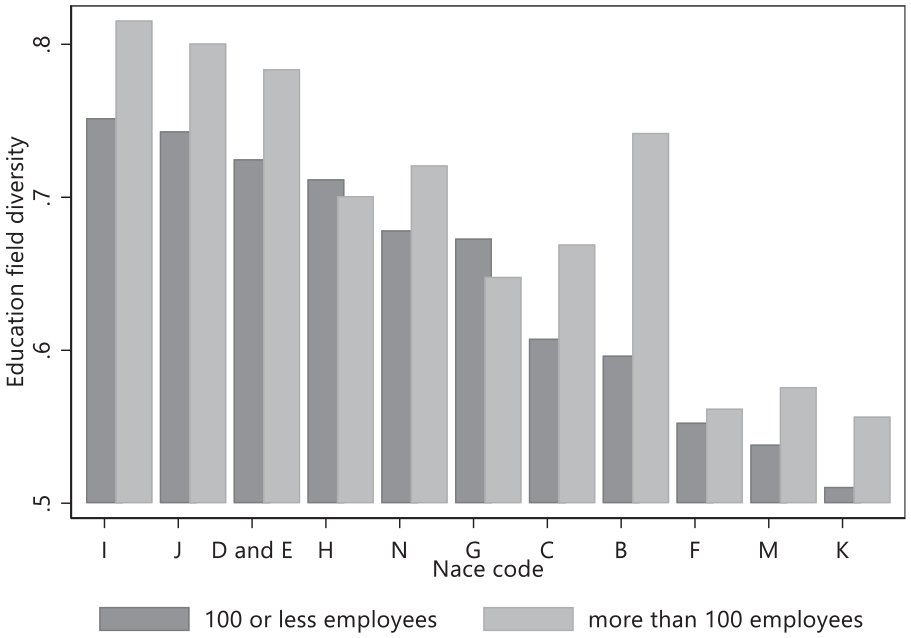
Diversity in education fields by Nace code and firm size.

Diversity in education levels by Nace code and firm size.
Results and Discussion
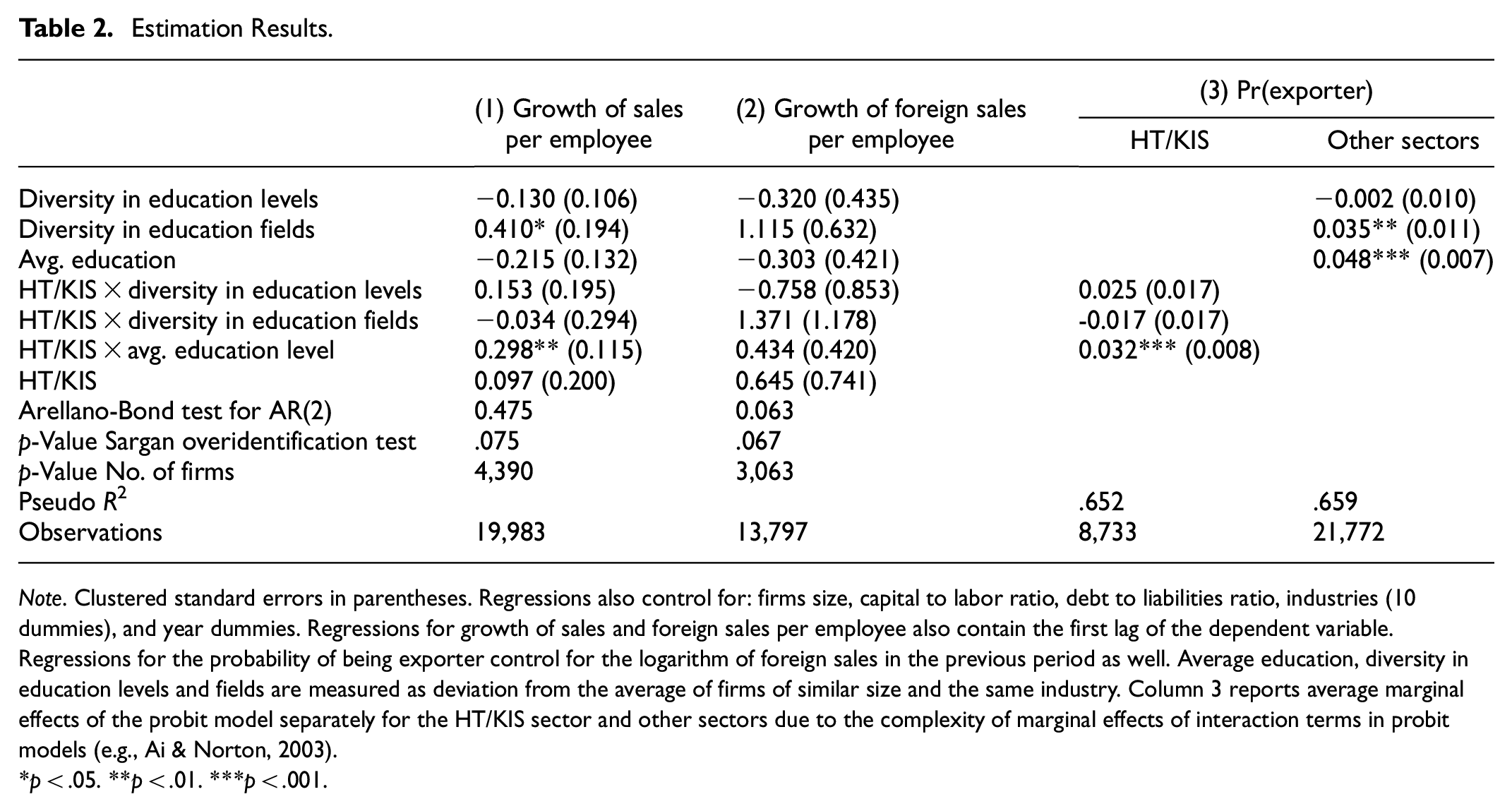
Table 2 shows the impacts of diversity in education levels and fields (measured with normalized diversity indices) on the three proxies of firm performance: the growth of sales and foreign sales per employee and the probability of being an exporter. Estimates indicate that an increase in average education level above competitors’ (i.e., firms of similar size and in the same industry) average has a statistically significant positive effect on the growth of sales per employee in the HT/KIS sector, which is not surprising as these sectors depend on a highly educated workforce. It is also positively associated with the probability of being an exporter.
Estimation Results.
Note. Clustered standard errors in parentheses. Regressions also control for: firms size, capital to labor ratio, debt to liabilities ratio, industries (10 dummies), and year dummies. Regressions for growth of sales and foreign sales per employee also contain the first lag of the dependent variable. Regressions for the probability of being exporter control for the logarithm of foreign sales in the previous period as well. Average education, diversity in education levels and fields are measured as deviation from the average of firms of similar size and the same industry. Column 3 reports average marginal effects of the probit model separately for the HT/KIS sector and other sectors due to the complexity of marginal effects of interaction terms in probit models (e.g., Ai & Norton, 2003).
p < .05. **p < .01. ***p < .001.
Results also reveal a different relationship between the two measures of diversity and growth of sales per employee or probability of being an exporter. While an increase of diversity in education levels above the average diversity in education levels of competitors does not have a statistically significant effect on a firm’s growth of sales per employee or the likelihood of exporting, a higher diversity in education fields increases both measures of firm performance. An increase in diversity in education fields by 0.1 (or 10 percentage points) above the industry average for a particular firm size is associated with 4.1% increase in growth of sales per employee and 0.35 percentage point increase in the probability of exporting for those in non-HT/KIS sector. However, the association between diversity in education fields and the likelihood of exporting is not statistically significant for firms in HT/KIS sector.
The results clearly indicate that the impacts of diversity in education levels and diversity in education fields on firm performance differ in size. Their size also depends on the measure of firm performance and the firm’s sector. Therefore, the lack of consensus in the existing empirical literature, which concentrates on different industries, and lacks a common measure of diversity or performance indicator, comes as a no surprise. Because the two measures are positively correlated (see Table 1), a large part of the positive effects of education diversity on firms’ performance in studies measuring only diversity in terms of levels could be due to the omitted variables bias. In other words, in those studies, diversity in education levels might be actually measuring the effect of diversity in education fields.
Here presented results are in line with studies that measured the diversity in terms of field of education, and all found a positive effect on performance (Hambrick et al., 1996; Kearney & Gebert, 2009; Navon, 2010). They are also supported by studies that used a combined measure of education level and field diversity and estimated positive or insignificant effects on firms’ performance (Backman & Kohlhase, 2020; Parrotta et al., 2014a, 2014b).
A possible explanation for the positive effects of diversity in fields of education and insignificant effects of diversity in education levels on firms’ performance is Lazear’s (1999) theory. It claims that firms benefit the most from labor force diversity if individuals with disjoint skills can communicate with each other. The communication among workers with different educational levels might be more prone to barriers and conflicts (Pelled & Adler, 1994; Secord & Backman, 1974), than among individuals with different specializations (Pelz, 1956), possibly due to greater differences in norms, beliefs, and behavior between than within groups of individuals with specific level but different fields of education (Gifford & Nilsson, 2014; Schommer, 1998). As a result, the labor force diversity in education fields benefits a firm’s performance more than diversity in terms of levels of education.
Ilmakunnas and Ilmakunnas (2011), however, offered an alternative explanation saying that firms specialize in low or high skill tasks. According to their theory, firms with a skill-diverse workforce (in terms of levels of education) are the ones that failed to specialize and have, as a consequence, lower performance. According to here presented evidence, this explanation is less likely.
Conclusions
This paper investigates how the diversity of all employees—measured with human capital diversity in education levels and fields of education—affects the probability of being an exporter, growth of total sales, and foreign sales per employee in a wide variety of industries. The results show that increase in diversity of fields of education above the one of competing firms is positively associated with firm growth and the extensive margin of trade for non-HT/KIS firms, but the same does not hold for diversity in levels of education or firms in HT/KIS.
The findings of this paper show that authors trying to measure the workforce’s heterogeneity should bear in mind that educational level diversity and educational field diversity do not have equivalent impacts on firm performance. What is more, the two measures are positively correlated, meaning that studies concentrating on the heterogeneity of educational levels are actually estimating the combined impact of diversity in terms of levels and fields of education due to the omitted variable bias. The presented results also offer some reconciliation between previous mixed results in the literature on education diversity and firm’s performance, as they show that association differs by economic activity of the firm and a measure of firms’ performance.
Although the results seem to fit Lazear’s (1999) theoretical model regarding the relationship between a firm’s growth and labor diversity, further research with additional data on communication problems among different groups of workers is needed to support such claims fully. Unfortunately, the administrative data used in this paper does not enable such examination. Future research should also try to measure differences in the actual level and specialization of skills instead of formal education as the latter present only a proxy of an individual’s actual abilities. A limitation arising from the Slovenian economy structure is the lack of large firms in our sample. The researchers should investigate whether the associations between the constructs differ in large firms compared to small and medium ones. But even though this paper left the explanation as to why diversity in education fields is and diversity in education levels is not beneficial for firms’ performance to future studies, it provided support for advising firms and their managers to strive for diversity in education fields of their workforce.
Footnotes
Acknowledgements
I thank my colleagues from the Institute for economic research who provided insight and expertise that greatly assisted the research, although they may not agree with all of the interpretations/conclusions of this paper.
Declaration of Conflicting Interests
The author declared no potential conflicts of interest with respect to the research, authorship, and/or publication of this article.
Funding
The author disclosed receipt of the following financial support for the research, authorship, and/or publication of this article: The paper is part of the project “How to speed up growth of Slovenian enterprises: Structural dinamization, granularity, internationalisation and innovation (ID J5-9332)” which was financially supported by the Slovenian Research Agency.
