




Abstract
The purpose of the research is to analyze the effects caused by the competition of companies with labor informality on the innovative behavior of companies with labor formality that compete in the same industry. This research references and analyzes the implementation of law 1429 of 2010, which stimulates the formalization of labor and informal firms. The results estimated by fixed effects exhibit a positive and significant effect of the competition of companies with labor informality in the total innovation of formal companies. On the other hand, once the formalization and job creation policy was implemented, there was a decrease in total innovations of formal companies. The empirical analysis also highlights a different impact of informal competition depending on whether the innovation is in process or product. In particular, this research finds that process innovations are more intensely affected by labor informality than product innovations. The quantitative strategy relies on a panel data econometric model between 2007 and 2016 using the Survey of Innovation and Technological Development (EDIT) and the Great Integrated Household Survey (GEIH) provided by the National Administrative Department of Statistics (DANE).
Introduction
Labor informality is defined as the non-compliance with the social protection rules of the company toward the worker in an employment relationship, which is a structural characteristic in the countries of Latin America and the Caribbean. Informality affects the profitability of companies with formal employment since they must compete with companies that do not pay taxes by operating outside the law. The above may lead to misallocation of resources and potentially significant total factor productivity (TFP) losses (Hsieh & Klenow, 2009). Consequently, labor informality discourages the formal sector from investing in developing new or improved products or other types of innovation. For this reason, this work aims to analyze the effects caused by the competition between businesses with informal labor on the innovative behavior of firms with labor formality that compete in the same industry. The empirical strategy considers a Colombian labor market reform that should reduce the rate of informal employment in industry and other Colombian sectors.
This research obtains information on informal employment from the GEIH survey. This survey accounts for the general characteristics of the population and employment conditions: income, worked hours, hours dedicated to other activities, economic sector, social security, and educational level, among others. This survey does not directly measure the labor informality rate of companies. However, it has variables such as economic activity and the size of the productive unit that allow reference to the Annual Manufacturing Survey (EAM), which has the characteristics of the companies in which they are carried out the activities indicated by the population surveyed in the GEIH. The variable labor informality rate is calculated for each industry, and its effect is evaluated on the development of innovations within formal firms.
The results estimated by fixed effects exhibit a positive and significant effect of the competition of companies with labor informality in the total innovation of formal companies. On the other hand, once Law 1429 of 2010 on formalization and job creation was implemented, there was a decrease in total innovations of formal companies. Additionally, this negative effect on innovation was sizable in industries with higher rates of informality. The empirical analysis also highlights a different impact of informal competition depending on whether the innovation is in process or product. In particular, this research finds that process innovations are more intensely affected by labor informality than product innovations. This argument is consistent with a scenario in which product innovations yield immediate profitability. Conversely, process innovations involve higher costs and time in their implementation, which makes their prompt profitability difficult, besides the uncertainty in the expected profits due to informal businesses’ competition.
According to the literature review, this is the first empirical research in Colombia that analyzes the effects caused by the competition of companies with labor informality on the innovative behavior of companies with labor formality that compete in the same industry. The limited evidence on this subject is not only characteristic of Colombia but, in general, of Latin American countries. Consequently, this is an innovative study to the extent that it includes the informal economy as an actor in the innovation system and considers that the formal and informal economy are not separate spheres. Finally, this research suggests the need to consider the informal economy in innovation policies and generate incentives for their formalization.
The rest of the paper is organized as follows. Section 2 raises the related literature. Section 3 contains the law of formalization of employment, informality, and innovation, while section 4 shows the theoretical motivation. The following sections include the empirical analysis, results, and conclusions.
Literature Review
The economic activity within the informal sector, traditionally defined as an activity not regulated by law and related to the absence, weakness, and ambiguity of property rights, represents an emerging frontier for innovation (Webb et al., 2009). The coexistence of a formal and informal sector implies that formal companies face the dilemma of competition or innovation with informal companies, which discourages formal sector companies from generating innovations (Amaral & Quintin, 2006; Banerji & Jain, 2007). This is because informal firms that compete with firms in the formal sector could limit the incentives to innovate, especially if the products of informal firms are close substitutes for those of formal firms. However, the informal sector can benefit given the market conditions where competitive advantage is low, and opportunities for imitation are more abundant with fewer entry barriers to specific industries (Allred & Park, 2007; Bu & Cuervo-Cazurra, 2020; Godfrey, 2011).
In developing countries, informal firms account for up to half of the economic activity (Godfrey, 2011; Ohnsorge et al., 2022). In Latin America, the lack of intellectual property rights has become relevant (Barros, 2015; Grazzi & Pietrobelli, 2016). Informal firms seem to have low productivity and produce low-quality products, and, consequently, they do not pose a threat to formal companies. Economic growth comes from the formal sector, including companies run by educated entrepreneurs and exhibiting much higher productivity levels. The expansion of the formal sector leads to the decline of the informal sector in relative and eventually absolute terms. Some informal firms convert to formality but generally disappear because they cannot compete with more productive formal firms (Kraemer-Mbula & Monaco, 2020; La Porta & Shleifer, 2014).
The existence of a large informal sector can be a factor that limits the options for innovation strategies of formal companies in many developing countries, affecting competition (Fu et al., 2018). The marginal impact of informality on the innovation of formal firms diminishes with the intensity of the competitive pressure of informal firms, consistent with an inverted U relationship between the propensity to innovate and the competitive pressure of firms in the informal sector. This pattern emerges even after controlling for the number of competitors, suggesting that the pressure exerted by informal firms on formal firms goes beyond a mere increase in the number of competitors (Mendi & Costamagna, 2017). Companies’ innovation strategies are aligned with the broader contexts in informal settlements; In this sense, the alignment between capacity portfolios and specific regime structures has set limits to the success of pro-poor innovation strategies in informal settlement contexts (van Welie et al., 2019).
Informal firms are an obstacle to innovation. Starting operations in the informal sector mainly affects a company’s perception of the need to innovate; In this regard, this result suggests the existence of considerable information disadvantages for companies that started informally and eventually went formal concerning companies that started in the formal sector (Mendi & Mudida, 2018). In recent decades, the field of entrepreneurship studies has become increasingly interested in the relationship between entrepreneurship and the informal economy. Thus, legitimizing this hidden business culture could effectively promote business and economic development in these populations (Phelps, 2021; Williams & Nadin, 2010).
In sum, there is a close interconnection between institutions and the informal sector, in the sense that the institutional environment of the country can partly explain the informal sector. Conversely, the presence of an informal sector can affect efficiency. The existence of informality can affect the innovation decisions of formal firms in several ways. On the one hand, informal firms that compete with firms in the formal sector alter firms’ incentives to innovate, especially if the products of informal firms are close substitutes for those of formal firms. Likewise, innovation is a factor that can push the development of informal companies into the formal economy. In this way, the survival of informal companies may be linked to their ability to innovate. From the endogenous growth theory, the central function of laws and institutions encourages innovative investment, which significantly stimulates growth. If there is weakness in them, there is inefficiency.
Methodological Description and Identification Strategy
In this paper, the effect of Informality on innovative performance is evaluated using a fixed-effects panel econometric model. Thus, the econometric model proposed is:
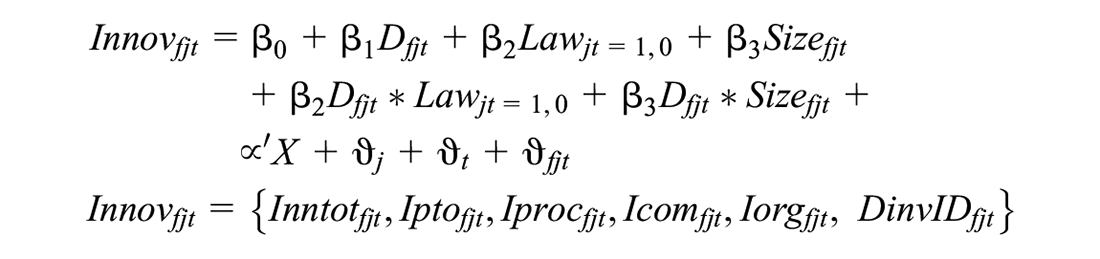
First, a regression is estimated using a fixed-effects panel model with five count variables that characterize the proxies of innovations by firms
Data
The data set comprises the number of companies found after linking the two surveys published by the statistics authorities DANE, the EDIT, and the EAM for 2007 to 2016. This data set contains 42,245 observations of Colombian companies in the manufacturing sector. The objective of the EDIT survey is to characterize the dynamics of technological development in terms of intensity and trajectory of innovation and technological development activities. Also, assess the impact of public policy instruments and establish the types of occupational profiles applied in different areas or departments in companies.
To calculate informality in companies is used the GEIH survey. The EDIT is a sample of the EAM that contains information on companies with 10 or more people employed or with annual production larger than an established value for each year. The GEIH is a survey in which information about employment conditions is requested from households. The GEIH survey, unlike the EAM and the EDIT, allows the identification of other relevant variables for this research, such as labor informality and labor income. However, joining these two surveys brings shortcomings and limitations that can induce some inconsistencies. For instance, while responding to the GEIH, the household workers may erroneously report their economic sector, and the firm’s size could be overestimated. Nevertheless, comparing the GEIH with the EAM is valuable because it allows for an approximate measure of labor informality in each manufacturing industry over time.
The labor informality rate was calculated as a percentage ratio of the informally employed population between 18 and 28 years old, and the number of the employed population between 18 and 28 years old. Informal employment is measured through the informality module of the GEIH survey, and the informal sector, although not measured directly, can be referenced through the EDIT, which takes the characteristics of companies in which these activities are carried out. The definition adopted by DANE for the measurement of informal employment refers to the 15th International Conference of Labor Statistics (ICLS) resolution of the International Labor Organization (ILO) of 1993. Furthermore, the nature, size, and economic activity of the firms are part of the criteria for measuring the informal sector recommended by the DEHLI group. The Colombian statistics institute DANE adjusted some elements considering the realities and characteristics that allow the measurement of the Colombian labor market. These indicate that the approximation for measuring informality in terms of the scale of employed personnel within the companies should be up to five workers, excluding self-employed and government employees. The results of this rate are obtained with the two digits of the GEIH, and this rate is applied to companies belonging to this informal sector (Figure 1).
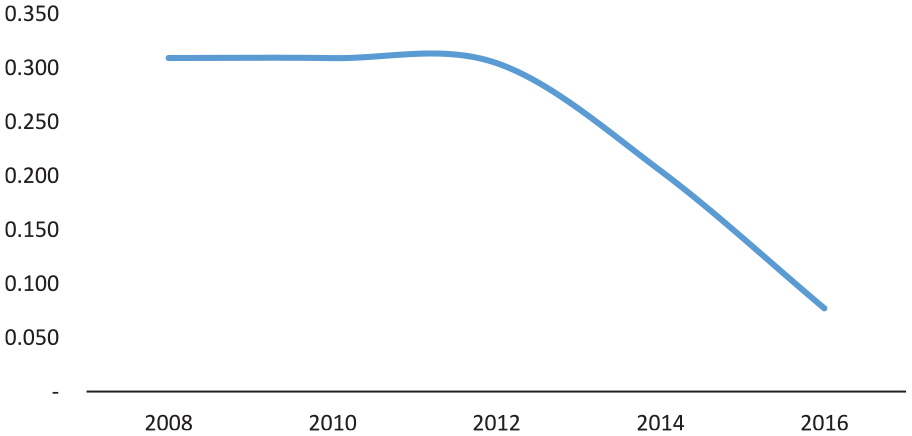
Informality rate 2007 to 2016.
The informally employed population is the employed personnel with the following characteristics:
Private employees and workers who work in establishments, businesses, or companies that employ up to five people in all their agencies and branches, including the employer or partner.
Unpaid family workers.
Unpaid workers in companies or businesses of other households.
Domestic employees.
Day laborers.
Self-employed workers who work in establishments of up to five people, except professional freelancers.
Employers in companies with five or fewer workers.
Government workers or employees are excluded.
Finally, this research references and analyzes the implementation of law 1429 of 2010, which stimulates the formalization of labor and informal firms. The incentives for informal entrepreneurs to formalize their business consisted of reductions in labor costs and tax rates during the first year of operations. Additionally, these benefits were also extended to all formal companies created before enforcing this law. Firms of any size that hired new employees under 28 years old or earned less than 1.5 minimum wage (less than 415 dollars in 2011) and for the first time will contribute to social security. The law also says that the National Government will establish special programs to promote the formalization and generation of employment in isolated regions such as Amazonas, Guainía, and Vaupés, where their geographical situation and the lack of infrastructure prevent connection with the rest of the country.
There are two margins of informality. First, the extensive margin if companies register and pay entry fees to achieve formal status; and second, the intensive margin if formal firms hire workers informally. The objective of Law 1429 of 2010 was the formalization and generation of employment. The purpose of the labor formalization in the intensive margin allows us to develop this research. In particular on the effects caused by the competition of companies with labor informality on the innovative behavior of companies with labor formality within the same industry
The quantitative strategy of this research analyzes the innovative performance as a dependent variable, which represents the count of innovations with a discrete and non-negative scale. According to graph 1, this variable is characterized by a high number of zero observations and few observations with high positive values. In this regard, it can be inferred that it follows a Poisson or negative binomial distribution. Analyzing the dependent variable, it will be possible to observe the relationship between the informality rate and the variation in innovative performance. Based on the information available in the EDIT and GEIH, the quantitative strategy will analyze the following variables:
Count of innovations of firms. Source: EDIT for the years 2007 to 2016 (Figure 2).
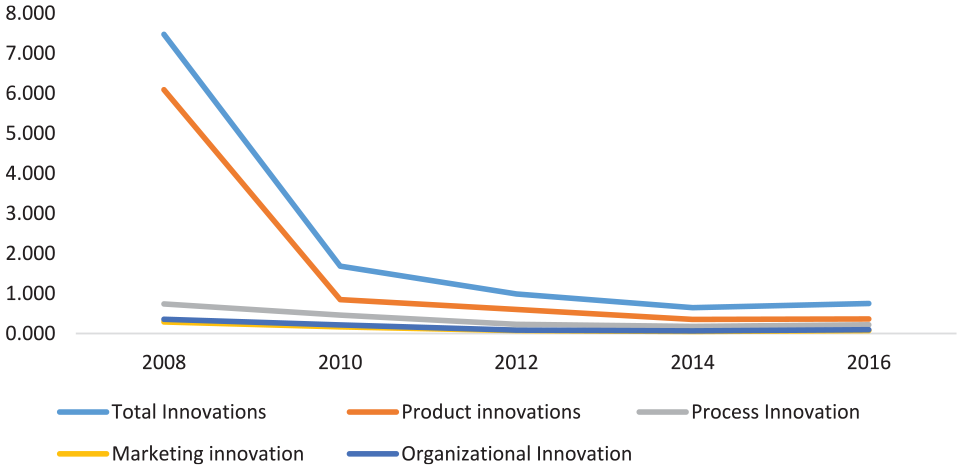
Average innovations 2007 to 2016.
Results
Analyzing the summary statistics in Table 1, it can be concluded that companies were able to generate an average of two innovations of any type between 2007 and 2016, where product innovations were carried out in a higher proportion, followed by process innovations. On average, companies hired 33 employees, and the informality rate was 30% during the same period (Tables 2 and 3).
Summary Statistics of Interest Variables.

Source. EDIT and GEIH 2007 to 2016.
Poisson and Logit Regressions Fixed Effects.

Source. EDIT 2007 to 2016.
Note. Standard errors in parentheses.
p < .1. **p < .05. ***p < .01.
Poisson and Logit Regressions Fixed Effects.

Source. EDIT 2007 to 2016.
Note. Standard errors in parentheses.
p < .1. **p < .05. ***p < .01.
Our empirical strategy relies on estimating an econometric model of fixed effects. This model measures effects caused by the competition of labor informality in the innovation of formal companies. The results reveal a positive and significant effect of the competition of companies with labor informality on the total innovation of formal companies. This positive effect on innovation may result from the competition exerted by informal firms over all those that compete in the same industry (Alvarez & Ruane, 2019; Mould, 2003). Specifically in Colombia, the competition of companies, in general, encourages firms to innovate more, mostly in products, than in any other type of innovation (Pinzón Giraldo, 2018).
The studies cited above do not directly relate to the pressure exerted by the competition of companies with labor informality. However, they help to understand that the achievement of innovation is a result conditioned to competition that is expected to be significant when there are informal companies that operate with lower payroll costs. One of the benefits of labor informality is the lower costs of inputs compared to those faced by formal companies. These non-salary costs (payroll taxes) are among the most important causes of business and labor informality in Colombia (Santa María & Rozo, 2008). Thus, the transition of companies from informality to formal employment will indeed impact the total cost of operation and the development of their economic and innovation activities. The pressure exerted by competition undoubtedly varies depending on the level of productivity of informal firms, the complexity of imitating products produced by formal firms, and the substitution of products in the market. It is necessary to consider that, although formal companies, in general, are the ones that hire workers with all the guidelines established by law, not all of them are as productive as informal companies (Levy, 2018).
On the other hand, once Law 1429 of 2010 on formalization and job creation was implemented, there was a decrease in total innovations of formal companies. This negative impact could be a net effect of the competitive resources involved in hiring workers formally, even if they are fewer. Additionally, this negative effect on innovation was sizable in industries with higher rates of informality. Specifically, a 1% increase in the informality rate in an industry reduces the total innovations of formal firms in that industry by 0.1 units, a statistically significant effect. One of the reasons is that the employment formalization law could have led informal companies to transition to labor formality, involving higher expenses, at least on the payroll. As a result, new formal firms will decrease their total spending on innovation. In particular, this potential decrease in innovation in informal firms may have reduced innovation within firms in the same sector.
The empirical analysis also highlights a different impact of informal competition depending on whether the innovation is in process or product. In particular, this research finds that process innovations are more intensely affected by labor informality than product innovations. This argument is consistent when companies lack the skills needed to produce new technology. In this case, it is easy to introduce a new variety of products with more immediate profitability than redesigning production processes. Additionally, industries that face high competitive pressure from informal companies undoubtedly will have fewer incentives to develop innovations, especially new processes, due to the cost involved compared to the low expected returns.
Concerning innovation by firm size, large companies innovated more but invested fewer resources in R&D after the implementation of the law. These effects can partly be explained because the potential growth in the percentage of formal employees in a specific sector will cause an increase in the stable workforce within companies in the same sector. Thus, it is suggested that most stable companies increase internal capacities for innovation. The adverse impact caused by the employment formalization law on R&D can be considered as a net effect on the competition of resources that hiring formal workers implies.
Control variables such as knowledge networks are significant with a positive sign for all the models. This suggests that an increase in knowledge networks coming from clients, suppliers, universities, and research centers, may result in more innovations and less probability of investing in R&D. In other words, the more open a knowledge network is, the more innovations are developed. Therefore, companies that use external sources of knowledge (such as research centers, clients, suppliers, and others) typically have remarkable processing of technological capacity.
Finally, in all models, size is a relevant determinant of innovative performance, and only in binary choice models investment in R&D is significant and positive. In this sense, the bigger the companies with less competition among them, the more stimulation for innovation. This is also known as the Schumpeterian hypothesis; it states that larger companies or industries with less competition tend to have a greater propensity to innovate.
Discussion
Limitations in this research are related to the data source used to obtain the labor informality rate in each of the industries of the manufacturing sector. The variable labor informality rate was not found in any database directly surveying companies. Nonetheless, this variable is obtained from a survey answered by the economically active and non-active population.
This can lead to self-reporting biases, causing sampling errors. For example, the worker responding to the survey may erroneously report the size of the company and its economic sector. Considering the above, the labor informality rates in some industries, even more so in industries with low participation in the sample size, may have errors causing biases in the empirical results. Nevertheless, comparing the GEIH with the EAM is valuable because it allows for an approximate measure of labor informality in each manufacturing industry over time.
The effect of labor informality on the development of formal business innovations challenges academics and professionals to empirical discussions for future research. Labor informality is a structural problem that policymakers and employers must address through policies and strategies that encourage labor formality and the development of innovation activities. Otherwise, the innovations of the formal companies will decrease, and the possible indirect effects of the innovations will be null. All these considerations may open avenues for future research that evaluate the relationship between policies and the levels of taxes on the formal sector and the labor costs of formal business as a determinant of innovation activities.
In addition to the empirical results, it is necessary to understand how to deal with labor informality? How is the informal economy a source of innovation, and what kind of innovation is developed? What characteristics do companies with labor informality that develop innovation have? What links exist between these companies and companies with labor formalities? Also, what are the implications of all this for economic policy? In Colombia, the rate of labor informality is high. Therefore, innovation management should be based not only on the company’s ability to improve its products and internal capabilities but also on its ability to adapt its processes to a highly informal economy. On the other hand, the fact that informal firms are an obstacle for formal firms to innovate reflects that informality also creates a competitive advantage. In this way, innovation management should not be analyzed in isolation, but in its competitive advantages, it is necessary to consider the competition of informal companies, both labor, and business.
Footnotes
Appendix A
The Informality Rate and Average Innovations 2007 to 2106.

| Years | Informality rate | Total innovations | Product INNOVATIONS | Process innovation | Marketing innovation | Organizational innovation |
|---|---|---|---|---|---|---|
| 2008 | 0.309 | 7.473 | 6.090 | 0.738 | 0.290 | 0.356 |
| 2010 | 0.309 | 1.681 | 0.845 | 0.458 | 0.165 | 0.212 |
| 2012 | 0.304 | 0.989 | 0.602 | 0.230 | 0.072 | 0.085 |
| 2014 | 0.205 | 0.645 | 0.352 | 0.178 | 0.050 | 0.065 |
| 2016 | 0.077 | 0.748 | 0.363 | 0.218 | 0.071 | 0.095 |
Source. EDIT and GEIH 2007 to 2016.
Author Contributions
Fernando Barrios organized the database, analyzed and interpreted the data, and reviewed the theoretical framework of the structural model through which the impact of informality on Innovation was evaluated and was a major contributor in writing the manuscript. Luis Carlos Castilo and Sandra Mora reviewed existing literature about this issue and actively drafted the outcome document, and reviewed the conclusions and discussions, and was a major contributor in writing the manuscript. All authors have read and agreed to the published version of the manuscript.
Declaration of Conflicting Interests
The author(s) declared no potential conflicts of interest with respect to the research, authorship, and/or publication of this article.
Funding
The author(s) disclosed receipt of the following financial support for the research, authorship, and/or publication of this article: This research received no external funding, and the APC was funded by Fundación Universitaria del Area Andina, Colombia.
Institutional Review Board Statement
Not applicable.
Patents
There are no patents resulting from the work reported in this manuscript.
