




Abstract
China’s manufacturing industry has emerged as a major contributor to both the nation’s economic growth and global trade. Achieving high-quality development in this sector is not only crucial for China’s sustainable progress but also holds significant implications for the global economy. Considering the importance of Chinese manufacturing industry, this paper establishes a framework for exploring the mechanism of manufacture industry’s high-quality development in China’s three economic regions based on the Driver-Pressure-State-Response (DPSR) model and Structural Equation Modeling (SEM). SEM is established for analyzing the multiple paths of manufacture industry’s high-quality development in the eastern, middle and western economic region of China. The findings reveal distinct patterns in each region. In the eastern region, a unidirectional path of “Driver-Pressure-State-Response” is confirmed, with a particular emphasis on quality improvement and efficiency increase. The middle region exhibits a leapfrog path characterized by “Driver-Pressure-State” and “Pressure-Response,” where quality improvement and dynamic conversion play critical roles. Conversely, the western region demonstrates an interrupt path of “Pressure-State-Response,” highlighting the significance of structural rationalization and dynamic conversion. Based on these results, sustainable solutions and suggestions for promoting high-quality development in the manufacturing industry are proposed, providing valuable targeted insights for the transformation and advancement of China's manufacturing sector. This study makes a novel contribution by developing a DPSR-SEM model and expands literature and knowledge in high-quality development of manufacturing industry. Practically, this study can guide decision-makers, managers, and stakeholders in understanding the interactions between driving forces, pressures, states, and responses in the context of manufacturing industry.
Introduction
The manufacturing industry plays a pivotal role in economic development, job creation, and technological advancement. China, as the world’s largest manufacturing powerhouse, faces a unique set of challenges and opportunities for the sake of high-quality development. China has been widely recognized as the world’s largest manufacturing economy in terms of gross output, value-added manufacturing, and industrial production. In 2022, the manufacturing sector accounted for 36% of China's Gross Domestic Product (GDP). However, despite this impressive progress globally, China's manufacturing industry is still in the phase of low profit and low value-added (Ma et al., 2019). This phase highlights the need for China to enhance the overall quality and efficiency of its manufacturing industry. Moreover, China’s manufacturing industry exhibits regional disparities in high-quality development. The eastern, central, and western regions of China, each face distinct challenges and opportunities due to variations in natural resources, geographical locations, and levels of marketization. These disparities hinder the improvement of the high-quality development level of Chinese manufacturing industry as a whole, impeding the national progress and posing obstacles to achieving sustainable development goals (SDGs) (Han et al., 2022).
Given these circumstances, understanding the pathways to high-quality development in Chinese manufacturing industry becomes crucial. By exploring the mechanisms that drive high-quality development in different economic regions, valuable insights can be gained to address the challenges and leverage the opportunities present. Different methodologies can be used to understand the high quality development of manufacturing industry in China. In this study, a hybrid framework of Driver-Pressure-State-Response (DPSR) and Structural Equation Modeling (SEM) was employed. Integration of DPSR and SEM can provide valuable insights and more appropriate findings. DPSR is an important instrument to support in decision making process, and it provides an effective solution according to the different environmental conditions. Although, DPSIR has been recommended by some researchers, which includes drivers, pressures, state, impact, and response, however, this study chooses DPSR model because of multiple reasons including simplification and focus, complexity reduction, less data intensive, policy, and management focused and lastly, emphasis on responses.
Different studies have been conducted by using DSPR and other integrated methodologies. For example, J.-Y. Wei et al. (2019) developed an integrated framework and an index system by using DPSR and ANP for evaluating the enterprises energy efficiency; Ren et al. (2022) proposed a hybrid framework of AHP and DPSR for econ-system health assessment in China. Li et al. (2022) used an integrated methodology of DPSR and entropy weight to assess the human-water harmony. Zhang et al. (2023) established a framework on the base of DPSR and generalized linear mixed model to investigate the potential of urban river methane emission. Development of measurement and structural model on the base of DPSR has been ignored. Therefore, this study aims to assess the high-quality development by introducing a novel DPSR and SEM methodology. The purpose of integrating SEM with DPSR in comparison to PLS-SEM is because of its capability of dealing with complex structural models, confirmatory factor analysis, larger sample sizes, and data that adhere to parametric assumptions. It offers advanced features for model evaluation and hypothesis testing. Specifically, in first, this study aims to develop an evaluation index system for high-quality development in Chinese manufacturing industry based on DPSR. Secondly, this study attempts to verify the relationships between different pathways in three different regions of the China (Central, East, West) based on DPSR-SEM.
This study contributes in multifold. In first, theoretically, the adoption of DPSR-SEM model in Chinese manufacturing industry allows researchers, practitioners, and policymakers to have a holistic view into the theoretical underpinnings of resource-environment interactions. This study can advance DPSR knowledge, models, and frameworks that enhance our understanding of sustainability challenges and solutions within the context of a rapidly evolving industrial landscape.
Practically, implementation of the DPSR-SEM model in the Chinese manufacturing industry can contribute by promoting sustainable development, efficient resource utilization, and effective policy-making. Stakeholders can gain a deeper understanding of the complex interactions between industrial activities and the environment through the adoption of DPSR-SEM model in manufacturing industry. This understanding can facilitate sustainable practices, promote responsible growth, and contribute to China’s broader environmental and economic goals.
Literature Review and Research Hypothesis
Literature Review
Currently, Chinese manufacturing industry has transitioned from a phase of rapid development to a phase of high-quality development. This shift is not only a necessary requirement for China’s economic modernization but also a significant strategic move for the convergence of China’s manufacturing industry with the world’s high-end technology sector. As the high-quality development of Chinese manufacturing industry continues to advance, research in this area primarily focuses on the definition of high-quality development, therefore, the establishment of evaluation index systems, and the identification of influencing factors in the system is essential.
Regarding the definition of high-quality development in the manufacturing industry, Xu et al. (2022) defined it as a new paradigm for an enterprise that emphasizes not only the expansion and resource input but also the production of high-quality products and the provision of superior services. It underscores the importance of both economic and social value to achieve elevated levels of enterprise development. Financial asset allocation is a critical factor influencing the high-quality development of enterprises. Sun and Wang (2022) argued that high-quality development represents a new economic structure that pursues sustainable production practices, efficient allocation of resources, and the coordinated development of the economy and society. Unlike high-speed economic growth, high-quality development abandons the sole pursuit of expansion and prioritizes growth driven by quality, efficiency, and innovation. This transformation in momentum, efficiency, and quality has propelled the manufacturing industry toward a new development model. Qu et al. (2021) clarified the concept of high-quality development in the Chinese manufacturing industry and assess the levels of high-quality development across different regions in China from 2011 to 2020. Their research revealed significant variations in the development levels of high-quality across regions, with intra-regional disparities being the primary reason for overall regional differences.
In terms of constructing evaluation index systems, Su and Wang (2022) established a comprehensive evaluation system for the high-quality development of the manufacturing industry. Their system encompasses seven sub-systems: innovation development, economic benefit, quality benefit, structural optimization, degree of openness, social contribution, and green ecology. Similarly, M. Wang et al. (2022) developed an evaluation system consisting of eight dimensions: innovation, speed and efficiency, structural optimization, integrated development, high-quality brand, green manufacturing, business environment, and social security. Yu et al. (2022) utilized a Novel Grey Dynamic Double Incentive Decision-Making model to evaluate high-quality development in the manufacturing industry based on four dimensions: R&D and innovation capability, processing and manufacturing capability, brand marketing capability, and environmental protection capability. J. Y. Liu and Xie (2018) evaluated and analyzed high-quality development in the manufacturing industry from specific aspects such as scientific and technological innovation and environmental regulation.
Regarding the exploration of influencing factors, Du and Hong (2021) identified the slow structural upgrading of Chinese manufacturing industry, the lack of independent innovation capability, and the constraints posed by the development environment as the primary factors impacting high-quality development. Under the new development pattern of a “double-loop,” improving the structure of Chinese manufacturing industry promotes high-quality development, and the scale of green development plays a mediating role in this process. H. Y. Wang and Li (2021) analyzed the impact of capacity utilization on the high-quality development of the manufacturing industry. They established a nonlinear threshold regression model and investigated the influence of environmental regulations and capacity utilization on high-quality development. Based on summarizing the four characteristics of Chinese innovative manufacturing industry, B. Y. Wang (2021) constructed a four-fold decomposition model of labor productivity by incorporating human capital factors. They analyzed the significant role of technical efficiency in the development of the innovative manufacturing industry and further investigated the influence and mechanism of the factor market on labor productivity. Zhang et al. (2023) explored the direct and indirect mechanisms of factor mismatch and independent innovation on the high-quality development of the manufacturing industry. F. Wang and Shi (2022) selected 27 sub-industries in Chinese manufacturing industry and, comprehensively measured the level of high-quality development through two aspects: green development efficiency and export technology structure. They analyzed the influencing factors of high-quality development from two perspectives: internal supply factors and external environmental factors.
While existing literature offers abundant research on the high-quality development of the manufacturing industry, there remains a lack of analysis concerning the diverse mechanisms driving high-quality development in different regions. Given that the high-quality development of the manufacturing industry is a complex system project, this study introduces the Driver-Pressure-State-Response (DPSR) model based on the work of S. Wang et al. (2016). By combining this model with the actual development of Chinese manufacturing industry, this study establishes a Driver-Pressure-State-Response (DPSR) model. This study aims to make two primary contributions. Firstly, from a complex systems perspective, this study integrates the DPSR model and SEM to explore the mechanisms driving high-quality development in the manufacturing industry. This approach allows us to uncover the path to high-quality development and identify key factors. Secondly, this study conducts a comparative analysis of the mechanisms driving high-quality development in the eastern, central, and western regions of China. By highlighting the differences in paths and key factors, this study proposes targeted measures to enhance the level of high-quality development in different regions and bridge the development gap between them.
Research Hypothesis and Framework
To systematically promote the high-quality development of the manufacturing industry, it is crucial to achieve coordination and unity across six dimensions: innovation, green practices, openness, sharing, efficiency, and risk control (Qu et al., 2021). This approach differs from the traditional focus on the growth of manufacturing industry quality development. High-quality development encompasses a broad scope, involving various aspects of the economy, society, culture, and the ecological environment. It is a dynamic and complex system with interconnected and interactive factors, aiming for sustainable and healthy growth (Ladi et al., 2022). To understand the internal mechanism of this system, this study constructs a DPSR model for the high-quality development of the manufacturing industry. The high-quality development system of the manufacturing industry comprises four dimensions: driving (D), pressure (P), state (S), and response (R). By exploring the interplay between these dimensions, we can uncover the correlation among the influencing factors in this system and reveal the development mechanism.
Relationship Between Drivers and Pressure
Long-term drivers in the manufacturing industry, such as technological innovation and power transformation, exert pressure on digitalization and environmental regulations. They signify the “why” behind changes in a system. This pressure leads to changes in the state of greening and structural rationalization. Consequently, the manufacturing industry must transform its development to achieve high-quality outcomes (Suuronen et al., 2022). Scientific and technological innovation, along with the need for a power shift, serves as a long-term driver for the continuous development of the manufacturing industry. In China, with the increasing level of technological innovation, digital technology plays a critical role in manufacturing industry development, generating pressure for high-quality development (Alsaad et al., 2022). Existing research indicates that digital technology effectively addresses resource mismatch (Z. Y. Wei, 2022), promotes the accumulation of human capital and industrial upgrading (J. J. Liu et al., 2022), and strengthens technological innovation (Mao & Zhao, 2020) during the high-quality development process in the manufacturing industry. Understanding this relationship is vital for environmental management and policy-making because it supports to identify the key drivers that need to be addressed to achieve desired outcomes, manage negative impacts, and promote sustainable practices. Therefore, based on the above discussion it can be proposed:
H1—There is a positive effect of “driver” on “pressure.”
Relationship Between Pressure and State
The state of a system is regarded as current condition, quality, or status. It encompasses various aspects of the system, such as environmental health, biodiversity, resource availability, and overall functionality. The state reflects the long-term and cumulative effects of pressures on the system. The pressures resulting from drivers directly influence the state of the system. Changes in pressure can lead to shifts in the state of the system, which may include declines in biodiversity, changes in ecosystem structure, alterations in water quality, and other measurable changes. Dang et al. (2023) described that Understanding the association between pressure and state is essential for effective environmental management and policy formulation. By investigating this relationship, scientists, policymakers, and stakeholders can find which driving pressures are contributing most significantly to negative changes in the state of the system. This information can inform decisions on mitigation strategies, conservation efforts, and sustainable resource management practices to maintain a desired state and minimize negative effects on the environment (Ren et al., 2022). Based on above mentioned argument, following hypothesis is proposed:
H2—There is a positive effect of “pressure” on “state.”
Relationship Between State and Response
The state of a system is considered as its current condition, quality, or status resulting from the pressures exerted on it due to various drivers. The response is the action or set of actions taken by individuals, societies, institutions, or governments in reaction to the state of the system. Responses can be adaptive or mitigation strategies designed to cope challenges or opportunities presented by the current state of the system. The state of a system works as a trigger for responses. When the state of a system diverts from a desirable situation, it signals the need for intervention to address potential issues or capitalize on opportunities (Zhang et al., 2023). For instance, emergence of new technologies such as big data, block chain might prompt institutions to develop regulatory measures to deal with them. Understanding the association between state and response is important for effective decision-making and management in complex systems. By considering the state of the system, stakeholders can develop targeted and evidence-based responses that address specific challenges or capitalize on opportunities while aiming to maintain or achieve desired states (J.-Y. Wei et al., 2019). This holistic approach ensures that responses are aligned with the actual conditions and needs of the system. Therefore, based on the above mentioned literature, it can be proposed:
H3—There is a positive effect of “state” on “response.”
Based on the above literature and hypothesis, this paper constructs the analytical framework of the DPSR model (Figure 1). This framework decomposes the mechanism of high-quality development in the manufacturing industry into different paths as described in research hypotheses.

The analytical framework of the driver-pressure-state-response model.
Research Methodology
Taking 30 provinces and cities of China as the research object, the research data are mainly obtained from the statistical yearbooks of each of the 30 provinces from 2005 to 2020 and the China Statistical Yearbook, the China Economic and Social Development Database and the China Regional Economic Statistical Yearbook, with individual missing values interpolated by the linear trend method. Further, sources for the data collection have been precisely described in Table 1.
Data sources for the study.

Based on the action mechanism framework of manufacture industry high-quality development system, the conceptual model is conducted (Figure 2). The conceptual model includes four potential variables (driver, pressure, state, and response) and nine observed variables (technological innovation potential, technological innovation enhancement, power conversion, greening, structural rationalization, digitalization, environmental regulation, quality improvement, and efficiency improvement). The SEM, which is a statistical method, used to analyze the causal and correlation relationships between potential variables, is a validation method with certain applicability and validity for exploring the inherent action mechanism of manufacture high-quality development system (Rajbhandari et al., 2022).
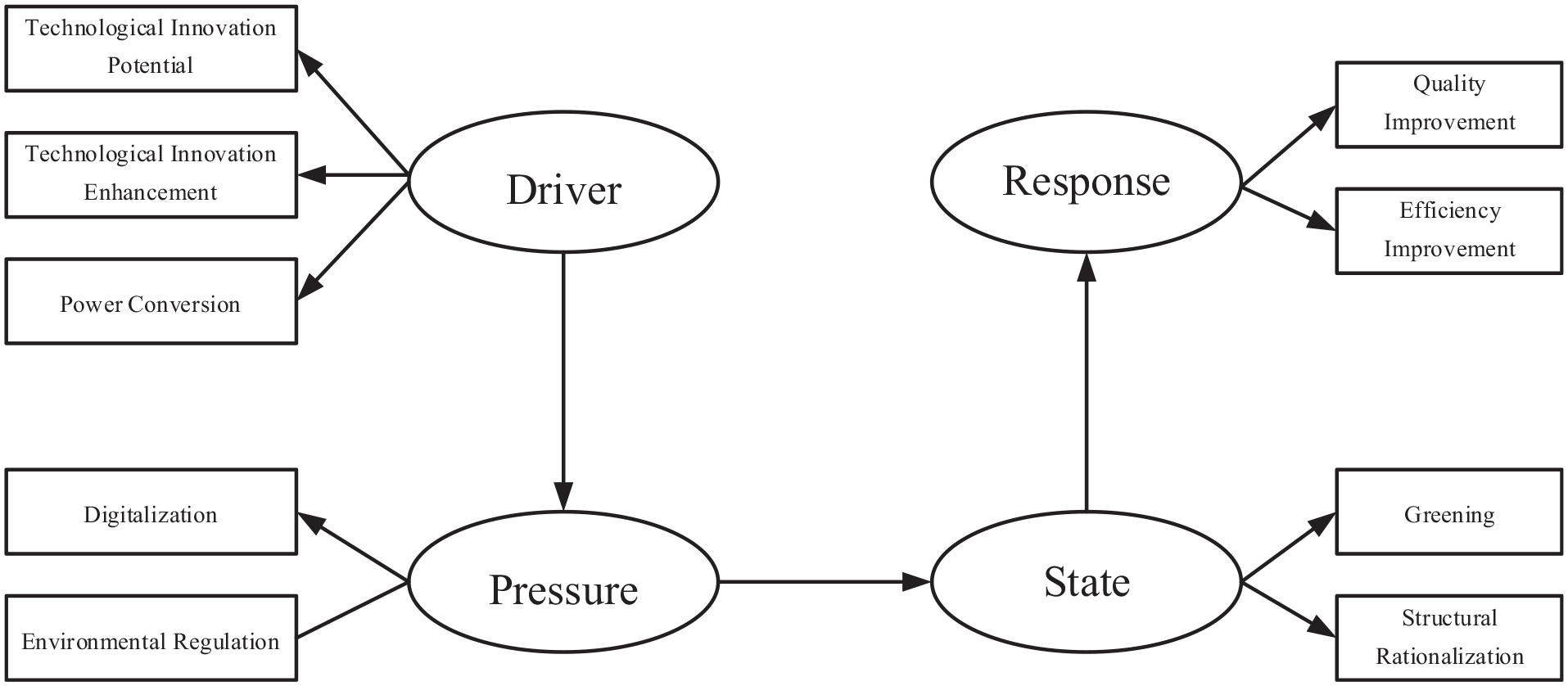
The conceptual model of manufacture industry high-quality development system.
Indicator System Construction
Indicator System Construction
Based on the existing research, this study presents an evaluation index system (Table 2) for China’s high-quality development system in the manufacturing industry. The system is constructed based on the connotation of the DPSR model, combined with the current situation of Chinese manufacturing industry development. The following explanations are provided:
The Evaluation Index System.

Driver: The driver (D) represents the causal factors that influence changes in the high-quality development system of the manufacturing industry. Science and technology innovation, as highlighted in the research by Su and Wang (2012), plays a crucial role in driving the continuous upgrading of the overall manufacturing industry. It drives an upgradation in the product quality, enables the provision of high-quality services, and serves as a significant driving force for high-quality development in the Chinese manufacturing industry. Additionally, the degree of transformation of the manufacturing industry into a high-energy industry is also a driver of high-quality development (J. J. Liu et al., 2022). The innovation potential investment index and the innovation enhancement investment index serve as characterization indices for science and technology innovation, while the manufacturing power conversion index is an important characterization index for the transformation of manufacturing industry.
Pressure: Pressure (P) refers to the influence of digitalization and environmental regulation on the development of the manufacturing industry, driven by technological innovation and power shift (J. J. Liu et al., 2022). The problem of digital pressure is characterized by the digital inclusion index, while the problem of environmental regulation is characterized by the total investment in industrial pollution control.
State: State (S) represents the state of structural rationalization and greening in the development system of high-quality manufacturing, influenced by the dual effect of digitalization and environmental regulation pressure (Verma et al., 2022). According to the research of Du and Hong (2021), the industrial structure of the manufacturing industry is a key factor in its high-quality development. Continuous optimization and upgrading of the industrial structure can effectively improve the production allocation efficiency of the manufacturing industry. The state of industrial structure rationalization in the manufacturing industry is characterized by the structural rationalization index. F. Wang and Shi’s (2022) research suggests that high-quality development in the manufacturing industry must prioritize both high efficiency and green development. The greening index is used to characterize the state of green development in the manufacturing industry.
Response: Response (R) refers to the measures taken to address the impact on the state caused by drivers and pressures. Considering the new development concept, high-quality development in the manufacturing industry emphasizes both higher quality and efficiency (Mofolasayo et al., 2022). Therefore, this study characterizes the response to high-quality development in the manufacturing industry based on both quality and efficiency.
Calculation of Indicator Weights and Composite Indices
Based on the indicator system constructed in this study, the original data are processed to calculate the indicator weights and the comprehensive index. Since the factors of the response system belong to multi-indicator characteristics, the entropy value method is applied to make objective assignment and calculate the comprehensive index of the factors of the response system from 2005 to 2020.
Entropy value method was to determine the weight of indicators and steps for the development of comprehensive index are given below:
The extreme difference method is used to dimensionless standardize the secondary indicator data, while data shifting was carried out to eliminate the effect of zero. As the factor indicators of the four systems are all positive, the formula is as follow:

where
The values of the measures are standardized using equation (2).

Calculating the entropy value as

where:
weights of each secondary indicator were calculated using equation (4).

This results in the calculation of a composite index for the Tier 1 indicator “efficiency improvement.”

The Combined index for Tier 1 indicator “quality improvement.”

Data for Evaluation Index
Based on the above-mentioned steps, an evaluation index system of Chinese manufacture industry high-quality development was develop on the base of two major dimensions “quality improvement” and “efficiency improvement.” Data for 30 provinces from 2005 to 2020 was calculated. Then, the average values of the comprehensive indexes in terms of quality improvement and efficiency improvement are obtained through further processing (Table 3). From Table 3, it can be seen that the overall development level of Chinese manufacture industry high-quality varies significantly in different region. Among them, east region is in leading form, central region comes at second and west region is in the last. In other words, east region is better than central and west region in terms of quality improvement and efficiency improvement. The central region is lower than the west region in terms of efficiency improvement, but higher than the west region in terms of quality improvement, thus indicating that the manufacturing industry high-quality development in east region is relatively coordinated.
The Composite Index of the Factors of the Response Factor System.

Results and Discussions
Results
Pathways to Manufacture Industry High-Quality Development of the East
From the fit test results of the structural equation model (Table 4),
Fit Test Results of the Structural Equation Model.

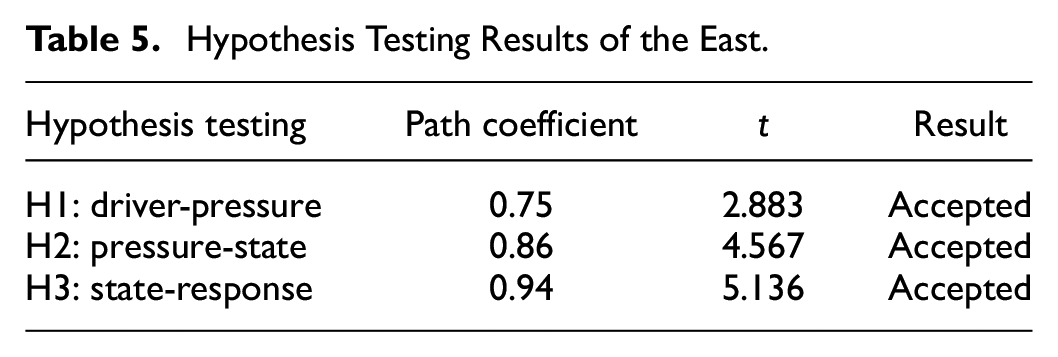
The results obtained from the application of AMOS to investigate the action mechanism of high-quality development in the manufacturing industry in the East are presented in Figure 3. The findings from the hypothesis test and the identification of key factors are presented in Tables 5 and 6, respectively. The results reveal a unidirectional chain action path known as “Driver-Pressure-State-Response.” Upon analyzing the identified key factors, it is evident that all factors within the system have significant results, with a particular focus on quality improvement and efficiency enhancement. This implies that high-quality development in the manufacturing industry in this region is driven by the “potential and advancement of science and technology innovation, as well as the transformation of power within the manufacturing industry.” These driving factors exert pressure on “digitalization” and “environmental regulation,” resulting in a transformation of the state of “structural rationalization and greening.” As a response to these changes, the focus shifts toward quality improvement and efficiency enhancement.

Results of high-quality development path of manufacturing industry in the East.
Hypothesis Testing Results of the East.
Key Factor Identification Results of the East.

P < .05. **P < .01. ***P < .001.
The region under consideration includes Beijing, Shanghai, Jiangsu, Zhejiang, Guangdong, and other provinces and cities. Among these, Beijing and Shanghai are leading manufacturing hubs in China, encompassing a wide range of industrial sectors, including numerous high-end manufacturing industries. Guangdong, Jiangsu, and Zhejiang have the highest number of large-scale industrial enterprises in China, with Guangdong ranking first with 47,456 such enterprises and Jiangsu boasting higher manufacturing profits. Overall, compared to the central and western regions, this region exhibits better resources and foundations for high-quality development in the manufacturing industry. Benefiting from strong support from national policies, this region possesses greater resources for science and technology innovation, thereby providing a stronger trigger for high-quality manufacturing development. Simultaneously, confronted with the dual pressures of digitalization and environmental regulation, the region must transform its industrial structure, increase the proportion of high-end industries, and reduce excessive consumption of ecological resources to enhance the environmental sustainability of manufacturing industry. Therefore, this region should strive to “achieve development through protection and protection through development,” while responding to the high-quality development of the manufacturing industry through efficiency enhancement and quality improvement.
Pathways to Manufacture Industry High-Quality Development of the Central
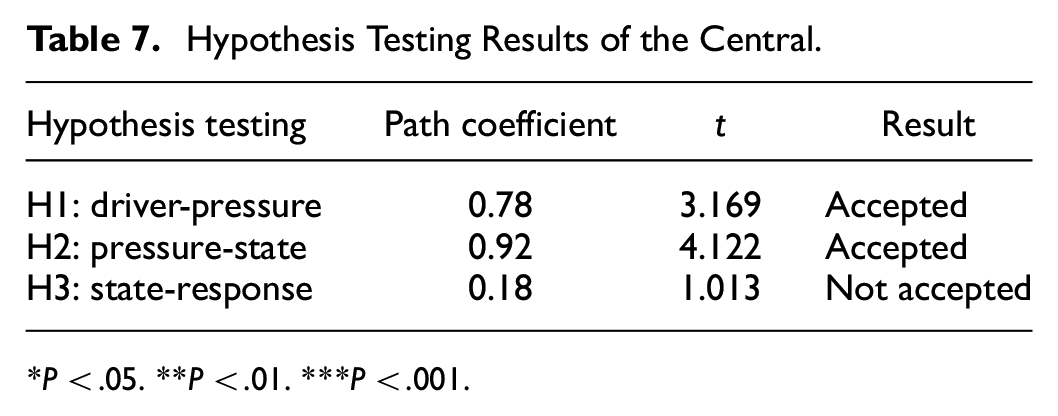
Applying the same analytical approach to the Central region, the data analysis (as depicted in Figure 4) reveals that the action mechanism of high-quality development in the manufacturing industry follows the paths of “driver-pressure-state” and “pressure-response” (Table 7). Regarding the identification of key factors, all factors demonstrate significance, except for “greening” which does not significantly impact the “status” (Table 8). These findings suggest that the driving forces for high-quality development in the manufacturing industry in this region are similar to those in the East. Specifically, “science and technology innovation” and “power transformation” play crucial roles in promoting high-quality development. However, there are differences in the developmental pathways between the two regions. Under the influence of effective drivers, the high-quality development of the manufacturing industry in the Central region experiences pressure from digitalization and environmental regulation but has not undergone significant changes in its industrial structure or greening status.

Results of high-quality development path of manufacturing industry in the central.
Hypothesis Testing Results of the Central.
P < .05. **P < .01. ***P < .001.
Key Factor Identification Results of the Central.

P < .05. **P < .01. ***P < .001.
Pathways to Manufacture Industry High-Quality Development of the West
The Central region comprises Hunan, Hubei, and Jiangxi, with Wuhan serving as a key manufacturing base with strong radiating and absorptive capacities. In recent years, with the transformation and upgrading of high-energy industries in the East, the Central region has witnessed a significant inflow of manufacturing industries from the East, leading to an increased development of the manufacturing industry. However, the regional economic development level has not resulted in a commensurate high-quality response from the manufacturing industry. Consequently, there is a need for the Central region to intensify the transformation of high-energy industries, thereby fostering a high-quality development in the manufacturing industry through improvements in efficiency and quality enhancement.
Analyzing the data from the West region (depicted in Figure 5, Tables 9 and 10), it is observed that the “driver-pressure” path is not significant, indicating a distinct action mechanism for high-quality development in the manufacturing industry. Instead, the interrupted action path follows the sequence of “pressure-state-response.” Regarding the identification of key factors, apart from “power transformation,” which does not significantly impact the driver, and “efficiency improvement,” which does not significantly impact the response, the other factors do not exhibit significance in relation to the response. These findings highlight significant differences in the paths of high-quality development in the manufacturing industry between the West and the Central regions.

Results of high-quality development path of manufacturing industry in the West.
Hypothesis Testing Results of the West.

Key Factor Identification Results of the West.

P < .05. **P < .01. ***P < .001.
Driven by “technological innovation” and “power shift,” the development of the manufacturing industry in the West region does not exert pressure on digitalization and environmental regulation. The West region primarily includes provinces and cities such as Gansu and Ningxia, which are rich in natural resources but have relatively weak manufacturing industry foundations. These regions started their manufacturing industry development relatively late, employ a relatively traditional development model, and demonstrate a lower level of scientific and technological innovation. As a result, the overall high-quality development of the manufacturing industry in the West lags behind.
Upon analyzing the actual manufacturing development situation in this region, it becomes apparent that the effective driving force for high-quality development is weak. Scientific and technological innovation and power transformation fail to play an effective role, leading to underutilization of abundant natural resources. The pace and sustainability of manufacturing industry development are determined by its driving forces. Therefore, the West region should accelerate the construction of manufacturing industries, enhance integration with both the East and the Central regions, establish new pilot projects for manufacturing industry development, introduce reforms, foster city clusters dedicated to manufacturing industry development, and expedite progress toward high-value-added industries. Furthermore, increasing the potential for scientific and technological innovation and investing in quality improvement will form an effective driver for promoting high-quality development of the manufacturing industry in this region.
Discussion
Results for the first hypothesis are mixed in different contexts, as, it was accepted in the central and east region of China, however, drivers for high quality development in manufacturing industry have least role in influencing pressure in the west region. The results for the first hypothesis are similar to the Dang et al. (2023) which shows that changes in the driving forces causes a significant change in pressure in the carrying capacity of water resources in Longnan city of China; However, contradict with the results of Ren et al. (2022) which describe that major driving forces of ecosystem health including natural and economic factors can increase or decrease the pressure on ecosystem health. Findings in the study of J.-Y. Wei et al. (2019) showed a similar pattern where major driving forces of enterprises energy efficiency including technological innovation, society, natural reserves, corporate environmental concern, and investment in R&D. Findings for hypothesis 2 are significant for all regions in China which shows that pressure influences state significantly. Findings from the study of Dang et al. (2023) are not so different which show that pressure for carrying capacity of water resources significantly influence the state to take necessary actions. Further, results show a similar pattern with the study of Ren et al. (2022) which describe that change in eco-system pressure significantly influence the eco-system state. Results for H3 are mixed which show that state has a prime responsibility in influencing the response of citizens and enterprises in east and west region of China, however, in central region the results are not significant for H3. The results Zhang et al. (2023) showed the same pattern where they found that government as a state should motivate corporate sector to give a special consideration on GHG emission due to water pollution and focus on the complete cycle of carbon emission products. Results of H3 are also similar to the study of J.-Y. Wei et al. (2019) where they found that government as a major stakeholder can promote energy-efficiency and energy-efficient technologies in corporate sector by developing appropriate measures and R&D based institutes.
Conclusions and Suggestions
Conclusions
Based on the hybrid approach of DPSR and SEM, this study establishes an analysis framework and conceptual model to investigate the high-quality development in the manufacturing industry of China. This study explores the paths and key factors influencing high-quality development in the East, Central, and West regions of China using SEM.
In the East region, the action mechanism follows a one-way chain path of driver-pressure-state-Response. The manufacturing industry in this region demonstrates a relatively high level of high-quality development, and the test results confirm the significance of all factors within the system. Digitalization, environmental regulation, and structural rationalization significantly impact the high-quality development of the manufacturing industry in the East and emerge as key factors that cannot be overlooked. Therefore, increasing investment in digital financial inclusion, industrial pollution control, and further accelerating the development of high-energy manufacturing industries are crucial priorities for this region.
In the Central region, the action mechanism follows a jumping path of driver-pressure-state and state-Response. The high-quality development of the manufacturing industry in this region is driven by technological innovation and power transformation. However, changing the industrial structure and greening status does not lead to a high-quality development response in the manufacturing industry. Key factors in this region include power conversion and quality improvement.
In the West region, the action mechanism follows an interrupted path of pressure-state-Response. Driven by scientific and technological innovation and power transformation, the development of the manufacturing industry in this region does not exert pressure on digitalization and environmental regulation. The notable difference between the West and other regions lies in the weaker drivers. Thus, it is essential to accelerate progress toward higher-energy industries, increase the potential for science and technology innovation, and invest in quality improvement to facilitate the high-quality development of the manufacturing industry in this region.
Suggestions
To further promote the high-quality development of the manufacturing industry in China, this study puts forward the following suggestions:
In the East region, despite having a strong foundation and resources for manufacturing industry development, there is a need to address the issues of excessive consumption of ecological resources and declining environmental quality, as the development level of the industry improves. It is crucial for this region to shift the development mode of the manufacturing industry toward green development, and focus on industrial pollution control. By doing so, the region can improve the green level of the manufacturing industry, achieve a balance between industry development and environmental protection, and follow to the requirements of the dual carbon target.
In the Central region, the low level of the manufacturing industry structure acts as a key obstacle to high-quality development. To overcome this, the region should accelerate the transformation of manufacturing industries into high-energy industries. It is important to focus on upgrading the manufacturing industry to knowledge-intensive, value-added, and technology-driven sectors. By enhancing the overall quality of the industry and promoting structural optimization, the Central region can facilitate high-quality development.
In the West region, the lack of drivers for high-quality development in the manufacturing industry can be attributed to traditional development models and inadequate levels of technological innovation. To address this, the West region should vigorously develop its manufacturing industry, strengthen integration with the East and the Central regions, establish new pilot projects, foster city clusters, and accelerate the transition toward high-energy industries. By creating new manufacturing industry chains with regional characteristics and following the latest trends, the West can overcome the limitations of its traditional development model and stimulate industry growth.
Promoting coordinated and integrated development among the East, Central, and West regions is crucial. These regions exhibit significant differences in the level and paths of high-quality development in the manufacturing industry. Therefore, it is important to strengthen the interaction between these regions and realize linked development. The East region should take the lead in enhancing the level of scientific and technological innovation in the manufacturing industry and utilize the influence of large cities and coastal areas to drive industry development in the Central and West regions. Similarly, the relatively less developed Central and West regions should leverage their resource advantages and actively participate in the high-quality development of the manufacturing industry in the East region.
Theoretical and Practical Implications
This study contributes to a range of theoretical perspectives, from sustainability and systems thinking to organizational behavior and strategic management. It can offer insights into how a novel DPSR-SEM based framework influences decision-making, innovation, and sustainable practices within the manufacturing sector. This integration presents the framework's versatility and usefulness beyond its original conceptualization. This study can provide insights into how the DPSR framework by aligning SEM can help manufacturing industry move toward high-quality development by creating a balance between economic, social and environmental factors. This study can contribute to the DPSR knowledge by providing theoretical insights on the interplay between drivers, pressures, states and responses and how it leads to an effective decision making. The final output of the DPSR framework is responses that can contribute to the major technological changes in the manufacturing industry, as it explores how responses is associated with the adoption of innovative technologies (e.g., artificial intelligence, robotics etc.) that promotes high-quality development. Lastly, this study can contribute to stakeholder theory by inspecting how the DPSR framework includes various stakeholders, such as employees, communities, regulatory authorities, and customers. It can explore how responses are shaped by stakeholder interests and impact the state of the system.
Practically, this study has several implications for manufacturers, policymakers, and other stakeholders. Manufacturing industry can adopt a more holistic approach to decision-making by considering not only production efficiency but also the broader influence on environmental, social, and economic dimensions. This can promote more sustainable and well-rounded business strategies, and manufacturers can adopt environmentally friendly technologies, reduce waste, and optimize resource use consequent in improve environmental performance. Further, through the identification of driving pressures and their potential influence, manufacturing industry can better anticipate and manage risks associated with changes in the business environment. This allows proactive adaptation to evolving market demands, regulatory changes, and supply chain disruptions. DPSR-SEM based framework also support manufacturing industry to comply with environmental regulations and standards. This can prevent legal issues, fines, and reputational damage while promoting a reputation among consumers and investors. This framework also motivates transparency in reporting practices, which can enhance accountability to stakeholders. Enterprises can communicate their efforts to address driving pressures and their impact on the state of the system. Lastly, this study helps manufacturing enterprises aligning their practices with the UN-SDGs, contributing to global efforts for a sustainable and bright future. In conclusion, research on the adoption of the DPSR-SEM framework in high-quality development within the manufacturing industry can lead to multiple practical outcomes that improve sustainability, risk management, stakeholder engagement, innovation, and overall business performance. It provides guidelines to enterprises toward a more comprehensive and responsible approach to business operations, benefitting both the organization and the broader society.
Limitations and Future Research Directions
Research on the adoption of DPSR-SEM framework can bring valuable insights in manufacturing industry but it’s necessary to acknowledge its limitations and future research directions. Firstly, this study is based on high-quality development in manufacturing industry, however, the effectiveness of the framework could differ based on factors such as industry subsector, geographical location, firm size, and regulatory environment. This work is based on the data in between 2005 and 2020. Data availability and quality could limit the depth of analysis and the accuracy of findings. Performing longitudinal studies to understand how the adoption of the DPSR framework influences manufacturing practices over time might reveal trends, encounters, and successes in the long-term implementation. Investigating the causality and feedback loops within the DPSR framework more deeply can also bring insightful results. Investigating how certain responses might influence driving pressures and system states over time can provide a different angle of the manufacturing industry. A combination of quantitative analysis and qualitative analysis (e.g., interviews, case studies) to provide a deeper understanding might also be performed.
Footnotes
Declaration of Conflicting Interests
The author(s) declared no potential conflicts of interest with respect to the research, authorship, and/or publication of this article.
Funding
The author(s) disclosed receipt of the following financial support for the research, authorship, and/or publication of this article: Funding Information: Social Science Foundation of Shaanxi Province (2022D055).

Data Availability Statement
Data sharing not applicable to this article as no datasets were generated or analyzed during the current study.