




Abstract
The study investigates the extent job rotation on the career development of Royal Malaysian Navy officers in a fixed wage setting model. It attempts to fill in the gap in literatures concerning the impact of job rotation in a non-conventional wage setting model. The present study is benefited from an actual data set of Royal Malaysian Navy officers that is obtained from Department of Human Resource, Royal Malaysian Navy in 2017. The data consists of 1,686 officers that are ranked from Lieutenant RMN (ZA18/44) to Captain RMN (ZA24/5)2. The analysis of an Ordinary Least Squares OLS regression showed that job rotation is positively associated with education level, training, and experience. The likelihood of job rotation increases if the nature of job is more flexible in terms of hours of work, skill, and content. Further, there is a significant effect of job rotation on wage. Specifically, a quantile regression indicates that the low rank positions such as Lieutenant and Lieutenant Commander are benefited more from job rotation than a Captain in terms of wage premium. However, the small effect of job rotation in the fixed wage setting environment suggests a need to review the way job rotation is being implemented by Department of Human Resource, Royal Malaysian Navy. In this regard, work experience should be viewed as an important catalyst for enhancing the positive wage impact of job rotation, so much so that it outweighs the role played by educational attainment in the Malaysian navy sector.
Introduction
Job rotation research in career development have centered on a flexible salary setting paradigm (Nicholas & Judy, 2004). In contrast, the present study examines the extent to which job rotation helps career development when labor is exposed to a fixed wage setting model. Productivity is the sole driver of labor wage and job promotion in a flexible wage situation. The salary determination in the fixed setting model, in contrast, is more difficult and not entirely based on productivity. Thus, using a sample from a fixed salary setting model, the present study undermines (Bhowal et al., 2021)’s prior result that job rotation impairs performance. The present study hypothesizes that in a fixed salary context, job rotation has a lower impact on career growth.
To empirically test the theory, the present study benefits from the actual data set of Royal Malaysian Navy officer that is directly obtained from Human Resource Department in 2017. The Royal Malaysian Navy is the Malaysian Armed Forces’ naval arm. The officers of the Royal Malaysian Navy are appointed by the Malaysian government. As a result, they are subjected to a fixed wage model under the Malaysian government’s service program. The current study looks into the impact of work rotation on the labor market outcomes of Royal Malaysian Navy Officers, namely wage rate and job promotion length.
In the government fixed wage setting model, promotion and wages are not exclusively based on labor productivity. Other major factors that influence labor wage determination include experience, seniority, and education level (Mahuteau et al., 2017). It’s worth emphasizing that under the government’s fixed pay system, every worker is quite likely to receive an annual raise if they can show even the smallest amount of productivity (Service Circular, 2011).
In terms of job advancement, regardless of production level, one is only allowed to receive single promotion. To put it another way, labor advancement is limited to the next level position. In the fixed salary system model, no worker is allowed to advance beyond the next level position in order to receive a double or triple promotion. This guideline applies even to productive workers who are chosen for the fast track promotion program (Service Circular, 2011). Workers at the top quantile typically have the greatest wage advantage (Amirah & May, 2020).
This distinct aspect of the fixed wage setting model appears to implicate labor career development in more complex ways. According to a previous research, workers in the public sector earned 5.1% more per hour than their private-sector colleagues (Mahuteau et al., 2017). It makes it more appealing to workers to quit in a flexible wage setting approach. In the meantime, workers who are enrolled in the system are unlikely to leave (Scandizzo et al., 2009). As a result, career advancement becomes competitive and difficult. In light of the rise of Industry 4.0, the demand for innovative and cutting-edge skills is critical for the future of employment (Hirschi, 2017).
As a result, workers who are subjected to a fixed wage setting model must equip themselves with the most up-to-date skills and knowledge in order to stay competitive in the business. More importantly, the firm’s and work organization’s assistance is critical to a successful career growth. There is no doubt that organizational support adds to an individual’s professional path in a favorable way (Marhaini & Nur, 2017).
The Royal Malaysian Navy’s Department of Human Resource (DHR) is in charge of the Royal Malaysian Army’s human capital development. They are putting forth every effort to arrange and carry out employment rotation for all officers in the Royal Navy. Job rotation is a way for workers to increase their motivation, gain experience, and learn new skills in the workplace. Motivation is an internal characteristic that can motivate people to attain personal and organizational goals (Lindner, 1998). It has a substantial impact on labor performance, which in turn stimulates an individual’s career development (Asvir et al., 2011).
In the context of the Royal Malaysian Navy, job rotation refers to a change in officers’ assignment that involves transferring a position or task to another department in the same or a different location for a set amount of time (Buku Rujukan Laut, 1066). For example, a staff officer in the operation department has been scheduled to transfer to the planning department within the same level of position. It aims to expose officers to various experiences and help them develop their talents.
Job promotion is an important part of professional development since it keeps officers motivated to accomplish their duties well. It’s a crucial strategy for increasing worker productivity (Akbari & Maniei, 2017). As a result, there’s no denying that job rotation has a favorable impact on employee performance (Al-Romeedy, 2019) To earn job advancement under the fixed wage setting model, navy officers must demonstrate their capabilities through important relevant experience and skill upgrades. Job rotation planning allows for the acquisition of relevant experience and skill upgrades. As a result, it is critical for the Department of Human Resources to establish a clear and promising job rotation direction in order to ensure that all Royal Malaysian Navy Officers have a successful career growth.
The objective of the study are twofold. First, it is aimed to identify the determinants of job rotation in a fixed wage setting model. The Royal Malaysian Navy’s nature, which includes both flexible and non-flexible positions, provides a unique perspective on how job rotation affects the organization. The second goal is to investigate the impact of duty rotation on the advancement of Royal Malaysian Navy officers’ careers. Wage effect is one of the results of interest in this study since it is related to career growth. It tries to fill in the gaps in the literature on the impact of job rotation in the fixed wage setting paradigm. The strength of this study lies on the use of actual data set of Royal Malaysian Navy officers. As a result, it would be able to offer an accurate and reliable assessment of the influence of job rotation on navy officer pay.
The paper is structured as follows. The next section discusses job rotation literature reviews. It is followed by an outline of the Royal Malaysian Navy Office’s career path. Following that, the data and methodology used in the paper are examined. Section 5 contains the analysis and discussion of the finding. Finally, section 6 wraps up the paper and discusses some of the consequences of the findings.
Job Rotation
Job rotation and career growth have a distinct and substantial relationship. To begin with, job rotation is critical for developing staff abilities. As a result, it is a critical requirement for those who lack workplace training (Bolton & Gold, 2004). When there is a need to advocate more contemporary technology, the rotation clearly aids workers in learning new skills quickly. As a result, workers who rotate jobs more frequently obtain more diverse experiences faster (Orpen, 1994). More critically, the experience obtained is more diverse than that earned by people with fewer work rotations (Campion et al., 1994). Because job rotation improves worker ability, it is more usually connected with workers who have less tenure, receive extensive on-the-job training, and work in a new industry.
Second, work rotation allows the company to improve the job allocation of its employees. Firms may find it easier to identify the most suited position if a person can be watched completing several types of tasks and assignments (Ortega, 2001). More crucially, if a company has little knowledge about a worker’s abilities, the advantage of job rotation grows tremendously. As a result, this process provides a greater number of workers with opportunities for advancement (Orpen, 1994). This argument works because resources within organization can be transferred through job rotation channel (Lynskey, 1999; Wright & Snell, 1998). The rotation gives the company more knowledge about personnel’ strengths in various talents and disciplines.
Employee flexibility is the third key relationship between job rotation and career growth (Friedrich et al., 1998). Functional flexibility provides effective job rotation in addition to job enlargement and semi-autonomous work groups. Job rotation gives the organization with additional flexibility to allocate work based on the varied talents acquired. Finally, workers are able to do a variety of activities and provide employment flexibility and cross-departmental collaboration for the benefit of the company’s performance (Thongpapanl et al., 2018; Wright & Snell, 1998).
Therefore, good organizational support is critical to a worker’s career advancement (Vimala & Hu, 2011). As a result, any expenditure geared at enhancing efficiency and broadening experience has an impact on growth (Wang & Holton, 2005). For Royal Malaysian Navy officers, career is developed through job promotion. A good career development is shown through a successful job promotion from a low rank position to a higher rank one, according to Dries et al. (2008). It is seen as a tool for recognizing and rewarding those who have proven effective job performance. Nonetheless, the job upgrade comes with increased tasks and responsibilities. A systematic job rotation is used to distribute these additional workloads and responsibilities.
Thus, it is critical for the Department of Human Resources to develop work rotation strategies that accurately reflect career advancement. DHR defines job rotation in human resource management as a worker’s job rotation from one unit or department to another, similar to Bennett (2003). According to Kraimer et al. (2011), an organization’s role is defined by its capacity to assign appropriate jobs to workers. BRL 1,066 evaluates officers on a meritocracy basis on numerous characteristics such as performance, experience, education qualification, training, leadership, and discipline in order to further their careers in the navy. The goal of job rotation is to provide workers with a diverse set of skills and experiences gained from working in a variety of similar units and departments. Many studies have shown that job rotation improves worker productivity (Chen et al., 2015; Kurtulus, 2010; Salih & Al.Ibed, 2017). The skills and experiences obtained are essential for adapting to various work conditions and settings (Bolton & Gold, 2004). Job rotation can lessen the chance of a company failing under certain circumstances (Delpasand et al., 2010).
Royal Malaysian Navy Officer Career Path
The Royal Malaysian Navy is one of the Malaysian Armed Forces’ maritime defence force. The types of jobs available in the Royal Malaysian Navy are quite similar to those found outside the military. They both have operations, engineering, and logistics departments. They do, however, play diverse functions and provide varying degrees of risk. Protecting the interests of the national defence through the defence assets it controls is the primary duty of the military service. Each officer will gain work experience in all areas of competence available at the Royal Malaysian Navy, including those connected to war and defence policy as well as diplomatic relations. Each item of defensive equipment is very expensive and employs cutting-edge technology. Each asset has a unique process for carrying out the primary defence function.
The Royal Malaysian Navy’s highest rank is Admiral, while the lowest rank among navy officers is Junior Leftenan. The Royal Malaysian Navy’s hierarchy is depicted in Figure 1. Cadet Officers are the beginning of a navy officer’s career in training. After being appointed as Acting Sub Lieutenant, their official career begins with the Royal Malaysian Navy. Officers have an equal chance of promotion to higher ranks such as Sub Lieutenant, Sub Lieutenant, and Admiral.
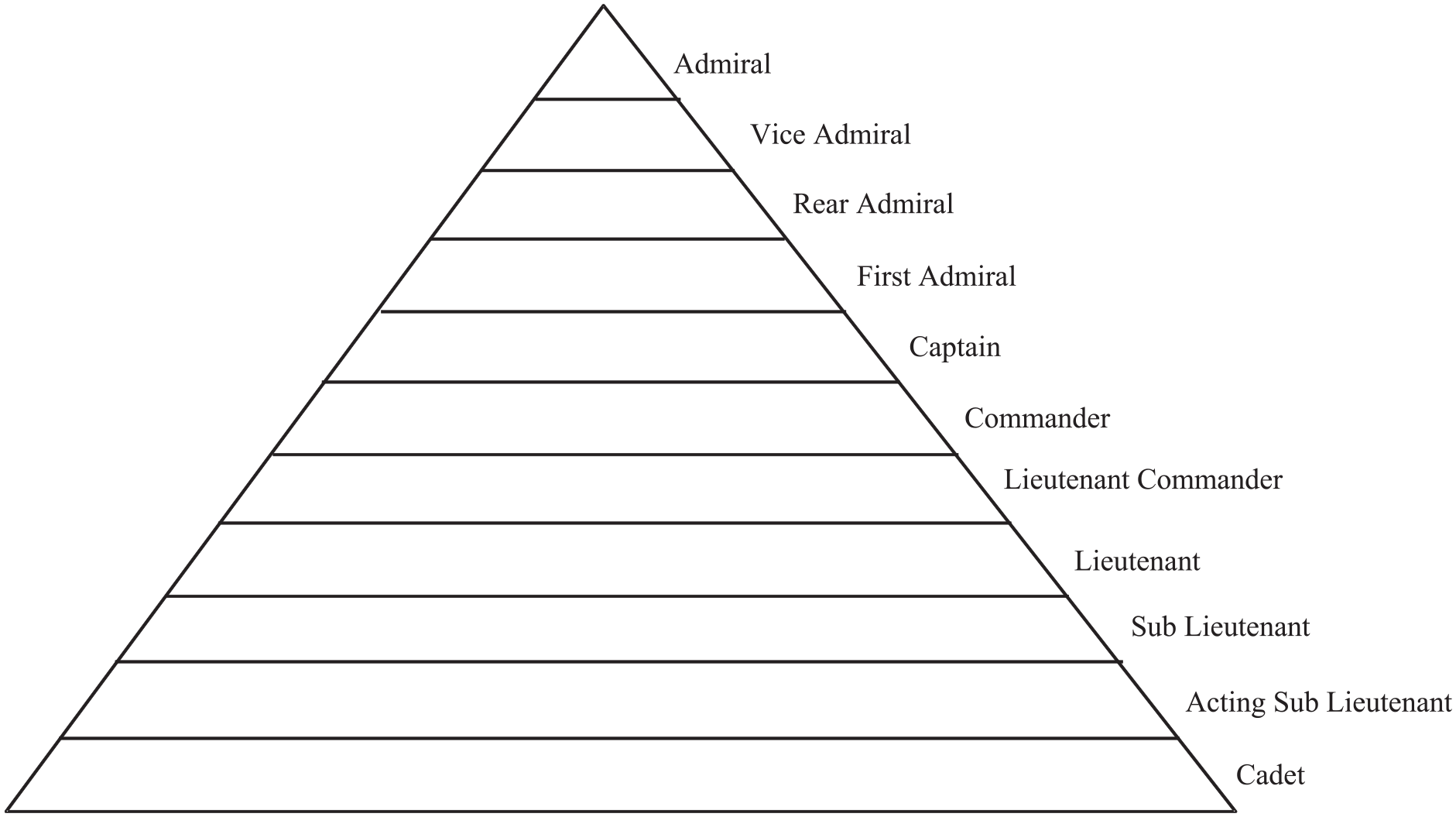
Royal Navy Officer hierarchy.
On a rotating basis, Navy officers are assigned mandates and assignments. Senior officials are expected to rotate jobs more frequently than junior officers. The average job rotation by position, department, and gender is shown in Table 1. This table highlights a number of significant points. For example, a Lieutenant rotates jobs 5.53 times on average. Job rotation is more common at higher posts, such as Commander and Captain, with 12.57 and 18.23 times respectively. It suggests that the officer post and work rotation have a beneficial association. Specifically, the higher a navy officer’s rank, the more employment rotation occurs. In terms of job rotation, navy officers in the executive and resource departments rotate more than officers in the engineering department. Third, male officers rotate jobs 8.2 times while female officers rotate slightly lower at 7.16 times. This could be related to the fact that women make up a small percentage of the navy’s membership. Female officers make up about 8% to 10% in the Royal Malaysian Navy, and their numbers in vessel operations are rather low.
Job Rotation by Position, Department, and Gender.

Source. Secondary Data, Department of Human Resource, Royal Malaysian Navy.
Data Description and Methodology
Descriptive Statistics
The present study obtained a secondary data on navy officers from Department of Human Resource, Royal Malaysian Navy, Ministry of Defense Malaysia. The data contains of information for 1,686 navy officers from Lieutenant to Captain. Table 2 shows that male officers make up 91.64% of the Royal Malaysian Navy’s officers. All of the officers have a range of educational backgrounds, such Malaysia Certificate Examination (2.9%), Diploma (31.83%), Bachelor Degree (50.62%), and PhD (50.62%). (0.12%). Malays make up 93.76% of the officers in the Royal Malaysian Navy. Despite their small numbers in the Royal Malaysian Navy, men officers earn an average of RM6,363 per month, while female officers earn just slightly less at RM6,314. Despite this, female officers attend an average of 7 more training sessions than male officers. The executive department (64.75%) has the most officers, followed by engineering (21.13%) and resource (14.13%) (14.18%).
Data Statistics by Gender.

Source. Secondary Data, Department of Human Resource, Royal Malaysian Navy.
OLS Regression Model
The analysis begins with a standard OLS regression model to identify determinant of job rotation as following;

Where JRi is number of job rotation and Xk are individual observable characteristics. The first regression sheds light on the relationship between individual observable traits and job rotation. The current study hypothesizes that navy officer duty rotation is associated with individuals who are more educated, experienced, and trained.
Further, the OLS analysis continues with a standard Mincer (1974) wage regression model to measure the effect on job rotation on wages as following;

Where Wi is hourly wage, JRi is number of job rotation and Xk are individual observable characteristics.
The semi-log function, lnWi (natural log of wages), is adopted as the dependent variable in this analysis. The semi-log function is the standard form for this type of model and transforms the distribution of wages from strongly skewed to normal. In addition, estimated parameters are easily transformed into percentage changes.
The variable of job rotation (JRi) is a central interest to this study. The coefficient of β1 measures the effect of additional job rotation on the percentage change in hourly wage. Job rotation, in general, increases human capital, which increases productivity and, in turn, increases wages. The sign of the coefficient (β 1 ) is predicted to be positive, with the magnitude of the coefficient growing as the rotation job rises.
One important human capital characteristic usually included in the standard wage function is labor force experience (EXPi). The quadratic form of labor force experience (EXPSQ) is also included to model the concave form of workers’ wage profiles. The experience variable does not follow a conventional measurement in Mincer model. The experience is calculated by subtracting the present year with year of appointment into Royal Malaysian Navy. Thus, it clearly demonstrates years of experience working in the navy. The EXP variable’s expected sign is positive, whereas the EXPSQ variable’s expected sign is negative.
To account for the pay premium that is often associated with married males, marital status and gender are included. Both married and male officers are showing encouraging signals. The wage equation includes an ethnic dummy variable of Malays to indicate that ethnic Malays earn lower (higher) wages than other ethnics. The Malay dummy variable’s anticipated sign is positive. To link the effect of human capital investment on wage premium, a training variable is included. Finally, the resource and engineering department dummy variables are set to 1 if the officers are from those departments, and 0 otherwise.
Quantile Wage Regression Model
Nevertheless, the standard OLS regression is subjected to non-Gaussian disturbance. The estimation of hourly wage at mean value is not representative of the entire distribution. To overcome this issue, the study proposes a quantile wage regression as follows:

Where Xk is the vector of all the independent variables in Equation 1.
Quantile regression overcomes a number of shortcomings in the standard OLS model. It does not impose arbitrary exogenous sample selection criteria to separate the sample. Therefore, the estimation can be done at as many quantiles as technically possible. The quantile regression allows observed identical workers with different unobserved abilities to experience different wage level and wage path as the regressor values change across the distribution. It results in the coefficients to yield different value at different quantiles.
The key advantage of quantile regression is its independency from sample selection bias problem as the estimation of each quantile takes into account of the entire sample. The quantile regression takes into account individuals’ heterogeneity that may arise when wages respond to variation in the variables such as job rotation, years of schooling, and experience. The approach enables the estimation of each explanatory variable along the whole wages distribution and subsequently the estimation of the effect of individuals’ heterogeneity upon wages. Furthermore, it is robust to heterosecedasity by minimizing the sum of absolute values of residuals.
Result and Discussion
Table 3 shows OLS regression of job rotation. Job rotation is favorably associated with years of schooling, experience, and training. Workers with a higher level of education, experience, and training are more likely to rotate jobs more frequently. The findings imply that it is critical to guarantee that new tasks and jobs are completed correctly. As a result, the Royal Malaysian Naval’s Department of Human Resource emphasizes the importance of having sufficient knowledge, skills, and exposures in order to relocate and cycle navy officers to other responsibilities. Thus, in order to be considered for job rotation, navy officers must have the requisite training, experience, and educational levels.
Determinants of Job Rotation.

Significant at 1%.
Significant at 5%.
Significant at 10%.
Surprisingly, married officers are less likely to rotate jobs frequently. The inability of married officers to accept job rotation offers could be attributable to a lack of flexibility owing to family obligations. Meanwhile, the findings show that single and non-married officers can take advantage of their flexibility and availability to take on a variety of responsibilities and take on new challenges on a rotational basis. It’s worth noting that some of the tasks include irregular work hours, frequent travel, and the possibility of job transfer.
The findings also reveal that navy officers in the executive department are more likely than their peers in the resource and engineering departments to rotate jobs. Executive officers are responsible for administrative tasks. Officers must be rotated in order to learn about and be exposed to a variety of managerial, organizational, and governmental jobs. Navy officers in the resource and engineering departments, on the other hand, specialize in a certain profession that necessitates extensive knowledge and experience. As a result, engineering and resource officers are not required to be generalists on the job. Nonetheless, because of the positive coefficient of interaction term between years of schooling and engineering variable, engineers with higher education levels are more likely to rotate jobs frequently than engineers with lower education levels. Although engineers are less likely than executive officers to be involved in job rotation, having a higher education could mitigate the unfavorable effects.
Table 4 shows OLS and quantile wage regression of navy officers. R2 ranges from .46 to .79 for all models. In particular, independent factors in the models account for 46% to 79% of the variation in the dependent variable. In the OLS model, years of education, experience, training, and Islam all have positive significant effects on officers’ earnings. The fact that education has a good effect is supported by literature (Hazrul & Zulkifli, 2017; Noorazeela & Noorasiah, 2016; Psacharopoulos & Patrinos, 2004; Sook et al., 2013; Zulkifly et al., 2010). Malays in the resource and engineering departments, on the other hand, are paid less than their peers.
OLS and Quantitle Regression Model of Job Rotation.

Significant at 1%.
Significant at 5%.
Significant at 10%.
The interested variable of job rotation has only a small positive effect on wages at 1% significant level for OLS model. In particular, one time increase in officers’ job rotation leads to 0.58% increase in wage or RM50 in monthly wages for a captain.
More comprehensible points are provided by quantile regression models. The effect of job rotation is positively significant at 1% level in each quantile. Nonetheless, the effect is small, ranging from 0.6% to 0.4%. Surprisingly, the favorable effect diminishes as one moves up the quantile scale. The compensation premium from job rotation decreases as navy officers advance in rank. Low-rank positions, such as Lieutenant and Lieutenant Commander, benefit more from job rotation than Captains, according to the findings. Officers in the bottom 10% quantile see a 0.6% income increase from job rotation, while those in the top 10% see a 0.39% increase.
Figure 2 illustrates the effect of all independent variables along the quantiles. It is evident that as regressions reach higher quantiles, the salary effect of job rotation decreases. As a result of the findings, it appears that job rotation should be prioritized in order to boost human capital among lower-ranking officers such as Lieutenants and Lieutenant Commanders. These officers must take advantage of job rotation opportunities in order to gain the most up-to-date knowledge and abilities in a variety of duties and assignments. As a result, it gives low-ranking navy officers a significant advantage in their career advancement to higher-ranking positions. Top-ranking officers in the Royal Malaysian Navy, on the other hand, may be required to rotate jobs as part of their training. They should concentrate in a single field, but in the interim, they should take advantage of job rotation to broaden their ideals and leadership skills.

Independent variable effects by quantiles.
The finding differs slightly from Jans and Frazer-Jans (2004), who found that job rotation has a reasonable impact on military performance. In a fixed wage setting model, the effect of job rotation on wage is rather small, as demonstrated in this study. The current study, on the other hand, adds to the prior conclusion by indicating that the level of employment rotation varies by navy officer position. Given the minimal positive significant effect of job rotation, the current study implies that the Royal Malaysian Navy’s Department of Human Resource has a lot of work to do to improve job rotation planning.
The other control variables demonstrate mixed results. The wage return trend for the experience variable is similar. Officers in the lower tail had a more favorable significant effect of experience. As the wage distribution hits the upper tail, the magnitude begins to drop. On the other hand, for officers at the medium level, the influence of education or years of schooling on pay is larger. The naval officers at the bottom and top of the pay scale, on the other hand, receive a lower wage return on their schooling. These finding are consistent with previous studies in Malaysian labor market (Osman & Shahiri, 2013. Shahiri et al., 2016. Shahiri & Park, 2018. Zulkifly & Hazrul, 2017).
The study includes two dummy variables for officers in resource and engineering department. The control group is officers in executive department. Officers in the resource and engineering departments are paid less than executive officers at the bottom end of the wage. Captains in the resource and engineering departments, on the other hand, earn more than those in the executive department at the top of the 10% wage distribution. It appears that holding a professional engineer’s certificate and being referred as a subject matter expert gives naval personnel in the engineering sector an advantage in terms of earning greater salary than their competitors.
Table 5 shows OLS and quantile regression models of job rotation with several interaction terms. The interaction terms are used as a robustness check to validate the association between job rotation and wages that has been established through various channels.
OLS and Quantitle Regression Model of Job Rotation with Interaction Terms.
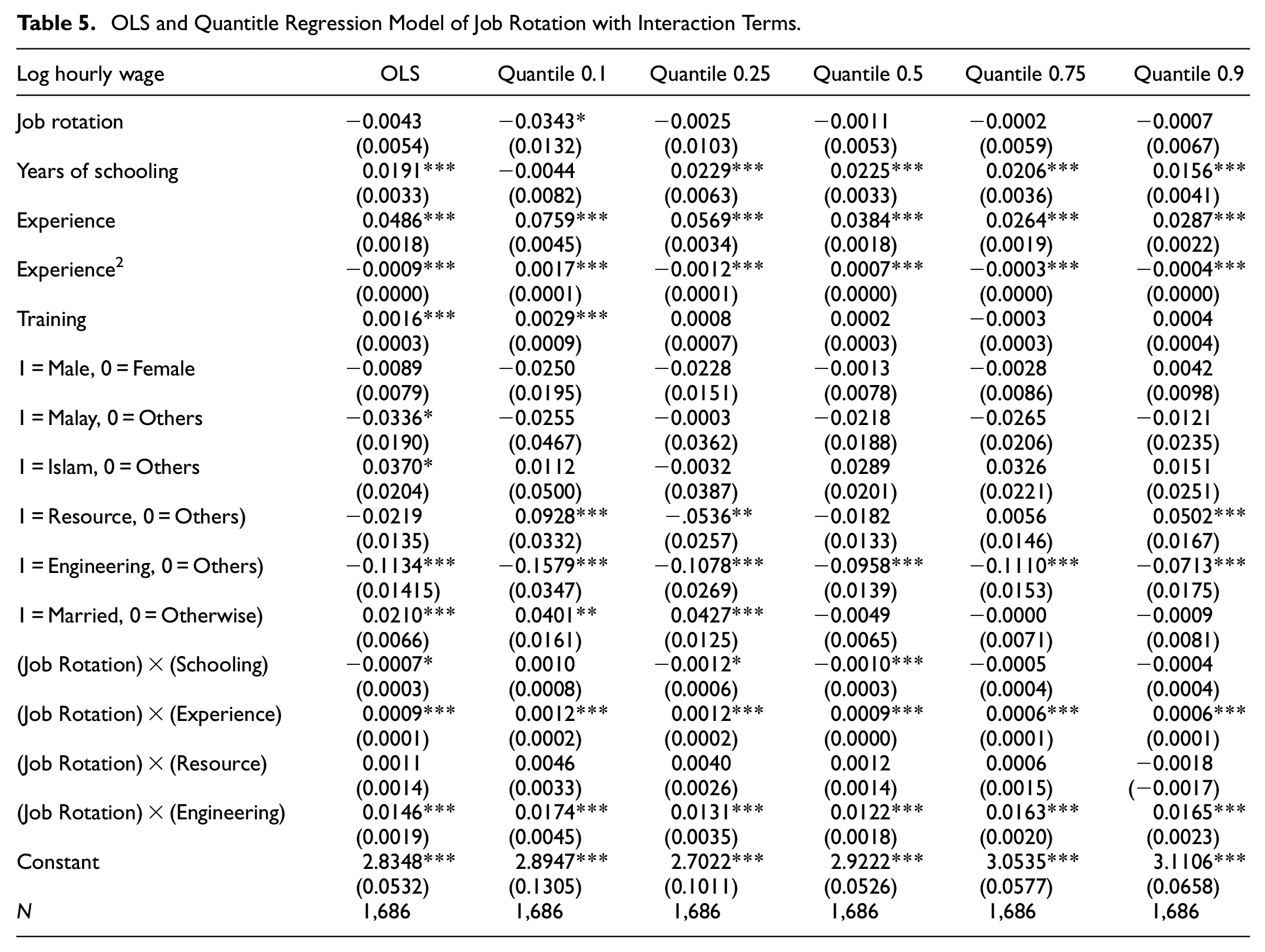
The finding demonstrates that the wage impact of job rotation among the low salaried young engineer is greater than that of the high salaried older engineer. The role of job rotation as a wage enhancer increases with more work experience, as indicated by a positive interaction term between experience and job rotation at the lower salary distribution. Experienced navy officers, regardless of wage distribution, are expected to have been better equipped with job-specific and generic skills necessary for enhancing their job performance and minimizing job risk when serving various departments on a rotational basis (Kampkötter et al., 2018; Rerkjirattikal & Olapiriyakul, 2021). Such experience is therefore expected to enhance the monetary reward received from job rotation.
However, our finding from the interaction between job rotation and year of schooling reveals an otherwise negligible role of education in enhancing the wage impact of job rotation in the navy. As such, Malaysian navy officers may not benefit from educational attainment measured by years of schooling when performing different job tasks on a rotational basis, casting doubt over the applicability of educational qualification obtained when fulfilling job assignment at different departments. In fact, it is the need for performing various job tasks throughout one’s job tenure that determines training participation, rather than educational attainment itself (Görlitz & Tamm, 2016). It is explicit to note in the Malaysian navy sector that work experience does matter for enhancing the monetary reward of job rotation, so much so that it outweighs the importance of educational qualification.
In summary, work rotation is important for early career growth, particularly for young engineers. Young engineers at the lower end of the pay scale should therefore have jobs that rotate so that they can gain more experience and eventually earn a higher income. On the contrary, educational qualification merely serves as a job market signaling on trainability (Di Stasio, 2014) to gain entry to the navy sector.
The same implication is observed among workers earning at the upper-end of the wage distribution. Thus, job rotation could be a useful instrument for experience accumulation. The outcome demonstrates how important job experience is for career advancement among high-earning employees. This is the result of accumulating experience by job rotation in the past.
Conclusion
The goals of the present study are to identify job rotation determinants and to analyze the effect of job rotation on wages in a fixed wage setting model using sample from Royal Malaysian Navy Officers. Human capital accumulation appears to be the fundamental link between job rotation and wage according to the findings. If a navy officer has a decent education, enough training, and enough experience, he or she is more likely to rotate jobs more frequently. If the nature of the job is more flexible in terms of hours of work, ability, and substance, the likelihood of rotation increases. A more in-depth examination reveals that job rotation has a considerable impact on pay. However, the small effect shows that the Royal Malaysian Navy’s Department of Human Resource should review how job rotation is implemented.
The existing job cycle appears to be hindering officers’ advancement in their careers. It may lead to officers’ reluctance or opposition to being relocated or reassigned to a new job. The fact that experience has such a strong influence suggests that there are other elements that motivate officers to advance in their careers. In a public sector fixed wage setting approach, seniority and experience are clearly still important factors in promotion. It potentially creates an ironic belief that promotion and wage increment is automated as workers continue holding the job for another year. It obstructs workers’ ability to be innovative, productive, and proactive.
There is a pressing need to get rid of this negative perception. Job promotion is a significant reward to a productive worker in an organization. Therefore, the Human Resource Department must embrace a comprehensive strategy to support job rotation. The review must fully consider the need and the interest of organization when officers are being rotated on their jobs and assignment. The goal is to generate people that are talented, experienced, and highly motivated to do their tasks well. As a result, ensuring a stable and rewarding career growth in the Royal Malaysian Navy is critical.
In fact, our study has proven the importance of work experience being a catalyst for enhancing the positive wage impact of job rotation, so much so that it outweighs the role played by educational attainment in the Malaysian navy sector. Navy officers are expected to have been equipped with various skillsets gained through training and work experience before being assigned different job roles on a rotational basis. This important human capital enhances job performance and labor productivity among them when serving various departments, which in turn matters for wage determination. Such momentum is particularly relevant for relatively low-salaried and high-salaried navy officers serving the engineering department. Therefore, the direction of human resource planning in the Royal Malaysian Navy should be first navigated toward hiring suitably qualified young candidates based on educational attainment to infer the extent of their trainability, subsequently placing them in different departments throughout their probationary period for skill development purposes before ultimately assigning them to various job tasks on a rotational basis once their employment status has been confirmed. By so doing, these young navy officers may find long-term career advancement in the Royal Malaysian Navy, moving up to the job ladder and enhancing their earnings power.
In a nutshell, job rotation should be considered as a means of increasing the variety of jobs available to officers. Job variety is a vital value-added in the age of Industry 4.0 to separate workers from one another in the workplace. There has been a growing demand among organizations to seek out more diversified labor in the workplace in order to lower many of the costs associated with traditional employment, in which staff specialized in a specific skill or expertise.
Despite establishing certain key findings, the current research is confined to the effect of job rotation for high-skilled positions in a fixed salary setting scenario. As a result, the study’s future direction may need to incorporate workers of various skill levels. It would provide a more intuitive understanding of how job rotation helps workers of varying skill levels in the context of a fixed salary situation. The inclusion of labor from a variety of skill levels allows for more representative observations from workers who work regular and irregular hours.
Footnotes
Declaration of Conflicting Interests
The author(s) declared no potential conflicts of interest with respect to the research, authorship, and/or publication of this article.
Funding
The author(s) received no financial support for the research, authorship, and/or publication of this article.
