




Abstract
Morningness–eveningness is the preference for different times of day for activity and sleep. Here, we addressed the effects of sleep behavior and morningness–eveningness on sociosexuality. Three hundred students (M age = 22.75 years, with 95% between 18 and 28) participated online, answering questions about morningness–eveningness (rMEQ [Reduced Morningness–Eveningness Questionnaire]), midpoint of sleep on free days (MSF), sleep duration, and the Sociosexuality Orientation Inventory–Revised (SOI-R). The SOI-R contains three subscales, Behavior, Attitude, and Desire. Evening orientation and short sleep duration were related to a higher total SOI-R and to the three subscales. Based on the linear models, the strongest effect on sociosexuality was produced by gender (27% explained variance) while age accounted for 6% of variance. Nonadditive variance explained by sleep–wake behavior was 7% (MSF), 4% (sleep duration), and 4% (rMEQ scores; 3% rMEQ-based typology). Older age was related to less-restricted sociosexuality, and men were less restricted than women in Attitude and Desire. Sleep duration and rMEQ scores were associated with Attitude and Desire; but only MSF was significantly related to Behavior. The data show that sleep–wake variables are associated with sociosexuality, with evening orientation and shorter sleep duration being related to a less-restricted sociosexuality.
Introduction
Morningness–Eveningness (M/E)
M/E is considered as an interesting facet of individual differences (Adan, Archer, Hidalgo, Di Milia, Natale, & Randler, 2012). M/E is primarily related to the preference for different times of day for mental and physical activities. For example, morning types reach their highest performance early during the day whereas evening types reach their peak performance in the afternoon, evening, or at night. M/E can be assessed by a set of questionnaires, and M/E is a heritable trait (von Schantz et al., 2015) with a genetic basis (Barclay, Watson, Buchwald, & Goldberg, 2014; Toomey, Panizzon, Kremen, Franz, & Lyons, 2015; Watson, Buchwald, & Harden, 2013). The variance in circadian preference is reflected in diurnal profiles of hormones, such as melatonin (Burgess & Fogg, 2008) or cortisol (Randler & Schaal, 2010) and body temperature (Baehr, Revelle, & Eastman, 2000; Mongrain, Lavoie, Selmaoui, Paquet, & Dumont, 2004). Evening types reach their nadir of body temperature later (Baehr et al., 2000), have their melatonin peak later (Burgess & Fogg, 2008), have lower cortisol levels in the morning (Randler & Schaal, 2010), and are also delayed in social rhythms, such as eating, meeting other people, or working (Randler & Jankowski, 2014). Overall, family, work, and school schedules seem important factors affecting M/E (Leonhard & Randler, 2009).
There are different measures of M/E. The common questionnaires (see Di Milia, Adan, Natale, & Randler, 2013 for an overview) relate to preference for given hours for activity and to affect in the morning (Di Milia & Randler, 2013), and they correlate with real behavior as assessed by actigraphy (Thun et al., 2012) A different kind of self-report, the Munich ChronoType Questionnaire (MCTQ; Roenneberg, Wirz-Justice, & Merrow, 2003), focuses exclusively on the sleep–wake behavior neglecting the aspects of affect. However, it allows for assessment of sleep duration and time in bed.
Many recent studies focused on the links between M/E and personality aspects (see Adan et al., 2012, for an overview) or well-being (Díaz-Morales, Escribano, & Jankowski, 2015). In short, evening types are more extraverted (e.g., Matthews, 1988), whereas morning types are more conscientious and proactive (Randler, 2009). Furthermore, impulsivity is higher in evening types (Adan, Natale, Caci, & Prat, 2010; Russo, Leone, Penolazzi, & Natale, 2012), as well as risk-taking (Killgore, 2007) and sensation seeking (Antúnez, Navarro, & Adan, 2014; Russo et al., 2012; Tonetti et al., 2010). Evening people tend to act out in an independent and nonconforming manner and resist to follow traditional standards—they prefer unconventional ways and call traditional rules into question (Díaz-Morales, 2007). Evening types also tend to be creative (Giampietro & Cavallera, 2007), right thinkers (i.e., preferring the right hemisphere over the left; Fabbri, Antonietti, Gioirgetti, Tonetti, & Natale, 2007), and individualistic (Vollmer & Randler, 2012). Clearly, personality traits are related to the circadian system (M/E). Also, evening people seem more intelligent than morning people (Díaz-Morales & Escribano, 2013; Roberts & Kyllonen, 1999), even when they are evaluated in the morning. Similarly, eveningness was related to higher emotional intelligence (Stolarski & Jankowski, 2015). Kanazawa and Perina (2009) suggested, based on a survey of ethnographies of traditional societies, that nocturnal activities were probably rare in the ancestral environment and that more intelligent individuals were more likely to become nocturnal than less intelligent individuals. This is based on the hypothesis that intelligent people might better cope with new environments, such as darkness. Therefore, higher intelligence might have been the basis for our ancient predecessors to extend their daily schedule into the evenings (Kanazawa & Perina, 2009).
Sociosexuality
Sociosexuality is defined as individual differences in willingness to engage in uncommitted sexual relations (Simpson & Gangestad, 1991; Penke & Asendorpf, 2008). People with unrestricted sociosexual orientations report more casual sex encounters and multiple and concurrent sexual partners (Seal & Agostinelli, 1994). Sociosexuality is nowadays defined by three aspects: Behavior, Attitude, and Desire; thus, a number of sexual partners in a life span reflect only the behavioral aspect of sociosexual orientation (Jankowski, Díaz-Morales, Vollmer, & Randler, 2014; Penke & Asendorpf, 2008). The personality profile of sociosexually unrestricted people and the personality profile of evening types have some characteristics in common, such as greater impulsivity and risk-taking (Seal & Agostinelli, 1994), openness to experience, higher extraversion, lower agreeableness and conscientiousness (Hofer et al., 2010), and higher levels of Dark Triad traits (Jonason, Li, Webster, & Schmitt, 2009). The Dark Triad traits refer to three specific constructs that are not targeted by usual personality questionnaires, and are described as deviant, but not in clinical terms. These traits cover the dimensions of Machiavellianism, psychopathy, and narcissism.
Sociosexuality, M/E, and Sleep
Some studies on M/E and sexual behavior reported the possibility that gender differences in chronotype or circadian preference may be a result of a sexual-selection process (Gunawardane, Piffer, & Custance, 2011; Piffer, 2010; Putilov, 2014; Randler et al., 2012a). Differences between males and females have been interpreted as possible indicators for sexual selection since Darwin (1874). Putilov (2014) hypothesized that, due to sexual division of daytime labor in ancestral societies, the late bedtime preference evolved to solve an adaptive problem because the early night time was needed for displaying for courtship, for example, advertising mating value, such as high cognitive, music, gymnastic, artistic, language, and humor abilities. Evolutionary hypotheses are generally well suited to explain between-gender differences, but they are also useful for explaining within-gender differences because sexual selection always affects individual differences and variance between individuals. The classical example is the long tail in the male Peacock that leads to a sexual-selection hypothesis. In addition, in choice experiments between different male Peacocks, females prefer the males with longer tails, what shows that sexual selection is always based on individual differences (Petrie, Halliday, & Sanders, 1991). With respect to individual differences in M/E, evening men had higher saliva testosterone levels (Randler et al., 2012b), while higher testosterone levels have been related to a higher mating success (Ellison, 2001). Edelstein, Chopik, and Kean (2011) demonstrated an association between sociosexuality and testosterone in both men and women. Furthermore, the differences in personality led some researchers to the conclusion that evening types may follow a different mating strategy compared with morning types (Jonason, Jones, & Lyons, 2013; Maestripieri, 2014). Jonason et al. (2013) found that the Dark Triad composite is correlated with an eveningness disposition, and evening types score higher in the Dark Triad characteristics. This suggests that evening types follow a different and more sociosexually unrestricted mating strategy. Similarly, Maestripieri (2014) reported that evening type women were rather similar in their mating characteristics compared with evening men, suggesting that differences between the sexes in chronotype may not a be result from sexual selection, but rather that evening chronotype is related to sociosexuality independent of gender.
However, it is yet unclear if eveningness is related to mating strategy in both sexes because most studies were based on men (Gunawardane et al., 2011; Piffer, 2010; Randler et al., 2012a). Second, the number of partners of extra-pair matings is only one aspect of sociosexuality, and others are Attitude and Desire (Penke & Asendorpf, 2008). Sociosexuality Orientation Inventory–Revised (SOI-R), measuring Attitude and Desire beside Behavior, has been set in relation to M/E in only one study (Jankowski et al., 2014), which found that evening females were less sociosexually restricted than morning ones, whereas no relationship between sociosexuality and M/E was found in males. However, in the above study, only a morningness preference scale was used, which has been reported as less sensitive to detect gender differences, as compared with sleep timing (Jankowski, 2015). We, therefore, use two measures of the M/E construct, a preferences scale and sleep timing in this study. We hypothesize that sociosexually unrestricted subjects are more evening oriented, as they need to be more efficient during early night hours, when mating market is open. However, we expect the side effect of unrestricted sociosexuality in a form of shortened sleep duration.
Materials and Method
Participants and Data Collection
Two hundred twenty female and 80 male (M age = 22.75 ± 4.04; range = 18-55 years, with 95% between 18 and 28 years) students (96% students, 4% workers) from University of Education Heidelberg and University of Heidelberg were participating in this study. The study was web-based and students were invited by the intranet to participate. They were shortly informed that the study was related to personality, sleep, and sexual behavior. The respondents received an automatic feedback of their M/E score and if they are evening, neither, or morning types. The survey was unpaid, anonymous, and voluntary. The study took place in May 2014. The study followed the guidelines of the Forschungskommission der PH Heidelberg.
Measurement Instruments
Reduced Morningness–Eveningness Questionnaire (rMEQ)
The rMEQ was developed out of the 19-item Morningness–Eveningness Questionnaire by Adan and Almirall (1991). It contains five questions that are related to peak performance, preferred bed and rise times, morning affect, and self-assessment of chronotype. The rMEQ has good psychometric properties in many different languages (Di Milia et al., 2013), and the German version was used, which has undergone psychometric testing (Randler, 2013). The Cronbach’s alpha of the present study was .75. The scale ranges from 4 to 25. A high score presents a high morningness. We used the cutoff scores proposed by Adan and Almirall to define morning types, neither types, and evening types: 99 were evening types, 169 were neither types, and 32 were morning types. Concerning gender, 62 women and 37 men were evening types, 130 women and 39 men were neither types, and 28 women and 4 men were morning types.
Habitual sleep–wake cycle
We asked for the habitual sleep–wake cycle: bed times, sleep onset, wake times, and rise times to calculate midpoint of sleep (Roenneberg et al., 2003) and average sleep duration. Average sleep duration was assessed by 5 times sleep duration on weekdays and 2 times sleep duration on weekends divided by seven. Midpoint of sleep is based on the midpoint in clock times between sleep onset and awakening. The measure is based on midpoint of sleep on free days corrected for weekend oversleep (for details, see Roenneberg et al., 2004).
SOI-R
We used the SOI-R (Penke, 2011; Penke & Asendorpf, 2008). The coding was based on a 1 to 5 Likert-type scale. The scale consists of nine items, with three items per facet, Behavior, Attitude, and Desire. The scale is reliable and valid in its German version (Penke & Asendorpf, 2008), and the Cronbach’s alpha level was .84 for Behavior, .89 for Attitude, .88 for Desire, and .87 for the total scale.
Statistical analyses
First, correlational analyses are presented to show the bi-variate relationship between the SOI facets and the sleep variables. Second, we ran a series of multivariate linear models to assess the influence of age, gender, and every single sleep–wake variable on the set of the three dependent variables of the SOI (Attitude, Behavior, Desire) simultaneously. We use the term sleep variable as a summary for the four different measures (midpoint of sleep, rMEQ score, rMEQ type classification, and sleep duration). The four multivariate general linear models used midpoint of sleep and sleep duration as continuous variables, whereas rMEQ scores were used both as a continuous variable and a type classification (evening type, neither type, morning type). Afterward, univariate models were calculated with the three different SOI subscales, each as a dependent variable.
Results
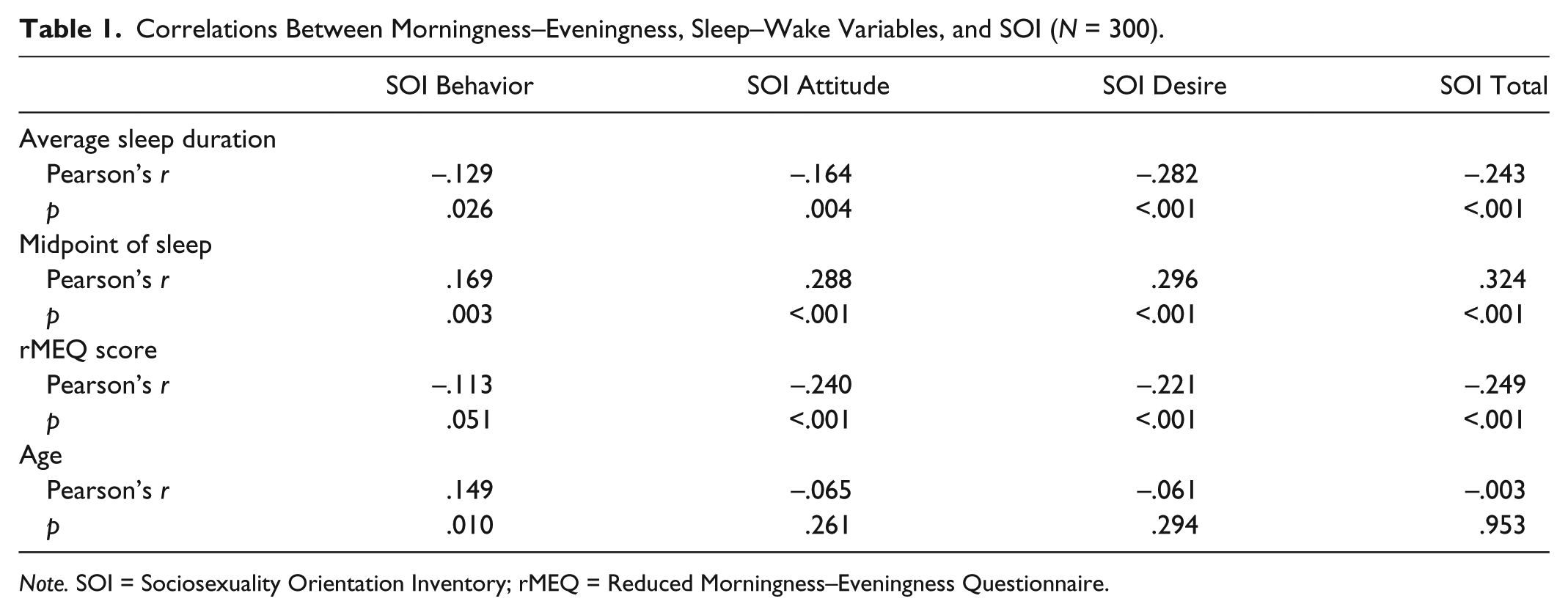
The independent predictor variables were correlated with each other. Scores on the rMEQ correlated with MSF (r = −.495, p < .001) and sleep duration (r = .202, p < .001). Thus, evening types had a later midpoint of sleep and shorter sleep duration. MSF correlated with sleep duration (r = −.188, p = .001). Correlational analyses revealed a significant relationship between SOI and M/E (Table 1).
Correlations Between Morningness–Eveningness, Sleep–Wake Variables, and SOI (N = 300).
Note. SOI = Sociosexuality Orientation Inventory; rMEQ = Reduced Morningness–Eveningness Questionnaire.
Evening orientation was related to a higher SOI score in general and to the three subscales. Similarly, short sleep duration was related to higher scores on the SOI subscales (Table 1). Age was related to a higher SOI Behavior.
All multivariate models revealed a significant influence of age, gender, and sleep variables on the three SOI subscales as dependent variables (Table 2). The strongest effect was produced by gender (about 26% explained variance in SOI scales). The influence of the sleep variables differed. Explained variance was highest with the MSF (7%), followed by sleep duration (4.1%) and rMEQ score (3.9%) and rMEQ type classification (3.4%). Age accounted for about 5% of the variance.
Results of the Four Multivariate Models With Age, Gender, and Sleep Variable/Chronotype as Independent Variables.

Note. The rMEQ was used as a continuous measurement as well as a factor. All three scales of the SOI-R (Attitude, Behavior, and Desire) were used as dependent variables in the multivariate models. rMEQ = Reduced Morningness–Eveningness Questionnaire; MSF = midpoint of sleep on free days; SOI-R = Sociosexuality Orientation Inventory–Revised.
Subsequent univariate models were carried out with SOI subscales examined separately (Table 3). Age had a significant influence on SOI Behavior, but not on the other two subscales. Gender differences were similar in all models with an influence on SOI Attitude and SOI Desire but not on SOI Behavior.
Results of the General Linear Models (Univariate Models) Based on the Three Subscales of the SOI as Dependent Variables, and Age, Gender, and Sleep Variables as Independent Variables.

Note. The four models were based on four sleep variables, these were rMEQ (continuous and type classification), midpoint of sleep (MSF), and sleep duration. Significant results are printed in bold. SOI = Sociosexuality Orientation Inventory; MSF = midpoint of sleep on free days; rMEQ = Reduced Morningness–Eveningness Questionnaire.
Men had higher scores on SOI Attitude and SOI Desire (Table 4). Sleep variables (rMEQ, sleep duration, MSF) exerted an influence on SOI Attitude and SOI Desire. Evening orientation and shorter sleep duration was related to higher scores on the Attitude and Desire subscales. Concerning Behavior, only MSF was significantly related to SOI Behavior. However, rMEQ type classification also tended to be significant (p = .063). The linear models confirmed the correlational analyses. In the analysis based on rMEQ type classification (instead of the continuous scores), also the interaction between gender and chronotype (evening, neither, and morning type) was tested but was not significant in the multivariate model as well as in the subsequent univariate models.
Gender Differences in the Three SOI Subscales Based on the Estimated Marginal Means (±SE) From Various Models (Differing in Sleep–Wake Variables Used as Predictors).

Note. SOI = Sociosexuality Orientation Inventory.
Discussion
We, here, show for the first time a correlation between sleep duration and SOI-R, a fact that has not been reported previously. This is interesting, and it shows that short sleepers have higher scores on SOI-R. However, the direction is unclear. Do short sleepers tend to be more sexually unrestricted or do sexually less-restricted people go out and stay out longer which decreases sleep duration? In our sample, sleep duration was correlated with M/E, which confirms that long sleep was related to high morningness. Although large survey studies claimed that both measures, sleep duration and sleep timing, are largely independent from each other (Roenneberg et al., 2004), there is some evidence that indeed evening types experience less sleep (e.g., Collado, Díaz-Morales, Escribano, Delgado, & Randler, 2012; Merikanto et al., 2012; van der Heijden, de Sonneville, & Swaab, 2013). Interestingly, in a bird species, the pectoral sandpiper, Calidiris melanotos, the shortest sleepers also had the highest mating success (Lesku et al., 2012). However, in a previous study, Randler et al. (2012a) were unable to relate sleep duration to mating success, but M/E was a significant predictor of mating success. This is no real contrast, because Randler et al. (2012a) focused on the aspects of behavior, such as number of partners, extra-pair matings, and age at loss of virginity. These aspects can all be summed up as (and are comparable with) a facet of the Behavior component of the SOI-R. And, similarly, the SOI-R Behavior was unrelated to sleep duration in the present study.
Second, we report an association of M/E with SOI-R Attitude and Desire in all measurements. This is related to previous work that showed that evening females are less restricted in their sociosexuality than morning females (Jankowski et al., 2014). As there was no interaction between gender and chronotype in the model based on classifications of chronotype, we assume that evening males and evening females might follow similar mating strategies. This is an interesting result, because it confirms the hypothesis of Maestripieri (2014) who found that female night-owls had average cortisol profiles and risk-taking tendencies more similar to those of males than to those of early morning females. Therefore, Maestripieri suggests that these findings provide some support to the hypothesis that eveningness is associated with psychological and behavioral traits that are instrumental in short-term mating strategies. Our results support this view that evening-oriented individuals of either sex might follow a short-term mating strategy. However, the direction of this association is still unclear. Is it the evening orientation that allows individuals to stay out long and, therefore, have more possibilities to meet and mate? Randler et al. (2012a) provided some evidence that eveningness is an additional predictor of mating success, even when controlling for extraversion and propensity to stay out late. Thus, eveningness enables to stay out late, but is an important and unique variable in addition to this aspect.
Concerning gender, in a study covering 48 nations, Schmitt (2005) reported significant sex differences in sociosexuality with a moderate to high effect size (see also Zheng, Zhou, Wang, & Hesketh, 2014). The present study reports sex differences in Attitude and Desire, with men scoring higher in both measures, but no differences in behavior have been detected. This is similar to another German population (Penke & Asendorpf, 2008). Similar to Penke and Asendorpf (2008), the Desire subscale revealed relatively high effect sizes (about 25% of variance explained), comparable with Penke and Asendorpf (2008).
Age showed only a small influence on SOI, with a higher score on the Behavior scale (similar to Penke & Asendorpf, 2008), but our small age range must be considered. However, in our linear models, we controlled for this age effect, so that the relationship between M/E and sociosexuality remained unaffected. Similar results were obtained by Jankowski et al. (2014) where older age was related to less-restricted Behavior and Attitude. Other cross-sectional results suggested that with older age in men and women, sociosexual Behavior becomes more unrestricted, whereas sociosexual Desire decreases, and sociosexual Attitude proves to be independent of age (Meskó, Láng, Kocsor, & Rózsa, 2012). The negative relationship between Desire and age could be simply a result of basic biological effects, such as the decrease of testosterone in men (Goh, Tong, Mok, & Said, 2007) or the menopause in women (Randler & Bausback, 2010).
In a more general discussion, the personality of the evening types could be considered as a whole phenotype, because many aspects of evening type personality may be generally related to mating success. For example, evening types are considered as more intelligent (meta-analysis: Preckel, Lipnevich, Schneider, & Roberts, 2011) and having a higher sense of humor compared with morning types (as measured by the Sense of Humor Questionnaire [SHQ-6]; Randler, 2008; Svebak, 1996), both of which are seen as attractive in the mating scenario (Greengross & Miller, 2011). However, these aspects could be studied in future work.
Although we have collected data on bed times and rise times, we did not show them in the present study because we focused on the main outcome variables (rMEQ, sleep duration, midpoint of sleep), and the single clock times are all correlated with each other, and the bed times are correlated with the composed measures (rMEQ, sleep duration, midpoint of sleep) to a large extent. For example, bed times on weekdays and on the weekend correlated >.5 with all three composed measures. Therefore, using all available data would inflate Type I error. Nevertheless, the data show that sleep–wake variables have an influence on sociosexuality, and we extend previous work by analyzing different aspects of the sleep–wake rhythm.
Limitations
Weaknesses of the study include the recruitment (an online survey), and we have no data on the size of the target population or how representative the sample was. Furthermore, the overall sample size is low, especially the sample size of men in the extreme group. Also, age range was limited because of the student sample. Future studies might focus on a more diverse age group across decades because SOI and circadian preference change with age.
Footnotes
Acknowledgements
The authors are grateful to Sasha Badbanchi for computerizing the measures and preparing the website.
Declaration of Conflicting Interests
The author(s) declared no potential conflicts of interest with respect to the research, authorship, and/or publication of this article.
Funding
The author(s) received no financial support for the research and/or authorship of this article: The work of K.S.J. was supported by a grant from University of Warsaw.