



Abstract
As residents of the Sino-Tibetan borderlands, the Naxi people have their own native religion, which manifests a mixture of indigenous beliefs with Tibetan Bon and Buddhism. A pictographic Scripture on the Five Emperors in the Five Directions discovered in Lijiang reveals in detail for the first time the influence of Chinese Taoism on the Naxi manuscripts. By analyzing the manuscript and the related religious rituals, it is proved that the prototype of the main figure in the manuscript comes from the Taoist classic of TaiShang DongYuan Zhao ZhuTianLongWang WeiMiao ShangPin 太上洞淵召諸天龍王微妙上品and its narrative is derived mainly from “LingBao WuDi GuanJiang Hao靈寶五帝官將號,” of the TaiShang LingBao WuFuXu太上洞玄靈寶五符序. It is also the only Naxi manuscript published to date that shows Han Chinese dragon worship among the Naxi people, though the detailed narrations are not identical to those in Chinese or Tibetan sources.
Introduction
There are more than 30,000 individual Naxi manuscripts that can be divided into some 1,000 types. These documents record the religious rituals of the Naxi people and are remarkably rich in content. As Joseph Charles Francis Rock (1952:1) asked, “whence did the Naxi derive their voluminous literature?” In his book The Na-khi Naga Cult and Related Ceremonies, he argues that the Naxi people’s religious documents are so multi-faceted that they must have been produced in different times and places. It is a composite religious edifice whose foundation rests primarily on primitive nature-worship, and on the ancient pre-buddhistic religion of Tibet, know as the Bon. Naxi religious literature has been influenced by Burmese Nat worship, Chinese Taoism, and finally Tibet Buddhism, its core is however Bon with an admixture of aboriginal tribal shamanism (Rock, 1952, p. 5).
Tibetan Buddhism and Bon religion have a profound influence on the Naxi people, as evidenced by the fact that Naxi rituals are partially derived from Tibetan, and some Naxi manuscripts have been found to record the Tibetan language. Zhiwu (1989, p. 45) argues that Bon religion had a significant influence on Naxi religion and claims that eight Naxi manuscripts demonstrate the evidence of Tibetan influence. Jiquan (2017, pp. 36–63) confirms He Zhiwu’s assumption by translating and analyzing eight Tibetan-influenced Naxi manuscripts, including those previously discussed by He.
However, Jiehong (2017, p. 40) believes that on the basis of inheriting the original beliefs of the Naxi people, Naxi religion has formed a unique religious and ethical system which is characterized by multiple gods, an emphasis on divination, relatively standardized and unified ritual protocols and religious classics by absorbing the contents of early Bon religion and gradually incorporating some elements of Buddhism, Taoism and other diversified religious cultures. Although it is difficult to define the nature of the Naxi religion, it is clear that the Naxi religion is not only a native religion, but it is also mixed with the beliefs of other neighboring residents.
The answer to the question of where the thousands of Naxi manuscript come from is much more complex than that, however. From the existing research outcomes, scholars have found that the Naxi manuscripts record not only the Naxi language, which is the language of the Naxi people, but also the languages of other peoples. Li (1984, p. 106) classifies such scriptures, which do not record Naxi, as “manuscripts in other languages,” and divides them into four categories: Tibetan, Chinese, Minjia and Lisu languages. There are very few scriptures related to the Chinese language, and so far there are only two, one being the Five Emperors in the Five Directions (WuFang WuDi Jing五方五帝經), and the other being the YuXieJi玉匣記“LiuRen ShiKe”六壬時課(Jiquan, 2017, p. 114). This manuscript is the only Naxi book of Taoist classics that records Chinese language found so far, and is therefore of great research value.
The purpose of this paper is to explore the origin of the Naxi manuscripts, and ask several questions such as “did they originate locally by themselves” and “did they borrow some cultural elements from other neighboring inhabitants?.” The study of the origin of the Naxi manuscripts confirms that the composition of the Dongba religion is complex and that there is Han Chinese influence in the Naxi scriptures as well.
Materials
Five Emperors in the Five Directions was discovered by Li (1984, p. 106). In his Collected Papers on Moso Studies麼些研究論文集, he wrote:
Five Emperors in the Five Directions appeared in Ludian魯甸 County area, and a new character was created for it. Its number in A Dictionary of Hieroglyphs象形文字字典 is “1587,” which shows that their pronunciation is also accurate and subtle. The manuscript of Five Emperors in the Five Directions contains sentences such as “the southern general goes south, in a red robe, on a red horse.” Many in the Lijiang area worshipped Lord Wenchang文昌. Were these lines taken from scriptures dedicated to Lord Wenchang? We can’t draw the conclusion, since we don’t have hard evidence yet. Some Naxi classics use the Naxi script to record the sounds of the Han people, so the shape and pronunciation of the original characters have been changed. This character was found only in Five Emperors in the Five Directions. It was created and translated by the chief Dongba of Ludian County, He Shijun和世俊. (Li, 1984, p. 106)
While sorting out and studying Naxi manuscripts, we discovered that the first half of the “Longevity Rituals: Seeing Off the Dragon” [zɿ33tʂu55py21lv55ua21me55] was none other than the Five Emperors in the Five Directions that Li Lin-ts’an has mentioned. According to its postscript, the scripture was written by He Shijun, the Dongba of Xinzhu Village, Ludian County. 1 Li Lin-ts’an had probably seen the scripture in He Shijun’s home. He maintained close friendship with He Wenzhi和文質, He Shijun’s grandson. 2 He had stayed in Dongba He Wenzhi’s home for 8 months, and was deeply impressed by He Wenzhi’s collection of Naxi manuscripts, as well as the Dongba’s own extraordinary talent. According to He’s own account, he “had the exceptional blessing of reading nearly all Naxi manuscripts and was able to immerse himself in the world’s best treasures, in quiet seclusion, away from the crowd” (Yang, 2000, pp. 107–108). 3 We can reasonably assume that it was in He Wenzhi’s home that Li Lin-ts’an first read Five Emperors in the Five Directions. After the death of Dongba He Wenzhi, his collection of manuscripts was purchased by related organizations. Five Emperors in the Five Directions somehow came into the possession of Lijiang Dongba Culture Research Institute. It was collected in the 15th volume of The Complete Collection of Naxi Dongba Classics Translated and Annotated (Lijiang Dongba Culture Research Institute, 2000, pp. 95–112), and was renamed the “Longevity Rituals: Seeing Off the Dragon” (See Figure 1). 4 This is how we came across Five Emperors in the Five Directions.

Cover page (Lijiang Dongba Culture Research Institute, 2000, pp. 15–67).
Li Lin-ts’an had noticed the uniqueness of the manuscript, but he hadn’t conducted any in-depth study into it, leaving much room for the future research. It is of great value due to the fact that it is the only Naxi manuscript recording Chinese.
Methods
This paper focuses on exploring the sources of Five Emperors in the Five Directions through documentary analysis. Firstly, the linguistic form of this manuscript was analyzed in terms of language and script, which revealed that the language recorded was Chinese. By analyzing the characters in the text, some special characters in the Dongba script were discovered. The linguistic and textual findings, as well as the hints from previous research, suggest that the manuscript is of Han Chinese origin. On this basis, the second step was to locate a corresponding Chinese text. Through the study on the origin of the key words in the text, it is suggested that it may have come from a Taoist classic. In the third step, the Taoist classics in the Chinese canon are searched, studied, and analyzed in comparison. In general, the Naxi manuscript were created for ritual purposes, and therefore the corresponding rituals of the Naxi manuscript are cognate with those of the Han. Finally, through historical records, it was confirmed that the Naxi did hold rituals due to the drought.
Analysis
Linguistic Evidence
In the main, Five Emperors in the Five Directions records the Chinese language, rather than the local Naxi language. A translator’s summary of the content of this manuscript says: The first half of this ancient scripture is sending away the Dragon in Chinese, with notable phonetic variations, some of which are not translatable in sense and have to be translated phonetically only (Wang, 2000, p. 68). Noticing its difference from other manuscripts, Wang Shiying王世英, a staff at the Dongba Culture Research Institute believes that the manuscript records a certain form of the Chinese language, but with nearly undecipherable variations, unlike the Chinese in general use in the area.
With a thorough study of the phonetic features of the manuscript, we conclude that the language recorded is a form of Chinese with local Naxi accents. The manuscript has 218 sentences in total. Several are unrecognizable mantras, three are in Naxi language, and the rest are all Chinese. However, the Chinese recorded is not the Southwest-China Mandarin, popular in Yunnan. The pronunciation of both consonants and vowels is deeply affected by the native Naxi language. Most vowels are single. There are no Yang vowels 陽聲韻 (those ending with n/m/g), or prenuclear glide. The tones recorded are identical to those in the Naxi language. The following are two examples:
(1) to³³fæ³³ta³³tse²¹ʨy³³pu³³fṿ³³pu³³y⁵⁵
东 方 大 将 军 保 福 保 佑
Eastern grand general gives blessings.
(2) to³³fæ³³ u³³lu²¹ɕi³³hu³³ʂʅ³³ʨy³³, næ²¹fæ³³ u³³lu²¹ɕi³³hu³³ʂʅ³³ʨy³³
东 方 五 龙 喜欢 世 间,南 方 五 龙 喜 欢 世间
Eastern five dragon like our world; Southern five dragon like our world.
Other than the above sentences which follow the normal Chinese sentence structure of “subject + predicate + object,” there are also sentences with “subject + object + predicate” structure, which is a manifest influence from the native Naxi language, where the structure of “subject + object + predicate” is typical. Most of the words in the scripture come from Chinese, such as “da jiangjun大将军” (Grand general), “de cai de zi得才得子” (getting wealth and offspring), and “bao fu bao you保福保佑” (gives blessings). But there are also hybrid words that combine Chinese and Naxi elements. 5 From the perspective of language, we can conclude that the manuscript bears close connections with the Han nationality.
Five Emperors in the Five Directions uses mainly Dongba pictographs, but with a few Geba glyphs.
6
A few symbols are very special. As Li Lin-ts’an noted, Dongba He Wenzhi created the symbol  for the Chinese character qu去 (go). In addition, there are symbols made by qieyin切音, including
  Qieyin is a way of creating new characters in Chinese, by combining the consonant of the first character and the vowel of the second character. Qieyin symbols are quite rare in Naxi manuscripts. At the moment, they are only found in manuscripts that record Tibetan language sounds. In other words, finding it impossible to record Tibetan language sounds, Dongba scribes would make changes to their native Naxi language and create new symbols. The Qieyin symbols in Five Emperors in the Five Directions serve a similar purpose, namely, to record the Chinese language more accurately.
7
Dongba He Shijun had created “Guzong” symbols 古宗字
8
for the Tibetan language (Li, 1972:128), some of which are qieyin scripts. In Five Emperors in the Five Directions, he also created special symbols to record Chinese sounds, including qieyin scripts. He was trying to use Naxi language to accurately record the languages of other nationalities. Though the forms and types of glyphs bear no necessary connection to the content, the appearance of qieyin characters can remind readers that a language different from the native Naxi tongue is being recorded and that its content may contain elements from the cultures of other peoples too.
Qieyin is a way of creating new characters in Chinese, by combining the consonant of the first character and the vowel of the second character. Qieyin symbols are quite rare in Naxi manuscripts. At the moment, they are only found in manuscripts that record Tibetan language sounds. In other words, finding it impossible to record Tibetan language sounds, Dongba scribes would make changes to their native Naxi language and create new symbols. The Qieyin symbols in Five Emperors in the Five Directions serve a similar purpose, namely, to record the Chinese language more accurately.
7
Dongba He Shijun had created “Guzong” symbols 古宗字
8
for the Tibetan language (Li, 1972:128), some of which are qieyin scripts. In Five Emperors in the Five Directions, he also created special symbols to record Chinese sounds, including qieyin scripts. He was trying to use Naxi language to accurately record the languages of other nationalities. Though the forms and types of glyphs bear no necessary connection to the content, the appearance of qieyin characters can remind readers that a language different from the native Naxi tongue is being recorded and that its content may contain elements from the cultures of other peoples too.
Linguistic evidence can only prove that the manuscript records a classic work from the Han nationality. Further study of the manuscript is needed to find the corresponding work.
Textual Evidence
Li Lin-ts’an believes that “Five Emperors in the Five Directions” is related to Taoism, but whether it’s related to the worship of Lord Wenchang in Lijiang area is yet to be proved. His theory is certainly feasible. The meaning of “Five Emperors in the Five Directions” suggests Taoist connections. In the central part of China, there were ancient records about “Five Emperors in the Five Directions,” such as “The Grand Steward” of “Celestial Offices” in Rites of the Zhou周禮, “Proceedings of Government in Different Months” in The Book of Rites禮記, and The Classic of Mountains and Seas山海經. During the Six Dynasties, these sporadic records developed and evolved into a Taoist classic. Therefore, this article focuses on the Taoist classics of the Han nationality, to find out relevant information through the comparison of key terms.
Five Emperors in the Five Directions has not been fully interpreted. 9 But after sorting out its contents, we were able to find a clear overall structure. The manuscript can be divided into four parts. The first part contains incantations. The second part is about how the five dragons of the five directions came to our world because they liked it. The third part deals with sending the dragons back, and the fourth part is a collection of blessings and incantations. The core content of this passage is “The Five Dragons in the East likes the world, the Five Dragon in the South likes the world, the Five Dragons in the West likes the world, the Five Dragons in the North likes the world, and the Five Dragons in the Middle likes the world.” The Five Dragons in the five directions appear in different shapes. The key meaning of the manuscript is the Five Dragons in Five Directions (otherwise called the Grand Generals), appear with the symbols of Tian Gan天干 (the Heavenly Stems), Di Zhi 地支(The Earthly Branches), Wu Xing五行 (the Five Elements), Wu Se五色 (the Five Colors), and their mounts. Therefore, we need to determine the identity of the main figure in the manuscript.
The Main Figure in Five Emperors in the Five Directions
The main figure in Five Emperors in the Five Directions is the dragon in five directions. In longevity rituals, the Dragon must first be invited and then sent off. Before we discuss it further, we need to confirm that the dragon in the manuscript is the “dragon” of the Han nationality. In Naxi manuscripts, there are three types of “dragon.” The first is [ʂʅ²¹ʐʅ²¹] (Figure 2), the local dragon, an early prototype of the local people largely based on the image of the snake. The second is the dragon of the Han Nationality, Naxi language called [lv²¹] (Figure 3), which found its way into the local culture after their contact with Han people. The third is a foreign dragon, designated in Naxi language as [ʂv21] (Ge, 1996). [ʂv21] are natural deities, related to the Indian Naga. In Buddhism, they are deities with a human body and a snake’s tail. [ʂv21] have varied types, numbers, names, locations and colors. As the gods of the water, “Naga” are worshiped as the guardians of water, rain, spring and well (Bai, 1990, p. 349). [ʂv21] have many depictions, often with a snake tail, but with the head of different animals, such as the tiger or the horse.
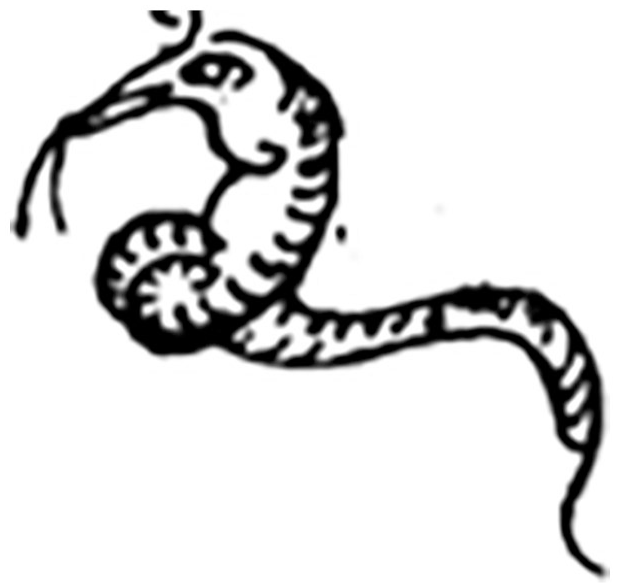
[ʂʅ²¹ʐʅ²¹] (Ge, 1996).

[ʂv21] (Ge, 1996).
The dragon in Five Emperors in the Five Directions is the Dragon of the Han Nationality for a number of reasons. First, in the whole text, “dragon” is pronounced as [lu21], which is loaned from the Chinese language. There is no Yang Sheng Yun (nasal vowels) in Naxi language, and the nasal sounds at the end of the vowels are generally omitted. Second, on the left of the first page of the main text, there is an illustration, the image of a Chinese Dragon (Figure 4). Fully covered in scales, it has a snake-like tail, four feet, long and slender ears, two horns on the head, a slightly out-turned nose, and two long whiskers that curve inwards, with ethereal breath coming out of its mouth, layers of clouds under its feet and flags on its back. The image is in line with the description in the main text: “The five dragons in five directions like the world and they come to the world with their five-colored flags” (Figure 2). The image is nothing like [ʂʅ²¹ʐʅ²¹] (the native dragon) or [ʂv21] (exotic dragon), which usually has the body of a snake and the head of another animal.
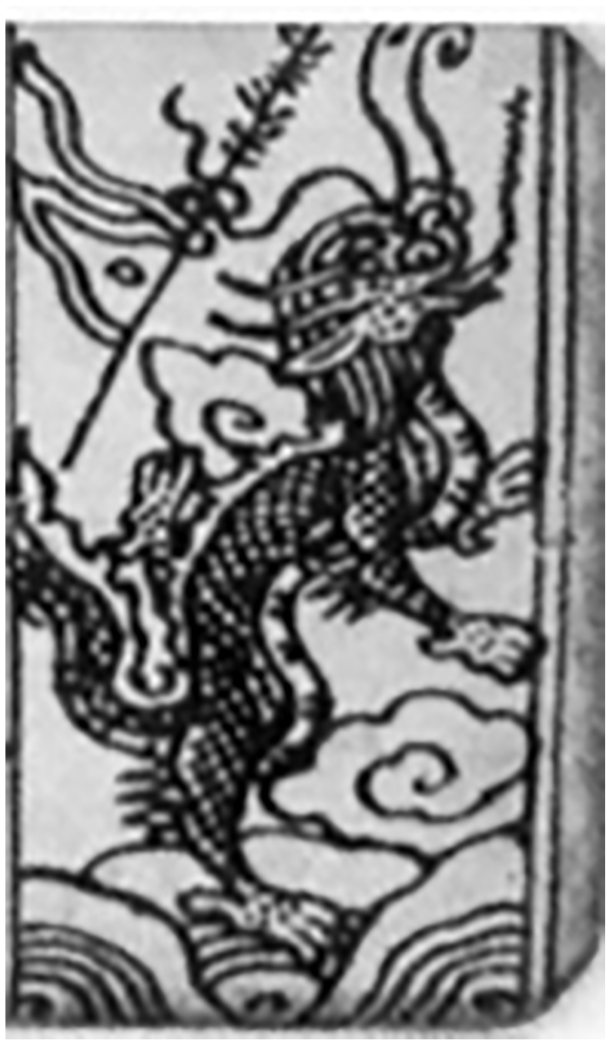
Chinese Dragon (Lijiang Dongba Culture Research Institute, 2000, pp. 15–68).
In the Naxi manuscripts that have been published, all dragons refer to the foreign [ʂv21]. Bai Gengsheng 白庚勝argues that the dragon called “Lu” in Dongba mythology is the dragon in the strict sense. But judging from the pronunciation and the shape of the symbol, it is likely that “Lu” came into being later, with the influence of Han culture. Therefore, it has no direct connection with [ʂv21]. That’s why no work in Dongba mythology mentions its origin or tells its deeds (Bai, 1990, p. 353). We have checked it up in a large amount of material and we believe Five Emperors in the Five Directions is the only published work that pays tribute to the Chinese Dragon.
The image of the Five Dragon in Five Directions comes from the Dragon King in Five Directions in Taoism. TaiShang DongYuan Zhao ZhuTianLongWang WeiMiao ShangPin 太上洞淵召諸天龍王微妙上品 (literally, the Highest Cavernous Abyss Summoning the Dragon King from the Heavens Sutra), a Taoist classic, records the Eastern Blue Emperor Dragon King, the Southern Red Emperor Dragon King, the Western White Emperor Dragon King, the Northern Black Emperor Dragon King, and the Central Yellow Emperor Dragon King(Zhang, 2014, p. 7).The following table is a comparison of the main figures in the two texts (Table 1).
A Comparison of the Main Figures in Five Emperors in the Five Directions and Taoist Dragon King Sultra.

The following is a comparison of the protagonists of the two classics in the form of a list:
Both scriptures have Five Dragon and Five Colors, with some differences in name. The Five Dragon in Five Emperors in the Five Directions is a collective denomination. It doesn’t mean there are five dragons in each of the five directions. Instead, it refers to a certain “Five Dragon,” in each of the five directions of east, south, west, north, and center. In the Taoist Dragon King Sutra, there is one Dragon King in each of the five directions. The Taoist idea of five dragon kings in five directions has spread far and wide. Five Emperors in the Five Directions has adopted the core concept from TaiShang DongYuan Zhao ZhuTianLongWang WeiMiao ShangPin. Other than this, the two scriptures bear no direct connection.
The idea of Five Dragon in Five Directions and the Taoist idea of Five Emperors in Five Directions are closely connected. So we explored other Taoist classics and looked further into the idea of Five Emperors in Five Directions. Scriptures that found their way to the ethnic minority area in the south-west are often plain in language and popular in content. While search for records on the idea of Five Emperors in Five Directions, we found that two Taoist classics are quite similar in content, namely, YuanShi WuLao LingBao GuanHao 元始五老靈寶官號 (literally, Primordial Five Elders Numinous Treasure Official Titles), and TaiShang LingBao WuFuXu太上靈寶五符序 (literally, Supreme Numinous Treasure Five Talismans). The former describes Five Emperors in Five Directions in detail. The latter includes one article particularly similar to Five Emperors in the Five Directions in content. The title of the article is LingBao WuDi GuanJiangHao (literally, Numinous Treasure Five Emperors Official and General Titles). The full content of the articles is as follows (Zhang, 2014, p. 59):
Eastern Lingweiyang, called the Blue Emperor, Heavenly Stems Jia and Yi, favored color of apparel Blue, riding the blue dragon, color of flag blue, its element Wood, corresponding star the Star of Sui, number of following gods 900,000, in line with Spring from above, giving birth to All Things below. 東方靈威仰,號曰蒼帝,其神甲乙,服色尚青,駕蒼龍,建青旗,氣為木,星為歲,從群神九十萬人,上和春氣,下生萬物。 Southern Chipiaonu, called the Red Emperor, Heavenly Stems Bin and Ding, favored color of apparel Red, riding the red dragon, color of flag red, its element Fire, corresponding star the Star of Yinghuo, number of following gods 300,000, in line with Summer from above, nourishing All Things below. 南方赤飄弩,號曰赤帝,其神丙丁,服色尚赤,駕赤龍,建朱旗,氣為火,星為熒惑,從群神三十萬人,上和夏氣,下長萬物。 Central Hanshuniu, called the Yellow Emperor, Heavenly Stems Wu and Ji, favored color of apparel Yellow, riding the yellow dragon, color of flag yellow, its element Earth, corresponding star the Star of Zhen, number of following gods 120,000, wearing the crown of the Nine Heavens from above, harmonizing the Earth below. 中央含樞紐,號曰黃帝,其神戊己,服色尚黃,駕黃龍,建黃旗,氣為土,星為鎮,從群神十二萬人,下和土氣,上戴九天。 Western Yaopobao, called the White Emperor, Heavenly Stems Geng and Xin, favored color of apparel White, riding the white dragon, color of flag white, its element Metal, corresponding star the Star of Taibai, number of following gods 700,000, in line with Autumn from above, collecting All Things from below. 西方曜魄寶,號曰白帝,其神庚辛,服色尚白,駕白龍,建素旗,氣為金,星為太白,從群神七十萬人,上和秋氣,下收萬物。 North Yinhouju, called the Black Emperor, Heavenly Stems Ren and Kui, favored color of apparel Black, riding the black dragon, color of flag black, its element water, corresponding star the Star of Chen, number of following gods 500,000, in line with Winter from above, preserving All Things from below. 北方隱侯局,號曰黑帝,其神壬癸,服色尚玄,駕黑龍,建皂旗,氣為水,星為辰,從群神五十萬人,上和冬氣,下藏萬物。
A comparative list of the two manuscripts in the following table shows their many similarities (Five Emperors in the Five Directions is abbreviated as “Jing,” and LingBao WuDi GuanJiang Hao is abbreviated as “Titles”).
From the above Table 2, we can conclude that the main figures in the two manuscripts are different but deeply related. The Heavenly Stems and the Five Elements are allocated in the same manner, thought the Five Colors are allocated differently to the Five Directions. The Naxi manuscripts have borrowed the Heavenly Stems from the Han culture. The images of the figures are similar too, wearing the clothes in the color of a particular direction and carrying the flag of the same color. The following is a detailed discussion from the perspectives of Five Elements, Five Colors, and images.
A textual comparison of Five Emperors in the Five Directions and the Taoist LingBao WuDi GuanJiang Hao.

Heavenly Stems, Earthly Branches, and Five Elements
The theory of the Heavenly Stems and Earthly Branches and the idea of the Five Elements originated from Han nationality, but they had far-reaching influences upon neighboring ethnicities, including the Naxi people. As Table 2 shows, the Heavenly Stems, Earthly Branches and Five Elements in Five Emperors in the Five Directions are the same as those of the Han nationality. In his study of the divination methods of the Naxi people, Li Lin-ts’an discussed in particular the Heavenly Stems, the Earthly Branches and the Five Elements in Naxi manuscripts (Li, 1984, p. 119).
It is exactly how the Han people use them. The Earthly Branches match the twelve zodiac signs, and the Heavenly Stems match the Five Elements. Five times twelve equals sixty, which is the sexagenary cycle in Han calendar. Moxie people’s combination of the Heavenly Stems and the Five Elements means Jia Yi Wood in the East, Bing Ding Fire in the South, GengXin Metal in the West, RenKui Water in the North and WuJi Earth
12
in the Center. It’s just that some people here gave more play to their literary talents and created more imaginative stories (see The Classics of the Origins of Divination).
13
In Li’s argument, the idea of “Jia Yi Wood in the East, BingDing Fire in the South, GengXin Metal in the West, RenKui Water in the North and WuJi Earth in the Center” is closely related to the Scripture under discussion. It so happens that when Li asked Dongba He Wenzhi about the Heavenly Stems, the Earthly Branches and the Five Elements, the Dongba replied that these ideas came from the Han nationality (Li, 1984, p.119). Therefore, we can conclude that the theories of the Heavenly Stems, the Earthly Branches and the Five Elements all came from Han culture.
The Five Colors
As shown in Table 2, the five colors in five directions in Five Emperors in the Five Directions are completely different from those in the Taoist LingBao WuDi GuanJiangHao, in terms of their order. From the second half of the “Longevity Rituals: Seeing Off the Dragon,” the East is assigned the color of “white conch,” the South the color of “turquoise,” the West the color of “black jade,” the North the color of “gold yellow,” and the center the color of “motley black jade” (Wang 2000, p. 68). The four colors assigned to the four directions remain largely the same, but the color assigned to the center varies in different classics. Take the colors assigned to the “Divine Pillars in Five Directions” in Chong Ban Tu [tsho21bər33thv33] for example: “In the East was erected the Pillar of White Conch; in the South, the Pillar of Turquoise; in the West, the Pillar of Black Jade; in the North, the Pillar of Yellow Gold; in the Center, the Pillar of White Iron.” Bai (1990, p. 245) believes that the coloring of the five pillars is largely consistent with the India-Tibet system of five colors and five directions. Besides, the substances that make up the five pillars are treasures of Bon religion and Buddhism. It can be concluded that Western culture, especially Indian-Tibetan culture, has been integrated into it. Bai’s argument makes sense. The five colors in Naxi language come from real objects, namely, conch, turquoise, black jade, gold, and motley black jade. Though closely related to Bon religion or Buddhism, these five treasures do not exactly match the four directions and four colors of Buddhism, that is, white for the east, blue for the south, red for the west, and black for the north. The Tibetans formed the current four directions and four colors only after Buddhism was introduced into Tibet (Xie, 1996, p. 57). As Table 3 shows, both the Naxi people and the Tibetans assign white to the East. It can be said that among the Naxi five colors, white in the East is influenced by Buddhism.
Five Colors and Five Directions Compared Among Han, Naxi and Tibetan Cultures.
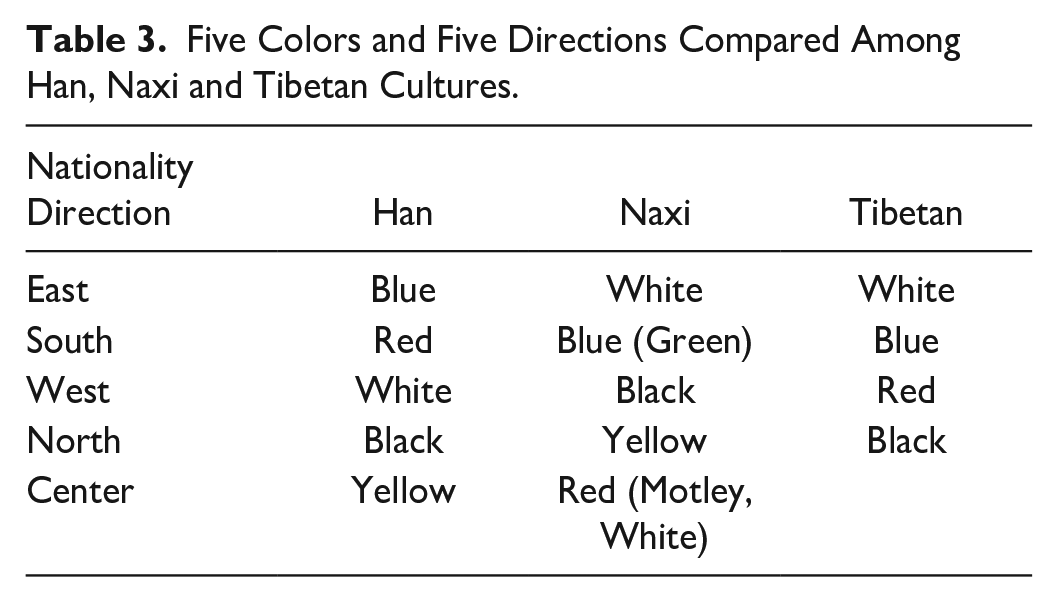
Japanese scholar Fumiko Shirakawa believes that the black and white symbols of the Naxi people are influenced by Tibetans, and the five-color symbols are influenced by Taoism in general. In both cases, the Naxi people have built in their own characteristics. 14 This argument is quite convincing. The overall idea of five colors in five directions might have come from the Han culture, but in assigning colors to directions, the Naxi people have adopted Buddhist elements while retaining their own characteristics.
Images
As shown in Table 2, in Five Emperors in the Five Directions, the images of the five dragons are portrayed in detail, including the colors of their hats, clothes and shoes, the flags they hold and the mounts they ride. These images are unique in all Naxi manuscripts. In contrast, the images in the Taoist LingBao WuDi GuanJiangHao are described in a simpler manner, including the colors of their overall apparel, the flags they hold and the dragons they ride. Except for some minor differences in color and mount, the images in both scriptures are largely similar.
The image of the main figure in Five Emperors in the Five Directions corresponds to the accounts in TaiShang DongYuan Zhao ZhuTianLongWang WeiMiao ShangPin, from which we can conclude that the Scripture is connected with the Taoist worship of the Dragon King. A comparison of Five Emperors in the Five Directions and LingBao WuDi GuanJiangHao reveals that despite minor differences in the main figures, the assignments of colors to directions and the mounts, they share remarkable commonality in their story framework, the idea of the Heavenly Stems, Earthly Branches and Five Elements, and the images of the main figures.
Corresponding Rituals
The dragon is one of the most important deities of the Chinese nation. Oracle bone inscriptions from the Yin and Shang Dynasties had narratives about dragons and rain. The classics of the Five Dragon Kings appeared in the Wei and Jin dynasties. During the Tang and Song Dynasties, the Five Dragon Kings were associated with the Five Emperors, and the connection was officially recognized in the Song Dynasty. In the Tang Dynasty, the five dragons of blue, red, yellow, white and black were sacrificed at mid-autumn every year. Five-dragon temples were built across the country. In the dry season, people built images of five dragons and danced in front of them to pray for blessings (Min, 2008, pp. 200–205). The widespread belief in the dragon among the Chinese is best manifested in the countless Dragon King temples across the country.
While Five Emperors in the Five Directions remains to date the only Naxi manuscript that worships the Chinese dragon, the Naxi people do keep the tradition of asking the Dragon King for rain. Their festival, the March Dragon King Gathering, is related to offering sacrifices to the Dragon King. With this festival, the Naxi people have retained the Tang Dynasty tradition of offering sacrifices to the Dragon King. With the Chinese belief in the Dragon King comes the building of Dragon King temples. Today’s Heilongtan Park used to be called “Dragon King Temple.” There used to be a Dragon God Temple at Heilongtan, but it was burnt down and only a stone tablet survived (Figure 5). Later, it was rebuilt at Heilongtan. Outside is the Lijiang Ancient Town Cultural Center (Figure 6), and inside the center is the Yuquan Dragon Palace (Figure 7). The tablet inscription is as follows:

Yuquan Dragon God Temple Stone Tablet Rubbing (courtesy of Li Ying).

Lijiang Old Town Cultural Center (courtesy of Li Ying).

Yuquan Dragon Palace (courtesy of Li Ying).
The Dragon God at Yuquan Spring has always been efficacious. In April this summer, the Spring suddenly dried up. Drought ensued inside and outside of the town and people were panicked. I, Yi, offered the local soil and led people to pray. The monk in the temple heard loud noises coming from the mountain at intervals, like those made by bulls. In 2 months, spring water came back. It was unmistakable that the Dragon answered our prayers. Hence, the following poetic inscriptions:
In the north of County Lijiang, At the foot of Mount Xiang, There is harbored a heavenly spring, with spring water ever gushing. Towering trees shade the sunlit bliss, Deep gullies lead to unknown abyss, In the unfathomably dark dungeon, Lies the abominable home of the Dragon, With thunderous powers and might, the Dragon kept the waters wild, forever responsive to prayers and calls, enough to break wavy walls. In mid-summer of the year of BingXu Of the reign of Emperor Guangxu The springwater suddenly went dead The seas dried up, and rocks scorched red. People ran to each other in panick Even the skies had grown melancholic Like babies with their milk lost, Suddenly finding their fate star-crossed. Has the Heaven lost its golden compassion And punished its people with this misfortune? Has the Dragon lost its generous mercy And no longer nourishes life that’s unworthy? I led people the town out on the road, To where we offered one pig and one goat Soldiers and civilians together like one All prayed for the water to run People with virtues like the Dragon Tend to hide themselves in seclusion Water began to run at will When the pools of the riverbed it did fill It’s not because of the Dragon, the water bearer But because of the virtue of our great Emperor With his righteousness, blessings and authority All gods are serving their duties properly. The Almighty stands in the center high His dutiful agents in earnest comply Upon the advice of Lord Cen and Zhang This remarkable deed was finally done All of his people in his grace fared And his blessings I also shared Couplets in the temple were hung The lasting honor of this wild place far-flung To the glorious Palace of the Dragon so honored Flowers and paper horses were offered These words were therefore inscribed on stone To future generations will our story be known Written by Ouyang Yi of Hu’nan Province, in the autumn of the Second Year of Bing Xu 麗郡城北,象山之下;孕此靈泉,澎湃奔瀉。 樛木翳日,絕壑通幽;窅曲深黝,實為龍湫 龍之為靈,奔濤驟霆;靡祈弗應,力破滄溟 光緒丙戌,月維孟夏;泉脈消竭,海枯石赭 遠近相告,蒼黃哽咽;慘若嬰赤,乳哺斷絕。 天胡哺吊,降此鞠凶!龍弗我恤,翳龍弗龍? 爰率士民,虔誠禱祀;羊一豕一,酌彼行潦。 龍德而隱,逝者如斯;盈科後進,左之右之。 匪龍之靈,惟帝之德;威福遐鬯,百神效職。 巍巍制府,逮及撫軍。岑公張公,薦此芘芬。 澤被群黎,詒我多福;祠額雙懸,貽此荒服。 崔嵬龍宮,永奠花馬。敬勒銘詞,永詔來者。 丙戌二年秋月楚南歐陽儀謹撰
The inscriptions on the stone tablet recorded how the spring dried up and people suffered from drought in April in the year of Bing Xu of the Reign of Emperor Guangxu. 15 Ouyang Yi led the people to pray. They offered a goat and a pig as sacrifice to the Dragon King, who they hoped would give them rain.
Besides, there was another stone tablet erected when a new Dragon King Temple was built. It was titled “Stone Inscription for the Newly-built Yuhe River Dragon King Temple (Yang, 2011, pp. 28–29).” Unfortunately, the tablet can no longer be found. The words inscribed are recorded in Annals of Lijiang County. According to the words, there was a spring at the foot of Mount Xiangshan, about five li north of the town. In April in the summer of the Year of BingChen, 16 there was a drought, which lasted until autumn. In the next year, the spring dried up again. So the people raised funds and built a Dragon King Temple, where they offered sacrifices and prayed for the Dragon King’s blessings. It turned out that after the Temple was built, spring water came back again and even swelled up in the summertime.
Lijiang has a typical warm-temperate plateau climate, with little rain throughout the year, and summer is the rainy season. If there is little or no rain in the summer, the spring drought will be even worse. The above two inscriptions show that the spring drought occurred in April, and the conditions got better in June and autumn respectively.
Conclusion
Through the analysis of the language and text of Five Emperors in the Five Directions, we can conclude that the direct source of the Scripture is Han culture. Textual analysis shows that the prototype of the main figure in the Scripture comes from the Taoist classics of TaiShang DongYuan Zhao ZhuTianLongWang WeiMiao ShangPin. Its storyline mainly comes from “LingBaoWuDi GuanJiangHao,” of TaiShang LingBao WuFuXu. The combination of five directions and five colors comes from the Bon religion. In the scripture, the title of the five emperors is changed to “grand general.” The dragon, which serves as the mount of the Emperor in LingBao WuDi GuanJiangHao, becomes the main figure of the story, and has its own mount. This is an adaptation made by the author/copier of this manuscript, who also added mantras before and after this story, in line with the narrative style of Naxi manuscripts. Therefore, Five Emperors in the Five Directions is a product of ethnic and religious exchanges. The study on the sources of the Five Emperors in the Five Directions only deals with the sources of a single Naxi manuscript, and does not answer the question of the sources of all Naxi manuscripts. To address this general question, thus requires an analysis of all Naxi manuscripts. In particular, the focus should be on the Naxi manuscripts that draw on the cultures of other ethnic groups, and academic scholars should analyze them one by one in order to find out from which ethnic group these manuscripts borrow some cultural elements, in which language they are recorded, and what literature they correspond to.
Footnotes
Acknowledgements
Our gratitude goes to Li Ying from Lijiang Dongba Culture Research Institute and Yang Linjun from Lijiang Teachers’ College careful and extremely helpful support. Many thanks to Dr. Duncan Poupard, who read both an earlier and the final draft of this article and saved me from many mistakes.
Declaration of Conflicting Interests
The author(s) declared no potential conflicts of interest with respect to the research, authorship, and/or publication of this article.
Funding
The author(s) disclosed receipt of the following financial support for the research, authorship, and/or publication of this article: This article is subsidized by the Fundamental Research Funds for the Central Universities (2020ECNU-HWFW016).
