



Abstract
Environmental ethics and moral obligation are action plan that helps to preserve the environment and has influenced consumption style. The utilization of green products and consumption has helped minimize environmental and health threats, which is considered to sustain the environment. In this study, we examine consumer environmental ethics, environmental attitude, social influence, and moral obligation through the mediation of the willingness to use green products toward green behavior. Using a questionnaire survey method to capture 250 consumers in Abuja, Nigeria and SmartPLS3.0 to assess the model validity. The outcomes of our study show that consumer environmental ethics, environmental attitude, and moral obligation positively influence willingness to use green products, which also influence green behavior. The mediating effect was established and willingness to use green products simultaneously mediates the relationships between consumer environmental ethics, environmental attitude, moral obligation and green behavior. Further, social influence does not predict willingness to use green products, and the mediating link between social influence and green behavior was not supported. The study provides implications based on the empirical findings for theoretical and managerial insight as well as for future research.
Introduction
In recent times, consumer environmental ethics and the willingness to consume sustainable products have become a magic formula for achieving success from various economic contextual backgrounds in the business world (Ogiemwonyi & Harun, 2020a). Even though both terms appear to express the same action, the differences and similarities between them have not been extensively investigated especially in developing nations such as Nigeria (Ogiemwonyi, 2022). Researchers have begun to question; whether “the willingness to use sustainable products” could translate to consumer environmental ethics, and lead to sustainable behavior (Ogiemwonyi et al., 2022). A similar trend in some environmental ethical behavior has shown that the consumption pattern has doubled significantly. For instance, in 2015, the market volume for ethical products increased in value from $793.8 billion to an estimated $900 billion in 2021 (Statista, 2018). In addition, it is reported in 2013 that the revenues on fair-trade international products increased from $5.5 billion to $9.8 billion in 2018 (Statista, 2018). More businesses in the economic sector have become fully aware of the need to consider the environmental implications and the well-being of humans when embracing sustainability (Ogiemwonyi et al., 2022). Research in the past has examined some aspects of ethical policy and its implications as a tool for sustainable strategies De Chiara (2016), environmental ethical consumption behavior Foti and Devine (2019), and the social-ethical issue (Chen et al., 2020). Traditionally, the willingness to consume sustainable products is considered in some studies (Wei et al., 2018; Yang et al., 2021). Although, the aspect of consumer environmental ethics has not been thoroughly examined especially in the Nigerian context. The research is silent concerning the relationship linking between these factors and green behavior. Formerly, a sizeable number of natural resources has been consumed which has derived consumers’ present-day feelings on the decreasing rate of these natural resources. These occurrences have led to changes in consumer perspectives concerning the environment. The pursuit of personal behavior and the willingness to consume green products became a piece of common knowledge (Ogiemwonyi et al., 2019). The emphasis on people to the environment and society due to the trouble from environmental issues became unacceptable (Kautish et al., 2019; Ogiemwonyi et al., 2019). This trend is about protecting the environment and nourishing good ethical standards with personal behavior. The consequences of environmental issues have led to the outcome of different consumption patterns; therefore, sustainable consumption, and the willingness to use green products became a global concern. Green products are products with low environmental impact and are good for human consumption (Chen & Chai, 2010). While, sustainable consumption requires the use of natural resources to reduce environmental impact and provide a social benefit (Liu et al., 2016).
In the United States, the green product market is anticipated to be $150 billion by 2021, and green consumption is achieving a conscientiousness as consumers are active participants to decide between green and non-green products and their willingness to use such products (Gelski, 2019). Limited studies have examined consumer behavior and their preference despite the importance of consumer environmental ethics on sustainable development (Liu et al., 2016). Numerous challenges to green sustainability are being encountered in developing countries (Ogiemwonyi & Harun, 2020a, 2020b). Numerous factors are influencing consumer intention, as well as the behavior of consumers; and these factors have been discussed and considered in green behavior studies. For example, the role of environmental concern and knowledge, green purchase values, green trust, and attitude (Aranti & Yenita, 2020; Karatu & Mat, 2015). Despite, some level of importance on different factors such as consumer environmental ethics, environmental attitude, moral obligation, and green behavior are also encouraged to be explored (Barbarossa & De Pelsmacker, 2016; Do Paço et al., 2019; Ogiemwonyi, 2022; Ogiemwonyi et al., 2022).
Further, a mixed result has been found in examining green trust as a mediator and exogenous construct within the domain of green behavior research conducted in several developing nations such as Nigeria (Karatu & Mat, 2015), Taiwan (Chen, 2010; Chen & Chang, 2012), Indian (Gil & Jacob, 2018), Indonesia (Alamsyah & Febriani, 2020), and Jordan Tarabieh (2021). These mentioned studies do not present a sufficient understanding of theoretical explanations. However, the current study lay hold on the theory of planned behavior (TPB) and incorporates—willingness to use green products to explore green behavior, thereby establishing a theoretical insight. The willingness to use green products involves different segments; these aspects are important to explore (Amatulli et al., 2019; Berger, 2019; Wei et al., 2018; Yang et al., 2021). Based on a scholarly review, this current study focuses on examining the influence of consumer environmental ethics Shapshay et al. (2018), environmental attitude Malik and Singhal (2017), social influence Johnstone and Hooper (2016), moral obligation Shanmugavel and Solayan (2021), and willingness to use green products Berger (2019), thereby contributing a positive insight to existing studies. In addition to these aspects, the study also explores the literature gap in connection to the willingness to use green products and green behavior (Do Paço et al., 2019; Michaud & Llerena, 2011; Trivedi et al., 2015). This means the willingness to use green products and green behavior was investigated. Although, willingness to use green products also serves as a mediating role to provide additional insight into existing research.
Therefore, the following section discussed the structure of our study; the theoretical background of literature, the theory used to capture the variables and hypothesis formations. Next, the research methodology applied in the study and the measurement of variables was discussed with the analysis procedure described. Our study further presents the result findings and discussions with the theoretical and managerial implications respectively. Finally, the limitations and future research directions were presented at the bottom.
Theoretical Backgrounds on the Theory of Planned Behavior
The theoretical background is formed in conformity with the theory of planned behavior (TPB) model (Ajzen, 1991). TPB describes the human intention and attitude, and its ability to predict human behavior, subjective norms, perceived behavioral control; and at the same time theories have suggested that intention will eventually be led to actual behavior; more than attitude, and is the nearest analytic precursor of actual behavioral performance (Ajzen, 1991; Fishbein & Ajzen, 1977; Gollwitzer, 1993). The attitude toward human behavior is a fundamental factor that controls behavior. Human attitude is established from the beliefs and the assessment of an occurrence in an event. The human attitude has a significant consequence on the intentions and behaviors of humans (Ogiemwonyi et al., 2022). Technically, the more repeatedly an individual attitude arises, the more likely they act suitably by that remark of the same attitude (Ajzen & Fishbein, 2005). Similarly, when people show a negative attitude, they also tend to act under such an attitude irrespective of their beliefs and behavioral outcome. Further, Ajzen (1991) depicts perceived behavioral control as an individual perception of the ease or difficulty to carry out or execute a behavior of returns. Subjective norms are a given authorization that is allotted to deduce social representation in changing behavior (Fishbein & Ajzen, 2011). Research has recommended the investigation of extending variables when measuring and examining TPB (Fishbein & Ajzen, 2011; Ogiemwonyi, 2022). As aforementioned, our study employed and builds on the assumptions of the TPB to gauge the hypothesized framework in estimating the relationship connecting environmental attitude, ethics of consumers, social influence, moral obligation and the mediating role of willingness to use green products toward green behavior. Although perceived behavioral control is not assessed in the study, a similar example was reported from previous research conducted by (Hao et al., 2020; Kong et al., 2014; Nguyen et al., 2019; Sultana et al., 2018; Tan et al., 2019). Conceivably, Ogiemwonyi (2022) suggested that extra predictive factors could be incorporated into the TPB model on the condition that these factors explain green behavioral intention variance (Ajzen, 1991). In addition, moral obligation, and consumer environmental ethics were put in based on the literature suggested by Ajzen (1991), Fishbein and Ajzen (2011), and Ogiemwonyi (2022), to review the all-inclusive understanding of green behavior. Consequently, previous research has made it clear that contextual environmental factors predict TPB assumptions and resulting constructs (Ogiemwonyi, 2022). This conforms with Ajzen’s (1991) belief of major assumption that attitude toward behavior, intention—willingness to use, subjective norms—social influence, perceived behavioral control—the probability of interest and other interconnecting factors are predictors of behavior. Therefore, the addition of constructs to TPB will advance the applicability and the body of knowledge in the context of green marketing.
Green Behavior
Unrestrained consumption is the main cause of degradation and decay in environmental quality (Ogiemwonyi, 2022). Society must stick to a practicable level of natural resource use and at the same time continue to sustain environmental quality to attain sustainable survival within the society for people and the environment (Chen et al., 2004). Environmental and action congress “that is, green parties” has highlighted the responsibility and commitment to limiting the clash between the environment, human activities and technological advancement and also convey the exigency for coming generations and emerging economy (Ogiemwonyi, Harun, Alam, Karim, et al., 2020; United Nations, 1992). The need to lessen environmental calamity connected to uncontrolled production and consumption has been instituted in emerging nations that have initiated green movements (Yu & Lai, 2005). Further, environmental familiarity has provided people with some level of awareness and consider their purchasing decision not to spike environmental damage but minimize environmental harm, in light of green behavior. Green behavior borders energy reduction, waste reduction, recycling, and consuming products and services that have undergone an environmentally friendly process in the production stage (Ghvanidze et al., 2016). Green behavior is all about environmentally friendly habits where people integrate environmental and ethical principles in their behavioral motives to show accountability. As per Kumar and Ghodeswar (2015), a product meets environmental quality when such product is procured using raw materials. The design meets environmental standards and the life cycle meets renewable standards. People can actively contribute to a sustainable society and present good ethical standards by selecting products or services that meet an environmental performance (Ghvanidze et al., 2016). To examine these practices, different factors make up green behavior influences in a different aspects. Moser (2015) conducted a study in Germany; it focused on the willingness to pay more for sustainable products. Ogiemwonyi and Harun (2021) conducted a study in Malaysia and focused on contextual factors influencing pro-environmental behavior; while the model provides evidence for environmental concern “that is, attitude, awareness, green culture and behavioural control” among young people. A study conducted in Taiwan focuses on the behavioral intention of consumers and perceived behavioral control as essential factors (Wu & Chen, 2014). In India, Do Paço et al. (2019) applied traditional theories to examine green consumer behavior and attitude. According to Song et al. (2019), consumer attitude toward green products will completely increase the prospect of embracing green behavior; this means the frequency of buying green products will increase conversely and will help build the right public image in the marketplace. The willingness to use green products has influenced consumer green behavior when comparing green products as a means of expressing behavior (Ogiemwonyi, Harun, Alam, Karim, et al., 2020). However, some prior studies do not extensively decode or stress the propensity of green behavior (Gil & Jacob, 2018; Kirmani & Khan, 2018; Li et al., 2016), while others encourage additional factors compelling green behavior (Ogiemwonyi, 2022; Ogiemwonyi & Harun, 2021; Wei et al., 2018). In the hope to understand the green consumer market and further examine the knowledge gap, this study further investigates additional factors by exploring these influences on willingness to use and consumer environmental ethics.
Consumer Environmental Ethics
Consumer environmental ethics are moral connections between the human race and the environment by providing comprehensive clarification toward nature and its resources. Environmental ethics help to address whether ethical connections between humans and the environment is appropriate; and what is the reality between people and nature (Ogiemwonyi, 2022). Consumer environmental ethics has ethical values when the society embraces a moral attitude and only when actions are favorable (Tsai & Tsai, 2008). Research on the emergence of environmental ethics has been ongoing where people unify environmental preservation with nature (Schuler et al., 2017). With the coming of theories of obligation, researchers have started to examine human responsibility and the environment along with the issues it possesses. These perspectives have moved from homocentric to non-homocentric values (Tsai & Tsai, 2008). The developed and developing nations’ action on environmental ethics has considered similar development of human-centric and non-centric paradigm shifts. For instance, the Confucian human principles in primaeval China. The Chinese Buddhist principle “all life is equal.” Confucianism in the Song and Ming ancestries “the people and world as one principle.” Some cultures in the East, as well as in Nigeria also have the homocentric views whereby, they are committed to protecting the environment and believe that the environment is considered an endowment from God to man and live sustainably (Ogiemwonyi & Harun, 2018, p.102). In the developed nations, there is anthropocentrism, environmental individualism, and environmental holism adopted by various people to consolidate environmental philosophy in the developed nation (Tsai & Tsai, 2008). As the Confucian philosophy of environment unifies the Western perspective and belief, it is regarded to be comparable to gauging environmental philosophy from the developed nation on environmental ethics and nature (Chung, 2005). In Nigeria, for instance, the people believe that traditional practices might be helpful to conserve the environment and suggest the need to assess the environment through all cultural practices, values and beliefs to incorporate environmental ethics and behavior (Chokor, 2018; Ogiemwonyi & Harun, 2018, pp. 101–102). Therefore, individual ethics is considered to play a unifying role and establish environmental decisions when making a choice (Todd, 2004). In other aspects of environmental ethics, these individual roles have been established for business decisions transformation (York, 2009), for Islamic teachings (Rice, 2006) and for studying human society, culture, and their development (Kopnina, 2012), as well as for social environmental action (Chokor, 2018). A commitment to the environment is expected from green consumers (Todd, 2004). Therefore, human society must live and meet its needs without necessarily compromising natural resources. Thus, awareness of consumer environmental ethics could be explored systematically (Schuler et al., 2017). The willingness to use plant-based/or sustainable products is based on the perspective of standard environmental ethics. Research has shown the connection between environmental ethics, ethical commitment, business and the environment (Zaman, 2013). Based on this perspective, the following hypothesis is stated;
Environmental Attitude
As per TPB, attitude is a psychological agreement that is based on the evaluation of the behavior of people to agree or disagree over an action (Ajzen, 1989). Attitude toward behavior is deduced to be a concomitant of accessible beliefs for behavior and behavioral consequence (Ajzen & Fishbein, 2005). Environmental attitudes are leading factors in green behavior studies, and remain a component of how individual behavior is influenced by the presence of others that encircle social psychology, conative effect and belief between responses and stimulus (Pratkanis et al., 2014). People have a different environmental attitude on a variety of concepts; these could entail people’s actions, beliefs, and objects on related issues as it affects the environment (Ajzen & Fishbein, 2005). For example, the concern for the environment could be seen as a degree to which people consider themselves to be environmentalists and promote environmentalism (Milfont & Sibley, 2016). Consumers’ attitude toward the willingness to use green products means positive or negative assessment of these products, that are environmentally friendly (Chen & Chai, 2010; Kautish & Sharma, 2019; Ogiemwonyi & Harun, 2021). Environmental attitude can be used to shape human behavior and could play a mediating role Ogiemwonyi, Harun, Alam, and Othman (2020) in the context of green marketing studies when the intention of consumers is the gauge (Ajzen, 2015; Fishbein & Ajzen, 1977). Individuals with positive and equitable environmental attitudes have the potency on the willingness to use green products. A study conducted among various ethnic groups such as African American, Asian, Hispanic, and White consumers has shown this path (Wei et al., 2018). While in India similar results were recorded among young adult consumers (Varshneya et al., 2017). In China, the environmental attitude was an essential factor influencing green product buying intention (Zhao et al., 2019). Similarly, Ogiemwonyi, Harun, Alam, Karim, et al. (2020) found that attitude is one of the leading factors that influence green product consumption in Malaysia and Nigeria. The study conducted by Eze and Ndubisi (2013), and Tan et al. (2019) reported no compelling evidence was found in environmental attitudes among young consumers in Malaysia. The study of Mobrezi and Khoshtinat (2016) reports no significant relationship between the willingness to use green products and environmental attitude. According to Joshi and Rahman (2015), environmental attitude may not necessarily translate to the willingness to purchase green products, except if the connection is influenced by environmental consciousness to indicate the significance of individual commitment with regards to ensuring a healthier environment to shape buyers’ decision. Sometimes, environmental attitude shows some inconsistency when conceptualized with green behavior (Moser, 2015). In addition, some research still holds inconsistent conclusions concerning the influence of environmental attitudes on the willingness to use green products (Wei et al., 2018). Despite the significance of environmental attitude and environmental quality development on economic growth (Ott & Soretz, 2018). Most earlier studies have focused on the willingness to pay a premium on green products (Kirmani & Khan, 2018; Wei et al., 2018), while ignoring the aspect of the willingness to use/or consume, suggesting bias. In our study, we investigate the influence of environmental attitude on the willingness to use green products toward green behavior. Therefore, the hypothesis is proposed;
Social Influence
Social influence refers to social pressure influence on behavioral intention (Ajzen, 1991). Social influence can be evaluated as individual conditions to conform to the expectation of another person as evidence of reality (Eze & Ndubisi, 2013). Social influence on value adaption of people is unprofitable when discerning among green consumers and non-green consumers. However, green consumers are more expected to have a significant trust level and expect others to engage in pro-environmental behavior; and the willingness to purchase and use the green products. Research has reported that people with high trust levels are more willing to show commitment toward green products than those with low trust levels due to the proneness of self-gain (Eze & Ndubisi, 2013). Whilst, the green consumer will make a choice that will enable them and their peers to display environmental consciousness to the society. Social influence has a different perspective. For instance, people in collectivist countries are more receptive to social influence on the willingness to use green products than people in individualistic countries (Maram & Kongsompong, 2007). A study conducted in an individualistic country reports that social influence influences green purchasing behavior (Costa et al., 2014). Results from another collectivist country report similar findings (Chan & Lau, 2000). In addition, another study submitted that there is more need for social influence compliance or similarity in collectivist countries (Hoyer & MacInnis, 2006). Social influence can be considered a salient and notable factor in behavioral research because people tend to seek social approval before using a new product (Thøgersen & Zhou, 2012). This recline on the concept of homophily—“the tendency for people to seek or attract those who are alike to themselves”; and can be regarded as social dynamics in which people try to display similar behavior toward sustainable products (Ryan, 2001). The purchasing of green products and the willingness to use the products has become a societal social norm. However, when products are at the initial or preparatory stage, people in collectivist countries are mostly not influenced by social influence (Thøgersen & Zhou, 2012). Sometimes people tend to behave individualistically in a collectivist society due to a particular norm of behavior change. Nevertheless, the influence of social influence was initially reported in interpreting cultural differences in behavior (Yamagishi et al., 2008). Although, research on social influence is still at the initial stage in developing nations—especially in Nigeria where the adoption of the green product is still at the beginning stage. This study further argued that the willingness to use green products is still at the developing stage in Nigeria (Ogiemwonyi, Harun, Alam, Karim, et al., 2020) where people have near consumption behavior with a small impact on social influence. This prospect may be functional in persuading the willingness to use green products among the people, given the proclivity of handing out information. Based on this perspective, the following hypothesis is stated;
Moral Obligation
Moral obligation could be identified as individual personal norms that help in the willingness to use green products and influence consumer green behavior (Han et al., 2017; Stern et al., 1999; Thogersen, 2002). Moral obligation influences an individual to perform or abstain from executing a specific behavior irrespective of the societal outcome and could be regarded as individual acceptance of a set of values or norms that are internalized (Schwartz & Howard, 1984). In the context of green marketing and consumer willingness to use green products, the impact of moral obligation has been examined in different aspects of green consumerism as a component of human consumption be it right or wrong utilization of such products (Barbarossa & De Pelsmacker, 2016). Moral obligations have been examined in recycling, in the severity to promote water conservation and in the perception of risk relating to nuclear energy (De Groot & Steg, 2010; Kantola et al., 1983; Thøgersen, 1996). Several studies also examined the impact of moral obligation on the environmental footprint of grocery purchasing (Panzone et al., 2020, 2021; Thogersen, 2002). However, consumer acceptance to use green products could be a result of self-fulfilment of behaving right, which are ethical when making consumption decisions Shaw et al. (2016) that is based on consumer high mindedness Moisander and Pesonen (2002), and could be a notable influence on behavioral intention of consumers and the green behavior (Ajzen, 1989; Beck & Ajzen, 1991). Consumers seek self-perception of morality, which is inconsonant with the formation of individual personal norms violation resulting to positive emotions such as pride, or negative emotions, such as guilt, and expectation (Schwartz & Howard, 1984). Consumers tend to engage in green behavior and use the green product to control their perception of authority when the aspect of their values is unprotected or pressurized. As per Schwartz and Howard (1984), personal norms are accelerated by moral obligation and concern; it entails the awareness of the positive or negative outcome of behavior with regards to the personal feeling of commitment. Moral obligation is a tenderness to prosocial behavior on the willingness to use green products (De Groot & Steg, 2010). According to Barbarossa and De Pelsmacker (2016), negative self-seeking behavior influences the green buying of non-green consumers while selfless behavior influences the green buying of green consumers. Research has suggested that the willingness to use sustainable products and moral obligation are significantly connected (Moisander, 2007). Although, these aspects are rarely considered; despite the understanding of the willingness to use green products (Powell et al., 2019), and the moral obligation outcome on green consumers (Barbarossa & De Pelsmacker, 2016), various important aspects of green behavior (Wu & Chen, 2014). Therefore, consumers are needed to behave responsibly in making a decision. Based on this perspective, the following hypothesis is stated;
Willingness to Use Green Products
The increasing supply and demand for green products lead to the belief that the environment is an important aspect that influences consumer purchase decisions. A recent survey shows an increasing concern among consumers on environmental impact and the willingness to use green products and pay a premium (Michaud & Llerena, 2011). Many organizations have perceived the purchasing opportunity provided by consumers and have begun products connected with environmental attributes. Green behavior and the willingness to use green products have led to new market segmentations. However, environmental protection and sustainable resource efficiency are the main motivation for individuals’ willingness to use green products, and an intention to act sustainably toward meeting their own needs (Yadav & Pathak, 2016). Environmental concern is the feeling and belief to use sustainable products that will ameliorate global ecological issues. However, due to the recent environmental concerns, consumers tend to use green products and conserve nature. Even though some studies highlight the weakness of green product usage, some have acknowledged its importance to society in the public domain (Ogiemwonyi & Harun, 2020a). Based on this perspective, the following hypothesis is stated;
Regarding consumer disposition on the willingness to use green products toward green behavior revealed that a significant mediating path exists; a study of green marketing toward environmental sustainability indicates a mediating relationship (Ogiemwonyi, Harun, Alam, & Othman, 2020). Nevertheless, environmental issues and challenges have increased, leading individuals to a decisive moment to purchase/or use green products for their basic needs (Barbarossa & De Pelsmacker, 2016; Wei et al., 2018; Yang et al., 2021), and a means for expressing pro-environmental behavior (Ogiemwonyi, Harun, Alam, Karim, et al., 2020). The willingness to pay more, and use green products has reflected in environmental benefits while making a purchasing decision that presents environmental features through consumption patterns (Karatu & Mat, 2015; Kirmani & Khan, 2018; Kong et al., 2014; Li, Wang et al., 2020). Awareness about the environment plays a major factor and acts as a mediator for people to adapt and use green products. People with high pro-environmental awareness and ethics would show more attitude toward the intention to buy and use green products (Li, Wang et al., 2020), although social influence (Costa et al., 2014) and moral obligation (Panzone et al., 2020) could play a significant factor in mediating these effects (Yadav & Pathak, 2016; Yang et al., 2021). For example, in a study conducted in a European nation such as Portugal, the willingness to use green products show a mediating effect on green behavior and the green purchasing process (Akehurst et al., 2012). In another study conducted by Kirmani and Khan (2018), a relationship was found between environmental attitude and the willingness to use green products. Sometimes behavioral intention of consumers also plays a significant role between green attitude and green behavior viz. the willingness to use green products (Taufique & Vaithianathan, 2018), along with a social representation of the willingness to use green products with consumer environmental ethical claims (Bartels & Onwezen, 2014). Research conducted on the propensity of green behavior highlights that consumers’ age, location, and information sources influenced the willingness to use a green product (Li et al., 2016). In addition, social influence, consumer environmental ethics and concern, and environmental attitude toward green products are the basic likelihood for consumer willingness to use green products (Mobrezi & Khoshtinat, 2016). Consumers purchase green products for reasons best known to them (Berger, 2019), and several studies have highlighted the mediating role—factors that lead to consumer willingness to use green products (Wei et al., 2018; Yadav & Pathak, 2016; Yang et al., 2021). In addition, Al Mamun et al. (2018) advocate the mediating role of consumer willingness for environmentally friendly products toward behavioral attitudes and low-income household essentials. The recent debate on the willingness to use green products has advocated the performance of a specific sustainable behavior (Ogiemwonyi, 2022). However, the role of the willingness to purchase sustainable products among consumers was found significant in previous studies that have examined similar factors in a different context (Biswas & Roy, 2016). Therefore, the current study put forward some investigation on the influence of the willingness to use green products, which has been argued (Kirmani & Khan, 2018). In the Nigeria scenario, the mediating role of the willingness to use green products in the relationship between consumer environmental ethics, environmental attitude, social influence, moral obligation, and green behavior has not yet been tested. Based on these research gaps, the authors form the following hypothesis;
Based on the hypotheses, the conceptual model is presented in Figure 1; showing the relationship among the latent constructs under investigation.

Conceptual model showing the causal relationship between variables.
Research Methodology
Study Population and Data Collection Procedure
The study was conducted in the residential area of the Federal Capital Territory of Abuja, Nigeria the most developed urban center with a large population of both male and female young and adult consumers, thereby providing a suitable context for observing consumer environmental ethics and the willingness to use green products. To collect data, a questionnaire survey was designed from previous studies and was divided into two sections. Section A—presents the demographic profile of male and female consumers, while section B—presents the measurement to evaluate consumer environmental ethics, environmental attitude, social influence, moral obligation, willingness to use green products and green behavior. Based on the research objective, a total of 300 samples were distributed among respondents using non-probability (convenience) sampling techniques (Malhotra, 2001), and only 250 (83%) were usable. The responses meet the minimum sample size for PLS-SEM following Hair et al. (2010) recommendation for seven or fewer latent constructs with each construct having three or more items on a minimum sample size of 150. The non-probability sampling technique is an inexpensive and low-cost practice for collecting data within a required specified period Salkind and Rainwater (2006) and has been adopted by a previous study (Peterson & Merunka, 2014).
Measures
The questionnaire was developed using scales from different past studies (see Table 2). The measurement of the construct was measured on 5-point Likert scales as 1 = strongly disagree and 5 = strongly agree. Measures for consumer environmental ethics are adapted from the scale developed by Tsai and Tsai (2008). There is three environmental ethics measure that will help to test the importance of conceptual environmental values and the surrounding issues associated with the environment on the policies to protect and sustain biodiversity. Environmental attitude measures are adapted from a scale developed by Chaudhary and Bisai (2018). The four-measure from environmental attitude will help to determine consumers’ preference for green products and their opinion regarding the importance of sustainable products to protect the environment. Lee (2008) establish scales to measure social influence. And this study adapted Lee’s (2008) work for developing the measure for social influence construct. The main aim of the measure is to check any change in consumer thoughts or feelings caused by other people to influence their decision. Moral obligation measures are adapted from Barbarossa and De Pelsmacker (2016). The three measures are measuring consumer obligation that arises when using a product in consideration of being right or wrong to purchase the green product to non-green product in a view to protecting the environment. The willingness to use green products is adapted from the work of Wei et al. (2018). The three measures are estimating consumer willingness and demand to use the green product for the long term. The measure also justifies why consumer spends time selecting green product as a means of showing increasing demand for green product. Green behavior measures are adapted using recent scales from the work of Ogiemwonyi (2022). The five measures for green behavior will help to check the ability of how consumer shows effort in minimizing harm to the environment through their consumption pattern.
Results
The study utilized Partial Least Squares Structural Equation Modeling (PLS-SEM) to examine the nine developed hypotheses that were model reflective using SmartPLS3. The study uses PLS-SEM because it can address multiple dependencies associated with high statistical efficiency (Ringle et al., 2020). Also, we applied SPSS 22 to calculate the demographic data (see Table 1). The study examines consumer environmental ethics, environmental attitude, social influence, moral obligation as independent variables, willingness to use green products as a mediator, and also plays the role of influencing variable to the independent variables and same time to the dependent variable of green behavior.
Respondent Profile.

Common Method Variance
This study has employed Harman’s One-Factor Test to find the common method bias (Podsakoff et al., 2003). However, the analysis implied not a severe issue of common method variance in this study. If the total variance for a single factor is less than 50%, it suggests that CMV does not affect the data. For the current study, the total variance was 27.93% which is less than 50% conform no CMV exists in the study data (Podsakoff et al., 2003).
Demographic Profile
The demographic profile of 250 respondents is presented in Table 1. The sample shows a frequency of 111 (44.4%) and 139 (55.6%) representing male and female consumers respectively. The majority of the participant is between 45 and 55 years of age representing (38%), and have received a sizeable household income of ₦200,001 and above representing (37.6%) of the participant, and they have obtained their bachelor’s degree (52%). The majority representing 66 (26.4%) are employees, while 24.8% and 23.6% are students and business owners respectively.
Results for Measurement Model Assessment
In assessing the reflective measurement model, four-step were followed; (i) the assessment of internal consistency through composite reliability of an adequate value of >0.70, (ii) the indicator reliability of an adequate loading of >0.4, (iii) the assessment of convergent validity through average variance extracted (AVE) with an adequate threshold of >0.50, and (iv) the discriminant validity procedure using Fornell-Lacker and Heterotrait-Monotrait Ratio (HTMT) method (Hair et al., 2017). Further, the results presented in Table 2 show that the internal consistency of the measures used, Cronbach’s Alpha (CA) and composite reliability (CR) ranged from (0.774 to 0.896), (0.873 to 0.928) respectively, thus surpassing the 0.70 cut off in all the cases (Hair et al., 2017). For convergent validity, the factor loadings (FA) of all the items and the average variance extracted (AVE) were conducted. Convergent validity was confirmed because all the items’ loading was more than 0.6 (Hulland, 1999) and the AVE for all the constructs was more than 0.5 thresholds (Hair et al., 2017). All the mentioned results are presented in Table 2.
Measures of Constructs.
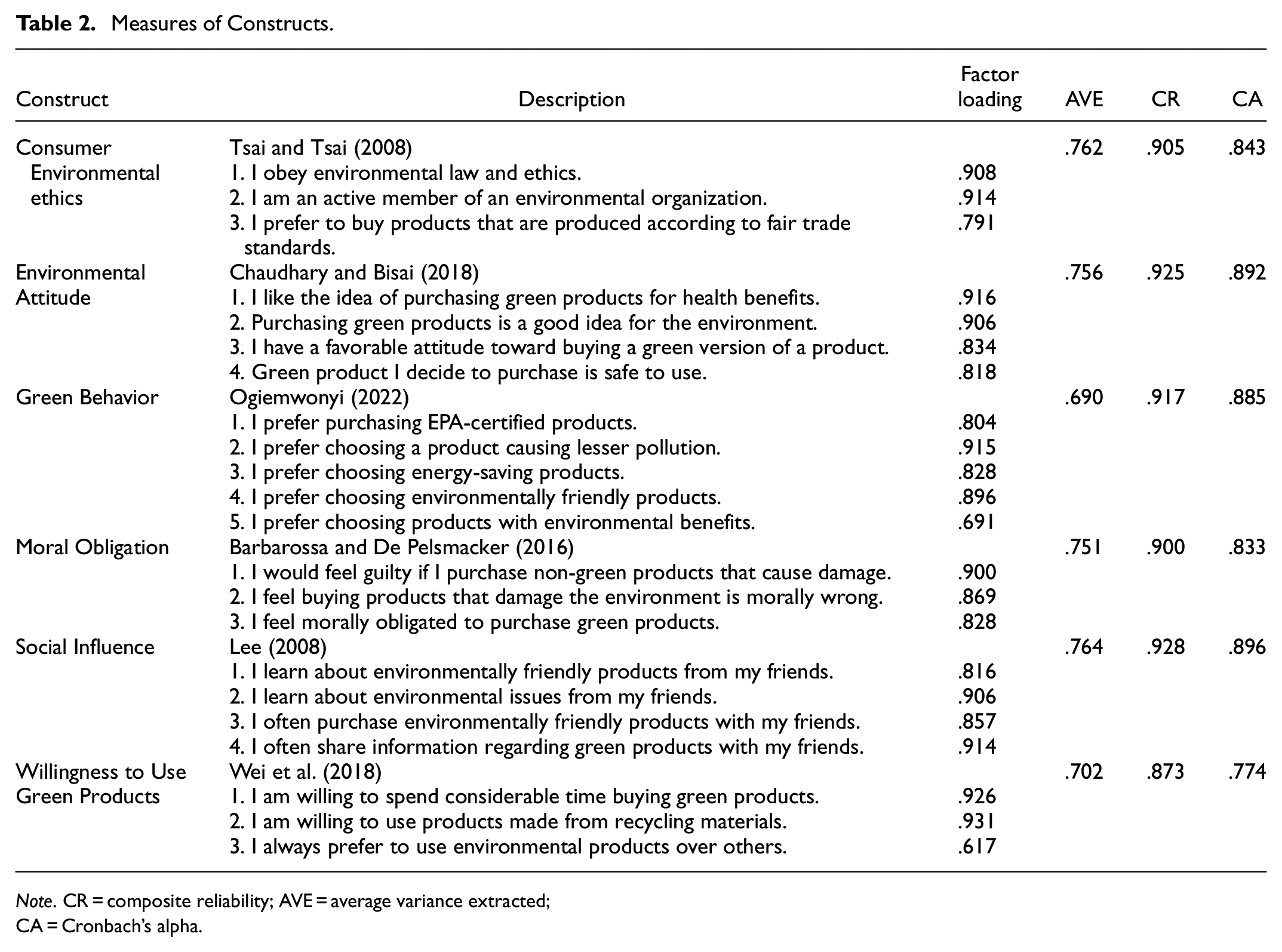
Note. CR = composite reliability; AVE = average variance extracted; CA = Cronbach’s alpha.
The discriminant validity was established in this study using two methods; Fornell and Larcker (1981) and Heterotrait-Monotrait Ratio (HTMT) proposed by Henseler et al. (2015). First, the Fornel-Larcker is calculated based on the average variance shared between constructs, and the square root of (AVE) should be higher than its correlation with other variables (Fornell & Larcker, 1981). The Fornell-Larcker provides the output based on the square root of AVE in diagonals and the correlations below it. The outcome shows that the latent constructs attain adequate discriminant validity considering the square root of the (AVE) which are significant to the correlations off-diagonal in the constructs. Table 3 gives the square root of (AVE) in the diagonal cells and their below values are the correlations. Each diagonal value which is the square root of (AVE) was higher than the corresponding correlations below it which indicated that the discriminant is achieved.
Discriminant Validity for FORNELL-Larcker Procedure.

Note. The off-diagonal values are the correlations between latent variables, and the diagonal is the square root of AVE. GB = green behavior; WUGP = willingness to use green products; CEE = consumer environmental ethics; EA = environmental attitude; SI = social influence; MO = moral obligation.
Secondly, the Heterotrait-Monotrait Ratio (HTMT) is another criterion for evaluating the discriminant validity. Henseler et al. (2015) proposed the HTMT method which confirms discriminant validity between each pair of variables if the correlation values are less than .90. Table 4 present the HTMT values are below the threshold of 0.90. thereby fulfilling the discriminant validity.
Discriminant Validity for Heterotrait-Monotrait Ratio (HTMT) Procedure.

Note. The value on the diagonal (bolded) is the square root of the AVE while the off diagonal is a correlation. GB = green behavior; WUGP = willingness to use green products; CEE = consumer environmental ethics; EA = environmental attitude; SI = social influence; MO = moral obligation.
Results for Structural Model Assessment
In structural model assessment, five criteria for assessing the Structural Model (SM) using PLS-SEM were observed (Hair et al., 2017). In the initial stage of assessment, it is important to address the latent collinearity issues (VIF). It is important to assess the significance and relevance of the structural model relationship. Further, the study also assessed the level of variance explained by the dependent variable (R2), the level of effect size (f2), and the predictive relevance (Q2). Moreover, the assessment of corresponding t-values of the path coefficient via bootstrapping with 5,000 resamples. The results of (R2), effect size (f2), collinearity (inner VIF), and predictive relevance (Q2) has been presented in Table 5. However, all the results of (R2) revealed substantial; meaning the model can explain 58% of the total variance on factors influencing green behavior; thus PLS-Algorithm was used to obtain the value of (R2) as presented in Figure 2. The (f2) shows medium and weak effects such that environmental attitude exerts a medium effect of (f2 = 0.217) in explaining the variance of green behavior, consumer environmental ethics (f2 = 0.025), social influence (f2 = 0.074), moral obligation (f2 = 0.001), willingness to use the green product (f2 = 0.075) exert a weak effect in explaining the variance of green behavior as presented in Table 5. The collinearity was less than 3, indicating no collinearity issue in the model. The predictive relevance (Q2) for endogenous variables were 0.539 and 0.436, higher than 0 indicating adequate predictive relevance in the model (Hair et al., 2017).
Assessment of the Structural Model.

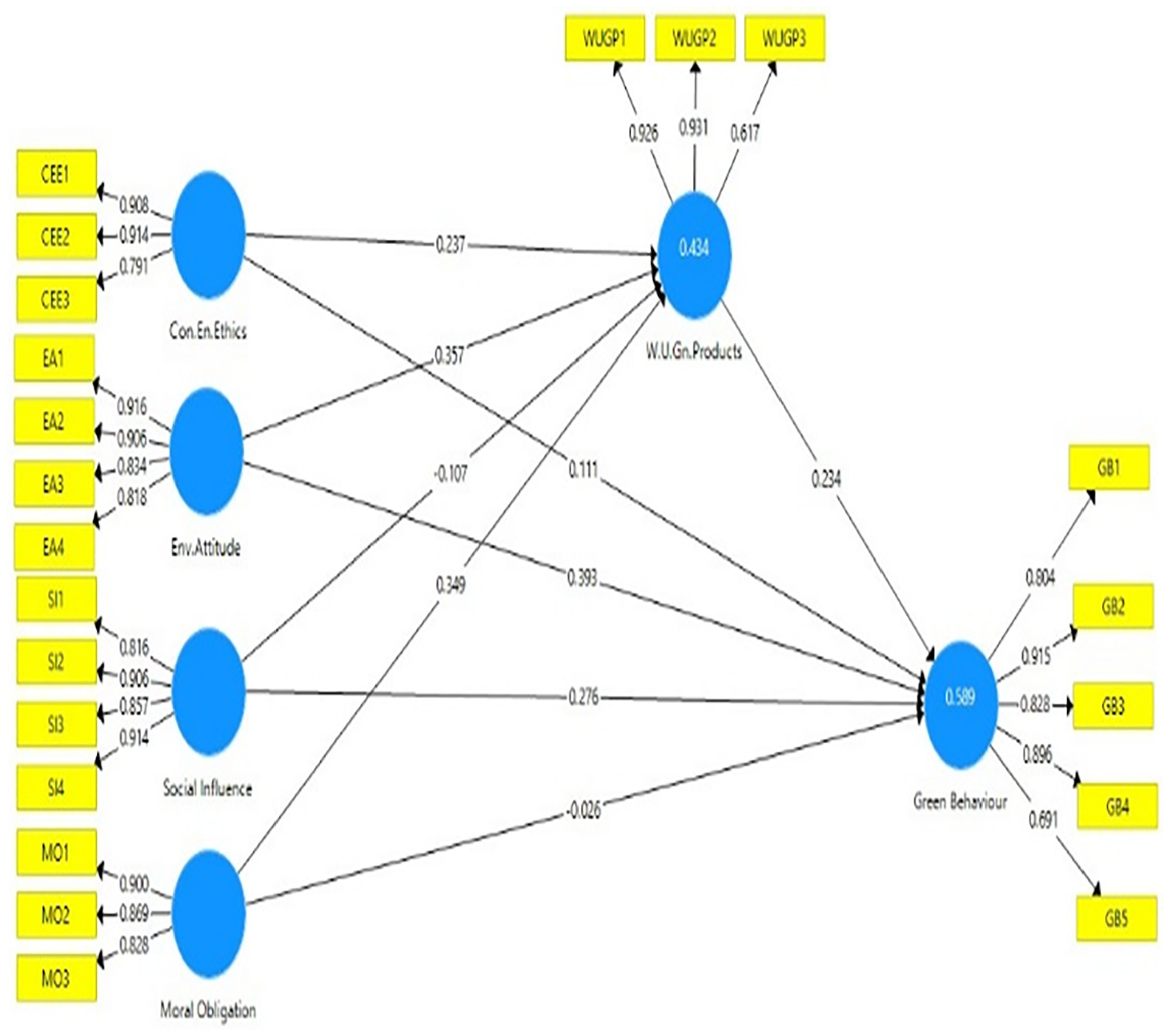
Measurement model with outer loadings and AVE values from PLS-Algorithm.
Furthermore, Table 6 presented the proposed hypotheses and must be supported at p < .05 and t > 1.96 (Hair et al., 2017). Result for the first prediction (H1) examines the relationship between consumers’ environmental ethics and willingness to use green products (β-value = .237, p-value = .000) is supported. Similarly, (H2) examines environmental attitude (β-value = .357, p-value = .000) is supported. However (H3) examines social influence (β-value = −.107, p-value = .095) is rejected, as the p-value is higher than 0.05. (H4) examines moral obligation (β-value = .349, p-value = .000) is supported. In extension to that, (H5) examines the relationship between willingness to use green products and green behavior (β-value = .234, p-value = .001) is supported.
Path Coefficient (Direct Effect) and (Indirect Effect) Result.

Note. OS = original sample; LL = lower limit; UL = upper limit; significant; *p < .05
Note. GB = Green behavior, WUGP = Willingness to use green products, CEE = Consumer environmental ethics, EA = Environmental attitude, SI = Social influence, MO = Moral obligation.
The study also tested the mediating role of “willingness to use the green product” on the model using Boot-strapping techniques with 5000 subsamples (Hair et al., 2017). As per the mediation in H6 (CEEthics → WUGP → Green Behavior) - (β-value = .055, p-value = .005), H7 (EA → WUGP → Green Behavior)–(β-value = .084, p-value = .020), H9 (Moral Obligation → WUGP → Green Behavior)–(β-value = .082, p-value = .010) is supported, meaning willingness to use green products act perfectly as a mediator between these relationships. Revealing significant mediating influence on the willingness to use green products in the relationship between consumer environmental ethics, environmental attitude, moral obligation and green behavior as the level of acceptance of p-value < .05 and t-value > 1.96 meet the threshold values. Likewise, the prediction of (H8) (Social Influence → WUGP → Green Behavior)–(β-value = −.025, p-value = .106) is rejected and reveals no mediating effect in the relationship between social influence and green behavior through the willingness to use green products as the p-value is higher than 0.05. In addition, zero exists in between LL and UL; as the LL and UL are negative confirming no mediation effect. Results are presented in Table 6 and represented in Figure 3.

Structural model with inner model t-values.
Discussions
The study is formed in conformity with the theory of planned behavior (TPB) model by Ajzen (1991), in efficacy to the willingness to use green products “intention,” consumer environmental ethics, environmental attitude, social influence, moral obligation, and green behavior. The model shows an explanatory strength of 58% of the total variance on factors influencing green behavior. As proposed, consumer environmental ethics, environmental attitude, and moral obligation positively influence the willingness to use green products, which eventually influence green behavior. Consumer decision toward the willingness to use green products is based mainly on the beliefs, moral obligations and environmental ethics relating to the benefit of green products which lead them to consumption that established the relationship found (Prentice et al., 2019). These findings also support the study conducted by Hojnik et al. (2019). The study shows that consumer environmental ethics play a unifying role in promoting green behavior. The manifestation of significant influence shows that moral obligation is relevant to environmental safety and could be related to the relationship between environmental attitude and green behavior.
The study predicted that moral obligation will positively influence the willingness to use green products, in ensuring this reality; support the study conducted by Joshi and Rahman (2015). In their studies, they found that consumer social responsibility and environmental burden influence their decision to buy and use green products. Thus, this could be attested to the fact that consumers may feel guilty for not buying a green product and their moral obligation to the environment may bind the course of action demanded, and the concern have some level of importance on sustainable development and the consumer environmental ethics perspective (Baynova et al., 2019). Further, consumers feel green products will protect them against health and environmental risk, such beliefs motivate them to engage in green consumption (Liang, 2016).
As anticipated, environmental attitude positively influences the willingness to use green products and eventually supports green product use and adoption. A similar result was found in a study conducted by Varshneya et al. (2017). Results from the study decode consumer willingness to use green products and a previous study conducted (see e.g., Kirmani & Khan, 2018) shows similar findings. According to Joshi and Rahman (2015), the majority of green consumers usually linked green product attributes to the environmentally friendly manufacturing process. However, to be forthright, the willingness to use green products is strongly influenced by environmental attitudes or concerns from consumers (Ogiemwonyi & Harun, 2021). Apart from consumers’ concern, attitude toward the willingness to use green products means conserving the environment, protecting the environment and optimizing natural resources that influence the attitude to utilization. Our study shows that environmental attitude is a lasting assessment for the consumer to show willingness in using the green products.
Unexpectedly social influence does not show any significant influence on the willingness to use green products, although contradicts our study assumption; but is consistent with the study conducted by Varshneya et al. (2017) which also shows no significant impact. This is in contrast to the observation made by Costa et al. (2014), and (Chan & Lau, 2000). The result may be due to consumers in developing nations like Nigeria are not influenced or motivated by social norms. Sometimes consumers tend to behave unconventionally until there is no standard set-in consumption pattern. However, Yamagishi et al. (2008) report a positive result. In their study, they found that consumers from collectivist societies are disposed to social influence. It can be stated that social influence is not an influencing factor to consumers to use green products which is still at the initial stage for consumers use. The rationale for this might be that the willingness to use green products will take a longer time before it will be accepted as a social norm. While some consumers do not need social influence or public demonstration to use green products, some will buy green products due to the individual level reason such as health and environmental benefit as well as safety and sustainability and not necessarily due to social influence.
Similarly, the extension of moral obligation in this study exerted a positive influence on willingness to use green products. This means moral obligation boosts the variance in the willingness to purchase and use green products, which suggests the moral consideration of green behavior. This is consistent with the study conducted by Petschnig et al. (2014). When consumers feel morally obligated to safeguard and preserve the environment, the change will result in stronger adoption of green product utilization. These findings are similar to studies conducted on environmental topics and green marketing that applied TPB (Chan & Bishop, 2013; Chen & Tung, 2014; López-Mosquera et al., 2014). Thus, provide satisfactory support for the moral concept in contributing to considerable knowledge of green behavior in the environmental context on willingness to use green products (López-Mosquera et al., 2014). Moral obligation is an underlying factor when consumers are suggesting environmental supportive decisions. This is noted by Ajzen (1991), apart from social pressure and other factors from the TPB framework in predicting the behavior of consumers. However, such behavioral prediction may be specific which conforms with moral obligation as an additional factor of intention for green products. The study shows that moral obligation toward willingness to use green products has the highest impact (β-coefficient: 4.346) on green behavior.
The study also found a positive relationship between willingness to use the green product and green behavior. Although, there is doubt if willingness to use the green product will lead to green behavior which remains a discourse among researchers (Jaiswal & Kant, 2018; Kirmani & Khan, 2018). The willingness to use green products is expressed by the consumer for the good-natured of the environment. Such consumer willingness influences the purpose to buy green products (Chan & Lau, 2000; Dagher & Itani, 2014). This implies consumers are not only feeling anxious about environmental quality but also about the consequence of green product purchase that is connected with their buying decision. Previous studies have established a similar relationship between consumer willingness to green behavior (Lai & Cheng, 2016). This study further shows that willingness to use green products is a predictor of green behavior in environmental research. The study also examines the mediating effect of willingness to use green products and found a positive indirect relationship between consumer environmental ethics, environmental attitude, and moral obligation on green behavior. Examining these aspects of mediation in the study constitutes a major significant aspect of the study which supports the extended TPB model and falls within the lines of previous studies (Al Mamun et al., 2018; Beck & Ajzen, 1991; Kai & Haokai, 2016; Maichum et al., 2016; Yadav & Pathak, 2016). This shows consumers’ proclivity to consume green products is important to attain sustainable development. This further reflects consumer indirect impact on green product usage which is in agreement with TPB (Ajzen, 1991).
Theoretical Implications
This study is the first to empirically investigate consumers’ environmental ethics and the willingness to use green products in the Nigerian context with the application of the TPB which is fundamental to strengthening green behavior teaching and practices in academics, especially in Nigeria. Our study provides evidence that examines the willingness to use green products as a mediator toward green behavior; these findings extend insights toward current assumptions underlying the precept of TPB and green behavior adoption. The study deepens previous insights that examine the predictive role of green behavior factors in understanding consumer environmental ethics. The TPB used in the study helps to establish the validity of green behavior and attitude prediction with the role of consumer environmental ethics, social influence, moral obligation and willingness to use the green product in the Nigeria context through the addition and supportability of the predictive factors on TPB model. Previous studies have not utilized these factors in green behavior studies in the Nigeria context; thus, this makes the conceptual model distinctive which has not been yet been tested in developing nations like Nigeria. Although a few studies have been conducted in other developed and developing countries (Bartels & Onwezen, 2014; Kautish & Sharma, 2020), they have not discussed the efficacy of social influence in linking the willingness to use green products toward green behavior validity despite the ethical claim observed in their study. The findings recorded add an up-to-date perspective on literature that examines willingness to use green products that are characterized by green behavior which is to a great extent limited in the study context. The research builds on previous findings thereby deepening the understanding of green behavior factors while providing insights for result-driven intervention as a focal point to improve green product use. Understanding consumer environmental ethics and consumer willingness to use green products is important but has not been properly speckled in green marketing studies. Our study is among the earliest to first examine pro-environmental actions that can alleviate the environmental effects of consumer attributes (such as environmental ethics, willingness to use green products, social influence and moral obligation) in the Nigerian context.
The study affirms consumer environmental ethics in explaining consumer behavior and willingness for green products. Green products vary from conventional products due to their reliance on design, benefits and durability. Our study shows that consumers are motivated to utilize green products while the need to pay more could translate into environmental concerns influencing green behavior. This finding is interesting for the advancement of theoretical implications to bolster green behavior initiatives in academics. Furthermore, we provide evidence that contributes to environmental ethics literature by showing consumer usefulness in the context of green behavior. Consequently, these constructs established a direct influence on willingness to use green products which are considered the positive role of individual consumers with the nexus of positive green behavior. Although our study complements prior findings and the role of consumers has been established in environmental ethics (York, 2009), very few studies exist on the quantitative aspect of willingness to use green products. Therefore, it is important to contribute verifiable evidence concerning green behavior and the willingness to use green products, providing an insight into green marketing study.
Managerial Implications
The study results shed light on managerial insights for practitioners to formulate policies to enhance consumer environmental ethics on willingness to use green products and promote green behavior. The study helps policymakers to enhance public sensitivity toward global environmental issues and further ameliorate consumer preference toward the willingness to adopt green products. Although, the willingness to use green products will help in the growth of the green business. Government and green managers can adopt policies and strategies that will promote environmental ethical standards improve green consumerism and encourage social norms. In addition, the study has established these facts as an action plan for promoting green product consumption in developing markets. Policymakers will learn to understand the impact of factors that help sustain sustainable consumption keeping in mind the importance and role of environmental ethics, the attitude of consumers, social influence and moral obligation. Although environmental ethics and moral norms are completely similar, their distributive influence will help build sustainable consumption and brand sustainable product for consumers. Thus, the findings will serve as a guild for marketers who plan to penetrate the Nigerian market in strategizing an effective marketing approach which will encourage the consumer to use green products and embrace green behavior. Furthermore, our study provides insight into how social norms can be implemented in emerging markets. When consumers do not consider social influence as a predominant willingness to use green products, then practitioners and green marketers should put in some consideration to change the mindset of consumers. Practitioners should take up social media because consumers are more complacent and confident to share information with the medium than relying on friends to learn about environmental issues and good ethical standards. Practitioners should learn that adjusting the breach existing between consumers’ heed and consumption practice requires collective effect from the society, government, and various institutions/or organizations through the promotion of awareness regarding the environment to advance green consumption and willingness to use green products. Various seminars and campaigns can behold to promote green products and highlight the special attribute and values of these products. Environmental topics should be introduced to enhance the knowledge and understanding of the willingness to use green products (Ogiemwonyi & Harun, 2020b); thus, the implementation of standard operating procedures should be enhanced among green markers to maintain moral obligation and environmental ethics as well as the attitudinal level among individuals.
Limitations and Future Research
The study is based on the quantitative aspect of cross-sectional data. This may not help in coming to a final judgment due to the causal relationship as the findings are limited to the area of context. However, this model can be recreated in another context with a specific on green and non-green products for a better understanding of environmental ethics. In our study, the mediating effect of willingness to use green products was examined; future research should consider studying consumer participation, and perceived effectiveness as well as demographic attributes which may have a measurable influence in understanding consumer environmental ethics and green behavior of consumers (Vicente-Molina et al., 2018). Future research can also focus on investigating green behavior concerning knowing the impact of religion on consumer environmental ethics. This will help to ascertain how various religions support environmental ethics. Although the TPB was applied in this study which offers insightful findings, the addition of perceived behavioral control and subjective norms from the TPB model may provide a supplementary understanding and should be considered in future studies. Furthermore, the generalization of the findings could be limited to the study context since the study applied a sample size of 250 and not a representation of the entire population from the dispersed population (Ogiemwonyi, 2022). Research is encouraged to use a larger population with more representativeness of different groups in future.
Footnotes
Declaration of Conflicting Interests
The author(s) declared no potential conflicts of interest with respect to the research, authorship, and/or publication of this article.
Funding
The author(s) received no financial support for the research, authorship, and/or publication of this article.
