




Abstract
Discussions about the threats that climate change poses to the viability of humans and other living things have been the topic of discussion among international organizations, academics, and businesses. Despite the massive contribution of manufacturing firms to the economic development of many countries, their actions and inactions contribute to a higher level of environmental pollution. China is among the leading countries in terms of global carbon emissions. Therefore, this research seeks to explore the role played by green psychological climate (GSC) and green human resource management (GHRM) in improving employees’ green behavior (EGB). The study further evaluated the moderation influence of green transformational leadership (GTFL. The research received 565 responses from manufacturing firms in the Jiangsu Province of China within 8 months. The AMOS software was applied to test the proposed research hypothesis. The study outcome concluded that GHRM positively and significantly influences GSC and EGB. Moreover, GSC, directly and indirectly, affects the connection between GHRM-EGB. Lastly, the analysis confirmed that GTFL moderates the link between GHRM and staff behavioral outcomes. This study’s novelty and originality focused on GSC’s mediating effect in improving the relationship between green human resource management and green employee behavior. The research recommends that firms accomplish their greener and ecological targets by strengthening their GHRM and GSC and providing a GTFL approach to stimulate EGB at the workplace.
Keywords
Introduction
China became the globe’s most significant contributor to carbon emissions in 2007, exceeding the United States, and currently produces nearly 25% of green gas emissions (Heggelund, 2021). Since 1990, China’s carbon emission has substantially surged. There have been well-established plans for China to change this narrative; for instance, the five-year (FYP) policies and other interventions have been implemented to combat climate change issues (Cai et al., 2022; A. Sampene et al., 2021). The present study mainly targeted manufacturing firms in China’s Jiangsu province. China is ranked as one of the most populated countries globally, whose production and economy rely on enterprise and manufacturing firms (A. Khan et al., 2023). These firms, over the last decade, has caused severe environmental pollution that needs to be addressed by stakeholders, policy-makers, and ecological analyst (Cai et al., 2022). Furthermore, previous studies have stressed the importance of green human resource management (GHRM) in companies’ efforts to improve their environmental performance (I. Ahmed et al., 2023; Song et al., 2021; Zhao & Huang, 2022). Environmental scientists and scholars have revealed that GHRM is gaining attention because of the global ecological crisis (Aboramadan, 2022; Ojo et al., 2022). However, there is a literature gap in studies that have analyzed the consequences of GHRM on inspiring staff to engage in attitude and behavior in mitigating environmental pollution and improving sustainable business policies from the Chinese context. As a result, it is imperative to evaluate how policies and actions stipulated by GHRM can predict GSC at the workplace.
Moreover, Farooq et al. (2022) revealed that large enterprises and small firms have begun to care about ecological degradation. Environmental activism has become paramount among manufacturing firms due to the awful level of climate change; hence, more firms are proactively engaging in innovative green actions (A. Khan et al., 2023). Additionally, as ecological threats worldwide become more pressing, businesses are adopting green policies and practices to encourage staff to improve their green behavior (EGB) at work. EGB are behaviors and actions that staff participates in that show their commitment and contribution toward the sustainability of the environment. Hence, Sabokro et al. (2021) asserted that EGB is crucial for the sustainability of society and the firms’ implementation of green initiatives. In the environment and behavior literature, EGB has been described in various forms; for example, some literature refers to it as a pro-environmental behavior (Fatoki, 2023; Hu et al., 2022; Nisar et al., 2021; A. K. Sampene et al., 2024), eco-friendly behavior (N. Ansari et al., 2022).
The evolution of GHRM policies and practices has been linked to the concept of a green psychological climate (GSC) in workplaces (Chen et al., 2021). GSC denotes the workforce’s behavior, actions, ethics, and perceptions of firms’ environmental goals. In other words, GSC refers to enterprises’ policies, plans, and environmentally-oriented actions to improve the EGB (Sabokro et al., 2021; Xu et al., 2022). Advancing the discourse further, extant studies have indicated that green transformational leadership (GTFL) is a paramount and essential factor when examining the topic of GHRM and EGB. However, some studies have evaluated the moderating effect on the connection between GHRM-EGB, especially from the perspective of Chinese manufacturing firms. Hence there exists a literature gap that this research seeks to address. It is, therefore, critical to examine the iteration impact of GTFL on the interplay between GHRM-EGB.
Theoretically, studies analyzing the EGB GSC, GTFL, and GHRM association have resorted to the ability, motivation, and opportunity theory (AMO) proposed by Appelbaum et al. (2000) and the resource-based view (RBV; J. Barney et al., 2001). Therefore, this study applied these two theories to evaluate their applicability to the study variables. The AMO emphasizes that employees in an organization should be inspired or motivated, and the enterprise should allow them to participate in sustainable goals (Pham et al., 2019; Shoaib et al., 2021). Regarding the RBV, J. Barney et al. (2001) argued that firms could rely on their internal resources and employees’ capabilities to improve their organizational performance. Accordingly, this study proposes that leadership qualities are internal corporate resources that enterprises can harness to improve their ecological and business performance.
Research Motivation and Contributions
From the above discourse, it is evident that GHRM, GSC, and GTFL are concepts that manufacturing enterprises are currently engaging in to promote their EGB. Accordingly, this investigation seeks to evaluate the interaction among these variables and how it can help promote ecological stability and help firms achieve environmental sustainability. As a result, this analysis aims to elaborate on the effect of GHRM on GSC and EGB. The research also evaluates the influence of GSC on GSE and how it can mediate the connection between GHRM-EGB. The research also examines the iteration role played by GFLT in the relationship between GHRM-EGB. The following research questions are what this study intends to answer:
The following are several ways that the analysis sought to contribute: First, the present study improves knowledge and understanding of GRHM by examining its influence on employees’ psychological and behavioral outcomes at the workplace. The effect of GHRM on GSC has received less attention, requiring empirical analysis to close this literature gap. Hence, the study contributes to the literature on GSC by analyzing its direct and indirect effects on EGB. Second, prior studies have assessed firms’ environmental strategies and the various antecedents of EGB (Sabokro et al., 2021; Xu et al., 2022). Hence, this study highlights the impact of GSC on staff EGB. Furthermore, scanty studies have evaluated the mediating effects of GSC on GHRM-EGB. Therefore, to overcome this gap in the literature, this research provides empirical findings on the mediation influence of the GSC on the relationship between GHRM-EGB. Third, the study advances recent theories, such as AMO and RBV, about GHRM and EGB studies. Hence, this study enriches prior studies that have explored individual behavioral concepts regarding ecological sustainability. For the AMO theory, this study improves the empirical findings (Luc, 2020; C. Sun et al., 2021). For RBV, the research enhances the understanding of prior studies (Kuo et al., 2022; Shahzad et al., 2021). Fourth, previous analysis has demonstrated that GTFL has emerged as the center of focus for both managers and academics (Li et al., 2020; Mansoor, Farrukh et al., 2021). However, few of these studies have explored the iterative impact of GTFL on the connection between GHRM and EGB. Thus GTFL. Thus, the current analysis investigated how GTFL influences subordinates to engage in policies outlined by GHRM, which will consequently affect their green behavior. Fifth, this study proposes that GHRM and GSC are essential to improve EGB. Therefore, as policy implementation measures, organizations should appreciate the significance of GHRM management initiatives such as green training, selection, appraisal system and monitoring to help enhance EGB.
The remaining study aspects are organized as follows: Section 2 examines the theoretical foundation and hypothesis formulation. The methodology used is the main topic of Section 3. Section 4 elaborates on the conclusions drawn from the PLS-SEM study. The interpretation of this work, theoretical and practical ramifications, a conclusion, and recommendations for further research are all presented in Section 5.
Literature Review
Theoretical Framework
Appelbaum et al. (2000) proposed the AMO theory, which helps evaluate the connection between employee’s ability, motivation and opportunity and firms’ performance. The theory suggests that employees’ capabilities, motivation, and presented opportunities enable them to contribute to organizational success. Hence, in line with the AMO theory, this study asserts that ability implies GHRM policies, which include (a green recruitment process and green training and development) that are targeted at improving employees’ capabilities and skillset to contribute to firms’ ecological goals (Shoaib et al., 2021). Motivation includes the provision of green rewards and incentives and green compensation) and opportunity relates to (green empowerment and teamwork) which proved to employees to contribute their quota to improve the firm’s environmental objectives (Luc, 2020; Shoaib et al., 2021). This research applied the AMO for the following reasons: First, the study contends that the purpose of GHRM policies in a firm is to entice, inspire, incentivize and nurture employees to engage in green behavior, which can eventually help firms reduce environmental pollution. Hence, manufacturing firms must successfully reach ecological targets and provide employees with the proper psychological climate, motivation, and opportunity on their EGB. Second, several existing studies on GHRM have indicated that AMO can help explain the interaction between EGB and firms’ environmental goals (Zhao & Huang, 2022; Pham et al., 2019; Shoaib et al., 2021).
The current investigation incorporated the RBV theory, which suggests that resource is essential to an enterprise’s competitive edge. The initial RBV model proposed by J. Barney (1991) focused on (VRIN) and indicated that the value, rarity, imperfectly imitable and non-repeatability nature of firms’ natural resources could improve their competitive advantage. Later in his work, J. B. Barney and Wright (1998) modified the “VRIN” framework to “VRIO,” where the “O” is an organizational process. This is because, to identify the potential, a firm must be in a manageable condition to fully exploit all resources and capabilities. Drawing upon the concept of the RBV theory, this analysis evaluated GTFL as a boundary parameter (moderating effect) on the linkage between GHRM-EGB. Thus, this research proposes that GTFL is a critical human resource (intangible asset, rare and imperfectly imitable) that could help firms improve their environmental performance. Hence, based on the RBV viewpoint, the study suggests that the actions and behavior of a GTFL will inspire and motivate them to adhere to the policies proposed by the human resource department concerning ecological preservation at the workplace. Considering employees’ unique needs and demands, GTFL can nurture employees to engage in green practices, fostering green behavior. Prior studies have applied the RBV theories in examining the connection between GTFL and EGB (Aidara et al., 2021; Haldorai et al., 2022; Z. Hameed et al., 2022). After carefully evaluating the AMO and RBV theories, it was evident that only a few studies have highlighted the effect of GHRM on EGB. Moreover, AMO theory can help businesses evaluate the performance of their employees. Hence, applying this theory provides a fundamental basis for understanding how motivation, opportunity, and ability influence green employee behavior. Furthermore, since GTFL is considered an essential intangible asset by organizations, the examination of GTFL under the RBV framework is essential to improving firm environmental sustainability. Since few studies have evaluated how GHRM influence EGB and the mediation effect of GSC, this study addresses this research gap by employing the AMO and RBV theory.
Hypothesis Development
GHRM and EGB Nexus
Extant studies have investigated discussion on the connection between GHRM-EGB. GHRM processes are crucial in shaping people-management practices and affecting employees’ pro-environmental behavior (Saeed et al., 2019). For instance, Song et al. (2023) analysis indicated that perceived GHRM has a direct positive effect on employees’ green innovative behavior, highlighting the impact of GHRM on fostering environmentally friendly practices. Fawehinmi, Yusliza, Wan Kasim, et al. (2020) highlighted that the most effective way to implement GHRM policies in an organization is based on the AMO paradigm. Thus, the concept of this paradigm is founded on a series of procedures encompassing green hiring and training as well as green development that facilitate skills necessary for engaging in ecologically friendly actions and behavior. The relationship between GHRM and employee green behavior is also influenced by employees’ work values, environmental knowledge, and green values. Empirical findings by prior studies have proven that GHRM policies significantly affect EGB. For example, Chen et al. (2021) studies indicated that staff perception of firms’ GHRM strategies affects their level of EGB. In addition, Syafri et al. (2021) evaluated the effect of GHRM on EGB among 180 firms in Indonesia. The results from their research indicated that GHRM is an influential variable that impacts the level of EGB.
Similarly, Kim et al. (2019) suggested that GHRM actions enhance staff eco-friendly behavior. Moreover, GHRM has been found (Suharti & Sugiarto, 2020) to promote employees’ eco-friendly behavior, contributing to realizing environmental goals within organizations. Other empirical studies have also highlighted the direct impact of GHRM on EGB from different jurisdictions (Aboramadan, 2022; Ribeiro et al., 2022; Sabokro et al., 2021). From the forgoing analysis, this investigation suggests that for manufacturing firms to improve their environmental performance, they need to implement key GHRM policies that can affect EGB. Therefore, to extend the AMO viewpoint, this research hypothesizes that:
H1: GHRM has a direct and positive relationship with EGB.
GHRM and GSC Nexus
Research has shown that organizational practices, leadership, employee engagement, and environmental support influence the development of a green psychological climate. For example, Li et al. (2023) in their studies have demonstrated that GHRM practices are associated with developing a positive psychological climate, which, in turn, influences employees’ in-role green behavior and psychological well-being. Staff GSC will be stimulated when they learn that their firms’ GHRM policies and processes support their green values and environmental sustainability initiatives (Dumont et al., 2017). A green psychological climate is developed when GHRM strategies outlined by the firm are related to the working procedures of the enterprise, which relate to the AMO proposition. Thus, social cognitive mechanisms, shared working systems, and perceptions about environmental plans significantly affect employees’ GSC (Shah et al., 2021). In other words, workforce connection with their workplace environment and discourse about firms’ guidelines and policies help shape their GSC (Norton et al., 2017).
Additionally, Susanto (2023) highlights the positive impact of optimal implementation of GHRM tactics on job satisfaction and green work engagement, contributing to fostering a positive psychological climate (GSC) among employees regarding environmental initiatives. As a result, firms must promote the environmental responsibility of staff through GHMR actions such as green job designs and suitable rewards for employees who exhibit environmentally friendly behavior in the workplace (M. A. S. Khan et al., 2019). Sivalingam and Arulrajah (2022) emphasize that when firms provide environmental support and sustainable performance, they create a supportive environmental climate within the organization. Empirical analysis from extant studies has revealed that GHRM positively impacts GSC. For instance, Sabokro et al. (2021) showed that GHRM actions positively affect staff GSC among 384 Iranian firms. Hence expanding the AMO model, this study proposes a direct connection between GHRM-GSC.
H2: GHRM has a direct and positive relationship with GSC
GSC and EGB Nexus
Prior studies have recognized GSC as an important ambient factor influencing individual attitudes and actions in the workplace (Mateen et al., 2023). Businesses can, therefore, facilitate a GSC by providing guidelines and goals that align with firms’ environmental initiatives (Bhutto et al., 2021). In the context of green human resource management (GHRM), a positive psychological climate is instrumental in fostering a supportive atmosphere for environmentally responsible practices. About the research conducted by M. Ahmed et al. (2020), it is noteworthy that employees initially observe and comprehend their work settings before taking appropriate action. The collective mindset of the organization’s operations, strategies, philosophy and principles for green initiatives across the workforce is captured as GSC (Chen et al., 2021). Employees are inspired to operate sustainably in a firm that puts in measures to promote their GSC. According to M. A. S. Khan et al. (2019), managers committed to green initiatives and sustainability objectives create a favorable environment that encourages staff members to adopt eco-friendly practices. Research has shown that employee participation in green initiatives increases when employees believe their leaders are genuinely dedicated to sustainable practices. This positive perception has a cascading effect on EGB and GSC (Cai et al., 2022; A. Khan et al., 2023). As a result, employees with distinct viewpoints and attitudes toward business green initiatives are better equipped to work effectively and fulfill their share of the responsibility for improving a company’s environmental sustainability (Sabokro et al., 2021; Saleem et al., 2021). Staff embrace climate experience and practices and enhance organization engagement for participating in EGB when they observe higher levels of positive GSC. In other words, a conducive GSC motivates staff to uphold environmental stewardship laws and norms with extraordinary passion, improving EGB levels. Since both GSC and EGB are natural resources (RBV), they are unquestionably the most accurate predictors of eco-friendly behavior. Shah et al. (2021) empirically revealed that GSC significantly influences firms’ sustainable environmental efficiency. Several other empirical analyses established that GSC directly impacts EGB (Chen et al., 2021; Jamshed et al., 2023; M. A. S. Khan et al., 2019). Based on the RBV theory, this study asserts that well-functioning GSC presented by firms can enhance EGB; the study, therefore, hypothesizes that:
H3: GSC has a direct and positive relationship with EGB
Mediation Effect of GSC Between GHRM and EGB
Literature on GHRM states that several underpinning processes may indirectly influence green employee behavior (Ercantan & Eyupoglu, 2022). Hence, the approach through which GHRM affects EGB is mainly associated with the psychological and social system known as GSC. The concept of GSC includes “a person’s judgment about firms’ action toward ecological preservation” and, more so, “staff perceptions regarding firms’ environmental policies” (Ercantan & Eyupoglu, 2022; Mateen et al., 2023). The workforce in an organization embraces GHRM agendas and policies, which sometimes change their opinions and perceptions about the firms’ ecological plans. Hence, cognitive processes such as GSC make staff aware of a firm’s stringent environmental regulations, which can influence their engagement in green behavior (M. A. S. Khan et al., 2019; S. Zhou et al., 2018). Chen et al. (2021) found that GSC mediates the impact of the nexus between staff-perceived GHRM policies and EGB.
In addition, Khan et al. (2019) also collected research data from 447 staff working in service and industrial firms in China. The analysis from their study agrees with the argument that GSC mediates the nexus between ethical leadership and EGB. Mateen et al. (2023) used quantitative research to collect data from 161 Pakistan health industry staff. The study’s findings indicated that GSC mediates the association between GHRM-EGB. Moreover, other studies have also highlighted that a conducive GSC would motivate staff to engage in specific eco-friendly actions (Das et al., 2019; Dumont et al., 2017; Jamshed et al., 2023; Norton et al., 2017). It is worth noting that prior studies established the direct linkage between GSC and EGB without evaluating its indirect influence on this relationship. Hence, based on the RBV theory, this investigation proposed GSC as an intervening element to enhance the connection between GHRM-EGB. As a result, this research predicts that GHRM stimulates EGB through GSC.
H4: GSC mediates the connection between GHRM-EGB
Moderation Effect of GTFL Between GHRM and EGB
GTFL can offer followers practical assistance and inspiration to accomplish their greening goals. In addition, this form of leadership empowers employees to go beyond their abilities to stimulate the firms’ environmental sustainability (Farooq et al., 2022). Z. Hameed et al. (2022) investigated the moderating influence of GTFL on EGB among 428 employees in Pakistan’s food and personal care industry. Their research found that GTFL positively moderates the connection between GHRM and organizational support for EGB. Moreover, Mansoor, Farrukh et al. (2021) believe that top executives of firms should engage in the GTFL approach to promote green initiatives that can fuel EGB. Their research highlights the importance of the synergy between GHRM and GFLT to stimulate EGB and creativity. Another empirical study by Iqbal et al. (2023) found that the GTFL moderates the connection between GHRM and the level of firms’ environmental commitment toward improving EGB. Furthermore, the outcome from (Farooq et al., 2022) identified GTFL as an essential element that can provide critical insight into how firms can inspire staff to generate new ideas in providing solutions to environmental problems. Moreover, Huang et al. (2021) revealed that GTFL exhibited by top executives significantly predicts firms’ proactive ecological strategies.
Similarly, extant studies have highlighted the moderating effect of GTFL on different behavioral constructs (Zhao & Huang, 2022; X. Sun et al., 2022; J. Zhu et al., 2022). Employing the AMO and RBV model, this research forecast that GTFL strengthens the association between GHRM and EGB. Therefore, the study proposes that:
H5: GTFL has a positive moderating impact on the linkage between GHRM and EGB.
Research Gap
Table 1 further presents some empirical studies examining the research’s constructs. Thus, the literature reviewed so far has demonstrated that fewer studies have analyzed the effect of GHRM, GSC, and GFTL on green employee behavior, especially from the context of China. Therefore, the study’s findings will contribute significantly to the GHRM, GSC, and GTFL literature. The empirical evidence outlined in this research has crucial policy implications that managers, scholars and environmental scientists can follow to help improve ecological sustainability in China.
Prior Studies on the Conceptualization of the Study Variables.

Conceptual Framework
The study’s conceptual framework is presented in Figure 1. Based on the two theoretical backgrounds of the survey (AMO and RBV), the study proposes a direct linkage between GHRM and EGB (H1). Moreover, the research suggests that GHRM will positively influence GSC (H2). H3 focuses on the influence of GSC on EGB, and H4 analyses GSC’s mediating effect in the study model. H5 delves into the moderation role of GTFL.

Research conceptual framework.
Methodology
Research Strategy
The data analyzed in this research was obtained from enterprises in China’s Jiangsu Province that manufacture products for the health, plastic, chemical, metal, textile, and green technology industries. These firms were selected because their production activities cause havoc to water, air, and land; hence, it is appropriate to provide research focusing on EGB. This can enable policy-makers to understand the issue and formulate measures to eradicate environmental pollution. In addition, these firms are under enormous pressure from customers, the government, and stakeholders to preserve and protect the ecological system. Moreover, most of these enterprises have well-established human resource management systems. Hence, their opinions and perceptions are critical to helping devise mechanisms and initiatives to improve environmental sustainability.
The study used the purposive sampling approach to select the respondents for this study. Purposive sampling was used because it enables researchers to squeeze a lot of information out of the data that has been collected and further allows researchers to describe the major impact their findings have on the population. The study employed the purposive sampling approach because, given the study’s nature, it allows individuals to share their opinions on the topics and issues under consideration (Adam et al., 2020). In addition, as Campbell et al. (2020) emphasized, purposive sampling techniques help evaluate and analyze quantitative data to maximize the validity and reliability of the study data. Moreover, this research adopted the purposive sampling approach because existing studies have revealed that it is an efficient, robust, and reliable sampling technique for selecting responses (Campbell et al., 2020). The target audience for the study consisted of firms’ managers, assistant managers, and supervisors who thoroughly understood their enterprise’s sustainability practices. In addition, the authors contend that managers and executives at firms play a crucial role in monitoring and overseeing ecological issues at the company.
Data Collection Process
Questionnaires were distributed to the selected manufacturing firms in Jiangsu Province. Due to the pandemic situation in China, we sent a questionnaire link to the respondents through emails. The questionnaire collection process lasted 8 months (March to October 2022) to provide ample time for the response. This also helped the study to receive a high number of responses. During the data collection process, reminders were sent to the participants so that they could provide their answers promptly. In addition, an expert in the field was consulted to evaluate the questionnaires before sending them out. To avoid ethical issues, the research included a consent statement in the questionnaire that indicates that their responses will be treated confidentially. Also, the responses will be used solely for academic purposes.
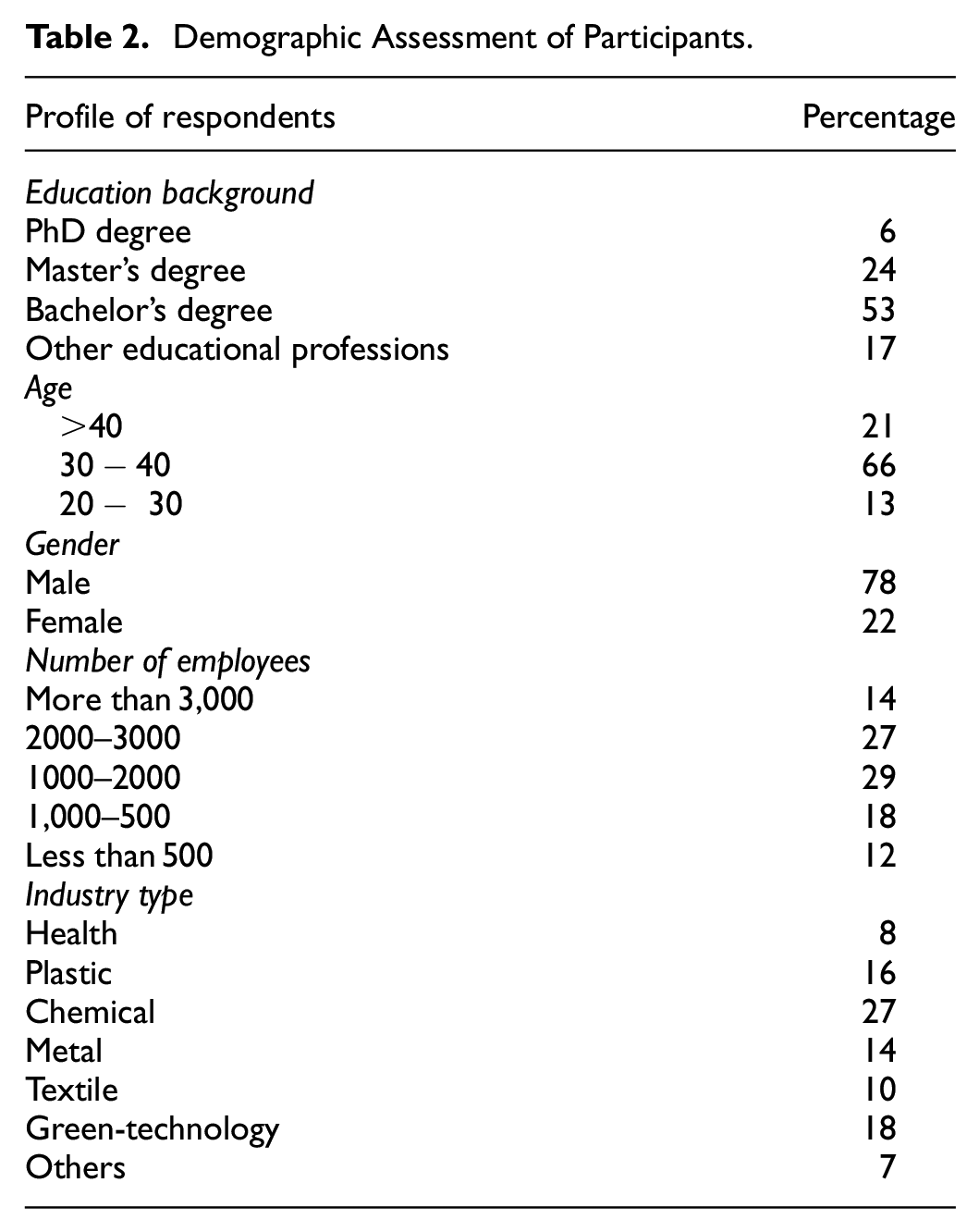
The study distributed 950 responses to the chosen manufacturing firms; 355 responses were received in the initial wave, and 210 were further received, making a total of 565 used for the analysis. The response rate from the survey was 59%, indicating a higher response rate from the participant. As Hair et al. (2014) stated, the representative sample ought to be greater than ten times the most significant number of path model that leads to a particular parameter in the structural model. The sample size of 565 is in line with their recommendation. Additionally, the sample size is similar to earlier studies examining these constructs (Ali et al., 2021; Juliana et al., 2021). Table 2 contains the demographic profile of the respondents.
Demographic Assessment of Participants.
Measurement of Variables
This section explains the instrument used to collect information and data from the participants. Supplemental Appendix 1 presents the questionnaires that were used in this study. The 5-point Likert scale will be employed for the study’s measuring constructs (1, strongly disagree; 2, disagree; 3, neutral; 4, agree; and 5, strongly agree). The procedures used to measure each construct are listed below:
Green Human Resource Management
The constructs for GHRM were assessed using six items, and these questions were selected from the studies by Farooq et al. (2022) and Ren et al. (2022). The items include “My firm provides staff with periodic green training activities” and “During appraisal performance, my firm considers employees’ green behavior.” The factor loading for this construct was between 0.752 and 0.893, indicating a sufficient variance for the various items.
Green Psychological Climate
The construct of GSC comprises five items: “All staff members are urged to conserve energy at work” and “The management places a strong emphasis on reducing production waste.” The items were selected from the research by Du and Yan (2022), M. A. S. Khan et al. (2019), and Sabokro et al. (2021). The factor loading for this construct ranges between 0.726 and 0.852, showing that the individual component of the construct was strongly linked.
Green Transformational Leadership
GTFL was evaluated with six items. Some questions include “My leader is a role model for subordinates regarding ecological sustainability” and “My leader inspires and motivates me to work in a pro-environmental manner.” The items were adapted from these studies (J. Zhu et al., 2022). This variable had factor loadings between 0.760 and 0.895, indicating a sufficient variance for the various items.
Employee Green Behavior
The measurement scales for EGB comprised six items: “I embark on my professional duty in a manner that enhances the eco-system” and “I feel obligated to protect the environment for future generations” (Foster et al., 2022; Sabokro et al., 2021). The factor loadings of this parameter range between 0.760 and 0.834, indicating a sufficient variance for the various items.
Control Variables
Prior studies have revealed that it is necessary to examine the influence of control variables that are theoretically or empirically associated with the focal parameter of the study (Ali et al., 2021; Chan et al., 2022). Moreover, control parameters are tested to help solve the tendency of multicollinearity in collecting the research data (Qu et al., 2022). Hence, this study will evaluate three control variables: respondents’ gender and educational background.
Reliability and Validity of Scales
In quantitative data analysis, the examination of the validity and reliability of the construct is very integral. Hence, structural model techniques can analyze their reliability and validity assessments, including the Crochbach Alpha (CA) and Composite Reliability (CR). Hair et al. (2020) suggested that to evaluate the internal reliability of the study’s parameter, the CA and CR of the research variables should exceed the statistical value of 0.70. In addition, the factor loading for all the variables should also exceed the threshold of 0.70 (Hair et al., 2014; Rönkkö & Cho, 2022; A. K. Sampene et al., 2023). Furthermore, the average extracted variance (AVE) is one of the critical assessments that help establish the internal validity and consistency of the research model. The threshold for the AVE has to be greater than 0.50, as recommended by Agyeman et al. (2021), Hair et al. (2020), and A. Khan et al. (2023). As presented in Table 3, the study’s outcome proved that CR (internal consistency) and CA (indicator reliability) statistical coefficient exceeds the threshold of 0.70. Additionally, the AVE scores for the research variables exceeded the minimum criteria of 0.60, demonstrating a considerable standard of internal consistency. The outcome proved that the series in the measurement construct were reliable and valid.
Outcome of the Reliability, Validity and VIF.

Note. FTL = factor loading; CA = Crochbach alpha; CR = composite reliability; AVE = average extracted variance; VIF = variance inflation factor.
Common Biased Method
The issue of common method bias (CMB) may affect the validity and robustness of the result because the information gathered for the study will be self-reported. Hence, the research applied the Podsakoff et al. (2003) CMB test to overcome the CMB or multicollinearity issues. This CMB test calculates the variance inflation factor (VIF) for all the variable structural components. The suggested threshold is that the VIF for a single item should not exceed 5.00 or 50%. Hence, as presented in Table 3, all these tests’ outcomes revealed that the VIF values for all the series were less than the threshold of 5.00.
Confirmatory Factor Analysis (CFA)
The research moves further to evaluate the CFA of the model with the aid of the statistical tool AMOS version 21. The study employed the structural equation model as the analytical approach to examine the relationship among the variables. This statistical software provides CFA assessment approaches that can be used to explore the models’ fitness in the structural analysis (Amankwah & Sesen, 2021). Two critical tests evaluate the model’s structural fitness indicator: the IFT-Incremental fit indices and AFI-Absolute fit indices. The outcome and threshold for both the IFT and AFI have been captured in Table 4. The IFT comprises three tests: the Tucker Lewis index-TLI, Normal fit index (NFI), and Comparative fit index (CFI). The TLI, NFI, and CFI help evaluate the ratio of the difference between the proposed model to the difference between the independent research model.
Outcome of IFT and AFI.

Note. IFT = incremental fit indices; AFI = absolute fit indices.
Moreover, the AFI evaluates the coefficient of the chi-square divided by the degree of freedom (CMIN/DF). The RMSEA, which indicates the root mean square error of approximation, helps rectify the propensity of the chi-square. The GFI, which represents the goodness of fit index, measures the accuracy between the observed matrix and the hypothesized framework. The threshold for the IFT and AFI test has been suggested in previous studies (Amankwah & Sesen, 2021; Lin et al., 2021; Masocha, 2018). Hence, the outcome of this analysis revealed that the research model had a good CFA of.
Results
Descriptive Analysis
The outcome of correlation analysis, standard deviation, and mean statistics for all the series are displayed in Table 5. The results indicated GSC had the highest measure of mean coefficient among all the variables. Furthermore, the correlation analysis captured in the table proved that all the series were positively and significantly correlated.
Standard Deviation, Correlation and Mean.

The values with “***” indicate that the correlation between those variables is very highly significant (p < 0.001).
Discriminant Validity
Evaluating the discriminant validity among the research constructs is also vital and helps address the inaccuracy of the structural model. The study tested the factor loading to ensure all components and individual items do not exceed the minimum requirement of 0.70. In addition, the Fornell and Larcker (1981) validity was further explored, and the outcome has been captured in Table 6. Hence, the required threshold of the Fornell Lacker criteria of the statistical significance of the variable’s component should be less than 0.90 (Cai et al., 2022; Fornell, 1992; Roemer et al., 2021). As captured in the table, the results proved that all the constructs meet discriminant validity requirements.
Outcome of Discriminant Validity.

Hypothesis Analysis
The study examined the structural model in four phases with the aid of AMOS software, and the outcome is presented in Table 7 and Figure 3. The study applied the structural equation model to evaluate the proposed hypothesis. In the first phase, the research evaluated the control variables of the study. Thus, the analysis examined how gender and educational background influence their green behavior level. The investigation found that gender (β = .541, p-value = .000) and educational background (β = .436, p-value = .000) significantly influence EGB. The statistical analysis from the goodness of fit
Outcome of Hypothesis Analysis.

Note. LCI = lower confidence interval; UCI = upper confidence interval.
***Denotes significance level at 1%.
In the second phase, the study explored the direct linkage among the research variables. The outcome proved that the GHRM (β = .183***) directly influences EGB. This outcome supports the research H1. In addition, GHRM (
Model 3 focused on the mediation influence of GSC on the link between GHRM-EGB. To explore the significance level of the mediation impact of GSC on these variables, the study applied the bootstrapping specification approach of 5,000 sizes of the sample with the help of the AMOS version 24 software. This strategy of mediation testing approach in this software has been proven by existing studies (N. Ahmad et al., 2021; M. A. S. Khan et al., 2019). The study’s outcome revealed that GSC
The graphical illustration of the iteration effect is displayed in Figure 2 and 3. The graph illustrates how GTFL can strengthen and improve the connection between GHRM-EGB. Thus, a higher level of GTFL enhances the actions of GHRM, which will ultimately encourage them to engage in EGB.
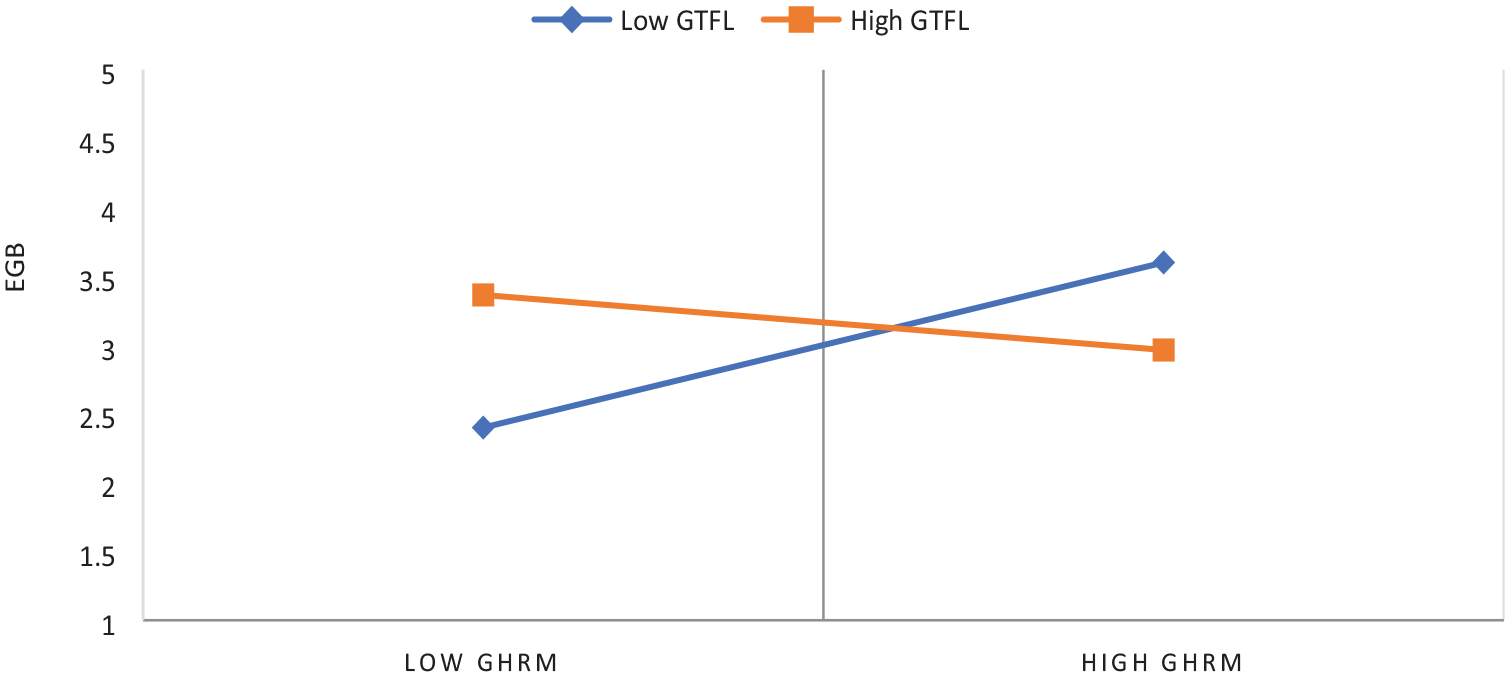
Moderating impact of GTFL.

Results of the structural model.
Discussion
This study explored the effect of GHRM on the GSC and EGB of manufacturing enterprises operating in China. The research further analyzed the mediation impact of GSC on the connection between GHRM-EGB. In addition, the analysis examined the influential role of GTFL in strengthening the link between GHRM and the green behavior of the workforce. The study’s key insights are addressed below. First, the research empirically revealed that these firms’ green actions and initiatives implemented by GHRM affect EGB. This outcome supports the AMO theory and prior studies that indicated greener measures proposed by GHRM of an organization enhance employees’ decision to participate in green behavior at the workplace (Farooq et al., 2022; Irani et al., 2022). Thus, GHRM consists of a collection of green recruitment, green evaluation and assessment, green rewards and remuneration and other firms’ strategies to promote ecological stability (Chen et al., 2021; Ojo et al., 2022). Additionally, through GHRM policies, employees will become aware of the firm’s agenda, plans and policies toward achieving its intended environmental objectives. Green HRM approaches help employees to become more environmentally conscious and enable them to apply that awareness to organizational goals, encouraging EGB (Ercantan & Eyupoglu, 2022; Norton et al., 2015). Prior study’s findings are in line with the current study’s conclusion that GHRM policies are essential in promoting EGB (Aboramadan, Kundi, & Becker, 2022; S. Ahmad et al., 2021; Farooq et al., 2022; Z. Hameed et al., 2022; Rehman et al., 2021; Shoaib et al., 2021; S. Zhu et al., 2022).
Second, the current analysis findings indicated that GHRM action promotes GSC. By extending the AMO perspective, the study found that GHRM policies predict GSC. Thus, the present analysis unravels a new perspective on the GHRM-GSC literature. More specifically, the study’s findings have demonstrated that GHRM actions and policies can improve employees’ perception, ideas and understanding of firms’ environmental goals, enhancing their GSC. Afota et al. (2023) asserted that the workforce adapts to the firm’s GRHM plans and policies, altering their concepts and perceptions of the firm. Thus, staff members formulate perceptions about the firms’ GSC through a cognitive mechanism. When a firm provides the necessary information or communicates its environmental objectives to staff and allows them to contribute to this initiative, it helps improve their level of GSC (Sabokro et al., 2021). The outcome collaborates with the results of these studies (Chen et al., 2021; Jamshed et al., 2023; S. Zhou et al., 2018).
Third, enriching the theoretical framework of the RBV, the findings of this research revealed that workforce GSC has a positive and favorable impact on their green behavior. The inference from this analysis is that since GSC comprises employees’ impressions, concepts and assessments concerning firms’ environmental and sustainability strategies and systems, higher GSC can affect their green behavioral outcomes. Furthermore, GSC entails staff members’ understanding of an industry’s concept of ecologically responsible operations and legislation contributing to their EGB (Mansoor, Farrukh et al., 2021). Ercantan and Eyupoglu (2022) argued that GSC is a strong component that can shape individual behaviors and attitudes within the organizational culture. Hence, the viewpoint and suggestions of staff about business environmental performance goals are ascribed to GSC, which supports the perspective of the RBV. Extant studies have also demonstrated that GSC positively influences EGB (Chen et al., 2021; Jamshed et al., 2023; M. A. S. Khan et al., 2019).
The current investigation also established that GSC is integral in shaping the interplay between GHRM policies and EGB. The intuition supporting this result is that when GHRM outlines environmental plans and projects and communicates them to employees, it can shape staff’s shared views and perceptions toward acting environmentally friendly. The study participants confirmed that when they witness that their enterprise outlines measures to mitigate carbon emission, their GSC is enhanced, encouraging them to partake in EGB. In other words, GSC can spur staff to comprehend actions and strategies initiated by the human resource department toward reducing the ecological footprint, which will inspire EGB. Moreover, this finding also indicates that GHRM attempts to maximize resource utilization while guaranteeing minimal ecological destruction can result in an enterprise with a better GSC, thereby influencing employees to participate in green behavior and actions at work. These findings advance the literature on GSC (Chen et al., 2021; M. A. S. Khan et al., 2019; Sabokro et al., 2021; Shah et al., 2021).
Lastly, envisioning both the RBV and AMO theory, this study tested the iteration influence of GTFL on the nexus between GHRM-EGB. The study outcome highlighted a significant and positive iteration effect on this relationship. This analysis implies that GTFL comprises a leadership approach that establishes benchmarks, fosters awareness, and shapes and motivates employees to pursue green practices that enable firms to achieve their environmental goals. Thus, through GFTL, employees can be encouraged and inspired to partake in GHRM measures that enhance EGB. Moreover, GTFL pertains to a leader’s efforts to persuade subordinates to go beyond the line of environmental commitments regarding enterprise environmental sustainability (Yang et al., 2021). GTFL is a leadership approach that encourages employees to relentlessly promote ecological projects and objectives, boosting the firms’ standing for sustainability and perhaps even creating green commercial prospects for the enterprise (Begum et al., 2022; J. Zhu et al., 2022).
Similarly, W. Zhang et al. (2020) demonstrated that GTFL is an intriguing leadership style that inspires followers to nurture and develop their capabilities and abilities to help firms improve their green corporate image and eventually bring green opportunities. In addition, W. Zhang et al. (2020) added that GTL could incorporate pollution control into creating new products, solidifying firms’ corporate environmental performance and facilitating ecological sustainability. Interestingly, the study outcome is inconsistent with Farooq et al. (2022), who demonstrated an insignificant moderation influence on the association between GHRM and GSC. The importance of GTFL in improving firms’ environmental performance, GHRM and EGB have been further enumerated in these prior studies (Begum et al., 2022; Du & Yan, 2022; Z. Hameed et al., 2022; Li et al., 2020; Mansoor, Farrukh et al., 2021; Omarova & Jo, 2022; Zhao & Huang, 2022).
Conclusion and Implication of the Study
Conclusion
In this period of high carbon emissions, manufacturing firms are formulating green initiatives, green creativity, and enterprise strategies to reduce their ecological footprint in society and the environment. This issue is essential to manufacturing enterprises since their routine activities have been reported to significantly affect environmental sustainability (Mansoor, Jahan, & Riaz, 2021; Zameer et al., 2020). Therefore, the current analysis investigated the integral and beneficial role that GHRM can play in enhancing EGB. Moreover, the study presented a theoretical model based on AMO and RBV to examine the mediation effect of GSC and the moderating influence of GTFL on the association between GHRM and EGB. The study outcome concluded that GHRM positively and positively influences GSC and EGB. Moreover, GSC, directly and indirectly, affects the connection between GHRM-EGB. Lastly, the study outcome confirmed that GTFL could augment the interaction between GHRM-EGB. The study’s results are relevant to manufacturing firms, encouraging them to improve their GHRM and GSC to promote EGB.
Theoretical Contributions
Theoretically, this research advances research and literature on RBV. Thus, the research has demonstrated that firms can rely on GSC and GFFL leadership as internal organizational resources to improve GHRM policies and EGB. Hence, the study enriches prior studies that have applied RBV in their research (Aidara et al., 2021; J. Barney et al., 2001; Human Capital Insights, 2021; Kuo et al., 2022; Meirun et al., 2020; Shahzad et al., 2021). Furthermore, the findings of the study have proved that when employees are inspired, motivated and provided with an opportunity, they can contribute their best for firms to achieve their environmental targets through their green innovative strategies and initiatives, which is embedded in the AMO perspective (Chung & Pak, 2021; Z. Hameed et al., 2022; Shoaib et al., 2021; Singh et al., 2020; C. Sun et al., 2021).
Moreover, the study contributes to literature from five different perspectives in environmental and behavioral research; GHRM (Darvishmotevali & Altinay, 2022; Haldorai et al., 2022; Mateen et al., 2023; Omarova & Jo, 2022; Ren et al., 2022; Ribeiro et al., 2022; Zhao & Huang, 2022), GSC (Chen et al., 2021; Jamshed et al., 2023; M. A. S. Khan et al., 2019; Sabokro et al., 2021; Shah et al., 2021; S. Zhou et al., 2018), GTFL (Begum et al., 2022; Du & Yan, 2022; Farooq et al., 2022; Iqbal et al., 2023; X. Sun et al., 2022; Zhao & Huang, 2022) and EGB (N. Y. Ansari et al., 2021; Deng et al., 2022; Fawehinmi, Yusliza, Mohamad, et al., 2020; A. A. Hameed et al., 2022; Latif et al., 2022; Ming et al., 2022; Muo & Azeez, 2019; Norton et al., 2015; Ojo et al., 2022; Pham et al., 2020).
Managerial Implications
The findings from the research have demonstrated that the successful harmonization of GHRM actions and GSC can be used as an effective management mechanism to help improve EGB. Thus, from a practical perspective, manufacturing enterprises can benefit from proper GHRM strategies that managers formulate to help employees improve their green behavior. Hence, this study outlines a key managerial strategy that firms can align with their corporate green goal. The research proposes that green recruitment and selection as part of GHRM policies. The process requires enterprises to select employees with adequate knowledge about current issues, for instance, climate change, global warming, emissions and environmental pollution. Thus, during the selection process, employees can be interviewed, and questions can be asked about their perception, knowledge and skills concerning ecological safety. This approach can help firms recruit staff with the best knowledge and creative ideas about promoting environmental sustainability. Prior studies have confirmed that green recruitment is the best alternative to improve firms’ ecological targets (Raza & Khan, 2022; Shoaib et al., 2021; X. Zhou et al., 2022).
Second, the study recommends organizing green training programs for new recruiters and existing employees to enhance their abilities and competencies using new technological tools to improve firms’ environmental plans (Shoaib et al., 2021). Training programs are generally instituted as part of the greening agenda of enterprises. Saeed et al. (2019) asserted that green training activities could enable staff to comprehend and better understand ecological preservation issues, making them more concerned about environmental control measures. Prior studies have proclaimed that implementing corporate sustainability plans, such as tutoring staff members on how to safeguard the ecology, can stimulate them to participate in green behavior in the workplace (Altmann et al., 2020; Fatoki, 2021; Raza & Khan, 2022; Shoaib et al., 2021). Third, green appraisal and performance evaluation encompass a model of assessment for measuring how well staff members work to achieve their work or tasks related to firms’ sustainability activities (Haldorai et al., 2022). In addition, Saeed et al. (2019) revealed that businesses must devise a thorough strategy for incorporating green appraisal and performance into their GHRM plans. Thus, a green assessment provides green performance indicators to establish performance standards for all workforce. The evaluation process should cover impact aspects such as the environmental responsibilities of all departments, the firm’s carbon emission targets, and the EGB analysis (Saeed et al., 2019; Yang et al., 2021).
Furthermore, the research recommends that green rewards be instituted in strategic efforts to inspire, motivate and entice employees to support firms’ environmental aims (Mansoor, Farrukh et al., 2021; Pham et al., 2019). As suggested by subsequent studies, staff may be motivated and enticed by non-cash benefits, including acknowledgment and praise they received as a form of green reward for their actions (Raza & Khan, 2022; Saeed et al., 2019). Hence, manufacturing firms can reach their greener strategic priorities by improving these aspects of GHRM components.
Moreover, the research found that GSC enhances the connection between GHRM and EGB. This research, therefore, suggests that managers and top executives should provide the proper psychological climate for staff members at the workplace. Thus, the staff team can be engaged in any relevant decision regarding the firm’s environmental targets. This will further strengthen their green behavior and will reinforce their ecological habits.
Lastly, the research confirmed that GFTL provides the appropriate mechanism that stimulates staff to collaborate with efforts and actions proposed by GHRM, which enforces EGB. The current analysis, therefore, suggests that to create GSC and foster EGB, managers need to adopt a GTFL culture. When corporate strategy involves and supports GTLF, these leaders inspire and motivate their followers to engage in proposed GHRM policies that will eventually encourage EGB. In addition, the company’s green strategy and leadership approach would strengthen its corporate image in the minds of investors and stakeholders who are committed to ecological stability. Therefore, top managers must acknowledge how pivotal it is to adopt GTFL and sustainable measures to reduce the negative environmental impact of corporate activity.
The study also proposed that firms conduct training programs and workshops to educate employees about sustainable practices and their impact. Provide information on energy conservation, waste reduction, recycling, sustainable transportation options, and other relevant topics. Encourage employees to share their knowledge and experiences with others. Establish clear and measurable green goals for the organization and individual departments. Encourage employees to set personal green goals aligned with the organization’s objectives. Regularly track progress and provide feedback to foster a sense of accountability. In addition, enterprises can form employee-led green teams or committees to drive sustainable initiatives within the organization. These teams can identify areas for improvement, implement green practices, and organize awareness campaigns. Involve employees from different departments and levels to ensure diverse perspectives. Managers can ensure employees can access the necessary resources to practice green behavior. This could include recycling bins, energy-efficient equipment, teleconferencing tools for remote meetings, bike racks, and designated carpool parking spots. Make it convenient for employees to adopt sustainable practices.
Limitations and Future Research Directions
Despite this analysis’s enormous theoretical and practical inspiration, the research has these limitations. Thus, since the study focused on a few manufacturing firms in the Jiangsu Province in China, we cannot use it in terms of general discussion. Hence, the sample size is quite limited, and the study focuses on just one province in China. However, in future endeavors, the study’s theoretical framework can be tested and replicated in different jurisdictions. In addition, the concept of GHRM was measured unidimensional without structuring it into various strategies such as green training, selection, reward, and compensation. Hence, future studies can consider GHRM as a multi-facet variable to explore its impact on EGB. In addition, the structure model’s methodological approach only predicts the causal effect of the proposed research model. Hence, future studies can employ advanced research approaches to help us understand the psychometric impact of these variables. The study model can also be improved by evaluating concepts such as green self-efficacy, green commitment, and managers’ ethics regarding pro-environmental behavior at work.
Supplemental Material
sj-docx-1-sgo-10.1177_21582440241279274 – Supplemental material for Does Green Human Resource Management Stimulate Employees’ Green Behavior Through a Green Psychological Climate?
Supplemental material, sj-docx-1-sgo-10.1177_21582440241279274 for Does Green Human Resource Management Stimulate Employees’ Green Behavior Through a Green Psychological Climate? by Cai Li, Pearl Abredu, Agyemang Kwasi Sampene and Fredrick Oteng Agyeman in SAGE Open
Footnotes
Declaration of Conflicting Interests
The author(s) declared no potential conflicts of interest with respect to the research, authorship, and/or publication of this article.
Funding
The author(s) disclosed receipt of the following financial support for the research, authorship, and/or publication of this article: This research is part of [1] Innovation team construction of “low carbon economy and industrial development,” supported by the excellent innovation team construction project of philosophy and Social Sciences in Colleges and universities of Jiangsu Province.[2] The Humanities and Social Sciences Research Program of the Ministry of Education: Research on the Formation Mechanism and Breakthrough Path of “Low-end Capture” in the Global Value Chain of High-tech Industry (18YJA630105).
Ethical Statement
Not applicable.
Consent to Participate
Not applicable
Consent to Publish
All authors reviewed and approved the manuscript for publication.

Supplemental Material
Supplemental material for this article is available online.
Data Availability Statement
The data of this manuscript will be provided by the corresponding author upon request.
References
Supplementary Material
Please find the following supplemental material available below.
For Open Access articles published under a Creative Commons License, all supplemental material carries the same license as the article it is associated with.
For non-Open Access articles published, all supplemental material carries a non-exclusive license, and permission requests for re-use of supplemental material or any part of supplemental material shall be sent directly to the copyright owner as specified in the copyright notice associated with the article.
