



Abstract
The ultimate goal of healthcare systems is to offer care and the right treatment to patients. To achieve it, Pharmaceutical Supply Chain (PSC) in the healthcare system needs to be effective and efficient. This study aims to investigate the role of inventory level control and demand forecasting on PSC performance of hospital pharmacies. Data was collected from 171 respondents working in private hospitals in Bahrain using a survey questionnaire and was analyzed using a structural equation modeling approach. The study found a significant positive relationship between inventory level Control and PSC performance. Similarly, the relationship between demand forecasting and PSC performance was positive and significant. This research has implications for practice, including assisting hospital pharmacies to find the best practices to manage the pharmaceutical inventory and understanding the impact of inventory control and demand forecasting in PSC performance to ensure zero stockouts and withstand fluctuations in demand and supply. The results of the study can prove to be beneficial to hospitals and healthcare providers in establishing an appropriate PSC system and making better decisions in medicine supply.
Keywords
Introduction
The pharmaceutical industry plays an essential role in the financial development and social care of any society (Singh et al., 2016). It has been defined by Shah (2004) as a complex industry concerned with the invention, evolution, and production of medicines and remedies. Indeed, improvements in the pharmaceutical industry and suitable supply have ensured that people can access medications without difficulty (Yu et al., 2010). The Pharmaceutical Supply Chain (PSC) is a unique supply chain (SC) accountable for ensuring that suitable medicine is supplied to the right individuals at the exact time and in the proper condition to treat diseases (Mehralian et al., 2015).
Pharmaceutical products represent an essential component in the healthcare sector’s performance (Mokrini et al., 2015). Pharmaceutical inventory is stated as the stock of products reserved to satisfy future needs in pharmacy operations and is considered the main asset of the pharmacy (Santhi & Karthikeyan, 2016). Moreover, pharmaceutical inventory is different from other perishable goods as it is more expensive in all SC stages, and it directly affects individuals’ health. Inventory management of pharmaceutical products is essential to accomplish the patient’s needs (Denton, 2013). Therefore, improper control of stock can impact patients’ health and cause economic losses. Thus, the decision-maker should take special care to ensure a successful PSC (Uthayakumar & Priyan, 2013). Enhancing the SC performance of hospitals is becoming essential as the organization struggles to meet customer satisfaction at a lower cost (Mathur et al., 2018). Therefore, hospitals have focused on the management of inventory to lower costs and advance the levels of service (De Vries & Huijsman, 2011). Furthermore, inventory management has become crucial for healthcare organizations to accomplish the task of carrying vast quantities of a variety of drugs for emergency needs (Nicholson et al., 2004). The objective of inventory management in a pharmacy is to guarantee the availability of drugs and to reduce pharmaceutical costs (Santhi & Karthikeyan, 2016).
In recent years, the pharmaceutical sector in the Kingdom of Bahrain has witnessed a boom in investment due to encouraging government regulations (George & Elrashid, 2020). On the other hand, PSC performance is a significant challenge confronting Bahrain’s health sectors to meet patient demand successfully and overcome drug shortage. The constant issues in hospital pharmacies such as medicines’ expiration and stock-outs are due to the difficulty in the execution of supply chain management (SCM) in the health industry (Bhakoo et al., 2012; Haszlinna Mustaffa & Potter, 2009). Moreover, Bhakoo et al. (2012) refer to the reasons that contribute to this difficulty from previous research, such as physician preferences, regulatory pressures, inadequate knowledge of medical staff about SCM practices, the long development cycle of pharmaceutical products, and complexity in forecasting the patients’ requirements and hospital supply needs.
Controlling medicine is related to a country’s capability to address community health issues (Uthayakumar & Priyan, 2013). However, assuring pharmaceutical products’ accessibility at an optimum price is a big challenge, unless the management system directs the SC practices to meet customer demand (Uthayakumar & Priyan, 2013). In hospitals, significant portions of operating expenses are the pharmaceutical components (Rachmania & Basri, 2013). Moreover, deteriorating vital resources and medicine shortages can happen due to ineffective PSC (Awad et al., 2016). Indeed, patient safety connects with the availability of medicine. Thus, the SC in hospitals is vital and needs to be trustworthy (Denton, 2013). Moreover, medicine supply is of the highest importance in any healthcare organization (Moktadir et al., 2018). Therefore, this study focuses on the SCM of pharmaceutical products in hospital pharmacies in Bahrain. Healthcare organizations in Bahrain are required to improve their services and keep pharmaceutical products’ supply costs low. This research is expected to find some solutions to the PSC problems in Bahrain and contribute to healthcare organizations’ development in Bahrain in improving the availability of medicines to patients and keeping drug costs down. Furthermore, the results of the study will help the hospitals and healthcare providers in providing the best quality of healthcare to patients and reducing the PSC operational cost. Specifically, this study focused on the inventory management aspects that are vital for the performance of the PSC in terms of cost, quality, and patient responsiveness in hospital pharmacies, namely: inventory level control and demand forecasting.
Objectives of the Study
To investigate the effect of inventory level control on the pharmaceutical supply chain (PSC) performance of hospital pharmacies in Bahrain.
To examine the impact of demand forecasting on the pharmaceutical supply chain (PSC) performance of hospital pharmacies in Bahrain.
Literature Review and Hypothesis Development
In the healthcare sector, a SC includes the movement of various goods through the involvement of different stakeholders to supply goods in an appropriate manner and provide good quality and the right quantity to accomplish the suppliers’ requirements (Mathur et al., 2018). Moreover, effective SCM in healthcare permits institutions to raise productivity, increase quality, decrease the operation period, lower cost, and improve performance (Elmuti et al., 2013). However, healthcare organizations need to achieve operational efficiency through practical methods and decrease expenditure without adversely affecting individual safety (Alshahrani et al., 2018; Uthayakumar & Priyan, 2013).
Inventory management in the healthcare system is complicated because it is connected to many factors. In essence, the factors affecting inventory management in healthcare are the demand and supply of inventory items, nature of healthcare inventory items, type of inventory item and storage facility, nature of the inventory distribution system, replenishment policy, service level growth, patient medical conditions, physician prescribing behavior, the criticality of inventory items, and interactions among parties (Saha & Ray, 2019).
Many studies provide relevant recommendations to deal with pharmaceutical inventory management issues in the healthcare industry (Bhakoo et al., 2012). Indeed, PSC management needs successful plans for inventory control and harmony between SC stakeholders (Uthayakumar & Priyan, 2013). Generally, hospitals must have a specific pharmaceutical inventory policy appropriate for each type of pharmaceutical product, as adopting a single inventory policy results in a medicine shortage. Consequently, having one inventory management policy in hospitals is not sufficient to ensure the availability of medicine. Hence, hospitals should use different inventory management policies based on pharmaceutical product value and clinical significance (Kritchanchai & Meesamut, 2015).
In this context, different researchers have developed optimization models for solving pharmaceutical inventory problems. Generally, mathematical models allow the assessment and identification of the main metrics that measure the possible outcomes of targeted transformation situations and can be manipulated to make solutions. Therefore, a mathematical model of the PSC should allow the analytical assessment of its present and alternative scenarios in terms of structural and behavioral characteristics, in response to fluctuations in patient needs, market demands, and resource availability (Settanni et al., 2017). From a practical perspective, future PSC models should be constructed to make accurate predictions about the future need to meet patient demand. Franco and Alfonso-Lizarazo (2020) proposed two different mathematical models evaluated over real data and simulated scenarios in a pharmacy-hospital echelon under demand uncertainties. The first model determines the replenishment dates over a planning horizon that result in cost reduction, while the second model determines an acceptable expiration date that helps the hospital to minimize the number of expired medicines and inventory levels.
Similarly, Franco (2020) developed a simulation model to evaluate PSC costs in Colombian hospitals. The model was adjusted and verified based on real data in the clinic to represent the behavior of the final cost of medicines. This research concluded that the final cost of medicines is fluctuating and is affected by different factors. Goodarzian et al. (2020) proposed model aims to optimize the production, distribution, allocation, location, ordering, inventory, and transportation of pharmaceutical products utilizing multi-modal transportation. Using such a model facilitates PSC management and leads to patient satisfaction. Also, Goodarzian, Kumar, and Ghasemi (2021) have proposed a model and heuristic method to solve the PSC problems and to reduce the total cost and the delivery time of pharmaceutical supply to the hospital and pharmacy, while improving the reliability of the transportation system. Moreover, due to the growing demand for medicines during the pandemic, forecasting the demand for medicines is important to minimize cost, offer a timely service to patients, and prevent medicine shortages. Therefore, Goodarzian, Ghasemi, et al. (2021) presented a simulation method that had been used to estimate the quantity of the required medicines demand. Additionally, Goodarzian, Taleizadeh, et al. (2021) developed a multi-objective, multi-product, and multi-echelon mathematical formulation called Sustainable Medical Supply Chain Network during the COVID-19 pandemic and the simulation approach has been used to calculate the demand distribution function of the required medicines. Also, Goodarzian, Wamba, et al. (2021) presented a green medicine supply chain management network design to reduce the total costs and environmental impacts by considering the environmental influences related to the establishment of pharmacies and hospitals.
Pharmaceutical Supply Chain Performance in Hospitals
Attaining SC performance is significant for any business to ensure customer satisfaction and cost-saving. Also, the performance of SCM is of considerable importance to achieve and sustain competitive advantage and higher profits (Acar & Uzunlar, 2014). Specifically, the performance of an SC is critical for improving healthcare organizations (Lega et al., 2013).
A PSC is a complex SC categorized by numerous stakeholders. It needs various participants such as pharmaceutical manufacturers, distributors, regulatory agencies, wholesalers, and information service providers (Singh et al., 2016). Moreover, Goodarzian, Wamba et al. (2021) considered the pharmaceutical supply performance to depend on a chain of organizations that contribute to the performance of distributing and supplying medicines. While PSC management encountered various challenges including drug ordering for numerous locations. Moreover, it needs to order in bulk for all stores in the whole chain or purchasing groups at one time. However, the challenging task faced is that each store will have its own set of particular requests and requirements (Zhang et al., 2008). A PSC has greater significance than another SC as pharmaceutical products are essential to individuals’ lives. That is why it requires accurate implementation to ensure better performance (Moktadir et al., 2018).
Healthcare organizations need to have successful SC plans to satisfy the patient’s needs effectively and decrease the effects of crisis events (Polater & Demirdogen, 2018). Similarly, hospitals must set standard policies and evaluate their current practices to improve their supply and availability of drugs (Iqbal et al., 2017). Indeed, assessment of SC activities can result in detecting the issues and opportunities. Further, Mensah et al. (2015) considered enhancements in SC performance as a major factor in total hospital sustainability. Therefore, the measurement of PSC performance is significant for hospitals. The most commonly used performance indicators for hospital SCM performance are costs, benefits, quality, and safety (Carrus et al., 2015). Also, SC responsiveness can be used to assess healthcare’s ability to satisfy the patient’s need at a low cost at the right time (Polater & Demirdogen, 2018). SC responsiveness is “operationalized as the ability of suppliers to react to schedule changes, process orders in a timely fashion, deliver quickly, and meet scheduled due dates” (Handfield & Bechtel, 2002, p. 379). The assessment of the SC performance is based on two components: firstly, the ability of the SC to reduce the cost of provided goods; and, secondly, that the SC can supply goods in a timely manner with better quality and proper quantity (Green et al., 2008). Therefore, this research measured the PSC performance in hospital pharmacies using three performance measures: cost, quality, and patient responsiveness.
The Relationship Between Inventory Level Control and Pharmaceutical Supply Chain Performance
Business demand and marketing issues play a critical role in identifying the ideal inventory. Generally, effective inventory control results in the maximization of business profit, lower cost, and customer satisfaction. There is a strong relationship between successful inventory control and business performance (Koumanakos, 2008). Inventory control is the process of managing inventory to meet customer demand at the lowest possible cost and with a minimum investment (Blackburn, 2010). Each echelon in a traditional SC is accountable for its inventory control to meet its customer demand (Disney & Towill, 2003). The demand uncertainty or disturbed data streams between SC players is referred to as the bullwhip effect. The bullwhip effect mostly leads to unnecessary inventory, lengthier lead times in the SC, and increased costs (Claassen et al., 2008). Moreover, inventory control has a vital role in an SC (Rachmania & Basri, 2013). Thus, this research intends to highlight inventory level control in hospital pharmacies and its relationship with PSC performance.
To fulfill patients’ needs, the health sector faces a distinctive and complex challenge in inventory management of pharmaceutical deliveries. However, inventory management faces challenges due to unexpected demand in hospitals and seasonal fluctuations in demand. Appropriate pharmaceutical inventory management in hospital pharmacies positively impacts the overall healthcare system and specifically patient safety (Romero, 2013). One of the inventory control types used in hospitals is ABC inventory classifications, which classify the minor proportion of objects that account for the maximum percentage of expenditure. Denton (2013) considered that correct ordering and a good relationship between the hospital and distributors are outcomes of successful inventory management. Denton (2013) suggested that hospitals develop their purchasing contracts by involving group purchasing organizations (GPOs). Through GPOs, hospitals can attain cost reduction and high efficiency by cooperatively handling inventory through the group. Also, hospitals can achieve successful inventory management by improving the visibility of inventory between the SC stakeholders. Oballah et al. (2015) highlighted the factors contributing to effective inventory management in health organizations such as assessing their performance metrics, inventory planning and scheduling, effective procurement, trained staff in inventory management, and the accuracy of records.
Furthermore, the study conducted by Haszlinna Mustaffa and Potter (2009) in private healthcare organizations in Malaysia found that stock accessibility problems or unsuitable pack sizes hindered the supply of drugs from a wholesaler to hospitals. Moreover, the inefficient management of inventory and poor inventory control methods lead to unplanned requests, consequently raising the operational cost. Bhakoo et al. (2012) concluded that there are numerous collaborative arrangements between SC stakeholders that affected the inventory management practices in a hospital SC. However, there are contingent factors that can impact the effectiveness of this arrangement, such as product properties, regulatory environment, degree of goal congruence, spatial complexity, and physical characteristics of the hospitals. Furthermore, Oballah et al. (2015) validated the contribution of inventory management practices, including inventory shrinkage, inventory records accuracy, inventory investment, and inventory turnover to a health sector organization’s performance in cost reduction and customer satisfaction. Moreover, the hospital pharmacy management teams should implement inventory management practices to improve the hospital’s performance. Also, Odhiambo and Kihara (2018) investigated the effect of inventory management practices on the SC performance of government health facilities in Kenya. This study assessed inventory management in terms of four practices, namely: lean inventory practices, inventory records accuracy, information technology, and demand forecasting. This study found that lean inventory practices, inventory records accuracy, and information technology significantly affected SC performance. In contrast, demand forecasting had an insignificant impact on SC performance. Similarly, Fredrick (2018) found a positive and significant relationship between pharmaceutical inventory controls and the performance of a PSC.
Hypothesis 1: Inventory level control has a statistically significant positive correlation with PSC performance in hospital pharmacies in Bahrain.
The Relationship Between Demand Forecasting and Pharmaceutical Supply Chain Performance
One of the essential factors that could influence the performance of an SC is forecasting (Zhao et al., 2002). However, effective demand forecasting in the pharmaceutical sector is challenging as there is no precise data on the consumption of medicines (Haszlinna Mustaffa & Potter, 2009; Merkuryeva et al., 2019). Demand forecasting is a process of attaining a fairly accurate approximation of the upcoming need for a product or service given the present state of the environment and historical data to plan and organize businesses (Merkuryeva et al., 2019). Moreover, the forecast is a crucial element for decision-makers to ensure accurate planning and inventory control. Consequently, more accurate estimates can improve the SC in terms of reducing inventory costs, meeting demand, and achieving customer satisfaction (Zhao et al., 2002). Indeed, the healthcare industry is required to manage the supply successfully to reduce the cost and work efficiently. In addition, inefficient inventory management, such as poor forecasting can lead to excessive loss and spoilage of the product (Koumanakos, 2008).
The study conducted by Awad et al. (2016) identified the four causes of unsuccessful medicine supply in Jordan: supply and demand imbalance, distribution factors, regulatory issues, and human factors. Moreover, this study recognized the possible PSC related causes of supply and demand imbalance such as unexpected need due to pandemic infections; supply disruption of raw material or final product; the addition of new uses for currently approved medicines; and demand increases due to political issues in the area. Moreover, Polater and Demirdogen (2018) found that SC flexibility has a mediation effect between demand forecasting, SC integration, supplier performance, and patient responsiveness at public hospitals in Turkey. Also, SC stakeholders should have accurate demand forecasting to meet the stable and uncertain demand to achieve flexible SC and patient satisfaction. Additionally, Rachmania and Basri (2013) found that successful pharmaceutical inventory management has a significant influence on hospital SC performance. Further, the utilization of better forecasting techniques such as Holt’s model would improve inventory control and reduce inventory costs.
Indeed, demand forecasts are considered a foundation of all PSC management and pharmaceutical logistics decisions. Thus, pharmaceutical industries need to focus on demand forecasting and inventory management to attain better SC performance and further improvement (Merkuryeva et al., 2019).
Hypothesis 2: Demand forecasting has a statistically significant positive correlation with PSC performance in hospital pharmacies in Bahrain.
The research model is represented in Figure 1 which shows the association between the independent variables of inventory management (inventory level control and demand forecasting) and the dependent variable (PSC performance).
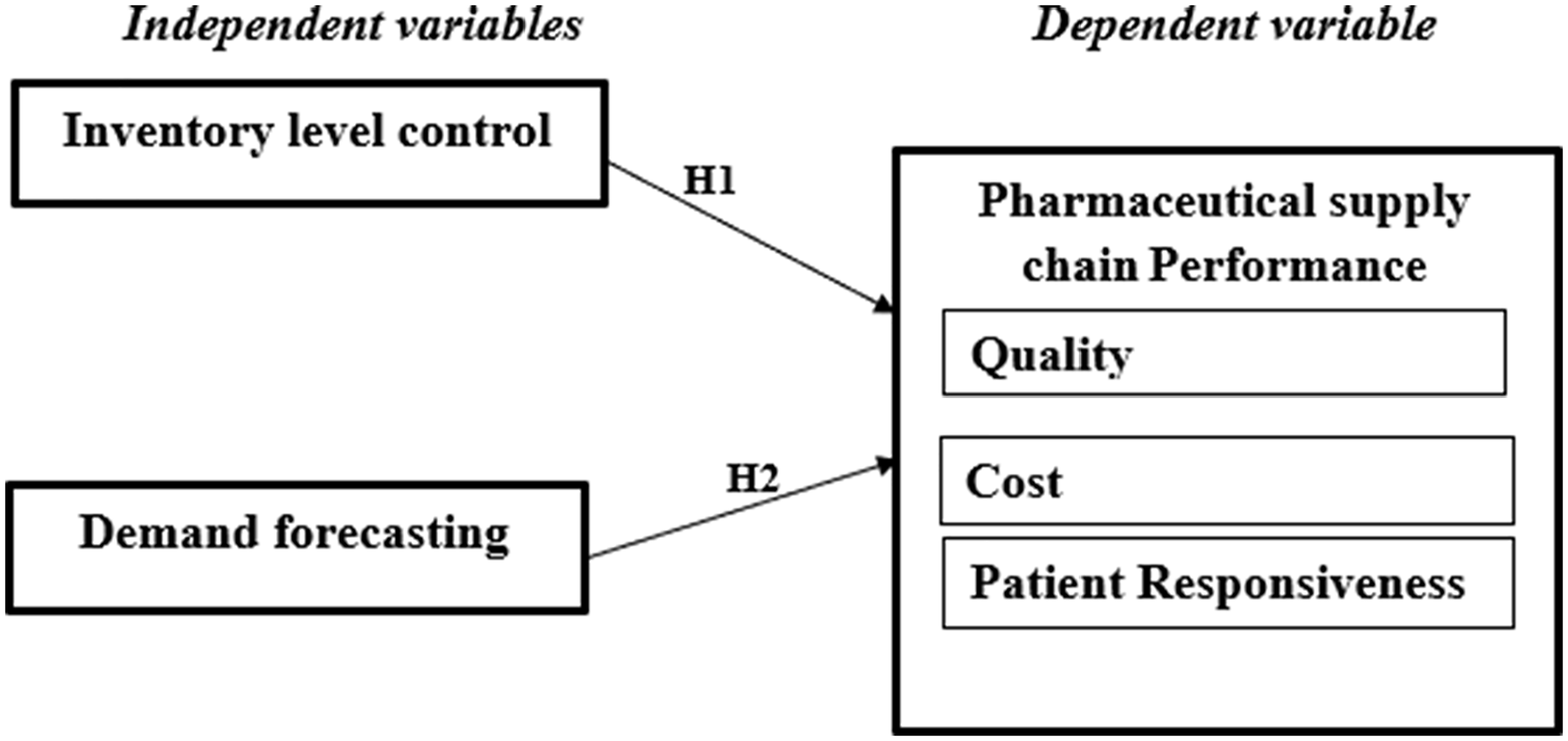
Research model.
Research Gap
One of the most studied problems in the literature is the inventory model; however, there are few works on inventory management in the pharmaceutical sector (Franco & Alfonso-Lizarazo, 2017). Moreover, many researchers studied the SCM and SC performance in hospitals, but only a few empirical studies have explicitly addressed PSC management in the hospital pharmacy echelon. Furthermore, the majority of the few studies conducted in the Gulf region discussed the hospital SC performance with no emphasis on PSC in the hospital, which increases the contribution made by this research. This research bridges some gaps in the literature. It is one of the limited studies in the Gulf region to tackle pharmaceutical inventory management dimensions and their effect on PSC performance in hospitals. Lastly, this is the first research to study this relationship in the Kingdom of Bahrain.
Methodology
To achieve the objectives of this research and to examine the relationship between the independent variables and the dependent variable, this research employed a quantitative cross-sectional method, constructed principally on a field survey. A two-part survey-questionnaire was designed in the English language using the relevant literature. The first part included the statements that were related to the study constructs which were developed based on previous literature, and the second part comprised the inquiries related to demographical information. The construct of inventory control methods comprised three items which were adapted from Fredrick (2018). Additionally, three items were adapted from Polater and Demirdogen (2018) to assess demand forecasting. Seven items were used to measure the PSC performance construct in terms of three performance measures: quality, cost, and patient responsiveness. These items were adapted from previous research (Chen et al., 2013; Polater & Demirdogen, 2018). All items of the constructs were measured using a 5-point Likert scale with “1” indicating “strongly disagree” and “5” indicating “strongly agree.” Additionally, the second part of the questionnaire consisted of a series of descriptive items related to the respondents’ demographical information.
The population of this study included only private hospital pharmacies in Bahrain as here the procurement and PSC control decisions are made by the hospital managers, unlike government hospitals where the pharmaceutical products’ procurement decisions are controlled by the Ministry of Health (Abdallah et al., 2017). There exist 59 private hospital pharmacies in Bahrain. In this research, a hospital pharmacy is deemed to be any pharmacy located in healthcare facilities such as hospitals, clinics, and medical centers in Bahrain. Alshahrani et al. (2018) estimated that in each hospital, there are five categories of respondents who operate within SCM. Consistent with the previous research (Alshahrani et al., 2018), five respondents were targeted in each hospital as the potential respondents. Personal visits were made by the researcher to achieve a high response rate. The researcher visited all the private hospitals having pharmacies as part of their organization. The questionnaire was submitted to the human resource department or administration department within the hospitals with a cover letter specifying the purpose and significance of the study. Data was collected for the year 2020 from mid-September to the first week of November.
The sample collection procedure of this research employed the non-probability sampling technique—convenience sampling. Hence, in this research, the researcher requested the human resources management or other decision-makers in the hospitals to simply select five staff from the hospitals that are involved in the PSC of the pharmacy, such as purchasing managers, pharmacists, SC professionals, or any other employee involved in the PSC of the hospital pharmacy who were easily accessible, available at a given time, and willing to participate. Finally, 171 questionnaires were completed and collected from the hospitals. The data collection was accomplished with a response rate of approximately 58% (George & Elrashid, 2021). Table 1 presents the measurement items.
Measurement Items.

Construct Reliability and Validity
Quantitative methods of data analysis were used to analyse the collected data using the Statistical Package for Scientific Studies (SPSS) version 22. Firstly, a reliability test was conducted to assess the internal consistency of the items of each construct using Cronbach’s Alpha. Table 2 shows the results of the reliability test. The results reveal that Cronbach’s Alpha ranged between .785 and .877. All research variables have a Cronbach’s Alpha which is greater than .7 as recommended by Hair et al. (2010). Therefore, the results indicate that the items included in the questionnaire are valid and accepted.
Reliability Statistics.

Next, factor analysis has been used to assess the validity of the questionnaire items. The accepted value of Kaiser- Meyer-Olkin (KMO) must be more than .5 (Kaiser, 1974). Moreover, the value of KMO of .70 and above signifies that factor analysis would be adequate regardless of sample size (Polater & Demirdogen, 2018). The findings of factor analysis for all constructs indicated that all constructs were statistically significant (p ≤ .001) and KMO = .812. Therefore, the findings are valid. Table 3 shows the KMO of each construct, which ranges from .719 to .741. Thus, the findings of the KMO tests indicate that the survey is valid and representative.
Factor Analysis for Each Construct KMO and Bartlett’s Test.

Demographic
Table 4 summarizes the profile of participants by gender, age, qualification, and experience in SC operations and the role of the respondents within the hospital. Generally, the demographic profile of the respondents indicated that a large proportion of the respondents had a higher education degree, and most of the respondents were pharmacists. These findings suggest that most of the respondents were competent, giving greater confidence in the results.
Demographic Information.

Assessment of the Model
A structural equation model (SEM) is a statistical modeling technique used to test sophisticated relationships among variables. The core aim of the SEM analysis is to validate the hypotheses (Polater & Demirdogen, 2018). Firstly, the measurement model (a confirmatory factor analysis [CFA]) has been developed. Next, a structural path model has been performed to test the relationships between constructs. There are several indicators of goodness-of-fit and most SEM scholars recommend evaluating the models by observing more than one of these indicators (Hoe, 2008).
Measurement Model Results
Confirmatory Factor Analysis (CFA) was performed using AMOS 26 to do validity analysis. CFA was also performed to ensure the uni-dimensionality and acceptable model fit indices (Abdallah et al., 2017). The chi-square statistic shows the model is significant and the χ2 = 106.896, df = 58, χ2/df = 1.843 (p < .01). Therefore, the model is significant, and the value of normed χ2 met the cutoff value below 3.0, as recommended by Garver and Mentzer (1999). Comparative Fit Index (CFI) = 0.947 and TLI = 0.928. Thus, CFI and TLI were more than the suggested minimum value 0.9 (Garver & Mentzer, 1999). Incremental fit index (IFI) = 0.948, was larger than the suggested minimum value 0.9 (Iacobucci, 2010). Moreover, the value of Root Mean Square Error of Approximation (RMSEA) = 0.07 was below the recommended level of 0.08 (Garver & Mentzer, 1999). In addition, the root means square residual (RMR or SRMR) = 0.023, which was below the suggested maximum value of 0.08 (Hu & Bentler, 1999). These findings suggest that the model fit is acceptable. Figure 2 shows the measurement model, while Table 5 presents the model fit summary of the measurement model.

Measurement model.
Tests of CFA and SEM With Goodness-of-Fit Indices.

Assessment of Structural Modeling Path Coefficients
To analyse the relationships between the constructs, a structural equation model (SEM) was applied. The model fit indices of the SEM showed a good model fit to the data set with χ2 = 113.173, df = 59, χ2/df = 1.918 (p < .01), CFI = 0.941, IFI = 0.942, TLI = 0.922, RMR = 0.03, and RMSEA = 0.073. Table 6 presents the output of path analysis of the structural model, while Figure 3 shows the full structural model. The findings show a significant positive correlation between Inventory Level Control and PSC performance in hospital pharmacies (β = .619, p < .001), and thus the first hypothesis of this research is accepted. The result also reveals a significant positive correlation between Demand Forecasting and PSC performance in hospital pharmacies (β = .152, p < .05). Therefore, the second hypothesis of this research is accepted.
Path Analysis.

, *** significance at p < .05 level and p < .001, respectively.

Full structural model.
Discussion
Inventory management is a critical factor that affects a hospital’s operational performance (Saha & Ray, 2019). Moreover, the main goal of inventory management is to reduce costs, maximize profit, and meet customer demand. Indeed, too much stock increases the possibility of spoilage loss. However, too little stock leads to poor customer service (Koumanakos, 2008). One of the main segments of the PSC system is the distribution to hospital pharmacies since it is the responsibility of the pharmacies to meet the required demand for drugs to treat disease in the health center (Goodarzian et al., 2020). Therefore, hospital pharmacies must improve their inventory decisions to achieve the required PSC performance in terms of cost, quality, and meeting the patients’ needs.
In this research, the inventory management variable was measured using two aspects: inventory level control and demand forecasting. The path analysis results show that inventory level control is positively associated with PSC performance in hospital pharmacies in Bahrain. Thus, PSC performance was improved by using appropriate inventory level control methods such as batch control and stock review and having suitable replenishment decisions such as lead time management. This finding is consistent with the findings of previous studies (Fredrick, 2018; Odhiambo & Kihara, 2018; Rachmania & Basri, 2013). The results suggest that hospital pharmacies need to implement appropriate inventory management practices to ensure zero stockouts and withstand fluctuations in demand and supply. Therefore, SC managers are required to understand the main issues affecting the PSC management in hospitals and manage all the information which affects the inventory system. Also, SC managers are required to avoid inventory losses, for example by managing expiration dates and storage conditions of medicine.
Additionally, the results show that demand forecasting is positively associated with PSC performance in hospital pharmacies in Bahrain. Therefore, having effective and successful demand forecasting methods results in effective PSC. This finding is in parallel with the findings from Rachmania and Basri (2013) and Polater and Demirdogen (2018). Moreover, it is essential for a healthcare system to forecast the amount and the order of the required medicine during in-need time Goodarzian, Wamba et al. (2021). Therefore, this research suggests that the SC professional needs the appropriate demand forecasting methods to take the right decisions.
Conclusion and Recommendation
The most vital goal of healthcare systems is to offer care and the right treatment to patients. Therefore, to achieve this goal and to meet health needs, healthcare systems are required to have a well-developed inventory control system. Successful inventory control is important to attain an effective PSC to ensure sufficient stock of needed drugs and reasonable costs by reducing risks of stockouts, expiries, and discarded medicines (Parmata et al., 2016; Saha & Ray, 2019). This research discussed this issue in the context of the Kingdom of Bahrain. Specifically, this research is designed to investigate the role of inventory level control and demand forecasting on the performance of PSC in hospital pharmacies in Bahrain.
In conclusion, based on the research’s findings, both inventory level control and demand forecasting are positively associated with PSC performance in hospital pharmacies in Bahrain. In the healthcare system, PSC requires effective inventory management policies to ensure the availability of medicines, without negatively affecting patient care services, and to decrease financial losses (Uthayakumar & Priyan, 2013). In addition, hospitals need to develop PSC performance to improve patient responsiveness and reduce operational costs. Hence, hospital managers and pharmacy managers have to make correct decisions on the inventory level they carry, order quantities, and purchasing dates to successfully serve their patients (Uthayakumar & Priyan, 2013).
Similarly, hospitals should construct frequent demand forecasts using statistical methods to respond to demand fluctuations and fulfill patients’ needs on time (Polater & Demirdogen, 2018). Therefore, this study recommends that PSC managers must pay more attention to improving the management of pharmaceutical inventory in hospital pharmacies to decrease the stockouts and the carrying of extra inventory. This can be achieved through appropriate inventory replenishment techniques, batch control, stock review, and accurate and reliable demand forecasting by using the right statistical methods; these practices will aid the carrying of suitable pharmaceutical inventory in the hospital pharmacies to address unstable demand, fulfill patient’s needs, and increase the patient satisfaction. Furthermore, this paper will help hospital pharmacies to find the best practices to manage the pharmaceutical inventory and pay more attention to improving inventory level control and demand forecasting methods. Additionally, this research provides essential information to all stakeholders operating in PSC in the healthcare sector to improve the quality of PSC, reduce operating costs, and improve responsiveness.
Implications and Contributions
This research has theoretical and practical implications for PSC operations. It draws implications for the healthcare sector, SCM managers, and academicians by highlighting the required knowledge base and professional contribution to improving PSC performance. Indeed, decisions made in the pharmaceutical inventory management system are significant. Therefore, healthcare organizations can adopt the inventory control policy and demand forecasting method that best suits them. Hence, one of the significant contributions of this paper is related to the inventory management impacts on PSC performance in terms of quality, cost, and responsiveness. The theoretical contributions of this study are various. The literature shows that there is a lack of real evidence and a need has been articulated for more comprehensive research. This research on inventory management and PSC performance addresses this need. Also, this research has responded to the corresponding calls for quantitative research that has reliability and validity. The theoretical implications of this research include developing a framework for inventory management and its contribution to PSC performance in hospital pharmacies. Most importantly, this research examines how both dimensions of inventory management can enhance the PSC. Furthermore, the empirical survey undertaken within this research has provided concrete evidence of the influence of inventory control and demand forecasting on PSC performance in healthcare organization and extends previous research that had investigated these concepts separately. This research also has implications for practice, including: assisting hospital pharmacies to find the best practices to manage the pharmaceutical inventory and understanding the impact of inventory control and demand forecasting on PSC performance. The results of this research showed that to improve the availability of pharmaceutical products and avoid shortages, inventory control processes need to be streamlined toward customer needs and demands by implementing a proper technique for inventory level control practices and improving inventory management policy. Also, the application of reliable and precise demand forecasting methods would advance inventory management practices across the PSC in the healthcare sector.
The contributions of this research include the role of inventory management in PSC performance. This is particularly important as this research is the first to tackle PSC management of hospital pharmacies in the Gulf region and specifically in the Kingdom of Bahrain. Moreover, for academicians, this research adds empirical evidence to the existing PSC literature and affords a platform for future research. Moreover, the findings of this research might aid researchers in improving the research instrument.
Limitations and Future Research
This research is subject to certain limitations. Firstly, this study was conducted in the Kingdom of Bahrain, limiting the findings’ generalizability to other countries. Moreover, this study concentrates only on the private hospital pharmacies in Bahrain. To expand the generalizability, the proposed model could be applied to hospital pharmacies in the government sector and other countries in future research. Because of the ongoing pandemic of coronavirus disease 2019 (COVID-19), it was impracticable to do personal interviews or to use the observation method of data collection. As a result, this study used a questionnaire as a single data collection technique. Furthermore, this study used a cross-sectional time horizon. Thus, only a snapshot of an existing state was captured using these survey methods. Therefore, a longitudinal, in-depth case study for analyzing every PSC operation and related issues would be an exciting avenue for future research. Future research could also discuss other factors that may impact the PSC, such as the regulatory environment, physician preferences, price, technology, and economic factors.
Supplemental Material
sj-docx-1-sgo-10.1177_21582440221149717 – Supplemental material for Inventory Management and Pharmaceutical Supply Chain Performance of Hospital Pharmacies in Bahrain: A Structural Equation Modeling Approach
Supplemental material, sj-docx-1-sgo-10.1177_21582440221149717 for Inventory Management and Pharmaceutical Supply Chain Performance of Hospital Pharmacies in Bahrain: A Structural Equation Modeling Approach by Shaju George and Safaa Elrashid in SAGE Open
Footnotes
Acknowledgements
Not applicable.
Declaration of Conflicting Interests
The author(s) declared no potential conflicts of interest with respect to the research, authorship, and/or publication of this article.
Funding
The author(s) received no financial support for the research, authorship, and/or publication of this article.
Ethics Statement
Not applicable.

Supplemental Material
Supplemental material for this article is available online.
References
Supplementary Material
Please find the following supplemental material available below.
For Open Access articles published under a Creative Commons License, all supplemental material carries the same license as the article it is associated with.
For non-Open Access articles published, all supplemental material carries a non-exclusive license, and permission requests for re-use of supplemental material or any part of supplemental material shall be sent directly to the copyright owner as specified in the copyright notice associated with the article.
