




Abstract
With the rapid development of digital technologies, digital transformation is becoming a critical way for enterprises to improve their performance. However, the current literatures lack sufficient research on whether and how the usage of digital technology improve supply chain performance. Based-on resource-based view and information processing theory, this study examines the impact of digital transformation on supply chain performance, as well as the mediating role of supply chain integration. The proposed hypotheses are tested empirically using data collected from Chinese A-share listed manufacturing firms for the years 2015 to 2022. The results show that digital transformation has a significant impact on supply chain performance, in which supply chain integration plays a partial mediating role. After a series of endogeneity and robustness tests, the results remain valid. Further analysis also reveals that the impact of digital transformation on supply chain performance is more significant for small and medium-sized enterprises (SMEs) than for large enterprises. In addition, firm size has a significant heterogeneous effect on this relationship, which implies that digital transformation is better able to improve SMEs’ supply chain performance. The findings provide guidance for enhancing supply chain performance through digital transformation and supply chain integration.
Keywords
Introduction
The rapid development of digital technologies is bringing about profound social and industrial changes that are affecting almost all aspects of enterprise’s operation. Digital transformation is changing the way enterprises operate in many industries (Büyüközkan & Göçer, 2018). Many studies have found that digital transformation can benefit enterprises by improving services (Lehrer et al., 2018) and increasing sales (Yeow et al., 2018), and by helping enterprises to manage upstream supply (suppliers) and downstream demand (customers), reduce inventory and coordination costs, and improving operational efficiency (Berawi et al., 2020). Digital transformation can also contribute to firm performance by collecting, processing and leveraging data related to customers, suppliers and markets (Gupta et al., 2021; Jabbour et al., 2020). Based on research evidence from Forrester Research, it is concluded that US manufacturers are benefiting from digital transformation, including shorter production cycles and product delivery, and increased business operational efficiency (Hennelly et al., 2020; Oubrahim et al., 2023).
In the field of supply chain management, digital transformation and supply chain integration are two terms that are widely discussing (Junaid et al., 2022). Digital transformation can improve supply chain management efficiency by increasing the accessibility of data and information and reducing transaction costs among partners (Nayal et al., 2022; Oubrahim et al., 2023). Some studies argued that information technology can help improve supply chain performance (Cui et al., 2023; Han et al., 2017). However, when considering digital technologies, few studies have examined their impact on supply chain performance. In addition, supply chain integration has received much attention in the last two decades due to changes in the market environment and competition, which has forced decision-makers to seek partnership strategies to improve supply chain performance (Cegielski et al., 2012; Flynn et al., 2010; Junaid et al., 2022; Oubrahim et al., 2023). Therefore, supply chain integration is crucial for efficient supply chain management (Huo, 2012).
While much of literature has examined the relationship between digital transformation and firm performance (Junaid et al., 2022; Oubrahim et al., 2023), in-depth studies on whether and how digital transformation affects supply chain integration and supply chain performance are rare, and even fewer related empirical studies. Specifically, theoretical analysis and empirical evidence on the mechanism by which digital transformation affects supply chain performance have not yet been fully explored (Oubrahim et al., 2023). Against this background, this study attempts to explore the relationship between digital transformation and supply chain performance, as well as the mediating role of supply chain integration, and empirically test those using data from China’s A-share listed manufacturing firms for the years 2015 to 2022.
There are three reasons for using Chinese manufacturing enterprises as sample. First, China has formulated a number of policies in recent years to support enterprises in adopting digital technologies, such as policies to promote the development of e-commerce industry and the extensive construction of Internet infrastructure, which have laid a solid foundation for enterprise’ digital transformation. Second, over the past decade, China has carried out extensive digital transformation in various sectors, especially in the manufacturing industry, and has achieved remarkable success. Third, the digital economy has contributed significantly to China’s economy growth with the manufacturing sector playing a key role, which attracted international attention (Guo & Chen, 2023). Therefore, the digital transformation practices of Chinese manufacturing enterprises can provide good experiences for enterprises’ digital transformation in other emerging markets (Zhang et al., 2023).
This study has three specific contributions. First, it analyses and tests the impact of digital transformation on supply chain performance, which can provide a new interpretation of whether digital transformation can enhance supply chain performance, and the conclusions can complement and enrich the existing literature. Second, the mediating role of supply chain integration is analyzed and verified, which can reveal one possible mechanism that digital transformation affects supply chain performance, and the conclusions can enrich the research content of supply chain management. Third, the heterogeneous effects of firm size and ownership nature are analyzed and tested, which can provide a basis for the implementation of targeted digital transformation in different enterprises.
Theoretical Background and Hypothesis Development
Resource-Based View and Information Processing Theory
Grounded in the strategic management literature, the resource-based view defines how enterprises gain competitive advantage through their resources and capabilities (Barney, 1991; Erboz et al., 2022). It argues that enterprises can achieve sustainable competitiveness in the market when the resources they possess are valuable, rare, imperfectly imitable, and non-substitutable. The underlying assumptions depend on the immobility and heterogeneity of enterprise’ resources and capabilities (Erboz et al., 2022; Guang Shi et al., 2012), which are characterized as either tangible, such as infrastructure, plant and equipment, or intangible, such as human capital or technology know-how (Erboz et al., 2022; Nath et al., 2010). Enterprises can enhance their competitive advantage by introducing strategic resources that cannot be duplicated by their competitors (Erboz et al., 2022; F. Wu et al., 2006).
The resource-based view is widely recognized as the dominant theory explaining how information technology resources shape business value (Shibin et al., 2020; Zhang et al., 2023). Existing studies have explored the impact of various information technology resources on organizational performance, such as information technology infrastructure (Benitez et al., 2018; Zhang et al., 2023), information technology capabilities (Chae et al., 2018) and information technology investment management (Ilmudeen & Bao, 2020). As a source of competitive advantage, information technology resources can be used to improve communication and productivity, reduce internal operating costs, and improve firm financial performance (Liang et al., 2010; Zhang et al., 2023). In line with this, digital transformation is based on digital technologies, which represent organizational resources and also can be considered as the key for enterprises to achieve higher sustainable competitive advantage (Erboz et al., 2022; Salam, 2021).
Information processing theory describes an organization as a system that needs and has the ability to process information to reduce uncertainty (Cegielski et al., 2012; Galbraith, 1974). It argues that organizations need to process information to maintain a certain level of performance, and the ability to process risk and dynamic information is a highly desired organizational capability (Belhadi et al., 2024; Srinivasan & Swink, 2018). In a highly turbulent and complex environment, such as unexpected market competition, changing customer demands and the COVID-19 shocks, organizations need high-quality information to cope with uncertainty and improve decision-making (Danese et al., 2013), and effective information acquisition, processing and sharing are predictors of business success (Li et al., 2020; Trujillo-Gallego et al., 2022).
Environment conditions determine the extent of an organization’s information processing needs, while the resources and tools associated with information collection, processing and management affects an organization’s information processing capabilities (Cui et al., 2023; Galbraith, 1974). Information processing theory advocates that organizations can adopt two strategies to help improve decision-making efficiency, that is, reducing information processing needs and improving information processing capabilities, which can be used to help improve organization’s decision-making efficiency in times of uncertainty (Cui et al., 2023; Galbraith, 1974). Digital transformation provides an excellent opportunity to experimentally test information processing theory (Ning et al., 2023). Premkumar et al. (2005) state that digital transformation can support organization to acquire skills that contribute to information processing. Melville and Ramirez (2008) also emphasize the need of investment in digital transformation to improve enterprises’ information processing skills. Fairbank et al. (2006) argue that digital transformation can be deployed within organizations through information processing design, thereby improving organization’s stability.
Digital Transformation and Supply Chain Performance
Digital transformation is one of the latest buzzwords that loudly raises awareness with regard to the ongoing change processes, attributed as “fast,”“radical,”“fundamental,” or “game changing” in recent years (Warner & Wäger, 2019). In the last decade, academic research on digital transformation has increased along with its practical implementation. Digital transformation typically refers to the process of improving an entity by triggering significant changes in its attributes through a combination of information, communication, computing, and connectivity technologies (Jayawardena et al., 2023; Vial, 2019), or the process of using digital technologies (e.g., artificial intelligence, blockchain, cloud computing, and big data analytics) to optimize business processes, improve efficiency and customer experience, and expand business opportunities. This is an ongoing process of using digital technologies in everyday organization’ life (Cetindamar Kozanoglu & Abedin, 2021; Warner & Wäger, 2019).
Digital transformation mainly involves the non-technical properties of digital technology application and highlights the strategic and organizational changes (Vial, 2019). It attributes digital technologies as major enablers of change and emphasizes how to improve operational efficiency and business performance through the adoption of digital technologies. First, digital technologies can improve organizational communication efficiency, make business operations more efficient and innovation more effective (Bharadwaj et al., 2013). Second, digital transformation can fundamentally change enterprises’ production, organization and marketing methods by adopting digital technologies (Zhai et al., 2022). Third, digital transformation can help enterprises develop new business models and create new value for customers (Hanelt et al., 2022; Zhai et al., 2022). These three aspects represent the daily processes and strategic changes that organization undergo in digital transformation (Zhai et al., 2022).
Digital technology has become an important pillar in building relationships between companies and their stakeholders, and they can influence enterprises to adopt new business models to achieve competitiveness. Digital transformation provides vital benefits to supply chains, such as improved availability of information, real-time data collection, optimized supply chain management practices, reduced production and transaction costs, timely delivery of products to customers, and improved efficiency and effectiveness of supply chain functions (Oubrahim et al., 2023). Khan et al. (2022) point out that modern digital technologies enable organizations to better understand customer needs, help enterprises build better relationships with customers, generate and share real-time information, make supply chains more agile and flexible, contribute to improved decision-making, and enhance business performance. Sharma et al. (2022) studied the digitalization of supply chain network and concluded that the digitalization of supply chain network can improve enterprise performance.
Various studies have also shown the critical role of digital transformation on supply chain performance. For example, big data analytics and Industry 4.0 are the most appropriate tools to improve supply chain performance (Gupta et al., 2021). Kim and Lee (2021) believe that digitalization positively affect the formation of social capital, which in turn positively affect supply chain performance. Raut et al. (2021) have shown that big data analytics directly impacts supply chain business performance. Based on their findings, Kamble et al. (2023) support this hypothesis by arguing that blockchain technology has a positive impact on supply chain performance. From these literatures, it is argued that digital transformation benefits organizational and supply chain performance. However, the current literatures fail to address the mechanisms by which digital transformation affects supply chain performance. In other words, there is a lack of in-depth academic research on the relationship between digital transformation and supply chain performance (Alsufyani & Gill, 2022).
According to the resource-based view, digital technologies can greatly optimize and enrich the exclusive resources owned by enterprises, which lays a foundation for the building of competitive advantage. For example, although the hardware and software systems that an enterprise invests can easily be copied and imitated by competitors, the knowledge, experience and skills accumulated during the process of digital transformations, which are closely integrated with corporate strategy, marketing, human resources, operations and business processes, can enhance the non-replicability and non-substitutability of the enterprise’ resources, increase the cost of imitation, and thus become the source of sustainable competitive advantage (Guo & Chen, 2023).
Amit and Han (2017) argue that enterprise’s resources can be arranged through digital transformation, including continuous resource acquiring, testing, crowdsourcing, sequencing, exploration, grafting, and streamlining through the adoption of digital technologies. For example, big data analytics technology is helpful for resource acquisition and allocation decisions (Gupta et al., 2020), while artificial intelligence technology can realize automated allocation of resources through big data analytics technology, as well as algorithm-based resource coordination and allocation decisions (Newell & Marabelli, 2015). Moreover, enterprises can facilitate cross-border collaboration to develop skills and share knowledge, and to access resources from partners through digital transformation (Shou et al., 2018), which also allows the accumulation and updates of resources and capabilities (Trujillo-Gallego et al., 2022).
From the perspective of information processing theory, digital transformation also reflects the information processing abilities of enterprises to evaluate their supply chains and make informed decisions. In the process of digital transformation, a large amount of data and information will be generated, which can be regarded as new resources and has the potential to create business value and enhance competitiveness (Yang et al., 2021). Digital transformation is transforming traditional supply chain management approaches to more data-driven ones (Singh & El-Kassar, 2019; Yang et al., 2021), and it can contribute to production planning, improve supply chain efficiency, reduce costs, and increase profits through effective information processing (Nguyen et al., 2018), as well as regulating environmental parameters such as resource consumption and energy efficiency in real time through automated optimization of manufacturing processes (Jabbour et al., 2020; Trujillo-Gallego et al., 2022).
By adopting digital technologies, such as Internet of Things, Cloud Computing, and Big Data Analytics, enterprises can efficiently collect and process supply chain data and information (Ning et al., 2023; Pan et al., 2021; Schniederjans & Hales, 2016; Wamba et al., 2015). For example, linkages in supply chain network can promote sharing of data and information, and interact with others through Internet of Things technology (Frank et al., 2019; Ning et al., 2023). Cloud Computing technology can enable data and information in supply chain network be stored and analyzed in real-time and then accessed as needed (Bruque-Cámara et al., 2016; Ning et al., 2023). Big Data Analytics technology can help businesses identify and extract useful data and information to make more scientific decisions (Gunasekaran et al., 2017; Ning et al., 2023). In addition, tracking changes in consumer demand is key to keeping the supply chain on track, and digital technologies can quickly monitor and transfer favorable customer demand to the enterprises to maintain uptime (Ning et al., 2023).
The most effect of digital transformation on supply chain seems to be the improvement of supply chain operational efficiency, including operational speed, cost, quality, flexibility, agility, and robustness (Singh & El-Kassar, 2019; Yang et al., 2021). Many studies also provided empirical evidence for the relationship between digital transformation and supply chain efficiency. Digital transformation can improve product quality, market responsiveness, production and planning efficiency and accuracy (Chavez et al., 2017; Yang et al., 2021), traceability and visibility of the product flow, which in turn improves supply chain performance by reducing cost, making better decision, and upgrading products and services (Gupta et al., 2021; Matthias et al., 2017). Therefore, we can propose the following hypothesis.
The Mediating Effect of Supply Chain Integration
Over the past two decades, due to the high level of global market competition and increased customer demand patterns, there has been a significant increase in academic and practitioner interest in supply chain integration (Kumar et al., 2017; Oubrahim et al., 2023; Tarigan et al., 2021), and supply chain integration is becoming a considerable research hotspot in the fields of operations and supply chain management (Ataseven & Nair, 2017). Supply chain integration refers to “linking major business functions and business processes within and across enterprises into a cohesive and high performing business model” (Chen et al., 2018), which is also described as linkages of supply chain processes across enterprises (Erboz et al., 2022; Flynn et al., 2010), and highlights the importance of strategic collaboration, information communication, risk and return sharing among supply chain partners (Osei & Asante-Darko, 2023; Zhu et al., 2018).
Supply chain integration is usually divided into external and internal integration. External integration refers the linkage of an enterprise’s logistics operations with its customers and suppliers across boundaries (Huo, 2012; Moyano-Fuentes et al., 2016; Oubrahim et al., 2022). It involves strategic cooperation with external supply chain partners and customers. Internal integration refers to collaboration among various supply chain functions within an enterprise to improve processes or to develop new products or services (Kumar et al., 2017; Oubrahim et al., 2023; Tarigan et al., 2021; Zhao et al., 2011). In practice, it is not enough to align the activities of the various supply chain functions within an enterprise merely, and tremendous outcomes can be reached by connecting external supply chain partners and customers along the supply chain network (Danese et al., 2013; Espino-Rodríguez & Taha, 2022).
External integration emphasizes business integration of the focal enterprise with supplier and customer (Boer & Boer, 2019; Erboz et al., 2022; Jajja et al., 2018). Supplier integration refers to the development of cooperation strategies, synchronized processes, data and information sharing mechanism and coupling system of the focal enterprise with suppliers (Chaudhuri et al., 2018; Erboz et al., 2022). A high level of supplier integration can improve production planning, on-time delivery, and service responsiveness, especially in upstream supply chain activities (Chen et al., 2018). Customer integration is defined as the coordinative and collaborative linkages of the focal enterprise with customers through data and information sharing and collaborative decision-making (Erboz et al., 2022; Jajja et al., 2018). Effective customer integration can enhance an enterprise’s capabilities to predict changes in customer demand (Droge et al., 2012). In brief, external integration can enable to develop close and collaborative relationships among supply chain partners (Flynn et al., 2010).
Digital transformation provides technological conditions for coordination and collaboration among supply chain partners, which can increase connectivity and information sharing (Yang et al., 2021), facilitate user’s involvement in product and service innovation, and improve supply chain integration level (Chavez et al., 2017). For example, traditional procurement is usually slow and expensive due to an amount of time spent on communication, while digital systems with greater data and information sharing capability can largely avoid unnecessary communication and enhance the efficiency of procurement activities (Davila et al., 2003; Yang et al., 2021). Li et al. (2020) noted that the adoption of digital technologies can enable the focal enterprise to communicate with supply chain partners to exchange and transfer data and information effectively, and build well-organized supply chain partnerships (Nayal et al., 2022). In addition, adequate data and information exchange and communication can help to strengthen understanding and trust among supply chain partners, which is necessary for effective supply chain integration.
In previous studies, some scholars have noted that the adoption of information technologies can facilitate supply chain integration (Kim, 2017; Yuen & Thai, 2017). For example, Thun (2010) demonstrated that information flow among supply chain partners is an indispensable element in promoting supply chain integration, as information technology can improve the accuracy of data and information exchange, which in turn leads to higher inter-organizational collaboration. Based on information processing theory, digital transformation can be viewed as a practice that enhances organizational information processing capabilities (Li et al., 2020; Dubey et al., 2021), and the adoption of digital technologies can facilitate data and information sharing and process coordination in supply chain network (Singh & El-Kassar, 2019), and by synchronizing delivery times and reducing supply chain partners’ data and information failures help enterprise to achieve a higher level of supply chain integration (Frank et al., 2019). Therefore, we can propose the following hypothesis.
According to information processing theory, multi-channel and frequent data and information exchange among supply chain partners can provide enterprises with more comprehensive and timely data and information closely related to change, which in turn can help manage uncertainty effectively. As a result, enterprises can manage their supply chain by establishing closer supply chain partnerships to improve sustainable supply chain performance (Espino-Rodríguez & Taha, 2022; Meng et al., 2023; Tarigan et al., 2021). According to the resource-based view, it can also be argued that supply chain integration can contribute to access to valuable and hard-to-imitate resources and capabilities (Delic et al., 2019), and ultimately lead to improved performance (Erboz et al., 2022). Kumar et al. (2017) also pointed out that supply chain integration plays a key role in shaping sustainable competitive advantage and improving supply chain performance.
Extant studies also suggested that supply chain integration can lead to positive outcomes, such as reduced transaction costs and improved operational or financial performance (Cao et al., 2015; Flynn et al., 2010; Wong et al., 2011). For example, Prajogo and Olhager (2012) found that supply chain integration can significantly affect performance. Erboz et al. (2022) found that supply chain performance is positively influenced by supply chain integration when they examine the impact of Industry 4.0 on supply chain integration and supply chain performance. Chang et al. (2016) pointed out that close collaboration relationship between suppliers/customers and focal enterprises can facilitate the sharing and exchange of data and information such as production plans, on-time delivery, schedules, and processes, and ultimately enhance supply chain performance. Therefore, we can propose the following hypothesis.
The adoption of digital technologies to supply chain system is a prerequisite for focal enterprise to meet the market demands in their quest for competitive advantage (Deepu & Ravi, 2021; Oubrahim et al., 2023). This is largely reflected in the process of transformation of traditional supply chain to digital technologies enhanced one (Ageron et al., 2020), which is also driven by shorter product lifecycles, changing market demands, limited resources, and increased global competition challenges (Oubrahim et al., 2023). While the basic role of digital transformation is to improve business process’s efficiency and effectiveness, it also helps to enable data and information sharing, facilitate coordination, and communication links among enterprises in supply chain network, which is the focus of supply chain integration (Nayal et al., 2022; Oubrahim et al., 2023). Thus, digital technologies can help enterprises obtain timely data and information from supply chain network and improve end-to-end visibility and flexible response to changes (Srinivasan & Swink, 2018).
With accurate data and information about supply chain provided by digital technologies, enterprises can make more valuable data-driven decisions. For example, the adoption of blockchain technology makes data and information more stable and unchangeable, and data and information cannot be edited without the authorization of approved stakeholders, which can strengthen supply chain integration (Oubrahim et al., 2023; Stroumpoulis & Kopanaki, 2022). Li et al. (2009) pointed out that the impact of information technology on supply chain performance cannot be fully realized if the role of supply chain integration is not fully exploited. Kamble et al. (2023) also argued that blockchain technology has a positive impact on supply chain performance, and this relationship is fully mediated by supply chain integration. Therefore, digital transformation can facilitate high-quality data and information exchange among supply chain partners and supply chain integration, and enhance supply chain performance. Therefore, we can propose the following hypothesis.
Research Design
Sample
To test the proposed hypotheses, we collect data on Chinese A-share manufacturing firms listed and traded on the Shanghai and Shenzhen Stock Exchange from the CSMAR (China Stock Market and Accounting Research) database for the years 2015 to 2022. We further use Stata software to remove (1) observations with missing values, and (2) special treatment (ST and *ST) sample firms, and (3) sample data with listing age <0.13463 firm-year sample observations are obtained. Meanwhile, continuous variables are winsorized at the 1% and 99% levels to reduce the impact of extreme outliers on the analysis. The descriptions of variables are shown on Table 1.
Variable Definitions and Desciptions.

Variables
Supply Chain Performance
In the existing literature, there are many methods to measure supply chain performance, such as methods that measure supply chain improvement, human resources, customer relations, profits and revenues comprehensively (Wu et al., 2014), or methods that measure customer satisfaction, sales, costs and services (Busse, 2016). We use the entropy method to construct a comprehensive supply chain performance index from five aspects: IPT, ROC, Q1, and Q2. The specific indicators are shown in Table 1. Firstly, entropy method is used to determine two positive indicators (IPT, Q1) and three negative indicators (IAT, ROC, Q2) according to the positive and negative influence directions of five indicators on supply chain performance. Secondly, the indicator is standardized (to avoid the 0 value of standardization, set an offset of 0.00000001), and denoted as xijk′. Then, the proportion pijk and entropy ek of each item are calculated to determine the information utility, and the weight wk is determined according to the proportion of a single information utility to the whole information utility. Finally, the weight is assigned to each standardized index value to obtain the comprehensive index value SCP, so as to measure the supply chain performance. The calculation formula is as follows.


Where, xmin,k, xmax, and k respectively represent the minimum and maximum value of the KTH indicator in n enterprises and r years, xijk represents the value of the i year, the j enterprise, and the KTH indicator.
Digital Transformation
The contents of annual reports of listed firms can well reflect the planning and implementation of digital transformation. Wu et al. (2021) used text analytics and Python software to capture the frequency of keywords, such as artificial intelligence, cloud computing, blockchain, big data, and digital applications in the annual reports of listed firms, and construct a digital transformation index, which has been used widely. We also adopt this method to measure digital transformation. First, construct a digital vocabulary. The terms associated with digitization are shown in Figure 1. Second, the python software tool is used to dig and capture the keywords related to digital transformation in the annual reports of listed companies, and the annual reports of listed companies can reflect the determination of enterprises to carry out digital transformation. In the end, the extracted word frequencies are counted and processed logarithmically. The higher the frequency, the higher the degree of digital transformation.

Dictionary of digital transformation.
Supply Chain Integration
This study focuses on external integration, which refers to data and information transfer and behavioral collaboration of focal enterprise with upstream suppliers and downstream customers (Huo, 2012; Jajja et al., 2018; Moyano-Fuentes et al., 2016; Qiao & Zhao, 2023). Customer integration (CI) can be measured by the proportion of sales of the top five customers, and supplier integration (SI) can be measured by the proportion of purchase of the top five suppliers.
Control Variables
Referring to the existing literature, firm size, asset liability ratio, earnings per share, board size, independent director proportion, ownership concentration, ownership nature, and age of listing are selected as control variables, and year and industry are used as dummy variables.
Multiple Regression Model
To verify the direct impact of digital transformation on supply chain performance, model (1) and model (2) are constructed as basic regression equations. The model (1) only controls year and Industry to fix time effect and industry effect, while the model (2) controls not only year and Industry, but also eight enterprise-level variables. In the model, i and t represent the listed company i and the year t (i and t in the model below have the same meaning). According to hypothesis 1, the estimated coefficients β0 and β1 of digital transformation should be significantly positive, indicating that digital transformation has a significant positive impact on supply chain performance.


To test the mediating role of supply chain integration between digital transformation and supply chain performance, we construct model (3)-(8). In these models, model (3) and (4) can examine the relationship of digital transformation and supply chain integration, if β2 and β3 are significantly positive, it indicates that digital transformation can facilitate supply chain integration and thus H2 can be verified. Model (5) and (6) can examine the relationship of supply chain performance and supply chain integration, if τ1 and τ2 are significantly positive, and H3 can be verified. Model (7) and (8) can be tested H3, if τ3 and τ4 are significant, and there is a mediating effect. Then if β4 and β5 are not significant, there is a complete mediating effect; if β4 and β5 are significant, there is a partial mediating effect, H3 can be verified.


Results
Descriptive Statistical Analysis and Correlation Analysis
The results of descriptive statistics analysis are shown in Table 2. The mean value of supply chain performance was 0.882, and the minimum and maximum values are 0.075 and 4.913, indicating that the supply chain performance of different enterprises varied greatly. The minimum value and maximum value of digital transformation are 0 and 4.19, indicating that the sample enterprises have basically implemented digital transformation, and the mean value is 1.334, slightly larger than the median value of 1.099, indicating that there are great differences in the digital transformation of different enterprises. Also, the minimum and maximum values of customer integration and supplier integration are (0.037, 0.912) and (0.057, 0.787), respectively, and the mean values are 0.320 and 0.309, indicating that the level of supplier integration and customer integration of different enterprises is significantly different.
Descriptive Statistical Analysis (Sample Size 13,463).

The results of correlation analysis are shown in Table 3. Digital Transformation (Dig), Supply Chain Performance (SCP), Supplier Integration (SI) and Customer Integration (CI) are all significantly positively correlated, indicating that the models set up are reasonable for regression analysis.
Correlation Analysis.

p < .001. **p < .01. *p < .05.
Regression Analysis
Model (1) and (2) is used to test H1. The result shown in column (1) of Table 3 indicates that digital transformation has a significant positive effect on supply chain performance (p < .001), and the result in column (2) indicates that digital transformation still has a significant positive effect on supply chain performance (p < .001) after adding control variables. H1 is supported.
Models (3) and (4) are used to test H2. The results shown in columns (3) and (4) of Table 4 indicate that digital transformation has a significant positive impact on supplier integration (p < .001) and customer integration (p < .001). H2 is supported.
Regression Analysis Results.
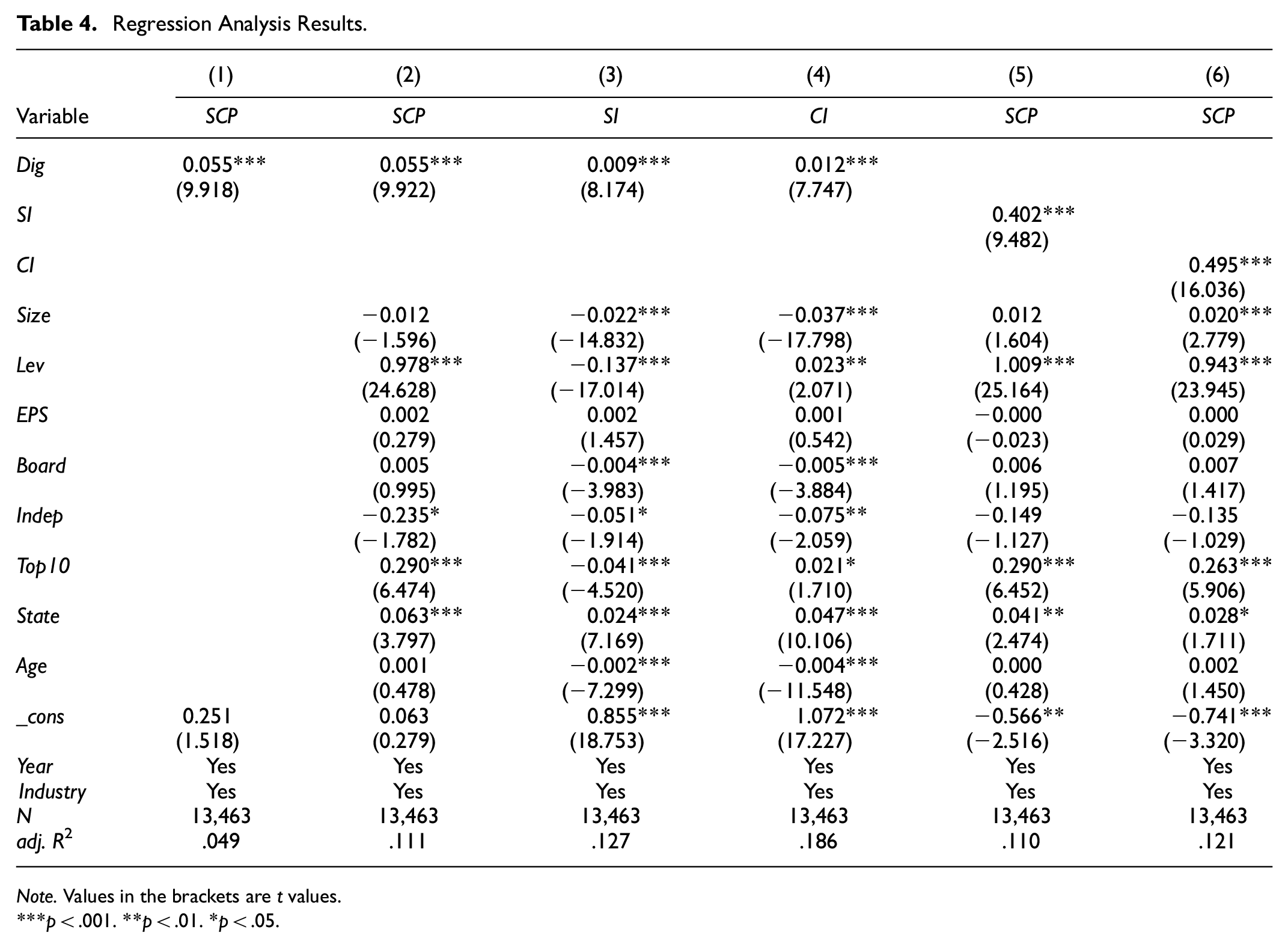
Note. Values in the brackets are t values.
p < .001. **p < .01. *p < .05.
Models (5) and (6) are used to test H3. The results shown in columns (5) and (6) of Table 4 indicate that both supplier integration (p < .001) and customer integration (p < .001) have significant positive impacts on supply chain performance. H3 is supported.
Models (7) and (8) are used to test H4. Table 5 show the results after adding supplier integration and customer integration as mediating variable, respectively, and the coefficients are still significant, indicating that supplier integration (p < .001, 0.052 < 0.055 and customer integration (p < .001, 0.050 < 0.55) play partial mediating role in the relationship between digital transformation and supply chain performance. H4 is supported.
Mediating Effect Analysis Results.

Note. Values in the brackets are t values.
p < .001. **p < .01.
Robustness and Endogeneity Test
Excluding the Samples of Digital Industry
This study mainly focuses on the impact of digital transformation on supply chain performance in traditional manufacturing. Therefore, according to the Industrial Classification Guidelines of Listed firms (revised in 2012) issued by the CSRC (China Securities Regulatory Commission), the sample with codes C39 (Computer, Communication and Other Electronic Equipment Manufacturing) and I64 (Internet and Related Services) are deleted, and the regression analysis is conducted again using Model (1) and (2). The results shown in columns (1) and (2) of Table 6 indicate that digital transformation still has a significant impact on supply chain performance. H1 is still supported. Also, the results shown in columns (3) to (8) of Table 6 indicate that H2, H3, and H4 can be verified, too.
Robustness Test: Excluding Samples of the Digital Industry.

Note. Values in the brackets are t values.
p < .001. **p < .01. *p < .05.
Replacing the Core Variable
Considering that the frequency of keywords related to digital transformation disclosed in the annual reports of listed firms may vary greatly due to statistical calibers. Therefore, entropy method is used to calculate the weights by years by standardizing the keyword frequency and obtain a comprehensive digital transformation index (Zhao et al., 2021). Regression analysis is conducted again. The impact of digital transformation on supply chain performance (shown in Table 7) is still significant. The mediating effect of supplier integration and customer integration is consistent with that in Table 4.
Robustness Test: Replacing Core Variable Index.

Note. Values in the brackets are t values.
p < .001. **p < .01. *p < .05.
Endogeneity Test Based on Lagged Regression
Robustness checks can solve potential error problem brought about by the selection of samples and variables, but there may be reverse causality problem, that is, enterprises with better supply chain performance may have more resources and higher demand for digital transformation, which in turn drives digital transformation. In order to alleviate this problem, regression analysis is conducted again after lagging the explanatory and control variables by one or two periods, respectively. The results shown in columns (1) and (2) of Table 8 indicate that digital transformation still has a significant impact on supply chain performance.
Endogeneity Test Based on Lagged Regression.

Note. Values in the brackets are t values.
p < .001.
Endogeneity Test Based on Propsensity Score Matching Analysis
To overcome self-selection bias problem, sample is grouped based on whether digital transformation is implemented, and firm size, asset liability ratio, earnings per share, board size, proportion of independent directors, ownership concentration, ownership nature, listing age, year and industry are used as covariant explanatory variables for nearest neighbor matching (NNM), radius matching (RM) and kernel matching (KM). Results shown in Table 9 are consistent with the above, indicating the findings remain valid after overcoming the selection bias problem of sample.
Endogeneity Test Based on Propsensity Score Matching Analysis.

Note. Values in the brackets are t values.
p < .001.
Further Analysis
Considering that the impact of digital transformation on supply chain performance may be different due to the difference of ownership nature, sample is further divided into state-owned enterprises (SOEs) and non-state-owned enterprises (Non-SOEs) for heterogeneity analysis. The results in columns (1) and (2) of Table 10 show that digital transformation has a significant impact on supply chain performance of both SOEs and Non-SOEs and p value of Fisher’s exam >.1, indicating that there is no significant difference in the effect of digital transformation on supply chain performance of SOEs and Non-SOEs.
Heterogeneity Analysis.

Note. Values in the brackets are t value.
p < .001. **p < .01.
In addition, considering that the impact of digital transformation on supply chain performance may also depend on firm size, sample is divided into large enterprises (LEs) and small and medium-sized enterprises (SMEs) for heterogeneity analysis. The results in columns (3) and (4) of Table 10 show that digital transformation has significant impact on supply chain performance of both LEs and SMEs, but the effect on SEMs is more significant. One possible explanation is that LEs may have stronger capital strength and more sufficient resources, and it is not urgent for implementing digital transformation, while SMEs can significantly improve supply chain performance by implementing digital transformation with the support of national policies.
Conclusions and Implications
Conclusions
With the rapid development of digital technologies, digital transformation has become an effective way for enterprises to gain competitive advantage. However, whether and how digital transformation affects supply chain performance has not been given much attention. Based on resource-based view and information processing theory, this study explores the influence mechanism of digital transformation on supply chain performance, and use data from Chinese A-share manufacturing listed firms for the years 2015 to 2022 to test the proposed hypotheses. The findings show that digital transformation can predict supply chain performance, and supply chain integration plays partial mediating role in this relationship. This indicates that the investment and deployment in digital technologies can promote supply chain integration and lead to better supply chain performance by facilitating access to information, reducing costs, improving product quality, and enhancing responsiveness and cooperation. In addition, firm size has heterogeneous effect on the relationship between digital transformation and supply chain performance. Namely, the impact of digital transformation on supply chain performance is more significant in SMES, which implies digital transformation can play a better role in improving SMEs’ supply chain performance.
Theoretical Implications
First, research on digital transformation has grown rapidly in recent years, but literatures on the contribution of digital transformation to supply chain performance are incipient. The findings complement and extend existing research. Second, firm size is an important organizational context factor that affects the relationship between digital transformation and supply chain performance. The findings can explain why some enterprises can achieve better supply chain performance in implementing digital transformation. Third, the existing studies believed that digital transformation is a key enabler to supply chain performance, but few empirical tests have been conducted, the findings provide an empirical evidence.
Practical Implications
First, enterprises should fully utilize digital technologies to improve supply chain performance. In the era of digital economy, enterprises need to establish data-driven decision-making mechanism to speed up response to changes and establish digital connections with upstream suppliers and downstream customers to support the improvement of supply chain performance. Second, enterprises should actively promote digital transformation to create conditions for supply chain integration. The application of digital technologies often brings disruptive changes, which requires organizations to break through inertia to reengineer supply chain network relationships, and thus improve supply chain performance. Third, different enterprises should implement targeted digital transformation strategies. SMEs can make full use of national policies to promote the application of digital technologies and gradually build market advantages in the process of digital transformation. LEs can leverage their resources and market position advantages to integrate multiple digital technologies and promote digital transformation.
Limitation and Future Research
This paper has carried out theoretical analysis and empirical test on the mechanism of digital transformation affecting supply chain performance and the intermediary mechanism of supply chain integration and has obtained research conclusions with certain theoretical value and practical guidance significance. However, there are also certain limitations. First, there is room for further improvement in the selection of research variables. Based on the existing research, some of the measurement indicators selected in this paper may not be representative, especially the measurement of digital transformation. Some scholars still have different views or doubts about the reliability of the method of measuring digital transformation by using the keyword word frequency in the annual reports of listed companies. Further in-depth discussion is needed to select more representative measurement indicators to ensure the reliability of the conclusion. Second, there is room for further optimization of the research data. Although the data of listed companies in China’s A-share manufacturing industry is selected in this study, there may be data distortion and other problems in the process of variable measurement and matching. For example, in the process of measuring the performance of the supply chain, the calculation and standardization of multiple indicators are involved, which may reduce the reliability of the data itself or the measurement indicators. In the next step, in-depth and detailed investigation can be carried out in combination with questionnaire survey or typical case analysis to further verify the reliability of the conclusions. Thirdly, the generalizability of the application of research conclusions. The research objects selected in this paper are manufacturing enterprises, which may limit the universality of the conclusions to enterprises in other industries. Therefore, future research can join other industries to further expand the scope of research objects. More importantly, more exploratory research is needed on how digital transformation affects supply chain performance. In fact, digital transformation may have an impact on supply chain performance through many different paths, and even other environmental variables may play a moderating role in the relationship between the two. The research in this paper only examines the path that digital transformation affects supply chain performance through supply chain integration, and further studies on the “black box” of the path relationship between “digital transformation and supply chain performance” are needed.
Footnotes
Acknowledgements
We thank our colleagues from the School of Business, Zhengzhou University for comments and assistance to improve the manuscript.
Declaration of Conflicting Interests
The author(s) declared no potential conflicts of interest with respect to the research, authorship, and/or publication of this article.
Funding
The author(s) disclosed receipt of the following financial support for the research, authorship, and/or publication of this article: We appreciate the support and funding from the Henan Provincial University Science and Technology Innovation Talent Support Program (Humanities and Social Sciences; No. 2017-CXRC-026) and the Henan Provincial Soft Science Research Program Project (No. 222400410494).
Ethical Statement
Not applicable.
