




Abstract
Competition between supply chains is significant, making it crucial for companies to continuously strive for supply chain competitiveness. Therefore, this study suggests trust, information sharing, and supply chain agility as key elements in supply chain management (SCM) and explores their impact on sustainable SCM performance. This study conducted surveys among companies that are establishing supply chains in Korea. In total, 332 valid questionnaires were included in the statistical analysis. A structural equation model based on SPSS 23.0 and AMOS 23.0 confirmed that trust has a positive effect on information sharing and supply chain agility, information sharing has a significant positive effect on supply chain agility, and supply chain agility has a significant positive effect on sustainable SCM performance. These findings suggest that companies can enhance their sustainable supply chain performance by prioritizing trust-building, facilitating smooth information sharing, and maintaining agility in their supply chain operations. Practical implementations include fostering closer cooperative relationships with trading partners, leveraging trust-based information sharing to reduce costs, and encouraging agile practices to stay competitive in uncertain environments. By doing so, companies, particularly in the manufacturing sector, can achieve improved performance without the need for significant additional investments.
Plain language summary
In today’s competitive business world, companies must constantly improve their supply chains to stay ahead. This study looks at how trust, sharing information, and being agile (quick to adapt) in the supply chain can improve sustainable performance. Researchers surveyed 332 companies in Korea and analyzed the data using statistical tools. They found that when companies trust each other, they share information more freely, which makes the supply chain more agile. This agility helps companies respond quickly to changes and improves their overall performance. The study concludes that building trust, sharing information smoothly, and maintaining agility are crucial for a sustainable and successful supply chain. Companies should focus on these elements to enhance their supply chain management and remain competitive.
Keywords
Introduction
The current supply chain environment is facing significant disruptions due to various factors such as global economic fluctuations, geopolitical tensions, wars, and technological changes. These disruptions have led to inefficiencies and vulnerabilities within supply chains, severely impacting business operations. In particular, the COVID-19 pandemic has caused widespread lockdowns, shipping delays, and supply shortages globally. Furthermore, political and economic shifts, such as Brexit and U.S.-China trade tensions, have further destabilized global supply chains, exacerbating the disruption. The current business environment that companies are facing can be summarized by the concept of VUCA (Volatility, Uncertainty, Complexity, and Ambiguity). Additionally, the globalization of supply chains, environmental uncertainties, and the increasing diversity of consumer demands make it even more critical for supply chains to maintain competitiveness in today’s rapidly changing business landscape.
In such a context, many firms have increasingly recognized the critical importance of supply chain management (Faramarzi-Oghani et al., 2023; Srivastava et al., 2022). Particularly, South Korea, due to its unique economic structure and cultural characteristics, places a heightened emphasis on trust-building and collaboration within its supply chains. This raises the question: how does trust influence the efficiency of information sharing in South Korean supply chains? While various factors have been proposed depending on the research objectives, the importance of information sharing has been consistently highlighted (C. Lee & Kim, 2023; Tang et al., 2023). To achieve effective information sharing, trust between trading partners within the supply chain environment is essential. Given the interconnected nature of numerous stakeholders within supply chains, establishing mutual trust becomes indispensable. Trust serves as the foundational basis for effective collaboration and smooth information exchange among supply chain participants, thereby enhancing both operational efficiency and agility. Specifically, Khan et al. (2018) emphasized that providing accurate information to trading partners is crucial for the smooth functioning of supply chains, and this process requires a strong foundation of mutual trust. Furthermore, Lu et al. (2018) argued that firms across diverse industrial structures create value through collaboration, and trust formation is integral to all these processes.
Supply chain agility refers to a company’s ability to react and respond quickly to changes in the market environment. Specifically, supply chain agility is fundamental to securing a competitive advantage in a global competition environment, as it enables the rapid handling of product and service requirements, customer demands, production volumes, and delivery schedules (Do et al., 2021; Patrucco & Kähkönen, 2021). Much research has been conducted in this regard. For example, it has been argued that supply chain agility enables a rapid response to diverse customer needs, thereby increasing the supply chain’s overall efficiency and effectiveness (Fayezi et al., 2017). Furthermore, sustainable SCM has been empirically confirmed as crucial in supply chains, and that to improve a company’s sustainability, capabilities such as supply chain agility are necessary (Wang & Wang, 2024). These points indicate that supply chain agility is an essential factor for maintaining continuous relationships with companies that are making transactions.
Therefore, this study seeks to analyze how trust, information sharing, and supply chain agility—key elements of relational governance—interact to enhance sustainable supply chain management performance in South Korea. Moreover, as sustainability in supply chains is now essential for long-term competitiveness and regulatory compliance, this research emphasizes the criticality of information sharing in enabling transparency, particularly in today’s volatile environment marked by the COVID-19 pandemic, geopolitical tensions, and other uncertainties. These dynamics not only enable firms to respond efficiently to unforeseen challenges but also contribute to the cultivation of enduring, sustainable inter-organizational relationships (Khan et al., 2016). As previously discussed, trust among supply chain partners is indispensable for facilitating information sharing and collaboration. Without trust-based relationships, organizations may harbor concerns about potential opportunistic behavior from partners, which can hinder cooperative efforts. Consequently, this study aims to provide an in-depth analysis of how trust, information sharing, and supply chain agility collectively influence sustainable SCM performance, with a specific focus on the South Korean context.
Therefore, the objectives of this study are as follows:
- To analyze the impact of trust on the efficiency of information sharing and supply chain agility in South Korean supply chains.
- To examine the influence of information sharing on supply chain agility and sustainable SCM performance.
- To explore pathways for enhancing sustainable SCM performance through relational governance mechanisms, specifically supply chain agility.
The paper is structured as follows. Section 2 defines the study variables and provides an overview of the existing research. Section 3 presents the process through which causal relationships between variables were deduced. Section 4 empirically analyzes the research model, and Section 5 summarizes the research findings and highlights the implications and limitations of the study.
Theoretical Background
This study was initiated with a focus on the importance of maintaining long-term relationships between firms within supply chains, while considering South Korea’s unique economic structure and cultural characteristics. By reflecting the influence of Korea’s economic and cultural environment on inter-firm collaboration and relationship building, this research aims to provide an in-depth analysis of the challenges and opportunities that arise within the specific context of South Korean supply chains. The importance of sustainability has recently garnered heightened attention across various academic disciplines, including business management. Within the field of supply chain management (SCM), sustainability across supply chain networks is increasingly viewed as essential. An extensive body of research suggests that constructs such as interfirm trust, information sharing, and supply chain agility act as critical enablers in driving sustainable performance outcomes within the supply chain (Gualandris & Kalchschmidt, 2016; Khan et al., 2016; Rashid, Rasheed & Ngah, 2024). Accordingly, it examines trust, information sharing, and supply chain agility and explores the causal relationships between these elements and the performance variable sustainable SCM performance. Through a review of the existing research, the study organizes related claims regarding these concepts and investigates their measurement methods.
Trust
Since past philosophers focused on finding absolute truths and defining right or wrong, trust was not the center of philosophy. However, from the late 20th century, scholars began to understand the significant role of trust in society and the economy. Therefore, it garnered more attention in psychology, sociology, organizational behavior, and economic theory. Subsequent studies agreed that trust is not merely a static repetitive occurrence but varies according to the situation (Thompson & Smyth, 2005). Thus, what is trust, and why is it such a complex concept? Trust is difficult to define and measure as a single concept and has various interpretations depending on the research objective. Therefore, to better understand trust, its multidimensional attributes must be comprehended. Trust means believing that the other party will be benevolent and honest toward oneself, whereas benevolence means being interested in another’s well-being, and honesty means acting truthfully and fulfilling one’s promises (Levine & Schweitzer, 2014). Trust varies with the cultural environment and situation. Accordingly, it can be categorized as competence- and goodwill-based (Doney & Cannon, 1997) and defined as the intention to reduce uncertainty about future actions of others (Mayer et al., 1995).
Thus, trust reduces opportunistic behavior by influencing the benefits and costs of interacting with others. Additionally, it can facilitate more open and honest information sharing, thereby mitigating the intrinsic information asymmetry between trading partners (McEvily & Marcus, 2005). Hence, trust established within the supply chain can lead to effective relationships between established suppliers in the long term.
Similarly, trust between buyers and suppliers significantly affects information sharing and collaboration planning (Cai et al., 2010). Moreover, in the relationship between suppliers and buyers, trust in the supply chain positively influences cooperation and logistical efficiency (Ha et al., 2011). Kim and Kim (2024) contend that contemporary supply chains are experiencing significant disruptions due to a variety of factors, underscoring the necessity of mutual trust for effective risk management with trading partners under these conditions. Specifically, considering the characteristics of South Korea’s supply chains and cultural context, emotional and cognitive trust are critical in reinforcing supply chain stability and fostering collaborative engagement, ultimately contributing to enhanced logistics performance. Furthermore, Rashid et al. (2023), in an analysis of 150 manufacturing firms, demonstrated that blockchain technology exerts a positive influence on supplier trust, SC traceability, SC transparency, and overall SC performance. Essentially, trust is established not just as an ethical value but also as a core force driving the success of business organizations that have a role in facilitating information sharing.
Therefore, this study focuses on the impact of trust relationships among various firms within the supply chain on sustainable SCM performance. As outlined previously, trust can be categorized into multiple dimensions; however, this study aims to elucidate the core mechanisms through which trust operates. Based on previous findings, emotional trust is measured through respect and honesty, while cognitive trust is measured through job performance, expertise, and know-how (Alshurideh et al., 2022; Ha et al., 2011).
Information Sharing
Information sharing is the act of making important information accessible to partners, expressing the willingness to allow other companies in the supply chain to use significant information beyond mere communication. The definition of information sharing varies slightly between scholars, but the context is similar. Initially, information sharing was defined as the mutual pursuit of benefits through the formal or informal sharing of valuable information between trading partners across various channels (Morgan & Hunt, 1994) and as acquiring and sharing information needed to plan and control supply chain operations (Simatupang & Sridharan, 2005). This phenomenon of actively exchanging knowledge with others to maintain amicable relationships between companies can be explained by social capital theory. Social capital refers to the sum of actual or potential resources embedded within or accessible through social relations among individuals or organizations (Coleman, 1988). The quantity of information shared increases when companies seek closer relationships and emphasize the importance of these relationships (Anderson & Narus, 1990). Specifically, social capital improves production costs (Carey et al., 2011). Previous studies have identified social capital as an important factor in improving both operational and environmental performance. For example, a study of 288 environmentally friendly manufacturing companies in Taiwan showed that active joint activities and communication significantly impacted both trust and knowledge sharing between companies (Cheng et al., 2008).
However, achieving effective information sharing presents several challenges. Data privacy and technical barriers are among the primary obstacles to seamless information exchange. Many firms, in particular, hesitate to share information due to concerns over confidentiality risks, data breaches, and potential misuse of data by counterparties (Wu et al., 2014). Additionally, incompatible IT systems among supply chain partners can hinder seamless information flow (C. Lee & Kim, 2023). Given these characteristics, the smooth facilitation of information sharing between firms necessitates the establishment of robust security measures, standardized technological solutions, and mutual trust. These mechanisms are crucial for effectively mitigating the risks of information leakage or misuse. In summary, in today’s uncertain business environment, information sharing is indispensable for firms seeking to achieve a competitive advantage. However, this can only be realized when it is founded on a strong trust-based relationship with their partners.
Supply Chain Agility
The concept of supply chain agility refers to a company’s ability to quickly respond and adapt to rapidly changing global market environments through joint operational activities with partners (Swafford et al., 2006). In the field of production management, Just-In-Time (JIT) production, a core strategy, enables firms to reduce inventory burdens, while lean operations minimize resource waste and enhance efficiency across supply chain processes, thereby increasing agility (Fullerton & McWatters, 2001). This approach is also linked to environmental sustainability. Green et al. (2019) argue that by adopting JIT and lean operational practices, firms can minimize resource usage, reduce carbon emissions, and conserve energy through optimal routing and minimized inventory, ultimately exerting a positive environmental impact. It is defined as the supply chain’s ability to quickly respond to changes in market and customer demand (Sangari et al., 2015) and as the ability to coordinate the network of members to meet unpredictable and constantly changing conditions (D. M. Gligor et al., 2023). It has also been described as a company’s ability to quickly respond when there is a change in the market or when internal or external disruptions occur, including to key suppliers (Braunscheidel & Suresh, 2009). Additionally, Rashid, Rasheed, & Ngah et al. (2024), from a dynamic capabilities perspective, examined the link between business performance and supply chain flexibility and agility, arguing that operational capabilities—specifically supply chain flexibility and supply chain agility—play a critical role in addressing supply chain challenges. Moreover, Al-Omoush et al. (2020), drawing on social capital theory, posits that supply chain agility represents a firm’s capability to respond effectively to rapidly changing market environments. The study further emphasizes that supply chain agility is essential for achieving and sustaining a competitive advantage in such dynamic contexts. Thus, supply chain agility can be seen as a critical capability for companies to thrive and maintain resilience in an uncertain business environment.
Supply chain agility can be delineated into multidimensional aspects: Responsiveness, flexibility, and speed have been proposed as the core elements of agility in uncertain business environments (Tallon et al., 2019) and to achieve new strategies (Alzoubi & Yanamandra, 2020). Therefore, supply chain agility is an essential element for maintaining relationships and continuous transactions with trading partners in an uncertain business environment and should be applied across the supply chain to create sustainable value.
Numerous studies have emphasized that mutual trust and information sharing are essential prerequisites for fostering agile behaviors among firms (Kim et al., 2024; Mukhsin & Suryanto, 2021). Furthermore, D. Gligor et al. (2020) highlight that trust-based relationships with trading partners serve as a critical enabler of agility in uncertain business environments. Similarly, Bai et al. (2023) argue that seamless and transparent information sharing between partners is indispensable for the rapid reorganization of disrupted supply chains. Additionally, Kim et al. (2024) observed that South Korea’s cultural background is deeply rooted in prioritizing rapid decision-making and immediate responsiveness. This cultural characteristic enables firms to swiftly adapt to dynamic market conditions and sustain a competitive advantage over time. From this perspective, it becomes evident that mutual trust and information sharing are fundamental building blocks for enhancing supply chain agility.
In conclusion, supply chain agility is a pivotal capability for maintaining relationships and ensuring sustained transactions with partners in uncertain business environments. Furthermore, it must be leveraged across the entire supply chain to create sustainable value and achieve long-term competitiveness.
Sustainable Supply Chain Performance
Sustainability refers to organizational processes that enhance long-term economic performance in individual companies and supply chains to achieve social, environmental, and economic goals (Carter & Rogers, 2008). More broadly, the concept of sustainability integrates social, environmental, and economic performance (Carter & Liane Easton, 2011; Carter & Rogers, 2008). Specifically, social sustainability seeks to promote societal development while protecting ecosystems, often articulated through concepts such as corporate social responsibility (CSR) and corporate sustainability. This encompasses a company’s commitment to ethical operations that consider environmental and societal impacts, alongside efforts to make positive contributions to local communities. In contrast, environmental sustainability refers to the commitment that corporate activities should not negatively impact the environment, whether in the short or long term. This approach includes resource conservation, improvements in energy efficiency, and reductions in carbon emissions, all aimed at minimizing the adverse environmental effects of business practices (Rashid, Rasheed, & Ngah, 2024). Hence, sustainable SCM can be considered a concept that combines sustainability and SCM to maximize the overall performance of the supply chain and minimize social and environmental issues (Mensah, 2019). Moreover, a sustainable supply chain emphasizes long-term viability through human resource management, technological innovation, and ESG (environmental, social, and governance) initiatives. This concept of sustainability transcends mere cost reduction or efficiency gains, positioning it as an essential element for corporate survival (Karmaker et al., 2023). Specifically, Hernández-Carrión et al. (2017) conducted an empirical analysis demonstrating that a firm’s social capital—encompassing networks, trust, and relationships—serves as a critical resource for enhancing its economic performance. In particular, sustainable SCM refers to activities that manage knowledge, information, and resources to minimize environmental issues and maximize social benefits (Tajbakhsh & Hassini, 2015) while enhancing their capabilities and economic performance in their supply chain actions with partners (Negri et al., 2021). Similarly, before pursuing profit, companies should practice eco-friendly tasks like environmental protection to build a socially sustainable business (Chin et al., 2015). Furthermore, Kumar et al. (2023) argue that sustainable SCM performance plays a pivotal role in fostering sustainable corporate growth and ensuring stable operations and long-term success in the rapidly changing global market. Therefore, sustainable SCM can be viewed as achieving ethical and economic performance by providing value to consumers and building close and sustainable relationships with trading partners, which is the ultimate goal of the supply chain.
As previous research shows, sustainable SCM performance can be viewed as minimizing environmental and social issues to enhance the overall economic performance of the supply chain. However, this study measured only economic performance. In this regard, eco-friendly activities, eco-friendly investments, and the type of produced products have a positive impact on economic performance (D’Angelo et al., 2023). Thus, for pharmaceutical companies, measuring only economic performance in the relationship between suppliers and buyers is considered more appropriate (C. Lee & Ha, 2021). Therefore, this study focused only on the economic performance of sustainable SCM performance, which is more closely related to the relationship between companies in the supply chain.
Hypotheses and Research Model
Trust and Information Sharing
Despite the recognized importance of cooperation between companies in the supply chain, it is difficult for companies to adopt and execute a cooperation framework (Park et al., 2016). This is because of the invisible power imbalances between partner companies and individual objectives (profits) at each stage of the supply chain. However, information sharing can provide solutions to disputes or conflicts with trading partners and enable companies to gain a competitive edge in today’s intense competitive environment (Simatupang & Sridharan, 2005).
Research has argued that a trust relationship is a prerequisite for information sharing between supply chain partners (Ha et al., 2011; Jiang et al., 2015; Palmatier et al., 2007). Specifically, Ha et al. (2011) measured the levels of trust of representatives from Korean suppliers and purchasing companies, empirically demonstrating the positive impact of trust on joint decision-making, information sharing, and sharing of benefits and risks. Moreover, Y. H. Chen et al. (2014) surveyed 226 managers of Taiwanese companies, showing that developing relational trust with supply chain partners increases the willingness to share and ultimately activates knowledge sharing. This is because as the trust relationship between supply chain partners strengthens, it is possible to enter into long-term rather than short-term contracts with them. Furthermore, efficient conflict resolution, customer responsiveness, and flexibility are enhanced, facilitating smooth information sharing. Trust also enables the sharing of both operational and strategic information, significantly impacting supply chain performance (Klein et al., 2007). In a similar vein, C. Lee and Kim (2023) highlight that firms may hesitate to share information with trading partners due to concerns over information leakage, misuse, and potential risks. They argue that both emotional and cognitive trust are necessary to address these concerns. In other words, in supply chains comprising numerous stakeholders, information exchange is critical, and mutual trust is essential to facilitate this exchange effectively.
To summarize the abovementioned research, the higher the level of mutual trust between partners, the more effort will be made to construct information exchange systems and provide relevant information. Therefore, the difference in levels of trust is expected to be related to information sharing between partner companies. Thus, the following hypothesis is proposed:
Trust and Supply Chain Agility
One of today’s corporate objectives is to achieve efficiency by minimizing costs and increasing productivity with the least amount of resources. Transactions based on trust can establish agreements where the expected benefits exceed the expected costs (McCarter & Northcraft, 2007). A common trait among companies that efficiently manage supply chain systems is improving accuracy, timeliness, and openness between organizations through trust relationships to enhance supply chain performance (H. L. Lee & Whang, 2000). An empirical analysis of the mediating effect of supply chain agility in the relationship between trust and performance confirmed the positive impact of trust on supply chain agility, which ultimately significantly affected SCM performance (Mukhsin & Suryanto, 2021). A positive relationship has also been demonstrated between trust in supply chain members and supply chain agility and innovation performance (C. J. Chen, 2019). Similarly, integration, mutual trust relationships, and supply chain agility are needed to enhance corporate performance (Ahin et al., 2017). Finally, building a trust relationship with partners ensures thorough protection of both informal and formal contracts, and allows more rapid and flexible contracting with the other party (Handfield & Bechtel, 2002). In supply chains, which consist of multiple stakeholders, mutual trust is essential. D. Gligor et al. (2020) assert that trust between trading partners plays a crucial role in fostering supply chain agility within rapidly changing business environments. In other words, as uncertainty in the business environment persists, companies must respond swiftly to market changes, underscoring the necessity of mutual trust to enable such agility.
Based on the above, trust between companies at each stage of the supply chain decreases transaction times and accelerates the flow of funds and materials. Therefore, it is expected that trust relationships will enable adaptation to uncertain business environments and affect supply chain agility, leading to the following hypothesis:
Information Sharing and Supply Chain Agility
The supply chain encompasses various sectors linked together in a chain, including product and service development, production, marketing, and delivery. This means an issue in one sector will significantly affect the entire chain. To minimize this, sharing information with counterparts is critical. Numerous studies have proven this. For example, it has been empirically demonstrated that information sharing directly impacts supplier quality control, supply chain agility, and supply chain innovation (Firmansyah & Siagian, 2022). Furthermore, it was shown that accurate and timely information sharing among different stakeholders in the supply chain enhances transparency and helps quickly correct errors (Ali et al., 2012). It has also been argued that sharing information between parties facilitates the flow of new knowledge and technology, increasing the efficiency of collaborative innovation (Huo et al., 2021). Thus, accurately sharing timely information minimizes a company’s lead-time and enables responsiveness to market changes and demands (Abdallah et al., 2021). In addition, sharing information between parties is essential for quickly restructuring the supply chain during disruptions like the COVID-19 pandemic (Bai et al., 2023). Zhou et al. (2024) argue that information sharing enhances visibility regarding demand and supply fluctuations, enabling firms to respond rapidly to changes occurring within the supply chain. They further note that the importance of information sharing becomes even more critical as the number of firms participating in the supply chain increases. Therefore, transparent information sharing during an event allows the trading partner to respond quickly and flexibly. Additionally, in urgent situations such as COVID-19, geopolitical conflicts, and other disruptions, it can be inferred that accurate and transparent information sharing between firms is essential for swift and effective response within the supply chain.
As such, information sharing helps to smooth process delays, understand market requirements, and reallocate resources to make quick decisions. Therefore, it is expected that information sharing positively impacts supply chain agility, leading to the following hypothesis:
Supply Chain Agility and Sustainable Supply Chain Performance
The relationship between supply chain agility and sustainable SCM performance is one of the most important assumptions in this study. This is because agile behavior is necessary to maintain continuous relationships and enhance performance with trading partners in globalized and uncertain business environments like wars. Supply chain agility can be explained as the degree to which the chain quickly responds to customer requirements and market changes. It is essential for maintaining continuous relationships between companies when the supply chain is disrupted (Singh & Vinodh, 2017). Engaging in agile behavior with trading partners offers various benefits. For example, supply chain agility positively impacts logistics costs, lead times, and inventory turnover rates (Agarwal et al., 2007), and supply chain flexibility is needed to enhance corporate performance (Vickery et al., 1999). The ultimate goal of companies is to reduce costs and increase efficiency and effectiveness, ultimately improving performance. Supply chain agility renders these goals possible (C. H. Hsu et al., 2022). Furthermore, workforce agility is essential to maintain a sustainable and competitive organization (Munteanu et al., 2020). For this, an empirical analysis in Saudi Arabia showed that supply chain agility can build successful supply chain systems and enhance innovation performance (Abourokbah et al., 2023). Furthermore, an analysis of the operational and sustainable performance of agile culture earmarked agility capabilities as essential conditions to maximize sustainability performance (Geyi et al., 2020). Thus, various factors are needed to enhance corporate performance. In particular, Korean culture places a high value on speed, and once relationships are formed, there is a tendency to sustain them over time. Kim et al. (2024), in their empirical analysis of supply chain agility and performance among Korean manufacturing firms, argue that considering the uncertain business environment and specific characteristics of Korea, firms can enhance performance by responding swiftly and flexibly to customer demands and market changes. However, the abovementioned research indicates that supply chain agility plays a crucial role in enhancing sustainable SCM performance.
Combining these discussions, supply chain agility helps improve corporate performance by rapidly and flexibly responding to the other party’s requirements. Therefore, it is expected that supply chain agility positively impacts sustainable SCM performance, leading to the following hypothesis:
Based on the preceding discussions, we formulated hypotheses and structured this study around four main factors: trust, supply chain agility, information sharing, and sustainable SCM performance. This is presented in Figure 1.
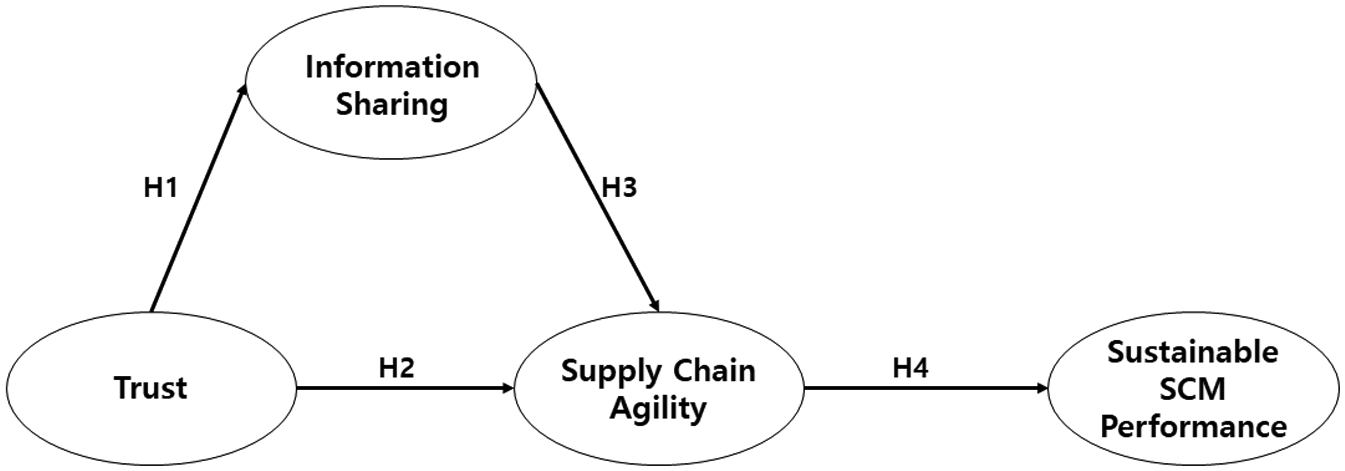
Research model.
Research Methodology
Data Collection and Sample Characteristics
This study aimed to empirically analyze the impact of trust, information sharing, and supply chain agility on sustainable SCM performance among companies in the supply chain. Before distributing the questionnaire, a pre-test was conducted with professionals working in SCM-related departments and individuals holding a Ph.D. in business administration to ensure the validity of the research content. Subsequently, the final survey items were selected, all of which were measured on a seven-point Likert scale. The survey targeted those involved in supply chain-related work in Korea and was conducted through a survey agency over 1 month starting in January 2024. In total, 3,000 questionnaires were distributed. After excluding invalid questionnaires due to insincere or no responses, 332 were ultimately used in the statistical analysis. A detailed examination of the sample characteristics reveals that respondents with 1 to 5 years of tenure in supply chain-related departments represented the largest proportion at 31.6%. In terms of main industry sectors, manufacturing comprised 33.4% of the sample, followed by telecommunications/information/service industries at 26.2%. Lastly, within the position in the supply chain, primary supplier accounted for 32.5%, while secondary or beyond suppliers represented 26.2% of the sample. The characteristics of the sample of this study are shown in Table 1.
Sample Characteristics.

In recent years, structural equation modeling (SEM) has been widely applied not only in business research but also across various social sciences. A key feature of SEM is its capability to incorporate latent variables that cannot be directly measured, offering alternative methodologies for analyzing discrete data (Bowen & Guo, 2011). A range of statistical software, including AMOS, EQS, and LISREL, is utilized for SEM analysis (S. H. Hsu et al., 2006). In this study, SPSS 23.0 and AMOS 23.0 were employed to conduct the verification process.
Measurement of Variables
To ensure the content validity of the latent variables, this study employed 17 measurement variables based on previous research. Table 2 provides the definitions and lists the references for these.
Operational Definitions of Variables.

Reliability and Validity Tests
Before verifying the hypotheses, this study reviewed the reliability and validity of the measurement variables. To examine reliability, Cronbach’s alpha values were calculated using SPSS 23.0. In the social sciences, values above 0.7 are generally considered reliable (Hair et al., 2010). Cronbach’s alpha values for the variables were as follows in this study: trust = .821, information sharing = .813, supply chain agility = .806, and sustainable SCM performance = .768. These values indicate high reliability for the measurement variables in this study.
Furthermore, the concepts of trust, information sharing, supply chain agility, and sustainable SCM performance were tested for convergent and discriminant validity. In general, the convergent validity of measurement variables can be checked via the average variance extracted (AVE) and composite reliability (CR). First, a confirmatory factor analysis was conducted using AMOS 23.0 to measure the fit indices of the proposed research model. Specifically, model fit indices can be categorized into absolute, incremental, and parsimonious fit indices. According to Hair et al. (2010), absolute fit indices assess the degree of congruence between the observed data and the specified model, encompassing indicators such as CMIN/DF, GFI, RMSEA, and AGFI. Specifically, a CMIN/DF value below 2 (or, in some cases, below 3) is indicative of good model fit. The GFI measures the proportion of variance accounted for by the model relative to the observed data; values exceeding 0.9 denote a good fit, while values above 0.8 are typically considered acceptable. RMSEA reflects the model’s approximation in the population as opposed to the sample alone, with values below 0.05 denoting satisfactory fit.
Incremental fit indices, including TLI, NFI, CFI, and IFI, evaluate model fit by comparing the proposed model to a baseline model. Among these, NFI and CFI are widely adopted due to their robustness against sampling error, making them particularly representative fit indices.
The results revealed that the model fit indices were CMIN/DF = 1.768, RMR = 0.034, GFI = 0.935, CFI = 0.925, NFI = 0.921, and RMSEA = 0.049. These values align with the threshold criteria recommended by Hair et al. (2010), which advocate for fit indices indicative of robust model alignment (CMIN/DF < 2, RMR ≤ 0.05, GFI ≥ 0.9, CFI ≥ 0.9, NFI ≥ 0.9, RMSEA ≤ 0.5). Accordingly, these findings validate the structural integrity and adequacy of the model employed in this study. The AVE and CR values of the variables of this study were also above 0.5 and 0.7, respectively, confirming the convergent validity of the measurement variables. Table 3 presents the results of the convergent validity analysis.
Results of Convergent Validity Analysis.

In addition, discriminant validity confirms that the concepts being measured are distinct. The criterion for assessing discriminant validity is that the square of the correlation coefficient between each variable should not exceed the AVE value. The verification results confirmed that the squared correlation coefficient between all factors is less than the AVE values. Table 4 shows the results of the discriminant validity test.
Results of Discriminant Validity Test.

Empirical Analysis
To verify the hypotheses presented in this study, a structural equation model using maximum likelihood estimation was employed via AMOS 23.0. The results of the structural equation model were as follows: CMIN/DF = 1.768, RMR = 0.034, GFI = 0.935, CFI = 0.925, NFI = 0.921, RMSEA = 0.049. The fit of the research model also met most recommended criteria (Hair et al., 2010). This allowed for the verification of the hypotheses, all of which were confirmed. Figure 2 presents the final structural model with standardized estimates obtained using AMOS 23.0, providing a visual summary of the relationships among the latent variables. Table 5 shows the results of the hypotheses testing.
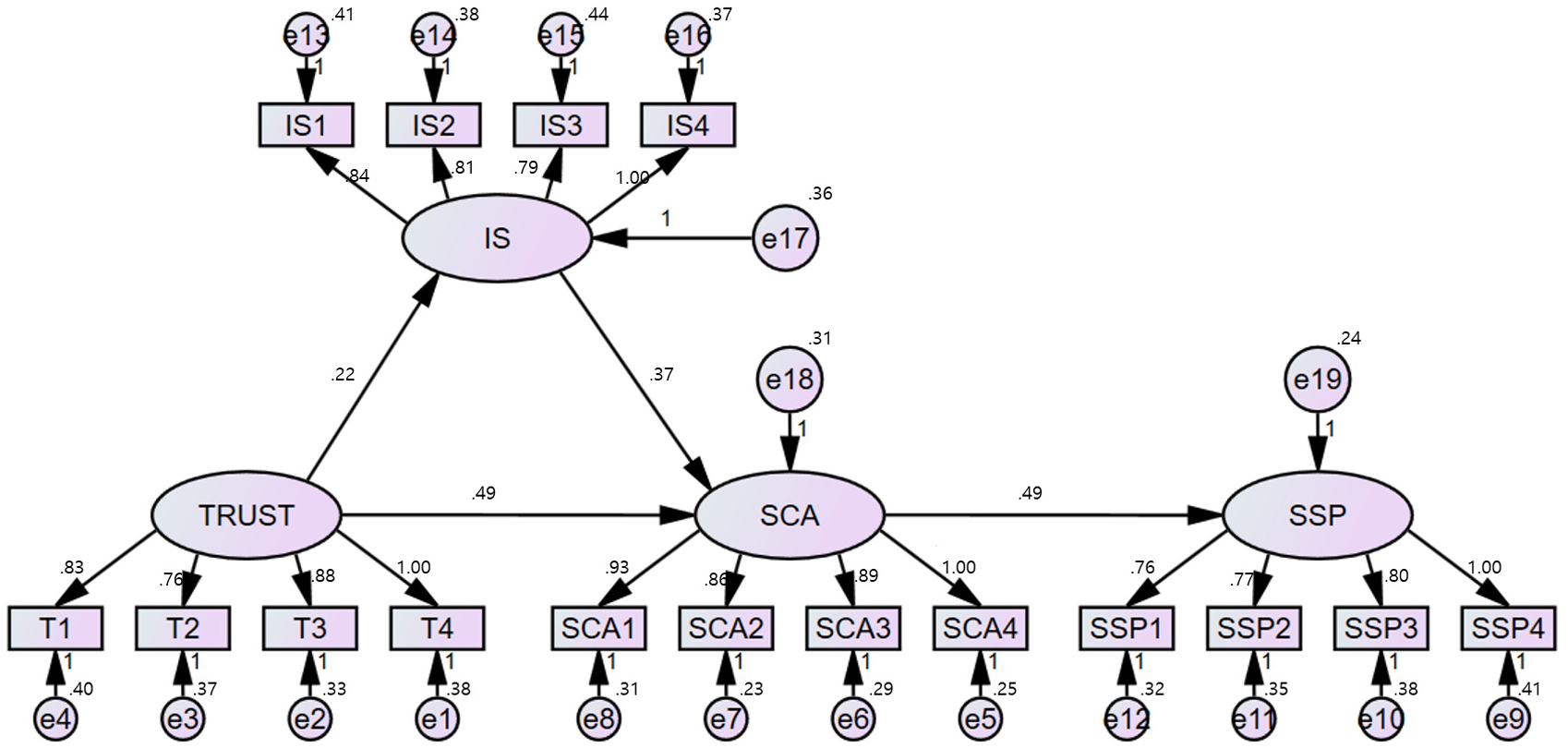
Results of the structural equation model.
Hypotheses Testing Results.

p < .05, **p < .01, ***p < .001.
Conclusion
Summary of the Study Findings
Sustainability plays a critical role in contemporary supply chain management, as it enables companies to secure competitive advantage and ensure long-term viability in a globalized business environment. Increasing policy demands from governments regarding environmental and social responsibility have made it challenging for companies to maintain a competitive edge without prioritizing sustainability. Specifically, sustainable SCM performance contributes to minimizing environmental impact by reducing resource waste and improving energy efficiency across the supply chain. Additionally, by fostering trust-based relationships not only with partner firms but also with local communities, companies can enhance their reputations, creating socially positive impacts. Against this backdrop, sustainable SCM performance drives sustainable corporate growth and plays an essential role in stable operations and long-term success in a rapidly evolving global market. Accordingly, this study identifies trust, information sharing, and supply chain agility as factors that enhance sustainable SCM performance within supply chains and investigates their respective impacts. The results of hypothesis testing are as follows.
First, trust has a significant positive effect on information sharing (β = 0.222, p = .013). This result suggests that trust has a moderate influence on the efficiency of information exchange, highlighting its role as a critical contributing factor in fostering effective communication within the supply chain. Today, companies are building relationships based on mutual trust to achieve their goals and improve their performance in a rapidly changing and uncertain business environment. This perspective aligns with prior research examining the importance of trust. For example, a bilateral survey among supply chain trading partners showed the association between trust and information sharing (Nyaga et al., 2010). Furthermore, an empirical analysis of Korea’s three key industries indicated that information sharing positively affects trust (C. Lee & Kim, 2023). Trust and information sharing are also essential for enhancing supply chain performance. Specifically, trust enables the sharing of both operational and strategic information (Klein et al., 2007).
Specifically, this study conducted a survey targeting individuals working in South Korea’s supply chain sector, taking into account the country’s cultural characteristics. South Korea exhibits strong collectivist tendencies and a relationship-oriented approach. Particularly in formal transactions, such as business dealings, cooperation based on trust and mutual respect is highly valued. This cultural foundation likely had a positive influence on the study’s findings.
However, some companies exhibit reluctance to share information due to concerns about information leakage and potential risks. To address this issue, it is essential to establish trust-based relationships with trading partners. Once trust is established, information sharing becomes more seamless, contributing to enhanced collaboration within the supply chain.
In conclusion, trust is a prerequisite for facilitating effective information sharing. Trust-based relationships enable the exchange of ideas and communication between trading partners, ultimately playing a critical role in improving supply chain performance.
Second, trust has a significant positive effect on supply chain agility (β = 0.491, p = .000). This finding demonstrates that trust is a strong determinant of enhanced agility within supply chain operations, underscoring its critical importance in dynamic and uncertain environments. Trust, also called belief or goodwill, is an essential element for forming productive partner relationships from a supply chain perspective (Ha et al., 2011). In trust relationship, interaction with the trading partner becomes smoother, and predicting uncertain situations and promoting action becomes possible (Kim & Lee, 2024). Particularly, when a trust relationship between companies in the supply chain is formed, accuracy, openness, and timeliness between companies can be facilitated (H. L. Lee & Whang, 2000). Similarly, when contracting with a trading partner, a relationship formed on trust enables more flexible and rapid contracts (Handfield & Bechtel, 2002).
Third, information sharing has a significant positive effect on supply chain agility (β = 0.372, p = .005). This analysis indicates that information sharing plays a significant role in improving agility, with a moderate level of influence, thereby reinforcing its importance in agile supply chain management. Information exchange between companies is crucial. Sharing information among companies in the supply chain is not merely communication but an expression of willingness to share significant information, company goals, risks, and losses. This perspective aligns with previous research examining the relationship between information sharing and supply chain agility. Herein, transparently sharing new knowledge and technologies allows the trading partner to flexibly address errors and issues through rapid actions (Ali et al., 2012). Furthermore, providing accurate information to the counterpart enables a quick response to the company’s lead-time, market changes, and customer requirements (Abdallah et al., 2021). Therefore, for agile behavior with the trading partner, it is necessary to share not only information such as knowledge and know-how but also the company’s current risks and losses.
Finally, supply chain agility has a significant positive effect on sustainable SCM performance (β = 0.487, p = .000). These results clearly demonstrate that agility is a key contributor to the improvement of sustainable supply chain outcomes, emphasizing its pivotal role in achieving long-term supply chain success. This result also aligns with previous studies stating that supply chain agility is essential for maintaining continuous relationships and enhancing performance between companies (Singh & Vinodh, 2017). Agile behavior with trading companies has various advantages including cost reduction and increased efficiency and effectiveness, which are essential elements for agile behavior with trading partners (Agarwal et al., 2007; Vickery et al., 1999). In addition, in today’s dynamic and complex supply chain environment, supply chain agility positively impacts the company’s financial performance, including factors like profitability (Panigrahi et al., 2023). Therefore, an agile culture plays a crucial role in long-term and sustainable performance enhancement with the counterpart.
Research Implications
Theoretical Implications
This study highlights several theoretical implications by integrating relational mechanisms into existing theoretical frameworks on supply chain management.
First, the significance of this study lies in its empirical analysis of supply chain agility from a relational perspective, which has previously been studied mainly in terms of a firm’s internal capabilities. This study presented and empirically verified trust and information sharing as relational mechanisms that significantly affect supply chain agility. This perspective aligns with the Dynamic Capabilities View (DCV), which defines agility and flexibility as critical dynamic capabilities that enable firms to sense environmental changes, seize emerging opportunities, and reconfigure resources accordingly (Teece, 2007). By positioning interorganizational relational resources—namely trust and information sharing—as enablers of agility, this study contributes to the DCV literature by illustrating how social capital can serve as a foundational source of dynamic capabilities within supply chain contexts. This finding suggests that agility in supply chains does not operate in isolation but interacts synergistically with other externally embedded capabilities. Consequently, measuring and improving trust and information sharing can inform relational strategies to enhance agility development.
Second, this study extends the application of Social Capital Theory by empirically demonstrating how trust and information sharing facilitate relational governance among supply chain partners. Relational governance refers to informal coordination mechanisms such as mutual trust, shared norms, and reciprocal commitment that function beyond formal contractual controls. The findings support the notion that social capital embedded in interfirm relationships promotes agility by enabling open communication, reducing opportunistic behavior, and strengthening cooperation under uncertainty. In doing so, this study deepens theoretical understanding of how social capital enhances adaptive capacity and sustainable supply chain performance, especially in volatile environments where formal mechanisms may be insufficient.
Finally, the study provides context-specific theoretical insights by validating the trust–information sharing–agility linkage within South Korean supply chains. While prior studies have raised doubts about the consistency of this relationship in Korea due to cultural and structural peculiarities (Ha et al., 2011; Youn et al., 2014), the present findings empirically confirm that trust enables smoother information flow, which in turn enhances agility. This supports the cross-cultural relevance of both Social Capital Theory and DCV, and affirms their applicability in supply chains characterized by hierarchical or collectivist norms.
Taken together, these findings emphasize the critical theoretical role of relational mechanisms in shaping dynamic capabilities and adaptive supply chain governance.
Managerial Implications
In addition to its theoretical contributions, this study offers a range of managerial implications that can support practitioners in applying relational strategies to enhance supply chain agility and sustainability.
First, companies should actively cultivate cooperative relationships with key supply chain partners to improve agility and sustainability without incurring substantial costs. Instead of relying solely on costly technological investments or formal coordination mechanisms, firms can enhance performance by fostering trust-based information sharing and mutual responsiveness. This approach helps reduce lead times, minimize risks, and improve decision-making speed under uncertainty.
Second, managers in Korea’s manufacturing sector—where limitations in capital and technology often hinder supply chain development—should prioritize building trust and communication structures with strategic partners. Rather than seeking isolated improvements, firms can benefit from collaborative planning processes, shared data platforms, and continuous engagement practices that promote joint agility.
Third, tailored strategies are required across different industries. In manufacturing, trust is essential to support the effectiveness of IoT-based monitoring and supplier management systems. In telecommunications and information services, trust-based information exchange enhances rapid market response and service innovation. In the bio-health sector, improving traceability and cold-chain logistics depends heavily on collaborative relationships to ensure quality and regulatory compliance. In each case, trust and agility should be regarded as foundational enablers of sustainable growth, not merely operational tools.
Finally, supply chain professionals should institutionalize mechanisms that reinforce trust and transparency. Examples include periodic inter-organizational workshops, joint scenario planning exercises, real-time data-sharing systems, and relationship governance reviews. These relational investments create long-term value by enabling firms to adapt swiftly to environmental disruptions and co-develop capabilities with their partners.
Limitations and Future Research
This study also has a few limitations. First, this study approached trust as a unidimensional construct. However, trust can be differentiated into affective trust, based on emotions, and cognitive trust, rooted in competence and expertise, depending on the research purpose and context. By considering trust from a multidimensional perspective that accounts for the business environment and diverse factors, future research could offer additional insights. Given that companies primarily focus on enhancing mutual goals and performance, they are likely to prioritize competence-based trust over affective trust with their partners. Future studies that examine these relationships in greater detail may provide a clearer understanding of the role of trust within the supply chain.
Sustainable SCM performance includes not only economic but also social and environmental performance; however, this study factored only economic performance. This was done based on the assumption that reducing unnecessary waste and enhancing economic performance is crucial and that improving economic performance will naturally increase environmental and social performance. However, this study primarily focused on measuring economic performance, which may limit the generalizability of the findings. Therefore, future research should adopt a multidimensional perspective that includes environmental performance (e.g., carbon emissions, energy consumption, waste reduction) and social performance (e.g., employee safety and welfare, community engagement) to gain a more comprehensive understanding of sustainable SCM performance. Such an approach could provide deeper insights into sustainable SCM performance and yield meaningful outcomes that contribute not only to academic knowledge but also to practical implications for industry stakeholders.
In future research, it will be essential to employ longitudinal studies to examine how trust and supply chain agility evolve over time within the supply chain context. Through longitudinal analysis, it would be possible to investigate how inter-firm trust, information sharing, and supply chain agility are either strengthened or diminished in response to environmental changes, thereby assessing the impact of these dynamics on sustainable SCM performance. For example, examining how trust between trading partners accumulates over time or fluctuates in response to external shocks (e.g., COVID-19, wars, economic crises) could provide valuable insights into the long-term performance of supply chains.
Footnotes

Ethical Considerations
No formal approval from the Ethical Committee is required for the study as it involved a survey of working professionals without collecting any sensitive personal data or employing experimental interventions.
Author Contributions
Conceptualization, Data curation, Formal analysis, Investigation, Methodology, Writing—original draft, Writing—review & editing.
Funding
The author(s) received no financial support for the research, authorship, and/or publication of this article.
Declaration of Conflicting Interests
The author(s) declared no potential conflicts of interest with respect to the research, authorship, and/or publication of this article.
Data Availability Statement
Data sharing not applicable to this article as no datasets were generated or analyzed during the current study.