




Abstract
Nowadays, both academic scholars and decision makers are raising much attentions to underscore the meanings of social sustainability practices to the success of firms, particularly in the context of emerging countries. Under the stakeholder resource-based view (SRBV) theory, the current research model was adopted to identify determinants of social sustainability practices and its linkages with performance outcomes of the supply chain. There were 204 valid samples collected from respondents who operate the supply chains in the Vietnamese medium and large enterprises. Empirical results indicated that social sustainability practices positively impact on the performance outcomes of the supply chain management. Critically, this study is among the very first-ever papers that significantly evidenced the mediating roles of customer performance and supplier performance in the relationship between a firm’s social sustainability practices and supply chain performance. The multidimensional concept of social sustainability has been extendedly incorporated in the context of Vietnamese companies, it provides managers and policy-makers useful insights for implementing social sustainability in the corporate sustainable development strategies.
Introduction
Globalization of production and social sustainability are interconnected concepts that have profound implications for the global supply chains as well as the well-being of human societies. The United Nations targets Sustainable Development Goals (SDGs) to decent work and economic growth, reducing inequality, and promoting sustainable production and consumption. To achieve these goals, it highly requires business responsible commitments and strategic action plans that prioritize the well-being of the people. Firms across the world are making efforts to address social impacts in their globally dispersed locations. In 2018, HSBC reported the survey on 8,500 businesses in 34 markets that almost 90% of businesses claimed to sustainable changes in their supply chains to improve performance outcomes (HSBC, 2018a). Global brands have gradually moved forward to build more sustainable supply chains. They are controlling the adherence of their strategic stakeholders and developing their ability to identify social, economic, and environmental issues in focal companies (Nicolăescu et al., 2015). Majority of businesses believe the sustainable development will result in tangible business benefits, such as reputation enhancement, opportunities for social consensus, differentiation opportunities, increased competitive advantage, new business opportunities, and revenue streams. The impact of sustainable development on performance outcomes has been studied over a period of time. Today, a prioritizing corporate social responsibility tends to be viewed more favorably in the marketplace (Sen et al., 2006). However, decision-makers are currently facing a wide array of challenges when implementing social sustainability practices (Awan et al., 2020).
Over the past few decades, sustainable development orientation has garnered a significant attention of academic scholars, scientists, public advocacists, and decision-makers. According to the Triple Bottom Lines (TBL) model, there are three primary dimensions of sustainable development: society, economy, and environment aspects (Norman & MacDonald, 2004). Social sustainability is a long-term, ongoing mission of ensuring social conditions and outcomes are optimized for generations to come. In a business context, social sustainability encompasses a number of social issues, including: human rights, working conditions, fair labor practices, workplace diversity, gender equality, community engagement, … and so on. Companies that raise the significance of social sustainability highly value their relationships with their primary stakeholders like employees, customers, and suppliers (Sen et al., 2006). Indeed, social sustainability is equally important as the economic or environmental sustainability but still not largely recognized in mainstream sustainability discussions(Cole & Aitken, 2019; Mani et al., 2016). Despite that social manners are seamlessly incorporated and embedded in all stages along the firm’s supply chain practices. In the literature, there has been a shortage of studies to intensively investigate the relationship between social sustainable development and performance outcomes (Shafiq et al., 2017). Hence, there is a call for a more comprehensive understandings about social sustainability impacts on firm’s performance (Mani et al., 2018).
In the context of business practices, suppliers and consumers are directly related to the input–output process of the firm’s supply chain system, the supply chain collaboration thus far is critical to a firm’s performance improvement (Vereecke & Muylle, 2006). Under the perspective of Stakeholder resource based view (SRBV) theory, these primary stakeholders are considered vital resources that should be ultimately capitalized (Barney et al., 2001). The SRBV highlights the significance of the building sustainable stakeholder relationships also the key to elevate firm’s overall performance (Freeman et al., 2021). The role of collaboration and shared values can be cultivated effectively as a strategic stakeholder policy to mitigate risks and avoid production disruptions due to unaddressed social causes (Klassen & Vereecke, 2012; Mani et al., 2017; Sodhi, 2015). In a mean time, social sustainability is about making sure that people can thrive and continue to exist in a healthy, fair, and equal way. According to Park-Poaps and Rees (2010), social issues are varied but not static due to some determinants such as culture, trust among stakeholders, strategies of the firms, etc., thus far, social issues can be effectively managed through continuous stakeholder dialogue and mutual understanding of the most relevant social issues in supply chains. Thereby, several findings have suggested that embracing social sustainability practices can enhance collaborations with stakeholders, including customers and suppliers, who increasingly value ethical and responsible business practices (Alghababsheh & Gallear, 2021; Gong et al., 2019; Mani et al., 2018; Sen et al., 2006).
In the same vein, several scholars have argued that the literature on supply chain sustainability will benefit from examining social initiatives in supply chains in terms of supply chain engagement and supply chain integration with key stakeholders in order to enhance supply chain sustainability performance (Mani et al., 2018; Morais & Silvestre, 2018; Sancha et al., 2015, 2016; Sodhi, 2015). In saying another word, the role of power among stakeholders can provide more explanations for the management of social issues in supply chains. Future studies could focus on exploring ways to manage social issues by building the capacities of supply chain partners (Park-Poaps & Rees, 2010). However, relatively little attention has been drawn to the extent to which firms have integrated social sustainability practices into the supply chain performance management in collaboration with key stakeholders like customers and suppliers. For instance, in the literature, Yawar and Seuring (2017) explored the interrelationship between social issues, stakeholders’ social responsibility actions and performance outcomes, they posited that buyer and supplier performance are identified as the key outcomes, but the interactions among these constructs would require further research. Some evidences have shown that supplier performance mediates the relationship between supplier social sustainability practices and buyer’s supply chain performance (Mani et al., 2018; Sancha et al., 2015). These studies though emphasized on supplier performance with respect to social sustainability adoption in the upstream supply chain to enhance buyer’s supply chain to performance, they neglected the role of customer performance. Moreover, to the best of our knowledge, there is no specific research extensively examining on how customer performance and supplier performance facilitate the impacts of social sustainability practices on firm’s performance outcomes in the supply chain management. Hence, we found a necessity of exploring the mediating effects of both customer performance and supplier performance in the interrelationship between firm’s social sustainability practices and supply chain performance. This study is thus amongst the very first studies exploring the mediating effects of firm performances into the literature of sustainable development, such as both customer performance and supplier performance.
In addition, there are few studies of the Asian context (Jamali et al., 2017), meanwhile, supply chain social sustainability practices in these emerging markets should not be neglected in the extant literature due to several following reasons. First, Asian-Pacific developing countries have been increasingly emerged as global production hubs where the majority of focal corporations have relocated their supply chains over the past decades. As to optimize cost structures and mitigate risks, most MNEs conducted manufacturing outsources and took advantage of cheap labor, sufficient natural resources, potential markets, high opportunities, and easy-going governments (Tatoglu et al., 2020). However, several social challenges related to business ethics, child labor, gender inequality, safety hazards, health, and welfare issues have increasingly raised much public concerns. Addressing these social causes needs a call for responsible solutions from local governments, focal corporations, and local enterprises. Second, Asia Pacific’s booming middle class getting larger with a forecast of 1.47 billion over 1.65 billion people by 2030 (PwC, 2023). Consumers getting wealthier are also demanding firms more sustainable and ethical practices, they are more interested in the origin of products. To build trust, information authenticity and traceability are requested to let buyers know how human, animal, and environmental elements are responsibly and ethically utilized along the supply chain (Nguyen et al., 2022). Third, workforce challenges are complicated and require something more from employers. Employees across the Asia Pacific are rethinking their lives, with work topping the list, they want more meaningful work, to bring their authentic selves to work, and to trust their employers (PwC, 2023). Fourth, social manners are complicated and varied dependent on the social development of each country, meanwhile, there is an urgent call to MNEs for better managing their environmental social governance (ESG) issues and mitigate risks in the local communities. In general, firms in Asian emerging economies are making efforts to adopt social sustainability practices in their supply chain due to several influences from stakeholders such as: consumer social pressure, the regulatory authorities, external stakeholders’ pressure (i.e., media, social organizations, social activists, and NGOs) as well as firm’s recognition of sustainability culture (Mani et al., 2018; Shafiq et al., 2017). Thus far, several researchers argued that this field needs further studies to investigate challenges in different contexts, particularly in developing markets (Nakamba et al., 2017). In the current study, the concept of social sustainability practices is defined as a firm’s ability to address social causes that are related to the safety and welfare of the stakeholders associated with the supply chain process (Mani et al., 2020). Therefore, we realized the significance of studying supply chain social sustainability in emerging markets. Among those, the current context in Vietnam is also an interestingly worthy studying topic as we will discuss further in the next section (section 2.1). In the meantime, there is a limited number of studies discussing about supply chain social sustainability in Vietnam.
This research primarily raises three major questions: (RQ1) How do social sustainability practices influence supplier performance? (RQ2) How do social sustainability practices influence customer performance? and (RQ3) How do social sustainability practices influence supply chain performance? Drawing upon the SRBV theory, this paper aims to examine how social sustainability practices influence on supply chain performance outcomes. Our research may convey several insightful contributions on how effectively manage a sustainable supply chain in the context of emerging markets. Hence, our contributions are threefold. First, the concept of social sustainability practices is identified and clearly explains how a supply chain performance was improved. Second, this study further examined the influence of social sustainability practices on a firm’s performance outcomes, including supplier performance, customer performance, and supply chain performance in the specific context of Vietnam. Last but not least, this study is critically, among the very first-ever papers that significantly evidenced the mediating roles of customer performance and supplier performance in the relationship between a firm’s social sustainability practices and supply chain performance. The remaining sections were organized as follows. Literature Review section highlighted the importance of supply chain social sustainability in Vietnam and reviewed literature on social sustainability and supply chain performances. Hypotheses Development section introduced SRBV theoretical background and research model. Research Methodology section explained the rationale of hypothesis development. Empirical Results section presented the steps involved in methodology and analysis. Discussion and Conclusion section showed results of data analyses, followed by discussions, some implications, and a conclusion.
Literature Review
The Significance of Supply Chain Social Sustainability Practices in Vietnam
Regional centers of integrated and interdependent economic activities are emerging as supply chains are brought closer together geographically. As an open and fast-growing economy in Asia Pacific, Vietnam is becoming a well-positioned manufacturing and business process outsourcing (BPO) destination for global brands. For instance, the role of Vietnam in the supply chain and production of the United States is increasingly important, evidenced that many top American MNCs have been raising investment capital in Vietnam such as Intel, Apple, Boeing, Microsoft, Ford, Nike, P&G … etc. Currently, Vietnam is also a potential alternative for China-plus supply chain relocation. In Vietnam, the production supply chains and manufacturing sourcing activities mainly focus on some labor-intensive sectors such as garments and textiles; footwear and electronics production. All manufacturing activities of both foreign enterprises and local producers are not only taking place across industrial parks and factories but also employing millions of local workers. To illustrate, in 2021 there were more than 11,200 labors working in manufacturing industries, this sector thus made up the largest proportion of labor structure with nearly 23% of Vietnamese workforce. Only the fashion and textile sector operated with about 6,000 factories, employed nearly 2.5 million workers which is approximately 2.7% of the country population. As one of the most important job-creating industries—electronics manufacturing workforce accounted for 7.3% of all manufacturing jobs and it is heavily dominated by female workers (about 60% in recent years; General Statistics Office, 2021).
It can be seen from the fact that firms’ supply chain practices have largely social impacts on the local people and the communities over the years. Despite having a great deal of benefits to the economic growth, there still are several social costs that place challenges to the sustainable supply chain in Vietnam. For example, excessive overtime work, particularly in the electronics industry with nearly 50% working over 48 hr per week on average; occupational health and safety risks; discrimination and sexual violence; gender-inequality; lower wages and allowances than that of other production countries in the region, wage theft and abuse workers, child labor; precarious work… are increasingly commonplace in Vietnamese FDI companies (International Labour Organization, 2022; Nguyen et al., 2022). There are around 32% of Vietnamese enterprises reported that it was challenging to meet the legal requirements for social insurance, there are 38.8% uninsured employment in the whole domestic economy in 2021 (International Labour Organization, 2022). According to Nguyen et al. (2022), most of the enterprises have only adhered to the government’s labor laws but have not significantly implemented any policies to promote social responsibilities, particularly in the Vietnamese context of textile and garment industries. From the management perspective, they constrained not only a decent working environment but also firm’s reputation. From the societal perspective, these social impacts did impose costs to vulnerable workers. Hence, in order to attain sustainable development objectives, it is extremely necessary to address these negative social impacts in tandem.
Notably, supply chain sustainability practices are now not only a growing trend or business considerations but rather it becomes business commitments to the stakeholders. From Vietnamese consumers’ perspectives, the trend of sustainable consumption has gained increasing public awareness; hence, it has impacts on the production and distribution system. It was reported on the HSBC report that there were 85% of Vietnamese firms aim to reach an industry-or-market recognized sustainability standard, 32% of manufacturing enterprises will select suppliers based on their sustainability practices (HSBC, 2018b). Therefore, as Vietnam has been entering as a key player of the global value chain, there is a call for an execution of social sustainability policies and business practices that prioritize the interests and equity of the people over generations in the community. The Vietnamese government has issued a number of policies and incentives for domestic SMEs to promote sustainable production and consumption as well as to transform the sustainable supply chain system. At present, the government is also striving to accomplish the United Nations’ 17 Sustainable Development Goals (SDGs) and transforming them into the National Action Plan of the Global 2030 Agenda in accordance with the country’s development conditions and priorities (United Nations Vietnam, 2020). In brief, there are 9 over 17 SDG goals related to social sustainability, among them, 6 indicators are typically associated with the supply chain performance in the Vietnam context, namely: (1) philanthropy, (2) human rights, (3) equity, (4) safety, (5) ethics, and (6) health & welfare aspects of social sustainability.
Social Sustainability Practices
In 1987, the United Nations Brundtland Commission defined “Sustainability” as “meeting the needs of the present without compromising the ability of future generations to meet their own needs.” From the perspective of firms, an alternative sustainability explanation refers to firm’s capability to locate social manners related to products and services that might affect the well-being, benefits, and safety of primary supply chain stakeholders (i.e., customers, suppliers, and employees; Duong & Ha, 2021). Over the past decades, the literature review of sustainability has been developed based on the Triple bottom line theory (TBL; Norman & MacDonald, 2004). The TBL diagram proposed three major pillars of sustainability: environmental, economic, and social sustainability. Social sustainability practices can be understood as business practices that not only improve employees’ welfare and benefit but also contribute local communities (Huq et al., 2016).
Following a prior study conducted by Mani et al. (2020), the concept of supply chain social sustainability in the current paper was defined as a firm’s ability to address social issues that are associated with the safety and welfare of the stakeholders associated with the supply chain processes in emerging economies. In recent years, many experts and scholars examine the determinants of supply chain social sustainability and implications in different contexts. In these studies, employees’ safety, health, and welfare are three essential elements of social sustainability practices. Prior studies have indicated that social manners of safety, diversity, human rights, and philanthropy have substantial influences on firms’ supply chain performance (Kumar & Rahman, 2015; Mani et al., 2016). In particular, three elements including safety, equity, and poverty are frequently identified as major sustainability determinants in emerging economies (Adomako & Tran, 2022; Chavez et al., 2016). In addition, factors including “safety, diversity, equity, human rights, and labor practices” thought to be influencing social sustainability have been explored in several studies (Lerro et al., 2018; Othman & Hemdi, 2013). Similarly, employee diversity is an important contributing factor to supply chain social sustainability in Malaysian manufacturing organizations (Chin et al., 2015). Following previous evidence, we proposed that social sustainability is a multidimensional construct, which includes philanthropy, safety, equity, human rights, ethics, and health & welfare. These six major factors may affect supply chain social sustainability in the emerging economies.
Philanthropy: Philanthropy in the supply chain means voluntarily bringing about interests and benefits to local societies and enhancing the human life’s quality. It can be done through educational associations, public and private charities, and non-government organizations (Abbasi, 2017; Hutchins et al., 2019).
Human rights: Human rights can be explained as standards, values and norms implementing equally to every person in the world (Quarshie et al., 2016). In the supply chain, human rights may be involved with business relationships; hence, firms should focus on their relationships with partners, suppliers and employees (Chow & Chen, 2012; Sancha et al., 2016)
Equity: Equity is an ethical theory grounded in delivering justice (Qureshi, 2016) The term equity refers to fairness—if all people have comparable rights and opportunities. Equity in the supply chain may reduce unequal chances linked with different ethnic or religious groups, gender, and discrimination (Furman & Maison, 2019).
Safety: Safety means being safe. In the supply chain, it refers to the working conditions of employees; they should be guaranteed and protected from risks or unhealthy environments. It also helps firms avoiding risks, unsafe conditions, and undesirable accidents around the workplace (Ahi & Searcy, 2015; Cooper, 2014; Jamali et al., 2017).
Ethics: Ethics emphasize the importance of corporate social responsibility, which entails producing products and services in an ethical manner that respects both employees and the environment (Godfrey, 2017). An ethical supply chain management requires businesses to include social and human rights, as well as environmental, factors into their global operations (Ananny, 2016).
Health and Welfare: Health and welfare refer to assistance programs from an organization such as medical, prepaid legal, insurance, salary protection, unemployment, long-term health care, and leisure/holiday programs for their staffs/employees (Brown, 2015; Chardine-Baumann & Botta-Genoulaz, 2014; Chow & Chen, 2012).
Sustainable Supply Chain Management
A supply chain is explained as “the integration of key business processes from end users through original suppliers that provides products, services, and information that adds value for customers and other stakeholders” (Carter et al., 2015). Moreover, a supply chain encompasses all operations that occur along the value chain, from raw materials to end consumers. Supply chain management (SCM) is defined as “the systemic, strategic coordination of the traditional business functions and the tactics across these business functions within a particular company and across businesses within the supply chain, to improve the long-term performance of the individual companies and the supply chain as a whole” (Lee & Nam, 2016). This emphasizes the need of balancing the three main aspects of sustainability: economy, environment, and society. Camacho and Vázquez-Maguirre (2017) define sustainable development as “the management of material, information, and capital flows as well as cooperation among companies along the supply chain while taking goals from all three dimensions of sustainable development, i.e., economic, environmental and social, into account which are derived from customer and stakeholder requirements.” This concept incorporating the tenet of Triple Bottom Line theory, emphasizes the need of inter-organizational information exchange for effective management, and considers stakeholders as an integral aspect of sustainable development. Environmental and social standards thus should be met by stakeholders in order to develop the sustainable supply chain system, while competitiveness is anticipated to be maintained via fulfilling consumer expectations and corresponding to the economic aspect.
Performance Outcomes
Performance outcome refers to an analysis of both efficiency and effectiveness in accomplishing a given task (Fugate et al., 2009). Efficiency is calculated as the proportion of resources used to outcomes, whereas effectiveness is explained as the degree to which customer-related objectives are attained (Bakar & Jaafar, 2016). For example, performance outcomes include customer performance, supplier performance, operational performance, and supply chain performance.
Supply chain performance (SCP): means the overall performance in the supply chain, including supplier performance, operational performance, and customer performance. It is also the collection of the supply chain’s activities in satisfying final consumer needs and demands. Moreover, SCP is relevant to other extended actions in the supply chain. For example, it helps supply chain managers satisfy the end-customers’ requirements through just-in-time delivery, product availability, and order responsiveness. SCP crosses “company boundaries since it includes basic materials, components, subassemblies and finished products, and distribution through various channels to the end customer” (Hausman, 2004).
Supplier performance: Previous studies have identified the link between the performance of buying firms and the role of supplier performance (Camacho & Vázquez-Maguirre, 2017; Krause et al., 2007). To get a competitive edge in the global market, supply chain managers should control suppliers and buyers effectively and efficiently (Sodhi, 2015). It has been shown that better controlling suppliers’ resources can reduce reputation loss and supply chain risk. Hence, supplier’s resources will contribute to the success of focal firms and improve supply chain business strategies.
Customer performance: is described as the collection, evaluation, and assessment of customer data pertaining to performance (Maestrini et al., 2017). In addition, customer performance means expanding a new market segmentation or satisfying current customers through customer responsiveness and customer loyalty programs. Moreover, the total success of the supply chain is defined by the cumulative increase in profitability of all its members (Rodríguez & Cruz, 2007), includes clients whose performance is closely related to the supply chain’s performance. Therefore, managers who integrate all members will enhance the performance outcomes successfully.
Stakeholder Resource-based View Theoretical Background
The stakeholder resource-based view (SRBV) is an approach to guide managers’ decision-making toward enhancing their organization’s sustainable development not only through the development of their own dynamic resources and competencies, but also through the development of the organization’s stakeholders, thereby boosting their specific utilities (Kull et al., 2016). The foundation of a company’s competitive advantages is come from the inventory of valuable, rare, inimitable, and non-substitutable (VRIN) resources. In other words, Alvarez and Barney (2017) suggested that the linkage between suppliers and customers allows enterprises to set up VRIN resources; hence, it will lead to the art or practice of successively outdoing a competitor. Besides this, while working together in the supply chain to increase sustainable development, the collaboration among stakeholders will provide organizations with important and intangible resources, such as human capital, research & development, financial support, etc. Moreover, diversity issues relevant with suppliers might be discovered by RBV and how this issue will affect the performance outcomes in the supply chain. Hence, managers can control and limit the risks and negative influences from these issues (Carter & Jennings, 2004; Shafiq et al., 2017). According to Falahat et al. (2020), capabilities refer to a source of competitive advantages that are accumulated and formed by unique configurations and interrelations of both internal and external resources of the firm.
In addition, SRBV is considered as a well-explained rationale to the application of social sustainability practices. The tenet of SRBV focuses on the significant roles of stakeholders as valuable assets that may help firms outperform their competitors (Alvarez & Barney, 2017; Sodhi, 2015). These groups of people are suppliers, customers, employees who are playing an important part and closely related to the firm’s supply chain performance. The SRBV theory, which was developed upon the RBV (Barney, 1991), utility theory, and stakeholder theory (Freeman et al., 2010) emphasizes that all supply chain members should be treated ethically. A good co-operation and integration with firm’s stakeholders will lead to better the firm’s overall performance (Adomako & Tran, 2022; Gong et al., 2019; Park-Poaps & Rees, 2010; Sancha et al., 2016; Vereecke & Muylle, 2006). In other words, managers should take responsibility for all the social issues that happened, since it may result in interruptions and dangers. Managers will get competitive advantages for the focal firms and achieve their supply chain performance successfully. Therefore, the authors developed a framework model based on the tenets of the SRBV to investigate how supply chain social sustainability practices impact on firm’s performance outcomes in the context of emerging markets. The research framework and hypotheses are shown in Figure 1.

The research model.
Hypotheses Development
Social Sustainability Practices and Supply Chain Performance
A large body of the literature has underscored that social burdens have specific impacts on supply chain performance (Chin et al., 2015; Klassen & Vereecke, 2012). Over the past decades, social sustainability has been implemented in the supply chain management (Abbasi, 2017; Morais & Silvestre, 2018; Nakamba et al., 2017). As the fact that, the global supply chain managers are trying to integrate and implement a system of practices that can reconcile the pressures of, one the one hand, the firm stakeholders’ expectations toward the environmental and social sustainability (Sen et al., 2006), on the other hand, improving their supply chain efficiency (lean and waste free) and effectiveness (agile to changes; Ciccullo et al., 2018). In the literature, several scholars tried to explore the link between social sustainability practices and supply chain performance (C. Bai & Sarkis, 2010; Ciliberti et al., 2008; Mani et al., 2020; Quarshie et al., 2016). A prior study examined the effect of social sustainability orientation in the US context, findings indicated that firms with higher level of social sustainability and long-term orientation can lead to superior operational performance (Croom et al., 2018). Similarly, Jin et al. (2019) found that a strong social sustainability orientation can be a competitive advantage for firms in facilitating superior innovation outcomes. Moreover, a recent study has evidenced that while integrating corporate social responsibilities into their bottom line, firms can not only practice sustainability practices to face criticisms following mistakes but also create value-added in the supply chain, especially through mitigating risks in the management system (Mani et al., 2017). In the same vein, a number of studies have emphasized the role of social sustainability practices in supply chain risk management (Duong & Ha, 2021; Klassen & Vereecke, 2012). Empirical results have shown that risk mitigation strategies do not always reduce the actual supply chain risks experienced by firms, whereas sustainability efforts can help firms do that, especially in the context of emerging markets. In addition, according to Hutchins and Sutherland (2008), a firm can significantly enhance supply chain performance and financial achievements by addressing social problems. In the mean time, previous studies have widely reported the positive relationship between sustainable development and performance outcomes in the supply chain (Andersen & Skjoett-Larsen, 2009; Mani et al., 2020; Sancha et al., 2015; Yawar & Seuring, 2017). As a result, the current research aims to evidence the effects of a firm’s socially sustainable development practices on performance outcomes of its supply chain management, particularly in the context of the Asian emerging market. Hence, we proposed a hypothesis that:
The Roles of Supplier Performance
Through the lens of the SBRV, a supplier plays an evitable part in the success of firm’s overall performance. More than as transactional entities, firms are incorporating well with suppliers as strategic partners who play crucial roles in the firms’ high-performing supply chains. Suppliers’ contributions go beyond simply providing high-quality materials necessary for the production and manufacturing process; they can have a substantial impact on a firm supply chain’s cost efficiency, innovation and competitive advantages (Lintukangas et al., 2019). The role of supply management innovativeness and supplier orientation in firms’ sustainability performance. The link between supplier performance and supply chain performance has been widely evidenced in the previous literature. Supplier performance includes financial status, a firm’s reputation, and brand image, which will directly influence on a firm’s supply chain performance outcomes (Busse, 2016; Gualandris & Kalchschmidt, 2016). The previous study has indicated a strong interaction between supplier performance and the firm’s overall performance (Zsidisin et al., 2015). The current study extensively examines the effect of supplier performance on the firm’s supply chain performance in the context of an emerges market, thereby, we proposed that:
The relationship between a firm’s sustainable development and supplier performance has been identified in previous studies. Previous findings have found that firms pay attention to corporate social responsibility strategies will enhance their supplier performance (Alghababsheh & Gallear, 2021; Mani et al., 2018; Zhang et al., 2014). Over past years, firms across the world have emphasized not only evaluating sustainable supplier selection but also supplier development strategy plans to address social issues in the supply chain (X. Bai et al., 2022). Mani et al. (2018) has further proved that there are two main motivations that push the buying firms to practice socially sustainable supplier development, which are not only to guarantee their own supply chain needs but also to enhance their supplier performance. Indeed, when a firm prioritizes social sustainability in its supply chain practices, it sets expectations for suppliers to adhere to certain ethical and social standards, in turn, influences supplier performance and collaboration (Alghababsheh & Gallear, 2021; Duong, 2022). The current research is developed on the SRBV perspective to examine the impact of social sustainability, hence, we proposed that a firm’s social sustainability practices can have a significantly direct effect on its supplier performance. Therefore, a hypothesis was developed as follow:
It can be implied from the above arguments that supplier performance embraced with social sustainability practices can directly influence a firm’s ability to uphold its corporate social responsibilities as well as meet regulatory requirements. A growing number of global firms would be pledging to work only with suppliers that commit to social and environmental standards in their production. This forms part of their wider sustainable supply chain management efforts that seeks to implement social sustainable practices. A previous study by Saunders et al. (2015) investigated the role of supplier integration in the context of project-based supply chain, findings have revealed that social sustainability concerning suppliers being engaged in the early stage of firm’s product lifecycle can leverage the focal firm a competitive advantage through supplier’s sustainable outcomes. Notably, suppliers that adhere to socially sustainable practices align with a company’s values and sustainable orientation and can contribute to a high-performing supply chain of the buying firm’s performance outcomes. Meanwhile, it is widely proven that supplier performance plays a critical role in influencing a firm’s supply chain performance. According to Mani et al. (2020), by implementing social sustainability practices in the upstream supply chain, it can strengthen the firm-supplier collaboration, which in turn, leading to improvements of supplier performance as well as firm’s performance benefits. However, in the extant literature, mixed results of social sustainability practices influencing overall performance indirectly through supplier performance has been discussed over the past few years (Gualandris & Kalchschmidt, 2016; Mani et al., 2016). Based on the above discussion, the authors thus assume the role of supplier performance that it may also mediate the link between a firm’s social sustainability practices and the performance outcomes of firm’s supply chain. Hence, the following hypothesis was proposed:
The Roles of Customer Performance
Customers—as a primary group of stakeholders have a high prominence to a firm’s overall performance. Customer firms are not only economic stakeholders but also a vital source of demands, for instance, what is expected from suppliers in terms of social responsibility (Shafiq et al., 2020). Over the past decades, a firm’s customer performance is mostly measured based on customer loyalty (Tan et al., 1998; Tracey & Leng Tan, 2001). Through creating innovative products and services, firms can target new segmentation markets; thus, they will have new customers and increase their sale volumes (Flint, 2004). Moreover, in terms of customer satisfaction and responsiveness, a firm’s customer performance can be improved throughout an accurate and effective information sharing (Delai & Takahashi, 2013). In the supply chain process, the problem of flexibility, customer responsiveness, and efficiency can be solved by approaching to mass customization (Longoni & Cagliano, 2016). Thus, by satisfying customer needs, and continuously improving operations based on customers’ feedback, the increased levels of customer-centric supply chain will drive the overall supply chain performance. In the current study, based on the SRBV theory, it was proposed that customer performance has a significant impact on the efficacy and efficiency of the supply chain. Hence, following previous studies we developed a hypothesis that:
There is a positive link between a firm’s sustainable development and customer performance (Gimenez & Tachizawa, 2012). A prior study has indicated that customer awareness is one of the major channels through which social sustainability practices affect to the firm values, in contrast, without awareness, customers are unable to reward a firm’s efforts in sustainable development (Gong et al., 2019). Indeed, when a firm demonstrates its commitments related to ethical and social sustainability practices, that can impact on how customers perceive brand, make purchasing decisions and customer engagement. In order to satisfy customers’ sustainable consumption demands, firms should elaborate customer performance because it is highly related with processes and actions inside the organization (Chen & Paulraj, 2004 ; Schoenherr & Swink, 2012). Klassen and Vereecke (2012) found that a firm’s objectives of cost reduction and market expansion can be improved when a firm well-incorporated social sustainability practices in the business operation. Enterprises prioritizing corporate social responsibilities would gain fruitful outcomes related to economic benefits and financial achievements. Additionally, high motivation from the firm’s employees can increase quality, production cost, and delivery service within a supply chain, that in turn, it contributes a higher customer performance (Andersen & Skjoett-Larsen, 2009; Mani et al., 2016). Hence, by examining the impact of social sustainability practices in the context of the Asian emerging market, it was proposed that firm’s social sustainability practices may have a significant influenced on customer performance. A hypothesis was developed as below:
In the highly competitive global market, firms are being challenged by customers to embrace their supply chains operating in socially sustainable manners (Shafiq et al., 2020). In a mean time, a firm’s social sustainability can have a salient impact on customer perception, and customer performance (Gong et al., 2019). It means that customers’ preferences for socially sustainable practices can drive changes in how a firm incorporates them into the triple bottom lines. Customers may feel more identified to a brand that shares their values, leading to stronger customer relationships, further enhancing the company’s reputation. Besides, internal customers as employees of a firm that values sustainability are more likely to advocate for the firm sustainable development (Glavas, 2016). This can lead to more efficient, innovative, and resilient supply chain operations that align with the firm’s commitments to sustainability (Sarkis, 2021). Customer performance plays a significant role in shaping a firm’s approach to sustainability and its subsequent impact on the firm’s supply chain performance (Mani et al., 2020). Therefore, the association between a firm’s social sustainability practices and its supply chain performance, thus far, can indeed be mediated by customer performance. The interplay between customer performance, firm social sustainability practices, and supply chain performance creates a feedback loop that drives positive change throughout the entire value chain. A hypothesis was proposed:
Research Methodology
Research Design
The research was conducted to examine social sustainability practices and its effects on firm’s performance outcomes in the context of the Vietnamese supply chain. We invited participants from several Vietnamese companies which have been established for at least 5 years. These participants are either executive managers or senior employees, their working positions are related to operational activities and supply chain management. Thereby, in the business practices, participants might certainly well understand and get familiar with the concept of social sustainability. We collected data via an online survey by sending emails. Email recipients were informed about authors’s autobiography, the purpose of the study, confidentiality statement, and then confirmed their willingness to participate in our online survey. The pre-test was conducted with six academic scholars and 15 managers to check the readability, clarity, relevance, and organization of the questionnaire. The individuals participating in this study have a professional background exceeding a decade in terms of job experience. The attendees in the pilot tests are sourced only from medium and large firms. They will acquire ample information and a profound comprehension of their corporate culture, alongside the objectives of sustainable growth. Initially, Firstly, the author will distribute the questionnaire via email and hard-copy directly to the managers and academic scholars. Furthermore, the author guarantees the preservation of their personal information and perspectives, emphasizing their confidentiality and their primary utilization just for the purpose of this research. The aforementioned recommendations will be utilized by the author in the last phase of this study, specifically in the context of practical implications. The draft questionnaire underwent minimal modifications based on the testing findings of Cronbach’s Alpha, which were obtained from a sample of 21 respondents. These amended questions were then utilized in the main research.
Sampling
The analysis of descriptive statistics illustrated the profiles of respondents. There were totally 305 respondents from 305 Vietnamese companies participated in the online questionnaires. These companies are operating business across different sectors, namely 32% in the agriculture field, more than 20% in service businesses, 18.4% in retailing and distribution, 17.4% in logistics, and 11.8% in manufacturing and production industry. In addition, most companies are medium and large firm sizes, and operating businesses for more than 5 years in the Vietnamese market, such as: more than 80% of companies ages 5 to 20 years, and 15.7 % of companies with more than 20 years of establishment. In terms of firm’s capital, there are 36.7% of companies have capital investments bigger than 5 million USD, and 23.3% have capital investments between 1 and 5 million USD. Among the participants, 47.5% are middle and top managers, 85.6% of participants have more than 3 years of working experiences. Most of participants have at least 4 to 5 years of working experiences in their current positions, therefore, they will have sufficient information and a deep understanding of their company performance and organizational culture. The demographic results of the samples were presented in Table 1.
Respondent Characteristics.

Measurements
All of the measurements of this study were adapted from previous studies and used 7-point Likert scale, ranging from 1 “strongly disagree” to 7 “strongly agree” (see Appendix Table A1). The measurement of “Social sustainability practices” was derived from studies of Mani et al. (2016) and Mani et al. (2015) with 6 second-order latent factors with totally 18 items. Three items adopted from research of Carter and Jennings (2004) were used to measure “Supplier Performance” construct. For the “Customer Performance” construct and “Supply Chain Performance” construct, we adopted measuring items from Mani et al. (2020).
Data Analysis
In order to validate the adequacy of the measurement model with latent variables, factor analysis and several statistical methods were incorporated in the current research. Because we applied the measurements from previous research, all the analyses could be conducted in SmartPLS (Ringle et al., 2020). The factor analysis in SmartPLS results showed that factor loadings of all measuring items were bigger than the threshold value of 0.7, construct’s composite reliability (C.R) ratios were also larger than .7 and average variance extracted (AVE) excessed the minimum threshold value of 0.5 (see Table 2; Hair et al., 2006). In addition, all Heterotrait – Monotrait (HTMT) ratios of the correlations between the constructs were in the range of .5 to .85. Accordingly, the convergent validity and reliability of the measurements were supported, it also indicated the discriminant validity (Agarwal & Karahanna, 2000). In addition, Table 3 shows the results of correlation matrix. Additionally, this result implied good discriminant validity of the measurement as the square root of AVE of each construct was greater than other inter-construct correlations (Agarwal & Karahanna, 2000; Chin, 1998 ).
Descriptive Statistics and Factor Analysis Results.

Note. C.R = Composite reliability; AVE = Average variance explained.
Correlation Matrix.
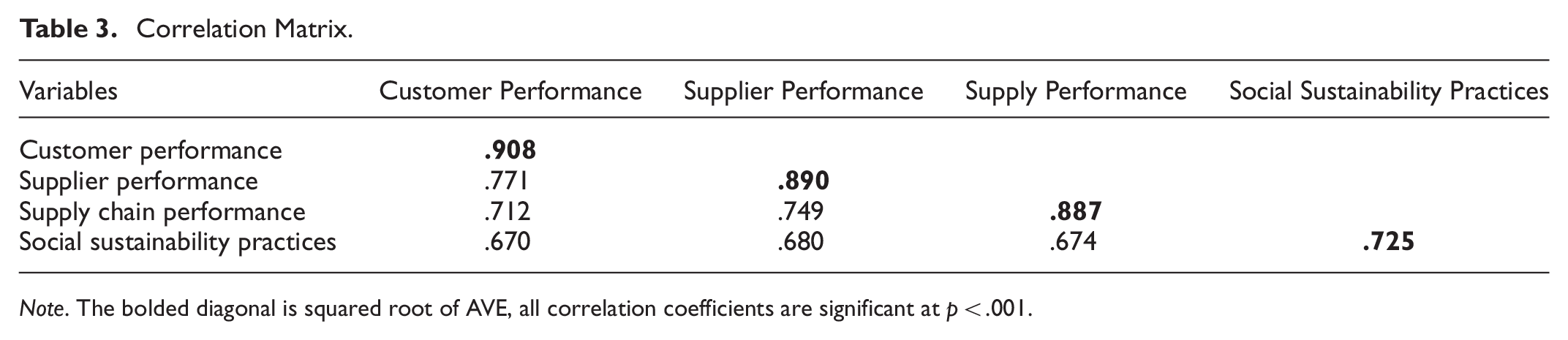
Note. The bolded diagonal is squared root of AVE, all correlation coefficients are significant at p < .001.
Common Method Variance
The Common Method Bias (CMB) were assessed to evaluate related variances during setting research design and data collection procedures. The CMB was investigated by two methods suggested by (Podsakoff et al., 2003). The results of Harman’s single-factor and the collinearity assessment approach (Kock, 2015) showed that CMB was not a major threat to the validity of the current research model.
Empirical Results
Based on factor analysis results that indicated reliable and valid measuring constructs in the research model, we then proceeded to assess the structural model and estimated the path coefficient using PLS-SEM. The path analysis process used SmartPLS 3.0 (Ringle et al., 2020) with the 5,000 number of bootstrap samples (Hair et al., 2014). Table 4 demonstrates the results of PLS-SEM. It evidenced that Social Sustainability highly impacts Supply Chain Performance (βH1 = .243, p < .01), Supplier Performance (βH2 = .680, p < .001), and Customer Performance (βH1 = .669, p < .001). Moreover, Supplier Performance and Customer Performance also have significant impacts on Supply Chain Performance (βH4 = .396, p < .001 and βH5 = .243, p < .01 respectively). Therefore, all hypotheses (H1, H2, H3, H5, and H6) were strongly supported. The R-squared values of three endogenous variables were highly significant, such as: Supplier Performance (R 2 = 50%), Customer Performance (R 2 = 47.6%), and Supply chain performance (R 2 = 67.2%). These R 2 value were above .35 indicating that it is a substantial model (Cohen, 2013) .
The Results of Path Analysis.

p < .05. **p < .01. ***p < .001.
Mediation analysis on SmartPLS 3.0 was performed to test the mediating effects of Supplier Performance and Customer Performance in the relationship between Social Sustainability Practices and Supply Chain Performance (Hair et al., 2017). The results show that the Social Sustainability Practices have significant specific indirect effect on Supply Chain Performance through Supplier Performance (βSSP->SP->SCP = .269, p < .001), supporting Hypothesis 4. Moreover, the impact of Social Sustainability Practices on Supply Chain Performance also significantly mediated by Customer Performance (βSSP->CP->SCP = .162, p < .01), therefore, supporting Hypothesis 7. The results of path analysis were demonstrated in Figure 2.

The PLS-SEM data analysis results.
Discussion and Conclusion
Finding Discussions
Based on the Stakeholder resource-based view theory, this study aims to empirically examine the influences of social sustainability practices in medium and large sized enterprises within the context of emerging markets. Hypothesis 1 was statistically significant to support that when a firm prioritizes on social sustainability, it will lead to an increase in the firm’s supply chain performance. Aligning with previous studies, empirical results evidenced the significance of company’s social sustainability practices on supply chain performance (Chin et al., 2015; Duong & Ha, 2021; Mani et al., 2016, 2018). In addition, the positive relationships between social sustainability and supplier performance and customer performance were supported in the Hypothesis 3 and Hypothesis 6. The results also confirmed the significant impacts of social sustainability practices on supplier performance, customer performance (Mani et al., 2016, 2018). It means a firm’s performance outcomes are also enhanced through supplier performance and customer performance (Mani et al., 2020).
In particular, the mediation roles of supplier performance and customer performance on the relationship between social sustainability practices and supply chain performance were was intensively investigated in the current as Hypothesis 4 and Hypothesis 7 were statistically supported. These mediation effects reflect the SRBV’s view of the collaboration relationships among stakeholders in the supply chain integration, whereas both suppliers and customers are among the stakeholders who constantly work to increase their utility revenues (Duong & Ha, 2021; Sodhi, 2015). Aligned with previous studies, these findings have demonstrated social sustainability strategies may connect all supply chain members and improve supply chain integration, resulting in high-performance outcomes (Mani et al., 2018; Sancha et al., 2016; Vereecke & Muylle, 2006). By successfully exploring the mediating effect of supplier and customer performance in the link between a firm’s social sustainability practices and supply chain performance, this study thus can contribute to filling research gaps in the current literature. It implied that supplier performance and customer performance are necessary conditions to further enhance the effectiveness of social sustainability practices on the firm’s supply chain performance. From the firms’ perspectives, stakeholders’ resources as vital resources and capabilities that should be effectively cultivated and managed to achieve superior performance and competitive advantages (Alvarez & Barney, 2017; Sen et al., 2006). Thus, this study has significantly highlighted the importance of social sustainability strategies, the findings of this research make several contributions to the extant literature and practical insights to the enterprise’s corporate social responsibility and supply chain sustainability.
Theoretical Contributions
By examining the effects of supply chain social sustainability in the context of emerging countries, the current study contributed to the extant literature on supply chain performance into threefold. First, our findings have further emphasized the significance of social sustainability practices in enhancing the firm’s superior supply chain performance (Nakamba et al., 2017). The finding is also in line with previous research (Chin et al., 2015; Duong & Ha, 2021; Mani et al., 2016, 2018). Furthermore, by examining this topic in developing countries, this research filled the research gap by extensively exploring different determinants of social sustainability practices in compared to developed countries. In addition, this study has validated six key facets of social sustainability practices in the context of Vietnamese firms, namely: philanthropy, safety, equity, ethics, health & welfare, and human rights.
Second, to the best of our knowledge, the current study is amongst the very first study investigating the interaction between social sustainability practices and supply chain performance, particularly in Vietnam. In addition, this research supports more evidence to the saliency of SRBV theory (Kull et al., 2016; Sodhi, 2015) in examing the roles of stakeholer performances to the firm’s overall success. The results show that supplier performance and customer performance can significantly mediate the link between social sustainability practice and performance outcomes in the supply chain. These findings are consistent with the tenet of the SBRV as it indicated the important roles of supplier and customer integration and engagement in a firm’s supply chain management (Gong et al., 2019; Saunders et al., 2015; Sen et al., 2006).
Last but not least, the adoption of social sustainability into a firm’s management practices will positively enhance the overall performance of supply chain and the performance of other strategic stakeholders, including customer performance and supplier performance (Alghababsheh & Gallear, 2021; Duong & Ha, 2021; Kumar & Rahman, 2015; Mani et al., 2018; Sancha et al., 2016). Another contribution of this study is that customer performance also affects supply chain performance, thus re-affirming the important role of customer performance and supplier performance which was indicated from previous research findings. The current study has significantly filled in the gap in the literature of social sustainability by exploring the mediating effects of both supplier performance and customer performance in the impact of social sustainability practices on firm’s supply chain performance outcomes. These findings are crucial to explain the important roles of key stakeholders’ collaboration and integration in developing social sustainable supply chain, in which, customer performance and supplier performance should be further effectively and efficiently integrated into the firm’s supply chain performance (Adomako & Tran, 2022; Mani et al., 2018; Park-Poaps & Rees, 2010; Saunders et al., 2015; Shafiq et al., 2020).
Practical Implications
Social sustainability is a long-term, ongoing mission of ensuring social conditions and outcomes are optimized for generations to come. In several ways, the outcomes empower managers to address social concerns with responsiveness. It encourages supply chain managers to improve the well-being and working circumstances of their employees and to contribute to the local community. Besides this, by stressing the significance of social sustainability objectives and their influence on improving supply chain performance, this study offers crucial assistance to business managers in the area of sustainable growth. Our research findings also indicate that people working for an ethical business will increase their loyalty to the firm.
Furthermore, our results demonstrate the beneficial association between social sustainability and supply chain performance, with supplier performance and customer performance serving as a mediator. Managers should have a deeper understanding of the significance of sustainability practices and how they might impact performance outcomes. This study proposes that managers should collaborate and encourage business partners, including upstream suppliers and downstream customers, to contribute to society and act ethically. As a result, the performance of the supply chain will be greatly increased.
Last but not least, this research provides better insights into the context of sustainable development in Vietnam. Managers in large and medium enterprises can use our findings as an effective strategy to apply social sustainability practices. This research also gives some helpful recommendations for managers when they make decision relevant with sustainable development goals. As a result, managers in developing countries can follow our instructions to improve sustainability in their business strategy to achieve their company goals successfully and gain more competitive advantages.
For policy-makers, firstly, the government should educate stakeholders in the supply chain, notably businesses, about sustainable development, therefore encouraging the business environment to pay greater attention to sustainability when exploiting and utilizing natural resources, particularly in the post Covid-19 era. Also, they must preserve the environment throughout production and commercial operations. In addition, the government must encourage businesses to prioritize employee welfare and health, safety, compensation, and working conditions. Moreover, policy-makers must continue to strengthen the legal framework for environmentally friendly development. In recent years, the establishment of environmental protection tax and charge laws has helped to increase environmental consciousness. It also results in an increase in money for environmental recovery. The environmental protection tax law supports environmentally beneficial activity. On the other side, this law hinders and bans environmentally destructive activities based on the idea that polluters must pay the expenses to recover and repair the eco-system.
Lastly, the government should take immediate and long-term action, concentrating on measures such as urgently removing existing obstacles and legal barriers that have not been completely resolved, encouraging the flow of public funding, and opening up resources for investment in production and business. In addition, authorities must continue to encourage cost reduction for businesses and improve access to preferential sources of finance. Furthermore, the government should address interruptions in the supply chain by diversifying export markets and growing domestic markets. The government should also focus on resolving the local labor shortage in specific industries, encourage the implementation of laws and solutions to assist employees’ welfare, salary, health and working conditions, as well as develop workers’ skills to satisfy market demand.
Conclusion
Although our findings contribute several insights to both theoretical and practical aspects, there are some limitations that should be addressed in our study. First, the social issues in emerging countries are different from developed countries. Thus, findings of the current study may only apply in the specific context of emerging countries. Second, this study excludes examining economic and environmental sustainability, while focuses on examining one pillar of social sustainability in the sustainable development. As a result, there are many opportunities for future studies. For instance, researchers can further integrate the other two pillars and investigate their relationships with supply chain performance outcomes, especially in emerging markets. Additionally, the data set were collected at a particular time in this study. Longitudinal studies should be conducted in the future to examine whether social sustainability practices are incompatible over time and situations.
In conclusion, our study proves that social sustainability practice is one of the most important strategies for managers to enhance their performance outcomes in supply chain management. It might go wrong if managers and policy-makers ignore the importance of social aspect in the supply chain, especially in the post Covid-19 era. With the findings, the authors confirm that in emerging countries, social sustainability is crucial to the long-term performance and survival of businesses. This study proves that managers should strive to improve working environments; their workers’ well-being, working conditions, healthcare, as well as the growth of the local community in order to achieve socially sustainable development objectives. As a consequence of these efforts, companies will establish a greater reputation and achieve their objectives more efficiently and effectively in managing a socially sustainable supply chain. In the process of developing supply chain sustainability, the collaboration relationships with primary firm’s stakeholders such as suppliers and customers, play a crucial part in enhancing the effectiveness of social sustainability practices on the overall performance of firm’s supply chain management. Firms thereby should capitalize well such important resources through cooperation programs, effective exchanges and communication as well as shared values and mutual understandings among stakeholders at the aim to effectively integrateing social sustainability practices in the supply chain management practices. In addition, the government has concurrently undertaken a variety of steps to encourage sustainable development and achieved significant success, such as macro-economic stability and economic growth. Authorities should, as part of their commitment to human development, emphasize improving the quality of life, gender equality, working conditions, health & safety, and well-being of individuals.
Footnotes
Appendix
Measurement Items.

| Construct | Measurement |
|---|---|
| Supply Chain Social Sustainability (SCSS) | |
| Philanthropy (PHIL) | |
| ssph1. | Encourages supply chain partners to participate in philanthropic activities |
| ssph2. | Volunteers at local charities |
| ssph3. | Donates to charitable organizations |
| ssph4. | Assists NGOs with societal development |
| Safety (SAFE) | |
| ssaf1. | Ensures supply chain facilities adhere to strict safety regulations |
| ssaf2. | Ensures women’s safety across the supply chain |
| ssaf3. | Ensures the safe incoming and outgoing movement of product to and from trading partner facilities |
| Equity (EQUI) | |
| sseq1. | Ensures strict adherence to gender non-discrimination policies at trading partner locations |
| sseq2. | Ensures workplace diversity at trading partners’ facilities |
| sseq3. | Ensures gender non-discrimination policies are in place at trading partners’ facilities |
| sseq4. | Periodically audits trading partners to ensure adherence to equality policies |
| Health & Welfare (HEWE) | |
| sshw1. | Ensures welfare of stakeholders at trading partner locations |
| sshw2. | Ensures availability of health care facilities in trading partner locations |
| Human Rights (HURI) | |
| sshr1. | Has a human rights policy for our manufacturing facilities |
| sshr2. | Audits trading partner locations and ensures non employment of child and bonded labor |
| sshr3. | Ensures non-employment of sweatshop labors in trading partner locations |
| Ethics (ETHI) | |
| ethi1. | Established an ethical compliance team, department or division in our manufacturing facilities |
| ethi2. | Has established a set of transparent, comprehensive and stringent ethical codes of conduct in our manufacturing units |
| Supplier Performance (SUPF) | |
| supf1. | We have been able to obtain products or services from suppliers with shorter lead time |
| supf2. | The supplier’s reliability is increased |
| supf3. | Suppliers have done their job efficiently |
| Customer Performance (CUPF) | |
| cupf1. | The customer is able to acquire more customers (customer’s customer) |
| cupf2. | The customer’s financial status is improved |
| Supply Chain Performance (SCPF) | |
| scpf1. | Increased customer satisfaction with fulfillment |
| scpf2. | Achieved compressed order lead time |
| scpf3. | Increased customer service level |
Declaration of Conflicting Interests
The author(s) declared no potential conflicts of interest with respect to the research, authorship, and/or publication of this article.
Funding
The author(s) disclosed receipt of the following financial support for the research, authorship, and/or publication of this article: This research is funded by University of Economics Ho Chi Minh City (UEH), Vietnam.

Data Availability Statement
Data available on request from the authors.