




Abstract
This study examines the role of time scarcity, cooking skills, meal preparation confidence, physical and mental effort for cooking, availability of cooking resources, familiarity and motivation on consumers’ intention to purchase and consume convenience food. The data of 501 consumers, selected through non-probability purposive sampling technique, was collected using a structured questionnaire. SPSS and AMOS software were employed for data analysis. The results of descriptive statistics and confirmatory factor analysis indicated good internal consistency and reliability of questionnaire, as well as adequate convergent and discriminant validity of measurement model. The outcome of the structural equation modeling showed that time scarcity, lack of cooking skills, lack of meal preparation confidence, lack of interest for physical and mental efforts in cooking, familiarity to convenience food, and lack of motivation in cooking has positive relationship/association with consumers’ intention to purchase and consume convenience food. Availability of cooking resources had no significant effect on convenience food consumption. Busy lifestyle, hectic work schedule, and multiple responsibilities within time scarcity construct were prominent factors which significantly influence consumers’ intention to purchase and consume convenience food.
Introduction
Time scarcity originating from various reasons results in modification of food consumption behavior of consumers. Long working hours, rise in nuclear and single parent families, increase in female participation in work force, desire to maximize leisure time and multiple responsibilities motivate consumers to seek convenience food worldwide (Buckley et al., 2007; Contini et al., 2018; Devine et al., 2009). In emerging economies like India, fast urbanization, significant rise in nuclear and dual working families, changing lifestyle, high work pressure, social engagement, and career-oriented environment are the major causes for time scarcity, which in turn increases the demand for convenience food. The consumers perceived that it saves time and energy; reduce stress; minimizes exertion due to preparing food from scratch and clean-up, provides opportunities for social and leisure activities and help in managing multiple responsibilities (Celnik et al., 2012; Chen & Antonelli, 2020; Djupegot et al., 2017; Gupta & Singh, 2016; Jabs & Devine, 2006; Jebarajakirthy et al., 2021).
Apart from convenience, cooking skills, motivation, culinary training and physical and mental efforts for purchasing ingredients, meal preparation, clean-up, and waste management are important factors influencing convenience food choice (Bava et al., 2008; Burton et al., 2017; Colton & Nightingale, 2020; Geeroms et al., 2008; Martins et al., 2020; Namin et al., 2020; Tani et al., 2020; Verriet, 2015; Wilson et al., 2017). Cooking skills and motivation are diminishing worldwide due to lack of training from parents, inclination toward employment-oriented careers, time scarcity, long cooking duration, and cleaning of cooking resources. It is generally perceived that cooking from scratch is time consuming and a tiring process (Bava et al., 2008; Kourajian et al., 2017; Monsivais et al., 2014). In rural areas, cooking traditional food is still predominant because cooking skills, knowledge, and motivation are passed from mothers to daughters as a part of cultural heritage. However, cooking skills and motivation are gradually diminishing in cities due to significant changes in lifestyle, reluctance to pass cooking skills to daughters due to inclination toward professional career and lack of provisions for imparting culinary training in school/college/university.
Cooking food from scratch/basic ingredients requires significant amount of physical and mental efforts. The lack of willingness and interest to spend time, physical and mental efforts and physical energy in cooking traditional food, cleaning of utensils and waste disposal are the key reasons for convenience food choice (Brunner et al., 2010; Verriet, 2015). Apart from cooking skills, meal preparation confidence is also important to cook food from basic ingredients. People who have low meal preparation confidence and cooking ability are inclined to use more convenience food as it requires minimal cooking skills and resources (Bava et al., 2008; Brunner et al., 2010; Kourajian et al., 2017; Martins et al., 2020; Namin et al. 2020). Familiarity is another important factor which significantly influences convenience food choice. The consumers prefer to purchase and consume convenience food due to their familiarity with sensory, quality, safety, and healthiness as well as cooking process (Honkanen & Frewer, 2009; Jaeger et al., 2021; Prescott et al., 2002; Steptoe et al., 1995; Y. Wang & Hazen, 2016).
Major comprehensive research concerning the role of a wide range of determinants that influence convenience food choice have been conducted in developed and industrialized nations (Brunner et al., 2010; Buckley et al., 2007; Burton et al., 2017; Celnik et al., 2012; Contini et al., 2018; Geeroms et al., 2008; Konttinen et al., 2021; Kourajian et al., 2017; Monsivais et al., 2014; Petrescu et al., 2020; Pieniak et al., 2009; Steptoe et al., 1995). Due to significant differences in social, cultural, and economic conditions, the choice of consumers in emerging economies such as India may differ from the choice of consumers in developed and industrialized countries. Prescott et al. (2002) revealed that convenience, healthiness, natural ingredients, and weight control were the key drivers influencing consumers’ preference of food in Taiwan and Malaysia, whereas food price and sensory appeal were the key determinants for Japanese and New Zealander consumers, respectively. Januszewska et al. (2011) indicated that sensory appeal was the key determinant in Romania and Hungary, whereas convenience, health, and food price were the important determinants in Belgium in context of food preference. Further, health, food price, and mood were the most influencing determinants for Philippino consumers. Therefore, it is crucial to carry out a comprehensive study to ascertain the role of physical determinants in influencing consumers’ food choice in emerging economies. In view of the remarkable market growth and importance of convenience food in India the main objective of this research was to assess the role of time scarcity, cooking skills, meal preparation confidence, physical and mental efforts for cooking, availability of cooking resources, familiarity and motivation on consumers’ intention to purchase and consume convenience food.
Conceptual Framework and Hypotheses
Time scarcity is one of the most important factor which significantly influence consumer’s intention to purchase and consume convenience food. Long and erratic working hours (Devine et al., 2009); rise in women’s full time employment (Bauer et al., 2012); spending more time in leisure activities (Sturm, 2004); diminishing trend of joint family system (Celnik et al., 2012); employment status (Celnik et al., 2012); dual working nuclear families (Jabs & Devine, 2006); and work pressure (Bauer et al., 2012; Devine et al., 2009) are the major factors influencing time scarcity that drive consumers toward convenience food choice. Jabs et al. (2007) reported that due to time scarcity, working mothers often rely on convenience food in order to give more time to their children than in cooking food from scratch. Beshara et al. (2010) revealed that convenience orientation and time pressure/time scarcity had negative effect on healthy meal preparation. Celnik et al. (2012) stated that consumers who experienced time scarcity/time pressure reduced time for household activities such as preparation, cooking, and clean-up which in turn drives them toward convenience food choice. Djupegot et al. (2017) revealed that consumers who face time scarcity are more inclined toward shopping and consumption of convenience food. In view of the above-mentioned comprehensive literature review, the hypothesis is postulated as
Cooking skills (Bava et al., 2008; Colton & Nightingale, 2020; Isser & Eizenman 2013; Martins et al., 2020; Monsivais et al., 2014; Namin et al., 2020); culinary training (Verriet, 2015; Wilson et al., 2017); meal preparation confidence (Beshara et al., 2010; Burton et al., 2017); physical and mental effort for cooking (Buckley et al., 2007); availability of cooking resources (Popkin & Haines, 1981); familiarity (Contini et al., 2018; Prescott et al., 2002); and motivation (Celnik et al., 2012; Hartmann et al., 2013) are the key factors which significantly influence convenience food choice. Cooking skills are important to provide nutritive and balanced diet for a healthy lifestyle. Irrespective of gender, cooking is perceived as a difficult and low priority task. Bava et al. (2008) reported that the lack of proper training by parents, significant increase in dual working families and breakdown of traditional family systems are the basic reasons for convenience food choice because cooking from scratch is a time consuming and tiring process. Brunner et al. (2010) reported that age, nutritional knowledge/information, and cooking skills were the key determinants influencing convenience food choice. Wolfson et al. (2016) and Namin et al. (2020) revealed that the major constraints of cooking from scratch were affordability, time scarcity, and lack of motivation induced by lack of enjoyment in cooking food from basic ingredients. Burton et al. (2017) stated that diminishing trends of cooking and other food related skills are the main concern in industrialized countries. Further, the consumers possessing cooking skills consumed convenience food less often than those who lacked cooking and other food preparation skills. The availability of convenience food, time scarcity, knowledge about cooking process, and culinary training significantly leads to lack of food preparation confidence and meeting the dietary recommendations (Priyadarshini, 2015). Based on the aforementioned comprehensive literature review regarding cooking skills, meal preparation confidence, physical and mental effort for cooking, and availability of cooking resources, the following hypotheses are proposed:
Familiarity, particularly with product attributes, is an important aspect which influences convenience food choice of the consumers. Familiarity with taste, quality aspects, safety measures, nutritional facts, preparation/cooking process, shelf life, and storage influences the consumers’ behavior in context of convenience food choice (Honkanen & Frewer, 2009; Pula et al., 2014; Jaeger et al., 2021; Y. Wang & Hazen, 2016). However, findings of some cross-national and cross-cultural studies reported familiarity as the least influential factor for convenience food choice of consumers (Januszewska et al., 2011; Prescott et al., 2002). In view of the aforementioned literature review, the following hypothesis is postulated:
The motivation for cooking food from scratch is diminishing because consumers perceive that meal preparation from basic ingredients is a time consuming and tiring process (Boustani & Guiné, 2020; Celnik et al., 2021; Hartmann et al., 2013; Slater, 2012). Globally, a decreasing trend in cooking skills and motivation has been observed resulting from the lack of domestic culinary training, inclination toward career orientation, hectic work schedule, competitive environment, time pressure due to social and religious engagements, engagement in leisure activities, and lack of sufficient cooking resources (Brasington et al., 2021; Gupta & Singh, 2016; Priyadarshini, 2015). In view of the above comprehensive review, the hypothesis is proposed as:
Consumer’s decision making process to purchase convenience food products is dictated by multiple factors such as social, psychological, ethical, religious, socio-demographics, economic, physical, marketing, commercial, and product determinants. The degree of the influence of the above-mentioned determinants on consumer’s intention to purchase convenience food products depends on attitude, behavior, and food related lifestyle (Dowd & Burke, 2013; Hena et al., 2021a, 2021b; Ting et al., 2017). The findings of previous studies highlights that convenience, time scarcity, cooking skills and motivation, price, availability, packaging, sensory, quality, safety, health, and processing technology were the key determinants that positively influenced consumer’s decision to purchase and consume convenience foods (Bandara et al., 2016; Braghieri et al., 2016; Geeroms et al., 2008; Hena et al., 2021a, 2021b; Omari & Frempong, 2016; Thong & Solgaard, 2017; Ting et al., 2017). In view of the above-mentioned comprehensive review, the hypothesis is postulated as:
Time scarcity, cooking skills, meal preparation confidence, physical and mental efforts for cooking, availability of cooking resources, familiarity, and motivation, which appears important in aforementioned literature review are included in the conceptual model to assess their role on consumers’ intention to purchase and consume convenience food (Figure 1).

Proposed research model.
Materials and Methods
Development and Pretesting of Questionnaire
A structured questionnaire was used as survey instrument to collect data from the participants. The main advantages of using a questionnaire for data collection is that it is economical, convenient to participants and easy for data collection as well as it provides quantifiable data to assess the role of determinants on consumer’s food choice. Developing a survey instrument (questionnaire) is the prime aspect of food marketing research because irrelevant questions in questionnaire lead to inaccurate data collection. Process of developing the questionnaire involved determination of research goals, formulating questions and reviewing questionnaire to align with research goals (Phellas et al., 2012). Comprehensive review of the previous researches concerning the role of time scarcity, cooking skills, meal preparation confidence, physical and mental efforts for cooking, availability of cooking resources, familiarity and motivation on consumer’s intention to purchase and consume convenience food (Table 1) as well as the feedback obtained from the consumers led to the development of the questionnaire.
Sources for Development of the Questionnaire.

Pre-testing of a questionnaire is a key step to ensure its accuracy and reliability in order to collect data from consumers. Prior to the main study, to gather data in relation to time scarcity, cooking skills, meal preparation confidence, physical and mental effort for cooking, availability of cooking resources, familiarity and motivation which drives consumers toward convenience food choice, the questionnaire was pre-tested at Prayagraj, Uttar Pradesh. The participants were asked to assess the questionnaire for potential shortcomings. The participants were requested to provide their opinion regarding the clarity, design, structure, and comprehensibility of the questionnaire in order to examine the role of time scarcity, cooking skills, meal preparation confidence, physical and mental efforts for cooking, availability of cooking resources, familiarity and motivation on consumers’ convenience food choice. Their feedback were incorporated in the final questionnaire to improve the reliability and accuracy in data collection (Hena et al., 2021a, 2021b; Konuk, 2019; Pieniak et al., 2009; Singh & Kathuria, 2016; O. Wang et al., 2015).
Participants
The participants comprised of students and in-service personnel of the university as well as professional from corporate sector. In context of gender, 41.3% males and 58.7% females participated in the study. The average age of the participants was 30.37 years, wherein 34.93% were between 18 and 25 years, 40.52% between 26 and 35 years, 18.76% between 36 and 45 years, and 5.79% between 46 and 65 years. In regard to marital status of the consumers, 48.9% were unmarried and 51.1% were married. Majority of the consumers who participated in the survey were employed (65.9%) with incomes ranging from USD 700 to USD 40,000 (INR 50,000–300,000).
Despite of some limitations, purposive sampling technique was selected for recruitment of the participants, because researchers were aiming to collect data from a particular group of consumers as they are the potential consumers in context of purchase and consumption of convenience food (Hena et al., 2021a, 2021b; Taherdoost, 2016; Tan et al., 2014; Singh & Kathuria, 2016). A total of 550 participants/consumers were recruited across four cities of India. According to the population of four cities (8.25 million), that is, Allahabad, Lucknow, Noida, and Aligarh, 550 participants/consumers taken in this study were more than the recommended sample size (400) for the population of 0.25 million with 95% confidence level and ±5% margin of error (Hena et al., 2021a, 2021b; The Research Advisor, 2006; Singh and Kathuria, 2016). The questionnaires of 49 participants were excluded because they did not provide complete and relevant data.
Data Collection
Data were collected in four cities of India, that is, Allahabad, Lucknow, Noida, and Aligarh during January 2019. The designed questionnaire was distributed to 550 consumers comprising of students and in-service personnels. They were informed in advance to gather at the conference/meeting rooms provided by the universities, colleges, and corporates. Prior to data collection, the participants were briefed regarding the present study and its objectives as well as the contents of the questionnaire. A five point Likert scale (Strongly disagree = 1, disagree = 2, don’t know = 3, agree = 4, strongly agree = 5) was used to evaluate the role of time scarcity, cooking skills, meal preparation confidence, physical and mental effort for cooking, availability of cooking resources, familiarity and motivation on consumers’ intention to purchase and consume convenience food (Hena et al., 2021a, 2021b; Singh & Kathuria, 2016; Steptoe et al., 1995; Ting et al., 2017).
Analysis and Results
Data Analysis Methods
Descriptive statistics such as mean, standard deviation, skewness, and kurtosis for each items of time scarcity, cooking skills, meal preparation confidence, physical and mental effort for cooking, availability of cooking resources, familiarity, motivation, purchase intention, and consumption were determined using SPSS version 24 software. SPSS software was also used to calculate Cronbach’s alpha to assess the reliability of the questionnaire (Hena et al., 2021a, 2021b; Nunnally, 1978; Rezai et al., 2014, Singh & Kathuria, 2016). Confirmatory factor analysis was performed using AMOS version 23 software to determine the reliability of the scale items, convergent and discriminant validity of the constructs of measurement model as well as model fit indices (Hena et al., 2021a, 2021b; Konuk, 2019; Nunnally, 1978; Pieniak et al., 2009; Singh & Kathuria, 2016). In order to assess the fitness of the measurement model with the data obtained from consumers, Comparative Fit Index (CFI), Tucker-Lewis Index (TLI), Goodness of Fit Index (GFI), Root Mean Square Error of Approximation (RMSEA), and Standardized Root-mean Squared Residual (SRMR) were used (Contini et al., 2018; Hair et al., 2010; Hena et al., 2021a, 2021b; Singh & Kathuria, 2016).
In order to test the proposed hypotheses in context of the role of time scarcity, cooking skills, meal preparation confidence, physical and mental efforts for cooking, availability of cooking resources, familiarity and motivation on consumer’s intention to purchase and consume convenience food, Structural Equation Modeling (SEM) technique was employed (Hena et al., 2021a, 2021b; Konuk, 2019; O. Wang et al., 2015). In order to determine the fit of the structural model, Comparative Fit Index (CFI), Tucker-Lewis Index (TLI), Goodness of Fit Index (GFI), Root Mean Square Error of Approximation (RMSEA), Standardized Root-mean Squared Residual (SRMR), and Chi square/degree of freedom (χ2/df) were calculated (Konuk, 2019; Hena et al., 2021a, 2021b; Rezai et al., 2014; Singh & Kathuria, 2016). To improve the overall fit of the structural model relating to time scarcity, cooking skills, meal preparation confidence, physical and mental efforts for cooking, availability of cooking resources, familiarity and motivation with consumers’ intention to purchase and consume convenience food, modification of indices technique was employed (O. Wang et al., 2015). Further, to examine the postulated hypotheses, standardized estimates, t-value, and p-value were calculated (Hena et al., 2021a, 2021b; Konuk, 2019; Singh & Kathuria, 2016).
Descriptive Statistics
Table 2 indicates that participants’ mean score for time scarcity, cooking skills, meal preparation confidence, physical and mental efforts for cooking, familiarity and motivation had significant effect on consumers’ intention to purchase and consume convenience food. Further, availability of cooking resources did not affect consumers’ intention to purchase and consume convenience food. “Busy life style”/“hectic work schedule” within time scarcity; “limited cooking knowledge”/“lack of culinary training” within cooking skills; “lack of confidence in cooking meals” within meal preparation confidence; “convenience food requires minimum physical energy” within physical and mental effort; “familiarity with taste” within familiarity; and “cooking from scratch is tiring” within motivation constructs were the key factors which positively influence consumers’ intention to purchase and consume convenience food. The mean value of skewness for time scarcity, cooking skills, meal preparation confidence, physical and mental effort for cooking, familiarity, motivation, purchase intention, and consumption varied from −0.918 to 0.722, which falls under the recommended cut off value of −1 to 1. The mean value of kurtosis for the above-mentioned constructs varied from −1.449 to 1.865 which lies within the acceptable cutoff value of −2 to 2 (Table 2). The results revealed that the data obtained for different items of time scarcity, cooking skills, meal preparation confidence, physical and mental effort for cooking, availability of cooking resources, familiarity, motivation, purchase intention, and consumption constructs were normally distributed (Hena et al., 2021a, 2021b; N. V. Olsen et al., 2012; Rezai et al., 2014).
Descriptive Statistics and Confirmatory Factor Analysis Results for Reliability of Constructs and Validity of Measurement Model.

Note. CFI = Comparative Fit Index; TLI = Tucker-Lewis index; GFI = Goodness of Fit Index; RMSEA = Root Mean Square Error of Approximation; SRMR = Standardized Mean Square Residual.
Significant at p ≤ .01; skewness: 0.918 to 0.722; kurtosis: −1.449 to 1.86.
Measurement Model
Factor Loading (FL), Cronbach Alpha (α), Composite Reliability (CR), and Average Variance Extracted (AVE) for time scarcity, cooking skills, meal preparation confidence, physical and mental effort for cooking, availability of cooking resources, familiarity, motivation, intention to purchase, and consume convenience food are demonstrated in Table 2. FL for time scarcity, cooking skills, meal preparation confidence, physical and mental effort for cooking, availability of cooking resources, familiarity, motivation, intention to purchase, and consume convenience food were significant (p ≤ .01). FL for all items of time scarcity, cooking skills, meal preparation confidence, physical and mental effort for cooking, availability of cooking resources, familiarity, motivation, intention to purchase, and consume convenience food ranged from 0.605 to 0.988 which lies above the recommended cutoff value of 0.50 (Contini et al., 2018; Konuk, 2019; Hena et al., 2021a, 2021b; Nunnally, 1978; Pieniak et al., 2009). Therefore, all items of above-mentioned constructs were considered for assessing the factors which influence the consumers’ intention to purchase and consume convenience food (Contini et al., 2018; Hair et al., 2010; Hena et al., 2021a, 2021b; Konuk, 2019). The value of α for time scarcity, cooking skills, meal preparation confidence, physical and mental effort for cooking, availability of cooking resources, familiarity, motivation, intention to purchase, and consume convenience food varied between 0.704 to 0.987, which was more than the recommended cutoff value of 0.70 (Hena et al., 2021a, 2021b; Konuk, 2019; Nunnally, 1978; Pieniak et al., 2009; Rezai et al., 2014; Singh & Kathuria, 2016). The values of CR for time scarcity, cooking skills meal preparation confidence, physical and mental effort for cooking, availability of cooking resources, familiarity, motivation, intention to purchase, and consume constructs varied between 0.900 to 0.988, which exceeded the minimum cutoff value of 0.70 (Contini et al., 2018; Hena et al., 2021a, 2021b; Konuk, 2019; Nunnally, 1978; Singh & Kathuria, 2016). The above-mentioned values for α and CR indicated good reliability of the questionnaire (Hair et al., 2010; Hena et al., 2021a, 2021b; Januszewska et al., 2011; Konuk, 2019). AVE for time scarcity, cooking skills, meal preparation confidence, physical and mental effort for cooking, availability of cooking resources, familiarity, motivation, purchase intention, and consumption constructs varied between 0.510 to 0.942, that exceeded the cutoff value of 0.50 (Fornell & Larcker, 1981; Hair et al., 2010; Hena et al., 2021a, 2021b; Konuk, 2019; Singh & Kathuria, 2016). FL and AVE found for different constructs indicated convergent validity of the measurement model (Contini et al., 2018; Fornell & Larcker, 1981; Hair et al., 2010; Hena et al., 2021a, 2021b; Singh & Kathuria, 2016). Further, the correlation estimates and square root of AVE (Table 3) indicated discriminant validity of measurement model (Fornell & Larcker, 1981; Hena et al., 2021a, 2021b; Konuk, 2019; Singh & Kathuria, 2016).
Discriminant Validity of the Constructs of Measurement Model.
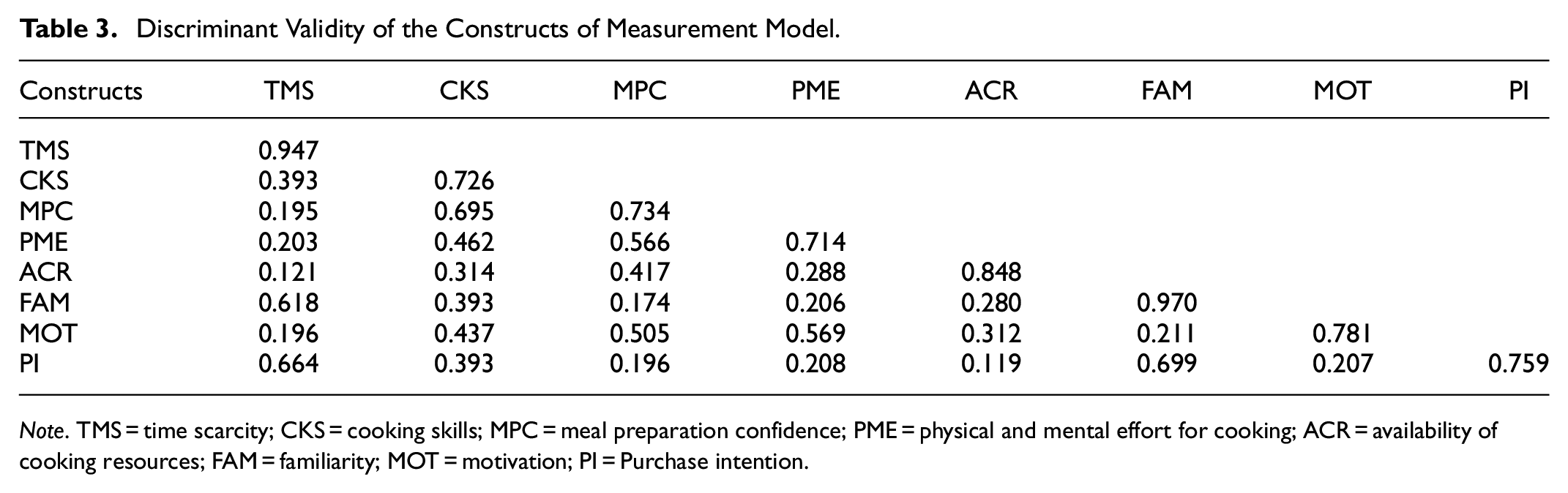
Note. TMS = time scarcity; CKS = cooking skills; MPC = meal preparation confidence; PME = physical and mental effort for cooking; ACR = availability of cooking resources; FAM = familiarity; MOT = motivation; PI = Purchase intention.
CFI, TLI, GFI, RMSEA, and SRMR indices were used to assess the overall fit of the measurement model relating to time scarcity, cooking skills, meal preparation confidence, physical and mental effort for cooking, availability of cooking resources, familiarity and motivation with intention to purchase as well as intention to purchase and consume convenience food. CFI was 0.911 (≥0.90), TLI was 0.907 (≥0.90), GFI was 0.901 (≥0.90), RMSEA was 0.072 (≤0.08), and SRMR was 0.078 (≤0.08), which were within the recommended cutoff values (Table 2). The values found for CFI, TLI, GFI, RMSEA, and SRMR indicated good fit of the measurement model (Bentler, 1990; Hena et al., 2021a, 2021b; Konuk, 2019; Rezai et al., 2014).
Structural Model
In order to understand the relationship between time scarcity, lack of cooking skills, lack of meal preparation confidence, lack of interest for physical and mental effort for cooking, availability of cooking resources, familiarity to convenience food, lack of motivation and consumer’s intention to purchase as well as intention to purchase and consume convenience food, a structural model was constructed. The model fit indices i.e. CFI, TLI, GFI, RMSEA, SRMR, and χ2/df were 0.908 (≥0.90), 0.904 (≥0.90), 0.901 (≥0.90), 0.076 (≤0.080), 0.079 (≤0.080), and 4.48 (<5.0) respectively, which falls within the recommended threshold value (Figure 2). The values obtained for model fit indices also indicated adequate fit of structural model (Bentler, 1990; Contini et al., 2018; Hena et al., 2021a, 2021b; Konuk, 2019; O. S. Olsen & Tuu, 2017; Singh & Kathuria, 2016).

Structural analysis of physical determinants influencing consumer’s intention to purchase and consume convenience food.
Figure 2 and Table 4 demonstrate the extent of relationship between time scarcity, lack of meal preparation confidence, lack of interest for physical and mental effort in cooking, availability of cooking resources, familiarity with convenience food, lack of motivation in cooking, and intention to purchase as well as intention to purchase and consume convenience food. The results presented in Table 4 demonstrated positive relationship between time scarcity and intention to purchase convenience food as the standardized estimate of the path of structural model was statistically significant (β = .723, t = 26.530, p ≤ .01), supports the proposed hypothesis H1. Lack of cooking skills indicated positive relationship with intention to purchase convenience food, because standardized estimate of the path of structural model was significant (β = .514, t = 19.360, p ≤ .01), supporting the postulated hypotheses H2. The structural model fit indices: CFI: 0.908; TLI: 0.904; GFI: 0.901; RMSEA: 0.076; SRMR: 0.079; χ2/df = 4.48 outcome of the structural model analysis revealed positive association between lack of meal preparation confidence and intention to purchase convenience food as the standardized estimate (path coefficient) was significant (β = .292, t = 2.470, p ≤ .05), confirmed the postulated hypothesis H3 (Table 4). Lack of interest for physical and mental effort in cooking food from scratch demonstrated positive association with intention to purchase convenience food as the standardized estimate (path coefficient) of the structural model was significant (β = .292, t = 2.470, p ≤ .05), which confirmed the postulated hypothesis H4 (Table 4). The results of the structural model analysis demonstrated insignificant relationship between availability of cooking resources and intention to purchase convenience food because the standardized estimate (path coefficient) was statistically insignificant (β = .012, t-value = 0.310; p ≥ .068), rejecting the proposed hypothesis H5 (Table 4). Familiarity to convenience food and consumer’s intention to purchase convenience food demonstrated positive relationship as standardized estimate of the path of structural model was significant (β = .533, t-value = 18.097, p ≤ .01), which supports the postulated Hypothesis H6 (Table 4). Analysis of the structural model revealed a positive association between lack of motivation in cooking and intention to purchase convenience food as the standardized estimate was statistically significant (β = .519, t-value = 17.545, p ≤ .01), supporting the proposed Hypothesis H7 (Table 4). Results presented in Table 4 also exhibited strong positive relationship between intention to purchase and consume convenience food, because standardized estimate (path coefficient) was statistically significant (β = .998, t-value = 61.962, p ≤ .01), which confirmed the postulated Hypothesis H8. The overall results of structural model analysis demonstrated that time scarcity (β = .723) was the key determinant which positively influenced consumers’ intention to purchase and consume convenience food, followed by familiarity to convenience food (β = .533), lack of motivation in cooking (β = .519), lack of cooking skills (β = .514), lack of interest for physical and mental effort in cooking (β = .508), and lack of meal preparation confidence (β = .292) respectively (Table 4).
Results of Structural Model Analysis.

Significant at p ≤ .05.
Significant at p ≤ .01.
Discussion
Time scarcity induced by multiple responsibilities, dual working condition, diminishing trend of joint family system, desire to maximize leisure time, hectic work schedule, and competitive environment are the key factors which significantly influence consumers’ intention to purchase and consume convenience food. Despite of good cooking skills and experience, younger generation and full time employed couples, desire to minimize time for preparing meals from scratch, cleanup, and waste disposal because of time scarcity. The findings of the present study (Tables 2 and 4) demonstrated that time scarcity plays a key role in influencing consumers’ intention to purchase and consume convenience food. The standardized beta (path coefficient) of structural model revealed that time scarcity induced by multiple factors was the most important predictor of consumers’ intention to purchase and consume convenience food. Further, mean participants’ score demonstrated that busy lifestyle, dual working condition, hectic work schedule, and multiple responsibilities were the key factors within time scarcity construct, that influence consumers’ intention to purchase and consume convenience food. The results obtained in this study are in agreement with the findings of the studies carried out elsewhere (Beshara et al., 2010; Brasington et al., 2021; Celnik et al., 2012; Contini et al., 2018; Devine et al., 2009; Djupegot et al., 2017; Jabs & Devine, 2006; Leenders et al., 2019). Isser and Eizenman (2013) revealed that time scarcity and fatigue of parents were important barriers in planning, preparation and waste management for cooking food from scratch/basic ingredients, which in turn drive parents toward convenience food choice. Chen and Antonelli (2020) revealed that time scarcity/time pressure influences the consumer’s food related behavior leading to decline in traditional cooking which in turn resulted in increase in convenience food consumption that also supports the findings of the presents study. Jebarajakirthy et al. (2021) observed that time scarcity/time pressure positively increases the effect of “value for money” perception to consumers’ purchase intention for on-the-go food consumption. Further, results of structural model analysis revealed that “value for money” was the key factor influencing on-the-go food consumption behavior.
Lack of cooking skills is another important determinant influencing consumers’ intention to purchase and consume convenience food. Worldwide, cooking skills are gradually declining as a result of lack of culinary training, lack of interest for cooking, time pressure, women employment, competitive environment for higher education and employment, and lack of interest for learning cooking process. The findings of this study demonstrated that lack of cooking skills was positively associated with the consumers’ intention to purchase and consume convenience food. Further the results indicated that limited cooking knowledge and lack of proper culinary training were the key factors, which positively influenced consumers’ intention to purchase and consume convenience food (Tables 2 and 4). The results of the present study are in agreement with the findings of previous studies (Brunner et al., 2010; Kourajian et al., 2017; Martins et al., 2020; Namin et al., 2020; Wilson et al., 2017). Burton et al. (2017) revealed that cooking and other food related skills are declining fast in industrialized countries. They further stated that consumers possessing cooking skills consumed convenience food less often than those who lacked cooking and other food preparation skills. Namin et al. (2020) revealed that cooking skills play an important role in preparing food at home from scratch. A positive relationship between cooking at home and pleasure as well as satisfaction was also observed. They further stated that frequent cooking at home was adversely related with enjoyment in cooking. The outcome of aforementioned comprehensive studies and the results of this study support each other as good cooking skills drive consumers toward food preparation at home, whereas lack of cooking skills leads toward convenience food choice.
Apart from cooking skills, meal preparation confidence is also important to cook food from basic ingredients/scratch (Beshara et al., 2010; Burton et al., 2017). The results of the descriptive statistics and analysis of the structural model demonstrated that lack of meal preparation confidence had significant and positive effect on consumers’ intention to purchase and consume convenience food. Further, lack of confidence for preparing day to day and variety of meal from basic ingredients/scratch were the key factors which influenced consumers’ intention to purchase and consume convenience food (Tables 2 and 4). Comprehensive literature review revealed that consumers with low meal preparation confidence and cooking ability were inclined toward convenience food choice as it is simple and convenient to cook (Bava et al., 2008; Brunner et al., 2010; Burton et al., 2017). Brasington et al. (2021) revealed that low meal preparation confidence and creativity was associated with higher consumption of convenience food. Further, consumers who possess higher cooking skills consume less convenience food. The findings of the above-mentioned studies strongly support the results of the present study.
Cooking from scratch is a time consuming process as well as requires significant amount of physical and mental effort, which in turn promotes convenience food consumption amongst consumers. The outcomes of descriptive statistics and structural model analysis revealed that lack of interest for physical and mental efforts in cooking was positively related with consumers’ intention to purchase and consume convenience food. Further, lack of willingness and interest to spend time, physical and mental efforts in cooking, buying ingredients, cleaning utensils, and waste disposal were the important factors which positively influence consumers’ intention to purchase and consume convenience food (Tables 2 and 4). Researches carried out in the past revealed that convenience food is helpful to consumers in minimizing cooking time, resources, efforts in cooking, cleaning, and waste disposal (Brunner et al., 2010; Buckley et al., 2007). Namin et al. (2020) reported that cooking from scratch involves physical and mental effort and is perceived as hard work that significantly influences consumers’ intention to purchase and consume convenience food. The outcomes of this study are in agreement with the results of abovementioned studies.
Availability of cooking resources plays a significant and important role in healthy food consumption. The results of descriptive statistics and structural model analysis demonstrated that availability of cooking resources had no significant effect on consumers’ intention to purchase and consume convenience food (Tables 2 and 4). In fact, basic cooking resources are available in almost all households in India. Therefore, the role of availability of cooking resources on consumers’ intention to purchase and consume convenience food was insignificant. Information regarding the influence of availability of cooking resources on convenience food choice is limited particularly in developing countries. Contrarily, Namin et al. (2020) reported that lack of cooking resources leads to disinterest in cooking from scratch, consequently driving consumers for convenience food choice.
Familiarity, particularly with sensory, quality and safety attributes as well as healthiness contributes immensely in determining consumers’ intention to purchase and consume convenience food (Contini et al., 2018; Pieniak et al., 2009; Steptoe et al., 1995; O. Wang et al., 2015). The results obtained from descriptive statistics and analysis of the structural model demonstrated that familiarity with convenience food significantly influenced consumers’ intention to purchase and consume convenience food. Familiarity with taste, quality, nutritional value, cooking process, shelf life, and storage were the important factors which positively influence consumers’ intention to purchase and consume convenience food. Further, familiarity with taste was the most important factor which influences consumers’ intention to purchase and consume convenience food (Tables 2 and 4). The findings of previous studies support the results of the present study (Honkanen & Frewer, 2009; Jaeger et al., 2021; Pieniak et al., 2009; Pula et al., 2014; Y. Wang & Hazen, 2016; O. Wang et al., 2015). Hena et al. (2021a, 2021b) revealed that price, familiarity, and health were important factors influencing consumers’ food choice, wherein consumers with higher socio-economic position gave more importance to the health attributes of food products. The study also reported the significant and important role of familiarity; however, time scarcity emerged as the key factor influencing purchase and consumption of convenience food. In contrary, Prescott et al. (2002) and Januszewska et al. (2011) reported that familiarity had the minimum effect on food choice in Japan, Taiwan, Malaysia, New Zealand, Belgium, Hungary, Romania, and Philippines.
Lack of motivation for physical and mental efforts and enjoyment in cooking food as well as spending more time in leisure and social activities instead of cooking food from basic ingredients are important factors, which drive consumers toward convenience food choice. The analysis of participants’ score and structural model demonstrated that lack of motivation in cooking was positively associated with consumers’ intention to purchase and consume convenience food. Further, disliking cooking at home, tiredness due to cooking and preference of leisure activities instead of cooking from scratch were the key factors influencing consumers’ intention to purchase and consume convenience food (Tables 2 and 4). The outcomes of the previous research support the results of the present study (Barbopoulos & Johansson, 2017; Hartmann et al., 2013; Wolfson et al., 2016). Brasington et al. (2021) reported that lack of time, unaffordability of healthy raw material, long working hours, effort required to cook from scratch, and lack of cooking skills were the major factors behind the lack of motivation to cook food, which in turn leads consumers toward convenience food consumption.
The outcome of the present study demonstrated significant theoretical implications. Firstly, the information and understanding about the impact of time scarcity, cooking skills, meal preparation confidence, physical and mental effort for cooking, availability of cooking resources, familiarity and motivation on consumers’ intention to purchase and consume convenience food is lacking, particularly in India. The empirical evidences for the aforementioned factors influencing convenience food choice enlarge and add new information to the existing literature. Secondly, some important factors such as meal preparation confidence, physical and mental efforts in preparing meals, and availability of cooking resources were not given due importance in the past. The empirical evidence for the aforementioned determinants adds new information to literature. Thirdly, the empirical evidences indicate that time scarcity is emerging as a decisive factor for consumers’ intention to purchase and consume convenience food in developing economies like India, which enhance the existing literature in this regard.
The present study highlights practical contributions too. Firstly, due to considerable change in food habits, it is important for the food processing industry, marketing agencies, and policy makers to understand the role of time scarcity, cooking skills, meal preparation confidence, physical and mental effort for cooking, availability of cooking resources, familiarity and motivation on convenience food choice in order to promote their business and provide safe and healthy convenience food to consumers. Secondly, considering the health issues related with consumption of convenience food, government should formulate strict policies to incorporate mandatory culinary/cooking training in schools, colleges and universities’ curriculum. Thirdly, novel and environment friendly production, processing, packaging and transportation technologies should be employed by food industry and marketers to ensure pleasant sensory appeal, good quality and high safety and healthiness of convenience food to minimize environmental degradation. Further, the government regulatory agencies should enforce mandatory requirements for food industries to obtain necessary food quality and standards certification to augment consumer trust toward convenience food.
Conclusion
The outcome of the present study stressed on the role of time scarcity, cooking skills, meal preparation confidence, physical and mental effort for cooking, availability of cooking resources, familiarity, and motivation on consumers’ intention to purchase and consume convenience food. In order to examine the extent of association between time scarcity, lack of cooking skills, lack of meal preparation confidence, lack of interest for physical and mental effort in cooking, availability of cooking resources, familiarity to convenience food, lack of motivation in cooking, and consumers’ intention to purchase and consume convenience food, CFA and SEM approach were used. Cronbach’s alpha and composite reliability confirmed the reliability of the constructs of the questionnaire. Factor loading, average variance extracted, and correlation estimates confirmed the convergent and discriminant validity of the measurement model. The fit indices revealed good and acceptable fit of the measurement and structural models. The standardized estimates (path coefficients) of the structural model revealed significant and positive association between time scarcity, lack of cooking skills, lack of meal preparation confidence, lack of interest for physical and mental effort in cooking, availability of cooking resources, familiarity with convenience food, lack of motivation in cooking, and consumers’ intention to purchase and consume convenience food. The results indicate that time scarcity was the key determinant which influences consumers’ intention to purchase and consume convenience food. Further, the availability of cooking resources was not linked with purchase and consumption of convenience food in emerging economies such as India.
Despite of the crucial insights brought forward by this study, there are a few limitations. Due to limited time availability, the study was carried out in four cities of India, therefore, the results cannot be generalized by large. Further, research focused on different cities should be carried out to obtain generalizable results. The applicability of the study is limited only to the consumers of a specific group. Therefore, similar studies should be carried out with a wide range of consumers to improve the applicability of results. Further, the present study doesn’t include school children although they account for significant consumption of convenience food. Therefore, future studies should take into account school children for generation of better results and offering safe and healthy convenience food for children.
Footnotes
Acknowledgements
The first author is grateful to the School of Environment, Resources and Development, Asian Institute of Technology, Bangkok, Thailand for providing fellowship to pursue the doctoral degree in Agribusiness Management.
Authors’ Note
The first author received fellowship to pursue the doctoral degree. The research project was the part of the doctoral degree programme.
Declaration of Conflicting Interests
The author(s) declared no potential conflicts of interest with respect to the research, authorship, and/or publication of this article.
Funding
The author(s) received no financial support for the research, authorship, and/or publication of this article.
Ethics Statement
All the respondents were explained about the purpose of the survey prior to the process. They were not given any incentive. All their queires/concerns about the confidentiality of their personal information/details were satisfactorily addressed; hence no personal information/details of any of the respondent is presented in the research. This research did not involve any animals.
